← DTC Podcast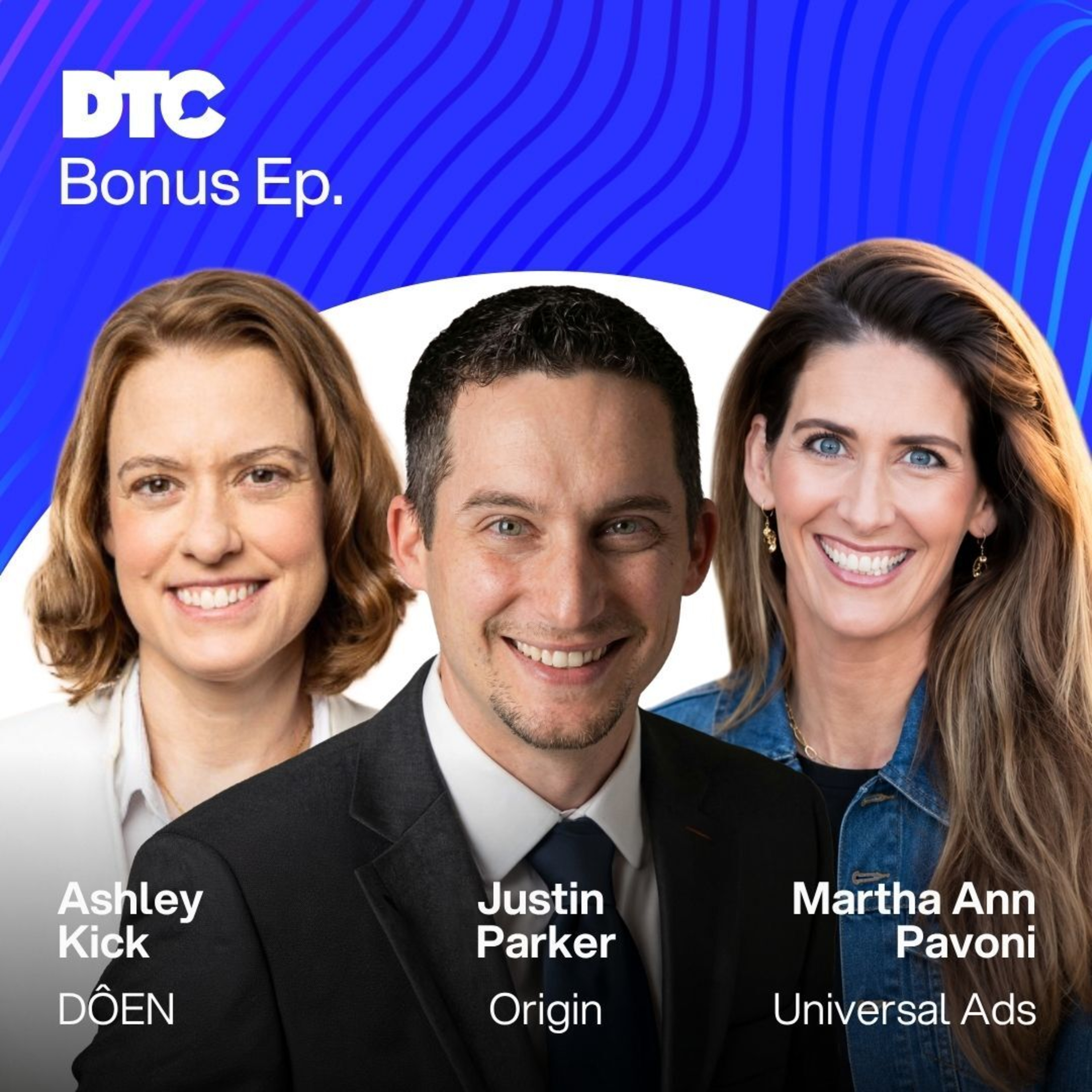
DTC Podcast
Bonus: How DÔEN, Origin & Universal Ads Actually Implement AI w/o Losing Their Brand | Whalies Panel
00:32:41
Loading summary
Transcript94 lines
- [00:00]
Martha Ann Pavoni
When I think about signals and the power that something like AI is having, it's really the connectivity to the data that unleashes the power of AI.
- [00:10]
Ashley Kick
Your customers fell in love with you, they fell in love with your founders, they fell in love with your story. And you have to be careful at how much of that you start to outsource.
- [00:22]
Justin Parker
All but three meta campaigns for us are managed by the automated media buyer. It's going really well. The amount of human in the loop has got to be proportional. That's involved.
- [00:34]
Martha Ann Pavoni
The best applications of AI are not visual, they're ROI driving.
- [00:39]
Justin Parker
Be the evangelist for your company, get the data, put it in, you have to do the legwork.
- [00:52]
Ashley Kick
Our next session is the Connected Commerce how enterprise brands are implementing AI throughout the stack. We're going to be talking about building integrated data driven operations and sports scaling without increasing headcount. Joining us on stage is our moderator is Eric Dick, president of D2C Newsletter. And joining him is Justin Parker, Director of E Commerce at Origin, Martha Ann Pavoni, VP of Product at Universal Ads, and Ashley Kick, VP of E Commerce at doan. So please join me in welcoming them to the Whaley stage.
- [01:25]
Eric Dick
Welcome to the stage, panelists. Very excited to be hosting this panel today talking about the Connected Commerce stack, how enterprise brands are implementing AI throughout the stack. To all panelists, what does it actually look like to embed AI in your organizations and what's the process by which you know you can trust it?
- [01:44]
Justin Parker
As we've heard today multiple times, the context that AI has access to is king. So it starts with giving the nuances of your business, you, your goals, your struggles even, and then also having a good stack to begin with. Right. Like we at Origin, we actually don't even consider software that isn't connected to Triple Whale because of how integral it is to have the data from our partner software in Triple Whale and being able to use MOBI to make insights and actions from it.
- [02:18]
Eric Dick
It's inherently like a decentralized process where you've got, especially in the early phases, you've got team members all innovating in different ways across six to ten different tools. How do you manage that at Doan internally?
- [02:31]
Ashley Kick
Yeah, I mean at Dowan, I think with anything when you do something all at once, then you never really understand how each piece of it performed in regards to the creation of the overall whole of whatever lift or not lift that you may have gotten. And so for Dowenn specifically, nothing that Doan puts out there is AI generated. At this point, our DNA Is very organic, is very created by women for women, led by women. So what we create is created by us and our team. How we disseminate it. We do lean on AI for that. What we did is we layered it in piece by piece. So you layer in, let's see for us, complete the outfit. We switched that from manual to an AI. What kind of lift did that bring? Then we kind of updated other pieces of the pdp. And then what kind of lift did that bring? Did we see a little bit of an increase in add to cart? Do we see a little bit of an increase in conversion rates? Increase aov. And we optimized our email to personalized send times. If you did all those things at once and oh my gosh, we have a lot of revenue now, you wouldn't know which of those things it was specifically. It's not fun to do things slowly all the time when it comes to technology because we're really excited. There's so much technology that is all doing such cool things and all the vendors say that their thing is the best of all of it. That's going to change all of our lives, of course, but it's phased rollout. One tool, one partner, one piece of each partner's stack. Because a lot of times they all do everything and it's one thing at a time, understanding the lift from each piece of it, recording it, moving on to the next thing.
- [04:23]
Eric Dick
So you don't, you don't have individual employees kind of flying off half cocked, but I guess everyone's using the individual tools a little bit themselves. But when it comes to organizational things, you're very intentional about how you're doing that.
- [04:34]
Ashley Kick
Absolutely, yeah.
- [04:36]
Eric Dick
What about Justin? What about on your side? Are you within your organization? Do you have people innovating all the time or is it more through centralized sort of like efforts where you're taking on new platforms, new tools?
- [04:46]
Justin Parker
Yeah, I mean, we definitely have the people that, you know, they want to get in and get their hands dirty and try things and you know, we, we definitely try to put the guardrails in place with the business context and make sure that definitions are clear that, that MOBI has the understanding of how our business operates and, and to, to make sure that the outputs that they're getting align across the board. Because that's inherently when you start to get metrics that don't agree with one another, even though they're pulling from the same source, if they don't have the right definitions, it creates conflict within the organization and then distrust of AI. In general. So we really try to do our background work to make sure that the business context is really filled out in MOBI specifically.
- [05:31]
Eric Dick
And then Martha just Connected TV is so hot right now. Talk to me about that a little bit. And then what sort of signals the brand should be looking for downstream when they integrate that.
- [05:41]
Martha Ann Pavoni
Yeah, absolutely. So just really quick, I'm not a brand, I'm not a commerce stack. I'm here representing Universal Ads, which is an advertising platform where we are really trying to sell premium TV but with the performance lens. So our core ICP today is U Commerce brands. The type of brands that we're really seeing success with are those that are like IG D2C, historical brands, the Doans, et cetera, that can really tell a beautiful narrative. And so when I think about signals and the power that something like AI is having, it's really the connectivity to the data that unleashes the power of AI. And when I think about what TV specifically brings, it's really some of that emotional signal, the power of the median of tv. When I also think about signal. Everyone in this room, the previous discussion was talking about conversion signal. I think the big message I take to everyone in this room is I can receive all that signal as well. Right. It's really the big change that has happened and why so many of the headlines are about AI and ctv. You see them actually coupled often is because the barrier to entry on the creative has changed so dramatically. So the median entry is much easier now. And then the measurement has changed too. Right. I've been talking to a lot of MMPs the past couple of months. If you saw on LinkedIn, we actually just launched mobile app promotion and that's really the big aha for me is that the power of the click isn't as important anymore. Right. With the likes of Triple Whale and other major measurement vendors, really the story is all about incrementality and that's a signal play, a big change in the ecosystem.
- [07:15]
Eric Dick
You mentioned creative, the cost of creative coming down. I'm curious from our brands on the panel, do you guys have guardrails around how you'll use creative? AI in creative, our whole value proposition
- [07:27]
Justin Parker
is that we're 100% American made. We take pride in showing the workers in our factory, we take pride in showing the people on the floor. So we don't actually use any AI creative. It's all 100% our stuff. But where we do use it is in idea generation, in analysis of the creative that's live. So we're Using it on everything but the actual imagery or actual video that goes live.
- [07:55]
Ashley Kick
I'm in a very similar boat. But you know, it doesn't mean that no one should ever use it ever. Of course. I mean our, I think our brands are just kind of built from a certain place. You know, your customers fell in love with you, they fell in love with your founders, they fell in love with your story. And you have to be careful at how much of that you start to outsource before it's no longer you. And you know, some places are able to get kind of far and, you know, not lose the soul of who they are company, but some brands have and it's hard to get that back. It's hard to get that trust back. And so like I said, you know, once again, you know, if, if you are going to venture down a route of your. What's being created by you is not necessarily being created by you, just take
- [08:42]
Eric Dick
that even more slowly, maybe just a little bit. On how your organizations are using mobi. I was really inspired obviously by Ben, Ben and Max's talk there. The 100% buy in on agentic media. Buying through MOBI is quite a commitment for a company at such a scale. Justin, how do you, how do you qualify how you're using MOBI right now?
- [09:01]
Justin Parker
Yeah, I mean, so we're in, we're part of the same beta. So all but three meta campaigns for us are managed by the automated media buyer. It's going really well. It was a process to get set up. I mean, I think, you know, you hear, you hear AI as a teammate left and right here. And that's really true. And the teammate starts off as an internal. Right. Like you really have to teach it what you need to get out of it. And I think, you know, the, those that take advantage of the AMB when it, when it goes to ga, like your intern is going to have, you know, grad school behind them and all kinds of learnings from the team that has put all the work in. So you're not going to, you know, you're not going to have the same ramp up time that we did. Yeah, we have, we have the AMD live, we're doing a ton of dashboards and landing pages and reporting through mobi2. I've unleashed it with a good portion of my team and I was joking the other night with the guys and, and I was like, you know, you guys are doing a great job. Stop sending me so many dashboards. Yeah, right, because there's so much you can do and they're so excited about it. But like quickly your inbox fills up with all of the work that they're creating.
- [10:09]
Ashley Kick
So yeah, there's a difference between data and information.
- [10:12]
Justin Parker
Yeah, sure.
- [10:13]
Eric Dick
I feel like we're all in an age of like fomo. A FOMO of AI. Fear of missing out, fear of not doing enough. All that you can do in a way. Ashley, where is AI delivering the most noticeable impact on your business?
- [10:26]
Ashley Kick
It really is getting the best content in front of the best person at the best time in the best classic market. Like, like. For us, incorporating Klaviyo's personalized send feature has increased our open rate significantly. Not afraid to say it. It's the marketing automation tool. And then from there like you know, bringing in AI into how, you know, the content that people are seeing on our PDPs in regards to like building outfits and things of that nature. Once we incorporated AI into our outfit, building add to cart started to increase and then you know, from there we also incorporate many more more flows these days like, like a next best purchase. A lot of, a lot of our AI is in email and how email content is being disseminated to people. And we've put in quite a few more flows. It gets product that you know, is predictably what a person might most likely will buy at the time that most likely will buy it. And we have found that those have certainly helped increase the amount of last click revenue that's coming from flows.
- [11:35]
Eric Dick
Martha, Universal ad sits at a pretty interesting place. I think we're not buying connected TV through MOBI yet. It's. I think it's on their, their radar. Thinking about how marketers use premium TV tv, how do you see them best plugging it into their existing stacks?
- [11:51]
Martha Ann Pavoni
Yeah, I love that question. When it comes to an existing stack, I think we take a very principled approach that we are API first by nature and so what that means in practice is we actually had announcement just last week with we announcing the MCP connector very similar to what Meta is doing. And so to me like frankly, yay, exciting Universal ads versus ctv. But it's not really the story. It's sort of a la MOBI where it's once you start doing this with every platform, you start to see that cross platform insights, you start to have actionable campaign reporting that isn't just isolated singular platforms. And then you can actually start to take action Too Once these APIs and the MCP layers on top of them start being action and recommendation based which frankly is governed by you not by Meta, not by Google. This is what we're all waiting for. I'm so excited. It really reduces, frankly. I think the big evolution that's going to happen over the next year, two, three, it's going to happen fast, is that your logins to Ads manager is going to go down quite dramatically. You're still going to use it for permissioning, for creative review, for billing. But your core job to be done activating a campaign, optimizing that campaign, looking at reporting should be your choice. Claude chatgpt Gemini choose your adventure.
- [13:10]
Eric Dick
Attribution is always such an interesting question around tv. Marketers are looking to things like TV because we're looking for ways to really grow the top of funnel, really bring new eyeballs and awareness. How are you guys thinking a little bit about measurement and of conversions?
- [13:24]
Martha Ann Pavoni
It has to be multi source. Unified triangulation is a term that we are hearing quite a bit in CTV space. But I truly mean it. You can't just look at pixel, you can't just look at app attribution. You have to turn to partners like Triple Whale to help validate that cross platform performance. And so it's not just about incrementality, it's also mta. It's the halo effect, attribution effect. I see this in practice. I'm trying to measure it as best as I can. My kids come home, they see an ad from three days ago, Mario Kart. We're then in Target and they're going, mom, it's the Mario Kart ad. And I'm like, what are you talking about? And I'm like, how can I measure this? So that's really the value of that screen and it's now cross device, right? It's in your hand, you're looking at it in your home. And the value of that emotional storytelling. I think the biggest evolution is going to come in the creative in this space. I think TikTok reels everything really pushed into that UGC. We all heard the Meta conferences last week about how the power of creative is so critical. This is the playbook. You speak this language, storytelling. Now it's really about pushing that through a measurement narrative.
- [14:29]
Eric Dick
Ashley, to follow up on some of the things you spoke about, where have you seen actual improvements in profitability, media efficiency, forecasting or decision making? Velocity?
- [14:38]
Ashley Kick
Oh goodness. I mean at this point I really use Moby I guess the most in regards to. I feel like they're kind of like my analysis, like Helper, you know. Whereas, you know, like we just launched our summer collection today, shopdoan.com and we had a lot of changes in the behavior for this collection that we've seen in previous collections. And so I was actually over there earlier today furiously asking Moby what happened between the hours of 10 and 12 today versus 10 and 12 on previous launch days that would have taken me so long to do with a bunch of spreadsheets and whatnot. So is AI like this massive thing for Darwin at this point? And the answer is no. It's taking small steps that are gradually getting us there to what at the end of six months or at the end of the year will be a monumental difference, or as it better be, year over year. That's really where we're taking it. I mean, at this point, I'm not right now going all in on anything with any one thing. It's like back in the day, everybody, way back in the day, everybody just sent direct mail, right? And everybody's like, ah, then our physical inboxes were getting too full, so everybody then switched over to email. So, oh wait, now our email inboxes are too full and our physical mailboxes aren't. And so, you know, it's this pendulum, Swift, right? Pendulum, Swift shift. There's my word. Swift, Swift. Taylor Swift may have worn a doan dress last week. I'm still obsessed about. It's swiftly shifting and when it moves one place, I think there's, there's negative space left, you know, where the pendulum used to be. And it's like. And so as everybody's moving over there and everybody's got, you know, AI people twirling around on, you know, ads, that's obviously overstating. We're going to look different. They don't maybe not necessarily can see exactly how, but you know, in that space is where I want us to be at least, you know, while we all still figure, figure things out. So, you know, before, like now, people do a little bit of email and a little bit of direct mail and it's the blend of the two that really I think is the sweet spot. And like, finding your sweet spot as a brand is going to be different for everybody.
- [17:08]
Martha Ann Pavoni
I love what you just said and it's something I've been thinking a lot about. Just like AI and the branding of AI, I think that actually over time that will go away. We'll stop using AI and everything and it'll be more about what is the value that this product is giving the end user and it'll be branded as such. Right, that makes sense. I've already talk about the light switches. Exactly. If you go into ads managers now, you'll see that they're slowly taking out the word AI. Right. Because it's just value. It's just how auto bidding works. It's just how auto placement works. You don't need to call it AI anymore. That's interesting. So I think that's the big evolution. And it's interesting because for you that value hasn't been shown to you yet. Whereas for me, I can't build and be competitive with the majors without having AI completely embedded in everything we're doing. So it's so crazy because that evolution will happen over time. It just, it hasn't given you value yet.
- [18:00]
Ashley Kick
Absolutely. Yeah.
- [18:01]
Eric Dick
It's happening very quickly. We just were reviewing a report, actually we did last year with triple whale on the state of AI and we were reading it and it was like, was this written in 2008? Like we were still talking about how your hands can't render, you know, and you know, things like that.
- [18:14]
Ashley Kick
I am robot was going to like be our 2026
- [18:19]
Eric Dick
from our perspective. We, we're a newsletter and podcast. We acquire new users on meta and just last week we hired our full time agentic media buyer named Gary and he's out producing the lead generation agency that we were working with.
- [18:35]
Ashley Kick
But your AI's name Gary or is there an actual person named Gary?
- [18:38]
Eric Dick
No, Gary was actually the guy that taught me how to media buy way back in the day. But this is a robot.
- [18:41]
Ashley Kick
Can you have a robot in Superman? This is like your number four. He's like that's a name like so
- [18:46]
Eric Dick
it's just me, I just put on glasses. No, it's a full out robot doing all our media buying now. We also have a creative strategist named Blanche and she's not as good yet, she's not as kicked in. But Justin, I think one of the things, the promise of AI is being able to scale without proportional headcount. It's a big promise. What roles or workflows are changing the fastest inside your organization?
- [19:08]
Justin Parker
For us it's the analysis and reporting. Right. Like we, we don't have a bi team anymore. We simply go to MOBI and just ask questions. And I think that from there the natural next step is going to be like marketing briefs. Creative briefs. It's going to be the. It probably some creative generation most likely copy first for us. Yeah, I could see some like again for, for us specifically PDP imagery, that sort of thing. Like things that's literally just like switching a color on Something.
- [19:39]
Eric Dick
Yeah.
- [19:40]
Justin Parker
Just because of the nature of our business.
- [19:42]
Eric Dick
Yeah, that makes sense. In an organization that has fully gone in on mobi, do people still use chat and Claude, or is that sort of like an organizational risk in a way? Because those programs don't have the context that mobile have.
- [19:55]
Justin Parker
Yeah. So outside of the front end, the marketing side, people still do use the other, other programs. We're trying to roll it out a little bit wider in the company. The thing with MOBI is exactly what you said. It has all of the context, it has all of the definitions. And to the earlier point a couple panels ago about it being a harness. Right. Like you're getting the newest version of whatever's out there, and you're also getting the talent of an awesome team that's working for you to pull together our product. They're the ones that are living on the bleeding edge of what's possible with AI. You know, as a, as an operator, I don't need to and shouldn't be spending my time learning what's the most, like, current thing with AI. I need to be making the company better. And if that includes AI, great. But that's not my primary role. My primary role is selling product. And so me spending my time on the things that the team here at Triple Whale is doing, it's duplicative. Like, I just rely on Triple Whale for that stuff.
- [20:59]
Eric Dick
Yeah. Martha, back to TV a little bit here. I think companies like Universal Ads have been really, again, democratizing and, you know, the ability to buy tv. I think for a long time people thought there was a, you know, a big barrier to that where you'd have to call up a station or buy huge blocks of tv. Right. But in the age of connected tv, it's made it much easier to do maybe a little future casting. How do you see TV buying evolving in this AI world where you could just sort of have things bought programmatically, maybe for the right campaign to reach people on the good screen?
- [21:33]
Martha Ann Pavoni
I think it really comes down to who you're partnering with.
- [21:37]
Ashley Kick
Right.
- [21:37]
Martha Ann Pavoni
If you're using a Triple Whale, what your objectives are. So this is by no means a one fits all, but you should absolutely be able to buy that through a centralized. Like going back to the MCP connector. I was saying if that's hooked up to our campaign management and multiple platforms are doing that again, MOBI could be that connector.
- [21:58]
Ashley Kick
Right.
- [21:58]
Martha Ann Pavoni
The connector definition is different for everyone in this room. But yes, that should be able to be done through one interface. And that interface does not have to be an Ads Manager in our future state. That's what I think. If you read meta blogs, if you read our blog, that's kind of what we are future casting right now. And that's okay. That's what we expect.
- [22:17]
Eric Dick
I'm interested, Justin. Back to the, the agentic media buying thing, because the way that we did it with Claude was essentially we had a, you know, a long conversation with Claude about how we think about media buying. And, and so we imparted, okay, here's how, here's how we think about testing, here's how we think about scaling. And that was our input based on what we think are best practices. I'm also like, I can also read the new product releases on GEM and Lattice and mtp. So it knows the technicalities of maybe how you should media buy. How much like human input have you had on how your agents actually buy
- [22:51]
Justin Parker
a tremendous amount, especially in the beginning. We have a director of paid media at Origin and I actually took over Paid Media while we were doing the implementation so that I knew exactly what was going on. And it's one of those things where the amount of human in the loop has got to be proportional to the risk that's involved with the process. Right. If it's something that's customer facing, if it has the potential to cost a lot of money, if it's not easily reversed, you've got to have a human in the loop and you also have to have the right human. AI is great at making good operators. Even better.
- [23:30]
Eric Dick
Yeah.
- [23:30]
Justin Parker
But it's also great at making poor operators.
- [23:33]
Eric Dick
It will gaslight the hell out of you, that's for sure.
- [23:35]
Ashley Kick
It will lie to you.
- [23:36]
Eric Dick
It will straight up lie to you sometimes.
- [23:38]
Ashley Kick
You want to know something funny?
- [23:39]
Eric Dick
Yes.
- [23:40]
Ashley Kick
A while ago it wasn't Moby, but I was asking an AI a question about the cannibalization of like my retargeting to my email and it was like, oh, they're cannibalizing. You really need to consider cutting back on your retargeting spend. I didn't. And the next week I asked it again. It was like, oh, they're working so well together. They're really doing a great job of being additional touch points and lifting each other up. And I was like, there you go. Thanks AI.
- [24:07]
Eric Dick
Yeah.
- [24:07]
Justin Parker
And that's the advantage of having the guardrails. Right. Like if you, if you take the time to set it up in the beginning, you can actually that that human in the loop isn't encountering the same mistakes, the same learnings that you went through. Earlier on. And even part of that is like we think to the phrase the exact phrasing of your question. We think we know what's best, but we're very often just as you would with any employee that you're doing a one on one with every week. We asked Moby, like what are we missing? How would you set this up if you didn't have your guardrails?
- [24:40]
Eric Dick
Right.
- [24:40]
Justin Parker
Like having genuine, like as genuine as you can have with an AI. Having a genuine conversation and being open to the fact that you might be missing something is super important in actually like making progress, iterative progress in the amd.
- [24:55]
Eric Dick
So you got to know when to impart what you think on AI, but also when to, you know, be judged by it for sure. Interesting. And it sounds like your situation, Ashley is less human in the loop, more AI in the loop. You seem a lot more guarded.
- [25:07]
Ashley Kick
Right. Where it's like you don't want to destroy it all, you know.
- [25:09]
Eric Dick
Yeah. And I guess your example there is how you've seen that, how it can get carried away.
- [25:14]
Ashley Kick
I could have like shut down all of my earliest part of my retargeting and then you know, that's super high rohas traffic, you know. And so it's, it's, you know, it's. What is it? You know, measure, measure twice, cut once sort of thing.
- [25:28]
Eric Dick
Part of that problem. I think in theory with Mobi that it should do that less because it has access to so much historical data.
- [25:35]
Ashley Kick
Yeah, I'm a big fan of Moby moving things into SQL tables. I'm like, okay, thanks Moby. Pop that over. And then you know, then you kind of get to like test it. You kind of get to poke around with it, spend time with it, maybe update different variables within the SQL and see if it's holding up. Like, you know, that's like, you know, just taking, having it get me to the right data and information more quickly is how I'm utilizing it right now. But like I said, we're taking baby steps in it and, but we're taking larger steps and how disseminating and so that's, you know, we're not 100% in the dark ages but you know, we are certainly being much more cautious and I think yeah, that's just, that's who the brand is. We're very transportative like in our photography and like who we are. We're very, it's very grounded and so for us to start making moves that I think would counteract what we are and who we are as a brand and what we value as a brand could be, it could be very. It could be problematic for sure.
- [26:41]
Martha Ann Pavoni
I was just going to say I think AI can be value negative when it's siloed and not connected to the data. Foundational source of truth. And so as companies are getting into this space, it's hard to do this, especially when you're a long tenured company, but you really have to start with the health of the signals that are informing the AI engine. And that's where, listen, I'm the first one. If you come talk to me afterward, I'll say one of our biggest strengths right now is we're last to market. We're getting to build everything 0 to 1 in a world that's AI native and that is a frickin power play. Yeah, right. You don't have to carry over an entire ad stack to the new AI world. I worked at LinkedIn, Snapchat, Twitter. It's really hard at the same time, wow, like meta Google. Everyone's crushing it. It's just how fast they're going. But it is pretty incredible when you can start day one with a clean data slate where everything's pumping into that same AI engine.
- [27:43]
Eric Dick
Justin, on your AI forward approach, does your team. Have you had to be really explicit with your team about what they are empowered to do and not when it comes to using various different tools? Or is it sort of like does the best bubble to the top or have you had to come out and say guys, hey, we're using MOBI only. And then maybe Claude, like have you,
- [28:01]
Justin Parker
have you had to be explicit with my team specifically? We are MOBI only because it has OpenAI and Claude in it. So there's no, with the, with the context that it has, there's no real advantage to going outside of the mutually owned system of, of mobi. So the other parts of our organization will, they'll use other AIs and stuff, but we're specifically moby with my team.
- [28:23]
Ashley Kick
Yeah.
- [28:24]
Eric Dick
And then how would you answer that? Oh, sounds like there might be some edicts.
- [28:28]
Ashley Kick
I mean I'm, I'm just certainly not as forward and right now a lot of my team, we try to keep it all like one in, one out right now. And so if too I don't have too many people in the kitchen at this point. Basically what I have come to rely on are my MOBI support staff because I just right now obviously we're very slow and rolling this out. And so as I start to build out things, I have weekly calls with either my account manager or the poor guy that got assigned to me to teach me MOBI too. And so they're incredible. So if you ever have any problems or issues or any. Definitely everything that you've been talking about. Not necessarily me, like they're definitely here to help and they will build reports for you. I know that my triple L team has been nice.
- [29:24]
Eric Dick
Most important question, are we still using EM Dashes? They're such a useful piece of punctuation. But you can't use them here. You gotta use semicolons. No one knows how to use them. It's a big. One of the biggest problems in our space right now is md. If I was, if I was M. Dash's agent, I'd be very upset.
- [29:39]
Justin Parker
I pull him out of everything.
- [29:41]
Eric Dick
Yeah.
- [29:41]
Justin Parker
Just because it looks like it's AI created.
- [29:43]
Eric Dick
Yeah, I know.
- [29:44]
Ashley Kick
And I used to love them.
- [29:45]
Eric Dick
Such a good piece of punctuation.
- [29:46]
Ashley Kick
Is it because I'm old?
- [29:48]
Eric Dick
Well, if you're that old, you'd like semi pollards like me.
- [29:51]
Ashley Kick
Exactly.
- [29:52]
Eric Dick
So maybe to leave everyone here. If people out here are using disparate tool sets for their AI, maybe in a siloed fashion. What's the first step they could take after this talk today? To get unsiloed, get on the same page and get building recursive loops with great AI.
- [30:08]
Justin Parker
I think the people in this room are the. They're the closest to being able to make change in their organization. You guys have, you guys have the, the best proximity to the data. You have the tools to actually make change happen. And some of the biggest wins that we've had have actually been cross functional wins. Like we've pulled in data from other parts of the business and, and married it with the E. Comm and marketing data to actually come up with like changes that need to be made to our products. Like so we're handing that off to the product team. So I would encourage you like be the evangelist for your company. Go out there and like get the data, put it in. Ask Mobi a simple question like find me the one product that needs to be fixed and then, then you can bring that to the product team. If they're not AI native. I think in most organizations it's a bit of you have to do the legwork. They're not going to come to you, they're not going to adopt it natively. You have to be the one that goes to the other branches of your organization.
- [31:10]
Eric Dick
Sets the expectation. Anything to add?
- [31:14]
Martha Ann Pavoni
Yeah, I think the sexiest AI is the AI you can't see, it's the AI that's driving roi. So I would say start with why am I building this? What am I trying to improve? And is it going to improve the outcome? I'm expecting it to drive roi. Start with that. But yes, I would say the best applications of AI are not visual. They're ROI driving data based.
- [31:43]
Eric Dick
Right. Based on how you use the data. And any final word from our AI pessimist?
- [31:47]
Ashley Kick
Oh my gosh. Yeah, Right. Talk to your developers. If you have a dev agency, they've probably broken this on somebody else's site. I would say just try not to go it alone. Talk to your industry peers. Most likely you're not the first person down, whatever path you're on. And always more voices are better than just yours. Probably.
- [32:10]
Eric Dick
Beautiful. Well, special thanks to our panelists for this awesome Whaley's panel. My first Whaley's. I had a great time. Thanks for everyone for showing up. Thanks so much for listening to today's episode. If you're not a subscriber to our newsletter, you can do that right now at directtoconsumerall. One word co. I'm Eric Dick and this has been the DTC podcast. We'll see you next time.