← DTC Podcast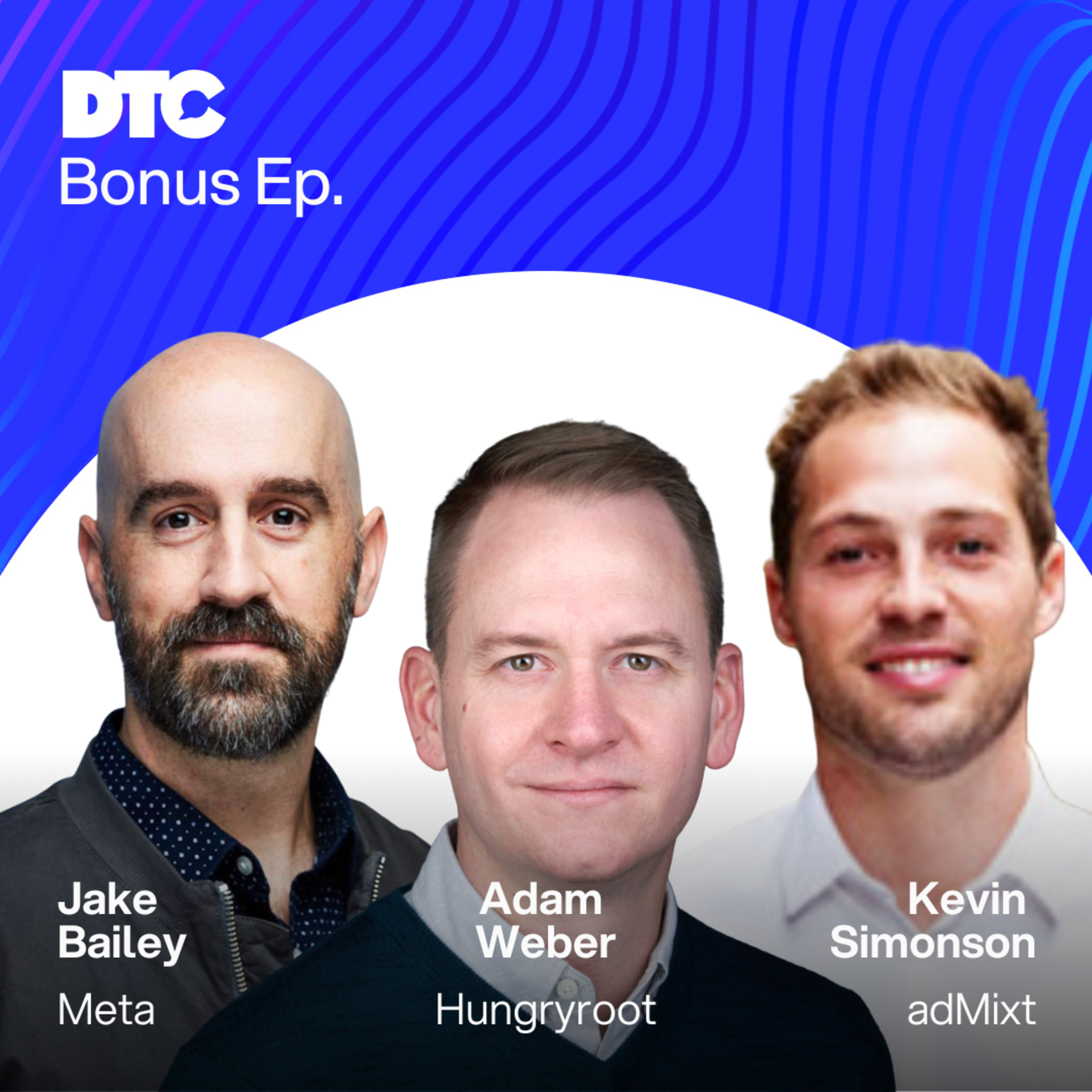
DTC Podcast
Bonus: How Hungryroot Scaled Meta Spend by 10x with Partnership Ads + Meta and adMixt on Cyber5 Success Strategies
00:42:23
Loading summary
Transcript125 lines
- [00:00]
A
Creative diversification. When we say that, what we really mean is creative concept diversification. So ads really need to look distinct in order to drive performance and find new audiences. And in particular, where we saw that was through partnership ads using creators. And we've seen that just explode in a way that we haven't seen before. And it's driving performance, it's driving scale, it's driving reach to new audiences. We saw that as a big difference between this year and last year. The AI has gotten so much better than any one person's ability, ability to arbitrage or pull the levers themselves. And so that's why we push so hard for people to adopt account simplification and adopt automation, because those are the things that are going to take the most signal and ruthlessly drive the best outcomes for the brands.
- [00:52]
B
Welcome to the DTC podcast, guys. I'm super excited to have you all here. We're going to do a full debrief on the Cyber five period courtesy of Meta here. Thanks for joining Jake, Head of industry over at Meta. And we have Kevin Simonson from Admixed as well as Adam Weber from hungryroot. We've going to be able to talk about it from Meta's perspective, from the agency perspective, and from Hungryroot's perspective as a brand. Adam, would you maybe kick us off with just a real quick high level intro of of what you're doing over there at hungryroot?
- [01:22]
C
Absolutely. And thanks for having me on, Eric. Yeah, so I'm the Chief Marketing Officer at hungryroot. Hungerroot is the easiest way to eat healthy. So we use AI to make meal planning, grocery shopping and personalized nutrition much, much, much more easy. And the way we do it is each week we recommend to all of our customers healthy groceries and delicious recipes tailored to their budget, nutrition preferences, lifestyle, really anything. And we do that by pulling from our assortment. We have an assortment of about a thousand better for you grocery items, both popular national brands and our own Hunger Root private label brand, as well as 50,000 one click shoppable recipes that can be eaten and enjoyed across breakfast, lunch and dinner. I joined Hugger about 18 months ago. I had a marketing as well as what we call food experience, which is kind of the merchandising arm of our business. Prior to that early career was in consumer packaged goods. And probably most notable, I was in maybe the original cohort, Jake of Disruptors at Meta. I led marketing at Dollar Shave Club from very, very early on all the way through.
- [02:19]
B
Oh wow, that must have been a.
- [02:21]
C
Ride it was a great time.
- [02:23]
B
I'll have to have you back on. We can dive into that one. Kevin, tell me about Admixed.
- [02:27]
D
Yeah, sure. So Admixed is a performance marketing agency, which there are a lot of. I think one of the more interesting things about Admixed is we actually don't buy, optimize or build ads through the platforms like Meta's Ad Manager. We do all of that through software that we built so directly through the API. And because of that, we're actually connected to, I think 18 different APIs, including like Northbeam and Triple Whale, Google obviously, and then several LLMs that help us do our work. We are 10% app installs, 10% lead gen, but 80% e commerce. My background's mostly paid social. Meta as a channel in terms of spend is the biggest channel we spend on across the board, I think for all of our brands.
- [03:09]
B
And Jake, welcome back. You were on, I think just last month, the original Disruptor. Welcome back.
- [03:14]
A
Thanks, Eric. It's great to be back. And just by quick way of introduction, I cover a lot of our EE Commerce and D2C disruptor clients on the outside. So it's great to be back. Thanks for having me.
- [03:25]
B
Let's start with a little debrief before we get into what worked. What were the vibes? What were the vibes from our side from Pilothouse, the performance marketing agency, was that all the brands that were prepared to crush it this year really did. They really saw amazing results. There was a lot of mitigate there. Any brands that didn't, there was usually very mitigating circumstances around their own choice about whether it not being the biggest time of year for them, not them not being ready from an inventory or a profit margin perspective to really push hard. But the brands that set their intention this year, from my side, absolutely crushed it. Kevin, from from your side, what did you see across your clients?
- [04:00]
D
I would agree. I mean, the vibe going in was certainly just worry, I think, around broader tariffs and the economy. And you hear a lot of things in the news which generally tends to be negative, whether that's it should be or not. So, you know, there's a decent amount of hold our breath, wait and see.
- [04:16]
B
See.
- [04:16]
D
But post Black Friday Cyber Monday, the sentiment was great. Honestly, everybody kind of beat gold, beat their forecasts. I think you saw, if you read broadly about the numbers that Meta did or Shopify did, they were up, right? Consumer spending was up and we just saw that across our portfolio. So it was good.
- [04:33]
B
What about you? Top level.
- [04:34]
A
Jake, from our side, we thought about it a lot from the consumer perspective, and I would say if there was one word that described it, it would be resilient. Um, we all know there's kind of a couple different economies that are. That exist right now in the US and so it's.
- [04:48]
C
It's complex.
- [04:49]
A
It's not as straightforward. But I would say the consumer was seeking value more than they ever have. And so those companies, to your point, that planned early with kind of big, bold offers and stretched the wallets of the consumers in a good way where they could capture more value for their money, those were the brands that really stood out.
- [05:09]
B
That makes sense. The one thing that we saw, I reported on this last week on our podcast, was there seemed to be a. In previous years, there's been a real creep on the time scope of what Black Friday Cyber Monday means. And in previous years, there was a large trend kind of throughout that whole period with maybe dipping a little in the middle. This year, what we found was there was more of an adherence to those two days. Friday and Monday became the real tent poles in the space. And I think every brand starting early. So what really mattered is having those great deals, like, on those days for our client. Is that anything that you guys saw?
- [05:43]
A
I felt like the deal started earlier.
- [05:45]
D
Definitely deals starting earlier. There's an economist I follow named Greg Easterbrook who has the universal theory of creep, where, like every year, Christmas stuff starts to go on sale in stores, like, all the way now into August. And I feel like Black Friday Cyber Monday has become that for November. Interestingly enough, Cyber Monday was softer this year, year over year than last year for us. And a lot of the brands still here from a year ago. And then I asked a bunch of friends, right on the brand side, agency side, I said, hey, did you see a softer Cyber Monday? And the majority said, yes, there was a couple exceptions. But I think also that's in part because of the start earlier.
- [06:21]
B
Right.
- [06:21]
D
The Black Friday Cyber Monday bump is just smoothed out over a longer timeline over the month.
- [06:26]
B
I made all my purchases on Monday, so I was doing my part to. To keep it hot. And then, Adam, I know you guys are, you know, as a meal. As a meal company, and you're going to be maybe stronger in January. But how did you think about Q4 and Cyber Monday Black Friday this year?
- [06:40]
C
Our vibes are very chill for Black Friday Cyber Monday, so you can track.
- [06:43]
A
Me with your questions.
- [06:45]
C
Our business just. People aren't really in the mindset of changing food habits and eating healthy, you know, on the day After Thanksgiving. So we definitely kick in more in January. So we sit back and just get ready for Q5.
- [06:57]
B
Okay, well, we'll dive into Q5 a little bit. But back to the Cyber5. What were some of the things that you guys saw kind of really working well this year? You clearly articulated very clear offer, really meeting customers where they're at in terms of providing value. I think, Jake, you really mentioned getting them to kind of open their wallets and make maybe bigger commitments for better value. Anything else that you guys saw, maybe, Jake, kick it off?
- [07:21]
A
Yeah, I think in particular, one of the things you hear us talk a lot about is creative diversification. And when we say that, what we really mean is creative concept diversification. So ads really need to look distinct in order to drive performance and find new audiences.
- [07:37]
B
And.
- [07:37]
A
And in particular, Eric, where we saw that was through partnership ads using creators. And we've seen that just explode in a way that we haven't seen before in a good way. And it's driving performance, it's driving scale, it's driving reach to new audiences. And so for us, we saw that as a big difference between this year.
- [07:56]
B
Last year really makes sense. I've been reporting on it, I think almost every podcast for the past five weeks. People have really talked about this concept that we talked about on our podcast of going below the audience segment, so to the demographics, like into individual peoples and their perspective, the angles. But what. What products that. What problems the product is solving for them. And if. And partnership ads are perfectly suited to do that, because if you have a good creator, a good partner, they're going to provide that entire, you know, that whole angle, and also what their kitchen looks like, what they look like, what they're wearing in a way that could. Your algorithm can then say, okay, well, this person's going to be a great fit for this. This ad. Did you see the same thing about partnership ads, Kevin?
- [08:35]
D
Yes. We actually didn't run a ton as much as we ran UGC in general. We ran some across our brands, and every brand's different, but that's true. I think the two big things that jumped out to me were continuing to run BAU or business as usual with Black Friday Cyber Monday. BAU did really well for us year over year. So that was. That's interesting to some people. It's not like they'll just come in on what you regularly run and buy things. Right. So you should keep it going and keep that momentum as opposed to, like, you have a little snowball that goes down a hill and gains momentum and then you stop it, try to start another one immediately. It just doesn't work as well. That was one thing and then one that was already said was deep discounts. I do think that whether it was the economy or just, hey, everybody likes a deal, deep discounting one. And I think the, I don't know if you all saw this in the DTC community. There was a meme going around of the guy from succession and his consumer sees a 20% discount and it was like, you are not serious people. You know, I think I like it just wasn't that doesn't move the needle as much as it used to or really much at all anymore, especially during that period.
- [09:38]
A
Yeah. And Eric, we kind of saw two different things happening there where you know, in some cases some brands are being smart about just making sure they protect margin and being careful there. But to Kevin's point, in some cases if you have a high margin category, you could go aggressively on your offer. And I think to Kevin's point, that 30% mark, 30% off was, seemed to be the mark that a lot of people were going after.
- [10:01]
B
That's what got me on Cyber Monday was the 30% off some Japanese steak knives that I just arrived today. Absolutely thrilled. Adam, I know you guys had some success with partnership ads. Talk to me about how that worked for you.
- [10:13]
C
A lot of what Jake said has been something we've been working on with with the Meta team for almost, almost over a year now. It's just really taken off for us. It was a very small percentage of our business, you know, when I joined, like I said, just over a year ago and it's now a meaningful portion if not the majority. And I think what Jake said is 100% right. And for our business it's extra special. So it's an amazing way to deliver creative diversification at scale. And for our business we solve a lot of different unique problems for customers. We're not just selling one Japanese steak knives that solve a singular problem. We actually appealing it's a great problem to solve. But we solve a lot of unique problems from a bunch of different angles and creators allow us to tell those stories. So for some people that might mean we're the best way to achieve your anti inflammatory diet or eat gluten free without having to check nutrition panels. For some people it's about the pain point of meal planning and having to go to the grocery store and how inconvenient that is. Or for others it's not when they have to do takeout twice A week and us solving that problem and allowing them to save money. And when you have that many problems that you solve as a business, one, it's great for your product or service, but two, it makes creative diversity at scale challenging. And partner ads and influencers have allowed us to push out and appeal to much, much more broader audiences, broaden our reach over the past year and achieve that type of diversification in a way that we really weren't able to before. And so I think that's been the magic behind it. And you know, it's something we're leaning into more and more and more heading into 2026 and then Q5 for sure.
- [11:41]
B
I can see I was just on your site and the way you have it organized in the one section anyways, tailored to your tastes and needs. You got everyone go to hungryroot.com to check this out. But you've got all these jobs to be done with your product. So it's looking for an anti inflammatory diet, high protein, gluten free, gut friendly. And then each of those, you've got a world of different angles within each of those even that you can get. And that's. And it's the number one insight I think on the podcast this year is the brands that won were the brands that are able to go into like their individual avatars and help solve those problems. And yeah, partnership ads, it's so much.
- [12:15]
C
More compelling when that comes from the voice of somebody who actually is looking for that diet or has that nutrition restriction rather than me, you know, having to manufacture that in the story of a UGC ad. And I think that's truly what it's about and I think for our business it's just a perfect alignment because we have all those like specific audiences and general audiences that need to hear that story. Creators and partner ads have just been.
- [12:35]
B
The way to do it just practically to dig in on that a little bit. What was your, was your strategy? Did you do a lot of it manually? Did you lot like a lot of the partnership discovery? Did you, did you kind of go out and just find, talk to you about your criteria for finding partners? I guess.
- [12:48]
C
Yeah, you know, immediately like, you know, it's maybe started with pretty, pretty, you know, tighter, tighter guidelines and restrictions. And I think what we've learned over time is that it's just about creating the compelling story and finding the right influencer that's you know, a lot that believes in the problem and solution that we, you know, have and have presented them and solved for them. And I think we've tried big, we've tried small, we've tried medium sized, we've tried specific influencers that are food influencers. We've tried ones that are specific nutrition ones, ones that are just parents. And I'm not joking. Like the answer is all of them work. There is a lot of bit trial and error because you have to get the person to be compelling in their, you know, their delivery and create compelling content. And that's probably more where the rubber hits the road, less so than trying to like microscopically pick apart which ones work and which ones don't. And so it's really been a pretty broad. It's broad and scalable for us. I know, Jake, if from your side, what your thoughts are.
- [13:40]
A
Yeah, we've looked at this a number of different ways with our data science team, with our product folks. And we've had folks that have done really well with micro creators. We've had some that do great with macro creators. And the reality is it's usually the best practice is to use a blend of both. And we do see separately that sometimes the most opportunity to do really well here is actually right in the middle. You know, these creators that have 40, 50, 60,000 followers. So they're not, they're not micro. You're not, you know, your, your, your friends and family, but they're not also, you know, the largest celebrities in the world. It's usually somewhere right in the middle that tends to do really well. And Adam, I'm sure that's kind of what you see on your side 100%.
- [14:24]
B
I just back up a little bit too, for though I think most people in this audience are familiar with what meta partnership ads are. But the beauty of them is it's not in traditional influencer. It doesn't have to be traditional influencers where you're paying for their influence. You're doing, you're putting budget behind their handles.
- [14:39]
C
Maybe.
- [14:39]
B
Jake, at a highest level, just talk to me about how meta thinks about partnership ads for people that might not be familiar.
- [14:45]
A
Yeah, partnership ads is essentially leveraging somebody who can speak eloquently on a particular topic and they might have a following on Instagram, on Facebook. And partnership ads is essentially an exchange between a brand and that creator, that influencer, where they can speak on behalf of the brand to the audience, to their followers in order to help drive outcomes for the brand. And in a lot of cases, what we found is that this drives both brand lift for the advertiser themselves, but it also, and Adam can speak to this as well. It Drives down funnel outcomes, which is really, really important. We're all about trying to make sure that we meet the customer where they are. And now that the AI is much, much better. And it is really good about taking those creators, those influencers that have a good following and layering in in exchange with that brand so that they can drive outcomes that match what the consumer wants.
- [15:42]
B
I remember Nick Shackelford in 2018 at an event I put on, he did a big presentation on whitelisting, as it was called back then, where you're actually. But back then, the challenge of like telling a person who may not be tech savvy or that level of tech savvy, you know, all you got to place this pixel, you got to, you know, do all these things. This, this sor handoff. I imagine partnership ads have made that a lot simpler. I guess that was a big prerogative there.
- [16:06]
C
I, I could, I think I could speak before that. At dollar Shape Club days, we have to, you have to use to get the login of the influencer and run the paid amplification from their actual profile. So there was a whole like setup that we had to do back in, you know, 20, 2016 to be able to do it. So it's gotten a lot easier, Jake, than. So thank you for that.
- [16:23]
D
It has.
- [16:24]
A
But to your point, we do have a long way to go in just continuing to make that more seamless for all parties involved. And some of the things that we are building here I'm very excited about and are showing even more improved performance. And one there, Eric and Adam is partnership ads plus catalog ads. That's one we're very, very excited about. So for any of the e commerce companies that run catalog ads and the ability to combine that with a partnerships ad we've seen to be particularly potent and to drive, you know, a 20% improvement in performance.
- [17:01]
B
And does that just essentially make the creator look like they have a store in a way where it's like their content and then the catalog ads come right underneath them so it kind of almost looks like it's their store.
- [17:10]
C
But think how compelling that is that like I get a creator to talk a video about the amazing gluten free snacks that they got on our platform or the gluten free, you know, dinner recipes that they bought and they're making live in their kitchen and then the catalogs just pop up for those individual items, allowing us a very seamless inroad to get somebody to onboard into the platform. So like I think that is that that's Going to be really exciting, Jake, when we, when that starts to build.
- [17:33]
A
Out and at the end of the day. And Kevin might be able to speak to some examples he's seen on, on his side. But this is all about making the buy easy and not only making it easy for the brand, but also just make it easier for the consumer to say, oh, I love what they're saying now. I go immediately to the products that they have in front of me.
- [17:50]
D
I mean, that's what I would say is like, you're just removing friction and hopefully the confusion around, wait, what are they using? Oh, where do I find it on the website? I mean, we've been doing this for a long time. We know that if you shorten the path to conversion, typically conversion rate improves. Right. So why not start at the ad in this case? So, yeah, I think when I saw the announcements of new kind of products that were coming out, that was one that I immediately flagged to our team and was like, oh, we got to run these. I could see these working really well. I'll back up. I wanted to add a couple things that might be interesting. So if you run a partnership ad, it becomes its own new creative concept. So like just a classic example of this is let's say you had a creator say, say something and then you had a different creator say the exact same thing. Me as a normal person would be like, oh, that's the same concept. But to meta, it's not if it's ran through partnership from their pages. So I think that's really powerful because for instance, we had a brand this Black Friday Cyber Monday, they had a piece of creative take off around a very specific product so well that it sold out or it's about to sell out, if it hasn't already. We're like, great problem to have the reward for good work is more work. But then it was like, hey, we can do that same ad with a different product and a different handle and it will be a new concept that we can put into the machine.
- [19:04]
C
Right.
- [19:05]
D
So that's like a, oh, this is what happens, what we're going to do about it. But I do think that's important because I don't think a lot of people know that or they add that value to say, going through the hoops to set up partnership ads, which are definitely easier than they've ever been. But it's not the same as just making a static. Right.
- [19:19]
B
What are the deal structures look like on the creator side of things? Like if you're going to get a piece of creative and you're going to pump, you know, Black Friday levels of budget through it. You're going to, you know, spend hundreds of thousands of dollars on it. Do you make deals that are one and done? Kind of like I'm going to pay you a fee for this partnership ad or are there sort of rev shares or like Adam, from your side, how did some of those deals get structured?
- [19:40]
C
There's definitely, I think, lots of growing diversity on this front as well in terms of how the deals get structured. And so you're starting to see it evolve from being much more of a flat fee approach to much more of a shared revenue or shared upside type of model. I think for us, what we've found success on is one structure for somebody that we're trying for the first time and then we evolve it into a multi touch relationship with the creator and influencer. Once we know that they fit, they're a good fit for Hungaroo. They like the product and they like the service. They deliver the message in a compelling way. So we'll often arrange it that way. A lot of our deals are still like a flat fee for the organic post. Sometimes there's a slight add on that the influencer will add to the mix for the rights to be able to do a partner ad. But I think the key thing for us is the kind of the trial and error dynamic and allowing us to go wide, try to find lots of influencers and then the we stick with the ones we work that work. We don't do one and dones because we find that actually repetition matters quite a bit here. I don't know where I saw this stat, but it was like the average message has to be delivered three to four times from a creator influencer for it to really actually drive the level of incremental purchase intent. And so we prescribe to that. And a lot of our deals are structured on multi touch multiple year or month type arrangement where then actually get a financial benefit out of it as well. The creator likes it because they have stuff in the bag for the rest of the year.
- [21:02]
B
Do you echo those. Those structures, Kevin, or any that you lean towards more than others?
- [21:06]
D
I. What he described is typically what you see when it goes well. Like the first is kind of a smaller, shorter trial. It's probably cheaper, but if it does well, typically the influencer knows or the creator knows. Excuse me, the brand obviously knows. So they're like, hey, we're both incentivized to make this work together longer term. And then it. And then it Varies wildly by. In terms of, you know, numbers of followers in the space and things of that nature.
- [21:29]
B
It's real. Win, win, win. Because you're also paying to grow that creator's audience.
- [21:34]
D
That's what I tell our brands to bring up all the time. Like, hey, a lot more people are going to be seeing you when we're putting $1 million behind this content. That's good for them. They're trying to grow their. Their creator brand. Right. So I don't think. I think that used to get lost a lot in the outreach kind of negotiation period, but now I think more creators are matured in the space and they understand it, but it's like, you should remind them that that's a big deal this year.
- [21:58]
B
Came across in a couple of my recent podcasts with Pilot House just how important it was to be nimble, to go in with a plan and go in with multiple horses in the race when it comes to all your different creatives and all your different angles.
- [22:09]
C
But be.
- [22:10]
B
Be very willing to kind of pivot, be nimble as much as you can. Is that something you guys found during the heady holiday season?
- [22:18]
D
Yeah, we were, you know, on computers all day, going back and forth in Slack with our brands that we work with making adj. I think kind of an interesting callback to, like, hey, the creep of Black Friday, Cyber Monday, starting earlier, I think puts you in a position to then, depending on where the company's at, whether that's revenue contribution margin or both, to say, oh, we now understand where we're trying to get to, and we can pull these levers in terms of, say, changing the discount or whatever it is during that period. And I think that's like, okay, when you should do it right, because the window's running out. So, yeah, I would say that's 100% true.
- [22:53]
B
The other thing we saw, I don't know if you've ever saw, we have another podcast on our network called Adventurous with one of the people at Pilot House named Aves, and she's one of the creative leads at Pilot House, and she is a peak millennial. She's like. And the thing that I was realizing this year is millennials are 35 this year. Like, millennials are, you know, in the. In that peak buying thing age. And she was able to make all these ads for a bunch of clients that just tickled those millennials and made them laugh, actually made, like, really generated some humor in the craz. And they really broke through the ones that I just always feel like if you can make someone laugh, you can make someone chuckle from an ad. It's like built in brand affinity. Right? Yeah.
- [23:32]
D
I mean, the other thing. Well, to this topic in general, you know, our focus up to the sale period, whether that's early November, Black Friday, Cyber Mondays, is incremental new reach. We're trying to reach new people. And how you reach new people generally, top of funnel, middle of the funnel. Our concepts that go after Personas, partnership ads can be a part of that. UGC is certainly a component of that. And especially because most of those content pieces are video, they're hitting the top in the mid and building that momentum. They can still close and be the bottom. But we see, because we get to pull the incremental reach report from the API, we consistently see the video, especially those types of contents, reach more new people at the top that then close off during the sale period.
- [24:13]
C
Right.
- [24:13]
D
So that's, that's the whole strategy right there in terms of, hey, to get new customers, you need to reach new people. How do you reach new people? All the stuff you guys are saying, right?
- [24:23]
C
It's funny, Erica, like, whether it's humor and everything, what Kevin just said, whether it's humor, just delivering something that's different and unique and catches people attention. One of my favorite stories, this isn't about necessarily making somebody laugh, but one of our best performing performance heads this year was a creator who lived on a house boat in a lake. So we're talking like it like literally on a platform in the middle of a lake. And she obviously, you know, it's a pain in the butt for her to get groceries, healthy groceries in particular. And she delivered this amazing piece of creative talk. You know, she used a drone to fly above her house and then talked about, you know, a video of her on like, literally like a little motorboat, like carrying her hungry box out to her houseboat. And it probably made me chuckle, but I think the point was it's just totally different. It was an ad that just broke through. It was Cord value prop, hit it. Great convenience of getting healthy groceries delivered to her door. Even if that's a houseboat. Clearly our market isn't getting people who live on houses in lakes.
- [25:19]
B
No, that's a tiny market.
- [25:22]
C
But it worked because it broke through and delivered the message.
- [25:25]
D
I will say you guys have probably seen the street interview ads made popular by two or three media. So we have a few clients and we brought them in because saw them and knew they did well from friends that had used them. And then we use them and they're funny. Like they're almost always funny, right. They hire comedians to do the street interviews and they honestly did well. They've done well. Especially like I said, middle funnel and top of funnel. So there's something to it for sure.
- [25:50]
A
One last thing that I would add that was important for I think the brands that were successful this holiday season. They've kind of both hinted towards it. It's just this notion of scenario planning. A lot of folks will kind of go in with like one plan and we all know it doesn't always go the way that you, that you expect. So having this notion of good, better, best, like three different scenario plans going in so that you know which actions to take when something happens is really important. And even better if you have buy in from your financial partners at your company, your CFO or VP of finance. So then you know exactly what you could do depending upon which scenario you're tracking towards.
- [26:28]
B
Very cool. Does that resonate with you guys? Did you have multiple scenarios for your clients, Kevin?
- [26:33]
D
Yeah, a lot of it was based on inventory. I think we, you know, we have a. Well, first you got to reach out to Meta and say, hey, what's our credit limit at and make sure that if you are in the situation where you need to spend more, you can. Right. Like that's getting way ahead of it. I don't think we did just being frank. Like a lot of downside if this then that planning and we're fortunate enough it didn't have to use it. But a lot of it's like, hey, if this goes really well, what can we do? And if we run out of inventory, what should we do? That that comes up pretty consistently.
- [27:01]
B
And then Adam, you mentioned that, that as a, you know, the kind of company you guys are, that Q5 is probably a little bit bigger than the Black Friday Cyber Monday stuff. What I guess were you kind of planting the seed? Like what, what does your Q5 look like for everyone in January Wants to eat better for all these ways. So that's your Super Bowl. Talk to me about that.
- [27:20]
C
You know, it's wild. It's, it's very different. The Black Friday ceremony vibes. In some ways it's very similar. In others, the way it's similar is that the volume ramps tremendously fast. Like you'd be surprised. Like we're talking 8am Eastern on 1226. It's like Q5 starts. It's not about like a gradual increase. You can see the dynamic in the consumer's minds. You can see the dynamic in the media landscape change all at once and it scales incredibly rapid. It does last longer than Black Friday, Cyber Monday type five days. It lasts well into January, February, at least for our business. And I think the big thing is to me it's all about habit change. And I think that so unlike the pressure to get a promo or a deal right, which is kind of how C5 works, this is really about kind of going back to your fundamentals. When people are most open to changing their habits and reevaluating how they eat and looking to try to change things up. How do you deliver all of our best foot forward in this timeframe when the market's the hottest and the media landscape's the most favorable. And so it's nicer in a way because it goes back to just delivering the fundamentals better, but just doing it at a bigger scale and not having the pressure of it having to be a deal the whole time.
- [28:30]
B
Do you do a deal or is that another benefit of being this kind of business where you don't have to do deep discounts?
- [28:35]
C
It's more the time of year. We do have regular ongoing promotions for new customers that is kind of a regular dynamic in our category. But there's nothing amplified about this time period. So we don't have to give away more in order to attract customers. They're just naturally in the market to try to try to find and change their eating habits. And our solution fits great for that. But what I still love about it, you kind of still get the same adrenaline rush, you know, as the C5, you know, as a marketer, like we're sitting around it's war room. I wake up at the crack of dawn the day after Christmas and I'm ready to go and our whole team's ready to go. And it's scenario planned out like Jake said. Like you know, we last year we learned our lesson, we whatever's best scenario we could have come up with, we beat by a whole lot. And it's really important you think ahead to get all the inventory, the supply chain, a great customer experience all lined up in all the different scenarios. And so you still get the adrenaline rush of that like really high, high impact, high scale moment in the business. And it's a lot of fun.
- [29:32]
B
You're really exemplifying this idea of avatar based marketing really well. Talk to me about what you sort of arm yourself with in January. Do you want multiple creators along each one of those sort of problem axes that you're going to be testing? Is that kind of how you think about it.
- [29:47]
C
Yeah. And we do the same thing across our regular video based ads that we create ourselves. We look at all the different kind of customer segments we have and all the different value props we have and it kind of creates a puzzle, right, because you can go inside of each of those different Personas, each of those niches, niche customer audiences, and talk about the individualized reasons why we're special. A lot of times that comes when we're creating the ads themselves, that the unique spins come in the hook and the common denominator kind of may stay, stay the same within a customer segment. On partners, obviously you kind of get one more crack. You only get one crack at it per post. That's a lot more about finding what's most compelling for that creator to talk about and letting them talk about it. But yeah, we assemble. This is probably similar to the C5 dynamic massive amounts of ads throughout the months of November and December that we don't launch at all. And we just sit on and then we dry powder all at the exact same time on December 26th and they all go out and they're just finding all that incremental reach all at the same time.
- [30:43]
A
One other thing I would add to that too, Eric, is that the consumer is still in that buying mindset. And whether that's buying for their family, in Adam's case, or whether it's buying for themselves, they're thinking about renewal and starting fresh and starting healthy. So that's a big piece of it. But in addition to that, we also see a lot of services based brands and advertisers advertising at the same time. Because of that same reason people, consumers are thinking about projects for the new year. And so anybody who's in this services based business, someone similar to Adams, they're also thinking about leads and lead gen and what that means for feeding the funnel as they broach into the next.
- [31:24]
B
Year just to get nerdy on campaign structure. Real briefly, I heard, I'm starting to hear for the first time advertisers sort of like foregoing testing campaigns. That was, that's one thing I've heard. They're just building everything into the, into their, into their, they're, they're scaling campaigns and they feel the algorithm is good enough to test. And if you're diverse enough in your creative, you don't need to force budget into different creatives. The algorithm or do that. Kevin, from your side, what, what are you guys thinking about campaign structure and testing.
- [31:51]
D
If you want to do a separate podcast, I'll just Rant about this for I will.
- [31:57]
So the, the reason this topic makes me rant is because everybody's different. Everybody's different and I, and I feel like our community. While hopefully it's fun spirited comparing a brand like a retail brand, maybe they have their own stores, maybe a third party retail, maybe they have 500 SKUs to a supplement brand with three different flavors and saying, hey, you should run it this way is crazy to me. I've just worked with too many brands, too many different business models over 15 years to where I say it's a one size fits all or this works best. I think there's so many caveats that it just drives me nuts. So, like, I mean, matter of factly, I went and asked this to my directors about two months ago. Every single one of them had a different answer. There are themes, there are themes with respect to like ASC and things like that, but everyone had a very different answer based on that business. And those answers were because they work.
- [32:49]
B
Right.
- [32:50]
D
So I don't know. I mean, I appreciate the conversation and I think it's interesting to see what other people do, but I think that when you get really, really good at this stuff, it's just nuanced.
- [33:00]
C
Yeah.
- [33:00]
D
And rant and rant.
- [33:02]
B
A very equivocal hot take. Adam, what's your hot take?
- [33:06]
C
I don't have a hot one on this one. I'm in agreements. I think it's different for everybody and I think it's really hard to find to say this is right or this is wrong. I think for us, we lean more into allowing our creative diversity and our broad audience reach to breathe. And so we set up our account to allow that to happen. But that doesn't mean it's right or wrong. It just means what works for us.
- [33:27]
B
Okay, Jake, tell us what's right.
- [33:30]
D
Yeah, you have all the data.
- [33:32]
A
It really is different by brand that we work with. And we work with some of the most advanced performance advertisers in the world and some of them will take a small percentage of their budget to dedicate to testing. And some of them, to your point, Eric, will just full on lean into it. Because the AI has gotten so much better than any one person's ability to arbitrage or pull the levers themselves. And so that's why we push so hard for people to adopt account simplification and adopt automation. Because at the end of the day, those are the things that are going to take the most signal and ruthlessly drive the best outcomes for, for the brands.
- [34:11]
B
Does Anyone have any hot takes? And do you? Does anyone have any. We love hot takes on the DTC podcast. Kevin, you must have some hot takes. Give me a hot take.
- [34:18]
D
I mean, this, this is a phone interest targeting still works.
- [34:21]
C
Very good.
- [34:21]
B
Love to hear it.
- [34:22]
D
We do it because it works. So we run it how we're supposed to with the incrementality testing and lift studies, and it helps us grow mid and top of funnel when done correctly. So that's. We don't have to get into that. Unless you want to scorching, but that would probably be the one thing that I bring up on a regular basis. People are like, what year is it? You know, so, yeah, it's a thing we do.
- [34:43]
B
I like it. Gotta test. Gotta test everything. Adam, any hot takes from your side or do you want to get in an argument?
- [34:51]
C
No arguments. This is a little bit of like, I don't know if it's a hot take, but at least where we're investing for 2026 and where we think things are heading.
- [35:00]
We'Ve been really spending a lot of time this year and investing quite a bit, building out a team to focus on organic content and identifying pretty quickly that there's a lot of crossover between what we're talking about here from a paid standpoint and also what works organically. Food as a pillar is like one of the top, most engaged with verticals from a social content standpoint. So it makes a ton of sense for our business. We think it's a great way to build brand, build customer relationships with our existing customers and it's been feeding a lot of the creativity for our paid as well. So there's a lot of time we're spending on organic. Again, I don't know if that's a hot topic, but I think it's something that's emerging when you're talking with meta.
- [35:38]
B
And you're talking about organic content. It's pretty hot, pretty spicy.
- [35:41]
A
Listen, I will say this, and this might be a hot take for Adam, but he's being very modest. His team is exceptional at operationalizing all things creators and partnership ads. And it's really special when you get to see a brand like this take off at the level that they are right now and just seeing how well they've executed here. So Adam is being very modest, but I think a lot of brands could learn a lot from him and the company.
- [36:06]
B
Don't run to the ad library of Hungryroot and go check it out. See what you can pick up on the 26th.
- [36:15]
C
But you're not going to find anything interesting.
- [36:16]
D
Just wait.
- [36:17]
B
At the end of the year, we like to do something called the double down, where we're like, what are the things that really work this year that you're going to double down on next year? It sounds like partnership ads are going to be a big part of that. Any, anything else to add there, Kevin?
- [36:28]
D
Well, I think that I was talking to Jake about this the other day. I think that the pendulum swings back and forth in terms of what's hot on marketing, like organic coming back. Right. Love it. And I, and I do think it makes sense in the food vertical. Beauty vertical, totally. And health and wellness. Right. There's some that just lend itself to that. But I think the pendulum swung years ago to, hey, just throw a lot of creative at the wall and go broad and it'll figure it out. And we got away from, I think, certain levels of measurement and I think you've seen the rise in a bunch of different companies.
- [37:00]
C
Right.
- [37:01]
D
North beam, triple. Well, house measured because measurements coming back and a pendulum swinging because it's not just throwing about a bunch of creative, but at scale. I mean, really at scale, when you're trying to reach new people, you need to measure mid and top. And I'm glad the conversation's moving that way because it's more technical as opposed to just like, yeah, broad and lots of stuff on the wall, which frankly is kind of lazy. Even if it's a lot of work, I just think it's bad work. So, you know, my 2026 is that that's going to continue. So that, that could be my double down. And I think it's even going to go further.
- [37:36]
B
And it's a return to traditional marketing, to not just having one platform where you can just throw a bunch of creative in and it'll sort it out. Like that's the podcast recently with Nick Sharman. He's like the number one thing that's changed this year that from three years ago is every brand has a strategist. Every brand has a creative strategist. We've reoriented Pilothouse to be, you know, to have this layer of, of strategists on top because you, you just can't throw spaghetti at the wall and see what sticks. You have to be thoughtful about it.
- [38:01]
C
I can say this as an, as an old school brand guy, but it's, it's cool to be a brand marketer again. And so, you know, I think for years everybody, you know, that was a word that people shunned and it was all about performance and performance importance. Now you got to be good at both. And it's the people who understand strategy, segmentation, messaging, compelling storytelling. They're needed on a team now in a way that they've never been.
- [38:24]
B
Jake, any predictions for what you seeing being a massive factor in 2026?
- [38:29]
A
I think it wouldn't be 2025 if we didn't talk about AI and where things are headed. You know, we are all running at this a million miles per hour, us being no exception to that. And, and it is going to make both the brand and performance marketers lives a lot easier. You know, in some ways probably a little bit more complex in the short term, but it's all going to be about getting the right content in front of the right consumer at the right time and driving outcomes that are incremental. And to Kevin's point, like leaning back into measurement is now more important than ever. And so for any CMO or CEO that I'm talking to, I'm stressing incrementality and making sure that they're leaning into that to make sure they're getting the most bang for their buck.
- [39:13]
B
Kevin, how are you thinking about. You mentioned middle and top of funnel? Are there any new ways that maybe you weren't a couple years ago thinking about that? Like are you talking about streaming? Are you talking about is it partnership ads specifically?
- [39:25]
D
Like yeah, yeah, I'm actually specifically when I'm talking about, for the sake of this conversation, just meta. So I know like from a marketing strategy standpoint, certainly multi channel, you know, linear, connected, everything. Right. Like yes, that is top and mid traditionally and actually more so than just meta. But I'm talking about actually bottom, mid and top within meta because we do have some brands that are frankly two channels deep, maybe three. Right. And spending a significant amount of money compared to their peers where we have to have that middle and top of funnel strategy just within the channel. The equivalent on Google is probably YouTube to search. Right. But meta, it's all siloed. So it could be both. But I'm referring to specifically meta.
- [40:07]
B
And are you letting the content determine the content and maybe the targeting as opposed to running awareness campaigns for instance, or are you actually using those campaign types?
- [40:16]
D
That's a good question. So it's targeting structure and creative. If I was going to simplify it into three things and it's going to vary by brand. But like I said, we do interest and lookalike targeting still to this day in conjunction with the majority being broad, frankly, but then creative, tailored to that interest targeting when applicable. We get that targeting information of our ideas of who we should target based off of Meta's data. Based off of Google's data. Because I think something that's talked about a lot for whatever reason in startups, when it comes to like kind of performance marketing, that's not talked about on the brand side as much is product channel fit. So identifying say a Persona, using some other channel and being like, hey, why isn't this working for us, say in Meta? Well, we got to figure it out. So I think like there's very creative ways to go out there and find maybe who might be in your tam that you're not necessarily hitting with your creative and then structuring and targeting an account to go get those people or put yourself in the best position to succeed and making sure you're adding the incrementality studies on top of that to prove that there's new people. But you know, the vast majority of our brand's goals are is ncac, right? Lowest new customer cost per acquisition and new customer growth in general. So to do that you have to shore up exclusions. You have to have a structure that's airtight and then you have to do these things on top of it.
- [41:35]
B
I could talk to you guys all day about this stuff. This is a great, great round. Take it. Coming on the D2C podcast. Yeah, this is fantastic. If you're looking to improve your diet, you should go to Hungry Root. Please do check out admixed as well. And you might have heard of Meta. They're going to be a big, big factor, I think, in this, in 2026 and beyond. Jake, thanks for putting this together. This is fantastic.
- [41:57]
A
Love spending time with you guys. Thanks so much.
- [41:59]
C
Thanks for having me.
- [42:00]
D
Thanks, y'.
- [42:00]
B
All.
- [42:07]
Thanks so much for listening to today's episode. If you're not a subscriber to our newsletter, you can do that right now at directtoconsumeralloneword. Co. I'm Eric Dick and this has been the DTC podcast. We'll see you next time.