← DTC Podcast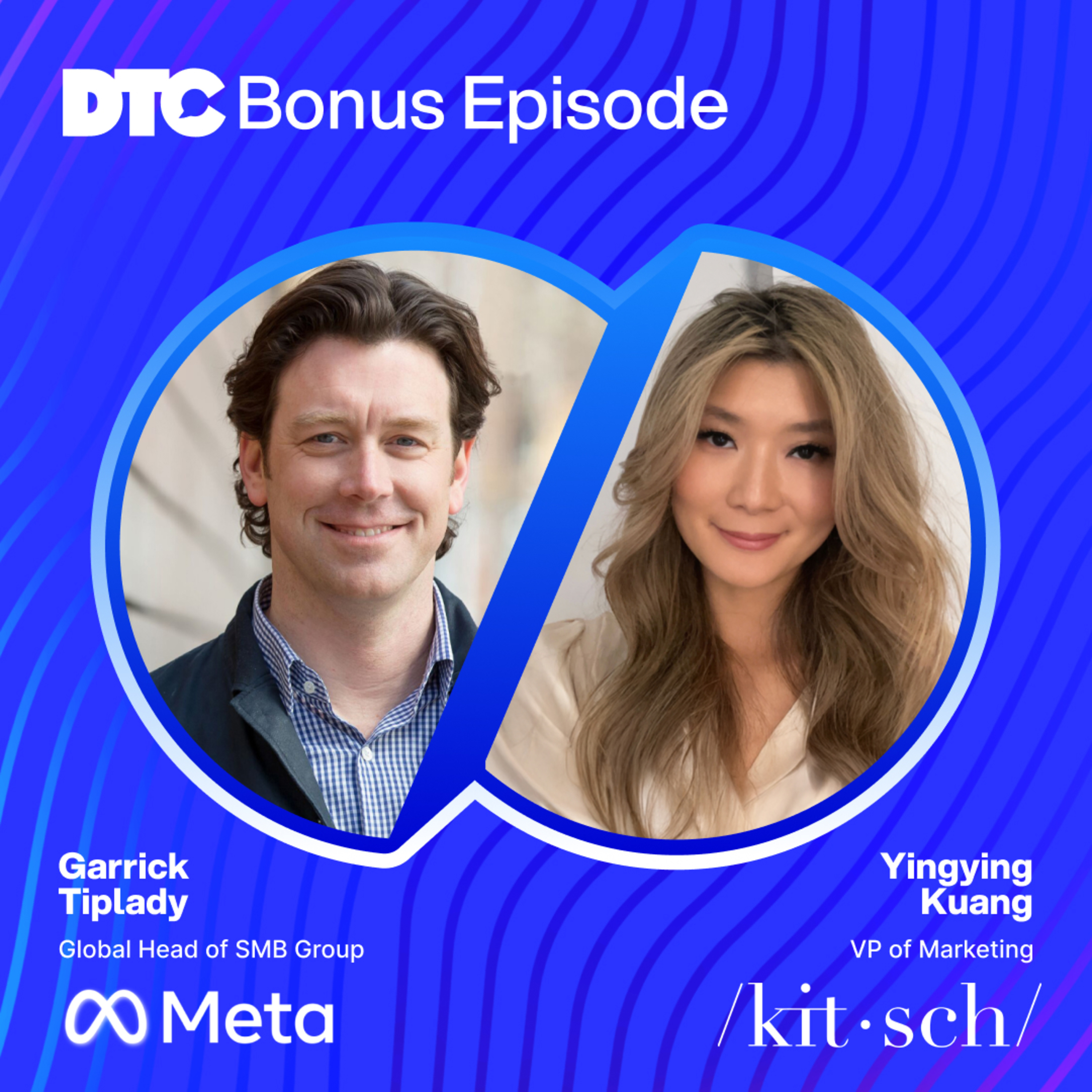
DTC Podcast
Bonus: Meta’s Garrick Tiplady & Kitsch’s Yingying Kuang on Scaling Creative and Media Buying with AI
00:42:42
Loading summary
Transcript69 lines
- [00:00]
Garrick Tiplady
AI in our view, is actually spurring basically a new era of creativity. And both agencies and advertisers are going to have an absolute key role in driving this feature going forward. We saw a 30% increase in advertisers using at least one Genai creative feature in Q1 this year versus Q4. Why is that important? It's important because we're actually seeing results with advertisers. We have an image generation tool. It takes a piece of existing creative and then turns it into multiple versions that have all been inspired by that original. We're actually seeing a 7% increase in conversion with those businesses using just this one feature.
- [00:49]
Eric Dick
Welcome to the DTC podcast. I'm super excited. Today we have two awesome guests. Garrick Tiplady, the VP from Global mid market Advertising sales at Meta, as well as Yingying Kwong, head of E Commerce growth at Kitsch. Why don't we start with you, Garrick? Can you give me a little bit more background on your focus and the kind of clients you work with at Meta?
- [01:11]
Garrick Tiplady
Yeah. Eric. First of all though, great to be on the show. I very excited to be here. So I lead the small medium business group here at Meta. So we focus on what I would say is some of the fastest growing and most innovative DTC marketers in the business globally. By way of background, I started at Meta focused on Canada, moved to North America and then more recently have been leading the global team. And what I will say is pre Meta days I started a number of companies. So I will say it is a real privilege to be working with such a breadth of interesting companies, founders, teams.
- [01:52]
Eric Dick
And to be on the forefront of AI automation at such an interesting time is probably pretty interesting.
- [01:58]
Garrick Tiplady
It is.
- [01:58]
Eric Dick
And then Ying Ying, tell us a little bit about your role at Kitchen, what Kitch is really focused on.
- [02:03]
Yingying Kwong
Yeah, absolutely. So I'm Ying Ying. I'm heading up E commerce and marketing at Kitch. So I manage everything on the direct to consumer side of the business. Everything. Customer acquisition, retention, anything that drive that customer to our website. I've been in the direct to consumer space for almost 10 years now, seeing all the changes in terms of media buying, creative testing on the Meta side as well. I remember the early days when I was doing, you know, media buying. CPM was like very cheap if there's a lot of hack. But that has evolved so much this day and Meta is a huge part of driving growth to Kitsch as well. Kitsch is a hair care and hair accessories brand. We really focus on products that are more accessible better for your hair and at a really good price point as well. E Throw it's really how can we make product that are accessible to customers that are better to use for our customer? And Meta is definitely a huge part of that product development process as well as our growth marketing media mix.
- [03:20]
Eric Dick
Super cool. I'm excited to dive in more into your sort of creative, your prodigious creative strategy, but let's, let's just back up a little bit. So because I'm in a similar boat with you, Ying, I've been in the performance marketing media buying space now for almost 20 years. And so the tension kind of between the constant evolution of the space and specifically over the last little while with AI versus sort of human intelligence. My ears really pricked up when I heard Mark Zuckerberg's comments, I guess about a month ago lately about we're going to get to a point when you're a business, you come to us, you tell us what your objective is. You connect your bank account. You don't need creative, you don't need targeting, demographic, no measurement. You just need to be able to read the results that we spit out. And my ears pricked up as a longtime media buyer to be like, finally, the robots are here to replace me. Garrick, can you speak a little bit to the sort of tension between AI and human talent when it comes to Meta?
- [04:14]
Garrick Tiplady
So it's a really good question and I would say an extremely important question. And let me say this unequivocally because we've had this discussion as it relates to media buyers and agencies. Agencies are critical to the ecosystem and they will continue to be critical to the ecosystem. In fact, Alex Schultz, our cmo, just recently posted on this exact same topic.
- [04:37]
Eric Dick
Yeah, saw that one too. That one felt a little better. I felt a little more at ease after his comments.
- [04:42]
Garrick Tiplady
Good. So here's how we think about AI. AI in our view, is actually spurring basically a new era of creativity. And our view is both agencies and advertisers are going to have an absolute key role in driving this feature going forward. So the way I think about it is as follows. In many ways, creative is actually the new targeting. And so what AI is going to enable agencies to do and advertisers to do is actually take some of the time they would have spent dialing or tuning dials and focus it on resources and on creativity where creating, where creativity matters. We're already seeing agencies use AI in a way that is generally aligned to this. You know, I think the other thing it's important to touch on is at the core of all of this. It's a really exciting time for small businesses who are using our platform. And just the fact is AI is going to help level the playing field. It's going to help new businesses and existing businesses reach new customers. And I ultimately think it's going to drive new avenues for growth that we've just not seen before. So I'm excited about the future.
- [05:54]
Eric Dick
I think so too. I think you think about like Photoshop and how much work was removed from a designer' plate when Photoshop came out. And it was an astronomical leap to level the play if you allow people to have all this technology and it's only made people, you know, more creative, you know, able to create more amazing designs. Hopefully this is a similar thing on a similar continuity. Ying Ying, what's your experience with that tension between human and AI with. With Meta's tools?
- [06:21]
Yingying Kwong
Yeah, I don't think AI is going to be here to take our job or to replace us. I honestly think it's going to make our life easier. It has made my life easier. You know, I don't have to, you know, sit in front of my computer and keyboard and just like setting up like 15 different audience when to test like the same 5 creative, it really take that guesswork out of the process in terms of media buying. And that's the fun part about being a media buyer as well. Right. I have done a lot of media buying. It's constantly evolving and I think the role of media buyer is changing to, you know, like a full funnel marketer. Right. You really have to think about your audience, what your audience want, what resonates with them, what creative you should test. And, you know, creative is the targeting now. Right. Like, there's no kind of like, I can go into meta and do 15 different assets with 15 different type of audience. Those days are gone. But that does make my life a little bit easier. So I don't have to do that manual process. But on the creative front, we really focus on the different type of our cohorts of customers and really develop creative that resonates well with those customers and get them to convert.
- [07:46]
Eric Dick
It's sort of like the more things change, the more things stay the same. Because I was right with you there in those years of like, okay, when you toggle this and when you surf our bid this way and we use the shotgun approach here and all these different, like, bidding techniques that people would talk about in order to try to game the system, that has nothing to do with your customer. That has nothing to do with how you're connecting with your customer. And so now as a marketer, all of our focus can go into, you know, connecting with our customer through creative as target. That's funny. We've been talking about creative as targeting I think for the past three or four years, kind of since we started this DTC company. Can you, can you talk a little bit about how you think about that piece of things, the creative ads targeting and how. Because it's like back in the day when everything was focused on your, your message to your customer, there wasn't that ability to narrow cast in the state you had to broadcast back in the day before something like meta. So now that you can target these individual avatars, how are you guys thinking about creative at scale on meta?
- [08:44]
Yingying Kwong
Yeah, for us we really. So we have a really great community of over 65,000 members who are, you know, our most loyal fans, our most loyal customers and they are really there to tell us some of the problems that they're facing every day. Right. And then how can we use our product to solve some of those problems? For example, we have our shampoo and conditioner bar is one of our top selling categories. It's not easy to sell a shampoo bar online I would say because people still don't know what that product is. Right. To this day I still have people come up to me, it's like what is a shampoo bar? So we really leverage a lot of those feedback and answer some of those questions throughout creative. So taking a lot of the guesswork out of like oh, what do we need to do for these creative here? Like what messaging is resonating for people, right? It's really, it's really simple. Like we have one top performing ads. I have been doing really, really well. It's a really simple headline. It's a shampoo, but better because the shampoo bar is like better for you. And that also targets a large range of customers. Right. So that's kind of like what we are using as a starting point. And then within that we kind of narrow it down to age focused demographic. Right. You know, if you're over 40, use the shampoo. So really target different group of customer. And you know, we also use a lot of product benefits, you know, creative and messaging of like what this product does, right. This is for hair growth, this is for volume. These are the things that customers are telling us we are looking for and that's what we are developing creative based on. So I think it's really helpful to use that as like a constant feedback loop to develop.
- [10:51]
Eric Dick
And just to go a little bit further, what, what kind of volume are you producing? Because I think that's a question all advertisers have across the platform is like, what kind of volume? And then how are you using maybe AI and Meta's tools to support the volume that you're, that you're able to test?
- [11:04]
Yingying Kwong
Yeah, we launched anywhere from 80 to 100 creative a week. So we do a ton of creative. And AI is really, really useful for that. Right. We use AI for a lot of copy and iterations, script writing. So we don't have to write a script from scratch. So we can use AI and say, hey, this is a top performing script. Let's try three different variations in three different tones. So it really cuts down the time of that process of copywriting. And I think AI is great for analysis as well. Right. I think from a data analytics standpoint, it's been really, really helpful for us to not having somebody to pull and analyze a lot of report very manually and really save us a lot of time to just focusing on creating amazing creatives.
- [12:06]
Eric Dick
Garrick, talk to me about the value framework that Meta talks about and how what Ying Ying is kind of speaking about fits into that.
- [12:13]
Garrick Tiplady
So you've got actually two factors. You've got value and you've got automation, and they both go hand in hand. And let me start with automation, because it talks a little bit about what Ying Ying was talking about with targeting. So think about automation. That is a tool basically for our systems to discover new audiences, find more opportunities for advertisers. So why is that important? So take an E commerce brand. You've got hundreds, maybe thousands of products and you've got to combine it with the different ways that people want to engage on our platforms. Then take the billions of customers and their personal preferences on our apps. And as you think about Creative, it's almost impossible to manually test all the different variations in that particular app. Right now where AI comes in as it relates to automation is you can now experiment pretty efficiently and quickly hone in on what's optimal in terms of where you want to target. The second component is value. So value is about aligning our systems really with what advertisers care about most. So this could be from your campaign objective to how you measure business outcomes. And let me talk a little bit about objectives. Like, with objectives, we want to allow advertisers to be much more nuanced with their business goals. So look at the macro level. You could think about it as this. You're targeting, I want new customers versus existing customers. I want somebody to buy as much product as possible or I want them to buy the highest price product that I have in my quiver. And so that's how we're starting to think about value. You can then translate that to margin, ltv, non purchase events, subscription signups. And so we really want to make sure that we align. And then the last piece is with measurement. We want to make sure that we align with how brands measure and really understand what their measurement source of truth is. So stepping back, AI and value to me are really complementary and here's how I see them connecting. So AI helps advertisers personalize their campaigns at a customer level, at scale. And then value gives advertisers control to really guide our AI to optimize what they really care about. And that's how it all hangs together.
- [14:34]
Eric Dick
Love it. And then practically Ying Ying, from your side, when you're testing this amount of creatives, I assume you're using like Advantage plus pretty heavily or is that exclusively at this point or are you still kind of running campaigns side by side?
- [14:47]
Yingying Kwong
Yeah, we, I would say we're about 80% advantage plus. We still use apo abo for some creative testing, but on our scale campaign we are fully scaling on ASC campaigns now.
- [15:04]
Eric Dick
I think some of the tension that we talk about on this podcast with our meta team at Pilothouse quite often is that idea that meta is always looking to optimize and that sometimes you want to be able to control the machine in, in some different ways. It's like sometimes meta's goals and the brand's goals don't always align. So sometimes meta can be sort of like focused on going for low hanging fruit, even if it means bringing in, you know, more. I guess not brand bidding in this case, but a lot of lower hanging fruit and people that already were going to convert as well. And so you really need to have ways to kind of help manage it to move further up funnel. Is that something you're seeing or is that all just done by toggling between reaching new customers and existing customers?
- [15:50]
Yingying Kwong
I will say a lot of that is done through creative. Right. The way that we think about it is we don't want to go against the algorithm, we don't want to go against the system, because that really have not worked for us or anyone we have talked to in the past. So we want to make sure that, you know, how can we be best prepared to work with the system to Find like as many new customers as we can. And the way that we do that is through creative. Right? Again, like there's, you know, no more these like growth hack in terms of audience targeting, bit optimization. Those just have not worked for a long time now. I think that's why we really pivoted to focus on creative diversification in the last few years at Kitch for us is really how can we have enough different looking creative with different messaging, different visual, different talents in the creative to be able to target very different customers. Customers on the ASD campaign. So that's how we think about it rather than, you know, like, how can we have the system and make sure that like we get new customer? Because those tactics just haven't worked.
- [17:11]
Eric Dick
I saw a tweet earlier this week and it was some prominent media buyer saying retargeting campaigns are so back, actually sort of launching separate campaigns for different parts of the funnel. It sounds like that's not really your experience experience right now. Where are you, Are you breaking out campaigns based on different parts of the funnel or are you just letting ASC know what people, what stage people are at in their buying experience?
- [17:34]
Yingying Kwong
We, we are letting ASC do a lot of that work now. I think a lot of the, you know, brand awareness stuff, we do test those, but at the end of the day we want somebody who converts, right? We want to drive that sale. So how can we better optimize towards that in all of our campaign is the goal. I'm not saying retargeting is bad. It definitely have its place, I think, you know, as a purchasers on, you know, sometimes when I see things like five, six times on Instagram or Facebook, I'll be like, oh, I'll buy it and try it out. Right. So that frequency does matter, but it really depends on the brand and the type of products. Right. We have a like lower price point products. Our top seller is around 15 to $20. So it's harder for us to, you know, spend $100 on prospecting for customers or we keep retargeting those customer and our purchase cycle is shorter. Right. Most of our customer who sees our product purchase within the same day because it's more impulse purchase item. So it really depends on the, you know, your product and your brand. It's not a one size fits all solution. So sometimes retargeting is needed. But for some brand like us, like we spend very little on retargeting.
- [19:02]
Eric Dick
Anything to add there, Garrick, on how media buyers should be thinking about maybe segmenting their campaigns or being in control of the machine as much as they can.
- [19:11]
Garrick Tiplady
Yeah, I think, you know, there's a piece I just. I want to comment on, which is just, I think we need to. Again, back to this discussion around AI, automation and value. Like, it's not our goal for advertisers to hand over control to our systems. Like, I think when you sort of peel back the question, it's really that advertisers want to understand what strategies they should be employing in their campaigns to really drive results. And so that's where we've got the Advantage plus suite. It's really about freeing up time so that brands can spend more time on creative strategy and then working with us on really defining what the objectives is that they want to deal with. Because at the end of the day, the more we can align them with the real business goal is, the more our systems can work to actually deliver what our advertisers need.
- [20:02]
Eric Dick
Yeah, strategy is such an interesting thing. It's something we're really focused on at Pilothouse. For years we've been articulating and it was funny. I have had met on the podcast before, different members, and they ended up talking about this thing that we did at Pilot House called. The Pilot test was something that really resonated with previous guests on the meta team, where it was like, we take a product and then we come up with our avatars, and then we come up with a, you know, an ad set that's got five ads in it, and they each speak to a specific angle and we just run it for some creative testing and see which gets the lowest cost clicks, and it kind of helps inform. But like, that's. That's just one little aspect of strategy. We recently took a client that was like a knife company and you could do that with. They have one approach to how they sell their knives. It's basically hunting knives. But we sort of went to them and we were sort of saying, like, what if, you know, you had this whole other approach, people were using these knives in their kitchen, and that's maybe not that kind of strategy where you're like, opening up the audience to a whole new. A whole new approach or a whole new way of thinking about things that might not be unearthed in your little avatar test, where you're just trying to figure out what specific angle makes people's pain points work. But whereas you can just like turn the other way and there's like a whole green field over here of like, a much broader strategic approach. That's the kind of thing I think that that media buyers get freed up to think about more when you've got all this, these tools in place.
- [21:27]
Garrick Tiplady
And this is where things like Gen AI Creative can actually be really helpful. So again, I think I mentioned it out of the gate but like AI is really ushering in this new era of creativity. And like if you look at our platforms, just think gen gen AI creative. We saw a 30% increase in advertisers using at least one gen AI creative feature in Q1 this year versus Q4. So you may ask, why is that important? Right? It's important because we're actually seeing results with advertisers. Like I'll give you one really small example. We have an image generation tool and what that does is it takes a piece of existing creative and then turns it into multiple versions that have all been inspired by that original. We're actually seeing a 7% increase in conversion with those businesses using just this one feature. That to me is where you've really got to think around what the opportunities are when you combine all these tools together.
- [22:29]
Eric Dick
Yingying, how are you using the Gen AI side of things at kitsch?
- [22:32]
Yingying Kwong
Yeah, a lot of it. Like Garrett mentioned as well, we can turn one image into five. I think that's like really low hanging fruit and very easy for us. And I think for smaller brands, who doesn't have as much creative resources as that, it's very incredible. Right. We used to have designers working for hours to create those images and AI just generates them in less than a minute. Right. So in terms of creative volume, that's these tools have been really, really helpful.
- [23:08]
Eric Dick
Have you experimented? I just, I've seen all the videos this week. I think it's Google's video engine or something. VO3 and seeing all these like incredibly lifelike, really hard to detect AI images or videos. Have you experimented at all with AI video?
- [23:22]
Yingying Kwong
We have, we have. We actually launched our first batch of creative that's fully generated by AI last week. So I think internally it's, you know, the way that we're looking at it is like one, it helps with our volume. Two, we cannot tell it was generated by AI because these videos were so good. And the more that we adapt to these tool, the better we are as creative teams too internally. Like you said, sometimes we just don't think about things a certain way and AI is a really good tool. Whether it's like scripting, copy, all that to give us a lot of new ideas and really help us produce a lot different and better creative.
- [24:12]
Eric Dick
Garrick, if we could talk a little bit more about the value focus on Meta's tools because I was speaking a little bit earlier about how sometimes there can be an issue where Meta is going after the lower hanging fruit and you want it to focus more on LTV or something like, can you maybe give some examples of how the tools have shifted to give advertisers more control and more perspective into the value they're driving long term? I think the biggest term on the podcast over this year has been like marginal roas, incremental roas really understanding when there's no overlap, how much value each of your ad platforms is really bringing to the table. Can you talk a little bit about the tech side, about what Meta has built out to address that?
- [24:56]
Garrick Tiplady
Yeah. So that goes back to my comment before, which is systems and our systems work really well when we understand the nuance of what our advertisers are looking to optimize. So again I mentioned it earlier, but it is things like really understand, are you optimizing for margin? Do you want to optimize for ltv? And we can kind of go through the list. I think at the heart of it though, it's really about for a lot of our advertisers understanding incrementality. Right. And how do you truly understand what incrementality is? If you're a marketer today, you want to understand what's incremental to really drive your bottom line. If I think about incrementality, it's really trying to answer the question of like what outcome did this ad or campaign drive that wouldn't have happened otherwise? And look, you obviously know this, but there are many cases it's possible somebody sees an ad, they convert, but this customer would have purchased anyway. And that's what we want to try and sort of avoid. In fact, the latest research I saw, if you are making spending decisions on last click alone, we know roughly 35% of that spend is wasted on non incremental sales. And so what we really want to do is make sure that we shine a light on incrementality so that our advertisers can really shift their investment towards whether it's a campaign or a channel or a tactic that we generally know is going to boost performance. And so as we are sort of looking to help our advertisers understand attribution, that's really where some of our self serve tools like Conversion lift come in, which really allows you as a marketer to understand and test out true incrementality.
- [26:43]
Eric Dick
Ying Ying, can you talk A little bit about how you've used these tools to really understand incrementality for your brand.
- [26:48]
Yingying Kwong
Yeah. So we have done a lot of channel lift study with Meta and we also use tools like North Beam to really give us a better picture of that customer journey. And I think as consumer self, we really don't buy something the first time we really see it. Right. It might take a few time, I might see an ad on a different channel before I purchase, but ultimately I learned about this brand or this product on Meta. Right. So it kind of paints a better picture of how customers are purchasing and what are some of the touch points that are needed before they make that purchase. So for us, we have been using North Beam for a very long time. We don't really make a decision based on last click attribution. I think we really want to look at this customer journey holistically. And we also. Kitchen is a very omnichannel brand as well. We have a really big retail presence and also a big Amazon present as well. So that gets even more complicated. But sometimes anecdotally, you know, if something goes viral, ad goes viral on Meta, we see immediate uplift on retail and Amazon for that specific product. Right. So we know it's driving incremental value to these other channel. That is not just our website. I think this year something that we are really focused on is using a lot of these tools like North Beam House to help us like how can we better measure what that incrementality is.
- [28:35]
Eric Dick
Those halo effects, I think that's what everyone's looking for. Synergy. Right. And a flywheel where you can put in 10 and get 20 in effort because of your whole ecosystem. Garrick, how are you viewing Meta kind of in the entire E commerce ecosystem with these other tools?
- [28:51]
Garrick Tiplady
So I think it's, you know, again, our view here is we really want to make sure that the advertisers using our platform have an ability to measure what works. And so as part of that, we want to understand not only what's happening on our platform, we want to understand their source of truth for how they're looking at measurement and incrementality. And you know, I do think, you know, you look at multichannel, you look at omnichannel, these are all interconnected and that's part of the frameworks that we work with our clients on.
- [29:24]
Eric Dick
I went through a bit of a journey, I guess over the last six months or so, talking with different brands and how they really think about their top of funnel. And I kind of, I was talking with a lot of brands who had, we're looking at things like TV to be more of a true top of funnel brand building exercise. And then I remember I did a podcast with Taylor Holiday from Common Thread Collective and he was, he kind of blew that out of the water. He's like, you really just need meta. Meta is still like, you know, 90% of it for so many people. You were talking Ying Ying. I think the top of funnel message message that works best for you guys is introducing people, for instance, to like, what is a shampoo bar? That's sort of like maybe your strongest top of funnel messaging. But how do you guys think about top of funnel and making sure? Because I think the big worry with Meta sometimes is that you can end up, if you're not careful, really saturating your mid and bottom part of your funnel and sometimes overspending there if you're not careful. So how do you guys think about making sure that you're bringing enough new people into the funnel and then not overspending on the bottom part?
- [30:22]
Yingying Kwong
Yeah, we want a whole media next to work together. Right. I think, you know, we have tested tv. We are still running TV right now. And that is also like helping to live meta as well. Right. But meta is still much needed in this journey for a customer because, you know, a lot of us saw a TV ad at like 8pm midnight and we don't just pull out our phone and immediately go to a website and purchase. It does drive that initial touch point and drive that awareness now that the customer knows we exist, knows what a shampoo bar is. But you do need that lower funnel touch point to get that customer to convert. I think that is sometimes where we kind of lose sight when we so focused on top of funnel awareness. Like we don't kind of close the loop on that purchase journey. Like how can we get people to actually click to the website and convert? And I think meta is really, really good at that. Right. Driving customer direct click, direct purchase, which is like incredibly needed in this customer journey.
- [31:39]
Eric Dick
We did our first meta podcast last week that'll air in a couple weeks. And it was about holiday prep, which is kind of scary to about. But we're.
- [31:47]
Garrick Tiplady
Now is the time to be talking about it.
- [31:50]
Eric Dick
Now is the time. So I'm curious. And so there's a couple questions here. One, Ying Ying, what's your approach for preparing for the holidays now? I'm also just interested in how you're thinking about all of the AI tools when it comes to periods where you're really going to be focused on offers and bundles and discounts and kind of things like that. A, you may not, but maybe talk first about how you're thinking about Meta and Q4.
- [32:13]
Yingying Kwong
Yeah, Q4, it's a super bowl season. We have a very giftable product. So Q4 does really, really well for us. The way that we really have been thinking about it the last few years is we use the first nine months of the year as testing, learning, find what works and to really understand, like what could do well going into Q4, we use all year as like that testing time frame. So it's like never, you know, too early to test for holiday, you know, because it is like our super bowl period. We don't, you know, you don't go to the super bowl with like all new plays and just be like, hey, let's just like test these things out on the super bowl. Right? So the way that we think about it, it's like, let's go back to our tried and true creative things that are working. Things have done well and how can we iterate those with the holiday messaging? How can we, you know, create offers with those creatives that are already working? Right. We don't have to re mend the wheel in Q4. You can still test things, but I would not recommend, you know, if you have more than 20% of new creative.
- [33:33]
Eric Dick
Going into Q4, I think that's a great show. We also like to use Memorial Day as a bit of a launching pad for brands that maybe we haven't worked with in the past where we're going to be testing our discounting strategy and just using that as a great data point for what we'll do in Q4.
- [33:48]
Yingying Kwong
And July 4th and Labor Day is a great one as well.
- [33:52]
Eric Dick
All warm ups.
- [33:53]
Yingying Kwong
Yeah. And really testing what type of offers work. Right. And I think our recommendation really is like, keep it simple. Customer doesn't like to have five different offers on the website. And then like they have to figure out, do the math, make it as simple as possible to get the customer.
- [34:14]
Eric Dick
To purchase anything to add there. Garrick on the Q4 approach, Ying Ying.
- [34:19]
Garrick Tiplady
Gave a great answer. I think the pieces that I would touch on start now. Really think about testing out what you want for Q4. I think, you know, to pull it back a little bit. For anyone who is newer to AI or automation, I'd say start integrating that into your campaigns now. Test, learn, figure out what's working, figure out what's not working so that you're ready for Q4 and I would say, you know, based on the previous part of the conversation, if you haven't started testing creative at scale, I would actually start to think about using Genai Creative. If you haven't already, like start testing that now. The last piece I'd touch on is just. And we haven't touched on this yet, which is creators, which is interesting. So, you know, I do think we're seeing a huge impact when brands are partnering with creators, particularly with our partnership ads format. The latest stat I saw, 53% of people are more likely to purchase an item if it's been promoted by a creator on real. So we're seeing some really, really interesting numbers. But Ying Ying, I know that's something that you think about quite a lot as well.
- [35:29]
Eric Dick
And these are real human creators. This is so far, these are real. These are the Geno 3 real people.
- [35:36]
Yingying Kwong
Yeah, yeah. I would say partnership ads have been a huge unlock for us in Q1. We have seen, you know, 15 to 25% better ROAS on some of these partnership ads. And it's also like meta have made it pretty easy to do it at scale now, testing different creative with different creators. And ultimately it also unlocks a different set of audience. Right. Audience who already follows these creators, these influencers on the platform. Otherwise we wouldn't have been able to reach some of these audience.
- [36:17]
Eric Dick
And are these whitelisted? What we would call whitelisted, where they're actually coming from, the creator's handle?
- [36:23]
Yingying Kwong
Yeah, we have done both. So we have done the partnership ad. It will be like Hitch with this creator. And we also have done the whitelisting model as well. We haven't seen a huge performance difference on either yet. They both have been doing really well for us.
- [36:41]
Eric Dick
I know the creator space, it's something that's constantly evolving and whether it's. We're talking more about creators than we are influencers at this point. But any words of advice for how brands should think about using creators? So they get more hits than misses? I guess.
- [36:56]
Yingying Kwong
Yeah, for sure. I think for us is finding the creator that is genuinely loves your brand. I think, you know, sometimes it's hard to sell a product when you never have used it. Right. So I think what really worked well for us is finding those creator that have already used the product, genuinely loves the product, so it doesn't feel like ad when they're talking to the audience. I think that's the most important thing. And followers and the size of the creator matter less. It really comes down to the creator loves the product and they can really create really good content with it.
- [37:41]
Eric Dick
And it goes back to the creative as targeting piece as well. Because each creator you use is going to appeal to maybe to a different audience for different reasons. Maybe they look similar, they have a similar lifestyle or whatever. So that, so the same, the same piece applies where you go out and you want to work with a bunch of different representative creators that speak to different parts of your audience, your avatars, and let them kind of do the heavy lifting with what they attract. We've got a lot of media buyers listening to this podcast. Maybe just some closing words on how media buyers who are really looking to become masters of their, of their craft should be thinking about meta in 2025 right now. Maybe Ying Ying, start with you. Like, what's your sort of like high level advice for media buyers looking to master this?
- [38:26]
Yingying Kwong
I would say listen to your customers, look at reviews, look at what people are commenting on, the ads. I think that's a great starting point on what creative to develop and really being customer centric, I think it's more important as a media buyer and marketer than ever these days because you really have to listen to what the customers need and they will tell you. Right. Customers are very open to feedback. They leave reviews, they're joining our community to tell us what they really want. So I think step one is going back to the basic and listen to what the customer needs.
- [39:08]
Eric Dick
And that's such a human response. Right. And I think that's the goal and the, and the, the, the upside with all of this technology is it makes us even more human. And it's not. I know so many media buyers out there that are like, they don't want to hear that. They want to hear change the button to blue and toggle this setting and, and, and get this audience here. They want all those easy to do things that they can do on a spreadsheet or do it on a platform, but really it's about listening to other humans and solving their problems. Garrick, you agree?
- [39:36]
Garrick Tiplady
I absolutely agree. I think the other piece I would say just to add to that, and it's been the through line of our conversation today is just, I would also lean into like we're in this new era of creativity, like lean into diversity of creative. I think it touches on what Ying Ying was getting at as well, which is the diversity of creative reaches and touches people in different ways. And so, you know, make sure you lean in.
- [40:03]
Eric Dick
Garrick, I don't know if you can speak to it all, but what is, is, is, is meta just going 100 miles an hour trying to, trying to develop new AI tools and new AI insights that are going to help advertisers. Like what, what can advertisers expect from Meta in, in the coming years on, on this AI front?
- [40:21]
Garrick Tiplady
So it's going to. Here, here's what I will say. It's going to be impossible to predict the future. I will say media buyers agencies will be part of that future. You know, we are going to continue to invest heavily but what I will know is our advertisers and the consumers who use our platform will be at the core of everything we do. We're really trying to continue to bridge that business and people connection.
- [40:46]
Eric Dick
I love it. The thing that I've been thinking about lately, the amount that I will talk in a given day to my ChatGPT or to or it's whatever AI agent I'm using the, and the amount that I'm willing to disclose it, I forget it was some principle that was like people are willing to give like every year people are weighed, are willing to give away more of their personal information kind of thing. It's like an ongoing thing. And the amount that I'm willing to talk to, the amount that my chatgpt knows about my not just what I want and what I would click on, but my like inner psyche in a way. And I'm really interested to see the way this data is proliferated in the external world. Like and I think again I'm very optimistic about everything but it's, it is amazing how much data is going to be out there about how people think when it comes to the, this, these AI systems. Any thoughts on that?
- [41:34]
Yingying Kwong
Yeah. The way that I look at it is it makes our life easier. Right. Like I want to be targeted by the white ads. I don't want to have to go search if I'm buying a mattress. I don't want to have to like, you know, do all the research about a mattress. I want to you know, like meta have good targeting that can just like get me the right brand and get me the right product. Right. That makes my life easier and I'm definitely willing to give up that data to make my life a little bit easier. Right, nice.
- [42:06]
Eric Dick
Well, I want to thank you both for coming on the DTC podcast today. I'm super excited for the AI outlook and it's great to yeah, hear kitsch is using things so, so effectively. Thanks for coming on today guys. This is fantastic.
- [42:18]
Garrick Tiplady
Very much appreciate it.
- [42:19]
Yingying Kwong
Thank you.
- [42:26]
Eric Dick
Thanks so much for listening to today's. Episode. If you're not a subscriber to our newsletter, you can do that right now at directtoconsumeralloneword. Co. I'm Eric Dick and this has been the DTC podcast. We'll see you next time.