← DTC Podcast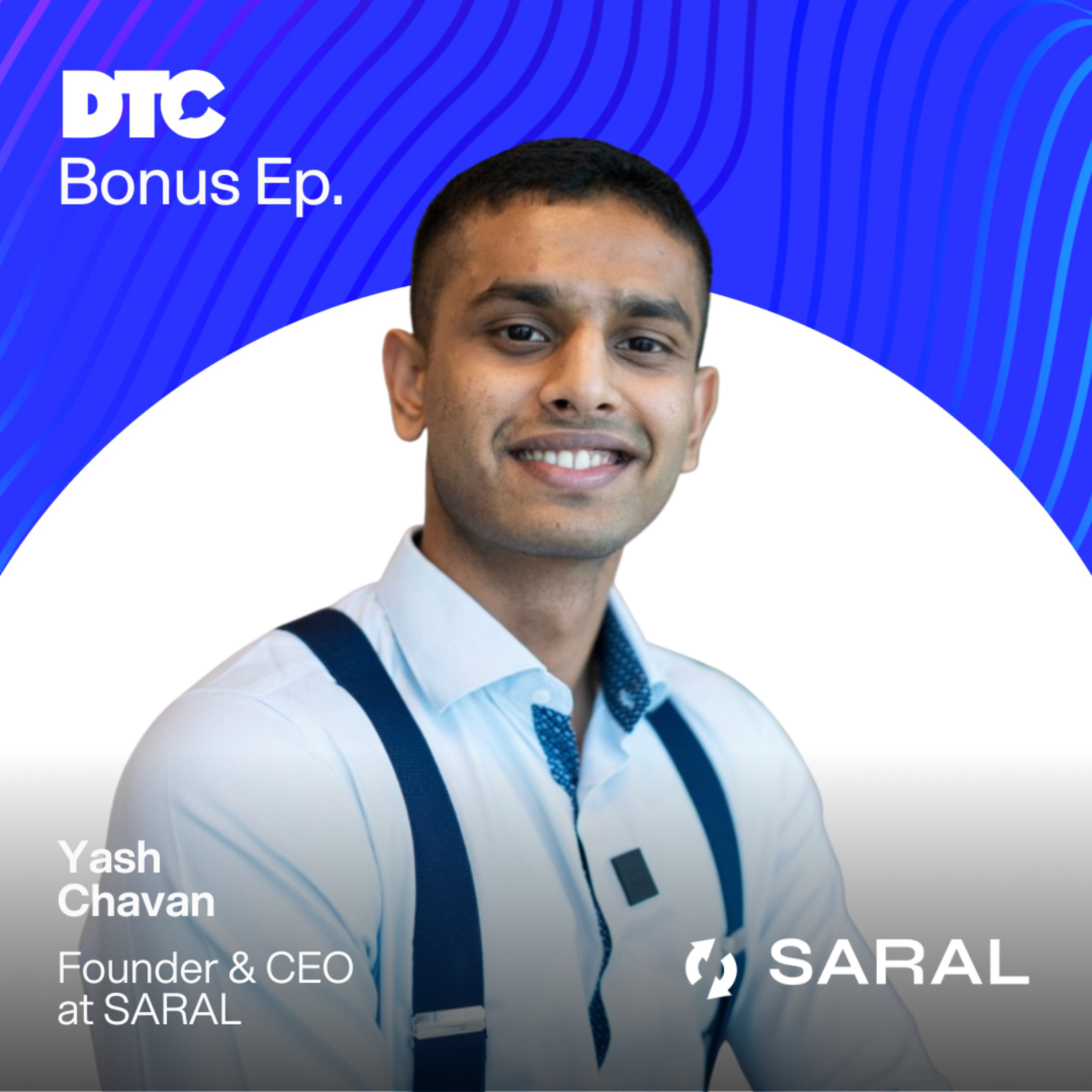
DTC Podcast
Bonus: The Math Behind Influence and Why Most Influencer Marketing Fails with Yash Chavan from SARAL
00:30:06
Loading summary
Transcript36 lines
- [00:00]
A
Whenever somebody says brand awareness or mindshare, people tend to think that's just like a woo woo concept that happens to some brands and does not happen to other brands. But you can pretty much use basic math to reverse engineer that concept. At any given time, only 3 to 5% of your total addressable market is going to be in market looking to buy. Right now algorithms on paid media are incentivized to go find you the customer that will convert the fastest for the cheapest. Those are in market buyers. You have a motion right now with your paid media to drive people who are in market to purchase from you. But there has to be another motion that takes people who are in that other 97% out of market, influencing them to move in market so that your ads perform better.
- [00:54]
B
Yash, welcome back to the DTC podcast. I've got my pyramid ready. We're talking influencer marketing and I wanted to start with your bold statement. Statement. Why is influencer marketing broken?
- [01:06]
A
Yeah, I like to say that. Or I say influencer marketing is broken or doesn't work because, because of the way frankly how a lot of brands approach it and how what a lot of content out there promotes influencer marketing to be. And the usual typical approach is you would try to like worst case, try to pay influencers. Pay a bunch of random influencers for posts and then see if they they get you any sales. Or they would do some sort of mass seeding campaigns where they would sen dozens of products to random influencers and then hopefully they post, maybe they post, maybe they don't post. Right. Or you would have some sort of an ignored affiliate program like a random link in the footer of your website or something. And obviously that doesn't end up working. And then brands conclude that, well, influencer marketing doesn't work. And then hopefully through this podcast we're able to share how do you make that work? But that's why I come with that bold statement and I say, hey, influencer marketing, the way you're doing it so far does not work.
- [02:04]
B
Let's take it back to basis. You had a. I think you described it really well in a way that I, that I kind of understood. How do you describe influence? What does it actually mean to build brand awareness through influencers?
- [02:15]
A
That's a very good question and I may have a very analytical answer to that because whenever somebody says brand awareness or mindshare or one of these terms, people tend to think that's just like a woo woo, little bit of a woo woo concept that happens to some brands and does not happen to other brands. But you can pretty much use basic math to reverse engineer that concept, right? So the way I think of it, because that's what we tell our brands when they come on Sorel, we're like, hey, your job is not to do influencer marketing. Your job is to build influence in your market. That's what you need to do. And it's basic math. So if you break down, let's go down to the Mac, to the micro. If you break down your icps or anybody's day into what I call scrolling sessions, there are typically anywhere between three to six scrolling sessions in everybody's day. Like you wake up, you're scrolling on your phone, maybe commuting to work, you're scrolling on your phone after lunch break, you're scrolling, commute back, you're scrolling. And that final guilty scroll right before bed. So there's these three to five scrolling sessions that are happening if that's where their attention is. Because everybody talks about this like you need to be where their attention is, if that's where their attention is. And those are the five social media scrolling sessions that they have. If your brand pops up three times, five times in their feed and pops up organically, not interrupting them with advertising, but organically pops up in content that they would have anyway consumed regardless of your brand, that I think is brand awareness and mindshare. And the way you reverse engineer that, here's where the math part comes in, is to pop up thrice in somebody's feed. That means some influence organically, an influencer has to post about you thrice a day or three influencers have to post about you once a day. If you just scope that out, that becomes a hundred active. You know, from my last podcast I keep talking about this like, build long term relationships, build an ambassador program. You just need 100 active ambassadors posting at least once a month. And if you have that, you have on average 3.33 posts per day, which means you're popping up thrice a day in somebody's scrolling sessions. You know, this is a little bit reductionist of math, but technically you're popping up thrice a day in somebody's scrolling sessions. And there you have it, you own mindshare, because you're popping up those many times in somebody's feed and they're noticing you on the side. The consequence of this is they then go directly visit your website and buy or they go. Whenever your Facebook ad pops up, they're more likely to click on it or they see you in a retail store and they're likely to pick up your item, your CPG code or whatever. So that's what I call owning mindshare and building influence in almost like a analytical fashion.
- [05:00]
B
I haven't heard it described like that before and it makes a ton of sense. It's just practically when we're doing this scrolling and I've been, I've actually been furnishing a new home that I'm in now. And so I think I am a prime candidate for advertising. And it knows it. And it's amazing the way it's kind of pushing me through these themes of like, of what it thinks I need. And it's working. So we're talking about ambassadors, which are pretty near the top of the influencer, the pyramid of influence that you've described. And you talked about having 100ambassadors and that's obviously that's a program at scale to get 100ambassadors. How much product seeding are we doing?
- [05:36]
A
Yeah, so typically we recommend brands do at least reaching at least 500 to 100 send outs per month. Now this is for the typical brand. If you're a more lower ticket brand, maybe you could do more if you're such. For example, there's some furniture brands on so that seed maybe 10 or 15 products every month because they're literally sending out sofas or office chairs or something very expensive like that. So volumes vary, but typically 50 to 100 products seeded every month and you end up with 100 or so active ambassadors in three to four months, roughly speaking. So if you do it consistently, it's pretty straightforward to get to that sort of two to three posts per day brand awareness metric.
- [06:18]
B
Now, just to reiterate, I think we've probably talked about all three of our podcasts, but I think for anyone listening, it bears repeating. Again, I have the implement right here. Just walk us through the pyramid of influence that you build out on Soral.
- [06:33]
A
Yeah, so brands need to stop doing this pray and pray influencer seeding and marketing that doesn't work. And I like to call it build your pyramid of influence. Right, or the influencer Illuminati like we called it on the last podcast, which is more, more of a fun name. But a pyramid of influence is basically pyramid of influencer partnerships that drive this influence in the market for you. And the way you build that is it's broken up into three distinct phases. And I'll tell you why this works, but I'll describe the phases first for everyone. At the bottom layer of the pyramid is A high volume seeding program. So you're seeding out product to 50, 100 influencers on a monthly basis on average. Some of them are going to post about you. When they post about you. Most brands stop at the seeding. They're like, yeah, we're running an influencer seeding program, but that's consistently run on a treadmill with no outcome or nothing long term to show for it because you see it and then they post and then that's it. And then like nothing happens from there. So you need a way to ascend the posters into something else, which is most likely an ambassador program. So an ambassador program typically has some affiliate commissions, discounts for their fans, giveaways, early access to products, you know, invites to events, maybe a community on Facebook or WhatsApp or something like that. It can be as deep or as light as you want it to be, but typically involves some sort of a commission and a discount. Right. So that's your ambassador layer. So you're seeding influencers. Most of them are posting hopefully. Then you take the posters or whoever's content you like and you turn them into ambassadors for your brand so you have something long term. So not just seeding and giving up, you're then making them affiliates so they have incentives to keep posting about you again and again. And that's how you build that. You pop up three times in somebody's feed. So you take that ambassador program and in say three months of building the program, you will see that the top, it's always a 9010 where the top 10% of your ambassadors drive most of the sales, most of the views and bring the highest quality of content to the table. So you take those top 10% across views, sales and content quality and you turn them into custom partnerships where you can then do UGC partnerships with them, whitelist their content for ads, put them on retainers so they keep posting about you and bunch of stuff like that, or co produce products, give them equity. You could go again, could go as deep as possible in some of these layers. But that's generally the structure. Seeding, ambassador, custom partnerships and then you have a pyramid because at every layer there is drop off.
- [09:03]
B
And so this is the big reason to do this is to shift from randomness to predictability. Right. Because you have this whole system contributing. If you're just focusing on that bottom layer, you're going to have a lot of inconsistency, right?
- [09:16]
A
Correct. 100%. And so basically the reason why this works is you are. And the reason why this is predictable. Why the word predictable is used is because at every layer you're reducing risk and rewarding. So at the seeding layer you have the least risk because the worst thing you lose is your cost of goods, right? So you lose your cost of goods if they don't post. If they post, that's great, then you got something in return. Then what you do at the second layer, you don't lose anything because you're only paying for performance. You're not paying for posts or anything. You're only paying if they get you a sale, then only after they've performed consistently for three months, four months, you take the top 10% who are pretty much always guaranteed to perform, whose audience is warmed up and already knows about the brand has bought from them. You turn them into like paid deals. And what would fall under more traditional influencer marketing where you're paying for posts and doing custom partnerships like that. So at every layer your risk is the least when you start off. And as they prove performance, you keep incentivizing them for more and more while reducing your risk. And then what this does is this ecosystem of partners that you create or an owned influencer community generates these three posts per day, five posts per day, and it becomes like this fountain almost of posts coming out about your brand and sudden you have brand awareness, right? So you can manufacture it.
- [10:36]
B
I think one of the things I like about influencer marketing, the thing that I'm talking on the podcast all the time these days again is just real true top of funnel and how you actually grow a brand. How you don't just milk the people who are already in market, but that you're constantly bringing new people into the market. And so talk to me about how influencers work to bring new people into the market.
- [11:01]
A
I like that question because it's that saying, right? In marketing, at any given time, only 3 to 5% of your total addressable market is going to be in market, AKA looking to buy right now. So when you're doing interest based ads, or when you're running say pay per click ads for keywords, you're specifically targeting your incentive. The algorithms on paid media are incentivized to go find you the customer that will convert the fastest for the cheapest. Those by definition are in market buyers. So your consistently targeting in market buyers. And what happens with that is every time like this is the classic. And you've seen this, we've all seen this. The classic DTC growth story is they get to their first growth milestone with paid media, right? Because it's easy to advertise. You can learn Facebook ads and you can grow to 3, $5 million GMV. And you do that by targeting all the in market buyers. And you think it's easy. You think that hey, I can just keep spending more to grow more. But you hit that milestone 3,5 mil usually and then you hit a ceiling because now you're running out of the in market buyers. Now the ads are shown to the same people and they don't want to buy anymore because they've already bought from you or they already have a subscription and they don't, they're not responsive to ads. So then you resort to trying tactics and different ads and hooks and so on. And that might appeal to some people, but you're not going to get a step change in results the way you on a, on a more even stepping back from influencers. Right. On a more conceptual level, the way you get a step change in results after this plateau is by having a motion. You have a motion right now with your paid media to drive people who are in market to purchase from you. Fantastic. But there has to be another motion that takes people who are in that other 97% out of market and keeping on moving them in market, influencing them to move in market so that your ads perform better. So usually a lot of influencer marketers talk about influencers are a better channel because of the ROAS is higher. Or you could pay 10% affiliate commission and that's 10x ROAS or whatever. But it's like, hey, it's not a standalone channel. It actually works, works so that all your other channel works even more effectively and it brings its own revenue. It's like a multi, multi impact channel. And the way you do that is you influence the market as influencers warm people up. It almost in one line, I like to say it like greases the funnel a little bit. If I'm seeing a product thrice every day mentioned organically, then I see that ad pop up on YouTube or on Google, I'm going to click and I'm going to buy. Right. And then I don't even need a discount for instance, because there's so much brand awareness. I already see people buying it. Maybe you don't have to discount anymore so you're more profitable, your click through rates on your ads are higher, your cost per click on Google is going down and so on. So that's how I think influencers, once you build this influence, kind of grease your funnel in a way.
- [13:50]
B
And what you're talking about Here ultimately leads to attribution. So what's going on with the state of attribution with influencers? What are you guys contributing?
- [13:58]
A
Yeah, it is. We are building some interesting stuff in our product around this. But just generally speaking, attribution is so. Because it's. It brings to mind this one example. I don't know if I shared it the last time, but I'll share it this time. We had a client, I was running an agency before this and then we had a client, skincare brand, new brand. So they started working with us for influencers. Typical skincare, right? And then they started working with a Google Ads agency a few weeks later. So just setting up, getting vendors on board and so on. So we started working with influencers in some four months or so. We had about some 150 or so active ambassadors for them posting consistently, getting two to three posts per day. But they were not seeing enough affiliate sales. So she was a little bit frustrated, the founder, but the Google Ads agency was crushing it. She's like, hey, look at this report. The CPCS are consistently decreasing. We're getting more clicks month on month. I'm like, who's driving all that demand? Where are the searchers coming from? And she was just unable to see that, that correlation. So she canceled our contract, we stopped working with her. And then two months later she comes back to me and she's like, hey, we need to spin up that influencer program again. Because all the Google Ads started getting worse and worse for the last two months because not enough influencers are posting, which means not enough people are searching for the brand and not enough people are clicking. So Google and Facebook tend to be these like almost sleazy salesmen that stand right at the door of the checkout and hand in their cookie. Right? Because if somebody's searching your brand name, they are more, most likely they know about the brand. They're going to find your brand and buy anyway. But then you're measuring your branded search and so on. So that's one of the examples of how attribution is so wonky and broken and is like a black box in this space.
- [15:46]
B
I just did a podcast yesterday with our Google team and they had discovered that on several of their accounts Google started reporting. Well, across all their accounts, Google started reporting new versus returning customers. But by using Elevar, they saw that they were wildly overstating the number of customers who were actually real. And it's just because the cookie data or whatever was not refreshed. So that Google doesn't Really know who's new and who isn't. So I'm sure that was something that influencers contribute to as well because they are inherently going to be bringing new eyeballs to your brand.
- [16:15]
A
Yeah, 100% they are that 97% who hasn't heard about your brand? You target all the people who have ad blockers, for instance. And then the question comes up like, how do you measure this? How do I know if it's successful? And the way you know if it's successful is one. Yeah, you measure all the basic stuff like, hey, how much affiliate revenue are we getting? Are influencers even posting about us? Because if they're not not posting, you're not going to get anything. Right? How many posts per day? That's one of the metrics that we track in Searle is ppd. So how many posts per day are you getting? Are you getting two, three posts per day? After at least six months, then yeah, something's happening. So those are the basic metrics. On a more marketing level, you could track conversion rates on your ad campaigns. Hey, are Facebook ads in general doing better than before? So is this click through rate higher? For instance, if the CTR is higher, people are more interested because there's brand value built up. Is the cost per click on our Google Ads going down because people are searching with more intent? Are our branded search keywords rising? That's one thing. Direct traffic to the website, are people just typing in the brand and visiting? Because a lot of influencers mentioned like hey, go to www.brandname.com and then people. So is your direct traffic increasing? Some of this stuff is important to track and see how the. Because the influencer programs its own impact is one of the ways to measure it is affiliate codes and, and discount codes and so on. But the true impact that we've seen is in some of these other ways, like your ads are performing better, your direct traffic is rising, branded search is rising, and so on. So that's how you should measure it more holistically.
- [17:51]
B
Super cool using AI every day. Obviously in this new world, how is Soral thinking about AI to improve its service?
- [18:01]
A
It's a little bit tricky because influencers are such a. We believe at least that influencers are such a human to human sport that you cannot have an agent talking to an agent, in my opinion, like an AI agent. So it has to be human to human because there's creativity involved, there's such relationship involved. There is. You know, sometimes you hop on a call with a creator and then you build that Relationship that you don't build otherwise. You like the Pura Vida founders, for example, big brand built purely on influencers in the early days. One of the sort of like the darlings of influencer marketing. Right. It's a great, great case study, so to speak, and something to study for anyone who's building influencer programs. Their founders, I think are, he's on a podcast or something and he said he went on lunches with their first some 200 or 250 influencers, like took them out for lunches and coffees. Like that's the sort of nature of influencer marketing. So I don't know AI, we're doing a lot of stuff. Like we recently launched Sia, which I know that you saw. Sia is our seral influencer agent which basically can find influencers for you, can draft personalized outreach, can respond to creators for you. Almost acts as a think of Sia as like an executive assistant for your influencer marketing. So in an old world where you would have to say get on siral and then also hire a VA or hire an influencer marketer and then train them to run siral for you. Now SIA can do some of that basics so that you can focus on the strategy and so on. But we still have what we call human in the loop. Right. So SIA does find the influencers, but you got to approve them. SIA writes the responses, but you got to approve, edit and send because there's always this human to human element that we want to preserve.
- [19:43]
B
Where do you see all of this going? I think as AI gets more and more prevalent, human to human connection is going to be valued. I think that's why we built agency. I've heard people predict that's why sporting is going to be even bigger because you have real humans competing head to head. I guess influencer marketing is in a similar boat. As long as you can create authentic relationships with people who can create authentic content, it's going to only grow.
- [20:08]
A
Yeah. That's why I don't super agree with the people who say that AI influencers are going to be all over the place. I think there'll be some AI influencers. Just how you know, there's these characters like Deadpool or one of these, you know, Thor and so on. You know, there's these few of them, but you can't have an entire ecosystem where people are because again, influencer marketing, I think I said this on the last one, but it's basically about trust, it's about word of mouth at scale where in an old world you had one person talking to five of their friends, it's now one person talking to 50,000 of their fans. Right. So it's that. And I don't think an AI influencer because if the ads are now being created by AI and everything's created by AI, you're shopping on ChatGPT. You need something that's authentic, that you almost have a one to one relationship with. And I think influencers are a great way at scale scale to build that relationship with your target customers.
- [21:05]
B
You mentioned Pura Vita and as a DTC darling, are there any brands in the last couple years that you think have done extremely well with their influencer strategy?
- [21:15]
A
Yeah, so many. I think one of the examples that comes to mind really is Obvi is one of our customers. Everyone knows of Obvi, so they're a great case study as well.
- [21:26]
B
Comes out on Monday.
- [21:27]
A
Oh, does it? Okay, great. Yeah, we did a webinar with them. It's probably somewhere on YouTube. If you search UPVI influencer strategy, you'll probably find that they do this exact again. By the way, this pyramid of influence is not my creation. It's because I'm in a position where I can see 250 brands and the successful ones and the not successful ones and I can see how they're structuring their programs. It's almost like a reverse engineered abstraction of how the successful brands are running it. That's exactly what OPPVI was doing before or I ever coined the pyramid of influence or whatever. So ABVI is a great one, Ridge is a great one. Who else? I think First Pharm, it's a fantastic affiliate program to study the fitness brand. They have some 4,000 active ambassadors. Huge, very passionate community about the whole. Their whole narrative is really compelling. So first form is a great example of labeling. They call them lesionaires. So they've given. They don't even call them ambassadors or affiliate. They call them lesionaires. So first form is a. We all know the very popular ones, right? So we know like Sephora has one and gymshark has one, but those are maybe a little bit too huge. So first form is good. Ridge is good because of their focus on YouTube as a channel because YouTube is so long term, right? Instagram, TikTok. I mean now they're being indexed by SEO. So we'll see how it goes in the next. Maybe we could do another one of these podcasts in a year and see where we are. But YouTube right now is the second biggest search engine, Engine. And so the videos are being indexed so you get long term value. So I think some of those are really good examples to study. Triangle is a good one. Triangle is a bikini brand. They had a very good, they fomoed, I think Kylie Jenner into posting about them because they couldn't afford her fees. So they seeded product. I think this is way back in 2015 or something like that. But they ceded product to all her friends who were smaller influencers. And then Kylie got four more and she reached out to them saying, hey, let's collaborate. That's like a very interesting story. So some of these triangle, if you want to study first form, Ridge, Abvi, Pura Vida, obviously are some really good examples.
- [23:37]
B
And we talked on the pre interview just about hexclad because they have focused their pyramid to the very top and got Gordon Ramsay and are now getting investment based on that partnership. It just shows you the level that influence can have when you really nail it.
- [23:52]
A
Yeah, correct. Yeah, totally. And the good thing is there's a Gordon Ramsay in every industry, right? There's like no matter where you are, who you are, what you, there's probably a Gordon Ramsay in your industry. So you can go get them. And the best way to find who your Gordon Ramsay is is by the only way Gordon Ramsay cares about your brand is if other people are talking about it. If nobody else is talking about it, there's no way like the token Gordon Ramsay of your industry is going to care about you. So build that seeding program, build that ambassador network and slowly you get so many. We've actually seen some brands being rejected by big macro influencers like 500k and above. I told them, hey, don't worry about them. You're new. Start with the basics, start with the less than 25k and then every 3 months go up market because all the 50k people follow all the 20k people and all the 100k people follow all the 50k people. So when you can reverse engineer that FOMO thing that I spoke of, you work with all the 25k people and dominate that market. All the 50k guys want to work with you, right? Then all the 100k people want to work with you and slowly you move up market and you can have them prove their performance and slowly get to your Gordon Ramsay.
- [24:58]
B
How has TikTok shops, like the growth of TikTok shops influenced or changed this space?
- [25:03]
A
TikTok shop is interesting because a lot of people have mixed opinions on it. I have seen it do well for some of our Brands like Obvi, I know crushes it on shop, Breez I know crushes it on shop. But I think there are some brands where it just does not work. Maybe in restricted categories, maybe if your average order value is higher, it doesn't work. So one of the good things is that it's normalized social commerce. It's maybe opened up the world of influencer and affiliate marketing for some brands. But I believe you should always have your own influencer community. You should always own your relationships direct to the influencer. And TikTok Shop can be a channel, YouTube Shop, Amazon, Amazon as an affiliate program. All of these could be channels of your influencer program, but you should own the relationship directly with the creator. So yeah, but TikTok shop, I think it's done a great job at normalizing social commerce, buying on social media and so on, but I think it works well for a very specific type of product. So before you invest in it, you got to think if your product kind of fits in that slightly lower aova be more impulse buy sort of framework. So yeah, it's what I've seen.
- [26:15]
B
I just think it's such a relevant topic because everyone's looking for ways to not just make sales online, but grow a brand. And I feel like influencer marketing is a lot of people put, you know, dip their toes in it, but to have a systematized approach to it where you can actually make it predictable and actually not. Not just slam people with ads, but really grow your brand, really grow your influence. It's almost like this. And paid social is like a real.
- [26:42]
A
One, two punch, 100%. And that's. Oh yeah, that's such a great point. Like I said, you need both. By the way, you need the paid also working with the influencers because otherwise you're leaving money on the table. And then you can whitelist the content. One, on a conceptual level, you're moving people from the 97% to the 3%, which means you need that motion to market to the 3% who are in market. Second, I think on a more tactical level, you can reuse. There's so many ways to get impact and squeeze juice out of influencers, it's insane. You can whitelist the content so you can run ads on behalf from the influencer's profile so it's more trustworthy. That's one way to do it. You can download the content. Some of our brands actually embed the content. We have a feature called Shoppable Feeds where you can embed the content on your website. So that you can just on the product page, for example, you literally have a mega reel of 50 different influencers who've posted about it on their stories, for example. That's insane social proof, right? So that shows that, hey, here's exactly how people are using it in their homes, for instance. So nothing conveys more trust than that, right? So instead of text based reviews, people have those embedded reels. There are so many ways to reuse content. Some people reuse content and then send it to an abandoned cart email saying, hey, you left this product in your cart. Here are three influencers and how they use it and boom, boom, boom. And then those are typically strategically chosen to tackle like the three main core use cases or something like that. So there's so many ways. And then how do you measure the ROI on that? Right, because that ROI is going to show up in your klaviyo, not on your influencer serial dashboard. But then there's ways to squeeze juice out of it.
- [28:21]
B
I love that you're burying such a hot tip right at the very end of the podcast. So if you're in the audience and you have not built your influencer pyramid, you got to go to getsoral.com and recruit CREST a free trial and tell Yash that D2C sent you because it's been an awesome partnership with you guys. I'm always learning more every time you're coming on.
- [28:39]
A
Hey, yeah, thank you and always appreciate the partnership. And Eric has already given Siral a call out, but I'll give another call out, right? I'll be nice. I'll be. So I would recommend if you haven't built an influencer, if you have built an influencer program, definitely check out Sorel because we can save you a lot of time and help you in easy ways to squeeze more juice out of it. But if you have not, don't even go to Searle right now. Just negotiate internally to reallocate 10% of your paid media budget to influencer marketing. And what you will find when you actually implement the strategy is, hey, our now paid media works much better with a 90% budget because the 10% is working to drive those people in market, right? So on a more strategic level, what you should do is take 10% of your paid media budget, put it towards influencer marketing for six months and then see the magic. If you want to do it in an easy, simple, fast way, go to getseroll.com Love it.
- [29:35]
B
That's the synergy effect, the flywheel effect that everyone is looking to figure out. Right, Yash. Thanks for coming on today. This is awesome.
- [29:41]
A
Eric. Thanks for having me. This was great.
- [29:50]
B
Thanks so much for listening to today's episode. If you're not a subscriber to our newsletter, you can do that right now @directtoconsumeralloneword.co. i'm Eric Dick, and this has been the DTC podcast. We'll see you next time.