← DTC Podcast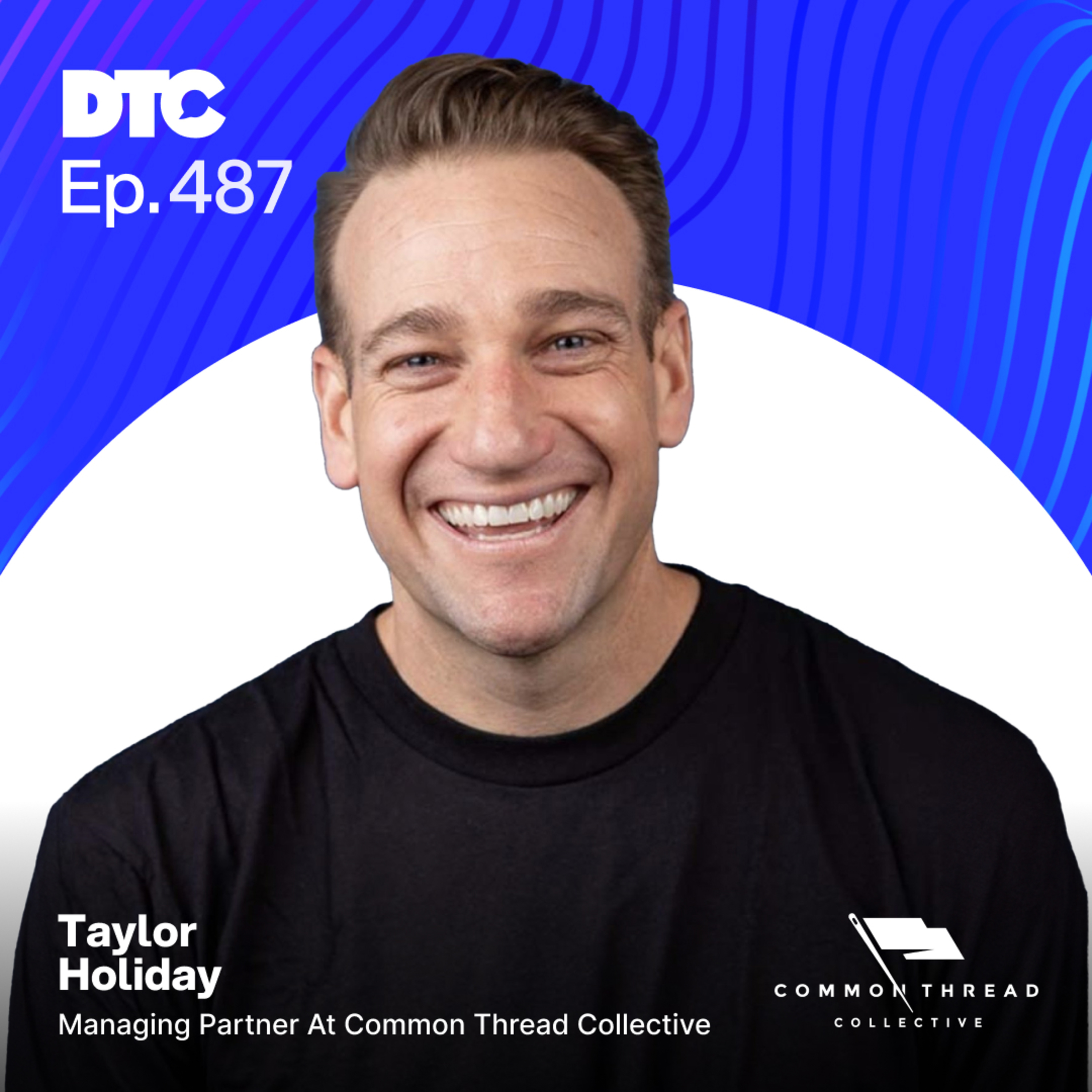
DTC Podcast
Ep 487: The Future of E-Commerce Growth: Profitability, Product Expansion & Smarter Ad Spend with Taylor Holiday
00:40:16
Loading summary
Transcript63 lines
- [00:00]
Eric Dick
More and more brands aren't just looking for Facebook ads or Google Ads. We're talking so much about like real top of funnel awareness growth, not overspending on the bottom of funnel to saturate it.
- [00:12]
Taylor Holiday
A lot of the brands that come to us, their spend is actually out beyond their marginal frontier like they're trying to grow against the top line revenue number that was created in a Covid era where the demand profile was so different. So step one in most cases for our customers is helping them. One of the things that people underappreciate about e commerce is that it's mass, seasonal and incredibly dynamic. Your costs need to be too. There should be so few roles that are actually full time employees because they should be like built to the baseline lowest common denominator of your opex as a percentage of revenue. Everything else is flex staffing because it's so variable.
- [00:59]
Unknown
Ready to Rapidly Generate Winning ad ideas in 2025 mot, the creative analytics and research platform used by brands like hexclad, Vuori, True Classic, and Jones Road Beauty, just released their explosive new report on what really works with meta Ad Creative. This report is more fact than feeling, featuring never before seen insights from Motion's analysis of $100 million in ad spend, a survey of 500 plus ad experts, and deep dive interviews with some of the most elite performance creative teams in D2C, including experts like Nick Sharma and Sarah Levenger. What's inside the seven biggest creative trends for 20, including how humor is making a comeback in ad Creative, the rise of earned nostalgia, and the ad trends that will help your brand stand out this year. This report is packed with real ad examples, new data and novel techniques from making AI enhanced creative concepts to bleeding edge creative ideas for advanced teams. Get your free copy now@motionapp.com creative trends and start rapidly creating ads that get attention and scale.
- [02:04]
Eric Dick
Taylor this has been a long time coming. When I first started in the E commerce business, I think it was probably even before I started with Pilothouse. I feel like I was watching your whiteboard videos. I just I You're a luminary in the space. I'm just really glad to have you here for a conversation. You've contributed so much to the industry's knowledge and to my personal knowledge. So thanks for coming on the DTC podcast.
- [02:24]
Taylor Holiday
Yeah, thanks man. I appreciate that. That all feels like very coded language for old, but I appreciate it.
- [02:29]
Eric Dick
Yeah. Well here we go. I'm also an old guy in the space. I wanted to by a post that you made recently About Common Thread Collective. It's, you know, we've been at Pilot House, been following kind of in your footsteps for like a long time and I wanted to just pick your brain a little bit on how the business has evolved. How long has it been now?
- [02:49]
Taylor Holiday
12 years. So we started my. I can easily demarcate it by my son. So I have twin boys that are 11 and they were born like six months into starting the company. So those early days were exhausting and hard. So we've CTCs a little older than them. We've been around for about 12 years since we started this, this adventure.
- [03:08]
Eric Dick
And then talk to me a little bit about. Because you guys had such a meteoric trajectory, you guys came up with like the E commerce heyday. And then recently I saw a post about some of the ways the business has evolved, which I found really interesting. And we're feeling it the same way at Pilothouse, so I wanted to hear, hear your thoughts on it.
- [03:26]
Taylor Holiday
Yeah, in many ways we are just a byproduct of E commerce as a market. And our growth reflects much of what E commerce has experienced, which is for nine years it was sort of steady, consistent growth. E commerce was sort of gaining in popularity and we were benefiting from that market dynamic. And so year over year we would grow as a small agency and business 50 to 100% a year. When you're small, that's not, you know, necessarily huge numbers, but compounded over a bunch of years. It's great. And then Covid happened and we were a geocentric company with offices in LA and New York and very much like an in person culture. And like most people, we walked out of our offices in March of 2020 and everything changed after that. And that was just, that was really 18, two years of chaos and chaos in a way that was at the time felt good and exciting because there was just so much demand and everybody on earth was suddenly in the E commerce business. You had big companies coming down because retail had shut down and now that was the only game in town. You had this massive influx of startups. So you had sort of from both directions, the market expanding and everybody wanting to spend money and grow and there was so much excess capital and it was just looking back on it, I think it'll be hard to really contextualize for ourselves how wild that time was. On top of that, we went fully remote, which changed our culture and company a lot in ways that was hard to anticipate just how much that would change us. We left at about 60 people and 18 months later, we were almost 200. Like, it just, it all happened so fast. And so there was a point at which more than 70% of the company had been at CTC less than a year. Like that's a wild shift in culture. And like your company fundamentally changes when that occurs. And in so many ways that I don't even think we could have begun to anticipate or maybe just said better. I didn't do a great job of anticipating. And it caused a bunch of cascading issues that as the market then shifted back out of that euphoric state, led us to have to suffer a lot of the consequences of that kind of whiplash.
- [05:24]
Eric Dick
Yeah, entirely. And now we're. I really liked your point that you made about maybe having fewer employees but increasing average salary per employee, which I thought was interesting.
- [05:36]
Taylor Holiday
Yeah. So, you know, I think about we still, regardless of the smaller staff, we're still very much a human services business. Right. Which is to say that I've always been obsessed with trying to think about how to create the best alignment between the organization and its people. CTC is an esop, which is a unique dynamic, meaning that we have an employee ownership program. So 20% of the company is owned by the staff. And I've always just felt that the right thing inside of a human service business is where the people are. The product is for as much of the value to accrue to the people doing the work. And that's something I've cared a lot about. And so as I thought about that, what I think you want to try to do is to build the tightest relationship between the impact that those individuals are making for the collective, to borrow the pun of common thread collective, and their value that they individually accrue. And so what I found was that as we're able to create greater efficiency through technology, system and process, we're able to then leverage the value of higher end talent to drive revenue for the business in a way that's both margin expansive to the entity itself and allows each individual to make more money. There's sort of a common trope about agency work, which is like the way you grow is you take senior people and you hire junior people and then you have the junior people do a bunch of work and that equals margin. Yay. Service deteriorates. And I'd say like, that was like a version of how we tried to go at it initially, but now I've like tried to really fundamentally reject that, which is to say, how can I take the labor profile that I Have and actually constantly increase the experience of it, increase the quality of it, increase the individual earning potential of each member and also increase the value to the organization in total. And so that's, that's been like a change in my own thinking in terms of how we build the best system possible. I tried to think a lot more like a law firm in the way that we think about labor and who does the work and trying to keep the best people doing the work and trying to celebrate client service work as the highest end in the organization versus like the idea that you aspire to management. That's not really what we aspire to here. Like every executive does work, they bill client hours. And so I think there's been a lot of things that we've changed that have sort of shaped the newer version of who we are.
- [07:48]
Eric Dick
I'd say I think that's super important thinking about it like a law firm because you, that you have this tenant. Like the traditional model in a tech company is to accelerate the doers into managers. But then you lose the doers who are the most valuable people in this client centric business.
- [08:03]
Taylor Holiday
Yeah. And so I couldn't think there's nothing more damaging than that idea. I think to agency owners, if I could caution them, it's that because your talented people aren't actually good managers. So you actually create like a dual problem which is that you take your best doing talent and you make them bad managers. And so now you have a bad manager and a worse doer. It's like the worst possible outcome. But what it often is is that there's a lack of career development or earning potential at the individual contributor level or sort of what it means to move up in the role means that you go out of client facing work into this pure management function. And I just think that the, the mo. The smartest, most talented people as they reveal themselves to have that kind of competency, you want to put them onto the most valuable work that you have. And that is a very basic first principle action for agency owners is to just say take your smartest people and have them do the most important work that you can do. Is a really, I think a basic idea, but it's very transformative if you actually deliver it.
- [09:00]
Eric Dick
Very cool. We don't talk about agencies very often. I'm. I'm talking.
- [09:02]
Taylor Holiday
Yeah, I'm sorry, I don't mean to. I don't know.
- [09:04]
Eric Dick
I want to. That's why I wouldn't have you on if I, if I, yeah. If I didn't want to chat about it because I think it's, I think it's super interesting. I'm actually thinking about starting another podcast potentially where we do do more interviews with agency founders. Because it is, it's, it's, it is such an interesting field. It's, it's funny. I just chatted with Jordan Menard who went from the agency space. He's still in the agency space, but going into building brands. I just saw actually a tweet he just made about that. You, you guys have diversified in so many different ways. Are you still in the brand space as well?
- [09:30]
Taylor Holiday
So I, so we, we went through all the normal agency owner behaviors where you decide, oh, you know, what we're going to do is we're going to launch a brand and then we're going to launch SaaS and we're going to do all the dumb things that no agency owner should ever do. So if you're listening to this, one of the things that I'm passionate about is that I think there is a fundamental miseducation about the potential value of a service business. And I actually 100% believe what I'm about to say. You may think I'm a liar, but I mean this. It is a better business model than SaaS. It is a better business model than E commerce for the sake of making yourself wealthy. They have better cash flow, better liquidity potential, like less risk. So much about. If I could encourage agency owners, anything, it'd be to fall in love with the service business model. I get that it's emotionally intensive to manage so many different people, but it's a really incredible business that I think more people should fall in love. But yeah, we chased every, every imaginable path. We still, there, there was a, we still own a brand called Bamboo Earth. I say we because there's a shared cap table between the two. I have no day to day responsibilities inside of the brand. I work exclusively in ctc.
- [10:38]
Eric Dick
So at Pilot House, we've used this podcast and this newsletter as a great top of funnel for the brand. How important have your, for instance, whiteboard or your, your sort of Persona in the industry? How important has that been to the growth of Common thread?
- [10:51]
Taylor Holiday
Yeah, so we've taken a pretty novel approach to marketing too in the sense that we, we view it as a profit center, not as a cost center. So when we think about developing assets like our podcast or like you're saying we have different content series that we'll do, we actually think about developing them as like online media series where we go out and we sell sponsorship dollars in partnership with them. And our goal is to like create distribution. So supportive distribution. So if I think about a partnership, this morning prior to this I was doing a webinar with A2X accounting software. Okay, we did, we did a partnership deal with a 2x accounting where I spoke at an event in Toronto. We did these webinars. They sponsored some of our content. And what that does for me is that my market position is all about the relationship between marketing and finance. They own relationships with brands who are interested in finance. They sell an accounting software so I get a platform to speak to them about a novel topic. They give me increased distribution and they fund the development of content for me to distribute. And I get to take their brand and put it in front of a bunch of people on my side. And so they give me authority on topics that I care about in areas that maybe aren't intuitive for a marketing agency to care about. Because we've cared a lot about trying to position ourselves as being like the financially minded marketing services firm. So there was a brand out value, there was distribution value and then there's monetary value in approaching it this way. And so we used to just think of our content as a thing we would try and use to generate like inbound traffic. But now we've actually sort of been able to monetize it and also drive incremental demand off of it. And so it's been a big change, but it's fun and it's been really helpful to us.
- [12:26]
Eric Dick
And you, the recent feather in your cap is you got lampooned by Brian McDonald in his video about, about your graphs and your charts and things like.
- [12:35]
Taylor Holiday
Yeah, exactly.
- [12:36]
Eric Dick
Maybe talk a little bit about your, your, your stick about, about like the. And that, that's something that I noticed right away as you were, you're thinking outside of the silos of meta ads or Google Ads and you know, hitting the scale button into these like much longer term perspectives on like what your marketing dollars are actually doing for your bottom line. Talk about you, the current zeitgeist you operate with when it comes to tying finances to this stuff.
- [12:58]
Taylor Holiday
Yeah, so there was something that was pretty obvious to me that was happening, which was we started to realize that like the idea of revenue growth was sort of going away as the abundance of capital disappeared. And suddenly there was going to be this like massive push towards profitability and the ability to sort of self finance through your own operations. And what I noticed was that brands would come to us and they had these like really unrealistic growth expectations that I had to navigate where if I just, like, sort of received the target, I was screwed. Like, I was never going to win this game that they were setting me up to play. And so the first thing we really wanted to do was to try and get in a position of being able to define the expectation in our relationships to say, like, okay, we want to be able to provide a point of view on what we think is possible. And that got us into forecasting. And so we started to sort of engage around. We think this is what's possible here. And you might have to let go of that old goal because that was a Covid era that's kind of gone. That's not real anymore. But here's a level set on what we think is possible. Can we create alignment on that expectation, go forward? And that was really the first step into it was getting into FP&A. So financial planning. Right. And then on the marketing side, one of the things I've always understood is sort of like the Seth Godin Purple cow principle, which is just that I think agency owners sometimes make this big mistake where, like, their value proposition is actually not unique at all. So if you think about, like, Meta gives us all badges and says, you're all premier agencies, and we put that on our websites, and then it's on every other agency's website. And then we say, like, we're a triple whale partner, and I use a triple whale dashboard. And it's like, so does 704 other agencies. And, like, you begin to gather all of these things that are actually not unique to you in any way, shape, or form. And so I think it's constantly on us as service providers to define our unique value proposition in the world, to really say, why choose us versus someone else? And that's something I think a lot about for CTC and. And the idea of being like, the most financially sophisticated firm, and this idea of connecting marketing tactics to financial outcomes, and my pithy little statement on my Twitter bio about being your CFO's favorite agency was like, sort of the angle we felt like would overlap with the market dynamic that was coming and a unique authority position that we could take. And so we sort of built everything into that lane. The content, the product, the service function, the messaging, all of it sort of moved in that direction. And what I can say is that, like, product market fit, whether you're a service provider or a brand is like, the most powerful thing there is. Like, in many ways, I screwed up Covid. Like, I don't Think I did a good job as a leader recognizing what that moment wanted, what brands were looking for. And we've always been sort of like, because I'm a bootstrapper, I don't, I've never really understood like the venture world and how to like growth at all costs. And the reality is that that moment wanted that. And I don't think we did a great job all the time in it, but this moment, I think we've done a great job of building our product and messaging to whatever is presently happening and creating that product market fit and the best alignment between what the brands are looking for and what we're able to provide.
- [15:50]
Eric Dick
And then if you telescope down from the like the highest level, thinking like an investment banker about your marketing, which was a theme I just had on the podcast recently, down to sort of that strategy piece that sits above each individual channel silo, how do you guys think about. Because more and more brands aren't just looking for Facebook ads or Google Ads, they're looking for a strategy to take them, you know, through their quarters essentially. And more and more on this podcast this, this year, we're talking so much about like real top of funnel awareness growth and not overspending on the bottom of funnel to, to saturate it. How are, how do you guys deal with that sort of level of strategy?
- [16:27]
Taylor Holiday
Well, there's, there's a few different things there. I think that what I have found is that a lot of the brands that come to us in this moment exist at a place where their spend is actually out beyond their marginal frontier. Like the dollars that they're spending are presently creating net negative contribution to the business. And that's because they, they're trying to grow against a number that ex, like a top line revenue number that was created in a Covid era where the demand profile was so different. And so because they're trying to comp to that, the media dollars that they're spending at that tranche like are super inefficient. So step one in most cases for our customers is helping them define the clear constraints and boundaries of their media dollars against the financial needs of the organization. And in almost every case right now, step one is pullback is actually like in every channel, you're too far, you're, you're too far out and we need to actually reset, create a boundary of we only spend in the event that XYZ is true and our preferred measurement modality would be incremental contribution margin. Like as long as you're creating positive incremental contribution margin, we can keep spending and then to reconstruct the demand creation system against that constraint, which usually shifts the focus out of channels and budgets and optimizations into creative and story and product, where I think the actual real value gets created. So that's a short answer to what is a fairly complex process. But most of the time what I see is brands are inefficient. They're trying to pursue growth. We have to reset that expectation, define a boundary and rebuild the system accordingly.
- [17:59]
Eric Dick
And this is where contingent costs come in, which is your theme for the year. A little bit where you're hitting. You're able to unlock different, different levels of spend if you meet certain contingencies.
- [18:08]
Taylor Holiday
Yeah. And the contingent cost thing is sort of one of the things that I see happen is like people will build like creative production budgets as an example that are like they'll put in a P and L and they'll put in a plan and it's sort of like, well, next month I have a production, an influencer budget, whatever, that's $50,000. But the idea is like it's $50,000 if you hit your January target. If not, we've got to revisit and think about the relationship between these things a little bit more. And I think that sort of one of the things that people underappreciate about E Commerce is that it's massively seasonal and incredibly dynamic. And so your costs need to be too. And this is why I think that like, I get that I'm a little biased saying this, but I don't think E Commerce is an FTE business. Like there should be so few roles that are actually full time employees because they should be like built to the baseline lowest common denominator of your OPEX as a percentage of revenue. And then everything else is flex staffing because it's so variable. Like your creative production needs in your peak month versus your trough month are so wildly different because your revenue can vary so dramatically for brands. And so E Commerce has a lot of dynamism in its costs. And what I saw is a bunch of brands that got bloated on a bunch of committed fixed costs. And you can't run like that when one month your revenue can toggle so differently month over month.
- [19:23]
Eric Dick
I saw your recent post too about consumer confidence and the big drop that said come in and the big increase in lack of security due to probably the tariffs. I don't, I don't know how your crystal ball is these days, but what do you think about this? This Looming tariff environment. Part of me wonders if it's, if it could shift, shift us a little bit away from conspicuous consumption. But at the same time I recognize that tariffs are essentially attacks on corporations rather than on individuals. So I'm just curious on your thoughts on the environment we may be heading into.
- [19:54]
Taylor Holiday
Well, you're going to drag me into a little bit of a political quagmire here, but I'm going to do my best to just sort of provide an economic opinion on it, which is just that. And one of the interesting things, like if you look at the most recent. So Steve RE Cook who runs our data team at cdc, he just published a really interesting thing which I think gets to the nuance of this question, which is we started looking at consumer confidence by state and started to sort of break apart the idea that there's like one thing happening and to start to understand some of the components of it. So as an example, he looked into like Maryland, which is like, if you look, think about Washington D.C. and Maryland as being like a very small set of population but dramatically affected by something like federal cuts, like the consumer confidence in that area actually fell off a cliff. Right. So this is, this is a group of people that are highly impacted by a very specific economic initiative and it shows up in the way that they plan to spend or execute their money. Additionally, we looked at states where that they were left leaning versus right leaning and found that like in Texas and Florida versus some of the left leaning states, the consumer confidence was actually higher. And so there's this, so there's these different dynamics I think that are at play right now where what actually shows up like do, do. Does the price of a car actually increase if there's a tariff on China? Like I think in the short term for sure how the economy responds to that and what happens, I think it's really hard to say. And I'm. I try and minimize the amount of macroeconomic predictions I try to make because I just think they're so hard to get right. They're just very challenging. But I do think that what it represents to me, I think is uncertainty. And uncertainty is not generally the kind of environment that you want to make a lot of big risky expenditures into. And so I think that there's some hesitation and I think even the softness in the end of January and early February that we're seeing in Meta and a few other places across just a revenue basis illustrates that a little bit brands are under a lot of margin pressure from every point of the P and L including Tariffs now, including their marketing efficiency, consumer demand seems to be meh mid. And so there's just a. It's just a tough combination. So I think it's a little bit of a shaky environment is my perception right now.
- [21:57]
Eric Dick
Good time to be in a service business, maybe.
- [21:59]
Taylor Holiday
Well, I think you're right. Like, I think, you know, it's funny, I get asked a lot of two things once. One is like, are you worried about AI or technology sort of really disrupting your service? And one of the things I've noticed is that as technolog technology evolves, like, the need for expert actually, like, increases in the short term because people don't know how to use the tool. Right. Like, in the early days of a tool, experts have a lot of authority because they take the time to understand what to do with it. And then eventually everybody learns how to use their iPhone. Right. Like, but it just takes time to catch up to that. And so I don't. I think in the short term, AI benefits service providers a ton. One, because our labor profile is made up almost entirely of human costs. And so we're going to gain the most efficiencies in this process. And then two, there's a new thing that we get to be experts on before somebody else. And so if we go do that learning, it benefits us disproportionately. And then the second thing is kind of just related to what you're talking about, which is like, well, does the. If brands struggle, does that affect your business as well? And again, because of our positioning, when everything's good, people don't need you. Everyone's an expert when things are working. But when there's struggle and when people need to suddenly figure out how to increase their financial sophistication, they look for support to do that. And so we have found that as the market, the brand market has gone backwards, that our business has actually gone forward tremendously.
- [23:13]
Eric Dick
How have you handled. You mentioned AI. How have you as an organization? Do you have, like, an AI czar? Do you have a centralized AI brain trust that you're working on things? And then you also incentivize every individual employee to be playing around with it. How have you handled that organizationally?
- [23:27]
Taylor Holiday
Yeah, so we hired DTC Jacob. You guys might know him. Some people joke that he's a robot out there on Twitter, but Jacob. Jacob has been. Is our director of AI at ctc. And he's basically responsible for identifying and executing innovation inside of CTC for AI to benefit the operating function of our company. And so we've done that first through a creative product called Compass that is actually going live this week. That helps to improve the pace and quality of our creative strategy work. We're also working on some internal communication tools where like our daily messaging and notes in Slack come from an AI and a bunch of different things. So we have somebody that. What I wanted to do is like, I wanted to put my. Not just dip my toe in the water, but sort of like whatever the next step after that is in the metaphor and actually commit to trying to see what this could do. Because the thing I feel still very unclear on, Eric, is like, I don't actually know how much this is going to change everything. It feels unclear to me. It seems like it could change a lot, but it's not immediately obvious how it's showing up. But I wanted to try and I wanted to really commit dollars to going after it. And so we've done some stuff that we think is going to be really cool and really impactful. And I remain bullish that like inside of an agency like ours or yours, there's just so many tasks that if we're really honest, our rote data entry, basic communication, looking up data, things that are just not well suited for humans to execute. And we did this thing, like, I'll give you an example. We, we. One of the cool things about being around a long time is we have like a Slack that's like years and years old, right, filled with thousands and thousands of customer questions. And so we exported our Slack history and we upload them to an LLM and categorize them into buckets of questions of like, what do people ask us? And then what is the response time relative to different questions and the quality of those responses. And if you think about like a very basic question that we get all the time, like, hey, what do you guys see happening on CPMS the last seven days for Brand X? Well, what does a human do if they get that question? One is that they're not present to receive that question all the time. So they have to like eventually go into the side channel, see the question, then they have to go load Ads Manager, select the date range, pull the trend, do a quick analysis, put it back. But an AI is omnipresent always there, has permanent access to every database that exists and can query those kinds of questions instantaneously. And so there's this whole bucket of things that exist that an AI as a service provision component inside of Slack is way better suited to do than your point of contact from the agency. And so I think those are the kinds of things that are really obvious and easy to in some ways get after. And then you sort of just keep building from there.
- [26:04]
Eric Dick
There's so many silos that happen in an organization where you'll just, even just. On this podcast, I'm learning things all the time. I'm talking to all these industry people and just figuring out how you can centralize your, your knowledge base a lot more. I see that being a huge use case for AI because you've got all these people making all these learnings across all these axes. AI can be omnipresent and kind of get more of the information, shared information to more of your team.
- [26:27]
Taylor Holiday
I feel like, well, and this is like if I could offer like any early aspiring agency owners or even ones that are our size or maturity, is that the entire value proposition, the entire thing is the idea that we have some sort of aggregate historical knowledge and experience. Right. And what I'll tell you is that's not true if when a new employee starts, there's no mechanism to access that historical experience or knowledge. And so your job in many ways is to build the underlying data infrastructure such that your business's like, historical knowledge does compound over time. And so I think that like agencies in an AI world have to really think about, like, what unique data do we have that's going to allow us to create tools and systems and processes that allow us to continue to fulfill that promise that we're operationalizing years of historical learnings. Because otherwise, like, if you're just a new employee, like if someone's been there for six months, they don't possess 12 years of CTC history and knowledge and experience, that's just not true. But the systems and processes do. As long as you develop and you're committed to that kind of underlying architecture.
- [27:30]
Eric Dick
For your information, it's been a while since I've actually been on the tools and I understand Advantage plus on Meta has taken over a lot more, but does that make the, the old lark bid cap versus cost cap debate less important with AI kind of taking over everything? And where do you stand on that?
- [27:46]
Taylor Holiday
So I think that it really actually makes it like the only thing that matters. And what do I mean by that? Because, like, look, I. There's. If there's any accusation I get all the time, it's my dogmatism as it relates to this issue. But here's what I would say, what Meta is doing. So they've just recently told everyone that they're moving to what they're calling advantage plus sales campaigns as the default. There's no BAU versus asc. You still can do it. But more and more they're signaling to us that, hey, we're going to this world and this world is going to be asc. And what we want you to do is we want you to dump hundreds of ads into this thing. We've launched Andromeda, our new super fancy machine learning that's going to allow us to have a better retrieval engine, process more ads, to deliver more, to understand more of a user's individual context, behavior. And AI is enabling all of this. So give us all the information and get out of the way. Right, well, okay, so in that kind of world, what do you then uniquely represent to the machine? Well, the unique thing that you have to represent is the desired outcome. You have to be able to state to the machine the one thing it doesn't know, which is what do you want, what do you want to happen? And when I think about all a bid cap or cost cap represents is that what is your input to the constraint in the system against its willingness to spend its money, against the incentive of meta. And so more than ever, you should give the machine the bid cap, give it all of the creative and get out of the way. And my hope is that what we're going to see meta do is actually move towards profit optimization. So that's going to make the bid cap less necessary because now what the bid cap is functionally doing is it's a proxy for you protecting the marginal result of the ad spend. Right? That's all it is, it's just you representing the desired marginal outcome. But if we go to profit optimization, then it's not necessary anymore because now it's considering the actual business impact that you desire. And so I think we're a couple of steps from not needing that anymore because the actual optimization isn't about revenue, it's about the marginal result of the business. And that's really all we're trying to protect with the cost cap or big.
- [29:40]
Eric Dick
You mentioned product development in 2025 being a huge driver of growth. And again, we're talking about things that are away from the algorithmically controlled things into like the realm of human creativity and actually solving problems. Why do you think product development is such going to be a huge driver of growth for brands in 2025?
- [29:56]
Taylor Holiday
I think that every product category basically gets competed down to zero on the Internet. So let me give you an example. We work with a brand called Born Primitive. They are a fitness brand that has grown up Selling their primary skew, the bulk of the volume came on women's leggings and sports bras. Women's leggings and sports bras. And when they started they had this organic search term listing for organic or for CrossFit sports bra. They were like the number one organic result that drove a bunch of their early revenue and was great. Well, in the course of five years there have been, I don't even know how to count, thousands of entrants into the women's leggings space. And so if you think about what does that do to your Google non brand cpc? Drives it up. Drives it up, right? What does that do to every Amazon listing, every search page, every competitor into the feeds of women who are looking for leggings. And ultimately like the marginal value of that category just goes down and down and down and down and down because there's cheaper options and cheaper options and cooler brands and cooler things. And it becomes so competitive that what would happen is as we would try and scale this category, we could not any longer achieve the roas of yesteryear, so to speak, right? So that product category value to the business was sort of stuck at this range and we would do everything. Like when I say we tried every cool piece of creative concept you could ever imagine, some of the best ads in the world and it wouldn't matter. There was no moving or returning back to the dynamics of the previous time. So a business like that is faced with a choice. They can continue to ram their head into the wall on this creative hamster wheel of trying to outperform every ad that's ever happened and ignore the realities of the market dynamics. Or they can opt into a new category to compete in, leave that business at a certain level of profitability that it can sustain and go, what happens if we get into footwear? And when they got into footwear, you know what it did? It unlocked a massive new tranche of additional profitable spend. Move the AOV up, helped improve their cash conversion cycle. There's less returns on shoes, there's more gross margin. Customers really loved it. They did some great marketing stories and all of a sudden the business increased in size. But you didn't have to sell one more pair of leggings, Right? And so I think those dynamics play out in every market. I think Ridge is a great example of this, where the growth goal for Ridge was never going to be more wallets next year. Like at some point, that is not the mechanism by which you're going to achieve next year's growth expectations. Right. Because the marginal cost of acquisition of the next customer is greater than the one, the previous one. And that's like a law of physics. Right. And so as you move out into the tambour, customers become more expensive to acquire. And so at some point you have to move into a new market segment. And that's what product expansion does. And the other thing is, is that meta in particular is about arbitraging the delta between the ECR so the estimated conversion rate and the actual conversion rate. And you know what does that really well? Promotion. But you don't want to get on that hamster wheel. You know what else does it really well? Novelty. So when you introduce new things, suddenly the ECR when you, if it was a 2.2, is what's being modeled for the distribution and bidding in your ads. If suddenly that jumps to 2.8 for a while, what you're capturing is the gain on that, the delta between the actual conversion rate and the estimated conversion rate. And new things do that really, really.
- [33:00]
Eric Dick
Well as well for retention. Right. It gives you just another reason to be reaching out to people with a real reason, not just another promotion.
- [33:07]
Taylor Holiday
That's totally right. Yeah, exactly. I think in many of these cases there's not as much cross sell as you want between these product categories. Like I think sometimes the retention piece of it can be a little bit overstated because customers don't cross categorically shop as much as we wish they did in some cases. But what it really does is it gives you a new set of customers to prospect and efficiency to go after. And then out of that cohort of customers now they also have retention value that they're. That you can realize. But it's really about so much of these businesses. Because here's the other reality. E commerce is not software. The LTVs suck. Like for the vast. If you're not a subscription brand, the LTVs are not very good. Like the gold standard is like 100% increase in value in a year. If your subscription, you can be higher than that. But most of these apparel or footwear brands, you're talking about somewhere between like 30 to 70% increase in value in a year and then it just goes down after that. So you're going to constantly have to find new people. That's just the nature of the business that we're in. And so finding out ways to get into more efficient new customer acquisition and not just watch that number degrade over time is hypercritical to the future of these growths. And that comes through increased distribution into Wholesale and other places as well as product category expansion. But the idea that you're going to take the same product and next year spend more money, more efficiently on that same SKU is highly unlikely.
- [34:25]
Eric Dick
We are talking all the time about ways that you can really grow your top of funnel, really grow brand awareness, brand consideration. What are you seeing? Like, are you guys doing a lot of TV? Are you seeing our brands doing well with TV? Are you, are you jumping onto YouTube? How are you guys seeing that expansion of the top of the funnel?
- [34:43]
Taylor Holiday
So I, this is a phrase I probably have a lot of issues with. I, I'm not totally sure that we have a collective agreement on what this phrase means. What I think people tend to mean is like a net new impression. And is that, is that what you say you're using?
- [34:59]
Eric Dick
In some ways not. I just feel like people end up spending on Meta, for instance, a lot of money on people that are already aware of your brand. And sometimes an add on Meta isn't the best way to make someone consider your brand. I know Meta is a full funnel channel where you are getting net new eyeballs and you are converting them into users. But I think there's this sense that there are more efficient ways that even if they're a little bit less trackable, there are more efficient ways to make more people aware positively of your brand. Maybe I'm wrong.
- [35:27]
Taylor Holiday
Yeah, well, I would, I don't know about wrong or right, Eric, as much as like, I just disagree. I, I just think that what I have watched brands do every time. There's sort of two different cases here. One is the expansion out of excess. Meaning, like things are going really well. I have an abundance of capital, my Meta channel is profitable and I want to go and expand and diversify my portfolio for the sake of wealth protection, like, and to grow. But even if the channel, the next channel I go into is slightly less efficient than Meta, that's still okay because I'm winning. That to me is like a great strategy. Diversification from a position of strength is great. And I think about this in the same way that if you were to come to me like and ask if you should do seed investing into startups and I'd be like, well, can you pay a mortgage next month? And if the answer is yes and you have a bunch of excess capital, then like higher risk, higher potential return investments makes sense. But my experience is that's not the position that a lot of businesses are in. I think we get stuck listening to the nine figure guys a little too much on this topic because they're a little bit too healthy for us to really take our directive from. And instead what people do is they're trying to solve an inefficiency problem with diversification. And I think that's a disaster is that in almost every case moving into the next net new channel is initially an efficiency reduction. Because think about it, you don't know what creative works, you don't know which targeting to go after. It's net new, it's a lot of testing, it's a lot of iteration, harder to track. That's not where efficiency lives. Right? That's like discovery that's going out to learn something new. You're going to get crushed likely the first time you do it and then you're going to have to improve over time. So what I always tell people is like really just try to think about your business more like a personal financial vehicle and just ask yourself like, do I have excess money that I'm investing for long term benefit? Like same thing. It's like if you said I want to buy a condo, well it might be simultaneously true that buying a condo is a great two year investment return. And also if you can't make your mortgage next month, that's going to harm you. Those things can be true at the same time which is that it's a good long term investment and it's a bad investment for you. And so I think each business just has to consider what am I expecting these dollars to do? And if you're going into television expecting that you're going to improve your P and L in the next two weeks, bad idea, not going to happen. And so I think it's just about understanding the expectation of what each channel has potential to yield. The other thing I'll say is that I find like these channels that are more impression based. So let's say TV, YouTube, the things, radio, where there is no direct click back to a transaction point, the demand capture tends to be distributed across more points of distribution. So in other words, if you have retail, Amazon and a website, then TV is really great because you can realize that demand in lots of places. But if you only have a website, you're going to see the economics of the TV thing I think rarely pencil in that scenario. And so it's just, it just depends again on there are businesses for whom every medium makes sense at some point. But for a $20 million E commerce business that's tight on cash and struggling to produce free cash flow next month in order to buy their inventory, I would be Very leery of trying out Snapchat. That's just like the way I feel right now. And especially if your core meta channel isn't profitable for you yet, man, I.
- [38:45]
Eric Dick
Gotta say, this is. This podcast sets a new record on ipm, which is a new acronym I just coined for Insights Per Minute. This has been fast and furious, man. I really appreciate it. This is a lot of fun.
- [38:56]
Taylor Holiday
Yeah, it's funny. Like, you're like, we don't. Do we have an agenda? Let's just get started. I'm like, we'll be fine. We'll figure it out. We'll get it.
- [39:01]
Eric Dick
That's right.
- [39:01]
Taylor Holiday
We know we do a pre interview.
- [39:03]
Eric Dick
But yeah, it would. I would have just wasted all this gold. So, man, I want to thank. Thank you for coming on the DTC podcast. You're the first other agency owner we've had on the podcast and I think.
- [39:11]
Unknown
We'Ll use this as we're going to.
- [39:12]
Eric Dick
Launch this on D2C, but we're going to use this as a launching point to talk with more agency owners on another podcast. Cause I think there's a lot of. A lot of value here.
- [39:19]
Taylor Holiday
I think you guys are doing a lot of cool stuff and I have a lot of respect for the newsletter and the things that you guys are up to. I think we're doing something together with the D.C. index coming up here too.
- [39:25]
Eric Dick
Yeah, that's right.
- [39:26]
Taylor Holiday
So that'll be cool. Keep a lookout for that showing up in the newsletter this week. And I think you guys have been super smart about it, man. And I have a lot of respect for what y'all are up to at pilot House. So keep. Keep going and keep bringing the insights and we appreciate it.
- [39:37]
Eric Dick
Thanks, man. Well, we'll negotiate the merger on the next podcast.
- [39:40]
Taylor Holiday
Yes. That's it. Hey, don't. I've been. I've been. I've been messaging Eric about this. It's coming. Keep an eye out.
- [39:45]
Eric Dick
Once Canada and the U.S. merge, we'll.
- [39:49]
Taylor Holiday
That'll be the symbolic. Exactly. That'll be the gesture we follow.
- [39:52]
Eric Dick
I like it.
- [39:59]
Unknown
Thanks so much for listening to today's episode.
- [40:02]
Eric Dick
If you're not a subscriber to our.
- [40:03]
Unknown
Newsletter, you can do that right now at Direct to consumer. All one word co. I'm Eric Dick and this has been the D2C podcast. We'll see you next time.