← DTC Podcast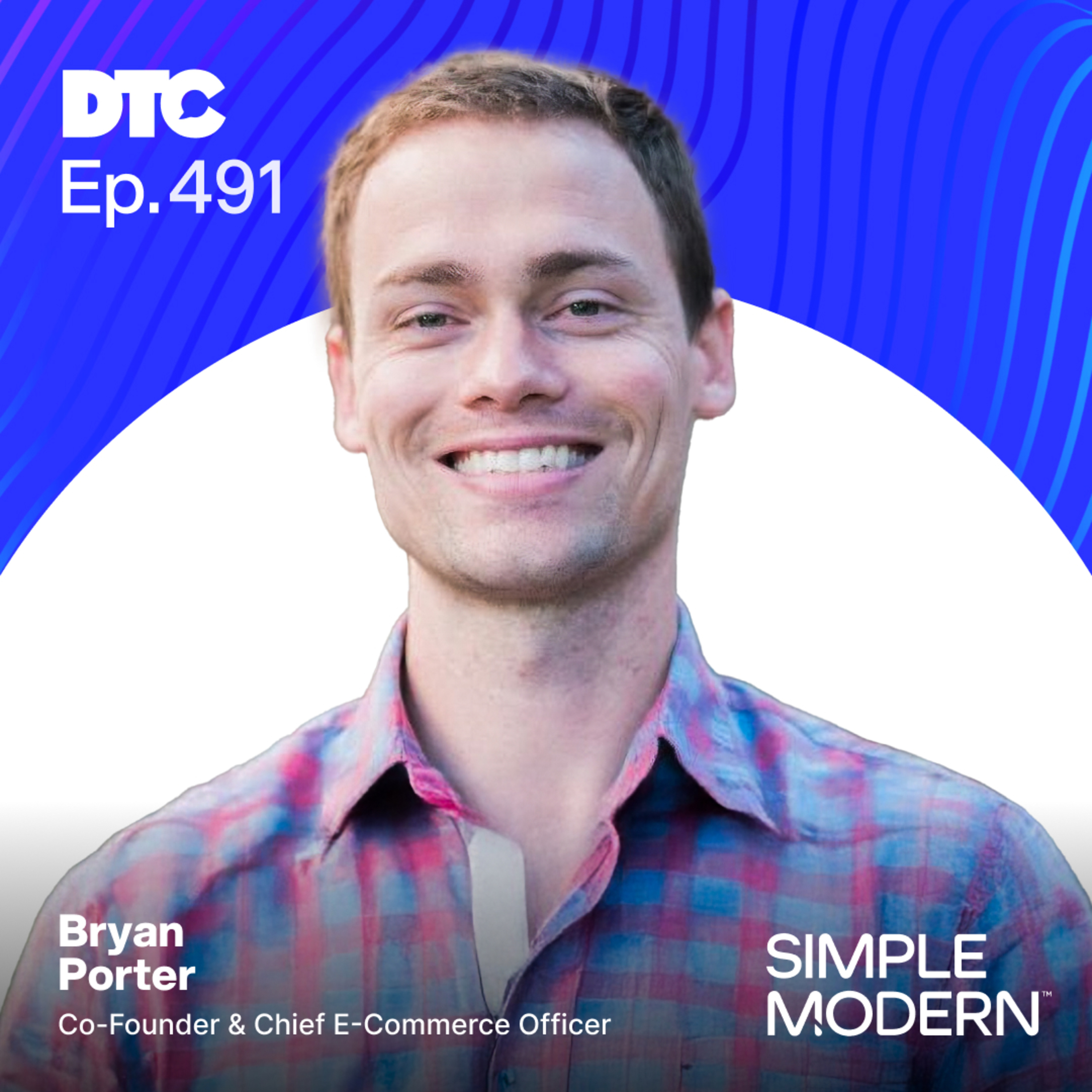
DTC Podcast
Ep 491: Scaling to $1B While Spending Just 5% on Ads – The Simple Modern Playbook
00:40:18
Loading summary
Transcript76 lines
- [00:00]
Brian Beckham
We're playing in a fashion category far more than a product that people are just buying for drinking water. Our first three or four years of growth were very much on Amazon. Whenever we it became obvious that we were becoming more of a prominent brand in our category, we were able to make the jump over to Target, which was very much a game changing expansion for us in our distribution. TikTok shop has been a little bit of an unlock for us in that it's made Influencer accessible to a brand that doesn't have huge margins. We want the company to positively impact everybody that it touches. We're wanting to scale the company as an impact machine as much as anything.
- [00:53]
Eric Dick
Imagine having the world's top social creative experts on your team, analyzing your ads, auditing your ad library and helping you.
- [01:00]
Mike
Deliver more winning creatives.
- [01:01]
Eric Dick
You don't have to imagine any more because Motion just launched Expert Agents, AI powered workflows designed by the industry's best creative strategists. These aren't generic AI tools. Each workflow is built by real performance marketers actively managing high spending ad accounts. You'll get access to things like Creative Performance Analyzer, powered by Dara Denny's framework, which helps you break down what's working and what's not with each of your ads. Or Ugly Ad Finder, created by Barry Hot, which scans your top spending ads and serves up organic social inspiration so you can make ads that actually stop. The scroll. Or Scale Unlocker from Jess Bachmann, which maps your current ad spend across the awareness stages to pinpoint your biggest growth. Unlock plus Motion's expert agents include custom tools for social listening, strategic ad iteration, and more, giving your team the insights of a veteran creative strategist at no extra cost. Start shipping more winning ads today@motionapp.com expert agents Brian welcome to the DTC Podcast.
- [02:05]
Mike
Been following Simple Modern for a long time now. I think I've heard Mike tell the story, but I'd love to hear your perspective on how things got going at SimpleModern and what you guys set out to do.
- [02:14]
Brian Beckham
Yeah, well first, thanks for having me on. It's an honor to be on here. I've listened to several podcast episodes and I've loved it. So thank you for sharing your platform with me. It's a long story. To be concise, I would say that Mike and I, we founded the company after working together for five plus years at another e commerce company. That experience was very formative for us. The main company was a penny auction website that was very dependent upon digital ads and we did Very well with that until we didn't.
- [02:57]
Mike
I remember those penny auction days. I was at an affiliate network during those penny auction days. It was a really interesting thing in the marketplace.
- [03:03]
Brian Beckham
If you're on the Internet around 2010, then yes, you for sure saw ads for Qubits and other type. Yeah, penny auction sites. So among many other lessons during that time of life, we learned that dependence upon digital ads can be bad. And I think it formed some scar tissue that maybe we're still working through. That's a negative. But it was formative in the sense of we wanted to, after working together a long time, create a brand that was not dependent upon digital ads. And seeing the opportunity to create a brand like that on Amazon was from our vantage point, very obvious because we were kind of competing against them and they were destroying us and everyone else. But it's if, if somebody walked up to you and said that if you can create a good enough product through Alibaba finding manufacturers in China and if you make a good enough product, we'll give you front of store placement and Target, you would say, yeah, of course I would do that. Well, that's, that's really the opportunity that is there on Amazon, if you can create a listing that converts better than the rest, then you have top, top of search placement. So that was even before knowing we wanted to do drinkware, believing that we could create a product and a brand that could achieve that was something that we believed. And so we started the company and started testing products, gotten a drinkware and then figured out how to make our drinkware listings be top of search on the biggest categories and we were off to the races from there.
- [04:57]
Mike
How big was the drinkware movement when you started in 2015? Like what were the. I guess Yeti was already there, but it didn't really become like such a cultural moment I feel like, until like the pandemic or a couple of, maybe a couple of years before that. Take me back to those early days of like the drinkware craze was, was, was it huge in 2015 when you started it?
- [05:19]
Brian Beckham
It, it felt big, I think because Yeti was already such a well known name in the space and there were other competitors like Hydro Flask. A company called Swell was really big at that time. It's been one of the fastest growing categories in the home and kitchen broader category, maybe even the biggest since 2015. So it's much bigger now than it was. But there at that time in 2015 when we started, there were legitimate competitors. And the interesting thing that we look back on is that we were competing against companies like Yeti that were very highly marked up in terms of margin. And then there were competitors like Ozark Trail and Members Mark that were at the absolute floor for cost and drinkware. And the interesting thing about our categories, those products are the same thing, more or less, almost the same quality. One of them's at a fraction of the price. It's been commoditized. And one of the big questions was, would the category move towards the commodities or would it move towards the premium brands? And overwhelmingly over the last 10 years, the price points have moved up that customers are willing to pay towards the Stanley type price points. Yeti and those brands have been increasing their prices. And all of that is really an indication that we're playing in a fashion category far more than a product that people are just buying for the practical use case of drinking water.
- [07:02]
Mike
I just did a podcast with Char Charms. I don't know if you're familiar with Charlotte. Yeah, so she's doing the, what are they called? The. For Crocs, but basically the ability to customize your, your drink vessel. But it is so interesting what it's become as like a status symbol and part of someone's sort of like accoutrement that they'll like wear out, that they'll also have this, this drinking vessel.
- [07:25]
Brian Beckham
Yeah, for sure. We, we compare it to shoes all the time. People buy shoes that they think either look good, go with their outfit or have a logo that they want to associate themselves with and they'll, they'll pay significantly more than they have to for a comfortable pair of shoes for that reason.
- [07:46]
Mike
Take me back to Amazon. Take me back to what? You know, what the thought process was, what, what, what work you put in to make sure that you were going to build yourself a shelf like as you say, sort of in, in a prime location and make your listing better than the other ones out there.
- [08:01]
Brian Beckham
Well, the beautiful thing about E Commerce is that the shelves are digital and they don't have limits to them like physical shelves do, which our biggest competitors were primarily focused on in store distribution like Yeti. And so they would only offer like 8 to 10 colors. And their incentives would be to not go out of stock because an empty shelf space is lost opportunity. So the premium brands did not have an incentive to really blow out the amount of ornamentations or colors that they offer online. The manufacturers who are offering the lowest cost products are not incentivized to have a ton of color selection because they're running factories and they don't want all their money to be in inventory. They want it to be in equipment. So we kind of sat in this sweet spot where we are natively E commerce, and we adopted a mantra of we would rather be a mile wide in SKU count and an inch deep in inventory, which is the exact opposite of what Yeti was doing. And to make a long story short, we bet on the idea that drinkwear is more of a fashion product, customers value choice. And we, we got all the way up to 45 different colors in our Amazon listings wild, which was way too much. It's like decision fatigue at that point. So now we have more like 30 different colors. But we really pioneered giving the customer like extreme amount of choice within our listings. And that was rewarded with having the highest conversion rates and being, you know, placed very, very highly on Amazon.
- [09:46]
Mike
You mentioned an inch deep and a mile wide. Did you find that you had issues keeping the variations stocked or did you find that with so many variations, people would just find one that was in stock that they liked?
- [09:57]
Brian Beckham
Yeah. Starting off, whenever we didn't have enormous, not enormous, but bigger scale, it was fine if we ran out of, you know, a few of our colors because there was a lot to choose from. Over time, as our scale grew and we hit more of a mainstream kind of mass audience, the more just Black was a really, like our best seller. Ironically, when we have all these colors in, black is the one that we sell the most. So it got to where over time, if we ran out of stock of one of our top five colors, that would be more damaging than carrying colors 40 to 45. And that's kind of when we started to shrink the amount of SKUs and optimize our offering a little bit more.
- [10:47]
Mike
Super smart to treat Amazon like that. And then how big have Amazon ads been as part of your Amazon growth strategy?
- [10:55]
Brian Beckham
It's definitely a lever. We intentionally try not to depend on them. We spend about 5% of our sales on ads, which I've heard brands go all the way up to like 20% of their sales they spend on ads. There's, I would say, one big reason why we're not as dependent, and that's because we've been able to grow our branded search to be 50% of our sales on Amazon.
- [11:24]
Mike
Oh, nice.
- [11:25]
Brian Beckham
So whenever a customer is searching for simple modern, specifically, we're not having to engage in the Amazon ads knife fight. That's happening whenever you search for water bottle.
- [11:35]
Mike
Arms race.
- [11:36]
Brian Beckham
Yeah, exactly. So we really deploy our Amazon ads budget on competitor keywords and keywords that are relevant but are really hard for us to rank organically on. One example of that would be we sell a lot of licensed product and we can convert sales on like Minions toys keywords even though we're not selling toys. If your kid loves Minions and they drink water then there's a good chance that we can convert you with our Minions water bottle. But we're not organically going to show there. So that's a great Amazon ads use case for us.
- [12:22]
Mike
What other growth channels have been key for Simple Modern in your growth here?
- [12:27]
Brian Beckham
Well, our first three or four years of growth were very much on Amazon and whenever we really it became obvious that we were becoming more of a prominent brand in our category, we were able to make the jump over to Target which was very much a game changing expansion for us and our distribution. We have just an incredible team and some of our teammates. One in particular had experience selling product into mass retail within the candy category. And he along with our, we have a chief sales officer and I'm our chief e commerce officer. So our chief sales officer is focused on our in store placements. They were able to go to Target and show them like hey, we're the best seller in this category with this company that you're terrified of. So we believe that we have value to add to your customer. And it also turns out that we have a ridiculous amount of colors we sell and the best data in the category on what customers want. So even more than the focus groups that you run on what you think is going to do well on your shelf. Like we actually know through sales data like what you should put on your shelf and the Amazon customer and the Target customer are. There's a heavy overlap between both of them. And it turns out that the products that convert really well on Amazon typically convert really well on a Target shelf.
- [14:13]
Mike
So did you have a similar like a differential edge on Target in Target as you did on Amazon in that your merchandising it just that your merchandising game was, was above some of the competitors because I guess we're talking now in the 2018, 2019 Yeti and all those. Those companies would be, you know, firmly entrenched in those in those in Target for instance. So how did you. Yeah, how did you stand out from those incumbents in Target?
- [14:37]
Brian Beckham
Yeah, it was really the combination that struck a chord on Amazon. It was the combination of like style, quality and value. We just have a very compelling offer. If you're not set on buying a certain logo then we had the best chance of getting that sale. And I will say that over time the category has definitely grown and matured and the playbook that got us entrenched has been noticed and used by our competitors. So at this point it's, it's a little bit of a different category than it was then, but that's what got us our footing with Target.
- [15:21]
Mike
And are you still in the middle ground between the commoditized, you know, utility kind of two bottles and the, the high end Yeti bottles or where do you guys fit in the pricing spectrum now?
- [15:31]
Brian Beckham
We're closer to the players at the top of the pricing game and we're, we're intentionally wanting to be viewed as in their category and not in the, the more commoditized product because really like we are very much as much of a brand as those other companies are. We have, we hold on to our customers as well as anyone does. We put as much focus into product dev and IP and color research. So we've, we've really proven that, that we belong in, in the more premium brand buckets over time and our ASPs reflect that as well. We have been able to, to take up price over time and it, the goal isn't for us to, to pass the brands in terms of price point that are above us. We still want to be at a discount. Incredible value compared to our competition. But yeah, we want to be playing in that realm at this point.
- [16:47]
Mike
You mentioned not wanting to be dependent on meta or on ads in general. Where do you net out these days with social ads?
- [16:55]
Brian Beckham
Basically we're trying to build that muscle right now. It's not necessarily a good thing that we've gotten to where we are very much without ads. Like we've sold 50 million products over the last 10 years and I would say that like our brand awareness is fairly low considering how many customers we have, especially compared to our competition. There's brands that have sold far less than we have, that are more of a household name than us. And I think that really has to do with paid impressions. We are focusing on that and trying to figure out what top of funnel advertising looks like in a way that's not lighting money on fire.
- [17:42]
Mike
We're talking about that on the podcast. Every episode that we've had on in 2025 is talking about ways that you can actually grow that awareness and consideration. Part of the funnel for your brand.
- [17:50]
Brian Beckham
Yeah, I mean it's definitely not a unique problem to us. We, I would say that TikTok shop has been a little bit of an unlock for us in that it's made influencer accessible to a brand that doesn't have huge margins. We have a lot of customers who make content on TikTok already and we, we offer any one commission to, to drive sales. We, we do a lot of sampling and I, I would say that the most helpful videos that have come out of TikTok have been from our newest and most exciting or seasonally relevant products. Those tend to do really well, ironically not the ones that we sell the most of, but the ones that are the most interesting. So we've, we've been able to improve our brand awareness for sure with, with that channel and hope to expand it this year.
- [18:49]
Mike
Yeah, you mentioned you're rising. You know your search queries are rising so people are seeking out the brand more and more. Has that happened so far from a conscious effort of top of funnel advertising or is that just been years of delivering amazing products at a great price that is just sort of happening more organically?
- [19:06]
Brian Beckham
For the most part, searches on Amazon have been built through what we call bottles in hand. Just getting as many customers as we can and having as high of a net promoter score as we can. We're in a category where there's probably more repeat purchasing than other durables. So I think, I think that that plays in our favor. We also have a really strong kids business and if, if my kids aren't just abnormal kids. Bottles get beat up and lost and.
- [19:38]
Mike
They'Re all at school. They all get left at school and then yeah, you forget to look in.
- [19:41]
Brian Beckham
Lost and found and oh man, every lost and found that I walk by I like there's just so much drinkware and sadly often several, several of our products on there. So it's not, not good for the, the, the bottles for those kiddos. But it does induce more searches for our brand and repeat buying.
- [20:02]
Mike
I saw a post that you made a couple of weeks ago maybe where you were seeing Simple Modern being advertised at a college basketball game and it was kind of neat to see that out in the wild. You mentioned lighting money on fire. It's always. I just did a podcast with Built with Spencer Toomey and they talked about having built on Mike Tyson's shorts during the fight and what a, you know, what a nice halo effect that was kind of causing. Is this college basketball thing a fairly new thing to kind of getting the brand out in that way?
- [20:27]
Brian Beckham
It is. It originated from a program we did with the University of Oklahoma. That's where we live is in Oklahoma City. And we, we did A marketing campaign with OU football where every game we made a unique limited edition Tumblr that was for sale and it's some of the best marketing we've ever done because people really wanted them and they would sell out and create a little bit of a scarcity market to where the next game there was excitement built up for what's the new cup gonna be? And there were people lining up at concessions trying to get it before they ran out. And we, we learned that one, if you have a product that is that you can use with marketing then that really helps to stand out and associate customers like hearing your. Your name with that product. And then two, it's just more memorable like if we just put our logo up around the stadium, I don't really think many people are going to notice that and remember it. But with the product it, it creates a higher quality impression. So we're expanding that playbook with Kansas basketball and several other college football teams this, this next year.
- [21:51]
Mike
And you've also experimented on TV this year or recently, correct?
- [21:55]
Brian Beckham
Yeah, we're, we're playing around with tv. We've, we've made a few different ads and trying to assess what the, the value it's driving is through several attribution tools and it seems like results are, are promising so far, but it's, it's definitely hard to tell.
- [22:17]
Mike
What about Applovin? Have you guys tested Applovin much? Because I think you're. There's probably a lot of crossover with the Candy Crush audience and your product.
- [22:25]
Brian Beckham
I agree. We haven't had a whole lot of success on Applovin so far. We're really trying to focus on kind of the top of funnel marketing that we just talked about in TV and I think that Applovin's a channel that we're probably going to spend more time.
- [22:46]
Mike
Trying to figure out any early learnings from tv.
- [22:50]
Brian Beckham
We're trying to isolate different markets and see what kind of lift that there is. And we, we've seen, we've seen a decent lift on, on Amazon so far. But I would say that the testing is a little too early to be conclusive.
- [23:07]
Mike
Whereas TikTok shops. I think I saw a post about seeing a really more attributable sales lift from one of your videos that went viral on Amazon. Viral on TikTok and then you saw the halo on Amazon pretty clearly.
- [23:19]
Brian Beckham
Correct? Yeah, it's. It's very easy for me to see the list on Amazon and our website from TikTok shop. We have fairly predictable run rates for all of our listings and it sticks out dramatically whenever you really have a video hit. And yeah, we've seen over 100% halo effect on our website and Amazon compared to our TikTok shop sales, which is interesting and I think it makes sense. I think that a lot of people are a little bit untrusting of buying product on TikTok right now, especially compared to Amazon where, yeah, you could get it in a few hours after you order it or on our website where you could personalize a product or you know, have a direct connection to us if you have an issue with your product. So it makes sense to me why it is that way. But yeah, trying to figure out how to, how to maximize virality on TikTok, which I think everyone is trying to do that right now you mentioned.
- [24:27]
Mike
So the video that went viral or the one that you spoke about in that post, was that one of those ones where it was like a really great mix of a, of a new influencer with one of your new really highly relevant products?
- [24:37]
Brian Beckham
Yes. Yeah, it's, it's maybe the best product we've made so far. It's a travel mug. So unfortunately it's not like adult hydration is the biggest category, just something you drink water out of. This product was a coffee tumbler. But the lid design is fairly innovative and we paired that with a really in season cool design. And yeah, the video just took off and we sold that. We went out of stock on that specific SKU very early on in the process of the video going viral, but it kept going and people just bought other colors of it.
- [25:18]
Mike
Do you have any plans to go outside of like, like Yeti for instance, getting into coolers or things like that? Have you thought about going outside of drinkware or do you plan to just kind of continue in the drinkware space?
- [25:27]
Brian Beckham
Well, starting out we had very wide parameters on what we would do. In fact, there was, there was a period in time where I was pretty interested in like toddler crib sheets and things like that because we're licensed with Disney and we sell a lot of kids bottles, but we're not going to do that now. Our parameters are a lot more narrow because we want to build a brand identity that's recognizable. So all that being said, yes, we're a very ambitious group. We did recently launch a new brand called Trevi that is in the electrolyte space. And it. There's a lot of obvious overlap with selling bottles and selling electrolyte powder. But yeah, we think that there's a lot of great things about that category right now. And we have a playbook that is in some ways similar to how we built Simple Modern. So we've got a lot of confidence and it's. The early returns have been good so far.
- [26:34]
Mike
I got hooked on electrolytes. I'm. I'm a. Like a bio steel fanatic. I just had Jordan Menard with instant hydration. I don't know if you know him, but he's an agency guy that's kind of flipped over to the product side and they're scaling incredibly. It's. I think. I don't. I think I might have seen an interview or a tweet with Mike Beckham talking before about if he was starting all over this idea of starting with a consumable. So, you know, you mentioned you've got good LTV and good repeat purchase rates as people buy a family of Simple Modern vessels. But there's something to be said for people buying, you know, a $60 tub of electrolytes every, every month, month in, month out, for years.
- [27:09]
Brian Beckham
Yeah. After seeing the economics for consumables being a durable brand, it was just kind of sad. It's totally different. And we think that there's the potential for Trevi to pass Simple Modern sometime, maybe even pretty quick, depending on how we can increase our subscriber rate and gain customers.
- [27:31]
Mike
Do you cross sell it all yet or are you kind of siloing the two brands in the beginning?
- [27:36]
Brian Beckham
They're fairly siloed. There is cross promotion. We do have Trevi listed on Simple Modern's website as an upsell because right now we're really just in the customer acquisition phase with Trevi and want to use Simple Modern as much as we can as a leverage point.
- [27:55]
Mike
You mentioned the kids business for Simple Modern. Is that something that was really done through appealing to moms and being on Amazon in the right way, or how do you attribute the growth in the kids business?
- [28:04]
Brian Beckham
Well, it's been interesting. Whenever we started off, it was very much taking product off the shelf in China, not doing our own product devices. Our first real dive into product development was creating a water bottle straw lid that was the best in the market. It took a few years for us to get it fully iterated and dialed in, but we did and it was awesome. And it really propelled our adult drinkware business forward. But what we didn't fully realize is that it was like the perfect kids lid. Um, because you can close the nozzle, it's fully leak proof, it's got a handle that makes it easy to carry around. And it's really easy to drink from. So we, we took the straw lid from our adult water bottle and started making kids water bottles with branded patterns on it and you know, did the same thing we did in adult drinkware with kids patterns. We made a bunch of them and cut the bottom 20% of them. Every ordering cycle brought new ones in and optimized into just some great the best kids patterns. Well eventually that leads to the Disney license. And the Disney license is crazy valuable especially for that category. And after we did that we took a step into kids backpacks have developed the best toddler backpack on Amazon. Same thing with kids lunchboxes, Bento boxes. We've, we've built out really the, the back to school products that you need for especially kids five and under. But now we're, we're focused more on kids five plus like things that they would want.
- [29:54]
Mike
Back to one of your LinkedIn posts. You recently made a post the 25 principles that have guided Simple Modern to close to $1 billion in sales, if not over.
- [30:02]
Eric Dick
If you had to pick three of.
- [30:04]
Mike
Those principles, I don't know if you have that post in front of you, if you have them top of mind, but what are some of the most important principles that you outlined in that post?
- [30:12]
Brian Beckham
Well, there's a lot of depth in each one that that was shared and I think a lot of time could be spent unpacking each one. But one that's always stuck with me, it's actually an Amazon saying that I heard in their offices is it's that customer trust is earned in drops but lost in buckets. And really the idea that connected with me is that a lot of e commerce is focused on driving that first purchase but not necessarily driving like the second and third purchase and building a customer relationship that lasts for a long time. And from Amazon's perspective they, they work hard to, to gain customers trust. It's very important to them. If you have an order that's shipped a month late or you know, gets back ordered, there's a good chance you just walk away from that platform and choose to shop with someone else. Amazon's LTVs, I don't even know, I don't know what mine is, but it's enormous. So the risk of them losing a customer is incredibly significant. And I think another aspect of this idea is that the idea of a brand is putting a visual identity to something that you trust or have associations with. So if Simple Modern builds, builds our brand identity around having great value proposition, great products, relevant style, if over time we start to violate that brand identity, then we're going to lose the customers that like us because of those attributes. So to me, it's been a great north star that there is a lot of risk now for us if we launch something and it's not very good if it leaks or if it doesn't, if you can't drink from it, we could do more damage than good by launching things. So that's been a really, really kind of helpful idea with me.
- [32:24]
Mike
I think of like in the past couple years, like brands like Target or Bud Light, for instance. And it's even in the marketing side of things, there's such small things like one influencer rubs their audience the wrong way or whatever, and it's this huge mass exodus of the brand. So it's. So that damage can just be a drip and it can cause buckets of damage too, if you're not careful, for sure.
- [32:44]
Brian Beckham
One other example that comes to mind for me is that my wife and I have bought several Honda cars over the years and the most recent version of the Pilot, like, we're kind of underwhelmed by it. We don't really like it all that much. And I think that most likely our next car purchase is going to be some other car brand. And who knows if we ever. I mean, we may not ever come back to Honda because of that one experience.
- [33:09]
Mike
It's Toyota all day. I've just. I've decided I'm going to find another two. They haven't betrayed my trust yet, so I'm going to stick with them. Any. Any other of those of your principles? I think everyone should go follow Brian and look at all 25 principles. But any, Any other ones that kind of come to mind as really valuable for the D2C audience?
- [33:26]
Brian Beckham
Yes, for sure. Viewing to viewing mistakes as tuition is something that we've really. And Mike has done a great job of focusing us on this idea. It's that if something goes very poorly, that's a learning moment. It's something that we've paid for, sometimes a lot of money for, but we're stronger even if we've missed an opportunity from whatever happened. Like, we've learned from it and we're better for it. That mindset does two things. One, it frees you up to, you know, not be afraid of making mistakes and being aggressive in trying things that are hard. But two, it helps you to focus on the negative thing in a positive way, a constructive way, instead of Mike pointing the finger at me and saying, hey, Brian, you're an Idiot. For doing this one thing. What were you thinking? Instead it's like, oh, this one thing happened and let's chat it through and we can learn from this. It really turns it into a positive and I think it helps just the team dynamic. 11 aside, here we hosted OU Softball's head coach to talk to the company. OU Softballs won four championships in a row. And they have a very similar mindset. The way that they say it is that failure doesn't exist because whenever that happens, you learn from it and it makes you better. If you view failure as something that can exist, then all of a sudden you get afraid of failing and it starts happening more and there starts to be more dissension, like among the team.
- [35:11]
Mike
I think that's a great advice. Unfortunately, have been separated in the last few years and I've come to view that as just. It was a very expensive lesson in a lot of ways. Right. And what I don't want to. The way I don't want my life to be or things like that. And it's just. Yeah. It comes down to reframing, right?
- [35:28]
Brian Beckham
Yeah, Absolutely. And then one, one other. I don't want to be on my soapbox too much here, but we care very much about like our hiring process and hiring missionaries instead of mercenaries. What I mean when I say that is that like, we would rather hire somebody who is in line with our, our company's mission of using the company for generosity and for other people. We'd rather hire someone who believes in that than like the best person in the world at that one task. Because the, the person who's aligned with our mission, there's a good chance they're going to have longevity with us and be here for five plus years. And every year, if they're really passionate about our mission, they're going to have a high motor, they're going to want to get better. And in year five, there's a good chance they're better than the, you know, all star that we could have hired in the first place. But then it really focuses the goal on like the team and not individual success. If we went out and hired the best, whatever email marketer on the planet, odds are that person is going to be out for their own best interests and elevating themselves maybe to the detriment of the team. And that's really a mindset that's toxic and that we want to avoid.
- [36:51]
Mike
And then they'll leave. Right. Because they'll go do it to someone else. Right. Whereas if you build that internally, how Big is the team now.
- [36:58]
Brian Beckham
We are at about 115 people as of now and we've been, we've been adding about 15 to 20 people a year.
- [37:05]
Mike
I feel like that's my biggest flex as an employer and as a business owner is really just like the fact that I'm able to pay a bunch of people like a really great wage that is fueling their, you know, allowing them to build their lives and maybe own a home or do these various things. Is that how you guys really think about the generosity as one of your core tenants of a business or how do you think about generosity internally?
- [37:27]
Brian Beckham
Yeah. So we, we want the company to positively impact everybody that it touches. There's just so many for profit companies that are out there to, you know, earn a return to shareholders and leave a wake of bodies in its, in its path to, to do so. But, you know, we're privately held. We don't desire to accumulate money or resources is like, you know, some way to fulfill our life's happiness. We know that's not like a path to happiness. And so really at this point we're wanting to scale the company as an impact machine as much as anything. And there's a lot of examples of generosity. Obviously there's money giving money away. We've been able to do things with our time. Like Mike and I and several other owners went over to China in November. It was kind of odd. We were like in the air when the election was being decided, which felt weird, I bet. But we went over to throw a banquet for the factory workers that make our products. And they're the people who literally create the things that we sell that people love. And a lot of American companies just treat manufacturers as outputs and they, they don't value them as people. But being able to, to go and express like our appreciation and, you know, do stupid things on the stage like dance and whatever other things that they think is entertaining. It's a joy to be able to do that. And we've built a really strong relationship with our manufacturer by doing that on an annual basis. So there's a lot of examples I could give. But I think the high level is we want to be relational, not transactional as a company because we view life as about relationships. That's what's valuable and that's what matters in the end.
- [39:37]
Mike
Super cool. Well, thank you, Brian, for coming on the DTC podcast. So you've got to go to simplemodern.com and grab some drinkware, but definitely follow Brian on LinkedIn or Twitter and go through all those 25 principles because I think there's a lot, a lot in there for our listeners. Yeah, this was really interesting. Thanks a lot, Brian.
- [39:54]
Brian Beckham
All right. Thank you for having me on.
- [40:02]
Eric Dick
Thanks so much for listening to today's episode.
- [40:04]
Mike
If you're not a subscriber to our.
- [40:06]
Eric Dick
Newsletter, you can do that right now @directtoconsumeralloneword.co. i'm Eric Dick, and this has been the DTC podcast.
- [40:14]
Mike
We'll see you next time.