← DTC Podcast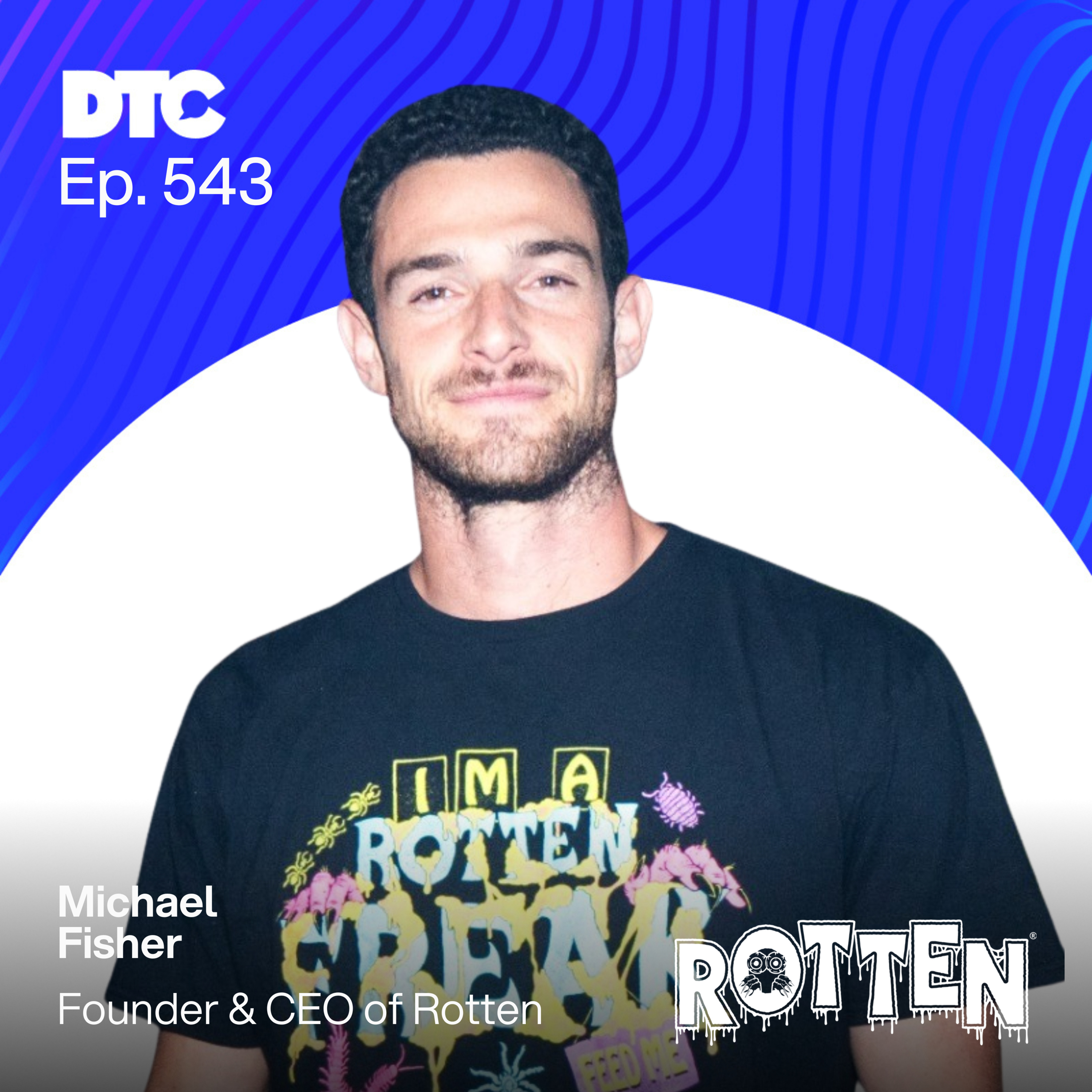
DTC Podcast
Ep 543: Rotten’s Retail Expansion: Seeding Strategy, Brand IP, and Standing Out at Checkout
00:28:30
Loading summary
Transcript70 lines
- [00:00]
A
It's super competitive out there for shelf space. And you know, it feels amazing when a retailer is interested in your product, your brand and you. And so it's hard to set boundaries and turn those things down. With TikTok Shop, a huge part of the strategy is just kind of mass seeding to really start to generate affiliate videos and it all kind of becomes a flywheel from there.
- [00:25]
B
What do you see as being the biggest growth lever right now? Is it more about finding new doors or expanding with the current right doors?
- [00:32]
A
Getting on shelf is the easy part. Getting off shelf is the hard part. And it's hard to internalize that when you're early on. And getting on shelf feels really hard, but it's definitely true.
- [00:49]
B
Welcome to the DTC podcast. Today we are returning to the scene of the crime with Michael Fisher, CEO and founder of Rotten My favorite better for you candy option. I used to have it in my studio here. I've actually moved to a new studio. I don't have a shelf unit, but still in my heart. Welcome back to the podcast, Michael. How you doing?
- [01:08]
A
Thank you, I'm good. Super excited to be back on here.
- [01:11]
B
Yeah, it's been an absolute whirlwind for you. I've been following your LinkedIn journey. Everyone chill. Make sure I include your handle in the link here. Make sure you go follow them. Give me an update. What's. What's been going on in the Rotten world?
- [01:23]
A
So much has changed. You know, we were, I think almost exclusively direct to consumer when we first chatted. We just had our Gummy Worm product out there. The team was much smaller and so, you know, since then, I'd say this year has both been kind of rapid retail expansion. We've grown a ton on E Comm as well. We came out with a new product line, our Gummy Crunchies, which is, you know, crunchy outside, gummy inside, which has now become, you know, our top selling flavor.
- [02:00]
B
I got us, I got, I just. On my recent vacation, we were eating nerds gummy clusters and I was like. And then I did a little research on Nerds gummy clusters and like what, how much it improved their sales to create this like Franken candy that's like this, you know, mad science of candy to make it so, so delicious.
- [02:19]
A
Yeah, I mean it's a, it's a great product, has definitely been very popular and you know, if you look at the sales of that product but you know, also broader sales in the candy industry, you see a lot of growth in gummy and multi texture sour. So it's definitely where what people are wanting to eat right now.
- [02:39]
B
Very cool. So, yeah, you've had a lot of product. I know we talked about changing your product formulation sort of midstream. I don't know if we ever talked about it on the podcast, but it's been an ongoing process. How many products do you have now? How many SKUs?
- [02:53]
A
We have four different flavors that we sell in two different bag sizes.
- [02:57]
B
Nice. Did you do the content series about grubs, gizzards and goo?
- [03:02]
A
We did. We started shooting that, tested it out. I think at the time, as I'm sure you know, it just like fell down to like a lower priority thing and so our resources ended up just going elsewhere. It's definitely something I would love to bring back at some point. It was very fun to go out on the Venice beach boardwalk and have people stick their hands in bins of gizzards and goo. And it was fun. I think it's a great concept. I think as a brand, you'll start to see more kind of ongoing social series from us moving forward. I think what we really needed to do at that point was focus back on product, so continuing to improve our product, coming out with the new product that we just launched at the beginning of this year, which is the Gummy Crunchies, and then really start to plot out our retail expansion.
- [04:04]
B
Okay, talk to me about your go to market with retail because, like, when we talked, it was all D2C. Talk to me about your retail journey and what's worked really well. There's.
- [04:12]
A
Yeah, we. We did some, like, early retail tests last year in 2024. So started out with a couple partners there. One of them was Zoomies, which is, you know, skate apparel, kind of mall retailer, I guess. Like, quick background. Like, one exciting thing about Candy is the fact that it's sold at checkout at most retail environments. So you have a pretty big channel of what, you know, some people refer to as different names. Whether it's specialty, away from home, alternative. Some of these retailers even, you know, think of like Lowe's or Best Buy or, you know, in our case, Zumies. There's a lot of opportunity to, to go out and partner with those retailers. For us, Zumiez was an awesome brand fit. It felt like we were getting in front of people who would really vibe with our brand packaging and be excited to try it. We also had kind of early partnerships with Foxtrot, which was, you know, is an upscale convenience store chain based in Chicago. And then we also went into Hy Vee Pretty early on. They were our first grocery partner in 2024 and that's a, you know, major grocery chain in the Midwest. So our approach was really to, you know, start out, be selective about kind of where we were partnering and testing, try it out. I say the other big piece of our strategy with retail has been to leverage in and outs strategically. So an in and out is, you know, when a retailer brings you in for, you know, just a specific period of time, they're not placing you on the shelf permanently for, you know, everyday sale. And so we designed shippers like these floor displays you can see, actually have an older version of one behind me. But this basically allowed us to go into a bunch of new retail environments, get our product out there, get it off the shelf so that people would actually see it even if they weren't, you know, looking for it or shopping for candy. It's a super fun shipper design. So it like stops people in the aisle. And we were able to test, go into stores that way, see if the product was selling and then basically double down with the retail partners where we saw it working and if there was a partner where it didn't work great, we didn't have to invest a lot more into that area.
- [06:34]
B
Was your hypothesis about zoomies correct? Was it a great product market fit there?
- [06:39]
A
Great product market fit. So we've expanded, got more items in there, they're an awesome partner. We've started doing kind of more marketing activations with them. I think we're the top selling candy at Zumies, which is awesome. So we've definitely taken that and expanded into that channel even more.
- [06:59]
B
And then are you doing the sort the display behind you, are you doing that in all retail spots or do you have a mix of those kind of features and on shelf placements?
- [07:07]
A
Yeah, we have a mix. So totally depends on the retail partner. Like sometimes, you know, if we proved out the channel we're excited about the partner, we'll go straight on shelf and then we'll use these, you know, throughout different periods of the year to get additional placement in the store. So like Halloween's coming up, it's, we've got a lot of shippers going out to our grocery partners because our branding is, you know, Halloween esque and it's candy and so great fit there. We have some retail partners where they want to test out the product before they're resetting their shelf. So we send, you know, shippers out there to start and then we can go on shelf beyond that. And then sometimes we'll launch with a retail partner and have both shippers and beyond shelf together, which is really for us like the ideal way to launch because candy is such an impulsive purchase. So even though like every CPG brand wants to get their product into secondary placements and you know, have shippers out there for candy, it's just so important that we get in front of the shopper and can, you know, encourage that impulsive purchase.
- [08:10]
B
Have you. I remember, I think we talked either on the podcast or since just about slightly de emphasizing the better for you nature of the product. Is that something you've done or is it still pretty front and center?
- [08:21]
A
Yeah, it's a great question. I think we don't really think about it as de emphasizing the better for you nature. We more so think about how do we prioritize what we emphasize. And so for us we really prioritize that this is a candy, delicious candy. This is a fun brand and I'd say better for you falls after that, but it's not something we like try to hide or anything like that.
- [08:46]
B
Your brand is such an asset. How are the merch sales going?
- [08:50]
A
They're good. We're actually about to restart a merch program that's going to be more focused on kind of regular limited time drops that will actually see us start to partner with artists, creatives, et cetera out there and use merch as a again platform for partnerships and so excited to kind of see that come to fruition.
- [09:12]
B
What is the style of art called? Is it like 90s skater, hyper gruesome? Like what is there a term for it? Because I know it's so nostalgic. To me, it just hits the spot for a bunch of design I remember from my young years.
- [09:27]
A
Yeah. I mean the world is kind of this world of gross out humor and culture. So there's a bunch of different design references. Like some of it's Ed Roth style, some of it's like Garbage Pail Kid esque.
- [09:43]
B
Garbage Pail Kids for sure.
- [09:44]
A
We're looking at old Nickelodeon materials, a lot like Nickelodeon magazine and old Nickelodeon shows. It's definitely a combination of a lot of different things.
- [09:57]
B
What's your current thinking around the types of content you want to be making around this brand to grow both your retail and your dtc.
- [10:05]
A
So we built out this huge kind of brand world and all of these characters that live in this world, whether it's Dr. Rotten who's, you know, the brand founder and this kind of mad scientist character, or it's Frankie Freak who's the, you know, Little green character on the front of our packaging and he's really the like main character in this world of freaks where, you know, according to Rotten brand lore, we all have a freak inside of us. And Rotten is the key to release that freak. Which is, you know, our call to action, to go have fun, live your truest, most authentic kind of freest self. And so with our content, it's really about how can we start to leverage and build up these characters and build up IP in that way.
- [10:54]
B
I just was daydreaming about a party I recently held where I put out, I just had some gummy cluster. I put out two bowls of gummy clusters. They were a massive hit. I feel like in your marketing adults having parties, I think a lot of people think of candy as like, you know, the freak, you know, just their private feast on, on some candy. But that idea of like building it into social settings more, it's always going.
- [11:16]
A
To be something people like completely and that's. It's a great idea. It's something we're wanting to lean into, especially around performance. Creative around Halloween is not necessarily positioning Rotten as like, hey, buy this to give it away for free to trick or treaters, but more so like we all love Halloween and it becomes this moment where for whatever it is, one month, two months, I saw people celebrating Halloween like earlier this summer. So it depends on the person, but we all like want to, you know, whatever, give our friends a Halloween themed gift or we're hosting a pumpkin carving party or whatever it is like lean into Rotten as that kind of occasion treat.
- [12:00]
B
How else are you. Because I guess for Halloween, you guys, it's kind of a special holiday for you. How are you trying to lean into the Halloween momentum as a candy brand?
- [12:09]
A
Great question. I mean one big thing we've done is with retail partners using this moment to gain additional placement in store. So sending a lot of our shippers out, I think the other piece is with our content. So on the performance side, kind of doing what I just said, leaning into like how Rotten can become a way to celebrate Halloween with your friends or family and then I think in addition with influencers, creators, there's a lot of people out there who love Halloween and are looking for Halloween focused content to be posting and so how can we work with those people and support them?
- [12:47]
B
So I kind of basically took a bunch of your LinkedIn posts. I think you're a great thought leader on LinkedIn. Can you talk to me about a time where you sort of asserted boundaries with a retailer? I Think that's one of the. That was a post that really resonated with me where I think a lot of people feel like, you know, with retailers that they're sort of totally beholden to them in a lot of ways, but it doesn't always work that way.
- [13:09]
A
I have a couple examples that I'll share. But it's hard, right, because it's super competitive out there for shelf space. And you know, it feels amazing when a retailer's interested in your product, your brand, in you. And so it's hard to set boundaries and turn those things down. So two examples I'll share and kind of the context there as well. One's going to be a retail partner that was interested in additional business with us that we ended up turning down because we were paid almost like six months late on their order before that. And so that was a partner where without kind of any communication or context around the late payment, just continued to not pay us and avoid emails and was really hard to work with. And so when it came, when they expressed interest in placing a new order for different products, we ultimately just decided that it wasn't something we wanted to pursue because we didn't feel like that was a smart move for our business right now. The other example is, you know, I've talked a lot about the shippers here and how that can be great for temporary placement. That said, they're expensive like this corrugate, printing it, shipping it, all of that, that's an additional cost for us. And so we need to make sure that that's a worthwhile investment. And so when retailers come to us and they want the shippers or they want the product temporarily and they can't show me we can gain permanent placement from that test, that's a sign to me that that might not be an opportunity worth pursuing. And so we've similarly set boundaries around would love to send shippers to your store. Can you let us know what does success look like on those shippers and what is the timeline for gaining everyday placement? If we're successful with the shippers and if the retailer can't answer that question for me, then to me it just shows they don't. They're not serious about bringing rotten in every day and they're just looking for, you know, the in and out shipper and depending on the retailer, like that's something that we have turned down.
- [15:21]
B
Can you describe your sampling strategy?
- [15:23]
A
So I think food and beverage is a category where you just want to be sampling. If you've got a good Product, you have distribution. It's just really important to get people to try the product because that's a huge hurdle. So we do a couple things there. One we've always had on kind of evergreen seeding campaigns. We're always kind of reaching out to people on TikTok and Instagram and elsewhere that are in these kind of verticals that we're interested in getting the product into, one of which right now is actually long distance runners who are using candy to fuel their exercise. And so reaching out to those people and, you know, sending them a sampler pack of free product and using that as like the first step to build a relationship. But also, you know, get the product out there, get them to share it, all of that. The other piece is really with TikTok Shop. So with TikTok Shop, a huge part of the strategy is just kind of mass seeding to really start to generate affiliate videos. And it all kind of becomes a flywheel from there. And for us, you can look at the seating as a cost center, which it is. You're sending product out there and paying for shipping. But ultimately it's a very cheap way to get the product out there, get someone to make a video for it. And again, as a goal for food and beverage, you just want people to be trying the product. And so we see TikTok shop as kind of an important strategy for us.
- [17:00]
B
And what kind of content is working well, driving to that, like that the.
- [17:04]
A
Creators or affiliates are making?
- [17:06]
B
Yeah, both internally, both. Both like within. Because I guess you guys are probably creating content on TikTok as well. And also what, yeah, what affiliate content and organic content is working well, I'd.
- [17:17]
A
Say, you know, comparison content works well. So, like showing how we stack up against competition, why we're better. That always works well with our product. It's really all about talking about taste, texture, showing the product super up close. Like I said, candy is a super impulsive purchase. So there's definitely friction to someone buying it online and buying it in a bundle. And so what you kind of have to do and what we've had to do is try and get them to desire that product from the video. Like they, if they're hungry or whatever it is, they're craving candy. Like we need to show them in that moment, like why they should be craving rotten. And so it's as much as you can, talk about the taste, texture, show it visually, all of that.
- [18:05]
B
Got to get some pop Rocks on the exterior of the candies and do some asmr even I'm sure ASMR would work already with the crispy, crunchy, chewy product especially.
- [18:16]
A
Yeah, that was when we launched our Crunchies. That was a big campaign that we did. There was, we worked with some ASMR creators.
- [18:25]
B
So like with retail, most important thing is pickup. Are people picking up your product? So how, how are you measuring that and how's it going and, and what are you doing to increase pickup in, in retail locations?
- [18:37]
A
So I mean you have. Well first I'll say like that's the name of the game, right? Like it's, it's funny, you know, being, being new to the CPG industry. Like there's things you just hear over and over again. One of them is getting on shelf is the easy part. Getting off shelf is the hard part. And it's hard to internalize that when you're early on. And getting on shelf feels really hard. But it's definitely true. Right? Like you got all this, you know, upfront work trying to get that one. Yes. It starts to snowball though. The more yeses you get, the more, you know, placements you're getting, it's easier to get new ones. So you're on shelf. Like if you're not gonna sell, you're not gonna get consumers to repeat and continually buy the product, then all that initial work was for nothing and you're gonna be discontinued pretty quickly. So it is true. I think our focus on moving off shelf combines a few pieces. So you know, we do all standard retail strategies so getting our shippers out to the store helps with that. Doing promos, other types of secondary displays, that really helps too. We also see digital strategies like all of our paid ads that run to our DTC site. That whole funnel has huge bleed in into retail. And I think there are some newer tools out there that you know, you can do GEO holdouts and then upload your syndicated data from retailers and see what kind of lift you get from running meta ads. We're not at a point where it's worthwhile to do that yet, but just from testimonials we get like I watch most of or a lot of the UGC that gets posted about our brand that I, that we have on our social listening tool. And so many people are going and buying us in store and referencing that they first heard about the brand from an Instagram or a Facebook ad. And so there's huge benefit to all of our digital marketing tactics that we have in place for our DTC channels, for our TikTok shop channels, for Amazon that people end up Buying in retail too. Like, everything is just so interconnected. People buy in store, then they buy on Amazon, then maybe they're gonna subscribe on D2C or there's so many different journeys. And so our goal is to be in as many places as possible so that we're wherever you want to buy candy from in that moment.
- [21:07]
B
Just generating awareness. Right. Like, and. And I think your brand does a lot of that heavy lifting. We talked just now about getting off the shelf, but I noticed a post about getting on shelf and the sort of psychology of retail buyers. What's worked really well to get in front and get on shelf with retail buyers.
- [21:25]
A
I'd say first of all, like demonstrating any sort of data around your velocity on shelf and other retailers or anything like that, that's probably first. However, like a lot of other brands, when you're super early, you're one, not buying that data because it's expensive, and two, you don't have a ton of data because you're brand new. So what we did was we actually captured a ton of data from our direct consumer base and we asked questions like, you know, what other products are they purchasing? Have they purchased other better for you candy before? Who are they? What age? What are they like, et cetera, et cetera. And we really started to filter those into tidbits that would be compelling to a retailer. So I'd say the most compelling stat we were able to pull in was the fact that so many of our customers had never bought better for you candy before so that we could use that and go to our retailers and say, hey, you might already carry XYZ brand, but we can show you, like our customers, incremental to those brands. Like, you're not going to put us on shelf and just capture the exact same customer you already have. Because you have to think like the mindset of a retail buyer. They're managing the candy category. Their goal is both to increase their margin, but also to increase the number of dollars, the amount of dollars being spent in the candy category. And so for us, the whole goal is not to just show like, hey, we're going to steal the exact same dollars you're already making on this other brand, but more so, how can we increase the dollars that people are spending on candy? And so we really leveraged our D2C customer base through surveys and interviews and all of that in order to do that.
- [23:23]
B
What would you say has been the most challenging part for you, maybe personally, professionally, during this phase of scaling?
- [23:29]
A
Yeah, the pace that we grow, it's like the place where I spend my time, the place where we have challenges, just feels like it's changing completely every three months. And so my job and what I do, I'm like, I get good at one thing, and then it's not important for me to do that anymore, which also makes it fun. But I think right now we're in a phase where there's some growing pains with operations and the amount that we've scaled.
- [23:57]
B
And just how many people are you now?
- [23:59]
A
We're now six people.
- [24:01]
B
Six people. I think you were two or one when we spoke last year or something, right?
- [24:06]
A
I think we were just one. Yeah. So the. The other thing I was going to say, in addition to operation, scaling is like scaling the team and again realizing, like, oh, wow, I have not had to hire people before. Like, how do you get good at hiring people or building and managing a team or, great, now we're a team of six. Like, what's our culture like? What do we expect from each other? How do I set the tone for that? Like, those are all new things for me to. To kind of manage and think about. And in. In a lot of ways, it's fun to always have a new challenge like that, but it also is challenging.
- [24:48]
B
Yeah. Do you. Are you in office? Are you guys all remote?
- [24:51]
A
We're all remote.
- [24:52]
B
All remote. And did you hire locally or did you kind of go all over for.
- [24:54]
A
It Went all over, but ended up with, you know, I'm in la, one other person is in la, one person's in San Diego. So there's a couple people close by, but looked kind of all over.
- [25:07]
B
I think you're in a great position because Halloween is so relevant for you. And then you head into Q4. Do you have big. You have aggressive growth plans this year?
- [25:15]
A
Yeah, I mean, we're growing almost 1,000% this year, so been insane and, you know, really not going to try and grow 1000% again next year, but somewhat close to it. And so, yeah, really aggressive growth goals I think you're going to see. Again, we have a lot of retail expansion ahead of us. We've got a lot of Runway on E. Comm still as well. And then, you know, we have some very exciting innovations. So new product launches coming both this year and next year.
- [25:50]
B
You can not answer this if you don't. If you don't want to. But I'm curious, what's your philosophy on profitability at this stage in this CPG business?
- [25:57]
A
I don't think I have, like, an insight on how it should Be for everyone. Like you have to. I think that's a key part of thinking about your business plan is like, what are our goals? How does that relate to our access to capital, how we want to think about fundraising, like, where do we want to be in five years and 10 years? So like, everyone has to answer that personally for their own business. For us, we are not a growth at all costs model by any means. And I think you'll see that in the way we expand with retailers is like, we're not bolting on doors as quickly as we can just for the sake of increased top line or increased number of stores. But we're definitely prioritizing growth right now.
- [26:43]
B
And what do you see as retail being the biggest growth lever right now? Just kind of finding the right doors? Or is it more about finding new right doors or expanding with the current right doors?
- [26:54]
A
I would say like right now and over the next six months, it's just a lot of new doors because we're so new to everyone. And then I think you'll see more. So like the second half of next year is when it will become a lot more about expanding with current retail partners gaining new doors with them, getting new skus in with them, rather than like tons of new chains and banners.
- [27:19]
B
Well, I want to thank you for coming back on the DTC podcast today for your yearly update.
- [27:24]
A
Yeah, exactly. I'll see you in one year.
- [27:26]
B
That's right. 1. One candy addict to another. Are you still a certified candy addict or has working in the field diminished your consumption of it?
- [27:38]
A
It's so sad. It has diminished my consumption. I know people always, they're like, they always assume or they ask like, oh, you're just. You must be eating your candy all the time. And I'm like, I wish. But like, it's just around me constantly that I actually. I don't end up eating it. And then I'll be at a trade show and we're sampling it and so then I start snacking on it and I'm like, that's pretty good. I like it. Nice.
- [28:01]
B
Everyone in the audience needs to go to eatrotten.com thanks, man. This was awesome. We'll talk to you again soon.
- [28:06]
A
Sounds good. Thank you.
- [28:14]
B
Thanks so much for listening to today's episode. If you're not a subscriber to our newsletter, you can do that right now at directtoconsumerall. One word co. I'm Eric Dick and this has been the D2C podcast. We'll see you next time.