Loading summary
Transcript239 lines
- [00:00]
Duncan Trussell
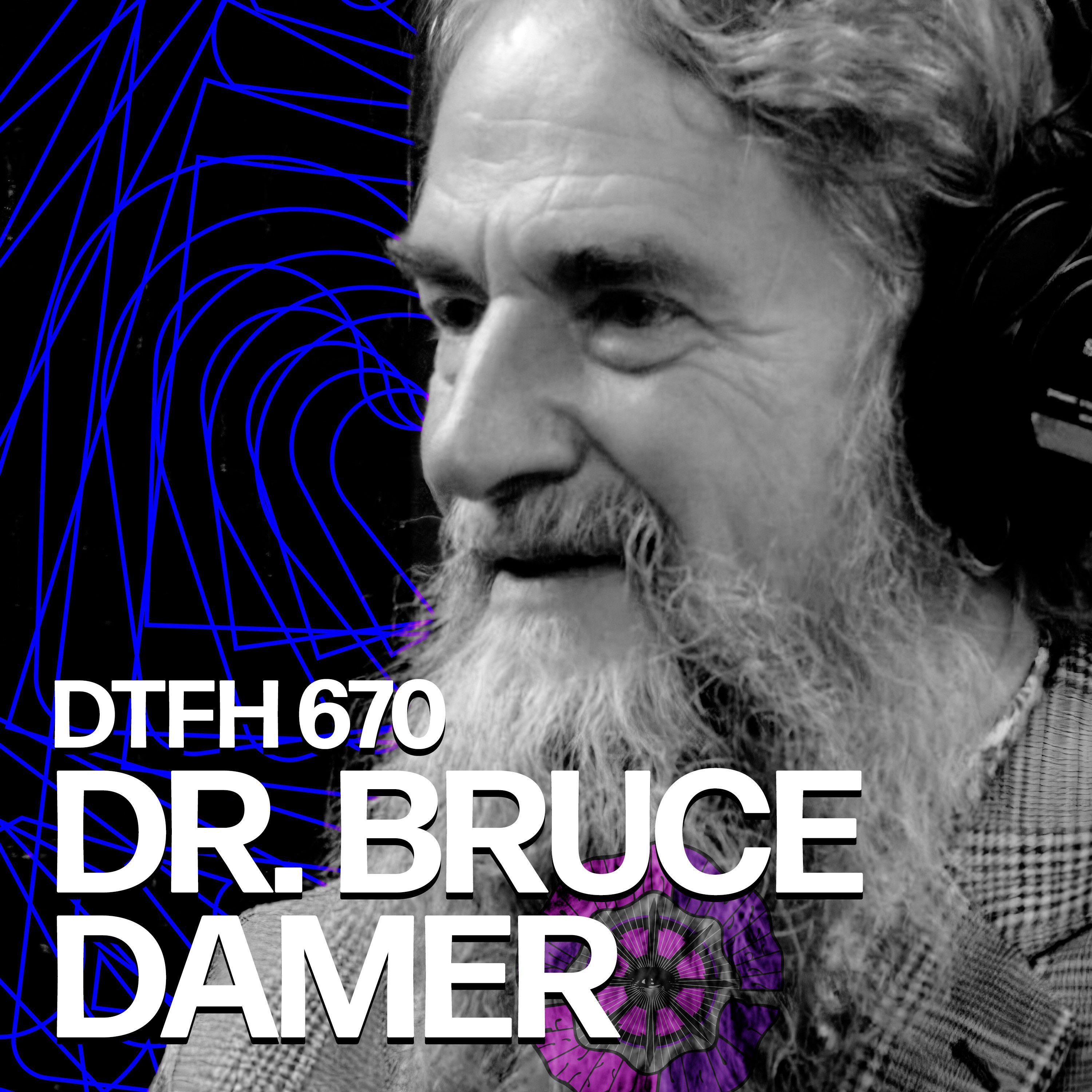
Greetings, my friends. It's me, D. Trousel, and this is the Dunker Trussell Family Hour podcast. And this episode has everything that you all have been asking for. I have a pretty varied audience at this point, and some people love the comedy episodes, but some people make requests. And one guest that I get requests for a lot is Dr. Bruce Damer. And I understand why. Bruce Damer was pals with Terrance McKenna. He is a genius who has come up with a theory for the origin of life. He's working on asteroid mining, and he has most recently started the center for Mines, the multidisciplinary investigation into novel discoveries. And essentially, there is a big invitation out there for intellectuals, scientists, and people who have been hiding in the psychedelic closet to come out and let people know that they have used psychedelics in a positive way that might have actually helped their creativity, their intuition, and like Bruce Dahmer, might have actually allowed them to witness something in the psychedelic realm that they could then bring bring into the world. This is incredible. I love maps. But it's nice to hear that psychedelics are beginning to become acknowledged as what I've always loved them for. Incredible tools for creativity and for the exploration of ideas. Dr. Damer shares with us today the incredible psychedelic story of how he came up with this theory for the origin of life, a theory that has been published in multiple scientific journals, Scientific American, and a lot of other places. A brilliant theory, and it's so cool. Not only that, if you're looking for a quick history of psychedelics and their prohibition in the United States, told by, let me reiterate, someone who is pals with Terrence McKenna and who is taken up the McKenna Psychedelic banner, then you're about to get that right now. Everybody, please welcome Back to the DTFH, my friend, Dr. Bruce Damer. Bruce. God bless you, Duncan. Thank you. Bless you, man. Like you just said, it's been at least a decade.
- [02:34]
Dr. Bruce Damer
It's been a decade since we've chatted. And we last talked at Burning Man 2017 when we did the tax IRS comedy.
- [02:44]
Duncan Trussell
I try to forget it. I don't think it went over as well as I wanted it to.
- [02:47]
Dr. Bruce Damer
People believed you when you said that. We're here to tax the gift economy and agents will be coming into the tent with laptops and to record your received gifts. You remember that one?
- [03:00]
Duncan Trussell
Absolutely. I just. It was really of. I just. I don't know why I think it's Burning Man. Your consciousness has expanded and you're looking for the antithesis of the Vibe, which sometimes produces comedy. And I thought, what is the most antithetical thing in the universe compared to.
- [03:23]
Dr. Bruce Damer
This, that we could bring to the playa?
- [03:25]
Duncan Trussell
That we could bring to the playa?
- [03:27]
Dr. Bruce Damer
A tax audit.
- [03:28]
Duncan Trussell
An audit on the burners. On burners who are giving sandwiches to people. And we wanted to tax the sandwiches.
- [03:36]
Dr. Bruce Damer
Yeah.
- [03:37]
Duncan Trussell
Yeah. It didn't. Didn't get a standing ovation, but the.
- [03:42]
Dr. Bruce Damer
Fact that it convinced half of the stone burners at the time, or the Billy people thought it was real for a second.
- [03:50]
Duncan Trussell
Well, I mean, it's sort of like, you know, a lot of people talk about harm reduction with psychedelics. And when I look back and think, like, you know, it would have probably been less disturbing to have, like, a severed head.
- [04:07]
Dr. Bruce Damer
Yes.
- [04:07]
Duncan Trussell
Than to talk about taxes in front of people. Tripping. So since we've talked. So much has happened in the world.
- [04:21]
Dr. Bruce Damer
So much has happened.
- [04:22]
Duncan Trussell
It's strange thinking back just 10 years ago, isn't it?
- [04:26]
Dr. Bruce Damer
The halcyon days of the teens.
- [04:29]
Duncan Trussell
Yes, yes.
- [04:31]
Dr. Bruce Damer
Innocence. Total innocence.
- [04:32]
Duncan Trussell
Total innocence. That is exactly. I mean, and of course, then we didn't think of it as innocence. We thought it was normal.
- [04:38]
Dr. Bruce Damer
See, we thought the aughts were innocent.
- [04:41]
Duncan Trussell
Yes.
- [04:41]
Dr. Bruce Damer
And the 90s were prehistoric.
- [04:43]
Duncan Trussell
That's exactly it. And, you know, all of the things that McKenna talked about seemed to be manifesting to some degree this acceleration and.
- [04:56]
Dr. Bruce Damer
The Quickening, I think Art Bell called it. Remember that?
- [04:59]
Duncan Trussell
The Quickening.
- [05:00]
Dr. Bruce Damer
Yeah.
- [05:01]
Duncan Trussell
And we were there in the canoe, floating down the idyllic river of the teens. Maybe you would hear the waterfall somewhere in the distance.
- [05:15]
Dr. Bruce Damer
You hear the rapids oncoming.
- [05:17]
Duncan Trussell
Yeah. And then, whoosh. Now here we are. And I am really curious to hear your thoughts on that Quickening, but also to hear how you've advanced in your incredible work that you're doing right now. And so where are we now, Bruce?
- [05:38]
Dr. Bruce Damer
We are. We're here in Austin because we're at south by southwest 2025, and we just did a major talk, was packed on psychedelics, research into psychedelics as creative catalysts for insight and breakthroughs. And not just in the artistic realm, but geeky, you know, geeks on drugs kind of a thing where they're actually downloading phenomenal solutions that are inaccessible in any other way. And this was going on from Aldous Huxley and Humphrey Osmond's first experience, where Osmond brought a bottle of mescaline on his front driver's seat down to LA to give Huxley, this really famous English intellectual, his first trip.
- [06:26]
Duncan Trussell
Yes.
- [06:27]
Dr. Bruce Damer
And then he wrote the Doors of Perception, which has opened the west to psychedelia. And in their letters from that day forward, they were talking about project outside, which meant that if psychedelics could give you insight into self, into the psyche, if you will, they could also give you outside into the world. And they thought of it as a tool for the intellect. And when Osmond coined the term psychedelic in 1956, it meant mind manifesting. So this was actually the intuitive grasp. It wasn't necessarily healing. Even though Osmond was working with addiction even then in the early 50s with LSD, it. That's where they thought the push was. And then in the mid-60s, the first study happened with Willis Harmon and Jim Fadiman, you know, who's now the father of microdosing on 23 professionals having mind blowing downloads using mostly mescaline. And it all got shut down.
- [07:28]
Duncan Trussell
Yeah. Now why did it get shut down?
- [07:30]
Dr. Bruce Damer
Criminalization.
- [07:31]
Duncan Trussell
Yeah.
- [07:31]
Dr. Bruce Damer
So literally, Fadiman tells us you can see him all over the Internet because they have a new book out called my, you know, microdosing Guide. He talks about. They received the letter from the governor, governor of California on a Friday that said cease and desist all studies with these compounds. And they decided to not open it. Well, okay now until they, I guess they submitted their publication.
- [07:55]
Duncan Trussell
I'm curious your thoughts on now. And I think we've all heard the Nixon wanted to find a way to criminalize ideology. He knew that the hippies were taking psychedelics and he knew that by making those illegal you could just arrest anybody you wanted to because most people had some kind of drug on them, thus giving you an avenue to put people in jail, the sinners in jail. Do you buy that theory? Because the deeper darker theory which I kick around, and anyone who's taken a psychedelic and had the thought, wait, why is this illegal? Has had this sense of something more ominous. A kind of almost gnostic matrix like force that wants to repress that flow of data from whatever that phenomenal realm is. And I'm wondering where you land on that.
- [08:48]
Dr. Bruce Damer
I think we give our government agencies and bureaucrats too much credit there. I think it was just that they were disturbed, youth culture challenging them. But they. What was it that Timothy Leary had said about the people who most opposed or vehemently opposed to psychedelics? Something like they'd never. Until they do them Right. Right. So the bureaucrats weren't necessarily taking psychedelics.
- [09:17]
Duncan Trussell
Well, but the CIA was. I mean, this is where the whole thing gets real weird to me is that. And I don't know, I saw some interview with the Grateful Dead. I can't remember which band member it was, but he just said simply they didn't want us to go in that door. And I often think about that. And also you're right, the youth culture and the especially in those days, what that must have looked like to a pretty square culture must have seemed quite threatening. But by driving this underground, all they succeeded in doing was sort of amplifying the thing that they were resisting. But also it's really. We'll never know.
- [10:02]
Dr. Bruce Damer
We'll never know. But one thing I can tell you for sure because I have sort of personal experience. Even though I was a little kid in the 60s, I came into the extent archives of Timothy Leary. So I was the agent for the Futique Trust for several years. And we had like 500 banker's boxes of his artifacts in a storage unit in Scotts Valley. And finally the co trustee identified a buyer and it was the New York Public Library which was just absolutely phenomenal through a rare books dealer. So in 2011 that collection moved. So a big tractor trailer came out to take it all to Queens. But they left 200 boxes in the storage. And the trustee called me up and she was practically in tears because she was throwing into a dumpsters. And so I will say I'm renting my own box truck and I'm coming up because the archivists, the curators at the New York Public Library decided to discard anything that was printed in a publication because they only wanted the typescript collection and it was precious. It was like 50,000 newspaper clippings and zines and everything all the way back to the 50s that had been meticulously cut out and stamped and timestamped by clipping services. Now this is pre Internet search, right?
- [11:24]
Duncan Trussell
Right.
- [11:24]
Dr. Bruce Damer
And so it was every story, including all the articles in the Harvard Crimson when Alpert and Leary were there. And a number of hand scribed things, his album collections, his books, including uncorrected proofs, everything. So I just put it in the truck and I brought it and put it in my barn and then I started to go through it because I could touch and smell, you know, because you got this funny smell of aging newsprint. Yeah, I could literally smell off those pages the articles starting in the early 60s when it was a wonder drug. Right. So you could, you could go through it and get that sense. 1963 Boston Herald, NASA to use LSD to train lunar astronauts.
- [12:12]
Duncan Trussell
Oh my God.
- [12:13]
Dr. Bruce Damer
That's what they thought. And so then you cruise into the 196345 and it explodes. So 65 acid tests. First acid test happens in SoCal, California in November. But then it goes all throughout the West Coast. You know, people are dipping cups into giant vats. So I heard, right, it was a huge thing. And by 66, so 67, there was a kind of a love idea. It was the new discovery, Summer of love, human being happened. 68, the darkness, right, the assassinations. And now that was happening externally in the political world. Vietnam was getting ugly. Nixon had come in, you know, LBJ had resigned, basically, he'd been defeated. So the Great Society had been defeated by Vietnam. And so the country flipped into this darkness. It seemed like a slope that it was pulling everything down. And yet in 69, you had Woodstock, which was a glorious light, and you had the moon landing, but then you had Altamont at the end of the year, which is absolutely dark. It kind of put the knife in the 60s and the kind of. So this goes into like the Rolling Stones. So the Rolling Stones hadn't been to America since 1967. They came for Altamont.
- [13:34]
Duncan Trussell
Oh, Jesus.
- [13:34]
Dr. Bruce Damer
And Mick Jagger said, oh, my God, what has happened to this country? It is so different. And they witnessed the stabbing in front of the stage. It was like, wow. So people don't realize that there are enormous historical forces at work. And this bloom came off the rose. And the rose was almost like an Eleusinian return, the rediscovery of ergot access to the other realms. But it happened so fast. In 18 months, it just ripped through American society so fast that it couldn't be absorbed culturally. So generations just reacted instinctively, in a sense.
- [14:18]
Duncan Trussell
Yeah, well, it's, you know, looking at it holistically, I'm sure you've heard like this concept, if anything that is created, it's opposite, it emerges. And if you do have a kind of mini renaissance, then you might expect the opposite to emerge. I'm not saying that it was the psychedelic revolution of the 60s that brought on that darkness, but any bright light, it's a cliche, has some dark shadow. And especially the light that psychedelics represented. This is unlike anything else. This is some kind of cosmic transmission that suddenly is like, accessible by most people. And it's so beautiful to hear the initial pre propaganda reaction.
- [15:10]
Dr. Bruce Damer
And it was so uninterpretable by the older generation, the adult parent generation that saw World War II depression survivors, World War II fighters, they come home to build a country. So they built the literal bones of the United states in the 1950s, and they brought huge middle class into being. They work damn hard yeah. So this is a really different mindset. But their kids who were raised on Sugar pops in the 50s and television and media had the luxury of going and doing this stuff.
- [15:42]
Duncan Trussell
Right.
- [15:43]
Dr. Bruce Damer
Going out to Woodstock on a Greyhound and living off of, you know, little handouts. Pretty much, yeah. And no generation previous had had the luxury of just flipping around and exploring. Exploring. They were all going to work in the mills and the farms. So it's the first generation that could ever do this in the history of the world. And so they went on this exploration en masse. And their parents just did not freaking understand, of course, because that's not how you build a world or a family or society. And there were huge numbers of casualties in this huge confusion. So the confusion in the United States was from the government powers that be all the way through the company space, all the way. To family. To family. To family.
- [16:28]
Duncan Trussell
Yeah.
- [16:29]
Dr. Bruce Damer
That's how rockingly disruptive this thing was. So the fact that people, by 1969, 70, you know, you had, of course, the Democratic. The riots at the Democratic convention, by 1970, 71, 72. People just wanted normalcy. Right, right. And they. They had to wait because the 70s, hyper, you know, inflation.
- [16:50]
Duncan Trussell
Yeah.
- [16:51]
Dr. Bruce Damer
Oil shocks. And then they had water gain. It just never seemed to end.
- [16:54]
Duncan Trussell
Right.
- [16:55]
Dr. Bruce Damer
And then infrastructure started to fall apart.
- [16:57]
Duncan Trussell
Yeah.
- [16:58]
Dr. Bruce Damer
And so.
- [17:12]
Duncan Trussell
This episode of the DTFH is brought to you by Lucy. Nicotine pouches. 100% pure nicotine. Always tobacco free. Now, what did Lucy figure out that the other pouch manufacturers did not? Lucy figured out that from time to time, your mouth goes completely dry. The phenomena is known as cottonmouth. And it's not a great feeling to be in the middle of a conversation and suddenly cotton at them and lift. It's terrible. It's terrible. Now, there's many ways that your mouth can become dry. Perhaps you're nervous, or perhaps you're stoned out of your mind. Now, if you were stoned out of your mind and suddenly your mouth went as dry as the Sahara Desert and you started smacking like a Nosferatu who just popped out of the coffin and hadn't had the blood yet, then you're gonna freak out. There's a possibility it increases your chance of freaking out. But you're in a great conversation, you're high, so you don't wanna stop the conversation. That's when you pull out a delicious Lucy breaker. These are nicotine pouches with an extra surprise. These pouches hold a capsule that can be broken open to release extra flavor and moisten that leathery Dry old puckered mouth, ears. So that conversation can continue with your future lover and maybe wife or husband. Set yourself up with a subscription and have Lucy delivered straight to your door. No more dealing with the judgment of the convenience store owner who thinks that you are coming in there too much to buy. Pouches. I love Wintergreen. Lucy's. That's my go to for pouches. I use 4 milligrams. But if you want to dive into the abyss, it goes way up with Lucy. Yeah. 12 milligrams. 12 milligrams. They've got it if you want that. But if you're like me, sometimes it's fun to just walk on the nicotine beach, not go surfing on the big waves. But they've got it all. 4mg. 8mg. 12mg.
- [19:30]
Ryan Seacrest
12Mg.
- [19:31]
Duncan Trussell
Let's level up your nicotine routine with Lucy. Go to Lucy Co Familyhour and use promo code familyhour to get 20% off your first order. Lucy has a 30 day refund policy. If you change your mind. You're not gonna change your mind. No one who loves pouches is gonna taste a Lucy and be like, I'm sending it back. And if you do, well, refer to my better help ad. Again, that's Lucy Co and use code familyhour to get 20% off. Lucy products are only for adults of legal age and every order is age verified. Warning. This product contains nicotine. Nicotine is an addictive chemical.
- [20:33]
Dr. Bruce Damer
It was a tired country by like 79. But then there was this new flowering of personal computing and stuff was happening. But we got through disco and we survived that. But so then the 80s was kind of this redawning and then psychedelia had so gone underground. The flame was relit by Terence McKenna. Yep, right. He was. He lit the pilot light and kept it going. And then we saw the rave scene. We saw MDMA enter the scene in Texas. Right here.
- [21:04]
Duncan Trussell
I had no idea. I thought it was in the UK is where it originated.
- [21:08]
Dr. Bruce Damer
So the story of the Stark Club, designed by Leo Stark, the great French architect, designed America's most fancy, beautiful private club in downtown Dallas. It housed like 2,000 guests. And it was all the Dallas and Texas socialite scene. Oil man, you name it. Kind of like we see here in Austin. And guess who the ringleader was. Larry Hagman, star of Dallas.
- [21:36]
Duncan Trussell
No way. Oh, I've heard about that. Okay, keep going. I'm so sorry.
- [21:40]
Dr. Bruce Damer
10 gallon hat. So there was a multi level marketing company in Texas to Manufacture mdma. You know, it was called Adam at that time. And when it hit the streets, it was called Ecstasy or Molly. Multi level. Of course, it's text. This is like Amway or something.
- [21:56]
Duncan Trussell
Sure.
- [21:57]
Dr. Bruce Damer
So they're making millions of doses in Texas.
- [22:01]
Duncan Trussell
Oh my God.
- [22:01]
Dr. Bruce Damer
And then what happens every weekend at the Start Club is you arrive and you're welcomed and you're, you know, prepared. You're the Texas socialite. And then somebody comes around with platters, everybody dropped.
- [22:17]
Duncan Trussell
Now I'm about to open your heart chakra.
- [22:20]
Dr. Bruce Damer
Oh no. It was coming to Jesus. It was love. It was love that would save the world. And the people that experienced that power, that was a new reemergence of something that isn't quite psychedelic. It was an empathogenic type emergence. And of course Sasha Shulgin had resynthesized MDA back in the late 70s and called Leo's F. And they decided, oh my God, this is gonna huge in marriage and family counseling. And people were using, it was legal. And the Start Club was where it hit the intelligentsia in conservative, Republican, Catholic. A friend of mine who's a. He walked into the Stark Club one day in 1985 and he. Or 84, 85. And he was, he walked in, fundraiser for the Republican Party, Catholic, Christian, attorney. And he walked. Super conservative guy, straight up, he walked out. He said, I was still Catholic and I still have my license to practice law, but I was a different human being when I walked out of that club. And that happened over and over and over again. And the reason why Rick Doblin and Maps have been able to cross the line, one of the reasons is that the conservative right felt deeply offended that this tool was taken from our society that was so healing. You know, I get emotional when I think about it. They said, God damn it. And so some of the people who had experienced that in that club in Dallas got on board and family wealth was put in and Rick was able to reach the descendants of the people who. Isn't that a most wild story?
- [24:08]
Duncan Trussell
See, I knew I was always flabbergasted by stories of Rick Doblin meeting with high level government officials regarding mdma. And I was always curious about how he got in the door. And to hear that it all connects to Larry Hagman. Larry Hagman is one of the wildest.
- [24:30]
Dr. Bruce Damer
In his 10 gallon hat. And actually somebody a few years ago was making a documentary and interviewed Lorenzo Haggerty, the friend of mine who started the Psychedelic Salon podcast, which was a huge thing for like our. Your generation too. So that's why he did it. So Lorenzo Haggerty was a dealer. So they interviewed him. He was a downlink in, in moving tens of thousands of doses of MDMA in the network here in Texas.
- [25:03]
Duncan Trussell
Wow.
- [25:04]
Dr. Bruce Damer
Yeah.
- [25:06]
Duncan Trussell
That is such a wild ride when you consider, and this is what I love about psychedelics is it's not just the obvious manifestations when you ingest them, it's their manifestation in society seems to reflect what they do.
- [25:25]
Dr. Bruce Damer
And to a great extent, MDMA is Texan, just as in Switzerland. Now you see the Swiss supporting tremendous new research into lsd. The Swiss consider LSD to be theirs.
- [25:38]
Duncan Trussell
Sure.
- [25:39]
Dr. Bruce Damer
It's a cultural commodity of their people. Absolutely. And it's a wonderful thing because it was born there. And of course MDMA was born in 1913. I think it was Merck or one of the companies synthesized it, but redefined uses for it. But when, when Sasha re synthesized it in his lab, you know, up in Lafayette, California up on, in the Shogun farm and tried it, he would do for the listeners, he would, it would always come down to a little pile of white powder for when Sasha was doing his chemical explorations. I think of Sasha as being the greatest alchemist who ever lived on the planet.
- [26:15]
Duncan Trussell
Wow.
- [26:16]
Dr. Bruce Damer
Because he synthesized thousands of compounds and self assayed and did his exploration. And he would take out the smallest little spoon that you use to put in, you know, one of those, those weigh scales that wind can't get in because wind will change the weight. And he would take that, that and start a titrated dose on himself. And then he would, he would start titrating up after a certain time to get to the critical and he would establish the where it's actually at fellow. And then he would push into effective dose and then he would, then he would explore. He would take his notebook out and start writing. Amazing.
- [26:55]
Duncan Trussell
I mean when you think of the courage in what you just described, having no certainty about what this might do other than its chemical composition, how it might relate to other psychedelics. We all know the story of Bicycle Day and Hoffman didn't titrate.
- [27:15]
Dr. Bruce Damer
And maybe that's it was an accidental dosing.
- [27:18]
Duncan Trussell
Exactly. But you know, and again, I don't want to get woo here, but how accidental is it that post World War II a perfect way of dealing with trauma is presented to the world by accident? World War II has happened. When we think about the descendants of that generation going off to be hippies, we're also talking about people who were raised by people with severe PTSD and what we know about epigenetics right now.
- [27:53]
Dr. Bruce Damer
Your dad would never talk about World War II.
- [27:55]
Duncan Trussell
There you go.
- [27:56]
Dr. Bruce Damer
End of story. And then your older brother was never going to tell you what happened in Nam.
- [28:01]
Duncan Trussell
Exactly. My dad was two tours in Vietnam. I have the identical experience. I know exactly what that's like. I know how tortured they are. And also, when he was close to passing, he would share with me a little bit of what it's like to be a veteran suffering from ptsd. And the medication that they would give you, which is benzos, what they would say is. What he told me is they would say, when it happens, just take these and stay inside. That's the fucking treatment.
- [28:37]
Dr. Bruce Damer
That was the protocol, dude, what the fuck?
- [28:40]
Duncan Trussell
And so then. So you hear this, and though I don't know where you stand on this sort of thing, I see a divine hand here, and I see, like, a trickster kind of divine hand, but also I do see a kind of miracle, which is, okay, trauma. So many wars now, generations of people. You know, if you were raised by someone with ptsd, then the odds are pretty good that you're going to pick up some parenting styles that maybe aren't the best, and you might find those coming. I have children now, and, you know, I have to be very careful, because a lot of these dads with ptsd, what did they use as a methodology for raising their children? They used what they learned in the Navy. They learned what they used about discipline and, like, harshness and harsh realities. And so suddenly, you know, we've got, like, this echo, a karmic echo, you could almost say, of radiating out into the world. And then, boom, this miracle drug appears.
- [29:49]
Dr. Bruce Damer
And, Duncan, when you look back. So I asked. I'm a geeky scientist, so I'm always on inquiry. And I was down in Peru with Dennis McKenna, who you've interviewed. And we both love him, dearly love him. He's the psychedelic teddy bears, as far as I'm concerned. I was standing next to the Lukuma tree, which is this ancient tree in a place that he and I have done medicine. They've just done a cocoa summit there. And I was connected to the medicine and to the full moon and the spectacularness of the Peruvian Andes. And I asked the Lakuma, this is what you do. You give yourself permission to do these things. I asked it, can you muster the forces of the plant kingdom to help us, to infuse us? And then Lukuma answered through these portals that Lukuma trees have. They're almost like breathing portals, said I've always been there. And then went through. And as the delivered history came, it was we're at 25,000 BC and the plants are putting the astringent into our minds and they're putting the concoctions, the first ferments, and it's growing our guts and our minds and our serotonin. And then you roll forward and the first distill, not distilled, but just regular alcohol. And the nine to one admixtures of the ancient wines which were included, Penny Royal and things like that. And then the Kykeon at Eleusis, which was the first hint of an LSD ergot. Incredible thing at the edge of neurotoxicity. That was master for 1600 years to turn on civilization. And then it rolls forward even even further. And suddenly we get massive carbohydrates which change us again. And then we get into the really interesting territory, we get caffeine showing up. So caffeine turned on the creative mind. It turned on all those people in those coffee shops in Amsterdam creating financial instruments and Pope Pius III calling it the elixir of the devil.
- [32:09]
Duncan Trussell
Did he really?
- [32:10]
Dr. Bruce Damer
He did. And so then someone brought him a coffee service in the Vatican. I forget what year this was. Yeah, he pronounced it manna from heaven. And then it became. Because he got turned on and he was like, aware and awake and feeling good. And so then all of Catholic Europe started open cafes. Right. In places. Yeah. So that literally was a moment in which a plant drug found its way. And then we built skyscrapers and railroads and everything on the back of caffeine. And of course, the Incans were building Machu Picchu on the back of coca and cocaine.
- [32:48]
Duncan Trussell
Right.
- [32:48]
Dr. Bruce Damer
In the correct doses, plus a lot of other things in the leaf.
- [32:52]
Duncan Trussell
Yeah.
- [32:52]
Dr. Bruce Damer
And so then it just kept accelerating. Then the real demon arrived. Distilled alcohol.
- [32:59]
Duncan Trussell
Yes.
- [33:00]
Dr. Bruce Damer
Almost killed Western civilization. The. The big problem of the 1820s. Right. And then strong opiates almost destroyed the East. Right, yes. And then nitrous came into Victorian England.
- [33:15]
Duncan Trussell
Hilarious.
- [33:16]
Dr. Bruce Damer
Hilarious. Right, yeah. And then we're rolling into the 20th century. Now we have synthetic chemists, so all kinds of things show up, but they all have roots in the plant kingdom, or of course, in the fungal kingdom. And then psychedelics, you know, which had been buried in Mesoamerica, the psychedelic tryptamines and psilocybin. And then even deeply, more deeply buried. You know, the MAOI plus DMT combination was probably concocted in the Andes. According to Manuel Torres, the Andean civilization listeners won't know this, but this is emerging archeology. It's like psychopharmacological kinetics. It turns out that the Andeans were absolute genius in admixtures. So the north north Incan civilization was doing snuffs that consisted of all kinds of things, like mescaline sources from, you know, a cactus and a nut that had both NAN and 5 Meo DMT in it. And this is a real thing, it's plant based.5 MeO DMT. And in the southern part of the Incan, so pre Incan empire, they were doing brews and they've actually found the vessels and they've done the archaeochemistry. And these, these ferments were sophisticated as heck.
- [34:38]
Duncan Trussell
Yeah.
- [34:38]
Dr. Bruce Damer
And so the, the other thing about the Incan civilization, it was cradle to grave psychoactive compounds available to infants and all the way to the end of life. And it wasn't mediated by priests. It was literally cooked in the village.
- [34:54]
Duncan Trussell
Wow.
- [34:54]
Dr. Bruce Damer
So it was a top to down, top to bottom psychedelic and theogenic medicine civilization.
- [35:02]
Duncan Trussell
You know what that makes me think of one of my favorite things about Burning man. And just to pause on this beautiful description of the history of psychedelics leading to where we are now. One of my favorite things about Burning Man, I just think about these Incan villages that you're describing that I had no idea. And I'm imagining the smells, I'm imagining the smell of whatever these brewing psychedelics are blowing through the wind. And that's what I love about Burning man is like, you know, a lot of festivals, you're gonna smell weed, whatever. Burning man, you get many, many wafts of DMT drifting on the wind. And the effect of that is magical. It's, you know, you really do feel like you've shifted in some kind of parallel reality. It's not like you're getting high off some secondhand dmt, but just if you smoke DMT and then you're smelling it again and again and again, this reminder of what's out there, it has a very powerful effect. And so when you think of olfactory, the olfactory facet of living in a place where psychedelics were not prohibited, but were accepted as a normal part of humanity.
- [36:17]
Dr. Bruce Damer
They were in the ether. They were the energetic. And here's a related story to that that the listeners will love. So if you all know who Carolyn Garcia is. Mountain girl. So the first partner, wife of Jerry Garcia, and she ran the board and everything for a Grateful Dead. Just a paragon of stories and humor and wisdom. About psychedelia from the 60s, 70s and on. Like, she was touring when they had to move their freaking stages and they almost bankrupt because they're trying to move. Like, they spent more on gas than they ever came. Can't imagine. So she can tell you all the stories, but one of the stories I got out of her was I was. We were camped together at Burning man, and I was sort of in awe of Mountain Girl because I was sort of new to the. The scene. And this is a person who's an elder who carries something really important. And so I was actually. I have to admit to the audience, I was coming up pretty hard on something. And I was in my wildest Burning man gear. But sitting right in front of her is a supplicant of Mountain Girl, and she's just sitting in a comfy chair. And I turned up to her and I said, mg, tell me something. If I was a. A, like, lily white teenager, this was the summer of Love, and you were about to dose me and send me out into the summer of Love, or if I'm here now at Burning Mass. So that teenager, instead of getting dosed, would go through a time portal instead of going out in the summer, love and family, dog, and everything would go and be dropped into 2013 at night on the playa and stand up without being dosed, which would the more impactful experience be. And she thought just for like a fraction of a Second, Burning Man 2013, we know how to do this. And that really meant that we built a psychedelic environment that was consistent, that could open the mind in a collective, in a community, in a safe container with all the smells, the pounding of the EDM and the vibratory, the cleanliness of the desert. And for her, this was a superior construction than a simple acid trip in Golden Gate Park. So that was her measure of. She said, we have come a long way.
- [38:52]
Duncan Trussell
Well, and you know, there's a. Oh, God, I don't even share this with people. It's so depressing. You know this, I'm sure. Strawberries, you see mold on the strawberry. Now, if you're a fool, you eat another strawberry that doesn't have the mold. But apparently the mycelium has worked its way through the entire damn straw. The whole thing's filled with mold, so it won't taste as good. But in the positive, when we look back at this beautiful history that you've articulated, including the many times psychedelics are driven underground, the mycelium, that's what the Grateful Dead was doing. And Burning man is this Burning Man's.
- [39:39]
Dr. Bruce Damer
A huge fruiting body that came up.
- [39:41]
Duncan Trussell
Fruiting body. And so these fruiting bodies, they don't just manifest as fun, incredible, enlightening festivals. The fruiting bodies. And I think this gets to the work you're doing right now are every time you hear somebody like Steve Jobs, someone who had a massive impact on Western society, and not just Western society, on the acceleration towards what I think McKenna called the singularity, they inevitably cite psychedelics as having some impact on their inventions. At the very least opening themselves up to, like here and in the case.
- [40:25]
Dr. Bruce Damer
Of Steve Jobs, to the certainty, the certain tude, that he had the permission and the power and the capability in a design sense and in a business leadership sense to do things and really create new things in the world. And he wasn't even sure what they were going to be. But he, you know, certainly because he's already at Homestead High, they're already going to the Homebrew Computer Club. And that was what he was really focused on. He knew there was something there, so. And he did it. And he had the courage and the gumption and to literally had the perspective to say no. Like, we don't do focus groups. We know what people are going to want.
- [41:08]
Duncan Trussell
Yeah.
- [41:09]
Dr. Bruce Damer
We don't do the whole corporate indirection thing and make a mess. We drive the, we drive toward this beautiful light of this design thing and we ship it, we put it in people's hands in the most powerful way. And it can be an ugly and messy kind of personal process. Anyone who's worked with Steve, especially in the 70s, into the 80s, knew. But if you talk to Andy Hertzfeld. So they were trying to finish the Mac OS for its launch and Steve came in. This is a good story about Steve's absolute focus on this perfection of the beauty of the vision of the Macintosh introduction January 1984. And Andy told me, because I'm a big collector of vintage computing and he said, Steve came in and it's like two months to launch and he was writing the operating system. He said, I want the Mac to, to write out and say its own name and. Right. And all they have is this tiny little speaker. It's not a real speaker.
- [42:14]
Duncan Trussell
Oh, shit.
- [42:15]
Dr. Bruce Damer
And what Andy does is he says, okay, you know, instead of blowing up and saying no, and Steve firing people and all the whole thing, he went to like Safeway and he found on sale this enormous tub of chocolate covered espresso beans. He bought like a couple of massive tubs of chocolate covered espresso beans and he Went back to Apple and that's all they ate for like three or four days. That's all they were eating. And they got so onto it, right, that they got the clarity, they used drugs to help them. And they actually hand coded a file that. Where the Macintosh said, hello, I am Macintosh. Right. Which is the great moment. And it is audible, but it's handwritten waveforms in a file that is sucking off of a floppy drive out of memory to say, I am Macintosh. And so it's that type. People rose to the occasion from the brilliance of this man who was unleashed by lsd.
- [43:20]
Duncan Trussell
Yep.
- [43:21]
Dr. Bruce Damer
Yeah. And gave us our modern world.
- [43:23]
Duncan Trussell
And we won't know all of the people who are unleashed by LSD or some psychedelic coffee, I guess, you know, like the story you just told. But we won't know all the people who are influenced by it because of the prohibition and because just the articulation of someone who takes psychedelics as a.
- [43:41]
Dr. Bruce Damer
Business person or a scientist designer, you're.
- [43:45]
Duncan Trussell
Going to lose funding.
- [43:46]
Dr. Bruce Damer
Well, and so this comes back to my story, which is I was certainly under the pall of prohibition. I was sort of halfway out the door, as many of you know, might have seen my talks on, on psychedelics. And I had sort of been gatewayed into Hyperspace by Terence McKenna. And then I introduced Terence to cyberspace and we had this partnership and then I just took it up. At one point Terrence said, turned to me and said, we knew he was ill. And he said, bruce, keep telling the story, but make it your own story very, very clearly. And so I took that up in 2003. So I described, but I didn't mention the word mushroom. I described my visionary experience of going to the origin of the cosmos, like the, the literal ignition of the cosmos. And it was on a solid enormous 15 gram bag of Terrence mushrooms at Terence penis. It was just cubensis. It was cubensis. But I found out later they were from the spore prints from La Cherera.
- [44:56]
Duncan Trussell
Jesus.
- [44:57]
Dr. Bruce Damer
God. So that was my first trip.
- [44:59]
Duncan Trussell
That was your first trip?
- [45:00]
Dr. Bruce Damer
That was my first trip.
- [45:02]
Duncan Trussell
Wait, I'm sorry. I'm so sorry. You have to help me understand. Why did you take 15 grams of Terrence McKenna's mushrooms?
- [45:17]
Dr. Bruce Damer
Because it was later on, of course, all your listeners know, listening to Terrence, he would admonish people and say, get a scale. Get a scale. Of course there's.
- [45:29]
Duncan Trussell
Any of us, I'm sorry, any of us having a weird mushroom trip. Hear him saying that in our heads, like, get a scale. Or I didn't get A scale and wow. So please continue.
- [45:40]
Dr. Bruce Damer
Actually, the reason that I took the whole bag so I'm in the southern and Terrence was waiting for me to report in, so I would go to his house in Hawaii in 99 and we would compare notes was the virtual worlds that I could open up in psilocybin in hyperspace, how did they compare to the ones in cyberspace? And then he switched roles and he became an avatar of cyberspace and met his whole in a tryptamine inflected world called Pollen.
- [46:10]
Duncan Trussell
Yes.
- [46:11]
Dr. Bruce Damer
Before Michael Pollan. And it's all on video. You can actually find it on YouTube. It's like, it's called Terrence McKenna on the Natch.
- [46:20]
Duncan Trussell
Oh, wow.
- [46:20]
Dr. Bruce Damer
And we put it. We recorded it in high eight at his house in Hawaii. We made a chopped up video. It's really fun to watch. So. So I go into the wilderness and I. I take these things and I take the first few and I wait and I have my campfire and my friend, my buddy's in a hot spring like a few hundred yards away. Can't see me or hear me. And it creates what I now call an endo trip. A trip that I could naturally do on my own.
- [46:51]
Duncan Trussell
Yes.
- [46:51]
Dr. Bruce Damer
Where I started with hypnagogic visions with closed eyes when I was 9. Learned how to dial my mind to turn them into full color kind of tv, drew them, drew these landscapes. And then I kept that system going to become my profession so I could visualize and ride whole computer code virtual world spacecraft for NASA and now origin of Life.
- [47:18]
Duncan Trussell
So you're seeing sort of all of these potential inventions that you've yet to bring into time space in your mind, and you're sort of product testing them. Wow.
- [47:30]
Dr. Bruce Damer
And so I had that skill set. And I think teenagers lose it because they get distracted, they get focus on other things. But super nerdy, autistic type, spectrumy teenagers, they still live in those worlds and they come through it. And so I learned how to. I built a really sophisticated machinery around observing trips. But they were trips that would take me over. They were called endo trips or endogenous trips. They were with no exogenous substance. And I avoided coffee. I never took an aspirin, I never smoked cannabis. And I'm in my 30s and I finally meet Terrence and I feel the wiggle, the draw, like now is the time. It won't destroy my machinery. So I literally had a discipline of shutting down access to my endotripping machinery while I was taking a psychedelic, turning that system that's always running off.
- [48:26]
Duncan Trussell
Why?
- [48:27]
Dr. Bruce Damer
I didn't want it to be disrupted. It could have been. It took 10 years for me to turn that system back on and have sort of an exo and endotrip running simultaneously.
- [48:38]
Duncan Trussell
What was that like?
- [48:40]
Dr. Bruce Damer
It led to this insight both of my own healing of being given up at birth and re experiencing my conception and birth, which untied a hard knot in my belly and then opened me up to such a flow state and such a more completed human being that I could turn with my buddy Mama Aya and we could head back to the birth of us all, back 4 billion years. Because the science that Dave Deamer and I were doing had reached a point of hairy complexity that we couldn't see beyond. What happens when these little protocells you form in the laboratory out of self assembling RNA and lipid compartments? Where do you go from there? We were doing it. What happened in that 4 billion years ago in those hot spring pools and you saw this. I went into the pool and became the protocell that was attempting its first division. So it was an advanced protocell. And David Luke calls this psychedelic perspectivism when somebody becomes the object.
- [49:46]
Duncan Trussell
Yeah. Now tell me. This episode of the DTFH is brought to you by my beloved sponsor, Squarespace. Squarespace has made it easy to build a website, to build your brand, to send out a mailing list, and most importantly, to extantiate your soul onto the interwebs. You got to do it, friends. Let's face it, we're all a mycelial, hyperconnected network of souls which are now manifesting in the digital realm. And you really don't want to get cubbyholed into some social media, monolithic, aesthetically similar hell realm, do you? Yeah, great. You've got your Twitter, you've got your Insta, you've got your TikTok, you've got your blue sky. But don't you want to actually express yourself? Don't you want to really show people who you are? Don't you want a members only area where you can give subscribers pictures of your beautiful dainty feet? You can do this all with Squarespace. Squarespace is a creativity tool. If you have had any experience that wasn't great making a website, and most people who go down the wrong avenue certainly have had a rough time. Squarespace is the antidote. Squarespace is the balm. Squarespace is the nectar that you can rub upon those HTML wounds scratched deep into your back by the dark gargoyle claws of some unscrupulous web designer or some crap service. This is not Squarespace. Squarespace is high end. They got everything you need. You need a shopping cart, they've got it. You want to send out mass mails that don't make people who are getting your emails feel like their identity is about to be stolen by some warlord in Afghanistan. Squarespace will make them weep with pleasure. And if you just have a spontaneous idea for a website that you think would be funny, and I think that's one of the most underutilized uses of Squarespace, you could throw something together in minutes. Also, they can connect all of your feeds to your website. So there's a one stop shop where people can mingle with your soul, your digital essence. They can stick their nose right down there into the fragrant valley of your digital cleavage. Even better, you can try it out for free. Go to squarespace.com Duncan try them out. And when you're ready to launch, use Offer code Duncan to get 10% off your first order of a website or a domain. Again@squarespace.com Duncan use offer code DUNCAN to get 10% off your 1st order of a website or a domain. What it felt like to be a protocell. I mean, did you have human awareness? Your human awareness field is there, or was it a completely alien experience?
- [53:18]
Dr. Bruce Damer
Absolutely alien. And I had to die to be reborn because I started to black out in the pool. And you asked into the ether, what is happening? And the voice came back. You asked to be born. How can you be here? So I blacked out, I was gone. And I came back to awareness with a scream, which happens when little babies come out of the. If they don't scream, they're not here and it's an emergency and you have to get them breathing. And the scream was in parallel with the tearing off of another compartment of vacuole. And my body was the lipid compartment. Whoa.
- [53:58]
Duncan Trussell
Was there pain? Physical pain?
- [54:00]
Dr. Bruce Damer
It was shock. So the scream was happening and the tearing off was happening. And inside the vacuole was darkness. It was dead. It was a stillbirth. And when I swung my observer camera back into my remaining body, I could see glowing polymers and all kinds of crazy activity going on. And reading and writing was going on. And it came to me.
- [54:26]
Duncan Trussell
You mean reading and writing? Like computer, Like a.
- [54:29]
Dr. Bruce Damer
Like a code. But it was a code in molecules. And that was the vision that led, that asked more questions and it presented answers. And I worked that for two and a half months. And then at the end of 2013, it all came in A massive download, you know, an endo trip rather than an exo endo trip.
- [54:53]
Duncan Trussell
So that was sort of like the integration of the experience. It left. It was a cliffhanger.
- [55:00]
Dr. Bruce Damer
It was a cliffhanger. And then when the whole thing came, and this is what happens with endo trip delivery, is it needs incubation time and you have to be patient. And then the endotrip downloads. And it was so clear, it was so comprehensive. It was about a 45 minute, you know, takeover. Kind of like one of Albert Einstein's thought experiments when he described all these worlds that would take him over. Yeah, like the man falling in the elevator, racing alongside a beam of light. Right. And so it was so coherent and it answered the questions that were answered in the Ayah experience. And it was the full reification of the full cycle of all the origin of all the biological functions and the communal uplift of life as a single body in effect, rather than individuals in competition, which is another implication for philosophy and even our thought about ourselves.
- [55:59]
Duncan Trussell
Well, I mean, this goes back again to this horrific event that happened that we call World War II. This. This something so horrific, it's still incomprehensible and it's absurdity. It's almost absurdity. What happened and what do you get out of that? You get a culture of competition. You get an amplification of just what you're saying. And of course, that would work its way into the science, wouldn't it? It would work its way in. You want a way to rationalize what just happened. You want a way to make sense of this madness? Firebombing cities, children incinerated. How do we make sense that we as a species just did this to.
- [56:53]
Dr. Bruce Damer
Each other and we keep going back and doing it again on a smaller scale?
- [56:58]
Duncan Trussell
That's right. And it's a great way, let me tell you, if you are looking for a way to turn off whatever the compassion thing thing is, that's how you do it. Survival of the fittest, baby. This is just the way it works. Only the strong survive by being selfish. Not only am I serving myself, but in some weird way I'm serving evolution as a whole. Because I'm the conquering victor. And yeah, I'm going to leave some corpses behind me, but come on, don't we want to get stronger as a species? And what you're proposing flies in the face of that. Completely flies in the face of that. In fact, you could almost argue it's some kind of biological communism or something.
- [57:36]
Dr. Bruce Damer
And what it is, and the great Thing about this vision, it's downloaded into science a year and a half later went into publication. Dave and I put out the first article and then it started rolling through the field. It rolled into a dozen groups that started reproducing it. Then we went out to actual hot springs. I said, dave, it's time to go to hot springs and do the chemistry right in the place that we're proposing. And it worked. So I remember flying down to New Zealand in 2018, going to, going to Mordor, basically going to Hellsgate in Rotorua with a beautiful team supporting us from University of Auckland. And I had my suitcase of chemicals and vials and my pipettors and everything. And I Wet, dry cycled 96 experiments, leaning over a boiling pool with a guy that saved my life a couple of times because I was gonna pass out. I actually should have been wearing oxygen.
- [58:40]
Duncan Trussell
Dear God. Yeah, terrible way to go.
- [58:42]
Dr. Bruce Damer
Terrible way to go. Falling face first into a hot spring.
- [58:45]
Duncan Trussell
That you, you experienced the origination of humanity, Ed. I mean, not that that was the exact hot spring, but that is a person perfect circle.
- [58:53]
Dr. Bruce Damer
And yet that's where the chemistry of the self assembly of RNA into vesicular compartments actually could work and work fast.
- [59:02]
Duncan Trussell
Can I just emphasize something here in case people are missing what's going on here? So many of us, during a psychedelic moment, have had some kind of epiphany, witnessed something, some idea that seems insane. And because of the propaganda against psychedelics, many of us disregard that. I was just, hi, man, whatever that thing was, it could be some philosophy, it could be science, who knows? We've all had various visions and instead of doing what you did, trusting it, experimenting with it, we throw it in the garbage pail of high ideas. Maybe we make a cool T shirt or something at the best. And so I just want to point out how remarkable what you're saying is, which is here is direct proof. If you've ever wondered if maybe the thing that you are thinking while you're high is actually real or could be extantiated into the world, here's the evidence.
- [60:09]
Dr. Bruce Damer
It's one example. And the caveat is that it's not for everyone. So for example, the only reason I was able to do that is I had years of training, right? And the mentorship of Dave Deamer. Read all the articles. I had my initial vague notions turned into real places, real geochemistry, right? And so I was prepped. I had set and setting working for me, but I had set up, right? And then I had a way to bring it down and get it validated, tested due diligence by colleagues, turn it into the correct language of science and propose ways to test it and then go out and test it and then invite other teams to test or falsify it. So because in the discipline of science or engineering or design field, we can land these things. So it's Terence McKenna's shiny objects that he wanted the elves to give him so he could bring them back. It's an example of.
- [61:10]
Duncan Trussell
That's right.
- [61:11]
Dr. Bruce Damer
But it takes a ton of preparation and a ton of personal discipline and commitment over years to do that. But then you do that. And the reason I came out of the closet with Dennis McKenna in 2022 was I felt it was time to stand up. And this is what Rick Doblin says. So Rick Doblin says, stand up and be counted and tell your story. That's how gay marriage got. Yep. Into the culture. And this is actually how cannabis came into the culture. Parents stood up and said, this has helped my child with their seizures.
- [61:48]
Duncan Trussell
Right.
- [61:48]
Dr. Bruce Damer
You know, various. Various people stood up. So I'm standing up to say it is possible to use these tools and make incredible breakthroughs and insights for humanity in areas we never expected. And there's a lot of it going on under the table. And we need to do the science. We need to study how the brain works in, in, in these states. And what, what minds. The center for Minds, which we established here in Austin just 18 months ago.
- [62:14]
Duncan Trussell
Say the name of it again.
- [62:15]
Dr. Bruce Damer
The center for Mind. Multidisciplinary investigation into novel discoveries and solutions. Gotta land those things.
- [62:23]
Duncan Trussell
Yes.
- [62:24]
Dr. Bruce Damer
We're based on maps, which of course people know that they. It brought the therapeutic research back, back online, all the way up to the door of the fda. We're hoping that we can get through that, but we raise money to give to top level university research teams to look at how psychedelics can catalyze creativity. And the first study has been announced. Yeah. After 55 years.
- [62:52]
Duncan Trussell
What's the study?
- [62:53]
Dr. Bruce Damer
It's amazing. So it's Greg Fonzo's team at UT Austin right here. Manoj Das is the principal investigator. And what they're going to do just. I'm not a neuroscientist and I don't play one on podcasts.
- [63:08]
Duncan Trussell
I do.
- [63:09]
Dr. Bruce Damer
You do?
- [63:09]
Duncan Trussell
What do you need to know? I'll tell you anything. I don't know.
- [63:12]
Dr. Bruce Damer
I don't know the difference between the amygdala and the, you know, the pons.
- [63:16]
Duncan Trussell
I don't either, but I act like I do.
- [63:18]
Dr. Bruce Damer
Yeah. So what they're going to do is, can you imagine this? There you'll be in the FMRI scanner, you'll be on a dose of psilocybin, you know, laboratory psilocybin, and you'll record a memory. You'll be presented something to remember. And there's different ways to record memories in different complexity. And they'll watch the little lights that light up to show where it went in your brain.
- [63:42]
Duncan Trussell
Whoa.
- [63:43]
Dr. Bruce Damer
Isn't that cool? Like, did it go into the cortical region? Did it go somewhere else? Did it go to the hard drive or the floppy drive? Yeah, that kind of thing. And then recovering that memory, they'll also be in the scanner and they'll watch where it comes out. Because the flux theory that MANOJ has devised predicts that you have higher fluency with psychedelics, depending on where the memory gets stored, more familiarity and more color and shape to a memory, more access to it and therefore more acuity to be able to run with it, less effort.
- [64:19]
Duncan Trussell
Wow.
- [64:20]
Dr. Bruce Damer
And that's tagged with psilocybin.
- [64:22]
Duncan Trussell
Wow.
- [64:23]
Dr. Bruce Damer
Isn't that amazing?
- [64:23]
Duncan Trussell
Yeah.
- [64:24]
Dr. Bruce Damer
First of its kind in the world.
- [64:25]
Duncan Trussell
Yeah.
- [64:26]
Dr. Bruce Damer
And we're now planning and proposing to support teams that are doing extended state intravenous DMT infusion. And Imperial College London under Chris Timmerman's been doing this. They've got dose studies done and several groups have gone through. And you're literally getting DMT through a saline pump and so they can keep it going an hour, hour plus through boluses, through these doses so that you can explore that space directly. So the DMT isn't broken down in the gut because it's going right into your bloodstream. And it's a natural thing that our brains create. So I think that the safety and efficacy is pretty, pretty high. So we're really excited about those studies called, sometimes called dmtx.
- [65:15]
Duncan Trussell
I mean, look this. To translate what you just said into my own dumb language, the first thing that pops into my head, the Spicer Guild in Dune. This is, you know, they're using melange to bend time, space. And it's like Herbert, we all know by now, or most people know as a mycologist, we know, potentially the inspiration for the blue.
- [65:39]
Dr. Bruce Damer
The blue honey.
- [65:40]
Duncan Trussell
Yeah, yeah, but, but, and it's. And, you know, to go back to McKenna's idea that maybe he could bring an object in from this realm, which is a wild idea. But then to look at maybe Herbert and McKenna and look at these intuitive notions, which is there's something that we can access here that is more than just a dream state. There's something here that will change everything. And it's not bullshit in the way that many people sadly think. And I think that's very sad when people add to whatever great moment they had. But I was high. I think that's a very sad. Oh, I guess you were high. Therefore invalidated. I hate that. It's so sad. That's a product of the prohibition. But what you're talking about here specifically with the I'm sorry, I don't want to go on a tube when I'm on mushrooms. But that's, that's a courageous thing people are going to be doing. But what you're talking about here with DMT specifically, if you ask me, is more than just an exploration of the mind. I think you're talking about one of maybe the very first. I don't know how to put it. Some kind of telescope into a parallel universe.
- [66:55]
Ryan Seacrest
Hey, it's Ryan Seacrest for Albertsons and Safeway. It's stock up savings time now through March 25th. Spring in for store wide deals and earn four times the points. Look for in store tags to earn on eligible household items like Ziploc freezer bags and dinner essentials like Hunt's diced tomatoes and Tillamook shredded cheese plus many more. Then clip the offer in our app for automatic event long savings. Stack up those rewards to save even more restrictions apply. Visit Albertsons or Safeway.com for more details. Hello, it is Ryan and I was on a flight the other day playing one of my favorite social spin slot games on chumbacasino.com I looked over the person sitting next to me and you know what they were doing? They were also playing Chumba Casino. Coincidence? I think not everybody's loving having fun with it. Chumba Casino is home to hundreds of casino style games that you can play for free anytime, anywhere, even at 30,000ft. So sign up now@chumbacasino.com to claim your free welcome bonus. That's chumbacasino.com and live the Chumba life.
- [67:51]
Duncan Trussell
No purchase necessary.
- [67:52]
Ryan Seacrest
BTWO prohibited by law.
- [67:53]
Dr. Bruce Damer
See terms and conditions 18 + and that's what you would call the strong hypothesis a put forward by Andrew Gallimore who you might have had him on the show.
- [68:02]
Duncan Trussell
I love him.
- [68:03]
Dr. Bruce Damer
So the strong hypothesis that there's a parallel other realm. It has certain you see in his book on it's very illustrated, beautifully illustrated. So that's the strong hypothesis and that leans a little too far for science. I mean you can't necessarily get an IRB approval for.
- [68:22]
Duncan Trussell
All my IRB approvals are getting rejected.
- [68:25]
Dr. Bruce Damer
They're all getting rejected. But insight. So in working with wonderful supporters like Anton Bilton and others, John Chavez of DMTQuest, John Dean of UC San Diego, these are really serious people.
- [68:40]
Duncan Trussell
Yes.
- [68:40]
Dr. Bruce Damer
And the quest for insight is one step removed from sort of the question of the sentient other.
- [68:50]
Duncan Trussell
Yes.
- [68:50]
Dr. Bruce Damer
But people who have insight, often even if they're not taking a substance, they feel the presence of an other. So Descartes felt that an angel had given him the dictum or formulation for measuring nature through number. And you know, Newton was extremely. He was a sort of spiritist.
- [69:17]
Duncan Trussell
Oh my God, a wild man, Mercury in his hair, Temple of Solomon, obsessed with kabbalistic stuff. Yes. I mean, again, these are just like what you're doing, which is incredibly courageous, by the way, and I hope people follow, which is, I mean, for me, I have a podcast. If I don't say I've done psychedelics, I lose funding. But if you're a serious scientist and you utter anything remotely close to it, even if you like, are maybe psychedelic positive, this can impact your life.
- [69:51]
Dr. Bruce Damer
And then back in 2016, a well known national magazine contacted me to do a profile because they were starting to cover ayahuasca and I was recommended. And about two hours into the interview I realized, oh my God, if my name, I see my name in print in this magazine, it will take me off NASA review panels, it will remove us from funding consideration, create that sort of back chatter and back of the hallway conference chatter about, you know, Damer's a druggie kind of thing, as Kerry Melas experienced.
- [70:26]
Duncan Trussell
Or musk, musk smokes weed on Rogan.
- [70:30]
Dr. Bruce Damer
Right.
- [70:30]
Duncan Trussell
And like they were.
- [70:32]
Dr. Bruce Damer
Or today, you know, oh, ketamine is addled as brain or something.
- [70:36]
Duncan Trussell
Oh yeah, it's a horse strike with us. Yeah, absolutely, man. I mean, it's still. We're dealing with like, we're not out of the woods here.
- [70:45]
Dr. Bruce Damer
We're not out of the woods. So what I decided to do was I waited about 10 years. Nine, 10 years to. So it was on the COVID of silent American in 2017. I think I was holding that up when we were. I was showing that to you in the tea house at Burning man. That cover story called A New Origin of Life and that was the public. And then it was on the COVID of astrobiology journal in 2020, which is like the top journal for our field. And then it was in Nature in major controversy, major stories in Nature magazine where clearly a paradigm shift had happened. Out of origin of life, deep in the oceans and hydrothermal vents. And it was now in the hot spring setting where Darwin thought warm little ponds.
- [71:29]
Duncan Trussell
Yeah.
- [71:30]
Dr. Bruce Damer
And all our colleagues were weighing in. And then by 2022, the articles have been cited. They're cited every day or two, three times a day in major journals. They're just cited by everyone, hundreds of citations. And so then I felt it's time and I checked this with Dave, I literally checked this with my mentor, with my colleague, who's my co author, and he just supported me to do this. And I said, dave, the reason I'm doing this is to stand up and be counted and tell a sane and measured protocol story, like a detailed story of how I use these extraordinary tools, extraordinary mind states to do a piece of work for all of human knowledge. And that I could encourage new postdocs or young people. Hopefully not. No teenager should be doing psychedelics. It's too soon. And they need, you know, you need set and setting. Frankly, I'm glad I didn't do psychedelics till my 30s because I had a formed mature container. So, you know, I wouldn't advise anyone who wants to solve some mystery in science to anyway, to do something.
- [72:44]
Duncan Trussell
I'm glad you're saying that. I mean it is very. It would be easy for someone to hear what you're saying who hasn't ever opened a book on folks, physics, biology had all the, you know, it's sort of like training an AI. You got to give it the data set to train on, you know, and then you ask it.
- [73:02]
Dr. Bruce Damer
And in my case, just so the listeners know, I didn't work, I worked on my healing for the first 12 or 13 years. I worked on insight into self before I took on outside into this world, you know, 4 billion year history. And only when I had done that work, that personal work, was I permitted myself because that personal work took priority. Gosh darn it, it took priority. And I absolutely. And it's funny because when I got to the Amazon, I think in 2011, the first time, when I was trying to go to sleep the night before we did our first brew, there was this raging torrent, like an endotrip of creatures and forces and everything that sometimes take over my brain. And I told all of them, see that corral down there on the bottom of the valley? You're all going in there and I'm closing the gate. Going to your room, go to your room, because it's too important for all of this to crowd my brain.
- [74:05]
Duncan Trussell
I didn't know you could tell them to go to the room. Yeah, I might actually revisit mushrooms again because I had no idea you could be like, go to your room. They swarmed through my body. They torment me. I didn't know you. Excuse me, I need to do science.
- [74:22]
Dr. Bruce Damer
No, I need pure energy. I don't need all the way I thought of it because I'd had experiences with mushrooms and everything before, and all the geometry that shows up for me, it was like, oh, this is sort of cobwebs, or it's the result of resistance or discomfort. Even though it's incredible, it just goes on and on, and it blocks vision, it occludes vision. And so when I started with the T with Aya, I didn't want any of that. I said, there's a pure form of this. There's a pure truth to this. I don't know what it is yet. And actually a butterfly arrived about that time and sat outside of my little Maloka building and opened its wings. And it was pure blue. It was actually a blue morpho. And I sat with it for about five minutes and I took a video of it. I asked it permission. So anyone who thinks it's Wu, I can actually send you the video of this opening its wings. And I put my nose right up to it because I figured, you know, things happen, right? This is potentially a teaching coming from the complexity of nature about the nature of the aya experience. And what it was, was the morpho would turn to the side. I took a flash picture to see the detail on the wings. And it was all forms and shapes and stuff. And then it turned back and it opened the wings to pure effervescent blue. And it was telling me there are two kinds of experience here. One is form, jaguars, all this stuff. And the other is just pure energy and presence. Your choice is yours. And I came into the pure blue. I mean, four hours later, I was in that blue energy.
- [76:08]
Duncan Trussell
Emptiness.
- [76:09]
Dr. Bruce Damer
Emptiness. And all the dudes, the noisy characters, were in the corral still in their room. And so that was a good start, but it was sort of a. And that's after 12, 13 years of psychedelic exploration, finally hitting that medicine, which was, for me, the best route to healing and then revealing my God.
- [76:31]
Duncan Trussell
This is why, in full respect to maps and Doblin, as someone who has PTSD in their family and recognizes how important that work is, but as a creative person and as someone who is. I wish I could say I come up with the origin of life on psychedelics, but I've Definitely come up with some good jokes.
- [76:56]
Dr. Bruce Damer
Yes.
- [76:57]
Duncan Trussell
And, you know, but as someone, as a creative, it's so exciting to hear that we maybe are moving past the model of psychedelics as medicine into the model of psychedelics as what we've all always understood them to be.
- [77:15]
Dr. Bruce Damer
And here's a fun expression for you. And I added this to the end of my talk in the UK with the Dennis McAnis conference, where I had a talk called It's High time for Science. At the end, it said, could it be that the medicines of our healing can also become the elixirs for discovery?
- [77:38]
Duncan Trussell
That is beautiful. And I listen anyway. And, I mean, any way I could participate? I would love to. Other than getting high and going into a machine, I just. I'm not ready. But, man, I got a. I have a panel I gotta get to, and I want to talk to you forever. So I feel like I'm getting ripped in half right now, but we.
- [77:58]
Dr. Bruce Damer
We got caught up. Duncan, it's so good, because I want to keep the conversation going with you.
- [78:04]
Duncan Trussell
Are you coming back to Austin? Are you going to be coming here a lot?
- [78:06]
Dr. Bruce Damer
I'm sorry. Yes. Because the center of our minds is based here. And the reason I want to keep this conversation going with you is because you have the magic superpower that Sasha Shulgin taught us about.
- [78:20]
Duncan Trussell
What's that?
- [78:21]
Dr. Bruce Damer
Levity.
- [78:22]
Duncan Trussell
Ah. Wow.
- [78:25]
Dr. Bruce Damer
He looked at me one day with his blue eyes that didn't have sight anymore, and he said something like, you know, the world has a lot of novelty. There's a lot going on, but perhaps it needs some more levity.
- [78:41]
Duncan Trussell
Listen, I'm happy to add whatever I can to what you're up to, and it's. I've got goosebumps. I can't believe I got to have this conversation with you. And I feel like people watching or listening, maybe they're going to want to reach out. And I don't know if you've gotten to that point.
- [78:57]
Dr. Bruce Damer
Yeah, they can go to centerforminds.org and just. Actually, they can fill out a survey that they can share their experience, their creative experience. And if they want to reach me directly, it's just brucenterforminds.org and I'm. I'm waiting to hear from all those beings that are using these tools in these amazing ways. Tell us your protocols, tell what you downloaded, tell how you landed in the world, and, you know, we need more people to stand up and tell the story.
- [79:29]
Duncan Trussell
Bruce, God bless you. You're doing the Lord's work. Thank you so much for coming back on the show.
- [79:34]
Dr. Bruce Damer
My pleasure, Duncan.
- [79:35]
Duncan Trussell
Thank you. That was Dr. Bruce Damer. All the links you need to find him are going to be in the comments section@douglattrustle.com or down here if you're watching YouTube. Don't forget to like subscribe. And if you want to go deep, become a member of the dtfh@patreon.com dtfh right here on YouTube. Thank you all for watching and listening. I'll see you next week. Until then, Hare Krishna hey, it's Ryan.
- [80:01]
Ryan Seacrest
Seacrest for Albertsons and Safeway. It's Stock up Savings time now through March 25th. Spring in for storewide deals and earn four times the points. Look for in store tags to earn on eligible household items like Ziploc freezer bags and dinner essentials like Hunt's Diced Tomatoes and Tillamook Shredded Cheese plus many more. Then clip the offer in our app for automatic event long savings. Stack up those rewards to save even more restrictions apply. Visit Albertsons or Safeway.com for more details. Hello, it is Ryan and I was on a flight the other day playing one of my favorite social spin slot games on chumbacasino.com I looked over the person sitting next to me and you know what they were doing? They were also playing Chumba Casino. Coincidence? I think not everybody's loving having fun with it. Chumba Casino is home to hundreds of casino style games that you can play for free anytime, anywhere, even at 30,000ft. So sign up now@chumbacasino.com to claim your free welcome bonus. That's chumbacasino.com and live the Chumba life.
- [80:57]
Duncan Trussell
No purchase necessary.
- [80:58]
Ryan Seacrest
VGW prohibited by law. See terms and conditions 18 +.