Loading summary
Transcript171 lines
- [00:00]
Duncan Trussell
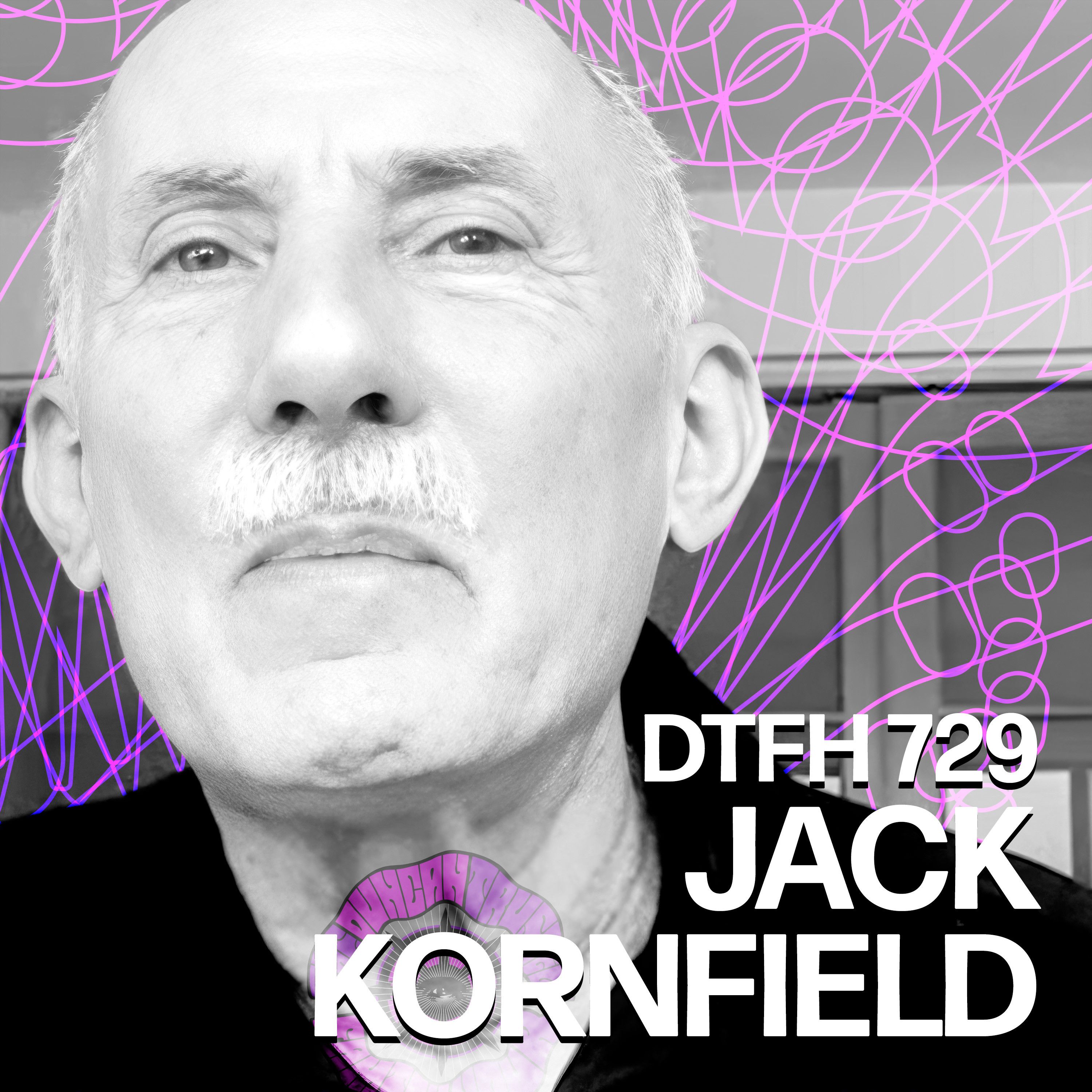
Greetings to you, my sweet friends, and welcome to the dtfh. Today we have an incredibly special episode with potentially one of the great Buddhist teachers living on the planet today. Jack Kornfield changed my life, and I am one of millions of people to say that he was a monk, came back to the United States, and much like Ram Dass, figured out a way to articulate the Dharma in a way that people like me could not just understand, but implement in our own lives. I've been lucky enough to see Jack give Dharma talks, and it's one of the most mystical, beautiful things to watch the effect he has on a room full of people. Everybody gets peaceful, everybody gets happy. And I still think about some of the things I've heard him talk about years ago every week. He is a brilliant, beautiful person, and we are lucky to have him on this planet. He just wrote a new book, all in this Together. Stories and Teachings for Loving each other and our world. So if you feel a little freaked out by the world right now, perhaps this conversation I had with Mr. Kornfield will make you feel a little better. So now, everybody, welcome back to the dtfh. Jack Kornfield. Jack, welcome back to the dtfh. It's really good to see you. Thank you. Great off mic. We were talking about. Jack was asking me, Aaron just had a baby. And the first question I had for you is based on the experience of being with a newborn, which is this mystical, heavy, beautiful experience. But Aaron saw this too, and this was probably less than 24 hours after the baby was born. This very deep look of sadness and grief and lucidity that was not a baby's sadness, like, came across this baby's face. It reminded me of, like, memes I've seen of, like, sad babies standing in front of the Buddhist wheel of life. Like, are you kidding me? I incarnated again. But in that moment, it really felt like some fleeting memory of whatever life she was in before this one. And I don't think we've ever spent very much time talking about reincarnation. And I was just wondering, what are your views on that.
- [03:03]
Jack Kornfield
First, I'm just with you, Duncan, in that extraordinary moment when a new human being pops out and says, okay, world, I'm here. I grew inside another person's body, my mom's body, and now I'm alive.
- [03:18]
Duncan Trussell
Yeah.
- [03:18]
Jack Kornfield
And they all come in. In character.
- [03:22]
Duncan Trussell
Yeah.
- [03:22]
Jack Kornfield
My daughter is a pretty sanguine person. She came out after long, difficult labor, but she was a.
- [03:31]
Duncan Trussell
Hold on. I lost you, Jack. Say that last sentence. Again, please. Sorry. It just flickered for some reason.
- [03:37]
Jack Kornfield
Yes.
- [03:38]
Duncan Trussell
Oh, that's better. Your audio is better too. I guess it flipped to your mic or something.
- [03:42]
Jack Kornfield
Go ahead. I flipped it.
- [03:43]
Duncan Trussell
Okay.
- [03:44]
Jack Kornfield
My daughter came out after long labor and she smiled. She was like a happy camper and that's her temperament. I remember working with a colleague who's really famous meditation teacher. And he'd always felt like he didn't belong here. And the earth was. It was like a bit of a trial. And he was doing his best and, you know, helping. And I said, well, you want to do a past life regression, which I do periodically. And he said, sure. And so we did this. Past life regression. I said, let's go back to your last life. And he was in this realm of light. He was like a deva. An angel. And I said, how is. He says, beautiful, but my light is beginning to dim and I can feel I'm moving toward another incarnation. So really talking about something incredibly mysterious.
- [04:48]
Duncan Trussell
Yes.
- [04:50]
Jack Kornfield
Because with this. Let's talk about. We're going to talk about death and birth. Is this okay? Can I keep going on this rift?
- [04:58]
RealReal Advertiser
So.
- [05:01]
Jack Kornfield
I was sitting with my father when he was close to dying. And he's. He was in the University of Pennsylvania where he had attended in the medical school, in the hospital. And he was terrified of dying. And he'd been a really difficult father. He'd been violent and a wife better and stuff like that. I'd come to terms with it. And he was my dad and I loved him anyway, in spite of it. And he was late at night. I'd been with him. He said, please don't go, don't go. He just wanted someone there, which we should have. Right when we're dying.
- [05:42]
Duncan Trussell
Yeah.
- [05:43]
Jack Kornfield
And I said, so what's going on? He said, he didn't say I was terrified, but he could see his eyes. It's really scary. And he kept looking at the monitors which he'd helped design to see if he was still alive or not.
- [05:57]
Duncan Trussell
Wow.
- [05:58]
Jack Kornfield
So I said to him, what do you think happens when you die? And he said, nothing. You go back to dirt. That's what you are. He was, you know, a materialist and a scientist. The brain does it. And I said, well, let me tell you a few things, Dad. I said, I trained in a monastery and I had these out of body experiences where I could float out of my body and see things happen at a distance in the monastery. And later I checked him out. That's what happened. I said, I've sat with a lot of people on the edge of death in hospice. And they'll leave their body and, you know, flirt with death, go to. And then they come back and talk about it. I've done past life regressions around the world. It's not my main thing, but I do it for fun. And people go back to different lives. I said, the thing is, you think you're your body, but the reality is you are consciousness that was born into this body. You're the play of consciousness. And when you die, what will happen? And this is in all the near death literature, from the Tibetan Book of the Dead to the Egyptian Book of the Dead to the Ars Moriendi in the Middle Ages. When you die, you're going to float out of your body. You'll probably kind of take stock and say, wow, that was quite a ride. Because that's what people report, right? Wow. And then you start to move toward the next step or the next incarnation. And I said, you're a scientist. You have to be open minded. This is an experiment. See what happens. I talked to Dalai Lama about this. I said, what do you really think happens? He said, I don't know, but I'm very excited to find out. So I said to my dad, if this happens, remember I told you so.
- [07:55]
Duncan Trussell
Yeah, yeah. I mean, the reality is not enough people get to be around dying people and not enough people get to be around new people. And something about those two components missing. I think it would create a real materialistic view of reality if you don't see the bookmarks in any human life. But that experience of being around a new person is not that far away from being around a person who's about to die.
- [08:37]
Jack Kornfield
They're the same. We have these portals into the mystery. When you're with a newborn, there's some sense of the miracle of life rebirthing itself. And Trudy, my beloved wife, was very young as a mother and somehow found herself alone in a hospital back in the early 60s, in a time when birth wasn't explained. She didn't even know what really hell was going to happen.
- [09:02]
Duncan Trussell
Yeah.
- [09:03]
Jack Kornfield
And a lot of pain and a lot of difficulty. And then she cracked open and she felt her body be in the stream of 10,000 generations of women who were all birthing the planet. And it was her first big mystical experience that what we are is this Earth re giving birth to itself. So there's that. There's a mystery at birth that you're attending to. And it's the same death as a kind of birth. You sit there and it's the birth from this body into the spirit. And if you sit with someone when they're dying, there's a moment when the spirit consciousness leaves the body silent as a falling star. And something momentous has happened. And that body is not a person anymore. And that's not who you. You're not your body and you're not your history. And I think about Ram Dass. When he was first teaching and he was on stage, he'd come back from India with his beard and his white robe, Baba Ram Dass, and be here now. He became very famous. And there was a woman in New York who shook her hands in the first row and said, ram Dass, are you Jewish? You know, what's with all this Hindu stuff? You can picture it, you can picture the lady. Come on, Ramdas, let's get with it.
- [10:31]
Duncan Trussell
That's a perfect heckle. Sorry to cut you off.
- [10:34]
Jack Kornfield
Yeah, yeah, yeah. He said, yeah, of course I'm Jewish. He said, so what's with it, Ram Dass? And he said, listen, he said, I was bar mitzvahed, you know, I. There's beautiful things in the Jewish tradition. There's the Hasidic mystics and there's a Kabbalah and things. So I love it. It's really beautiful. But then he looked back at her and he said, remember, I'm only Jewish on my parents side. Which was witty, which she was, but also really deep. Because who you are in this life is not limited to your family or your history. Who you are is something timeless. And we know it when we make love. Sometimes, if we're lucky, when we're climbing in the high mountains, when we sit with someone in that mysterious moment of coming in or leaving, you know, or listening to a music that you dissolve into and realize you're not just this body or this history. You are consciousness, right? That's who you are. You are spirit and we know it. And the society distracts you. In fact, Alan Watts said, most of religion is an inoculation against the mystery. Wow.
- [12:00]
Duncan Trussell
This episode of the DTFH has been brought to you by my friends at Factor. And I do mean friends, let me tell you, when your wife gives birth, you become like the person who has to like cook for her. You know, we did a home birth. She needs good food. It's your job. You gotta bring her stuff where she could turn that good food into breast milk for the baby, which is one of the great miracles if you consider it. And Factor is perfect for things like that. It's amazing. I have to. When they sent Me, the first meal kit. Honestly, I was very skeptical. Like as most of us, I've had shitty experiences with food you put in the microwave. So you're thinking like, there's no way microwave food can be good. Factor completely destroys that myth. It's not normal microwave food. This is fresh food and it is freaking delicious and filling and they've got something for everybody. If you're diabetic like me, you know what a pain in the ass it is just to find stuff with tons of protein to eat. And it's really easy to get lazy and be like, fuck it, I'll eat a bagel. And then your blood sugar shoots out of control. Factor fixes that. You could just throw a factor protein plus meal into the microwave. Boom. You're getting delicious food. And I. And it's not just cause they're giving me money to say this. I'm telling you, it's like restaurant food. It is fucking great. Their ingredients include lean proteins, colorful veggies, whole food ingredients and healthy fats. No refined sugars, no artificial sweeteners, no refined seed oils. And it's just we're all in such a hurry these days and to be able to like quickly make delicious healthy food, it is luxurious. They have 100 rotating weekly meals for you to pick from. Always fresh, never frozen. And I love them. Head to FactorMeals.com Duncan50OFF and use code Duncan50OFF to get 50% off your first Factor box. Plus free breakfast for a year. Wow. Offer only valid for new factor customers with code and qualifying auto renewing subscription purchases. Make healthier eating easy with factor. Thanks Factor. Yeah, that mystery. It does somehow seem. Maybe this is too heavy a word, but it seems antithetical to the way we're living in the world, that experience. It is interesting that when you're around someone who's dying, it's not like you're dying. Your heart might be breaking, but there is this ego dissolution that seems to be happening with them. And when I'm around this baby, it's easier to shift into that pre linguistic state around this baby. And I guess this makes me only because you've been. You're friends with the Dalai Lama.
- [15:32]
Jack Kornfield
You've and I sat in charnel grounds. And part of the monastery training was to sit and picture your own body as you watch another one burn.
- [15:43]
Duncan Trussell
But when you're like your teacher.
- [15:46]
Jack Kornfield
Yeah.
- [15:47]
Duncan Trussell
Did you get that same sense being or some of these monks or any of these people you've encountered along the way? Does it feel like you're Around a dying person or someone who was just born. But they're middle aged, they're not dying. Is that what actualized beings look like? Big talking babies?
- [16:15]
Jack Kornfield
I love your description. I think we're all big talking babies.
- [16:18]
Duncan Trussell
Babies, definitely.
- [16:20]
Jack Kornfield
I think there's some people that are closer to the mystery. You know, we get pulled off. And in India there's a saying that a baby gets born and saying, do not let me forget who I really am. And then the second thing they say is, oh, I'm forgetting already. Oh, wow. Because there's a kind of veil of things seem so real. And they are. And this is the thing. And Ram Dass again, just for whatever reason quoting him because he was so good, he said, you have to remember your transcendent nature, your true nature and your Social Security number.
- [16:59]
Duncan Trussell
Right?
- [17:00]
Jack Kornfield
Right. You have you. This is the human dilemma in some way. But there are people. And it doesn't have to be some fancy ass mama llama, swami, whatever in my industry. I know a lot of them, some are cool, but there are people who are close to the mystery who know that that's true. And I was sent a poem by this Australian stockman who's kind of an elder, you know, spiritual elder. And he sings a kind of song. And I certainly wouldn't do it as his accent, but he says, I tell you this story about the way you feel. Listen carefully. This. You can hear me, I'm telling you. Because Earth, just like mother and father and brother of you. That tree, same thing. Your body, My body, I suppose, same as you. Anyone, time, wait. Tree working when you sleep and dream. Daytime, sun working for you. And he goes on the stars up there, see, he's working. I can see it at night. You lie down, look, careful. He working. When you sleep, bloody pumping you. Look the star, he go pink. He come white. See him working in the night. You dream, you lay down that star. He working for you. Tree, grass, all working for you. And there's something so beautiful that he's saying you're not alone. You're woven into this life that's keep pulsing and keeping you alive. This is somebody who's close to the mystery.
- [18:46]
Duncan Trussell
And this, that view, yeah, you hear it in like shamanic traditions, but that view that humans have, this distortion because the way we quantify intelligence is based on some kind of technological production accruing stuff. But when you look at it from that perspective, that tree is just doing its thing for everything else. It's just purely giving the sun, purely giving the grass, purely giving the stars Just giving. Then you realize, yeah, you don't have to go to India to find some guru. Just find the closest tree. There you see a very advanced being, something that is fully in. Gauged in just giving itself to everything. Chop it down, doesn't care. By the way, the Giving Tree. Have you read that? Did you ever read that? My God, I read that.
- [19:48]
Jack Kornfield
I read the children's literature.
- [19:50]
Duncan Trussell
I read it the other day. I didn't know. I didn't know I'd heard it was good. I'm reading it to my kid. By the end of that book, you're just like, what are you doing? This is making me cry. You know, it does seem to sum up the other thing that goes along with the fantasy of the actualized being, which is fully in service to everything else.
- [20:15]
Jack Kornfield
Well, and, you know, being around children, you now have four.
- [20:20]
Duncan Trussell
Four.
- [20:21]
Jack Kornfield
Yeah. Being around children at their best, when they still have that connection, sometimes than young and mysterious and, wow, how did I get into this incarnation? Whoops. This was a mistake. I like the last time, like your new baby or that teacher or sometimes like my daughter. Great. This is, you know, I'm here for Earth. Let's see what happens.
- [20:45]
Duncan Trussell
Yeah.
- [20:45]
Jack Kornfield
But there is. We have. It's called the Child of the Spirit. And there's something beautiful in the Buddhist practices of joy to remember that what was born in you also was the child of the spirit that can't be taken from you.
- [21:02]
Duncan Trussell
Right.
- [21:03]
Jack Kornfield
If you think back to the most happy times, even people who had terrible childhoods, you know, rolling grass and tickling and laughing and stuff that there's a spirit of. Wow, this is amazing. That's always in there.
- [21:17]
Duncan Trussell
Yeah.
- [21:18]
Jack Kornfield
And anyway, I want to read a little poem from Fadi Judah. My daughter wouldn't hurt a spider that had nested between her bicycle handles for two weeks. She waited until it left of its own accord. If you tear down the web, I said, it will simply know this isn't a place to call home. And you'd get to go biking. She said, that's how others become refugees, Isn't it, Mom? And there's some part of us that knows that there's a huge mystery and children can be very close to it and remind us of that. Also because of the free spirit of play. Otters play and raccoons play and baby foxes play and bears play.
- [22:14]
Duncan Trussell
Yeah.
- [22:14]
Jack Kornfield
You know, and what is play? What is it? It's the universe saying, hey, baby, we're here.
- [22:22]
Duncan Trussell
Yeah. Yeah. And again, like, maybe I've just been watching the wrong stuff. But all of the things you're describing.
- [22:29]
Jack Kornfield
Yeah.
- [22:30]
Duncan Trussell
These stand in stark contrast to the adult world, to a world of treaties, to a world of tariffs, to a world of borders, to a world of laws, to a world of power. You know, all the. Which is, you know, somehow these two things are working together, but one seems like it would be quite pleased to get rid of the other. Well, you know, one.
- [23:03]
Jack Kornfield
That's not how it works. We're in the dance of joy and sorrow and birth and death and hot and cold and sweet and sour.
- [23:12]
Duncan Trussell
Yeah.
- [23:13]
Jack Kornfield
And pleasure and pain. And that's what it means to come into form in this universe. If there's birth, there also has to be death. Otherwise everything would just be light, eternal. That's cool. But to have. Actually, to have form means things are changing and things are born and they die. And this is the revelation from the Buddha that all things arise and pass away.
- [23:38]
Duncan Trussell
Yeah.
- [23:39]
Jack Kornfield
And we, when we make our peace with it, there's this beautiful chant that we do in the monastery. When you make your peace with that, there is a joy that comes because you feel the eternal game and you realize who you are is not this little separate person that you've been taught to, you know, buy things or, you know, climb the ladder or identify with your people as different than other people. But when you get quiet, you realize deeply you're part of this whole game and you get to open and soften. And in these times, you're talking about, you know, the political conflict and the continuing warfare and racism and all those things. And two things to say. First of all, no amount of technology, not AI and not computers and Internet and space technology and biotech is going to stop continuing warfare, continuing climate change, continuing racism and destruction, because they're all born in the human heart. And unless the human heart awakens to this mystery, we're going to keep repeating that. The beautiful thing is, even though it can feel like a difficult time at the moment, the great explorer Wade David said, despair is an insult to the imagination.
- [25:15]
Duncan Trussell
That's awesome.
- [25:17]
Jack Kornfield
And Gandhi says, when I despair, I remember that all through history, the way of truth has always been. And love has always won. Yes, there have been murderers and tyrants, and for a time, they can seem invincible, but in the end, they always fall. Think about it. Always. And so there's a bigger truth. And really it's the truth of love. Not that I'm preaching love, but love is like gravity. We are love, we are connected.
- [25:53]
Duncan Trussell
Right?
- [25:54]
Jack Kornfield
And then we act out in ways out of fear. You could say, okay, there's Love and fear. Fear comes from separateness.
- [26:00]
Duncan Trussell
Yeah.
- [26:01]
Jack Kornfield
When. When we feel separate, we're afraid.
- [26:03]
Duncan Trussell
Right.
- [26:04]
Jack Kornfield
And that's one chat. That's one dimension of consciousness. You know, you have to protect your body from the, you know, the wild animals from going back thousands of years or whatever.
- [26:15]
Duncan Trussell
Yeah.
- [26:15]
Jack Kornfield
And the ones who. Who see, realize, oh, we're part of this gorgeous, difficult, amazing, mysterious dance. Right. And then. Okay, I'm not preaching a philosophy, you might believe it, but it brings a certain kind of joy. It brings when you talk about, you know, the sages and the wise people and so forth. My experience mostly is that they're really happy.
- [26:50]
Duncan Trussell
Yeah.
- [26:51]
Jack Kornfield
Here's that. That beautiful book of. Called the Book of Joy. The meeting of Dal, Dalai Lama and Archbishop Tutu. And they're teasing each other, and the Tutu is, you know, patting the Dalai Lama's head and the Lamas reaching, tweaking, tweaking Tutu's nose. And, you know, they said, we're supposed to be holy men. And they just break out in laughter. And somebody says, adalai Lama, wait until apartheid. All these people you cared about were killed. You know, there was so much divisiveness for years. It was so horrible. And you, Dalai Lama, you've lost your country. You can't go back. They've closed the monasteries. And he said, yeah, they've imprisoned our monks and nuns. They taken our sacred text and burned them. They've taken so much. Why should I let them take my happiness?
- [27:44]
Duncan Trussell
Yeah. Yeah. You know, that is where I think mysticism becomes a kind of revolutionary technology, which is, of course, that's the. To me, that's the place you start zeroing in on, is there is an entire universe that is unquantifiable, unmonetizable. You can't tax it, you can't take it. You can't punish somebody by removing them from it. And when you stumble upon that, it really is a delight. It's hilarious, too. And somehow to me, only because I am neurotic, there's a real sadness that goes along with it. There is a. I don't know how to put it. It's sweet, but, man, there's something so poignant about it, and I hate to say it, you'll probably disagree. Tragic. There's something tragic about it that right next door to everyone's twisted, sad, warped, confused, distorted, deluded heart is this place that you're talking about, this place, regardless of whatever is going on geopolitically, interpersonally, there it is all the time. And I don't Know that Always. Maybe I'm just a party pooper, Jack, but whenever I stumble upon that thing you're talking about, I always feel like crying. It makes me sad. And then I don't want to feel it anymore. Friends, I want to invite you to check out Giordano Bruno and the Hermetic Tradition. This is the definitive book on Renaissance occult studies, hermeticism, and Renaissance philosophy. Not only serves as a great introduction to the intellectual milieu of the Renaissance, but it also bridges the gap between the late Renaissance magical thinking and the dawn of Enlightenment rationality. Giordano Bruno in the Hermetic Tradition profiles the fascinating outsider Giordano Bruno, who lectured on cosmology, philosophy, and memory, among other topics. These ideas led to his eventual arrest by the Roman Catholic Inquisition, where he was held captive and interrogated for seven years. Bruno refused to recant his ideas on theology and the universe, and. And was subsequently burned alive in 1600. His death marked the end of the Renaissance, and he remains a martyr to this day for syncretism, mysticism, free speech, and science alike. Let me tell you, this book is awesome. They sent me a hardcover copy of it. It's a limited edition. When they made it, they only printed 2,500 copies. And. And only 200 copies remain, and I've got one of them. You could have one of these last 200 copies. This book is incredible. If you want to feel like you possess an actual powerful grimoire, which this thing is, but you want the weight of a magical book. Or if you know someone who's into this stuff, it's a great gift, and you should definitely check it out. Copies are available for only 60 bucks at Gallowglassbooks Shop. That's Gallowglassbooks Shop.
- [31:44]
Jack Kornfield
So. Okay, a few things. First of all, you, like Ram Dass, are a public neurotic.
- [31:52]
Duncan Trussell
Yes.
- [31:53]
Jack Kornfield
And in some way, it helps because you say, oh, okay, you know, Ram Dass will say, I flunk the course. Right. Yeah. And. And. And we go, oh, I'm not the only neurotic person in the world, because what you're. What you're giving voice to is also is the suffering.
- [32:10]
Duncan Trussell
Yeah.
- [32:10]
Jack Kornfield
Which is the Buddha's first noble truth. First noble truth is there is suffering.
- [32:14]
Duncan Trussell
Yeah.
- [32:15]
Jack Kornfield
And it's kind of a relief to have a deep realization of it because it doesn't mean you did something wrong. You know that it's not your fault.
- [32:24]
Duncan Trussell
Right.
- [32:24]
Jack Kornfield
Right. I know, Duncan, you're powerful, but this is, you know, it's just the nature of things.
- [32:30]
Duncan Trussell
Yeah.
- [32:31]
Jack Kornfield
And then it goes on to say there are two kinds of suffering in the world. There's the pain that is just woven into birth and death and joy and sorrow and pleasure and pain and gain and loss and aging and death. That's just the natural fact of things.
- [32:49]
Duncan Trussell
Right.
- [32:50]
Jack Kornfield
And you could grieve about that because you love people and they die and so forth. But basically it's a description of duality. And then.
- [33:00]
Duncan Trussell
Right.
- [33:01]
Jack Kornfield
The real suffering is what we add to it. I want it to be different. I don't want it to change.
- [33:08]
Duncan Trussell
Right.
- [33:08]
Jack Kornfield
I don't. I. I hate this, you know, and I long for that. And the. The beauty when I invite people who are listening and you. To remember a time in your childhood when you were rolling down the hill on the ground. When you're teasing or tickling or something like those trees, nobody can monetize it because it's just. It was born in you, the child of the spirit.
- [33:34]
Duncan Trussell
Yeah.
- [33:35]
Jack Kornfield
And there's a kind of innate freedom. And yes, earlier that day, you might have had something difficult, but who you are is so much bigger than that. And then the thing that changes it is when you love your neurosis instead of judging it. And even, you know, when it's love turns to compassion, when you see all the ways that beings are suffering and causing suffering.
- [34:06]
Duncan Trussell
Yeah.
- [34:08]
Jack Kornfield
And you were saying it, and you realize it doesn't, you know, doesn't make sense, but they're lost. It makes the heart tender. And then we're in it together. We're on this amazing human ride. And the heart becomes so tender because you look at all sides and you say, how did it get there? And you go back in the history of Russia and Ukraine or in the history. And you go, oh, these people. Oh, my God, they've been. Or the. Whatever it is. And instead of the judgment, there's kind of an awe that we can survive through this. And the children are born and they roll down the hills and they tickle and they laugh and. And we have that, too, because the world is unbearably beautiful along with the ocean of tears. And that's the hand you're dealt, baby.
- [35:01]
Duncan Trussell
Yes, it is. And you see it when you. When you. Like, I mean, you as a parent, you know that the thought will. Maybe not. I'm sure with you, the thought does come into one's mind. What if something happens to this kid? You can't even fathom the heartbreak, you know? And you at that moment, get a glimpse of how vulnerable you are to this impermanent nature of things. How. Yes, that's and, yeah, you know, you've known unbearable things.
- [35:45]
Jack Kornfield
That's the worst.
- [35:46]
Duncan Trussell
That's the worst. And I've had a ball chopped off. And at that moment, to not respond with tightening up, battening down the hatches, scanning for all potential dangers in the environment, always on the lookout is very difficult. It's very difficult to not shoot shadow that experience of pure love with pure, absolute fear that something might happen to this beautiful being, even though, you know something will happen.
- [36:24]
Jack Kornfield
So there's that. There are also the moments when they act so difficult that that impulse arose in me. I want to take this kid and throw her out the window and just be done with her. So they bring up every part. And what's beautiful is that you're describing a kind of pure love that's there that we have and that's, you know, that's part of who we really are. Unless we have had some such significant conditioning, drama, whatever, that doesn't give us access to it. But there you are. You love. You would give your life for your kids. I would, you know. And what is that now? That is something way beneath all the other things that we talk about, the depth of that love.
- [37:18]
Duncan Trussell
You do it in a second, wouldn't it?
- [37:20]
Jack Kornfield
Just like. Yeah, just like it's the depth of. Know that joy that that child has at times that's still in you in some way. And so you have all that. And part of, you know, part of your game as a public neurotic or whatever you are, is, you know, is to give voice to all of this and not be afraid to talk about also how painful it is. Because it is painful.
- [37:47]
Duncan Trussell
It is.
- [37:49]
Jack Kornfield
It's. You know, some of it's unbearably painful, the loss of a child. And that fear, of course, you live with fear for your children that something could happen. I certainly have and do and would. And my daughter, when she was working in Cambodia after college for the world, whatever they were doing, kind of a world court, and she had some real difficulty and she, you know, emailed me or contacted me and I said, I'll get a plane tick tomorrow, I'll. I'll be there, you know, because we would do that. Yeah, we will do it.
- [38:29]
Duncan Trussell
But we won't do it for other people's kids. And that's where it gets weird.
- [38:36]
Jack Kornfield
May. Yes, maybe I would get on the plane, but I'm not sure I would give my life for another person's child. That's exactly correct.
- [38:45]
Duncan Trussell
That's right. That's where it gets.
- [38:46]
Jack Kornfield
Isn't that Isn't that mysterious? That's really mysterious.
- [38:51]
Duncan Trussell
That's right.
- [38:52]
Jack Kornfield
But there's something about love that says it's almost like, what can you touch? And, you know, you expand your circle of love and compassion in this deep way, but the willingness to sacrifice everything is such a mysterious thing. You know, I'll give my life for this other person. I mean, honestly, in the military it becomes a really important quality and people forget about it when they look at, okay, our military expeditions and the wars and all the horror that are with it. But the reports, the words from people from the battlefield is that they weren't dying for their country or their patriotism or their cause. Most of the time they're dying or they're putting their self out there for their comrades and their buddies that they trained with. Right. And they become a family.
- [40:00]
Duncan Trussell
Right.
- [40:01]
Jack Kornfield
And so the game is to. Einstein said it is to. Why in the circle of compassion, to see that the world is your family.
- [40:14]
Duncan Trussell
That's it. You know, you should check out my new book.
- [40:17]
Jack Kornfield
And then you say, well, Jack, you.
- [40:18]
Duncan Trussell
Should check out my new book. It's called all in this Together. And it kind of covers some of the things that you're talking about here.
- [40:27]
Jack Kornfield
It does. It's a book about responsibility.
- [40:29]
Duncan Trussell
Oh, you have my book.
- [40:31]
Jack Kornfield
It's mostly storytelling. Exactly. I'll tell you one, like, very, very brief story. There's lots of long stories of, you know, of the Dalai Lama or of, you know, great tales of King Arthur's court and what women really want. Which is a great story because one would like to have the answer to that. Yes, but there's little stories too. Like this kid goes, 7 year old goes into a restaurant, or 8 year old with his mom and dad. And the waitress comes and says, what will you have? She turns toward the kid and he said, I'd like a hot dog and a Coke. And his mother says, he will have the meatloaf, the mashed potatoes and some milk. She takes all the orders from the other adults at the table. And as she's leaving the table, she turns to the kid and said, you want ketchup or mustard on your hot dog? And he beams and he says, she thinks I'm real. And that's part of the book is reminding us of our inner nobility, that no matter where we are, there is a kind of dignity to your humanity. And it's to be treasured and to be valued. And part of what meditation does, it reminds you that it seats you in yourself in the middle, in your. Opens your heart to your Very own life which lets you love other people.
- [42:00]
Duncan Trussell
Why?
- [42:00]
Jack Kornfield
And the world.
- [42:01]
Duncan Trussell
Why is this? You know, I. It haunts me, this Krishnamurti dialogue with. I think it was Chogyam Trumpa. And Krishnamurti, I believe, was saying to Choghamsha Rinpoche, why are you bothering people with this meditation stuff? Like, why meditate? You know you're.
- [42:32]
Jack Kornfield
Foreign.
- [42:39]
Duncan Trussell
This episode of the DTFH is brought to you by Blue Chew, the boner sorcerers who have just created something incredible. Bluechew Gold is the newest innovation from the number one chewable Ed brand. Bluechew Gold dissolves under your tongue and works in as little as 15 minutes. That means you can get it on quicker and stay in the game longer elevation without hesitation. You don't want to wait an hour, 45 minutes to get hard. This is quick. This is science. This is pre singularity technology. And let me tell you, friends, it works really, really well. I'm an aging acid head, friends, who stays on social media too much. I am not ashamed to say that I slurp back blue chew tablets whenever I need them with no shame. Are you a Luddite? Do you use candles in your house? Because that's what you're like. If for some weird reason you feel like you shouldn't take advantage of this incredible powerful magic. Jump into the future with BlueChew. Make life easier by getting harder. And discover your options@bluechew.com and we've got a special deal for our listeners. Get 10% off your first month of BlueChew Gold with code DUNCAN. That's promo code DUNCAN. Visit BlueChew.com for more details and important safety information. And I thank BlueChew for sponsoring this podcast. Isn't it hard enough without having to add to it? You know how Krishnamurti was. You know, he's very like stern.
- [44:46]
Jack Kornfield
He was a curmudgeon. He was stern. He was actually a world famous curmudgeon. A spiritual curmudgeon.
- [44:52]
Duncan Trussell
A spiritual curmudgeon. We needed him. It was a good balance.
- [44:55]
Jack Kornfield
But he was a very important teacher and he was a curmudgeon.
- [44:59]
Duncan Trussell
A curmudgeon. But also, though I don't look at it the way he looked at it, which is like he was like acting like Buddhists were recommending some extra chore to reality. But it always astounds me when I finally get back on the cushion how incredible that moment is. And yet I don't want to do it. I don't want to meditate. I don't want. This is I guess the bullseye of my neurosis is that I recognize and have experienced this beauty that you are like, that you are a master of reminding people of. But I don't actively pursue it.
- [45:51]
Jack Kornfield
So, first of all, meditation can kind of get into the category of I have a good diet, I go to therapy, I work out, and it's like a new duty, a grim duty, okay? I have to effing meditate in order to become whatever I'm supposed to be, right? And actually, it's not a grim duty. Now, the thing to do with what you're saying is to get curious. It's not like you should meditate. I mean, the point of meditation is just to be here, so you can actually be here for this life, for yourself, for the things you care about, to be freer, rather than lost in all that tumult of worry or whatever. And so when you notice the resistance. I'm always interested in resistance. Instead of getting rid of it, say, something's cooking underneath, and what is it? And maybe if you pay attention a little bit, you notice it's the fear I have with my new child that was born. How will I be able to take care of all my children? And then, if you open to it, you name it, you say, this is not just your fear, Duncan. It's. You are woven with all the fathers of the earth, all the mothers of the earth. And you go, oh, okay, I can hold this. And I can sit and breathe, and great compassion comes. Or you notice that I don't want to sit because my mind is racing and I hate, you know, sitting in the middle of my racing mind because I don't want it to race. And then you say, how about if I just love it? Okay, baby, you're in a hamster wheel. You're running around, say, thank you. Thank you for trying to protect me, which is what it's doing. Thank you for trying to keep me good and make some money and be safe. Thank you. You can relax. We're just going to sit. So you shift from trying to change who you are to put your hand on your heart. Sorry, this is a little bit too, you know, West Coast.
- [47:52]
Duncan Trussell
I love it.
- [47:54]
Jack Kornfield
But you sit and you make a field of presence and courage, and it's really the courage to love it all and say, okay, I'm going to sit and love the whole, you know, the whole whatever. So this is from Laurie Chapman. She writes, I like nothing more in the world than sitting on my ass doing nothing. Right? So already this is like the instruction. If you want forget Krishnamurti and Jodi from that. They're both on the wrong page here. Laurie's got the teachings, and it's not my fault that I have this attitude because I happen to have an amazingly comfortable ass. It may not look like much, but if you could sit on this baby for two minutes, you'd realize that getting off this ass would be a crime against nature. All right, so there's your meditation instructions.
- [48:47]
Duncan Trussell
I don't have an ass.
- [48:49]
Jack Kornfield
Yeah, well, you got something under there. Maybe you are an ass, right? Not only you have one, you could actually be one.
- [48:58]
Duncan Trussell
Jack, I'm so excited to read your book. You know, your books have been fundamental to me and so many to my mom, to so many people. I'm sure thrilled to hear that we've got a new Jack Kornfield book coming out. And thank you. I'm really excited because at these Ram Dass retreats, it's the story. You just have this fountain of the most beautiful stories and you're so good at telling them. And, you know, it's a wild thing to be in a room when you're teaching.
- [49:35]
Jack Kornfield
Well, you know, stories are what keep us together. Muriel Rukhyser, the poet said the universe is made of stories, not atoms. Right. And that there's some way we know who we are through our stories, what we tell each other. This is the. So I want to read you a short one page little piece of a story. Story. Because it ties together the notion of stories, and I think it's in this new book. But also the question of despair and the difficulties of our times. And the Bodhisattva vow that says, I vow through the ups and downs, the joys and the sorrows of the bed, to keep a compassionate heart, to hold everyone in the heart of compassion. Tell me the weight of a snowflake, a tiny mouse asked a wild dove. Nothing. More than nothing, came the answer. In that case, I must tell you a marvelous story, the mouse said. I sat on the branch of a fir tree close to its trunk when it began to snow. Not in a blizzard, no, just like in a dream. Without a sound, without any violence. And having nothing better to do, I counted the snowflakes settling on the twigs and branches of the tree where I sat. Their number was exactly 3,741,952. When the 3,741,953rd Snowflake dropped onto the branch, nothing. More than nothing, as you say, the branch broke off. And having said that, the mouse went away. And the dove, a spiritual authority since the time of Noah, thought to herself, perhaps there's only one person's voice lacking for peace to be created on this earth. Wow.
- [51:53]
Duncan Trussell
New Year, same extra value meals at McDonald's now get a savory sausage McMuffin.
- [51:58]
Jack Kornfield
With egg plus hash browns and a.
- [52:00]
Duncan Trussell
Small coffee for just doll.
- [52:03]
Jack Kornfield
Limited time only. Prices and participation may vary. Prices may be higher in Hawaii, Alaska and California.
- [52:07]
Olive and June Advertiser
And for delivery, raise your hand if you want your nails to look perfect all the time. Me too. I'm Sarah Gibson Tuttle from Olive and June. And this is exactly why we created the MANI system. We wanted to make it possible for everyone everywhere to give themselves a beautiful manicure at home with our tools and our long lasting polish. Each manicure with our mani system comes out to just two. $2. That's right, $2. No more. 30, 40, $50 manis that you get at a salon and they take hours. Now you can paint your nails on your time and love them more than ever. And by the way, when people ask, who did your nails? Where did you get them done? You're gonna proudly say, I did them myself. Get 20% off your first mani system with code DIY nail20@oliveandjeune.com DIYnail20. That's code DIY nail20 for 20% off@olivendjune.com DIY nail20 Jackson we don't know.
- [53:06]
Jack Kornfield
It's too mysterious. We do not know.
- [53:09]
Duncan Trussell
Wow, that is so cool. Where does that story come from?
- [53:15]
Jack Kornfield
It's Kurt Kauer and I think it's in my new book. And the thing is that, honestly, we don't know. Somebody asked Somerset mom, you know famous British novels about being an ollist? He said there are three rules for writing the great English novel. Unfortunately, no one knows what they are. And I mean, that's our position, right? What we get to do. It's not given to you that you're supposed to save the world. God spare us all, or whoever, Buddha or something, or fix it. What we get to do is reach out and mend the places that we can touch to offer our seeds of intentions, of goodness, our care. And that transforms the world. Like that story that becomes the next snowflake. And it happens in the smallest ways. And we tend to think these giant problems, but it really also is hand to hand and heart to heart. Yeah, and heart to heart with the trees as that or Australian stockman said, the tree working for you. The stars are working for you. Every breath you take, you exchange with the trees around you and the practice of meditation and feeling your breath isn't like, okay, now I can concentrate, and I'm feeling my breath. Okay, cool. So what? But to feel that you're breathing with the whole. The world is breathing you. And that the breath you take in also comes from the people in your family you're exchanging and your neighbors and the raccoon in the backyard and the earthworms. And it also dusted the Rockies and Mauna Kea and the Fukushima nuclear reactor. And we're all breathing together. And then you remember, oh, here we are. Let's hold. How do we want to hold this? And you come back and the beautiful thing. It's kind of like resetting your intention. If you're in conflict in an argument, say. And I mean, it wouldn't happen to someone at my level, never. In case Trudy and I had some little tip right away. Should it happen in the moment that you're struggling, if you take a breath, it's called a mindful, the sacred pause. Just one breath in 30 seconds and you tune in, you ask yourself, what's my best intention? What's my highest intention? And usually if there's a conflict, there's a part I want to be right. I know I'm right and she's not, or they're not right, and I am. You know that.
- [56:03]
Duncan Trussell
Yeah.
- [56:04]
Jack Kornfield
And then I remember, oh, my best intention is that we love each other.
- [56:08]
Duncan Trussell
Yeah.
- [56:10]
Jack Kornfield
And immediately my tone of voice changes my spirit. I'm not trying to win a contest anymore. I'm trying to connect. It's not far away, right? That's all right. And then people say, yeah, but the world is harsh, and what happens if you encounter and whatever. There's a really beautiful story in this book about an aikido master, Terry Dobson, meeting this belligerent tough on a subway in Japan when he was training in martial arts. And Terry's like, I'm going to take him apart. And just as he's about to do it, this old man sitting there with his wife. Just come here a second. To the belligerent guy who's drunk. Tell me what you drink. And we like to drink sake. And all of a sudden, instead of that conflict, that moment of attention and connection changes the entire game. It's an amazing story, and a friend of mine is actually going to go make a film of it in Japan. But we can change this world in a moment.
- [57:22]
Duncan Trussell
I mean, that story, right? It ends with that drunk weeping with.
- [57:28]
Jack Kornfield
In the lap of the lap of this old man and his Wife talking about sitting under their persimmon tree because.
- [57:35]
Duncan Trussell
His wife had just died, you know.
- [57:38]
Jack Kornfield
And then he says, you know, he says, yeah. He says something about how, you know, how sad he's. How sad he's been because his wife has died and he doesn't have any friends and so forth. Says, they're there. Come over and sit with us. And that moment, that incredible moment of connection here, I read you another poem.
- [58:02]
Duncan Trussell
Great.
- [58:02]
Jack Kornfield
Okay. This is from Stella Nasonovich, called Everyday Grace. It can happen like that meeting at the auto repair, buying tires amidst the smell of rubber, the grating sounds of jackhammers and drills. Anywhere we share stories, grace flows between us. The tire center waiting room becomes a healing place as one speaks of her husband's heart valve replacement, bed sores from complications. A man speaks of multiple surgeries, notes his false appearance as strong and healthy. I share my sister's death from breast cancer, her youngest, only seven. A woman rises, gives her name, Mrs. Henry, then takes my hand. Suddenly an ordinary day becomes holy ground. And that's also who we are when we pause in our busyness, which is what meditation does, it says, you can pause and hold all this in your heart.
- [59:16]
Duncan Trussell
You're the best. Jack. I cannot thank you so much for giving me your time. You are just. That is. Listen, everybody out there, even if you haven't had your baby yet, listen to this. A week after you have a baby medicine. Thank you so much. Your book is out now. All in this together. Is it out?
- [59:43]
Jack Kornfield
It is. Guillaume Apollinaire, the great French philosopher, said, now and then, it's good to pause in your pursuit of happiness and just be happy.
- [59:54]
Duncan Trussell
Ah, yes. Thank you very much.
- [59:59]
Jack Kornfield
It's radical for you curmudgeons.
- [60:02]
Duncan Trussell
Yeah.
- [60:02]
Jack Kornfield
No, you can enjoy being a curmudgeon. I know you do. You actually love that. I absolutely do despair.
- [60:09]
Duncan Trussell
I do. It's good.
- [60:12]
Jack Kornfield
You can be happy in it. Savory. That's good.
- [60:15]
Duncan Trussell
I'll die. I'll cease to exist anyway.
- [60:20]
Jack Kornfield
You? Yeah, you'll like I said to my dad, you know, you wait, you'll see. And remember, I told you so.
- [60:29]
Duncan Trussell
Jack Kornfield, everybody. His new book, all in this Together. All the links you need to order that book will be down below. Also, Jack is one of the great dharma teachers in the world right now. Sorry if that. Sorry for that, Jack, but it's true. So anytime you get a chance, I'll take my daughter.
- [60:49]
Jack Kornfield
She'll straighten you out.
- [60:53]
Duncan Trussell
Thank you, Jack. You're the best.
- [60:55]
Jack Kornfield
Thanks, Tom.
- [60:56]
Duncan Trussell
That was Jack Kornfield. Everybody. Check out his new book, all in this Together Stories and teachings for loving each other and our world. Links are down there and thank you so much Jack for coming on the show and thank you all for listening or watching. I love you and I'll see you next week.
- [61:14]
RealReal Advertiser
This podcast is supported by the RealReal. Meet Christine. She loves shopping and this is the sound of fashion overload. Too many fabulous things, not enough space. So Christine started selling with the RealReal.
- [61:27]
Olive and June Advertiser
I've always loved collecting designer pieces, Gucci bags, Prada heels. But my style keeps evolving.
- [61:33]
Duncan Trussell
Selling with the RealReal game changer. I earn more.
- [61:36]
Olive and June Advertiser
And they do everything.
- [61:38]
RealReal Advertiser
Seriously. Just drop off your items or schedule a pickup. We handle the photos, descriptions, pricing, even shipping. You just sit back and watch your items sell fast to our 40 million members and I get peace of mind.
- [61:49]
Duncan Trussell
Knowing I earn more selling with the.
- [61:51]
Olive and June Advertiser
RealReal than anywhere else.
- [61:52]
RealReal Advertiser
Exactly this. That's the sound of your closet working for you. The Real Real. Earn more, save time, sell fast and only for the month of January. Earn up to $550 extra when you sell with the Real Real. That's right. Up to $550 extra. Go to therealreal.com to get started. Earn up to $550 extra this month at therealreal.com terms apply.