← Dwarkesh Podcast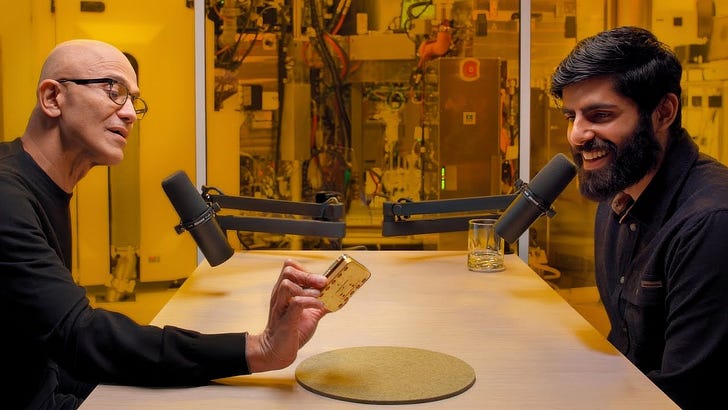
Loading summary
Transcript99 lines
- [00:00]
A
Satya, thank you so much for coming on the podcast. So just in a second we're going to get to the two breakthroughs that Microsoft has just made. And congratulations, same day in nature Majorana zero chip, which we have in front of us right here, and also the world human action models. But can we just continue the conversation we were having a second ago? So you're describing the ways in which the things you were seeing in the 80s and 90s, you're seeing them happen again.
- [00:25]
B
Yeah, I mean the thing that is exciting for me. Dwarkesh, first of all, it's fantastic to be on your podcast. I'm a big listener and it's just fun to be. You know, I love the way that you do these interviews and the broad topics that you explore. It sort of to me reminds me a little bit of my, I would say first few years, even in the tech industry starting in the 90s, where there was like real debate about whether it's going to be risk or CISC or hey, are we really going to be able to build servers using even x86 or when I joined Microsoft, that was in the beginning of what was Windows nt. So everything from the core silicon platform to the operating system to the app tier, that full stack approach, I mean the entire thing is being litigated. And that's, I think perhaps you could say cloud did a bunch of that. And obviously distributed computing and cloud did change client server, the web changed massively. But this does feel a little more like maybe more full stack than even the past that at least I've been involved in.
- [01:41]
A
When you think about what actually which decisions ended up being the long term winners in the 80s and 90s and which ones didn't and especially when you think about, you know, you were at Sun Microsystems, they had an interesting experience with the 90s.com bubble. People talk about this data center build out as being a bubble, but at the same time we have the Internet today as a result of what was built out then. What are the lessons about what will stand the test of time? What is an inherent secular trend? What is just ephemeral? What stands?
- [02:09]
B
Yeah, it's actually, it's interesting. I mean, I think the, if I sort of go back even at least the four big transformations that I've been part of. Right. If you say the client and the client server. So that's the birth of the graphical user Interface and the x86 architecture, basically even allowing us to build servers. It was very clear to me, I remember going to what was PDC in 91, in fact, I was at sun at that time. And in 91 I went to Moscone, went to. Basically that's when Microsoft first described Win32 interface. And I said it was pretty clear to me what was going to happen where the server was also going to be an x86 thing, right? So that when you have the scale advantages accruing to something, that's the secular bet you have to place, right? And so what happened in the client was going to happen on the server side. And then you were able to then actually build client server applications. So the app model. And it became clear then the web was the big thing for us, which we had to deal with in starting. In fact, as soon as I joined Microsoft, I think, what is it like the, you know, the browser, the Netscape browser or the Mosaic browser came out what, December, November of 93. Right. I think is when, you know, Andreessen and crew sort of had that. And so that was a big game changer. I mean, in an interesting way, just as we were getting going on what was the client server wave. And it was clear that we were going to win it as well. We had the browser moment and so we had to adjust. And we did a pretty good job of adjusting to it, right? Because the browser was a new, I'd say, app model. And we were able to embrace it with everything we did, right? Whether it was HTML in Word or build a new thing called the browser ourselves and compete for it and then build a web server on our server stack and sort of go after it. Except, of course, we missed what turned out to be the biggest business model on the web. Because we all assume the web is all about being going to be distributed. Who would have thought that search would be the biggest winner in organizing the web? And so that's where we obviously didn't see it. And Google saw it and executed super well. So that's kind of one lesson learned for me is like, hey, you got to really not only get the tech trend right, you also have to get where is the value going to be created with that trend. And these business model shifts are probably tougher than even the tech trend changes.
- [05:04]
A
Where is the value going to be created in AI?
- [05:06]
B
That's a great one. So I think, at least in my current thing is there are two places where I can say with some confidence, one is the hyperscalers do well, right? Because the fundamental thing is if you sort of go back to even how Sam and others describe it, I mean, like, if, you know, intelligence is Log of compute, whoever can do lots of compute, right, is a big winner, right? And the other interesting thing is if you look at Underneath even any AI workload like take ChatGPT, it's not like everybody's excited about what's happening on the GPU side, it's great, but it's like the ratio, like in fact, I think of my fleet even as a ratio of the AI accelerator to storage to compute. And at scale you've got to grow it. And so that infrastructure need for the world is just going to be exponentially growing, right? So in fact it's mana from heaven to have these AI workloads because guess what, they're more hungry for more compute, right? Not just for training, but we now know for test time. And as I said, test time. Interesting thing, when you think of an AI agent, it turns out the AI agents is going to exponentially increase compute usage because you now are not even bound by just one human invoking a program. It's one human invoking programs that invoke lots more programs. And so that's going to create massive, massive demand and scale for compute infrastructure. So our hyperscale business, Azure business, I think that's like other hyperscalers, I think that's a big thing. Then after that it becomes a little fuzzy because you could sort of say, hey, there is a winner take all model. I just don't see it. Because this, by the way, is the other thing I've learned is being very good at understanding what are winner take all markets and what are not winner take all markets is in some sense everything. Like I remember, even in the early days when I was getting into Azure, I mean, Amazon had a very significant lead and people would come to me and investors would come to me and say, oh, it's game over, you'll never make it. Amazon's it's winner take all. And having competed against Oracle and IBM in client server, I knew that. Look, the buyers will not tolerate winner take all, right? Structurally, hyperscale will never be a winner take all because buyers are smart. Consumer market sometimes can be winner take all. But anything there, the buyer is a corporation, an enterprise, an IT department. They will want multiple suppliers and so you gotta be one of the multiple suppliers. And so that I think is what'll happen even in the model side. So there will be open source, there will be a governor, just like on Windows. One of the big lessons learned for me was if you have a closed source operating system, there will be a complement to it which will be open source and so to some degree that's a real check on what happens. And so I think in models there is one dimension of maybe there'll be a few closed source, there will definitely be an open source alternative and the open source alternative will actually make sure the closed source winner take all is mitigated. So that's kind of at least my feeling on the model side. And by the way, let's not discount if this thing is really as powerful as people make it out to be, the state is not going to sit around and wait for private companies to go around and all over the world. So it's sort of, I don't see it as a winner take all. Then about that, I think it's going to be the same old stuff which is in consumer in some categories there may be some winner take all network effect, right? After all, ChatGPT is a great example. Like, I mean it's kind of like it's an at scale consumer property that is already got real escape velocity, right? I go to the app store and I see, you know, it's always like there in the top five and I say wow, like that's pretty unbelievable. So they were able to use that early advantage and parlay that into an app advantage. And so in consumer that could happen in the enterprise again I think there will be by category different winners. So that's sort of at least how I analyze it.
- [09:27]
A
I have so many follow up questions. We've got to get to Quantum in just a second. So on the idea that maybe the models get commoditized, look, maybe somebody could have made a similar argument a couple of decades ago about the cloud that fundamentally is just like a chip and a box. But in the end of course you and many others figured out you guys have amazing profit margins in the cloud and you figured out ways to get economies of scale and add up their value add. And fundamentally even forgetting the jargon, if you've got AGI and it's helping you make better AIs right now it's synthetic data and RL maybe in the future it's an automated AI researcher. That seems like a good way to entrench your advantage there. I'm curious what you make of that. Just the idea that it really matters.
- [10:12]
B
To your head there. At scale nothing is commodity. So to your point about cloud, I mean everybody would say oh cloud's a commodity, except when you scale. That's why the know how of running a hyperscaler, right? Like you could say oh what, what the heck, I mean I can Just rack and stack servers. In fact in the early days of hyperscale most people thought like God, there are all these hosters and those are not great businesses. Will there be anything like is there a business even in hyperscale? And it turns out there is a real business just because the know how of running, you know, whatever. In the case of Azure, the world's computing of 60 plus regions and with all the compute is just, it's a tough thing to duplicate. So the thing that I was more making the point was is it one winner, right? Or is it a winner take all or not like because that you got to get, right? Because categories you want you. I like to enter categories which are big tams where you don't have to even have the risk of it all being winner take home.
- [11:12]
A
Right, Right.
- [11:13]
B
I mean so if you're running like the, the best news to be is in a big market that can accommodate a couple of winners and you're one of them.
- [11:21]
A
Right.
- [11:22]
B
So that's what I meant by the hyperscale layer in the model. Layer one is models need ultimately to run on some hyperscale compute.
- [11:34]
A
Right.
- [11:34]
B
So that's sort of that Nexus I feel is sort of going to be there forever. Right. Because again it's just not the model but the model needs state. That means it needs storage and it needs to regular compute for running these agents in the agent environments. And so that's kind of how I think about why the limit of one person running away with one model and.
- [11:56]
A
Building it all may not happen on the hyperscaler side. And by the way, it's also interesting the advantage you as a hyperscaler would have in the sense that especially with inference time scaling and if that's involved in training future models, you can amortize your data centers and GPUs not only for the training, but then use them again for inference. I'm curious what kind of hyperscaler you consider Microsoft and Azure to be. Is it on the pre training side? Is it on providing the O3 type inference? Or are you just. We're going to host and deploy any single model that's out there in the market and we are sort of agnostic about that. It's a good point.
- [12:32]
B
I mean like so the way we have built out, at least the way we want to build out the fleet is in some sense ride Moore's law like the way I think that this will just be like what we have done with everything else in the past. Right. Which is in you kind of every year sort of keep refreshing the fleet, you depreciate it over whatever the lifetime value of these things are and then get very, very good at the placement of the fleet such that you can run different jobs at it with high utilization. Right. So sometimes they are very, you know, big training jobs that need to have highly concentrated peak flops that are provisioned to it that also need to cohere or what have you. That's great. So we should have enough data center footprint to be able to give that. But at the end of the day, these are all anyway becoming so big. Even in terms of if you say keep like take pre training scale and if it needs to keep going, even pre training scale at some point has to cross data center boundaries, you know, it's all more or less there. So great. Once you start crossing pre training data center boundaries, is it that different than anything else? Right. So therefore, so the way I think about it is, hey, distributed computing will remain distributed. So go build out your fleet such that it's ready for large training jobs, it's ready for test time, compute, it's ready. In fact, if this RL thing, the thing that might happen is you build one large model and then after that there's tons of this RL going on and test to me it's kind of like again, more training flops because you want to create these highly specialized distilled models for different tasks. So you want that fleet and then the serving needs, right? At the end of the day, speed of light is speed of light. So you can't sort of have one data center in Texas and say I'm going to serve the world from there. You got to serve the world based on having an inference fleet everywhere in the world, right? So that's kind of how I think of our, you know, build out a true hyperscale fleet. Oh, and by the way, I want my storage and compute also close to all of these things. Because it's not just AI accelerators that are stateless. Because I need to be able to have not just my training data itself needs storage and then I want to be able to multiplex multiple training jobs. I want to be able to then have memory, I want to be able to have these environments in which these agents can go execute programs. And so that's kind of how I think about it.
- [15:18]
A
You recently reported that your yearly revenue from AI is $13 billion. But if you look at your year on year growth on that, in like four years it'll be 10x that you'll have $130 billion in revenue from AI if the trend continues, if it does, what do you anticipate we're doing with all that intelligence? Like this industrial scale, Is it going to be like through office, is it going to be you deploying it for others to host? Is it going to be you got to have the AGIs to have 130 billion in revenue. What does it look like?
- [15:46]
B
Yeah, I see the way I come at it, Dwarkesh is it's a great question because at some level if we are going to have this sort of explosion, abundance, whatever commodity of intelligence available. You know, the first thing we have to observe is GDP growth. Right Before I get to what Microsoft's sort of revenue will look like. I mean there's only one governor in all of this. This. Right. Which is, this is where a little bit of we get ahead of ourselves with all this AGI hype. Which is, hey you know what, let's first see if let's say develop. I mean like remember like the developed world is what, 2% growth and if you adjust for inflation it's zero. Yeah, that like so in 2025 as we sit here, I'm not an economist, at least I look at it and say man, we have a real growth challenge. So the first thing that we all have to do is let. And when we say oh this is like the Industrial revolution, blah blah blah, oh let's have that Industrial revolution type of growth. That means to me 10%, 7% developed world, inflation adjusted, growing at 5%. That's the real marker. Right. So it's not just, it can't just be supply side. Right? It has to be. In fact that's the thing. Right. I think there's a lot of people are writing about it. I'm glad they are. Which is the big winners here are not going to be tech companies. The winners are going to be the broader industry that uses this commodity that by the way is abundant. And suddenly productivity goes up and the economy is growing at a faster rate. When that happens we'll be fine as an industry. But that's to me the moment. So us self claiming some AGI milestone, that's just nonsensical benchmark hacking. To me the real benchmark is the world growing at 10%.
- [17:40]
A
Okay, so if the world grew at 10%, the world economy is 100 trillion or something. The world grew at 10%. That's like extra 10 trillion in value produced every single year. If that is the case, you as a hyperscaler, it seems like 80 billion is a lot of Money, shouldn't you be doing like 800 billion? If you really think in a couple of years we could be really growing the world economy at this rate. And the key bottleneck would be do you have the compute necessary to deploy these AIs to do all this work?
- [18:09]
B
I mean that is correct. And so therefore. But by the way, the balance is like, I think a little bit of it is right now is like hey, let me like the classic supply side is oh, let me build it and they'll come, right? I mean that's an argument and you know, after all we've done that we've taken enough risk to go do it but at some point the supply and demand have to match. And so that's what I think and that's why I'm tracking both sides of it. Right. So that's why I think, you know, you can go off rails completely when you're like all hyping yourself with all the supply side versus really understanding how to translate that into real value to customers. And so unless, and that's why I look at my inference revenue. That's one of the reasons why even the disclosure on the inference revenue. It's interesting that not many people are talking about their rail revenue but to me that I think is important as a governor for how you think about it, right? And you're not going to say oh, they have to symmetrically meet at any given point in time, but you need to have existence proof that you are able to parlay yesterday's, let's call it capital into today's demand so that then you can again invest maybe exponentially even knowing that you're not going to be completely rate mismatched.
- [19:23]
A
Yeah, I wonder if there's a contradiction in these two different viewpoints. Because look, I mean one of the things you've done wonderfully is you make these early bets when there's you invested in OpenAI in 2019 even before there was copilot and any applications. If you look at the industrial revolution, these six 10% build outs of railways and whatever things, many of those were not like we've got revenue from the tickets and now we're going to whatever.
- [19:45]
B
There'S a lot of money lost.
- [19:46]
A
That's true. So if you really think there's some potential here to 10x or 5x the growth rate of the world and then you're like, well what is the revenue from GPT4? I mean if you really think that that's the possibility from the next level up, shouldn't you just like let's go crazy. Let's do the hundreds of billions of dollars of compute. I mean, there's like some chance to get that.
- [20:09]
B
The thing is, here's the interesting thing, right? The real question, quite frankly to answer is, is this just about like, that's why even that balanced approach to the fleet at least, is very important to me, right? Which is it's not about building compute, it's about building compute that can actually help me not only train the next big model, but also serve the next big. And you understand until you do those two things, you're not going to be able to really be in a position to take advantage of even your investment, right? So that's kind of where it's not a race to just building a model, it's a race to creating a commodity that is getting used in the world to drive. So you have to have a complete thought, not just one thing that you're thinking about. And so that's at least in my view of saying, and by the way, one of the things is that it will be overbuilt. To your point about, you sort of said what happened in the dot com era. And I look at it and say, now the memo has gone out that, hey, you need more energy and you need more compute. Thank God for it, right? And so everybody's going to race. In fact, I look at the number of. It's not just companies deploying. Countries are going to deploy capital and they will be clearly like, I'm so excited to be a leaser, because, by the way, I build a lot, I lease a lot. I am thrilled that I'm going to be leasing a lot of capacity in 27, 28, because I look at the builds and I'm saying, this is fantastic. The only thing that's going to happen with all the compute builds is the prices are going to come down.
- [21:39]
A
Yeah. I mean, speaking of prices coming down, you recently tweeted after the deep SEQ model came out about Jevons Paradox. And I'm curious if you can flesh out. So Jevons Paradox occurs when there's like the demand for something is highly elastic. Is intelligence that bottlenecked on prices going down? Because when I think about at least my use cases as a consumer, it's like, intelligence is already so cheap. It's like 2 cents per million tokens. Do I really need it to go down to 0.02 cents? I'm just really bottlenecked on it becoming smarter. And if you need to charge me 100x$100x bigger trading run. I'm happy for companies to take that. But maybe you're seeing something different on the enterprise side or something. What is the key use case of intelligence that really requires you to get a 0.002 cents per million toke?
- [22:23]
B
I mean I think the real thing is the utility of the tokens.
- [22:26]
A
Right?
- [22:26]
B
So which is in some sense both need to happen. One is intelligence needs to get better and cheaper. And anytime there's a breakthrough, like even what Deepseek did or what have you with the efficient frontier of, let's say performance per token changes and the curve gets bent and the frontier moves, that just brings more demand. And so that's sort of how I look at it. And that's quite what happened with cloud, right? By the way, here's an interesting we used to think, oh my God, we've sold all the servers in the client server era, except once we sort of started putting servers in the cloud, suddenly people started consuming more because they could buy it cheaper and buy it was elastic and they could buy it as a meter versus a license and it completely expanded. Like, I mean I remember like you know, going let's say to a country like India and sort of talking about oh, here is SQL Server, we sold a little. But man, the cloud in India is so much big than anything that we were able to do in the server era. And that I think is going to be true. Like if you think about, like if you want to really have in the global south, in a developing country, if you had these tokens that were like available for healthcare, that were really cheap, that'll be like the biggest change ever.
- [23:47]
A
A quick word from our sponsor, Scale AI Publicly available data is running out, so major labs like Meta and Google, DeepMind and OpenAI all partner with Scale to push the boundaries of what's possible. Through Scale's Data foundry, major labs get access to high quality data to fuel post training, including advanced reasoning capabilities. As AI races forward, we must also strengthen human sovereignty. Scale's research team SEAL provides practical AI safety frameworks, evaluates frontier AI system safety via public leaderboards, and creates foundations for integrating advanced AI into society. Most recently, in collaboration with the center for AI Safety, Skill published Humanity's Last exam, a groundbreaking new AI benchmark for evaluating AI systems, expert level knowledge and reasoning across a wide range of fields. If you're an AI researcher or engineer and you want to learn more about how Scale's data foundry and research team can help you go beyond the current frontier of capabilities, go to scale.com dwarkesh. I think it's quite reasonable for somebody to hear people like me in San Francisco and think, like, look, they're kind of silly. They don't know what it's actually like to deploy things in the real world. As somebody who works with these Fortune 500s and is working with them to deploy things for hundreds of millions, billions of people, what's your sense on how fast deployment of these capabilities will be? Even when you have working agents, even when you have things that can do remote work for you and so forth, with all the compliance and with all the inherent bottlenecks, is that going to be a big bottleneck or is that going to move past pretty fast?
- [25:23]
B
It is going to be a real challenge because the real issue is change management or process change, right? I mean, this is. Here's an interesting thing, right? Which is one of the analogies they use is just imagine how a multinational corporation like us did forecasts pre PC and email and spreadsheets, right? I mean, faxes went. Somebody then got those faxes and then did an interoffice memo that then went around and people entered numbers. And then ultimately a forecast came, maybe just in time for the next quarter. Then somebody said, hey, I'm just going to take an Excel spreadsheet, put it in email, send it around. People will go edit it, and I'll have a forecast. So the entire forecasting business process changed because the work artifact and the workflow changed. That is what needs to happen with AI being introduced into knowledge work. In fact, when we think about even all these agents, the fundamental thing is there's a new work and workflow. Like, for example, for me, even prepping for our sort of podcast, I go to my co pilot and I say, hey, I'm going to talk to Rakesh about, you know, our quantum announcement and this new, you know, model that we built for game generation, and just kind of give me like a summary of all the stuff that I should read up before going. And he knew, like the two nature papers, it took that. In fact, I even said, hey, go give it to me in a podcast format. And so it sort of even did a nice job of two of us chatting about it. Like, so that became. And in fact, then I shared it with my team. So I took it and put it into pages, which is our artifact, and then shared. So the new workflow for me is, I think, with AI and work with my colleagues. So that's a fundamental change management of everyone who's doing knowledge work suddenly figuring out these new patterns of how Am I going to get my knowledge work done in new ways? That is going to take time. It's going to be something like in sales and in finance, in supply chain. So for an incumbent, I think that this is going to be one of those things where. Let's take one of the analogies I like to use is what manufacturers did with Lean. I love that because in some sense, if you look at it, Lean became a methodology of how one could take an end to end process in manufacturing and become more efficient. It's that continuous improvement which is reduce waste and increase value. That's what's going to come to knowledge. This is like Lean for knowledge work in particular. And that's going to be the hard work of management teams and individuals who are doing knowledge work. And that's going to take its time.
- [28:16]
A
Can I ask you just briefly about that analogy? One of the things Lean did is physically transformed what a factory 4 looks like. It revealed bottlenecks that people didn't realize until you're really paying attention to the processes and workflows. You mentioned briefly what your own workflow, how your own workflow has changed as a result of AIs. I'm curious if we can add more color to what would it be like to run a big company when you have these AI agents that are getting smarter and smarter over time? Yeah.
- [28:44]
B
In fact it's interesting you asked it. I was thinking about it for example today. If I look at it, we are very email heavy. So I got in in the morning and I'm like man, my inbox is full and I'm responding. And so I can't wait for some of these copilot agents to kind of automatically populate my drafts so that I can start reviewing and sending. And so that's kind of what. But literally I do feel like I already have in copilot like at least 10 agents. Right. I have. Which I do at because I query them as sort of different things for different tasks. And I feel like there's a new inbox that's going to get created which is my millions of agents that I'm working with will have to invoke some exceptions to me, notifications to me, ask for instructions. So at least what I'm thinking is that there's a new scaffolding which is the agent manager is going to be that one. It's not just a chat interface. I kind of need a smarter thing than chat interface to manage all the agents and their dialogue. So that's why I think of this copilot as the UI for AI is a big, big deal and each of us is going to have it as, you know. So basically think of it as there is knowledge work and there's a knowledge worker. Right. The knowledge work may be done by many, many agents, but you still have knowledge worker who is dealing with all the knowledge workers. And that I think is the interface that one has to build.
- [30:17]
A
Yeah, I mean, I'm sort of curious about like you're one of the few people in the world who can say that you have access to 200,000, you have this like swarm of intelligence around you in the form of Microsoft, the company and all its employees. And you have to manage that and you have to how to interface with that, how to make best use of that. Hopefully more of the world will get to have that experience in the future. I'd be curious about how your inbox, if that means everybody else's inbox will look like yours in the morning. Okay, before we get to that, I want to keep asking you more about AI, but I really want to ask you about the big breakthrough in quantum that Microsoft Research has announced. So can you explain what's going on here?
- [30:55]
B
This has been, it's another whatever, 30 year journey for us. It's unbelievable. Like I'm the third CEO of Microsoft who's been excited about quantum. I think the fundamental breakthrough here, or the vision that we've always had is you need a physics breakthrough in order to build a utility scale quantum computer that works. And so we took that path, you know, which was the path of sort of saying, look, the one way for having that less noisy or the more reliable qubit is to bet on a physical property that by definition is more reliable. And that's kind of what led us to this majorana zero modes as the thing to go, which was theorized in the 1930s. And so the question was, can we actually physically fabricate these things? Can we actually build them? So the big breakthrough effectively, and I know you talked to Chetan, was that we now finally have existence proof and a physics breakthrough of majorana zero modes in a new phase of matter effectively. Right? So this is why I think we like the analogy of thinking of this as the transistor moment of quantum computing, where we effectively have a new phase, which is the topological phase, where, which is more reliable, which means we can even now reliably hide the quantum information and measure it and then, and we can fabricate it. And so now that we have it, we feel like with that core foundational fabrication technique out of the way we can start building a Majorana chip, that Majorana one, which I think is going to basically be the first chip that will be capable of a million qubits physical. And then on that thousands, thousands of logical qubits error corrected. And then it came on. Right. So then you suddenly have now got the ability to build a real utility square quantum computer. And that to me is now so much more feasible. Right. We've been working because without something like this you will still be able to achieve milestones, but you'll never be able to build a utility scale computer. And so that's why we are excited about it.
- [33:39]
A
Amazing. And by the way, I believe this is it right here.
- [33:41]
B
That is it. Yeah.
- [33:42]
A
Yes.
- [33:42]
B
Yeah. I forget now, are we calling it Majorana? Yeah, that's right, Majorana1 and I'm glad we named it after that. And this is the, I mean to think of the fact that we are able to build like something like a million qubit quantum computer in a thing of this size is just unbelievable. Like, I mean that. And that's I think the crux of it. Right. Which is unless and until we could do that, you can't dream of building a utility scale quantum computer.
- [34:11]
A
And you're saying the eventual million qubits will go on a chip this size?
- [34:15]
B
That's right.
- [34:15]
A
Amazing. So other Companies have announced 100 physical qubits, Google's, IBMs, others. When you say and you've announced one, but you're saying that yours is way more scalable in the limit.
- [34:29]
B
Yeah. So we're by the way, the one thing that we have also done is we've taken sort of an approach where we sort of separated out our software and our hardware. Right. So we are building out our software stack. So which is in fact we now have with a couple of different, with the neutral atom folks, with the ion trap folks. We're also working with others who even have, I think pretty good approaches, even with photonics and what have you. So that means there'll be different types of quantum computers. And in fact we have what, 20, I think the last thing that we announced was 24 logical qubits. So we have also got some fantastic breakthroughs on error correction. And that's what is allowing us even on a neutral atom and in ion trap quantum computers to build these 20 plus. And that I think that'll keep going even in, throughout the year. You'll see us improve that yardstick. But we also then said let's go to the first principles and build our own super Quantum computer that is betting on the topological qubit. And that's what this breakthrough is about.
- [35:37]
A
Amazing. The million topological qubits, thousands of logical qubits. What is the estimated timeline to scale up to that level? What is the Moore's law here? If you've got the first transistor look.
- [35:49]
B
Like we've obviously been working on this for 30 years. I'm glad we now have the fabrication, the physics breakthrough and the fabrication breakthrough. I wish we had a quantum computer because by the way, the first thing the quantum computer will allow us to do is build quantum computers because it's going to be so much easier to simulate atom by atom construction of these new quantum gates, essentially. But in any case, to me, I think the next real thing is now that we have the fabrication technique, let us go build that first fault tolerant quantum computer and that'll be the logical thing. So I would say now I can say, oh, maybe 27, 28, 29, we will be able to actually build this, right? So now that we have this one gate, can I put the thing into an integrated circuit and then actually put these integrated circuits into a real computer? That I think is where the next logical step is.
- [36:47]
A
And what do you see as 27, 28, you've got it working. Is it like a thing you access through the API? Is it something you're using internally for your own research, materials and chemistry?
- [36:59]
B
See, one thing that I've been excited about is even in today's world, right, because we had this quantum program and we had actually we could say, hey, here's some APIs to it. The breakthrough we had maybe two years ago was to sort of think of this HPC stack and AI stack and quantum together. In fact, if you think about it, right, AI is like an emulator of the simulator. Like quantum is like a simulator of nature. Like what is what quantum going to do? By the way, Quantum is not going to replace classical, right? Quantum is great at what quantum can do. And classical will be also because you can't like, I mean, like to be able to. Quantum is going to be fantastic for anything that is not data heavy, but it's got more exploration heavy in terms of the state space, right? So which is. It should be data light, but exponential states that you want to explore. And you know, simulation is a great one. Chemical physics, what have you, biology. So one of the things that we've started doing is really using AI as the emulation engine. But you can then train. So the way I think of it, as if you have AI plus Quantum. Maybe you'll use quantum to generate synthetic data that then gets used by AI to train better models that know how to model something like chemistry or physics or what have you, and these two things will get used together. So even today that's kind of effectively what we're doing with the combination of HPC and AI. And I hope to replace some of the HPC pieces with quantum computers.
- [38:41]
A
Great products come from teams that have full visibility into their development. As your company grows, levels of process start slowing you down. And that's where Linear comes in. They've built the project management tool that's quickly becoming the default for startups as well as larger companies who want to move fast. I've heard from a ton of my friends in Silicon Valley who tell me that they really love Linear and that's why I was excited to work with them. Ramp, cash, app, OpenAI and scale have all made the switch and remarkably, this is often the result of a grassroots campaign from their engineers who love Linear and are really frustrated with their current tools. Product teams love using it because everything exists where you'd expect to find it. The whole experience is lightweight, intuitive and fast. Linear's dedication to quality and craft are obvious from the moment you start using it and everything just works. So maybe you should chat with your team or if you want to use it yourself, go to Linear app Thorkesh to learn more. All right, back to Satya. Can you tell me a little bit about how you make these research decisions which in 20 years time, 30 years time, will actually pay dividends, especially at a company of Microsoft Scale. Obviously you're in great touch with the technical details in this project. Is it feasible for you to do that with all the things Microsoft Research does? And how do you like the current bet you're making that will pay out in 20 years? Does it decide to emerge organically through the org or are you like how are you keeping track of all this?
- [40:12]
B
Yeah, I mean the thing that I feel which was fantastic is what Bill sort of when he started MSR back in 95, I guess it's like, look, I think in the long history of these curiosity driven research organizations to just sort of just do a research org that is about fundamental research and MSR over the years has built up that institutional strength. So when I even think about capital allocation or budgets or what have you, you kind of sort of first put the chips in and say, hey, look, here is MSR's budget and we got to go at it each year knowing that most of these bets are not going to pay off in any finite timeframe. It may be the sixth CEO of Microsoft who will benefit from it. And I think that's kind of in tech that is, I think, a given. The real thing that I think about is when the time has come for something like Quantum or a new model or what have you, can you capitalize? So as an incumbent, if you sort of look at history of tech, it's not that people didn't invest. It is like you need to have a culture that knows how to take an innovation and scale it. That's the hard part, Quite frankly, for CEOs and management teams, which is kind of like fascinating, right? Which is it's as much about good judgment and it's about good culture. And sometimes we've gotten it right, sometimes we've gotten it wrong, right? I mean, I can tell you the thousand projects from MSR that we should have probably led with, but we didn't. And I always ask myself why? And it's because we were not able to get enough sort of conviction and that complete thought of how to not only take the innovation, but make it into a useful product with a business model that we can then go to market with, like that's the job of CEOs and management teams is not to just be excited about any one thing, but to be able to actually execute on a complete thing. And that's easier said than done.
- [42:35]
A
When you mentioned the possibility of six or I guess three subsequent CES of Microsoft, if each of them increases the market cap by an order of magnitude. But by the time you've got the next breakthrough, you'll be like the world economy or something.
- [42:46]
B
Or remember, the world is going to be growing at 10%. So we'll be fine.
- [42:50]
A
Let's dig into the other big breakthrough you've just made. And it's amazing that you have both of them coming out the same day in your gaming world models. I'd love if you can tell me a little bit about that.
- [42:58]
B
Yeah, I think we're going to call it Muse is what I learned is going to be the model of this world action or human action model. And this is very cool. See, one of the things that, you know, obviously Dall? E and Sora have been unbelievable and what they've been able to do in terms of generative models. And so one thing that we wanted to go after was using gameplay data. Can you actually generate games that are both consistent and then have the ability to generate the diversity of what that game represents and then are persistent to user Mods. Right. So that's what this is. And so they were able to work with one of our game studios and this is the other publication in Nature. And the cool thing is what I'm excited about is bringing. So we're going to have a catalog of games soon that we will start sort of using these models or we're going to train these models to generate and then start playing them. And in fact, you know, when Phil Spencer first showed it to me, where you had an Xbox controller and this model basically took the input and generated the output based on the input and it was consistent with the game. And that to me is a massive, massive moment of wow. It's kind of like the first time we saw ChatGPT complete sentences or Dolly Draw or Sora. This is kind of one such moment.
- [44:30]
A
Yeah. And it'll. I only got a chance. I got a chance to see some of the videos and the real time demo this morning with your lead researcher Katya on this and only once I talked to her did it really hit me how incredible this is in the sense that we've used AI in the past to model agents and just using that same technique to model the world around the agent and give this consistent real time. We'll superimpose videos of what this looks like atop this podcast so people can get a chance to see it for themselves. I guess it'll be out by then so they can also watch it. There's there. This in itself is incredible. You through your span of CEO have invested tens hundreds of billions of dollars in building up Microsoft Gaming and acquiring ip. And in retrospect, if you can just merge all of this data into one big model that can give you this experience of visiting and going through multiple worlds at the same time. And if this is a direction gaming is headed, seems like a pretty good investment we have made. Did you have any premonition about this or good coincidence?
- [45:32]
B
No, I mean I wouldn't say that. We invested in gaming to build models. We invest, quite frankly, I wanted. Here's an interesting thing about our history. We built our first game before we built Windows, right. Flight Simulator was a Microsoft product long before we even built Windows. So gaming has got a long history at the company and we want to be in gaming for gaming. And that's. I always start by. I hate to be in businesses where they're means to some other end. They have to be ends onto themselves. And then yes, we are not a conglomerate. We are a company where we have to bring all these assets together and be better Owners off by adding value. Right. So, for example, cloud gaming is a natural thing for us to invest in because that'll just expand the TAM and expand the ability for people to play games everywhere. Same thing with AI and gaming. We definitely think that it can be helpful and maybe changing. It's kind of like the CGI moment, even for gaming long term. And it's great. As the biggest world's largest publisher, this will be helpful, but at the same time, we've got to produce great quality games. I mean, you can't be a gaming publisher without sort of first and foremost being focused on that. But the fact that this data asset is going to be interesting not just in gaming context, but it's going to be a general action model and a world model. It's fantastic. I mean, like, you know, I think about gaming data as perhaps, you know, what YouTube is perhaps to Google gaming data is to Microsoft. And so therefore I'm excited about that.
- [47:08]
A
Yeah, and sorry, that's what I meant in just a sense of like, you can have one unified experience across many different kinds of games. How does this fit into the other, separate from AI, the other things that Microsoft has worked on in the past, like mixed reality, maybe giving smaller game studios a chance to build these AAA action games and. And just like five, 10 years from now, what kinds of ways could you interact with this?
- [47:29]
B
I've thought about these three things as sort of the cornerstones. Right. Of in an interesting way, even I five, six, seven years ago is when I said, like the three big bets that we want to place is AI, quantum and mixed reality. And I still believe in them. Right. Because you in some sense, like, what are the big problems to be solved? Presence. That's the dream of mixed reality, which is, you know, can you create real presence like you and I doing a podcast like this, I think we are still, like, it's proving out to be the heart of one of those challenges. Quite honestly, I thought it was going to be more solvable. It's tougher perhaps just because of the social side of it. Right. Which is wearing things and so on. We're excited about, in fact, what we're going to do with Aderal and Palmer now, with even how they'll take forward the IVAS program, because that's a fantastic use case. And so we'll continue on that front. But also the 2D surfaces, it turns out, things like teams. Right. Thanks to the pandemic, we've really gotten the ability to create essentially presence through even 2D. And that I think will Continue. That's one secular piece, the quantum we talked about, and the AI is the other one. So these are the three things that I look at and say, how do you bring these things together ultimately, not as tech for tech's sake, but solving some of the fundamental things that we as humans want in our life and more. We want them in our economy, driving our productivity. And so if we can somehow get that right, then I think we would have really made progress.
- [49:09]
A
Yeah. When you write your next book, you got to have some explanation of why those three pieces all came together around the same time. Right. There's no intrinsic reason you would think quantum and AI should happen. And 2028 and 2025 and so forth.
- [49:20]
B
That's right. But at some level, I kind of look at it and say, the simple model I have is, hey, is there a systems breakthrough? And to me, the systems breakthrough is the quantum thing. Is there a business logic breakthrough that's kind of like AI to me, which is like, can the logic tier be fundamentally reasoned differently? And instead of imperatively writing code, can you have a learning system? And that's sort of the AI one, and then the UI side of it is presence.
- [49:50]
A
Yeah. Going back to AI for a second. So in your 2017 book, 2019, you invest in OpenAI very early. 2017 is even earlier. And you say in your book, one might also say that we're birthing a new species, one whose intelligence may have no upper limits. Now, super early, of course, to be talking about this in 2017. We so far have been talking in sort of like a granular fashion about agents and office copilot and capex and so forth. But you just zoom out and consider this statement you've made, and you think about, like, you as somebody, as a hyperscaler, as the person doing research in these models as well, providing training, inference research for building a new species. Like, in the grand scheme of things, how do you think about this? Do you think we're headed towards superhuman intelligence in your time as CEO?
- [50:38]
B
I think even Mustafa uses that term. In fact, he's used that term more recently around what this new species. The way I come at it is you definitely need trust. Like, I think the one thing that before we kind of claim it is something as big as a species. The fundamental thing that I think that we've got to get right is that there is real trust, whether it's personal or societal level trust that's baked in. That's the hard part problem, because I think the one biggest rate limiter to the Power here will be, how does our legal call it, infrastructure, we're talking about all the compute infrastructure. How does the legal infrastructure evolve to deal with this? Like, entire world is constructed with things like humans owning property, having rights and being liable. That's the fundamental thing that one has to sort of first say, okay, what does that mean for anything that now humans are using as tools? And if humans are going to delegate more authority to these things, then how does that structure evolve? Like, until that really gets resolved? I think just talking about sort of the tech capability, I don't think it's.
- [52:06]
A
Going to happen as in, like, we won't be able to deploy these kinds of intelligences until we figure out how to.
- [52:11]
B
Because at the end of the day, there is no way, like today, you cannot deploy these intelligences unless and until there's someone indemnifying it as a human. That's, I think, to your point, that's one of the reasons why I think about like even the most powerful AI is essentially working with some delegated authority from some human. You can sort of say, oh, that's all alignment this, that and the other. And that's why I think you have to sort of really get these alignments to actually work and be verifiable in some way. But I just don't think that you can deploy intelligences that are out. So, for example, this AI takeoff problem may be a real problem, but before it is a real problem, the real problem will be in the courts. Because the courts, I mean, no society is going to allow for some human to say, AI did that. That.
- [53:00]
A
Yes, well, there's a lot of societies in the world and I wonder if any one of them might not have a legal system that might be more amenable. And if you can't have a takeoff, then you might worry, like, it doesn't have to happen in America. Right? Even if the good one, but even.
- [53:14]
B
Like, it's sort of like, even if in any one thing that we think that no society cares about it, right? They can be rogue actors. I'm not saying they won't be rogue actors. I mean, they're cyber criminals and rogue states. They're going to be there. But to think that sort of the human society at large doesn't care about it is also not going to be true, right? So I think we all will care, right? We know how to deal with rogue states and rogue actors today. The world doesn't sit around and say, we'll tolerate that. So therefore, that's why I'm glad that we have a world order in which even such. Anyone who is a rogue actor in a rogue state has consequences.
- [53:58]
A
But if you have this picture where you could have 10% economic growth, it really, I think, depends on actually getting something like AGI working. Right. Because tens of trillions of dollars of value that sounds closer to human wages are $60 trillion of the economy. Getting that magnitude is just like you kind of have to automate labor or supplement labor in a very significant way, if that is possible. And once we figure out the legal ramifications for. Seems quite plausible even within your tenure, that we figure that out. Are you thinking about superhuman intelligence? Like the biggest thing you do in your career is this, or.
- [54:36]
B
Yeah, by the way, you bring up another one. I mean, I know David Otter and others have talked a lot about this, which is that 60% labor. I think the other question that needs to happen is let's at least talk about our democratic societies. I think that in order to have a stable social structure and democracies function, you just can't have return on capital and no return on labor. You can talk about it, but that 60% has to be something that has to be revalued. So in my own simple sort of way, call it naive, is, hey, we'll start valuing different types of human labor. What is today considered high value. Human labor may be commodities. They may be new things that we will value, including that sort of person who comes to me and helps me with my physical therapy or whatever. It's like whatever is going to be the case that we value. But ultimately, if we don't have return on labor and there's meaning in work and dignity in work and all of that, that's another rate limiter to any of these things being deployed.
- [55:45]
A
Yeah, on the alignment side. So two years ago, you guys released Sydney Bing. And just to be clear, I think given the level of capabilities at the time, I think it was like sort of like a charming, endearing, kind of funny example of misalignment. But that was because at the time, it was like chatbots. They can go think for 30 seconds and give you some funny, inappropriate response back. But if you think about that kind of system, that can, like I think to a New York Times reporter, tried to get him to leave his wife or something. If you think about that going forward, and you have these agents that are for hours, weeks, months, going forward, just autonomous swarms of AGIs who could be in similar ways misaligned and just screwing stuff up, maybe coordinating with each other. What's Your plan going forward to like when you get the big one, you get it, right?
- [56:41]
B
Yeah, that is correct. And so that's one of the reasons why I think we us sort of when we even allocate compute, let's allocate compute for what is that alignment challenge and then more importantly, what is the runtime environment in which you are really going to be able to monitor these things? The observability around it, by the way. We do deal with a lot of these things today in the classical side of the things as well, like cyber. Right. We just don't write software and then just let it go. Do you have software? And then you monitor, you monitor it for cyber attacks, you monitor it for fault injections and what have you. And so therefore I think we will have to build enough software engineering around the deployment side of these and then inside the model itself, what's the alignment? And these are all. Some of them are real science problems, some of them are real engineering problems. And then we will have to tackle it. And by the way, that also means that take our own liability in all of this. So that's why I'm more interested in deploying these things in where you can actually govern what the scope of these things is and the scale of these things is. And so you just can't unleash something out there in the world that creates harm because the social permission for that is not going to be there.
- [58:01]
A
Yeah, when you really get the agents that can really just do weeks worth of tasks for you, what is the sort of minimum assurance you want before you can let a random fortune probably hurt?
- [58:14]
B
I think when I use something like deep research, even the minimum assurance I think we want is before we especially have physical embodiment of anything that I think is kind of one of those thresholds. When you cross that might be one place, then the other one is for example, the permissions of the runtime environment in which this is operating. You may want guarantees that it's sandboxed. It is not going out of that sandbox.
- [58:48]
A
I mean we already have like web search and you know, we already have the out of the sandbox now.
- [58:53]
B
But even the web, what it does with web search and what it writes. So like for example, like to your point about like, hey, if it's just going to write a lunch of code in order to do some computation, where is that code deployed and is that code ephemeral for just creating that output versus just going and springing that code out into the world? Those are things that you could in the action space actually go control.
- [59:21]
A
Yeah. And separate from the safety issues. As you think about your own product suite and you think about like, if you do have AIs as powerful at some point, it's not just like Copilot. In the example you mentioned about how you were prepping for this podcast, it's more similar to how you actually delegate work or work to your colleagues. What does it look like, given your current suite, to add that in? And I mean, there's one question about whether LLMs get commodified by other things. I wonder if these databases or canvases or Excel sheets or whatever, if the LLM is your main gate point into accessing all these things, is it possible that the LLMs commodify office?
- [60:02]
B
Yeah, I mean, it's possible to see. It's an interesting one, Right. I think the way I think about the first phase, at least of it would be can the LLM help me do my knowledge work using all of these tools or canvases more effectively? Like, one of the best demos that I've seen is a doctor getting ready for a tumor board workflow, right? So she's going in to a tumor board meeting. And so one of the first things she uses Copilot for is to create an agenda for the meeting. Because the LLM helps reason about all the cases which are in some SharePoint site and says, hey, these cases, obviously, you know, a tumor board meeting is a high stakes meeting where you want to be mindful of the differences in cases so that you can then allocate the right time, right? So even that reasoning task of creating an agenda that knows even how to split time, Super. So I used LLM to do that. Then I go into the meeting, I'm in a teams call with all my colleagues. Guess what? I'm focused on the actual case versus taking notes. Because you now have this AI copilot doing a full transcription of all of this. And just basically an intelligent is not just a transcript, but it's a. Think of it as a database entry of what is in the meeting that is recallable for all time, right? So then she comes out of the meeting having sort of discussed the case and not been distracted by note taking. And she's a teaching doctor, she wants to go and prep for her class. And so she takes and she goes into Copilot and says, hey, take my tumor board meeting and then create a PowerPoint slide deck out of it so that I can talk to my students about it. Like, so that's the tie. So the UI and the scaffolding that I have are canvases that are now getting populated using LLMs. And the workflow itself is being reshaped. Knowledge work is getting done. Like here's an interesting thing, right? If somebody is like one of the ways I think about it is if someone came to me in the late 80s and said, you're going to have a million documents on your desk, we were saying, what the heck is that, right? I mean, I literally sort of thought, oh, there's going to be literally a million physical copies of things on my desk. Except we do have a million spreadsheets and a million documents. And you do, and they're all there. And so I think that's kind of what's going to happen with even agents. So there will be a UI layer. To me, Office is not just about the office of today. It's the UI layer for knowledge work. It'll evolve as the workflows evolve. That's what we want to build. I do think the SaaS applications that exist today, right, these crud applications are going to fundamentally be changed because the business logic will go more into this agentic tier. In fact, one of the other cool things today in my copilot experience is when I say, hey, I'm getting ready for a meeting with a customer, I just go and say, give me all the notes for it that I should know. And it pulls from my CRM database, it pulls from my like Microsoft graph, creates a composite essentially artifact and then it applies even logic on it, right? And that to me is going to transform the SaaS applications as we know of it today in a big way.
- [63:26]
A
So SaaS as an industry might be worth hundreds of billions to trillions of dollars a year depending on how you count. If really that can just get collapsed by AI like is a next step up in Your next decade 10Xing the market cap of Microsoft again. Because if you're really talking about trillions of dollars, by the way, I think.
- [63:46]
B
It also would create a lot of value in the SaaS. Remember one of the big issues was one thing that we don't pay as much attention to perhaps is the amount of IT backlog there is in the world, right? So one of the ways is these code gen things plus the fact that I can interrogate all of my SaaS applications using a agents and get more utility will be the greatest explosion of apps. They'll be called agents. So that you can for every vertical in every industry, in every category, we're suddenly going to have the ability to be serviced so there's going to be a lot of value. I think you can't stay still like which is you can't say the old thing of oh I schematize some narrow business process and I have a UI in the browser and that's my thing. That ain't going to be the case. You have to sort of go up, stack and say what's the task that I have to participate in? And so you will want to be able to take your SaaS application and make it a fantastic agent that participates in a multi agent world. And as long as you can do that, then I think you can even increase the value.
- [64:59]
A
Can I ask you about some questions about your time at Microsoft?
- [65:02]
B
Yeah.
- [65:03]
A
Is being a company man underrated? So you've spent most of your career at Microsoft and, and look, you could say like maybe one of the reasons you've been able to add so much value is you've seen the culture and the history and the technology and how all this context by rising up through the ranks. Should more companies be run by people who have this level of context?
- [65:20]
B
That's a great question. I mean I've not thought about it that way but yeah, I mean I have sort of through my whatever 34 years now of Microsoft, it has basically been each year I felt more excited about being at Microsoft versus thinking that oh I'm a company person or what have you. Right. I mean that is not like I didn't go in there and saying it is about and I think that seriously, even for anybody joining Microsoft, that means it's not like they're joining Microsoft as long as they feel that they can use this as a platform for their both economic return but also a sense of purpose and a sense of mission that they can accomplish by using us as a platform. Right. So therefore that's the contract. So I think yes, companies can have to create a culture that allows people to come in and become company people like me and Microsoft got it more right than wrong, at least in my case and I hope that remains the case.
- [66:22]
A
How do you like the six CEO that you're talking about that will get to you is the researcher starting now. What are you doing to retain the future? Satya Nadellas so that they're in a position to become future leaders.
- [66:33]
B
Yeah, it's kind of fascinating. This is our 50th year and I think a lot about it. Right. And the way to think about, you know, I think longevity is not a goal, relevance is. And so I think the thing that I have to do. And all 200,000 of us have to do every day is are we doing things, things that are useful and relevant for the world as we see it evolving, not just today, but tomorrow? Like we have to, basically. And we live in an industry where there's no franchise value. So that's the other hard part, which is if you take the R and D budget that we will spend this year is all about what. It's all speculation on what's going to happen five years from now. And so you got to basically go in with that attitude that saying, look, we are doing things that we think are going to be relevant. And so that's what you got to focus on and then know that there's a batting average and you're not going to get. You have to have high tolerance for failure. That's the other thing which I think is unlike, you have to be able to sort of take enough shots on goal to be able to say, okay, we will make it to the other side as a company. And that's what makes it tricky in this industry.
- [67:51]
A
Speaking of, you just mentioned that you're what, two months away from your 50th anniversary of Microsoft's founding? If you look at the top 10 companies by market cap or top five, depending on how you count Saudi, Aramco, basically everybody else, but Microsoft is younger than Microsoft. And it's a really interesting observation about why. The most successful companies often are quite young. The average Fortune 500 company will last 10, 15 years. What has Microsoft done to remain relevant for this many years? How do you keep refounding?
- [68:25]
B
That is, I love that even Rita Hoffman uses that term. I love that refounding thing. And I think that that's the mindset. Like, I mean people talk about founder mode and I sort of, I think for us mere model CEOs and others, it's more like, hey, the refounder mode. And I think that it's. To be able to see things again and in a fresh way, I think is the key to me. And so to your question, can we culturally create an environment where refounding becomes a habit thing? Right? Which is like every day we come in and say, yeah, we feel we have that stake in this place to be able to change the core assumptions of what it is that we do and how we relate to the world around us. And do we give ourselves permission? I think many times companies feel over constrained by either business model, what have you, and you just have to unconstrain yourself.
- [69:24]
A
If you did leave Microsoft, what company would you Start company.
- [69:29]
B
I would start man. That's where the company man and me sort of says, I'll never leave Microsoft. I think that if I were thinking of doing something like I think picking a domain that has, like when I look at the dream of tech, right, We've talked, we always have said technology is about the biggest, greatest democratizing force. I feel like finally we have that ability. If you sort of say those tokens per dollar, per watt is sort of what, what we can generate. I would love to find some domain in which that can be applied where it is so underserved. That's where healthcare, education, public. By the way, the other place is public service. Your public sector would be another place where if you take those domains which are the underserved places, where my life as a citizen of this country or a member of this society or anywhere, what would I be better off if somehow all this abundance translated into better healthcare, better education and better public sector institutions serving me as citizens, that would be a place.
- [70:47]
A
One thing I'm not sure about hearing your answers on different questions is whether you think AGI is a thing in the sense of will there be a thing which automates all? At least starting with all cognitive labor. Anything that anybody can do on a computer.
- [71:01]
B
See, this is where my problem with the definitions of how people talk about it is. Cognitive labor is not a static thing, right? Like there is cognitive labor today, if I have an inbox that is managing all my agents is that new cognitive labor. And so today's cognitive labor may be automated. What is the new cognitive labor that gets created? Both of those things have to be thought of, right? Which is the shifting. So that's why I think this distinction, at least in my head I make is don't conflate knowledge worker with knowledge work. The knowledge work of today could probably be automated. Who said my life's goal is to triage my email, right? Let an AI agent triage my email. But after having triaged my email, give me a higher level cognitive labor task. Hey, these are the three drafts I really want you to review. Like, that's a different abstraction.
- [72:05]
A
But will AI ever get to the second thing?
- [72:08]
B
May. But as soon as it gets to that second thing, there will be a third thing, right? So this is where I think, why are we sort of thinking somehow that we have dealt with tools that have changed? What is cognitive labor in history? Why are we worried that all cognitive labor goes away?
- [72:27]
A
I mean, I'm sure you've heard these examples before, but the idea that like horses can still be good for certain things. There are certain terrains you can't take a car on. But the idea that like you're going to see horses around the street that are going to employ millions of horses, it's just like it's not happening. Right. And then the idea is, could a similar thing happen with humans but in.
- [72:45]
B
One very narrow dimension? Right. It's only 200 years of history of humans where we evaluate some narrow sort of things called cognitive labor as we understand it. Let's take something like chemistry. If this thing like quantum plus AI really helped us sort of do a lot of novel material science and so on. Yeah, that's fantastic to have novel material science being done by it. Does that really somehow take away from sort of all the other things that humans can do? Right. So why can't we exist in a world where there are powerful cognitive machines knowing that our cognitive agency has not been taken away?
- [73:30]
A
I'll ask this question not about you, but in a different scenario. So maybe you can answer it without embarrassment. Suppose on the Microsoft board, could you ever see adding an AI to the board, could it ever have the sort of judgment and context and holistic understanding.
- [73:47]
B
To be a useful advisor we added. It's a great example. One of the things we added was this facilitator agent in team. The goal there it's in the early stages of it is hey, can that facilitate our agent with long term memory not just on the context of the meeting, but with context of projects that I'm working on and the team and what have you be a great facilitator. Right. I would love even in a board meeting, right, where it's easy to get distracted. After all, board members come once a quarter and they're trying to digest what the heck is happening with a complex company like Microsoft. I think a facilitator agent that actually helped human beings all stay on topic, focus on the issues that matter. That's fantastic. That's kind of literally having to your point about even going back to your previous question, having something that has infinite memory and then that can even help us. After all, what is that Herbert Simon thing, which is we are all bounded rationality. So if the bounded rationality of humans can actually be sort of dealt with because there is a cognitive amplifier outside, that's great.
- [75:02]
A
Speaking of the materials and chemistry stuff, I think you said recently that you want in the next 250 years of progress in those fields to happen in the next 25 years. Now when I think about what's going to be possible in the next 250 years. I'm thinking like space travel and space elevators and immortality and cure all diseases next 25 years. You think?
- [75:24]
B
I mean, one of the reasons why I brought that up was I love that thing of, hey, look, the industrial revolution, if you say was the 250 year, right? I mean, if you sort of even take this entire change on from a carbon based system to something different, then that means you have to fundamentally reinvent all of what has happened with chemistry over the 250 years. And that's where I hope we have this quantum computer. This quantum computer helps us get to new materials and then we can fabricate those new materials that help us with all of the challenges we have on this planet. And then I'm all for interplanetary travel.
- [76:00]
A
Amazing. Satya, thank you so much for your time. Thank you for.
- [76:03]
B
It's wonderful.
- [76:04]
A
Thanks.