← Econ Dev Show Podcast - Economic Development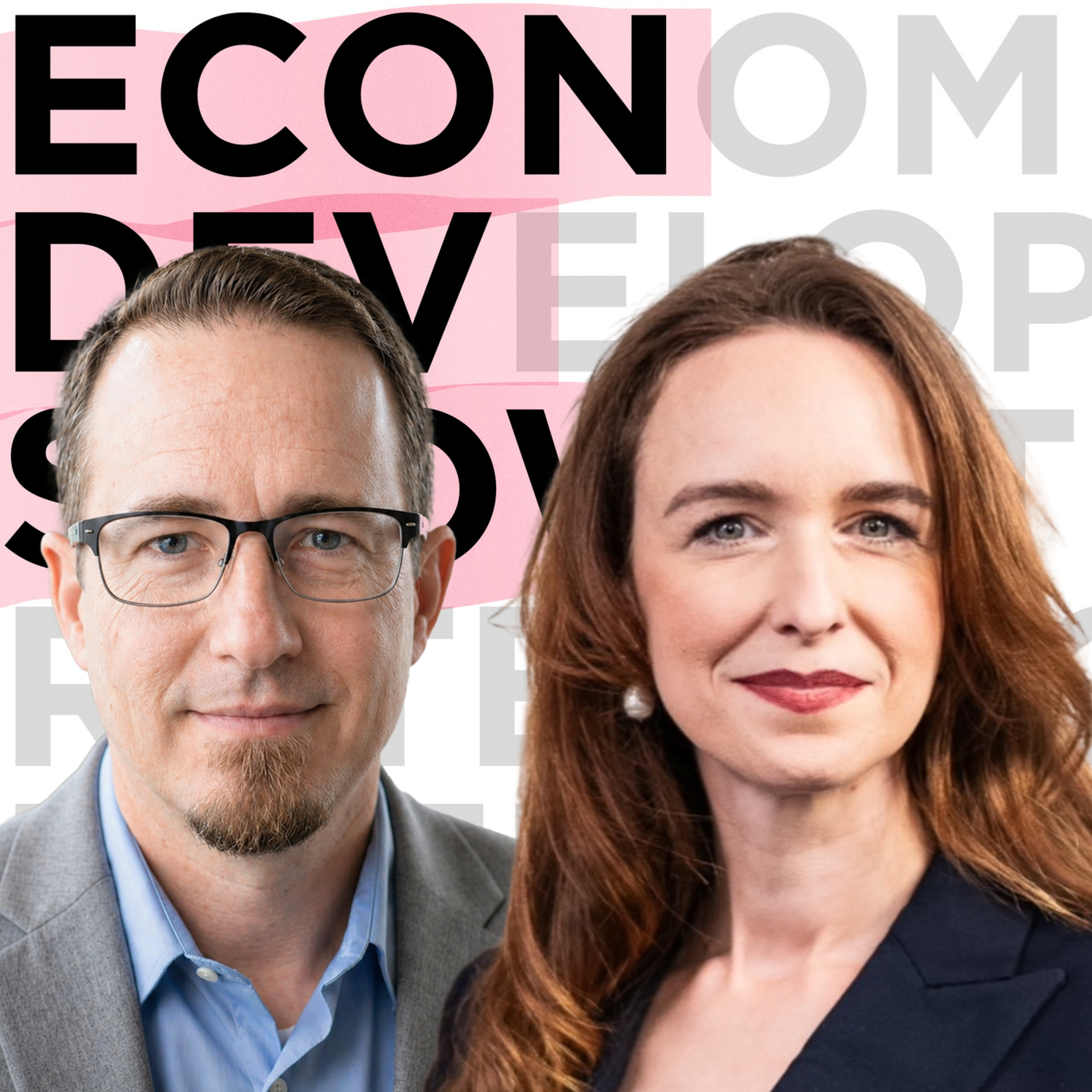
Econ Dev Show Podcast - Economic Development
222: How Energy Is Changing Site Selection with Anna Cardona
00:27:44
Anna Cardona joins Dane to talk about energy infrastructure, data centers, private-sector economic development, and why economic developers need to think more creatively about capital, community impact, and where deals really begin.
Loading summary
Transcript79 lines
- [00:02]
A
Welcome to the Econ Dev Show. We explore the strategies, ideas and insights that are driving economic development forward into the future. You'll hear new insights from passionate EDs about their successes and struggles. And you'll learn from attraction and retention experts about how to apply actionable strategies inside your Edo. We'll help take your organization, your community and your career to the next level. Here's your host, Dane Carlson.
- [00:36]
B
Welcome back to the Econ Dev Show. Today we're here with Anna Cardona. She's an economic development consultant with Wolves Development Group. Anna, welcome to the show.
- [00:45]
C
Thank you so much, Dane. I'm happy to be here.
- [00:48]
B
I'm happy to have you.
- [00:49]
C
Absolutely. I'm pleased to finally get to sit down with you.
- [00:54]
B
I am too because you've had such an interesting, interesting career and I would love to kind of hear about it. It has crossed a lot of different worlds. Design and real estate and marketing and business development and economic development, of course. And now your work with dci. Can you give us, I don't know, give us the couple minute version of your story. How did you find your way into economic development?
- [01:21]
C
Yeah, my background is in architecture and design. I started off from the University of Memphis and, and from there I went into project management. So I was just given a little more leeway and responsibility was managing large scale master planning projects and capital stacking projects and so that led into an interest in economic development. I was actually recruited by the great Olympus Chamber to come do business development, foreign direct investment for them and that, that was where I dipped my toe in the water of economic development, fell in love and so that's when I decided to really dig in and make that my career.
- [02:05]
B
What do you, what was it about economic development that you really loved?
- [02:10]
C
The fact that our work has the greatest possible impact on people's lives. I really wanted to, I started out in design thinking. I want to shape the built environment to make it a more amicable space for people to live, work and play. But then I started seeing, okay, we can master plan whole facilities like that. Oh, by the way, in economic development, we can master plan whole strategic initiatives for the next 10 years and we can rewrite the tax policies to be more beneficial for the residents or we can institute community benefits agreements. There was just so many ways I saw that I could have a greater impact on the community that I serve.
- [03:01]
B
And I think that's pretty normal from a lot of economic developers I've spoken to. They realize that they could have this sort of big impact on their communities, on the people in their communities, the, that they could positively impact them. Sometimes though, you give up, you give up the financial side of things, right. To go into economic development, it seems like you could have probably stayed in your original career and you could have been way ahead and you could have made a lot more money. And I just, I find that so interesting that economic developers seem to be in it not to make themselves rich necessarily, but to make their communities rich in all kinds of different ways. Right.
- [03:48]
C
I think at the core we're problem solvers, right? At the core we're problem solvers. We see a problem and we want to provide a solution, whether that's on the micro scale or the macro scale. And that's what led me to my work with Wolves Development Group most recently. I started with them in January of 2026 and we've hit the ground running. I've got currently 40 projects in my pipeline with them that ranges from everything from a $300 million manufacturing facility all the way up to a $5 billion data center. So we're seeing a lot of movement across economic development and we're seeing that power energy infrastructure is the real holdup of, of the projects. It's also one of the last things that you really plan for. You have talks with the utilities, right? But when you get down to okay, can you provide this load? It's on the back end after announcements have been made. So you, you see this problem and you want to provide a solution. So when I came across Rudy Chimo with Wolff's development, he introduced me to this investment fund that we're working with that provides capital for energy infrastructure which to all the projects that I'm working with currently has been a game changer in getting to the finish line or not.
- [05:25]
B
And how does that work? Walk us through that.
- [05:28]
C
Absolutely. So it's a $56 billion parent fund, total capital under management, and $8 billion of dry capital to support to deploy into energy specific infrastructure. The minimum check size for this is 10 million. So you can think of it like 1 million for each megawatt. So typically the projects need to have a energy use of advanced 10 megawatts to really get started. And it's really designed for off balance sheet treatment to preserve corporate borrowing capacity. It's energy as a service contract. So it's a contract runs for 10 to 50 years and at the end of the term the client executes a dollar buyout, securing unencumbered ownership of their assets. Additionally, there's no first position lien required so the fund can buy out existing Debt and LP positions offering flexibility for the asset owners with existing financing. So we're doing a lot with data centers, we're doing a lot with hospitals, college campuses, multifamily housing, healthcare institutions. And then of course, advanced manufacturing is a big one for us. But some of the things that that would cover in that would be combined heat and power systems, central plant systems, turbines, boilers, geothermal, solar and energy storage, fuel cells, and water cooling and treatment systems.
- [07:14]
B
Interesting. All of those things that we need to re industrialize all of the things
- [07:19]
C
that you're planning for on the back end once you get there with your engineers, and then you realize, wait, this is more money than I have, or we don't have adequate usage from the utilities partners, the municipalities. These are all problems that we're solving for at Wool's development.
- [07:41]
B
And how is this different for you being an economic developer on the private side than it was being at a public private entity like you were before?
- [07:53]
C
So there's a lot more freedom and flexibility in this. Whereas I was limited to a specific regional zone, now I'm working with projects all across the United States and Canada.
- [08:07]
B
Oh, so you do work everywhere. Okay, yeah. Interesting. And you probably don't report to a board anymore. That's probably the good thing, huh?
- [08:17]
C
Praise Jesus.
- [08:20]
B
I think we could all. I think we can all praise Jesus for you. That's. I think that's true.
- [08:25]
C
It's beautiful having a supportive board and I'm really in awe when that happens for people. I think that's great.
- [08:34]
B
Yes, I get that. When you were there, when you were. That was in. Your last thing was. That was in Tate County. Right? That's where that was. What did you learn about serving a local community that you're able to bring forward now to the private sector?
- [08:54]
C
Well, when I was working in Memphis, I got a real good education on urban economic development. And then in Tate County, I got the other side of the coin with the rural economic development. So now I understand the pain points that both of these communities face and I'm able to speak to solutions that are going to work. I understand that community backlash against projects is one of the, one of the major hurdles that we face. So we're working to create some curriculum within Wolves Development that would speak to those issues and create a consultancy for that as well.
- [09:46]
B
Oh, that's interesting. I hadn't thought of that, but that makes sense. I like that education because. Yeah, you're right, there is probably slightly different backlash depending on the place. But I mean, at the end of the day, this is the re industrialization that we all asked for. It just looks different than we possibly than we were imagining when we were asking for it.
- [10:12]
C
Absolutely. This is the new age industrial revolution. Data centers have changed the game completely.
- [10:21]
B
Yeah. What percentage of your business you think or your new business in the pipeline is data Centers?
- [10:26]
C
Probably about 13 to 20%.
- [10:32]
B
Yeah. It's just incredible. That didn't even exist as a. As really a category that we were all aware of a couple of years ago.
- [10:40]
C
Right.
- [10:41]
B
Interesting. How. How constrained do you think electricity is? Is that the big issue?
- [10:47]
C
Absolutely. The major hurdle is finding sites with power. And with a lot of these data centers there, there are maybe a handful of sites throughout the country that have power provided by municipalities, if any. I know of maybe three. Getting power to a site. Now you're talking about behind the meter solutions. Right. Then you get into, does the municipality or regional organization allow that? Does the utility provider allow that? Does the state regulations allow that? There's a lot of hurdles to jump in regards to getting all your ducks in a row with getting energy to the site.
- [11:35]
B
Gotcha. What do you think that maybe investors, commercial realtors and utilities and maybe public sector partners. What do they misunderstand about each other and what keeps them from working better together?
- [11:53]
C
Ego.
- [11:55]
B
Ego. They all have ego, probably, huh?
- [11:58]
C
Yeah. And it's like the stay in your lane mentality. Right. And I understand that I played the game with the players, but if, for instance, one time I got a message from the state, why are you pushing this project so hard? I said, because it's my job, so I want to stay in my lane. But sometimes you have to push back and go, this is what I'm here to do, and let's work together to get that done.
- [12:32]
B
What do you think a good. I want to say public private partnership, but I don't mean what we think of as a public private partnership, literally private business, like you're in now, working with the public sector or a public private partnership. What does that look? What would that look like? What would be like a good example of that? Or how could it really work? Or how do we know that it's working and it's not just a press release? That's probably better.
- [12:56]
A
Sure.
- [12:57]
C
We're in talks with several municipalities throughout the country right now, and we're working with them to assess and do audits on their energy infrastructure. And then it's a really quick turnaround. It's 60 to 90 days to deploy capital, and the municipalities can use that capital however they want. They want to reinvest it into their energy infrastructure, if they want to deploy it into public private projects, if they want to focus on hiring. There's a lot of variations of solutions that this fund can address. So when you talk about how does that work, you're really looking at the. Are the solutions, are the solutions innovative? Right. Because if they're not, it's time and money wasted because we're planning for the next. If anybody's not thinking, if you're thinking of the next 10 years, you're already behind. You need to think about the next 50 to 100 years because the, if you think about how fast the future and innovation comes at us, how much infinitely more will it increase with new innovation coming out? So we need to be thinking about the next 50 years. So that's what we're designing these solutions for these municipalities that wolves development.
- [14:26]
B
And what's the typical, how much capital do you typically deploy?
- [14:30]
C
So the minimum check size is 10 million. So you can think of it like 1 million per megawatt. So like you said. Yeah, yeah. And it goes up to 1 billion for large scale energy users. So when I talk with economic developers throughout the country, what I want them to really understand about my work is that I am, I can be an arrow in your quiver. Right. I can be a tool in your toolbox. You think of this investment fund as a partner that will come alongside you and get your projects across the finish line.
- [15:15]
B
Gotcha. And then are there any. You'll work with any size community, whatever they are, if they've got, if they have a need, that's what.
- [15:24]
C
Exactly. Exactly. The three checkboxes for qualifying are having land under ownership or lease agreement, having a power purchase agreement in place and having 40% of the cap stack in place. So if you have those three things in place, we're off to the races.
- [15:48]
B
And how long does it take? What's the process take? How long?
- [15:51]
C
So we do a project intake form, then we have team call, we check that everything's in place, then we take it to the board and it's 60, 90 days to deploy capital.
- [16:09]
B
Well, that's pretty fast. Is pretty fast. So where, where do you see, you were mentioning before the FU. Planning for 50 or 100 years out. But where do you see this all headed? Where do you see everything going? What's realistically, what, what's the next five years look like in your mind?
- [16:27]
C
Like I said, this is the new age industrial revolution. So we're going to see projects with capex like we've never seen before. We're going to see energy consumption and energy prices increase or we're going to have to find ways to do it behind the meters so it doesn't increase. We're going to have to start looking at typical economic development in a different way. Meaning that it was all about job count and capex. Right. But I think now it should be about community impact and revenue back to the municipality or region or the bottom line impact. Because what I've seen a lot of communities in the south, some of them are abating their taxes at a hundred percent for ten years.
- [17:33]
B
Right.
- [17:33]
C
The days of that in my mind are gone.
- [17:38]
B
They have to be over. They have to be over. Yeah. And you're 100% correct, I think, because let's just hypothetically imagine that we all have robots next year, let's just say, and we build a new factory and it's all robots so there's no jobs. That factory is still going to go somewhere and some community can still benefit from it being there. It's not going to be jobs, it's going to be some kind of revenue, the flowing back to the community. And we have to figure out how that works. We have to figure out a mechanism to do that, systems to put in place to track that. But it all has to change,
- [18:22]
C
right? Right, exactly.
- [18:25]
B
Innovation and like you said, community impact, how it improves the lives of the community, how it makes everything better.
- [18:32]
C
Right. How does it feed the local ecosystem? Our economic developers thinking of things in terms of ecosystems or are they thinking of things like what's my quickest win and getting your board to come alongside you is the real work? That's the real work. Right. They want to see the wins, they want to pat themselves on the back, Everybody wants to cheer and have a great time. That's part of the fun. But if you're not thinking about in terms of creating ecosystem that feeds itself in a regenerative way, meaning that one one helps the other and the other helps them in a circular type of fashion. You're just kind of spinning your wheels
- [19:24]
B
and you're doing what you did yesterday in the hopes that it gives you the same result in an entirely new world.
- [19:30]
C
I think one of the, one of the strategies that I implemented in Tate county was a regenerative industrial development ecosystem where I focused. I said to myself, okay, there's this niche electronics cluster and so I don't want to compete with that, I want to support that, but I want to find a way to make this place cool. Right. And that's the trick, right? Can you Make a place cool. How do you do that? You have to make it different. Right. And so they have all this agriculture here. So I thought sustainability and regenerative industrial development is the way to go. And so what I did was I filled my pipeline with all companies that were sustainable, eco friendly or had some sort of earth friendly products or services. And we had an enormous response to this. We had 50 companies in the pipeline at varying stages of readiness and we recruited three companies in a year. So it was. I don't know if they'll continue on with that strategy, but that's an example of how to create. How to create cool out of someplace that nobody's ever heard of before.
- [20:53]
B
How interesting. Interesting. Let's see, what else should I ask you? Oh, what advice would you give to break into economic development from another field? You know what? This is a great industry. I want to be a part of it.
- [21:16]
C
I think your network, when you go to conferences and go to as many conferences as you possibly can within comfort and get the cards and follow up. Right. I like to get cell phone numbers and I like to just text people like a song or a meme or something that, you know, I'm the Dale Carnegie method gal. Right. Like just, it's all about them. Right. And if you haven't read Dale Carnegie's how to Win Friends and Influence People, I would, I would start there. That's where I started. I sat down one day and just read it and then I thought, huh, maybe I, maybe I would like to be in marketing. This was like, you know, when I was 15. So, so expand upon that concept. Right? Really, really focus on relationships, not deals. Because the relationship will produce a deal if you've given a long enough timeline. So focusing on those relationships, and that's where the richness of this industry comes from, is all of the relationships that you get to create across all the different industries. Right.
- [22:44]
B
So what economic development conferences are you going to this year?
- [22:49]
C
Well.
- [22:49]
B
Or have you been to already?
- [22:50]
C
I have a kind of a different methodology I have. And this is a secret.
- [22:58]
B
Okay.
- [22:59]
C
So I have found a way to break into family office circles. And what I realized is that the deal does not originate at the in size selector conferences. It just doesn't. You know where it originates, Dane? It originates at the family office conference because that's where the. Yeah, yeah. That's where the CEOs are going to when they initially have the idea for the business to raise the capital.
- [23:39]
B
Sure, that makes perfect sense.
- [23:41]
C
So what I've done is pivoted and said Okay. I can visit with site selectors all day long online and call them and text them and keep relationships going online and then pivot my capital toward family office conferences where you're getting, you're, you know, that's, that's the 1%. You're, you're in the room with, with the money. So, and, and, and they're the ones who have all the, the deals. So, and, and, and you're so far at the front of the line that, that, like when I went to these family office conferences and promoted Tate county number one, you create a lot of really rich referrals. Right? So, like for example, at the family office circle, I met Pierre Dupont and he referred two clients to me. So you, you know, you see what I'm saying? Even if you're not coming away with a deal, you're coming away with some very networked connections that can refer you deals.
- [25:04]
B
Wow, I hadn't thought of this. That's a great idea. We might have to cut this from the episode and not share it with everybody.
- [25:11]
C
It's so good.
- [25:12]
B
Isn't is good? It is good.
- [25:18]
C
It's fine. If you want to keep it in there, I'm fine with that.
- [25:21]
B
Oh, I was going to keep it. I'm going to keep it in. Yeah, no, I think it's, I just was kind of joking about that. But no, I think it's good. So most kind of coming to the end of our.
- [25:35]
C
Sorry. Most of these family office circles have an invitation only type of scenario, so it's, you know, it's a little bit difficult.
- [25:47]
B
You're not going to be overwhelmed with competition is what you're saying.
- [25:52]
C
You can let people know.
- [25:54]
B
Good. So when you, when people hear this episode, let's just like sort of cut to the chase. When people hear this episode, what do you want them to come away with and what do you want them to come away thinking differently about what's the most important thing.
- [26:11]
C
So I want them to start thinking that. I want them to be empowered. Right. I want them to think you don't have to just take what the state gives you and process it. And that's your only pipeline. You can be empowered. You can go out to these conferences, you can pull the deals in yourself, you can finance them yourself, you can bring capital to the table that will assist your clients in getting these projects across the finish line. And I'm here to support that.
- [26:48]
B
Anna, always a pleasure. Where can people find out more information?
- [26:51]
C
Well, I'm on LinkedIn under Anna Cardona out of Memphis, Tennessee. With Wolves Development Group. We also have a LinkedIn profile and we have a website, wolvesdevelopmentgroup.com
- [27:06]
B
Excellent. Good to see you. Good to finally talk to you in person. It's been fun. Thank you so much.
- [27:15]
C
Thank you.
- [27:17]
A
You've been listening to the Econ Dev show with Dane Carlson. If you're an economic developer who never stops learning, for more expert strategies, fresh insights and new ideas to take your career, organization and your community to the next level, visit us on the web@econdevshow.com.