← Econ Dev Show Podcast - Economic Development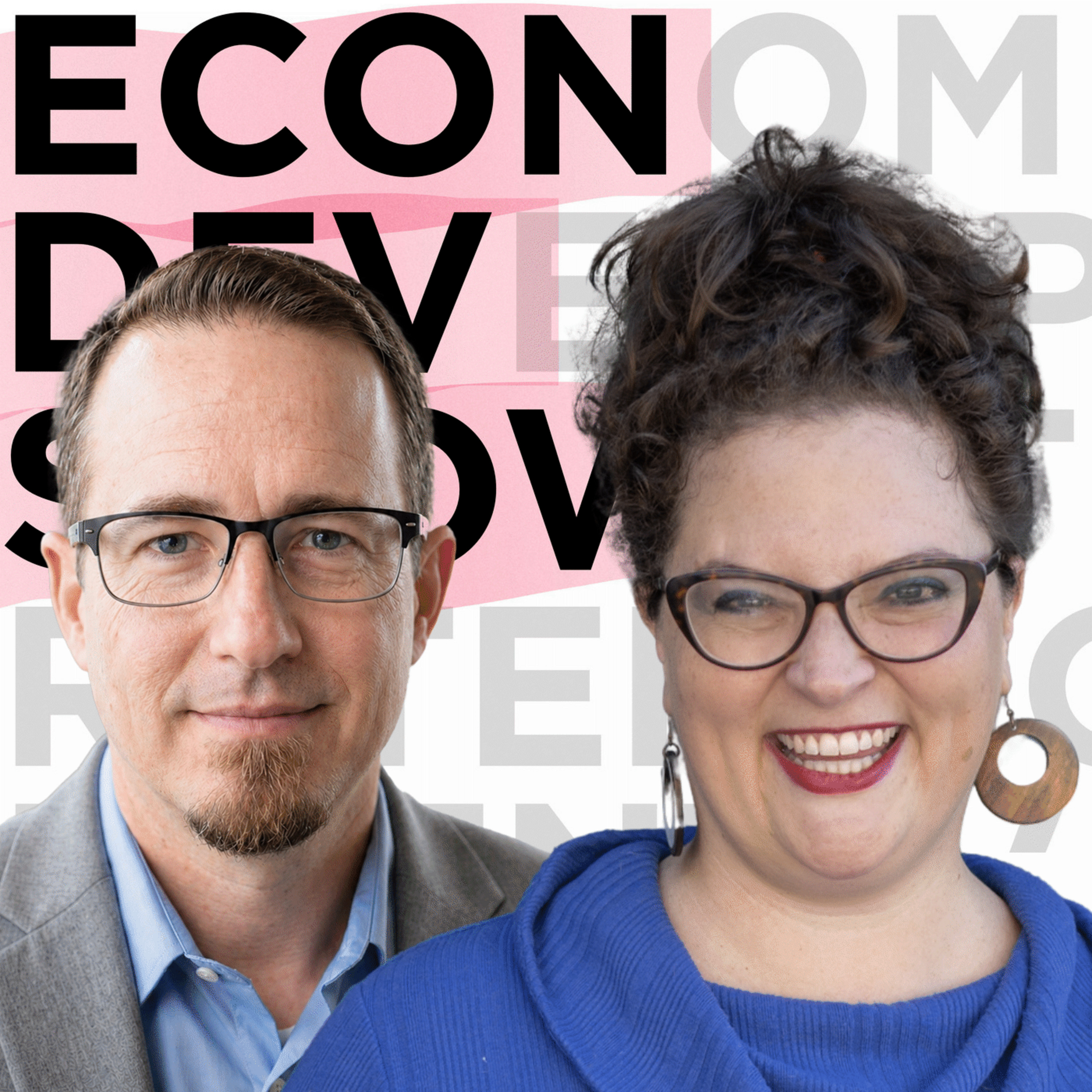
Econ Dev Show Podcast - Economic Development
228: Capital Is Not the Bottleneck with Liz Maxwell
00:27:20
Liz Maxwell explains how startup accelerators, homegrown entrepreneurship, and strong regional ecosystems can turn local problems into scalable companies, investment, and jobs.
Loading summary
Transcript42 lines
- [00:02]
A
Welcome to the Econ Dev Show. We explore the strategies, ideas and insights that are driving economic development forward into the future. You'll hear new insights from passionate EDs about their successes and struggles. And you'll learn from attraction and retention experts about how to apply actionable strategies inside your Edo. We'll help take your organization, your community and your career into your to the next level. Here's your host, Dane Carlson.
- [00:34]
B
Welcome back to the Econ Dev Show. Today we're here with Liz Maxwell. She is the chief of staff at the Idea Village in New Orleans, Louisiana. Liz, welcome to the show.
- [00:43]
C
Thanks so much for having me, Dane. Really great to be here.
- [00:46]
B
I'm glad to have you. So what is the Idea Village?
- [00:48]
C
First off, the Idea Village is a startup accelerator. We support ambitious companies who seek to have a major economic impact in New Orleans, Louisiana and across the Gulf south region. We do that through a suite of accelerator programs and we ourselves are a nonprofit, which is not necessarily a unique model, but not the way that everyone does it in the space. But we really believe that it is a philanthropic mission to support economic impact in this way and that this is the best model to do it. We also have an affiliated venture capital fund that supports select alumni out of our programs.
- [01:26]
B
So for our listeners who maybe don't know because they're traditional economic developers and maybe they don't play in this space, explain to them what is an accelerator? What does it do? Because they probably hear this term an accelerator.
- [01:42]
C
We like to say that. I like to think of the actual literal usage of the word right, which is we accelerate the path for a company and we help remove obstacles out of that company's path. Because building any business is challenging. And in particular, if you're trying to build a high growth company at scale, there are a lot of challenges that come up. There are a lot of things that you need. So an accelerator is really just a structured way to surround companies with resources and that includes expertise. That includes, we really use a mentorship driven model, believe that the expertise comes through a vast network of humans. And so we spend a lot of time building that network, also building the network of founders and companies. Knowing that many people have more than one company over a lifetime, which I believe is part of your history and background as well.
- [02:32]
B
Absolutely.
- [02:33]
C
And then I'll just sort of wrap up the formal definition by saying that an accelerator really puts usually a time bound structure around that process. So we run a couple of different types of accelerators. Our earliest stage program we call Idea Institute, which is a 12 week curriculum it's a hybrid program so folks can go through the accelerator from anywhere in the country really. And we do have quite a bit from even outside the Gulf south region. But we have a lot of founders from across Louisiana that attend weekly virtual zoom sessions that are the fundamentals of a scalable business model. They really learn the lean startup methodology, but also connect with peers, mentors, other kind of experts in the space along with that structured curriculum through the weekly sessions, and then have opportunities to connect in person. That's the early stage program. That's for founders. Anyone who has an idea for a business and really wants to understand what it would take to build that business at scale. And then the other primary accelerator that we run is called Village X and that is for, we say later stage founders. Later stage is always relative to where folks are in the space. So in the Gulf south, you're really targeting companies that are looking to raise a million dollars or more in venture capital. And so to us, that's sort of the later stage of the, you know, pipeline if you're beginning from zero with an idea for a company. And so that's a four month accelerator that we run only once a year. We put about 10 companies a year through that later stage Village X program. We put about 200 founders a year through the early stage program. So we're really committed to that structured model because we believe it's the best way to build a robust pipeline for the ecosystem.
- [04:21]
B
I think I'm probably just going to end up asking you to define a lot of terms.
- [04:24]
C
Sure, sure.
- [04:26]
B
Because I think that's probably the easiest way. So high growth startups.
- [04:30]
C
Yeah.
- [04:31]
B
Why are the, what are those and how are those different from, you know, somebody opening a bakery on Main Street?
- [04:38]
C
That's a great question. And in the context of economic development, we spend a lot of time also with local partners and allies working through these terms. I'll call those, I'll give them another name, like Main street businesses. So yeah, a bakery, a hardware store, a food truck. Right. Like any kind of mom and pop shop as they maybe used to be called. But those are also critical businesses for economic development. Right. I believe that every town needs a robust, quote, unquote, Main Street. We need those kinds of businesses as the backbone. And they're where we humans experience physical space. And I think that those businesses are so important to the lived experience of place. And so I love when economic development is really focused on making sure there's a robust and thriving kind of Main street or smaller business strategy there. We refer to Them as smaller Main street businesses largely because of the number of jobs that they tend to create over time. And the research out of the Kauffman foundation, which I did listen to some of your previous episodes, I heard reference before as well. But there is research that says that net new jobs in local economies come from startups and particularly from high growth younger firms, less than five years. Right. And so those are the types of businesses that we are really focused on. We believe they're the engine for job creation that quite honestly is under focused on that A lot of economic development tends to focus on attraction or kind of, you know, bread and butter, mom and pop shop, Main street businesses, which are both great economic development strategies. But we believe that particularly here in the Gulf south and in Louisiana, if we don't also focus on kind of homegrown innovation, homegrown entrepreneurship at scale, that we're never going to see a net increase in the jobs here, which is what we're really after.
- [06:35]
B
I think that's very helpful and I think it's important to recognize that we're not saying one is good and one is bad. We're saying they're both good and we need to. You need both, right?
- [06:46]
C
Yeah, absolutely, absolutely.
- [06:47]
B
So what kind of unique resources do these special high growth startups do they need compared to the Main street businesses?
- [06:56]
C
I'll say the end of the kind of definition of an accelerator that I usually give is that we differentiate it from incubators because incubators are usually place based. Think of like a co working shop or a, you know, physical building that maybe does a lot of work with entrepreneurs but it's sort of year round. But the acceleration process literally is meant to be more in the sense of a time bound programmatic effort to push people through a series of. Whether it's curriculum, workshops or experiences. And so to your question. Yeah, I think the specialized resources that we focus on they do include a lot of one on one coaching sessions. So I know our whole theory of change really is grounded in custom mentorship. And so whether it's the early Stage program with 200 founders a year going through it. Right. One of those 12 weeks we call coach week and I think it's actually this week. The team is literally finishing one of those up right now which is a week long series of zoom sessions where founder, founders and mentors sign up for different time slots. But then it's just a kind of rapid fire set of breakout rooms where they push people into connect with different. Whether it's financial advice, pitch advice, business Model advice. But our programs team spends a lot of time really trying to understand the specific challenges of each founder. So there's one on one coaching with someone on our team and then connections with a curated set of mentors. I guess I really can't speak to what Main street businesses might need as well, but I think that when you're building a tech business or a scalable business, you run into challenges that at least feel really unique, especially the further down the road you go. And so you really need that custom support.
- [08:44]
B
Gotcha. So you mentioned theory of change. What is that?
- [08:48]
C
Our theory of change is just what is our hypothesis of how we make an economic impact through our work. And I would say that we talk a lot about ecosystems, but really the environment of supportive resources that any focus area needs to succeed. Right. So in our case, really focusing on high growth startups and venture scale businesses. Right. The types of businesses that would take on venture capital at some point down the line, those are the types of companies we're focused on curating and supporting. And so we talk about a venture ecosystem, which I do feel like is the most jargoniest of jargon, but it's also kind of sexy and cool. So we have a theory of venture ecosystem development, like what does it really take to build a thriving environment for venture scale companies? And our theory has four components which is that it takes talent and the cultivation of that talent. So really the people and the humans. Another is access to capital. Of course capital is critical and I think that's also kind of a unique landscape in the Gulf South. The other is customers. So you really do need to not only have the people creating new businesses, but who's on the other side of the sales pitch. And we see our job as also customer cultivation for all of our startups. So making sure we have relationships in industry with corporates, with kind of folks who might ultimately be customers of new, bright, innovative companies. And then the last one is intentionally saved to last, but access to interesting problems. We really think that not just having a problem in and of itself, but that entrepreneurs are ultimately extremely creative people. And I think also living here in the south as I know you do as well, there's sort of no shortage of interesting challenges in our day to day life and that that is where the seeds of future ventures come from.
- [10:47]
B
Absolutely. You listed out a bunch and I want to dive deep into talent. But before we do, you said venture was sexy and a lot of communities think that they just need more venture capital. They think that capital is the bottleneck in Your experience, is that really the case?
- [11:06]
C
I do not think that capital's the bottleneck. I think that. I agree, everyone thinks capital is the bottleneck. Especially entrepreneurs think capital is the bottleneck. And we run into that a lot, I think, which is that entrepreneurs come to us for access to capital and we're like, that's so great. We totally want you to get capital. Why don't you spend the next couple of months talking to mentors and other peers and leaders and build out your business model, plan, get a few more customers and then we're going to make the introduction to investors. Right. Getting founders capital ready I think is really the role that accelerators provide. Like that's the service that we do to the ecosystem. So capital itself. Yeah, we can talk about capital a little more in depth as well. I think angel capital is critical. Venture capital is ultimately down the line as well. I think capital is pretty geographically loose. Right. Like it doesn't really see borders and is willing to travel and that. So that's where also like people feel like they need it locally. But actually what I would say you need is a robust entrepreneur ecosystem and venture ready companies. And the capital will find you if it's. If you're ready for it.
- [12:17]
B
Sure. So let's dive back into that talent piece, the mindset specifically you said. What did you mean by that?
- [12:24]
C
Yeah, I think about that a lot. I'm a New Orleans native, so I grew up here in the city. I was in college when Katrina hit and then lived in New York and Philadelphia and abroad for a while and so moved back in 2018 to hometown here. And I will say my path was never in economic development, innovation, startups kind of from the beginning. My background's in the arts and events conferences. I worked in the impact investing world for a while on the events media side and but got really curious about local economies and like how do, where do jobs actually come from? How do local economies actually work? Can you improve the economy in the local space? And so went back to grad school for all that. And anyway, that is all what brought me home personally. But I think the mindset piece to your question is from being a hometown girl, like returning here and just seeing a lot of people just kind of working through the. It's kind of interesting like economic depression is a term that we like use broadly in the space. But I think in the same way that people think they need capital from the outside, they think they need jobs from the outside. And entrepreneurship is ultimately a really empowering path I think. And I Also don't think everyone needs to be an entrepreneur, but I think that we can create jobs from any place that we're in. And so that's all the talent cultivation piece. And the mindset piece to me is sort of, and I see that as part of our work, even as an accelerator, but as just sort of spreading that gospel that you can make your own path here, you can, we can create jobs here, we can do this. And also that entrepreneurship is a skill that anyone can learn. It's not like a talent you were born with. It's a skill like anything else. You can learn the fundamentals of it, you can get guidance and improve on it, and anyone can do it. You can build something.
- [14:24]
B
You also mentioned that the, the Gulf south has the advantage because it's close to hard, real world problems, interesting problems. What problems do you see? What, what makes the region so perfect? Because there are, you know, what problems do you see that can be solved?
- [14:42]
C
Yeah, well, I'll be very curious to listen and see if Michael Hecht and I say the same things or similar things. But I imagine we have some similar analysis because it's just the, the truth and the facts of the landscape here. Right. That the physical infrastructure and assets that we have here in energy, in industry, kind of the, the petrochemical industry corridor that is in Louisiana, the ports, and the amount of exporting that we do specifically out of New Orleans. And so between that kind of energy and coastal infrastructure and then also, you know, as you move through the Gulf south, there's quite a bit of advanced manufacturing down here. That is all where I think that the future of innovation needs to be built out of those kinds of hard problems, or rather that's where we need innovation in is, you know, what is the future of our energy industry in this country going to look like? What is the future of manufacturing? And because the physical assets are located here in the Gulf south that quite honestly, I feel like a long time ago were sort of put here and put away in a space that things are put in rural Louisiana that maybe we don't want to see or people don't need to see day to day. But that is the infrastructure that is going to carry us forward for decades to come. And so we need innovation in that space specifically. And that's why I think we're uniquely positioned to lead and be part of the innovation economy of the future of this country.
- [16:11]
B
Because you have those unique challenges, those unique problems that need to be solved and you have those unique customers that can buy the solutions to Those problems, I think it all sort of goes together.
- [16:25]
C
It's unique in the sense that we have the assets and infrastructure here. But the challenges like particularly around let's say coastal erosion are challenges that so many places have and will have. And shout out one of our, one or two of our great startups here to give an example. But our coast is a company that is a former NASA scientist who has built kind of drone technology to specifically analyze coastal erosion both. And so her customers are both, you know, municipal, city, state property owners for the coat who have assets on the coast, but also personal property homeowners who are looking to protect those assets and understand what coastal erosion is going to do to them over time. So it's yeah, kind of AI driven risk analysis there. And we, so that's our coast, which is fantastic. We also have a company called Glass Half Full which is a kind of like sweetheart of the local scene. It's a totally incredible story. They're two lane University grads who started a glass recycling business and also came to us kind of considering a nonprofit model. You know that that was their passion, glass recycling. And maybe they should run the whole business like that. And we kind of helped work with them on. We think you have a venture scale business here that could have outside capital and real revenue because they essentially have a two sided marketplace where they collect from residential and commercial customers for glass recycling, process that glass into sand and use it to restore coastlines for coastal erosion. So those are just two examples of brilliant companies that are coming out of the Gulf south here that I think are solving problems that are going to impact it nationally or globally as well.
- [18:13]
B
And the fact that they developed a, a two sided marketplace without, you know, sort of knowing maybe what they were doing, that's pretty, that's great in and of itself because that's really, really hard. So you, you guys recently had the Third Coast Venture Summit. Yeah, tell me about that.
- [18:28]
C
So the Third Coast Venture Summit is an annual event. It's in March every year. So we did just have it and we'll have it again next March. So you can book your calendars now. But the Third Coast Venture Summit is to be a real showcase of founders from across the entire Gulf South. So Texas, Louisiana, Mississippi, Alabama, Florida. We had over 30 companies this year who are building kind of seed to series A think like raising a million dollars up to $20 million in venture capital. So we did a big showcase of those companies. But the real play here, back to the question about access to capital, is that that event is built to convene national investors here in the Gulf south and to showcase the talent, the companies, the work that's being built in this region. And to what I was saying before, that capital really doesn't care about geography so much like they're willing to travel. And so we put that event as a flag in the ground three years ago now to say, well, come here, look at this stuff and make the case of things. I was just saying about the industry assets here, you know, why you should be paying attention to this region long term. So we had over a hundred investors come this past year from out of town and, or from out of the region and we're really excited about the path and continued, I want to say, growth of that event, but really kind of intentional growth. It is meant to be a very small kind of curated convening. We work to keep at least a 2 to 1 ratio of investors to founders to make it really useful for both sides. And so yeah, we do plan to continue doing that event into the future and are very open to anyone who is interested kind of in either side of that marketplace or thinking about ways to con investors and capital in their region to showcase the assets of what they got.
- [20:26]
B
A lot of communities want to be a part of this entrepreneurial ecosystem or want to create an entrepreneurial ecosystem in their community. And they do pitch nights and they do demo days and entrepreneurship weeks and all these things. How do they avoid startup theater? Right? How do they, how do they avoid.
- [20:49]
C
So my background's in theater. That is exactly the space that got my undergraduate degree in all the World's a stage, I will say. So I don't know that we need to avoid the theater of it, but I hear the question of the, the substance underneath, right? How do we make sure that there's really like economic impact being driven through the work and not just showcase and yeah, that's a good question because I think that there is a lot on that kind of theatrical, performative side. As you mentioned of the pitch nights and the. We also ran New Orleans Entrepreneur week here for 15 years. But I think the answer to your question is that that type of public facing work really needs to be met with investment in the underlying work, which is accelerators, which is incubators, which is coaches and kind of the people who are working every single day with startups and with companies, which is all the unsexy work, right? Like that's the stuff that, you know, all the whiteboards and the things that get erased and never shared on a stage and the hours of pitch prep that go into making a three minute pitch, five minute pitch, right? These are like insane kind of theatrical forms to have these like sound bites of like the years of work put into a company. But that's where I think economic development really does need to invest in all of the support services that exist in an ecosystem that go into making the public facing work actually robust and real.
- [22:20]
B
Let's talk about metrics, right? Economic development runs on metrics, but startup ecosystems are kind of messy, especially since capital knows no bounds and you know, you can have employees everywhere and just everything that goes into this, like how do you track this or not even, how do you track this? How do other communities know whether or not their innovation ecosystem is healthy or not?
- [22:48]
C
Yeah, we as an accelerator, we have decided to focus on three core metrics which are revenue, capital and jobs. Those are the outputs of our companies. We have some other vanity metrics as well that we use and you can find in our impact reports online, such as over the 25 years of the Idea Village's history, now we've served 23,000 entrepreneurs. But we think the metrics that matter are really looking at the output of our work, right, which is the success of the companies and that those get measured, you know, in revenue, capital and jobs. I think those metrics are a nice balance on each other as well. Right? Because we want the companies to, you know, you can be a successful company and get investment through capital without having much revenue. You can have a lot of revenue, but also not quite be investment ready. And then that's also just maybe a different type of business. And then the jobs again to me are kind of the bread and butter of why I got into this business. But I think at the end of the day, like is the true success of our work. And so, and ultimately we are after that net new job creation in the economy. Right. Companies come and go. And so we want to be looking at our current work, what we are doing right now, you know, what, how we can see the impact that we are working on today. So we use the last five years frame on those numbers as well. So in the last five years, our most recent published numbers I happen to have right here. But our companies, this is about 60 companies, which is really the ones out of the later stage cohorts specifically. And they have raised 97 million in capital, generated 41 million revenue and created 505 jobs. But yeah, we kind of shorthand that to like nearly a hundred million in capital, over 500 jobs, 40 million plus in revenue, and then when we look at our, you know, kind of annual budget as a nonprofit, I was talking about that philanthropic model earlier. We've also kind of been looking at that recently and said that in the last, looking at that same last five year time period, that's really for every $1 in public community kind of philanthropic dollar invested into our nonprofit leverages $15 in private capital, which is a, it's a good return on investment at this stage.
- [25:10]
B
So I think as our final question, I want to know for our listeners who want to make one practical move this month before their next board meeting to support homegrown innovation, what should they do?
- [25:25]
C
Because I would start by googling innovation in your area. Right. Like see what's happening. Sure. Because maybe there's something amazing that like hasn't been surfaced. But I really like the frame of your question Dane, which is like to bring it to the board meeting to really say like this is something that maybe is already happening in our area. The other thing I would really point back to the Kauffman foundation and the research on innovation and the economic impact of innovation in startups. And that's maybe the second thing I would suggest is whether or not there is innovation in your area already, the research is there and really backs this strategy, which is why we're so kind of gung ho on it. So I would check out both the Kauffman foundation research and then Daniel Eisenberg is some other real research on the density of startup ecosystems and how you need to ultimately kind of work towards a tipping point of self sustaining momentum for innovation to really take off as an economic development strategy in your community.
- [26:28]
B
Liz, this has been awesome. If any of them want to learn more about the idea village, where should they go and if they want to contact you, how should they do that?
- [26:35]
C
No, this has been a really fun, incredible opportunity. Thank you Dane. I really appreciate it. Yeah, you can find us@ideavillage.org you can also look up thermit.com to learn more about the Venture Summit in March. And I'm Liz ideavillage.org I'm not great at my email, but I do my best and also just contact us through the website and someone will hunt me down.
- [26:57]
B
Fantastic. Thanks so much.
- [26:58]
C
Great. Thank you.
- [27:01]
A
You've been listening to the Econ Dev show with Dane Carlson. If you're an economic developer who never stops learning, for more expert strategies, fresh insights and new ideas to take your career, organization and your community to the next level, visit us on the web@econdevshow.com.