Loading summary
Transcript114 lines
- [00:05]
John Prideaux
The economist. Not long ago, I boarded an outbound ferry from Staten island in New York. The 25 minute trip takes you across the blue grey waters of the city's harbour to a terminal on the southern tip of Manhattan. On your left, you pass Ellis island and the Statue of Liberty. Off in the distance to the right, you see the Brooklyn Bridge. Out in front, the glass, steel and granite towers of lower Manhattan reach up to the sky. The buildings are physically imposing, but that's not what draws me to this view. It's what they stand for. Because even if you've never been to New York, you've felt its pull, maybe even imagined yourself inside it. Like Ross and Rachel Spiderman or Sinatra approaching it via the water. It feels like a great and powerful civilization is opening its arms out to you. On this trip, I stood on the passenger deck and took it all in. But I wasn't here for the sightseeing. I was on the trail of a long dead hero of mine.
- [01:38]
Alexis de Tocqueville
Here we are in New York. From a Frenchman's perspective, it looks disarmingly weird. There isn't a dome, steeple or a large edifice in sight, which leaves one with the impression that one has landed in a suburb, not the city itself.
- [01:56]
John Prideaux
Alexis de Tocqueville also arrived here by boat, almost 200 years before me, in May 1831. He was 25, a wiry brown haired aristocrat on a mission from the French government. Visiting the New World for the first time, Tocqueville wasn't greeted by an imposing skyline. Back then, New York was a modest outpost of bricks and timber, almost entirely confined to the lower tip of Manhattan. Paris was four times bigger. Pigs roamed the streets. This was no superpower. The country was barely 50 years old, with just 24 states. Voting was mostly for white men. If Europeans thought about America at all, it was as a cranky political experiment doomed to fail. But Tocqueville caught a glimpse of something different.
- [02:51]
Alexis de Tocqueville
It was there that civilized men were to try and build a society on new foundations. And applying for the first time theories until then unknown, they were going to give the world a spectacle for which the history of the past had not prepared it.
- [03:20]
John Prideaux
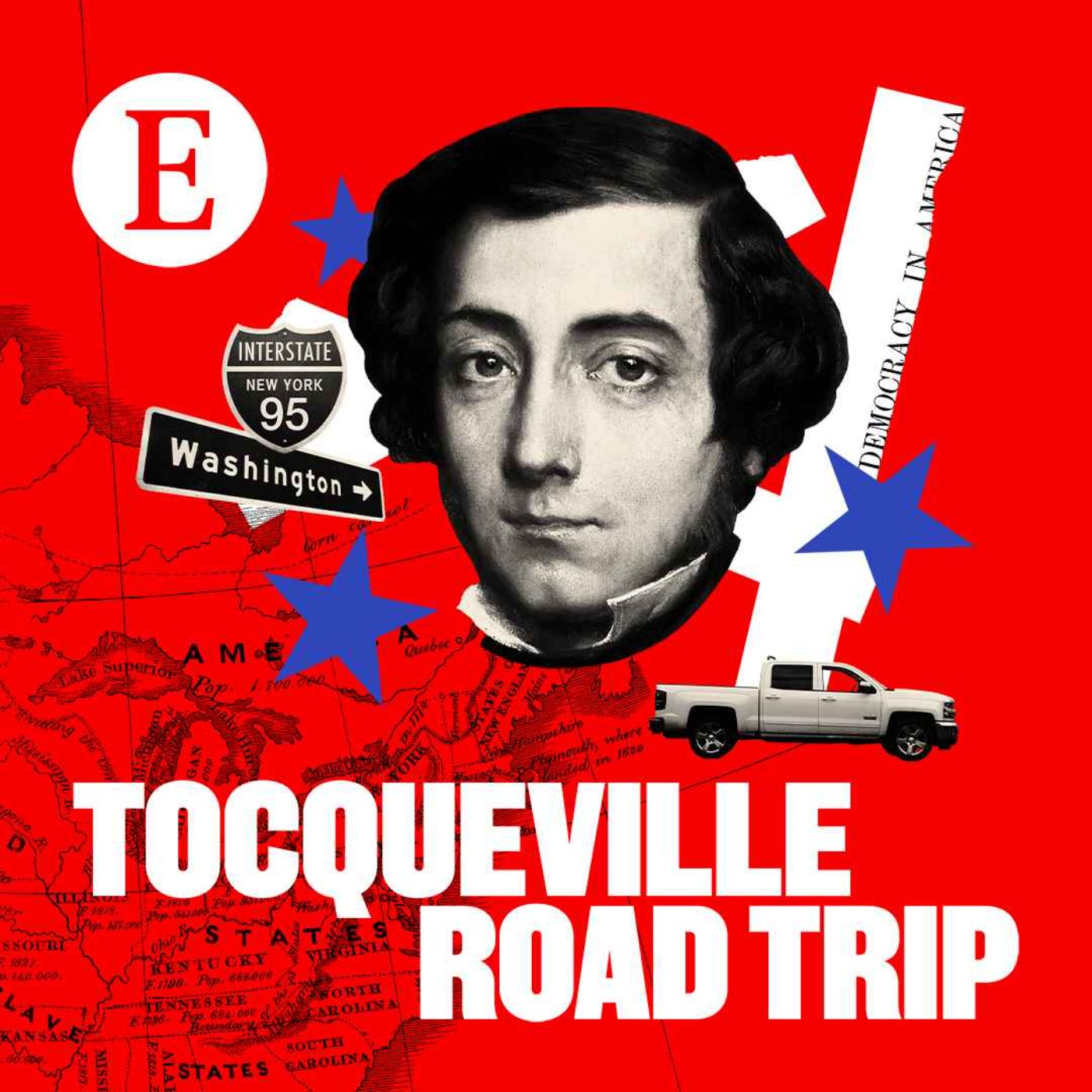
America was a vision of what the future might hold. A land with no kings or queens, where citizens made the rules. The first modern society without an aristocracy. To a young man curious to understand how liberalism and democracy worked in practice, it was an exhilarating case study. So Tocqueville and his friend Gustave de Beaumont set off on a road trip. It took them nine months they visited 17 of the 24 states and met hundreds of Americans from all walks of life. Tocqueville spoke to innkeepers, merchants, lawyers and priests. He sat in upscale drawing rooms in Manhattan, where and by campfires with Ojibwe and Iroquois people. He paddled down rivers, rode horses through mosquito filled forests, and met Andrew Jackson, America's seventh president. At the White House, Tocqueville filled up 14 notebooks and dozens of letters with his observations. He became a sort of foreign correspondent and political analyst before either was really a thing. Then he returned to France. He'd never come back to America. But those letters and notebooks became the basis of a work that remains perhaps the single most insightful thing ever written about the United States. A book called Democracy in America. That book has been my companion since I first started writing about this country for the Economist. I began reading it on the plane over from London to Washington for my first assignment as a US reporter in 2013. Like anyone moving abroad to start a new job, I was both excited and and nervous. My biggest worry was whether a foreigner like me could have anything useful to say about a country they'd never lived in before. Tocqueville offered some reassurance. His radical insight was that America was much more than a country. It was an idea. And he saw that this idea was so powerful it would bend the arc of history. People don't talk about the British or the French dream, but 200 years after Tocqueville, we still have a sense of the American one. It's a belief system, a faith even, and its gospel has been shared around the world. Growing up in Britain in the 80s and 90s, I absorbed it without thinking. Television introduced me and my sister to a galaxy of American stars. From Madonna to Michael Jackson, Marty McFly to Michael Jordan, they all seemed about a thousand times cooler than anyone in Britain. And the TV news only confirmed what we already knew. Americans were the good guys. They'd defeated an evil empire and won the Cold War. We all wanted in on it. Now it's not so simple. People inside and outside America are questioning the vitality of its democracy and its right to lead the world. For the past ten years, I've been the editor in charge of the Economist's coverage of America. In that time, I've written or edited more than 100 cover stories on the country. Often when Donald Trump has done something crazed or alarming, usually I'm the person in the room advocating for optimism, arguing that America's checks and balances were built to withstand tougher challenges than this. But a year and a half into the wildest presidency any of us have ever seen, I'm starting to have my doubts. And the best way I could think of dealing with them was to go back to Tocqueville, to try to see this America through his eyes. He saw a system that could be chaotic on the surface, but that remained stable and resilient underneath. A form of government that would generate more prosperity and enable more happiness than any of its rivals. Two centuries on from Tocqueville's journey, I want to know if that's still true. I'm going to retrace his steps around the country, talking to Americans from all walks of life just like he did. It's an old fashioned road trip with stops in New York and Niagara, Michigan and Boston, with a crossing south into Kentucky and a visit to D.C. at the end. And it's also a chance for me to take a moment for myself amidst the madness, to clarify what I really think about this land of prodigies and as Tocqueville put it, and to answer a pair of questions that have been on my mind as this country approaches its 250th birthday. How much of what Tocqueville admired about democracy in America still holds true today? And how worried should I be feeling about what's been lost? From the Economist, I'm John Prideaux, and this is my Tocqueville road trip. Episode 1 Game of Chance. Everybody,
- [09:13]
Jonathan Marder
Before we sit down, we've got a little treat.
- [09:16]
Anthony
Hi, it's great to see everybody. I'm Anthony, and thank you to Barbara. There'll be many thank yous. So nice to see so many of you. This isn't an upbeat tune, but I feel like it delves into the moment that we're in.
- [10:24]
John Prideaux
I'm in New York's Upper west side. The lighting is low, the wood paneling is dark. There's a menu in a special font and a countertenor to entertain us. Normally, when I come to the city for work, I I speak to policy wonks or executives in bland meeting rooms. People do not generally play the lute, but this time Tocqueville is my guide. When he arrived here with Beaumont, word immediately spread about their aristocratic credentials and their lofty mission to understand the new world. New York's emerging upper class took note. The two of them received a flurry of invitations to dinners, balls and soirees. And they began hanging out with Americans who had done very well out of democracy. Tocqueville was impressed. Never have a people been blessed with such happy, dynamic conditions of existence. He wrote to a friend. I wanted to begin my journey in the same kind of company. So I started looking around for members of the Manhattan establishment who might humour me and my weird idea for a road trip. America is still a powerfully hospitable place. The replies came in quickly. One of them came from the office of a philanthropist called Barbara Tober. And it brought me here to a long table in a private dining room at Lincoln Centre, surrounded by luminaries of New York's art scene.
- [11:59]
Michelle Okadona
But I also think you know New York likes you when you're lean and hungry and you're out there hustling. And there is a certain undeniable energy and creativity that comes from that.
- [12:11]
John Prideaux
There are artists and curators, dancers and musicians and some of Barbara's fellow philanthropists. I'm curious to find out whether these people have the same optimistic feelings about their country and as the ones that Tocqueville met.
- [12:25]
Michelle Okadona
What I love about New York, and
- [12:28]
it's always been this way, it has
- [12:31]
been a land of opportunity.
- [12:34]
You have everything at your fingertips, provided that you figure out how to get there. One night in the summer, I got out of the number six train, I walked down 59th street to the park and it was a beautiful day and there was an open restaurant.
- [12:54]
John Prideaux
Michelle Okadona is an artist who, like most of the folks here this evening, has lived in New York since the 1980s.
- [13:02]
Michelle Okadona
And there was music playing and all of a sudden it started singing the music New York, New York. And everybody stopped their conversation.
- [13:13]
John Prideaux
To her, the city remains a wellspring of opportunity, just like the place Frank Sinatra sang about.
- [13:19]
Michelle Okadona
And there must have been 100 kids. Singing star Da da da da. You know, I've never seen anything like it. It was really out of a film.
- [13:32]
John Prideaux
As much as I love Tocqueville, I'd worried that my plan to follow him might be too esoteric. But as we moved from appetizer to entree, my doubts are easing. Some of that may be down to the hospitality, which is every bit as generous as it was when Tocqueville was here. More generous, in fact. He frequently complained about the lack of wine. And my glass is being attentively refilled with delicious American Chardonnay. But more encouragingly still, these New Yorkers seem to care about my long dead traveling companion even as they're making jokes about him.
- [14:08]
Jonathan Marder
Alexis de Tocqueville wins the award for being the least read but most quoted author about America.
- [14:16]
John Prideaux
Jonathan Marder is a public Relations executive. And he thinks that on one point at least, Tocqueville has been proved wrong.
- [14:25]
Jonathan Marder
He argued that there was an inherent struggle in America between two opposing the spirit of rugged individualism versus the conflicting spirit of creative associations and common grounds. But in fact the two strands are woven together.
- [14:43]
Agnes Hu Tang
So this is an interesting trivia. Tocqueville came to America at the time when Andrew Jackson was president.
- [14:51]
John Prideaux
Agnes Hu Tang is an art historian and as she was reading Tocqueville, she was struck by a scene that felt oddly familiar.
- [14:58]
Agnes Hu Tang
He met Andrew Jackson in Washington D.C. and in his journals he talked about how he was not impressed with Andrew Jackson. This was a man that was prone to violence and was turning America in a different direction. Tocqueville observed that he has a tendency, the inclination to become a despot. So I stopped there.
- [15:24]
Alexis de Tocqueville
Did he want Greenland?
- [15:29]
Agnes Hu Tang
So we have a lot to say. Think about.
- [15:36]
John Prideaux
I left the soiree at Lincoln Centre feeling reassured that I was onto something, but also with a lot to think about because. And there's no way of getting around this. Democracy in America is a dauntingly large book. My edition runs to over 700 pages. The index alone takes up 12 of them and runs from abolition and Adams, John Quincy through to workers, writers and Zeisberger, David. He was a missionary who spent time among Native American tribes. Since you asked. Tocqueville combined a journalist's knack for gathering stories in the field with a philosopher's love of analysis, structure and theory. Like all great French intellectuals, he was constantly on the hunt for the deeper meaning behind things. This makes him easy to poke fun at. One chapter in Democracy in America, for instance, is titled how the Excessive Love of well Being Can Be Harmful to well Being. Another is headed why the Americans have Never Been as Passionate as the French for General Ideas in Political Matters or perhaps my favourite, on the gravity of Americans and why it does not prevent their often doing ill considered things. But actually, Tocqueville's restless desire to find meaning and to divide his thinking up into short, clearly chaptered essays is a feature, not a bug. Because Democracy in America is not a book that you read cover to cover. It's one you browse through and graze on, slowly filling up on the fruits of his thinking. I've been doing this for years. I'll take down my copy from the shelf, scan through the index for the topic I'm working on, Presidential elections, say, or the Supreme Court, or the south, or any one of a hundred other things, and see what Tocqueville thought and now, as I approach the end of my time as US Editor, I'm going to explore five key areas in which I think this brilliant Frenchman has something important to say about America. One in each episode, contrasting his ideas then with what I find now,
- [17:51]
Barbara Tober
I'll
- [17:52]
John Prideaux
look at the unique way in which Americans think about personal responsibility and the ever present tension here between the forces which want things to remain the same and those driving rapid material progress. I'll examine the arguments over free expression and take a close look at two forms of democratic tyranny, both of which have become a rising concern in the Trump era. And I'll start with the biggest and most important idea in the book.
- [18:22]
Alexis de Tocqueville
Among the new objects that attracted my attention during my stay in the United States, none struck my eye more vividly than the equality of conditions. I discovered without difficulty the enormous influence that this primary fact exerts on the course of society.
- [18:42]
John Prideaux
When I think about democracy in 2026, the pictures that flash into my mind are of fundraising emails, campaign merch, political adverts and opinion polls. A system whose purpose is to get politicians elected. But that isn't the first thing Tocqueville saw. For him, democracy was a social revolution as much as a political one. Just like the aristocratic society in which he had grown up, it was governed by powerful rules and norms which shaped everyone's behaviour. Only in America, the rules weren't about strictly enforced class hierarchies, they were about equality. He noticed this in the fact that most rich people he met seemed once to have been poor and in the voluntary associations which sprung up whenever a problem needed to be fixed. He even noticed it in the friendly, informal way in which American parents treated talk to their children. Equality of conditions everywhere. In this series, I want to test Tocqueville's theories against the lives of modern day Americans.
- [19:53]
Interviewer (possibly John Prideaux)
Barbara, which seat would you be happiest in?
- [19:55]
Barbara Tober
That little one.
- [19:56]
Interviewer (possibly John Prideaux)
Very good.
- [19:58]
John Prideaux
Barbara Toba. And her Rolodex made that Manhattan dinner party possible. She's in her early 90s, with a wave of silver white hair and a welcoming manner. She lives about a mile to the east of Lincoln Centre on Park Avenue. Her block has a liveried doorman and a canopy over the pavement. The lift opens straight into an apartment full of art and books and colour. On the face of it, Barbara might not seem like a walking advertisement for equality of conditions. And her lifestyle definitely tends towards the aristocratic glittering soirees, upscale friends, nights watching Cosi Fan Tutti and Rigoletto.
- [20:40]
Barbara Tober
I really enjoyed giving money to the opera. I really did. Those chandeliers, that was expensive and it's in perpetuity. I mean, I was so proud. I sit under the chandelier, the biggest chandelier. I sit right there. Next, the plaque is at the window. I love the fact that I was able to do that.
- [21:10]
John Prideaux
But look closely and you can find all sorts of democratic forces at play here. For one thing, Barbara isn't trying to hoard her money or shore up a dynasty. She seems intent on spending it all before she dies. As well as her philanthropic activity, she recently commissioned an artist called Machine Dazzle to design a tomb for her. Or to be precise, for her and her late husband, who died in 2021. It will be a seven foot long wave of love, decorated with a shield of Achilles, crossed skis, books, a violin and a running horse.
- [21:47]
Barbara Tober
He learned how to ride for me. I learned how to ski for him. That's his urn. This is mine, which I will fill up when I get gone.
- [21:58]
John Prideaux
It's easy to imagine Europeans of a certain class scoffing at this. So trashy, so American. But I think Tocqueville would see something else here. He was deeply impressed by America's estate laws. These ensured that fortunes didn't simply pass on to the eldest son, as they did in aristocratic societies. Instead, they had to be shared among all surviving children equally. The idea that wealth is something to be earned, enjoyed, and then broken up and redistributed is equality of conditions in action. And we can find it woven into other parts of Barbara's story, too. Because she didn't inherit her fortune from her parents, she trained as a secretary when she was a young woman. And she told me about how she hustled her way up the career ladder starting in the mid-1950s.
- [22:50]
Barbara Tober
I walked into Conde Nast. I said, I want Vogue and I want $85 a week. She's looking at this kid wearing an outfit she made herself because I did. I made all my own clothes. And she says, we'd hate to lose you on account of salary. I said, what do you want to pay me? She said, $65 a week instead of $85 a week. I said, okay.
- [23:26]
John Prideaux
Through a mixture of grit and talent, Barbara rose to become the editor of Brides magazine in the mid-1960s. Then, in the early 1970s, she found her own perfect match, Donald Tobert.
- [23:40]
Barbara Tober
Donald and I used to dance everywhere. Oh, my God, we danced. We were famous. Here come the Tobers. Oh, my God, it was so fabulous. He was so cool, smooth, fantastic, great dancer. He went to Poly Prep they taught him how to dance when he was a kid.
- [24:02]
John Prideaux
Donald was a businessman and the scion of the Sugar Foods Corporation. If you've ever been to an American diner, you probably will have encountered one of their products, small pink sachets of a sugar substitute called Sweet N Low.
- [24:16]
Barbara Tober
You know, he'd go into a little diner and he'd say, you know, here's the Sweet N Low. And Sweet N Low doesn't have any calories. Oh, well, we want to have that.
- [24:27]
John Prideaux
I imagine Tocqueville looking slightly bemused at the idea of a Park Avenue fortune based on tiny parcels of not sugar. But he'd certainly have recognized the democratic forces that made it all possible.
- [24:51]
Barbara Tober
Would you like to see something amazing?
- [24:54]
Interviewer (possibly John Prideaux)
Yes.
- [24:54]
Barbara Tober
Yes.
- [24:54]
Will you follow me, please? I will show you something amazing
- [25:01]
John Prideaux
from the library where we're talking. A door leads through to another room that Barbara has redone since Donald's death five years ago. There's a large table covered in trinkets, invitations, and photographs.
- [25:13]
Barbara Tober
I love it here. I come here every day. I talk to him. I feel complete, and I feel sorry for people who just, you know, pack somebody away and that's the end of it. Because there's something very beautiful about the essence of this place.
- [25:45]
John Prideaux
Barbara has made a shrine to her late husband and to their previous lives. Looking back, she sees a place of opportunity where wonderful things could happen. Perhaps never more so than when an actual movie star was in the White House.
- [26:01]
Barbara Tober
Reagan was the best. Reagan was. Reagan wanted all of us to make money. I mean, you could feel it. I mean, he wanted us to have fun and go out and make money. And, yeah, he was applauding us the whole time while he was president. You could feel it.
- [26:30]
John Prideaux
That was then. But the present moment feels quite different.
- [26:35]
Barbara Tober
Oh, now everybody wants you to cut back, think about the rest of the world, and. I don't know, we're all on a diet.
- [26:52]
John Prideaux
I'm sure that Tocqueville would see Barbara as a descendant of the New Yorkers he encountered. Restless, outgoing, unapologetic about making money and spending it. But there are also notes in this story that would be new to him. Things that he didn't hear from Americans when he was here. A gnawing sense that the present is worse than the past and that some newly apparent flaw in American democracy has something to do with it.
- [27:20]
Barbara Tober
Oh, God Almighty. There's gotta be somebody out there now. We've got this mayor, the New York. I don't even want to go there, but politics is really amazing these days. It really is throwing the dice. I mean, that's where we are, just throwing the dice.
- [27:54]
Zoran Mamdani
My fellow New Yorkers, today begins a new era. I stand before you moved by the privilege of taking this sacred oath.
- [28:11]
John Prideaux
A few days before I met with Barbara, Zoran Mamdani was inaugurated.
- [28:16]
Zoran Mamdani
We will replace the frigidity of rugged individualism with the warmth of collectivism. If our campaign demonstrated that the people of New York yearn for solidarity, then let this government foster it.
- [28:39]
John Prideaux
This is a strange moment for New York, the first time in the city's history that it has elected a socialist mayor. And it's hard not to read Mamdani's election as a sign that lots of people think America's basic deal with its citizens, work hard, get ahead no longer exists. Polling bears this out. Only 30% of Americans aged under 30 think they'll be better off than their parents. And more than 60% say that American democracy is either in trouble or has completely failed. Barbara's response to this has been to withdraw into the past. But as I continue in Tocqueville's footsteps, I'm about to meet a wealthy New Yorker who has taken a different approach, one whose story takes us closer to a vision of America's future.
- [29:33]
John Katz Matidis
What happened is he went over and asked her to dance with her, and me and Hillary were standing in the corner watching. And everybody else circled all of them and watch the two of them dancing.
- [29:50]
John Prideaux
It's a public holiday, but John Katz Matidis is in his office in midtown Manhattan. He's busy showing me some of his favorite photos.
- [29:59]
John Katz Matidis
This is the White House. It's just like in the movies. This is Margot.
- [30:06]
Interviewer (possibly John Prideaux)
So it's Margot, your wife dancing with President Clinton?
- [30:09]
John Katz Matidis
Yes.
- [30:10]
John Prideaux
Almost all of these pictures feature John or members of his family next to famous American politicians from both parties. It's like a who's who of powerful Americans.
- [30:20]
John Katz Matidis
Mario Cuomo. That's about 30 years ago. One of our stories.
- [30:26]
John Prideaux
There's Ronald Reagan again and Henry Kissinger and Barack Obama.
- [30:31]
John Katz Matidis
This was a sit down meeting with the President or whatever.
- [30:35]
John Prideaux
John is a heavyset man in his late 70s, wearing a rumpled black suit, blue tie with Greek columns on it and a fleece vest. Coqueville might have called it Gilet. His office is not what I imagined a billionaire's workplace to look like. A desk that looks like a hand grenade detonated nearby. Screens and wires everywhere. An old iPhone repurposed as a clock. For someone who could quite literally buy anything he wants, John seems delightfully unfussed about appearances. But he clearly is proud of the status that his wealth has afforded him.
- [31:11]
John Katz Matidis
And you know, the library of Camp David is named after my daughter. The bigger the check, the bigger the naming, right?
- [31:21]
John Prideaux
John Katz Metidis wasn't born into a world of presidential libraries and million dollar fundraisers. In fact, he wasn't even born in the US he was born on the island of Nisyros in Greece. He arrived in the US by boat in 1949. He was six months old. John grew up in an apartment block in West Harlem. No elevators in this one.
- [31:48]
John Katz Matidis
I never knew we were poor because we always had food on the table. My father worked seven days a week. My mother did whatever she had to do.
- [31:58]
John Prideaux
He came up through a different kind of New York to Barbara's, but still with the same central themes. Hard work, perseverance, and upward social mobility.
- [32:08]
John Katz Matidis
I learned how to speak English through a 5 inch television set because my parents didn't speak English.
- [32:15]
John Prideaux
John also turned out to be good at maths. He got a place at NYU to study electrical engineering. After his first year, he came home for the summer.
- [32:24]
John Katz Matidis
I was ready to plop down on the couch and watch television for the next 13 weeks.
- [32:29]
John Prideaux
But his immigrant parents had other ideas.
- [32:32]
John Katz Matidis
And my mother went to Tony's store on 137th street and got a job for me. Come home. My mother threw me off the couch and said, you're going to work. Well, I spent 80 hours a week working for Tony and I learned a little bit about the supermarket business and I enjoyed it.
- [32:54]
John Prideaux
This was the late 1960s. John dropped out of college and bought his own grocery store, which he named Red Apple. Before long, there were 10 Red Apple stores scattered along Broadway, and he was reportedly making a million dollars a year. Over the coming decades, his Red Apple group expanded its operations into aviation, oil refineries and real estate. Most recently, Red Apple has been moving into media. We're speaking in the offices of WABC Talk Radio, which John acquired in 2019. He's now reportedly worth a little under $5 billion, making him one of the 400 richest people in America. His rise and rise makes me think of another famous quote from Democracy in America.
- [33:41]
Alexis de Tocqueville
The American inhabits a land where everything is constantly moving and each movement seems, seems to be progress. For an American, one's entire life is spent as a game of chance.
- [33:57]
John Prideaux
John has been playing the game of chance since he arrived here on the boat from Greece. Each movement has seemed to be progress and he has no plans to slow down. He's constantly checking his phone and I
- [34:11]
John Katz Matidis
say this and It's a terrible thing to say. You retire, you die. Our Creator who created us, if there's no purpose in living, you die.
- [34:32]
John Prideaux
Viewed through one lens, and this all looks very Tocquevillian, equality of conditions at its finest. But as with Barbara, there are also things about this story that my travelling companion would find concerning. When Tocqueville was here, there were just a handful of ultra wealthy Americans, most of them holdovers from the colonial era. He didn't see this small group of people as a threat to the fabric of the country, but he warned that future generations should keep a close eye on America's industrialists. Because if a new kind of aristocracy was going to rise from anywhere, it would be from here.
- [35:12]
Alexis de Tocqueville
The friends of democracy ought constantly to turn their anxiety in this direction. For if ever permanent inequality of conditions and aristocracy are introduced anew into the world, one can predict that they will enter by this door.
- [35:33]
John Prideaux
When Forbes started publishing its 400 richest Americans list in 1982, there were 13 billionaires in the country. And the total wealth of all the people on the list was 260 billion in today's dollars. Today, every single person on the list is a billionaire and their collective wealth is $6.6 trillion. That's about a fifth of America's entire GDP. This new billionaire class is served by an industry of estate planners, tax attorneys and lobbyists, helping ensure that their families remain wealthy in perpetuity. Just like the aristocrats of yesteryear, many of them are also using their wealth to influence politics. And that brings us back to John Katsimatidis. Because as well as all of those people in the photos on his wall, it may not surprise you to learn that this chronically online billionaire New Yorker is friendly with another one.
- [36:37]
John Katz Matidis
President Trump I've known for 45, 50 years. And he's a common sense businessman and he's a tough businessman. You have to be tough to survive a new.
- [36:49]
John Prideaux
They're still in close contact. At one point during our interview, John shows off a recent text signed President djt.
- [36:59]
John Katz Matidis
I think what he's trying to do is become a tough businessman on behalf of the American people. American people first, are allies and friends in the free world second.
- [37:14]
John Prideaux
And for me at least, things are about to get a whole lot Trumpier.
- [37:19]
John Katz Matidis
I'm interviewing you because you interviewed me.
- [37:23]
Interviewer (possibly John Prideaux)
This is really uncomfortable for me because I host a podcast as well. It's my day job, and so it's much easier being on the side of the microphone where you ask the questions
- [37:31]
John Prideaux
rather than answer them tocqueville's arrival in New York was a big deal for the local media. Newspapers boasted that the King of France had sent distinguished envoys with first rate talents to learn from their new republic. I'm pretty sure the King of England is unaware of my visit and I didn't see any write ups in the papers. But it's 2026 so John's invited me on his podcast.
- [37:55]
John Katz Matidis
We had visitors this week and one of our visitors is John Prideaux. He's the U.S. editor of the Economist.
- [38:05]
John Prideaux
Other guests the week I'm on include Lara Trump and and Newt Gingrich. And right out of the gate, John picks a talking point that I had not seen coming.
- [38:14]
John Katz Matidis
I grew up where the sun never sets on the British Empire. Tell me, how do you feel of what's happened in the last 50 years? And is the sun setting on the British Empire or versus? We've had a discussion where I felt that we're about to have the 250th year of the United States of America and that if we didn't have the right president that I didn't believe that we might not make the 300th year.
- [38:47]
Interviewer (possibly John Prideaux)
Yeah, I was really struck by that. The idea that it might, the country might not make it to its 300th birthday is, is alarming for me. What happened with the British Empire? Well, I think after the Second World War the country was kind of on its knees and also took the position that the parts that made up the British Empire should all have the opportunity to determine their own futures. They should all be able to decide for themselves if they wanted to be part of the British Empire, if they wanted to be independent. And so Britain's unusual, I think, in having given up an empire relatively peacefully. And I think that was mainly a good thing.
- [39:29]
John Prideaux
Often when I do media interviews I have a slightly out of body experience. But this is surreal in a new way. America is about to celebrate 250 years since the Declaration of Independence. And here I am defending the idea of self determination to a billionaire pal of the President.
- [39:49]
Interviewer (possibly John Prideaux)
Now it feels like we might be back in an age that's a bit more like the 19th century where countries are building empires. And that feels a lot more like a return to a kind of imperial age that Britain thought it had left behind.
- [40:03]
John Prideaux
A similar thing happens when our conversation turns to another issue of the day. For pretty obvious reasons, John considers himself pro immigration.
- [40:11]
John Katz Matidis
I was vice chairman of the Ellis Island Foundation.
- [40:19]
John Prideaux
But his views have hardened.
- [40:22]
John Katz Matidis
I think the Europeans gave a disease to the Americans because You guys, the Europeans allowed Europe to be invaded and I don't know you're British. I said one of the problems with Great Britain is they woke up one day and they were invaded and they were down to 47% non Brits.
- [40:51]
John Prideaux
I've checked this figure and according to the most recent UK census, 84% of Brits were born in the UK. The country is also 82% white, making it much less diverse than America. London, my home, is an outlier. 40% of its population was born abroad. This is a talking point that the far right influencer Tommy Robinson likes to repeat. So perhaps that's where John heard the number. But it's striking that someone so successful and well connected who owns their own radio station could be so fixated on a piece of misinformation. The same thing happens off air. Back in his office, when we discuss the new mayor of New York, John tells me about a guest he recently heard talking on wabc.
- [41:44]
John Katz Matidis
His philosophy was that all the foreigners we were invaded by invaded by the last six, seven years and the foreign born voted for this guy to make him mayor and that a majority of citizens were not really in favor.
- [42:16]
John Prideaux
The idea that Zora Mamdani won because of an influx of foreign born voters is also evidence free. But it feels true to John, for whom a belief that the west is being invaded by migrants has become melded with an existential fear for America's survival. And it's a talking point you hear repeated a lot on his radio station. John has hosted an Obama fundraiser in his apartment. He was on the finance team for Hillary's first run for president. His wife danced with Bill. This is a man who arrived in America on a boat and ended up owning an airline. But now he's certain that in 2024, because of their stance on immigration, the Democrats were within a whisker of bringing America to its downfall.
- [43:07]
John Katz Matidis
If Harris won the election. We were close. You know what song we play on my five o' clock show every day on wabc, we were on the eve of destruction. We were very close.
- [43:32]
John Prideaux
On the way out of the building, I noticed a poster of the Lone Ranger. Before the TV series or the movies, the radio show was a favourite on WABC and on dozens of other stations across the country. In the middle decades of the 20th century, millions of Americans would gather around their wireless sets and listen to stories in which a masked hero fought for the ideals on which their country had been founded.
- [44:00]
Radio Announcer
Nowhere in the pages of history can one find a greater champion of justice. Return with us now to those thrilling days of yesteryear. From out of the past come the thundering hoofbeats of the Great Horse Silver, the Lone Ranger riots again.
- [44:19]
John Prideaux
The Lone Rangers creed could have been lifted straight from Tocqueville. That government of the people, by the people and for the people shall live always that men should live by the rule of what is best for the greatest number, that all things change but truth, and that truth alone lives on forever. Tune into WABC now and you'll hear MAGA loyalists railing against migrants and wokesters. Or choose a left wing podcast and hear the same story, but with the roles reversed. Indeed, it sometimes feels like the only thing Americans agree on is that something about has gone badly wrong. This has certainly been my experience in New York. Barbara and John should have every reason to feel optimistic about the country that's given them so much. But instead they both find themselves lamenting the turn the US has taken. And the data tells a similar story. In surveys, most Americans say they would prefer to live in the past. Their country is also the only one in the west where a majority of people view their fellow citizens as morally bad. As the United States turns 250, the place seems haunted by a sense of loss. Tocqueville would be deeply saddened to learn this, and I think he'd also quickly see that inequality is only part of the problem. Because while America does seem to have developed a blind spot on inherited privilege, and while the rise of a billionaire class does make the country measurably less fair than it was even a few decades ago, it hasn't stopped equality of conditions from being the defining force here. And in lots of ways, gender, race, access to education. The US is far more equitable now than it was when Tocqueville visited, or even than it was when my parents were born. Objective measures show a country that's doing better than ever. Life expectancy has never been higher. Unlike in Europe, the economy here is growing. Wages of those at the bottom end of the labour market have been rising. So why have so many people lost their faith in the country? In order to get closer to an answer, we need to. Tocqueville's trek into the interior involved bumpy stagecoaches and creaking paddle steamers. I'll have the relative comfort of planes, trains and rental cars. My journey will span more than 3000 miles and will touch many of the same places he visited. I'll go to small towns and grand institutions. I'll talk to people who are battling for survival and others who say they've never been better. And for my next stop, I'm heading up the Hudson to a spot that now lies just beyond New York City's limits. A place that amazed Tocqueville when he was here. A prison that gets its name from a Native American phrase meaning stone upon stone. Sing sing.
- [47:52]
Unnamed Speaker (possibly a local or interviewee)
And I remember thinking like, damn, we can't. We can't. Like, we just not built for this kind of stuff. Like normally they put this stuff out here for certain people. We're not that people.
- [48:02]
John Prideaux
You can listen to that episode now for free, wherever you get your podcasts. To hear the rest of the series as it comes out, you'll have to be an Economist subscriber. Go to economist.com podcastsplus for our best offer. Tocqueville Road Trip was made by Imogen Svotka, John Shields, Pete Norton, Claire Reed and me, with additional editing by Rosie Blore and Sam Colbert. Wei Dong Lin is our sound designer. Darren Ng composed the music, and Nico Rofast voiced the extracts from Tocqueville. I'm John Prideaux. This is the Economist.