Loading summary
Transcript88 lines
- [00:00]
Creative Planning Advertiser
Then I thought, what if I've scaled businesses? What if I scaled my philanthropy? What if I did as much in one year as I've done in my whole life?
- [00:07]
Cash App Advertiser
See how your wealth could have even Greater meaning@creativeplanning.com impact most of us don't think much about how money actually moves until something slows it down or makes it more expensive than expected. That friction is exactly what Bitcoin was designed to rethink. Bitcoin is often talked about as an investment, but it was built to be used with Cash App. You can actually do that. Send Bitcoin instantly, pay at local square businesses that accept it, or move it to your own wallet whenever you want. It works more like real money and less like something locked in an account for a limited time. New customers can get $10 added to their balance. Just use code CASHAPP10 when you sign up. And don't forget this part. Send at least $5 to a friend in the first two weeks. Terms apply. Cash App is a financial services platform, not a bank. Banking services provided by Cash App's bank partners Bitcoin services provided by Block Inc. Brand for additional information, see the Bitcoin disclosures at Cash App legalpodcast.
- [01:13]
Jason Palmer
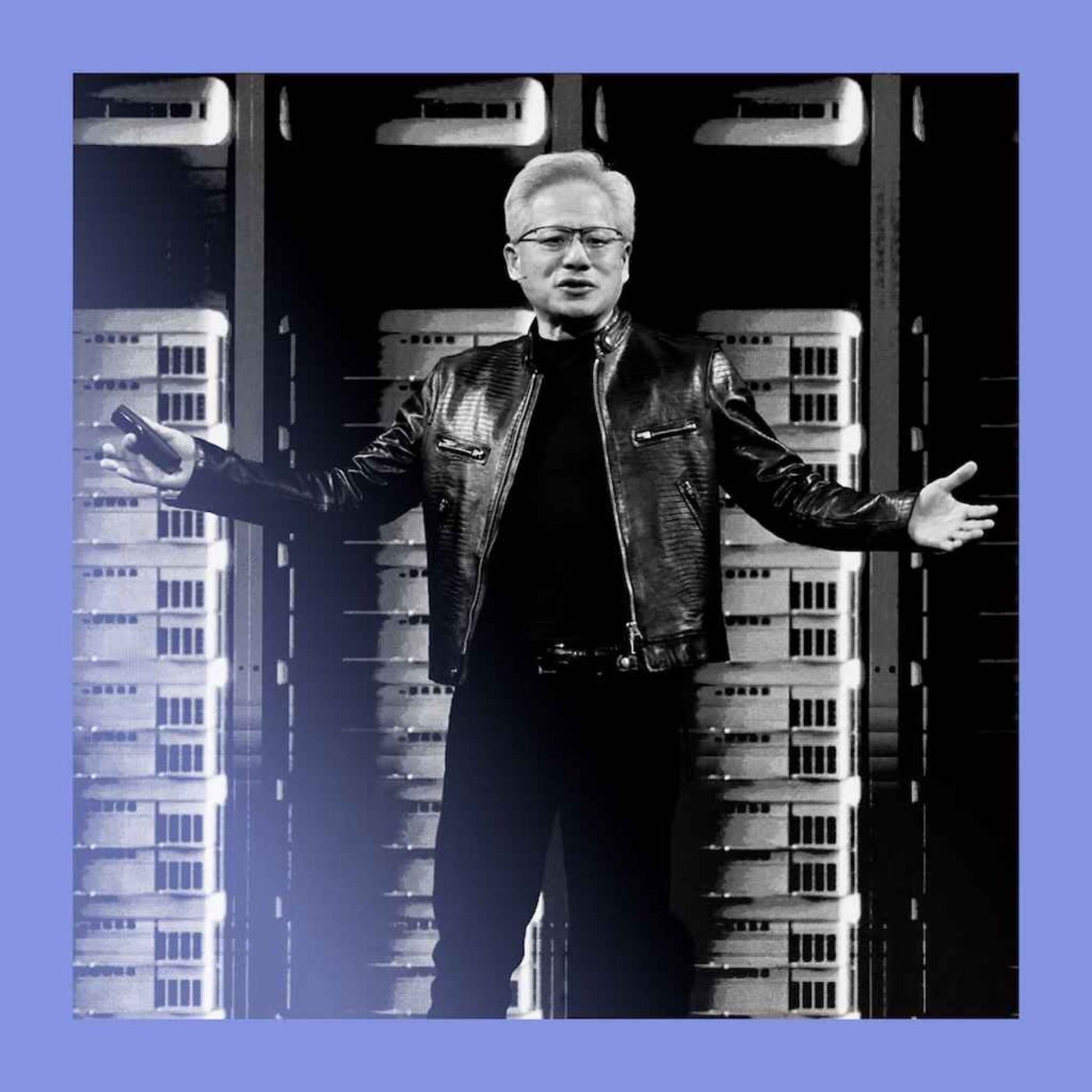
The Economist. Hello and welcome to the Intelligence from the Economist. I'm Jason Palmer. Today on the show, the wildly different contenders for Los Angeles Mayor and Lorem Ipsum Text for the corporate world. First up though, The world's most valuable listed company is having a hell of a year again. In March, Nvidia announced new chips in AI models and ambitions for space based data centers, even self driving cars. But yesterday, Jensen Huang, the firm's leather jacketed boss, shared what he said was far bigger news.
- [02:14]
Shailesh Chitnis
There is no question this reinvention of
- [02:16]
Lorem Ipsum / Corporate Text Narrator
the computer is as big of a
- [02:19]
Shailesh Chitnis
deal as the reinvention of the phone into what we now know as the smartphone.
- [02:24]
Jason Palmer
Our global business writer Shailesh Chitnis was in the room.
- [02:28]
Shailesh Chitnis
I'm in Taipei this week attending the Computex conference, which is a big conference for AI and semiconductors in Taiwan. During a keynote speech, Jensen Huang brought out two laptops in his hand and basically that signified that in partnership with Microsoft, they have developed chips specifically for the personal computer. So it's a big break for Nvidia from what they're known for, which is making chips for AI in the data center. This is now getting into the personal computer. So I think it is a big announcement in terms of what it signals for Nvidia's ambitions.
- [03:01]
Jason Palmer (Interviewer)
Well, let's start with why they want to do that in the first place. I mean, most people experience AI as essentially as a cloud service. What is the point of putting it on a computer and having it local?
- [03:13]
Shailesh Chitnis
I would say there are two reasons for this. The first is the rise of agentic AI, which is basically AI systems which perform pretty complicated tasks themselves. So maybe the simplest example always given is booking your travel reservation or doing certain things. The agent itself goes out and completes those tasks. The rise of agent tech AI has made central processing unit, which is a type of chip that is used predominantly in personal computers, very, very important because those are the kind of chips that are able to actually orchestrate these actions. Remember, Nvidia is known for making graphic processing units or GPUs. These are chips that are purpose built for training as well as running large language models. But as AI is moving into what is known as inference, where a model responds to user queries, more and more CPUs are starting to become important. And if I'm a user trying to use these agents every time, going to the cloud and running these things can be slow, it can also be expensive. Everybody's heard of people burning through their token budgets and things like that. If you're actually able to run these agents on your own laptop or personal computer, you can do it perhaps faster, but you can also do it cheaper. So that's kind of the driving force. It's basically the evolution of AI towards being more useful and getting into more applications that has driven the need for this type of a solution.
- [04:34]
Jason Palmer (Interviewer)
And so the bet is that at least the street level consumer use of AI is going to be mostly that the agentic stuff run locally on your own, no tokens spent.
- [04:45]
Shailesh Chitnis
Exactly. Now, I think what will eventually probably end up happening is it's going to be a combination of some stuff run locally, some stuff going to the cloud. But even if you have a laptop that is actually able to make those decisions and understand what you do locally versus what you send to the cloud, that becomes a big plus versus today, when most of us are using either Claude or ChatGPT, all of that is running on their cloud. So this actually opens up a lot
- [05:08]
Jason Palmer (Interviewer)
more options from a consumer point of view. As much as this interesting stuff might be going on under the bonnet, the experience of agentic AI will look the same for the average person. Or does it become different if it is built in Nvidia inside?
- [05:22]
Shailesh Chitnis
Yeah. So during the keynote, Jensen Huang actually had a good analogy, which I'll repeat here. He said that after smartphones, people use their Phones for everything other than phone calls. And so he sees a very similar future with the personal computer as well, which is something that will do a lot of tasks for us. So today we do a lot of things on the personal computer. We initiate the actions and things like that. The future could be one where the computer does a lot of things for us and it's a machine that's running on its own, making decisions. So he envisions a very different kind of PC than what we have seen over the past 40 years. And that's the reason he thinks it needs a completely new kind of chip.
- [05:57]
Jason Palmer (Interviewer)
And presumably Nvidia is not the only company seeing the future this way.
- [06:01]
Shailesh Chitnis
I think everybody in the industry agrees that the way the user experience on the personal computer, or quote unquote, the edge, as it's called in the jargon, it's going to be very different from what it was previously because of AI. The challenge is I don't think everybody has a firm view of what that future looks like, but I think everybody agrees it's not going to look like what it is today, which is you open up your browser, answer emails, open a spreadsheet, things like that. I think a lot more autonomy, a lot more agents running independently, all that is going to happen for sure.
- [06:30]
Jason Palmer (Interviewer)
And you think the industry as a whole is making that bet, or you think Nvidia is going out on a limb to some degree?
- [06:34]
Shailesh Chitnis
Well, this is a tricky question because different chip makers have different views on what they call an AI chip. I would say intel, amd. They've all been making moves in this space. What Nvidia has shown is what they call, again, quote, unquote, a superchip is a combination of a GPU and a CPU that they say is purpose built for this kind of a workload. It still remains to be seen. We've just seen the announcement, we don't know the specs and all these other things, so it's hard to compare like for like. But it's safe to say that most chip makers from intel, amd, Qualcomm and now Nvidia, they are actually making the moves in this space.
- [07:08]
Jason Palmer (Interviewer)
Now it's clear that Nvidia has really become the market leader for GPUs. Do you think that they have what it takes, that they're doing what it will take to be a market leader when it comes to these local AI chips?
- [07:19]
Shailesh Chitnis
It would be foolish to underestimate Nvidia in anything they do. Having said that, there are a couple of differences this time around. So Nvidia was always dominant in making graphics processor units when it became really useful for AI. In this case. Actually, intel and AMD are the true strong incumbents. Even Apple, which makes its own chips, has been doing that for a long time. So Nvidia is actually coming into this market new, which creates its own sets of challenges. Also in this case, if you remember, one of Nvidia's moats has always been the way its hardware and software, which is Cuda, work together. Well here Nvidia needs to work with Microsoft. It's a very different beast in terms of having an operating system and a chip working together. How they actually do that remains to be seen, but it's not easy to say that these trends in GPUs are going to translate into CPU that easily.
- [08:08]
Jason Palmer (Interviewer)
Shailesh, thank you very much for your time.
- [08:10]
Shailesh Chitnis
Thank you for having me.
- [08:25]
Cash App Advertiser
Most of us don't think much about how money actually moves until something slows it down or makes it more expensive than expected. That friction is exactly what Bitcoin was designed to rethink. Bitcoin is often talked about as an investment, but it was built to be used with Cash App. You can actually do that. Send Bitcoin instantly, pay at local square businesses that accept it, or move it to your own wallet whenever you want. It works more like real money and less like something locked in an account for a limited time. New customers can get $10 added to their balance. Just use code CASH APP10 when you sign up. And don't forget this part. Send at least $5 to a friend in the first two weeks. Terms apply. Cash App is a financial services platform, not a bank. Banking services provided by Cash App's bank partners. Bitcoin services provided by Block Inc. Brand for additional information, see the Bitcoin disclosures at Cash App Legal podcast.
- [09:21]
Creative Planning Advertiser
Then I thought, what if I've scaled businesses? What if I scaled my philanthropy? What if I did as much in one year as I've done in my whole life?
- [09:28]
Cash App Advertiser
See how your wealth could have even greater meaning@creativeplanning.com impact.
- [09:37]
Karen Bass
When my city is threatened, I will fight. I clash with Trump's ICE agents and Angelina.
- [09:44]
Erin (LA Correspondent)
Today is primary day in Los Angeles.
- [09:47]
Jason Palmer
Aaron Braun is our west coast correspondent.
- [09:50]
Erin (LA Correspondent)
One of the big elections everybody's got their eye on is the mayor's race in la and there are three top contenders. But the incumbent mayor is Karen Bass and she's a Democrat.
- [10:03]
Karen Bass
Arms to protect our neighbors. I achieved the first two year drop
- [10:07]
Erin (LA Correspondent)
in homelessness ever, but Bass is increasingly unpopular. A poll done in March found that 56% of Angelenos viewed her unfavorably. That's a lot. So that opened the door for two very different contenders to challenge her to become mayor of Los Angeles.
- [10:25]
Nithya Raman
We can bring LA back to what it really is.
- [10:28]
Erin (LA Correspondent)
To Bass, left is Nithya Raman. She's a council member who's affiliated with the Democratic Socialists of America.
- [10:36]
Nithya Raman
Single vote matters on June 2, because this city's future is absolutely worth fighting for.
- [10:41]
Erin (LA Correspondent)
And I, and to Bass is right, is a reality TV star that some of you might remember from the show called the Hills.
- [10:49]
Spencer Pratt
Business as usual is a death sentence for Los Angeles. And I'm done waiting for someone to take real action.
- [10:56]
Erin (LA Correspondent)
Spencer Pratt is a registered Republican whose home burned down in the Palisades fire last year.
- [11:03]
Spencer Pratt
That's why I am running for mayor.
- [11:05]
Erin (LA Correspondent)
And let if no candidate gets over 50% in this primary, which they won't, the two top finishers will advance to the general election in November. And right now, polling suggests the three candidates are neck and neck.
- [11:21]
Jason Palmer (Interviewer)
And what's on voters minds? What are the conditions in LA that they're looking to improve?
- [11:25]
Erin (LA Correspondent)
There's a lot of malaise and anger, Jason, in LA right now. I think Spencer Pratt wouldn't be gaining momentum if things were going well. Last year LA lost more people than it gained, even while other big cities in California are starting to recover from that Covid era population decline. In 2024, the median sale price of a single family home was about 11 times higher than median household income. Hollywood is contracting. Film and TV production is declining in la. That's costing the city a lot of jobs. And then the mayor has had to plug some pretty hefty budget deficits. When the city repaves streets, it often has to make upgrades to wheelchair ramps on sidewalks that cost about $50,000. So instead of doing that, the city for nine months just simply stopped repaving streets.
- [12:21]
Jason Palmer (Interviewer)
So how does Mayor Bass propose to fix all of that? What's her pitch?
- [12:26]
Erin (LA Correspondent)
Well, the interesting thing is she's not arguing that things are going well.
- [12:30]
Karen Bass
I remember LA when LA was affordable. I remember that. But when I became mayor it's like, oh my goodness, I inherited a hot mess.
- [12:40]
Erin (LA Correspondent)
Her main pitch is basically that something is broken in la, that the system is rotten, and that she's made some progress in her term towards fixing that.
- [12:50]
Karen Bass
And so we are beginning to turn things around. But the bottom line is I'm not finished.
- [12:57]
Jason Palmer (Interviewer)
So her pitch is essentially that things aren't good, but that she has made them better. Than they'd otherwise be.
- [13:02]
Erin (LA Correspondent)
Yeah, exactly. But I think that's a really hard pitch to make. LA is notorious for its big homelessness problem. Her signature program in her first term, Inside Safe, moves homeless people out of encampments and into shelters. It's very expensive, but it's been somewhat effective. The number of people sleeping outside has declined about 18% in the last couple years, but there's still 27,000 people sleeping on the street. Progress. But it still feels like this overwhelming problem.
- [13:32]
Jason Palmer (Interviewer)
What does Spencer Pratt bring to the platform?
- [13:34]
Erin (LA Correspondent)
Mr. Pratt's campaign is basically a big tent for anyone angry about anything in Los Angeles. He was interviewed by Joe Rogan recently.
- [13:45]
Spencer Pratt
There's just naked people everywhere now. And when I say people, naked zombies. And the DEA will tell you 90% of these homeless people have a drug problem. We have a.
- [13:55]
Erin (LA Correspondent)
He blames Mayor Bass personally for his home burning down in the fires last year.
- [14:02]
Spencer Pratt
The state and local leaders let us burn.
- [14:06]
Erin (LA Correspondent)
He honed his political chops on reality tv. He's a very effective messenger. His campaign, I think, practices a sort of hyper local version of Trumpian grievance politics.
- [14:22]
Jason Palmer (Interviewer)
Now, my producer has sent me a couple of campaign ads.
- [14:25]
Nithya Raman
Please, I'm begging you.
- [14:27]
Erin (LA Correspondent)
There's homeless drug addicts in front of the schools. My children aren't safe.
- [14:30]
Jason Palmer (Interviewer)
AI driven fever dream stuff. You say he's a good messenger. I suppose in this crazy era, he is, yeah.
- [14:39]
Erin (LA Correspondent)
I mean, he knows how to use social media. We should say these ads are made by fans of his and he will retweet them, but they're not actually made by his campaign. There's one in particular that I sort of can't look away from, and it portrays Karen Bass as the Joker in Batman, kind of holding court in a courtroom. Gavin Newsom is a courtier eating cake. Kamala Harris is swinging from a bottle of vodka in the corner.
- [15:07]
Karen Bass
Mom, look.
- [15:09]
Erin (LA Correspondent)
And then Pratt shows up as Batman, and him and a crowd of Angelenos pelt those Democrats with tomatoes who throw that. I've never seen political ads like this before, and they're gripping and also horrifying at the same time.
- [15:26]
Jason Palmer (Interviewer)
Which brings us then to the other contender on the ticket. Then. Tell me about her.
- [15:31]
Erin (LA Correspondent)
I met Nithya Raman recently at a coffee shop in Silver Lake in her council district. And she told me about how she would use her position as mayor differently.
- [15:41]
Nithya Raman
People talk about LA as having a weak mayor. It is by choice. It's because this mayor has not chosen to use. Use her power to push us forward. I want to Use it.
- [15:52]
Erin (LA Correspondent)
She has been the fiscal hawk in the race, arguing against big raises for the police union and exorbitant spending on a new convention center. She also thought Spencer Pratt's governing philosophy could be dangerous.
- [16:07]
Nithya Raman
He's not a joke. As much as I would like to think that he is, he is not a joke. He represents a version of politics that is fundamentally at odds with Los Angeles and what this city represents.
- [16:21]
Erin (LA Correspondent)
And so for people disenchanted with the mayor and kind of scared of Spencer Pratt, she would be the natural choice.
- [16:30]
Jason Palmer (Interviewer)
So from what you're saying, if this is a neck and neck race, Spencer Pratt is in fact not a joke. People might want his brand of politics.
- [16:37]
Erin (LA Correspondent)
He's not a joke. He's proven to be a really effective campaigner. And I think these three candidates do have distinct constituencies for the most part. Spencer Pratt will attract Republicans and independents and disaffected Democrats. Karen Bass is very much the establishment Democrat candidate Nithya Raman will attract voters to her left. But I do think people are underestimating the extent that the malaise and the anger in Los Angeles is scrambling political tribes. Pratt has run a surprisingly nonpartisan campaign, despite him being a registered Republican. He's talking about LA issues, he's not talking about Donald Trump. But I will say, even if he makes it through to the runoff, which would be a remarkable feat, Los Angeles county is only about 19% registered Republicans. The city will be even less red than that. So it will be a very big lift for Spencer Pratt to become mayor of Los Angeles.
- [17:40]
Jason Palmer (Interviewer)
Erin, thanks very much for your time.
- [17:41]
Erin (LA Correspondent)
Thank you, Jason.
- [17:46]
Jason Palmer
Moving up the ballot paper a bit. Today is also the day for Californians to vote in primary elections for governor. It is a ferocious battle. My colleagues over on Checks and Balance, our subscriber only sister show on American Politics, have been following it for their latest episode. Policy decisions made in America's most populous state can ripple across the rest of the country. So what does California's governor race mean for the future of the state and for national politics? Have a hunt for checks and balance wherever fine podcasts are sold and traded.
- [18:31]
Andrew Palmer
Ladies and gentlemen, we're pleased to announce a modern alternative to the Lorem Ipsum text.
- [18:38]
Jason Palmer
Andrew Palmer. No relation, writes Bartleby, our column on work and management.
- [18:44]
Andrew Palmer
This much loved piece of filler text, derived from Cicero's De finibus bonorum et malorum, has been used for layout purposes for centuries and remains available for anyone to use. But we believe that other newer forms of meaningless babble are even better at taking up space. Which is why we're thrilled to unveil Velocity Pivot. For most forms of corporate communication, it isn't necessary to change the text at all before you publish.
- [19:23]
Lorem Ipsum / Corporate Text Narrator
Velocity Pivot Hunger to win Relentless execution Insatiable Appetite Transformational volatility Double digit growth Token Maxing Tokenized Toe Curling Fireside chat Drinking from a fire hose Artificial Intelligence Augmentation not automation it's not AI that will take your job, but the person you using AI Headcount Reduction Tough decisions right Sizing Change Management Strategic strategizing Waterfall Agile Sprint Cascade Tentpole Brainstorming Whiteboard Miro Board Board Senseless Modernizing Digitization Revolution not evolution not revolution Vibe Coding Value Added MVP SVP CRO MCP PRD BBQ BAU KPI DEI Though we don't talk about the last one much anymore Edge Cases Use cases Suitcases Frequent flyer lounges Platinum Member Air miles in flight Dynamic environment Shifting landscape New Industrial Revolution Bias for action Actionable Traction Tractionable? Is that a word? It is now. Reimagine Reinvent Reinforce Revamp Renew Redefine Resilient Grit Growth Mindset Futuristic Heuristic Holistic Optimistic Systemic Getting the ick Transforming the value Value proposition Propositioning Transformational value Delighting customers Strengthening communities Leveraging insights Other verb noun combinations End to end Workflows Deployment Training Inference Stack Full stack Slack attack Unfolding Ever changing Fresh perspectives Instant personalized large scale Multi year multi service Long term investment Pipelines Embedded ecosystem leaders Leading through leadership Leaden prose New normal New paradigms Paradox Parabola Hockey stick J Curve K Shaped A game C Suite beyond sale Improved outcome Purpose Values mission behaviors Customer centricity Customer obsessed Some sounds a bit creepy to be honest. Old audacious Daring Restless ambition World class Industry leading game changing Top line metrics Blueprint Corporate DNA Digital workforce Orchestration Agentic Compute fueling Propelling Driving Accelerating Never breaking
- [22:27]
Creative Planning Advertiser
operational plot
- [22:31]
Erin (LA Correspondent)
it's not AI that will take your job.
- [22:35]
Jason Palmer
Thanks to subscriber Ralph Gerber for sending in his groovy version of Velocity Pivot and inspiring this segment.
- [22:45]
Jason Palmer (Interviewer)
If you'd like to send in your
- [22:46]
Jason Palmer
own remix, you can find the lyrics
- [22:48]
Jason Palmer (Interviewer)
in the Show Notes.
- [22:50]
Jason Palmer
Email your tunes to us@podcastseconomist.com vibe coding
- [22:55]
Cash App Advertiser
value Added MVP SVP FIFA Crow MCP PRG Barbecue.
- [23:08]
Jason Palmer
That's all for this episode of the Intelligence. We'll see you back here tomorrow.
- [23:31]
Creative Planning Advertiser
Then I thought, what if I've scaled businesses? What if I scaled my philanthropy? What if I did as much in one year as I've done in my whole life.
- [23:38]
Cash App Advertiser
See how your wealth could have even greater meaning@creativeplanning.com impact seeking pushing optimizing Creating
- [23:48]
Aramco Advertiser
Learning Discovering At Aramco, we believe in harnessing the power of data to push the limits of what's possible. That's how we deliver reliable energy to millions across the world. Aramco, an integrated energy and chemicals company. Learn more about us@aramco.com.