Loading summary
Transcript53 lines
- [00:00]
BetterHelp Advertiser
Is your dog's food created to maximize your dog's quality of life or to extend the food's shelf life. It's time to make the switch to sundaes. Sundaes was founded by a veterinarian and mom, Dr. Tori Waxman, who got tired of seeing so called premium dog food full of fillers and synthetics. So she designed sundaes air dried real food made in a human grade kitchen using the same ingredients and care you'd use to cook for yourself and your family. Every bite of sundaes is clean and made from real meat, fruits and vegg with no kibble. That means no weird ingredients you can't pronounce and no fillers because your dog deserves food made with care, not in the interest of cost cutting. You just scoop and serve. No freezer, no thawing or prep, no mess. Just nutrient rich clean food that fuels their happiest, healthiest days so you get more of them to share together. So go right now to sundaysfordogs.com Acast 30 and get 30% off your first three orders. Or you can use code Acast Acast 30 at checkout. That's 30% off your first order at Sundays for dogs.com Acast 30 or use code Acast 30 at checkout. This is an ad by BetterHelp.
- [01:15]
Podcast Listener
Did I talk too much? Can't I just let it go?
- [01:24]
BetterHelp Advertiser
Take a breath. You're not alone. Let's talk about what's going on. Counseling helps you sort through the noise with qualified professionals and online therapy makes it convenient. See if it's for you, visit betterhelp.com randompodcast for 10% off your first month of online therapy and let life feel better.
- [01:51]
Podcast Listener
The economist.
- [01:58]
Rosie Bloor
Hello and welcome to the Intelligence from the Economist. I'm your host, Rosie Bloor. Every weekday we provide a fresh perspective on the events shaping your world. Some diseases are so rare, it's been impossible to even contemplate curing them. Until now. An individualised therapy for a highly unusual genetic disorder has just been deployed. Our correspondent chronicles a medical Milestone and aged 81, Cecilia Jimenez was helping out at her local church in northern Spain. They needed someone to restore an image of Christ, so she agreed to try. The amateur painter unwittingly created a sensation. Our obituary's editor remembers her. But first, On Wednesday, our correspondent in Syria, Gareth Brown, sent us videos showing celebrations in Arab towns after Syrian government troops routed Kurdish forces in the north of the country. For the past decade, Syria's Kurds have essentially run an autonomous state in northern Syria. As that's crumbled, Gareth has been following the repercussions, including what's happened at a giant camp holding ISIS prisoners. It's known as Al Hol. As you might imagine, connectivity in this region isn't great, so the only way I've been able to talk to Gareth is via WhatsApp voice notes. So that's what you'll be hearing. And he's also sent me some short videos.
- [03:43]
Gareth Brown
I'm at Al Hol, the largest ISIS camp in Syria that changed hands from the Kurds to the government in Damascus, headed by Ahmed Al Shara. And the guards here tell us they're very worried about attempts by people to escape. And here at the main entrance, you can see we've got a lot of riot police. Huge crowds have gathered just the other side of the fence. Behind me is a section filled primarily with Iraqis and Syrians.
- [04:12]
Rosie Bloor
Gareth, you've been sending me a deluge of videos. I can see women and children inside the fences, and you're speaking to them through the wire. So who are these people?
- [04:23]
Gareth Brown
Hi, Rosie. So our whole camp was previously a sort of unknown village near the border with Iraq. And for the past decade, it's been home to more than 20,000 people with suspected ISIS membership. Foreigners, Syrians, Iraqis, people from Europe, all over the world. It's been the center of fighting. It's changed hands. And there are lots of international questions about what is going to happen to these thousands of people, prisoners held, suspected of ISIS membership.
- [04:52]
Rosie Bloor
What does this camp look like? Can you describe it to me?
- [04:56]
Gareth Brown
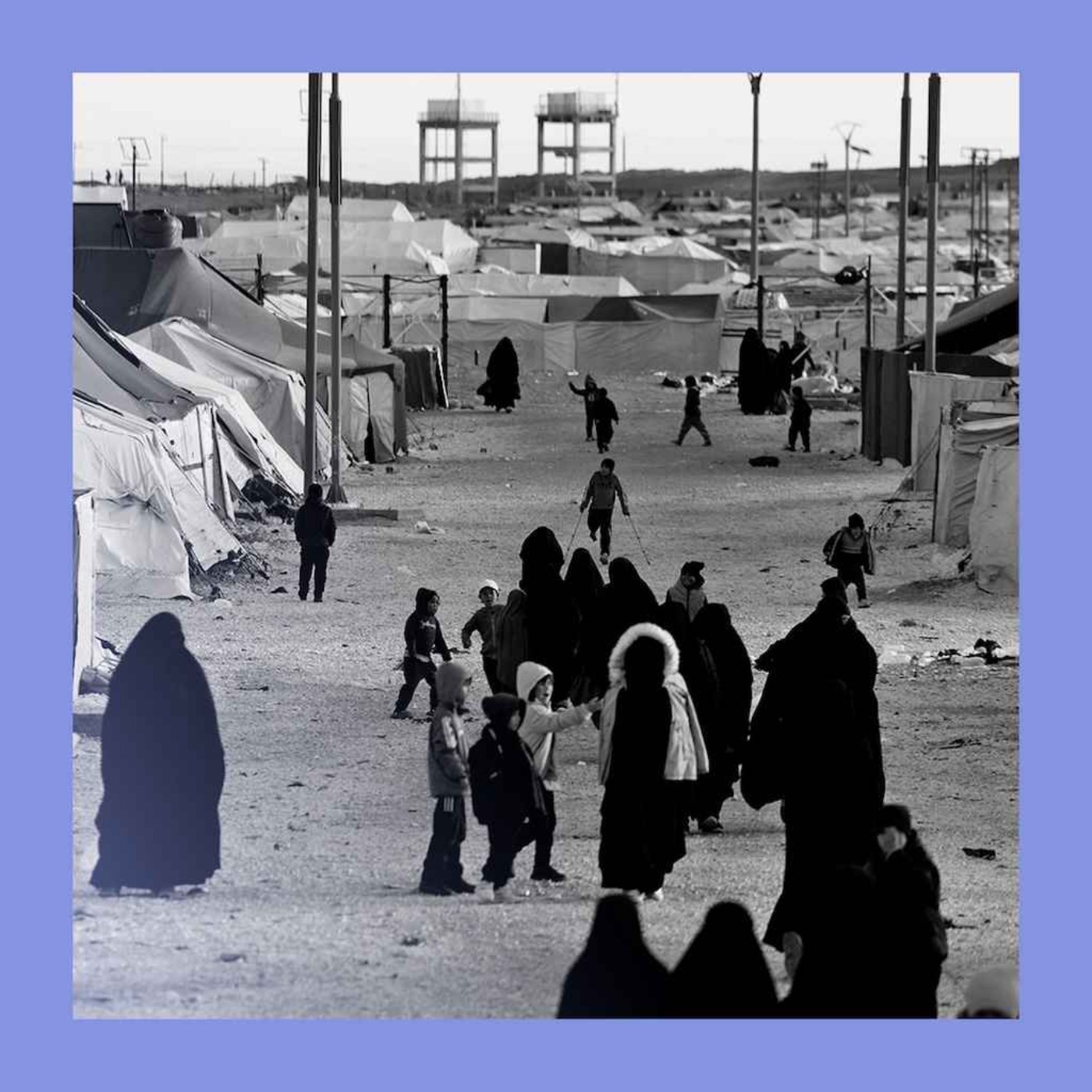
So I've been to our hole a few times, though not for several years. And essentially it's this massive oasis of tents in the middle of the desert, not far from the Iraqi border. And as we approached, you could sort of see that something was amiss. There were plumes of smoke coming from the camp, and we got stopped by this big checkpoint, and the guards said, are you sure you want to go near the camp? You should take some armed guards with you. Said, no, we're fine. We want to go and have a look. Really. It's just this huge camp that's fallen into disrepair. This is the fence, and frankly, put parts of it are just missing. And the first thing you see as you get to the main entrance, there's a line of SWAT police, armored up and sort of ready to beat back a crowd. On the other side of the fence, dozens, if not hundreds of people. Women in the Cubs, men, some of them are clutching papers. And this is what's known as the Arab section. It's thousands of Iraqis and Syrians. This camp is more than just a collection of tents though, Rosie, it's. It's got its own economy. There are market stores, you can buy sweets and basic foods in there. Some of the people inside the camps have mobile phones, they have Internet connection. So this camp has almost become a little mini city that's still controlled to some degree by ideologues from isis.
- [06:20]
Rosie Bloor
Gareth, it really doesn't sound like a prison. What do you know about the history of this camp?
- [06:27]
Gareth Brown
From about 2018, there was this huge offensive against ISIS in the north and east of Syria, in particular Deir Ezor and Raqqa. And it became a sort of dumping ground. The sdf, this Kurdish led militia which was the main partner on the ground of the American led coalition, was capturing thousands and thousands of people from ISIS held towns and basically just dumping them in Al Hol. And so on the one hand you had regular people who were just living in these ISIS held areas caught up in it, but then you had a lot of very ideological members of ISIS who were put in the camp and a lot of foreign countries didn't want them back. And so they've just been stuck in this sort of purgatory for well over five years now. Nobody really wants to take responsibility for them or knows what to do with them.
- [07:22]
Rosie Bloor
In the videos that you sent, there are women and children inside the fences, there are dogs wandering around, and you're speaking to people through the wire. So who are these people and how long have they been there?
- [07:34]
Gareth Brown
These are people from around the world. Many of them are the foreign jihadists that flocked to join ISIS to join the Caliphate. You'll find people from Central Asia, Tajikistan, Chechnya, Uyghurs from China, and some of them have been there six, seven years. Speaking to one boy from Bosnia who was 15 or 16, and I sort of asked him about his life before Alhoh and he couldn't really remember anything. He sort of said, I was in Baghouz. That's the village where ISIS made its last stand. You know, there's a very young population within the camp. Children have been born in it, some have grown into adults in the camp. And all they really know is life in that camp and this sort of very extreme ideology which is clearly still sort of circulating within the camp.
- [08:31]
Rosie Bloor
You say that the camp has been, I guess, liberated, some might say are people now trying to escape? What are they doing?
- [08:39]
Gareth Brown
Absolutely, Rosie. We saw a few groups sort of making a run for it climbing through gaps in the fence. I think one of the most concerning things was in the foreign section. You look at this fence and you just see there's hundreds of gaps and holes in it, and there's little kids climbing out, women climbing out, and then the guards sort of go and usher them back in. It's really not a secure facility. So we've literally just witnessed an escape attempt. This group of women and children had big rucksacks packed and they all, you know, made a dash for a hole in the fence. And a few of the guards here had to run after them, rounding them up. And one sort of said, if it wasn't for us, they would have gone. Shows you how precarious it is. I think the most interesting thing I saw was a large group of women and children who I believe were Uyghurs from China. And they were sat waiting with their bags packed. So they pack their bags, they go through a gap in the fence and then they make a run for it. And then the guys have to chase them and round them up, literally, as though they were expecting to get picked up. And one of the kids even said to us, they're coming to pick us up. Like, as if they'd had a message that they were going to come and someone was going to take them from out the camp to freedom somewhere in Syria or elsewhere. You know, we saw a lot of that and, you know, was this just some sort of dream or they thought this was an opportunity, or did they have a concrete reason to believe that they were now going to be taken out of the camp and they needed to have their bags packed and be ready to go? And Rosie, to be honest, you know, between the smoke billowing up, there was a building that was set on fire by inmates whilst we were there. The gaps in the fence, this is not fit for purpose.
- [10:30]
Rosie Bloor
Some people say that members of Alshara's government still have links to the jihadist group that he emerged from. Is there any sense in which his government might be sympathetic to the people in this camp and even letting them escape on purpose?
- [10:46]
Gareth Brown
I think Alshara's background as a senior member of Al Qaeda really complicates the relationship between the people in the camp and their guards. When the Kurds controlled the camp, they were fierce enemies of isis. Everyone in the camp saw the Kurds as their enemy, as an oppressive prison guard. And certainly what we saw were guards who were a lot more sympathetic to the people being held in the camp. Does this mean that Shahrir is going to release all of the people being held in our hole? No, I don't think so. And I think there's probably huge international pressure on him. You can imagine that certain people within his organization, within his military, within his security forces would have a much more sympathetic line. One thing you hear is, you know, there are a lot of Uyghurs, jihadists from China who played an important role in Ahmed Ashara's victory in capturing Damascus. And there's also a lot of Uyghurs held in Alhol, and. And you can sort of see how there might be links made there.
- [11:45]
Rosie Bloor
How much do you know about how strong the ideology of the people in this camp actually is? I mean, with so many people here, tens of thousands, surely they aren't all hardened fighters.
- [11:57]
Gareth Brown
I think the camp has a spectrum of ideologies. There are some people there who clearly just got caught up in. In the war, and they're essentially refugees desperate to go home, and they have no time nor love for isis. But others are extremely ideological. And I could see that when women wouldn't even look me in the eye, they asked if I was Muslim or Christian. When I said I was Christian, they refused to speak to me. The people being held in Al Hol cover the complete ideological spectrum, from those who wouldn't even speak to me because I'm not Muslim, to those who are just, you know, normal Syrians who got caught up in the conflict.
- [12:36]
Rosie Bloor
Gareth, you've painted some extraordinary scenes. What do they tell us about where Syria goes from here?
- [12:43]
Gareth Brown
I think this moment is multiple issues in Syria converging. We have the potential for sectarian violence. Arab versus Kurd violence could spike if things go in a certain direction over the course of the next few days. And finally, there are questions about how the international community interacts with Ahmed Shadda. The ISIS prisoners are a key international dilemma. And if he's perceived to be waging sectarian conflict against the Kurds, they have a lot of supporters in the Western world that could damage his reputation internationally. So we have so many of these flashpoints all flaring up at once in this current round of conflict.
- [13:27]
Rosie Bloor
Thank you so much for all your messages, Gareth. Hope to actually talk to you soon.
- [13:31]
Gareth Brown
Yeah, I look forward to that, Rosie, thanks.
- [13:48]
Rosie Bloor
Some months ago, the Intelligence reported on the early days of a trial in Japan of the man who assassinated former Prime Minister abe Shinzo in 2022 using a homemade gun. He has just been handed his sentence. And tomorrow on the Weekend Intelligence, we tell the full story. When those lethal bullets were fired, disparate forces collided A church cult, a political party, a patriarch, a lost soul and a fractured society. The assassination that changed Japan. You'll need to be a subscriber to listen.
- [14:27]
BetterHelp Advertiser
This is an ad by BetterHelp.
- [14:29]
Podcast Listener
Did I talk too much? Can't I just let it go?
- [14:38]
BetterHelp Advertiser
Take a breath. You're not alone. Let's talk about what's going on. Counseling helps you sort through the noise with qualified professionals, and online therapy makes it convenient. See if it's for you. Visit betterhelp.com randompodcast for 10% off your first month of online therapy and let life feel better.
- [14:59]
Momentus Advertiser
January is when we recommit to the habits that support our health and wellbeing. And naturally, we start looking at what can support those goals, including supplements. The supplement industry is a low trust category. It's lightly regulated, products are easy to make, and companies don't even have to list everything on their label. That's exactly why I choose Momentus. They've become the high trust brand in a low trust category. They weren't satisfied with the industry standard, so they built the Momentus standard. Their commitment to doing things the right way, not the easy way. What truly sets Momentus apart is their testing and transparency. Every product is independently certified by NSF for sport, meaning it's tested for contaminants, heavy metals, banned substances and verified for label accuracy. So you always know exactly what you're putting in your body. And if a product doesn't meet their standard, it never hits the shelves. In a space where trust is rare, Momentous is redefining what trust looks like. And I've genuinely felt the difference using their protein and creatine every day. Right now, Momentous is offering our listeners up to 35% off your first order with promo code PODCAST. Head to livemomentous.com and use promo code PODCAST for up to 35 percent off your first order. That's livemomentous.com promo code PODCAST.
- [16:26]
Rosie Bloor
Many ultra rare disorders are as devastating as they are unique. They might affect fewer than 1 in 50,000 people, sometimes just a single individual. The thing is that pharmaceutical companies don't develop drugs for such tiny groups. Even if they did, they could never test those treatments to ensure they're safe. That could all be about to change. In Britain, a new way to approve custom drugs offers hope. Could tailor made medicines be the Future?
- [16:57]
Natasha Loder
So on January 13, a child with a really rare genetic condition was treated with a medicine made just for her.
- [17:07]
Rosie Bloor
Natasha Loder is our health editor.
- [17:10]
Natasha Loder
What made this special is that she was part of a new kind of trial that is trying to make the production of customized medicines much more routine.
- [17:25]
Rosie Bloor
You're saying that Britain has just demonstrated a different approach. What's new about it?
- [17:30]
Natasha Loder
Yes. So what the medical regulator has done has said, look, we understand that the traditional pathways for making medicines are just not quite right for customized medicines. They're too onerous and we need a different way of doing things. And so what they're suggesting is that they approve a process. And so a drug company comes to them and says, well, we're going to make this kind of drug, we're going to make it in this way, we're going to give it in this kind of way and to these types of children. And the molecule that we give is fundamentally the same in each circumstance, but we will change it ever so slightly so that it allows each one of those children to be treated. And that's essentially what the regulator is saying, that they are going to allow a trial to take place on 11 children with rare and fatal neurodegenerative diseases, and they hope that the outcome of those trials will be that they will allow the process of treating them to be approved. And that means that the 12th or 13th or 14th patient can be treated just by essentially going to the company, and then they can make a new medicine just for that patient.
- [18:40]
Rosie Bloor
So they're essentially regulating a way to make a drug rather than testing the actual outcome of that drug.
- [18:48]
Natasha Loder
That is technically correct. But they are also monitoring whether each individual drug works. But that's not what's being approved. What will ultimately happen is you'll get a process for making the drugs that is regulated.
- [19:03]
Rosie Bloor
Sounds pretty risky to me.
- [19:06]
Natasha Loder
So it's certainly more risky than the way in which we currently make medicines, because, of course, every time you make a custom medicine, there must be this novelty factor. There are certain elements about the way this process been designed, obviously, is to reduce the risk, and that's by using, you know, a molecule that we understand very well of a specific length and chemical composition that's known to be safe. And then you make only a few small changes that help you treat the condition. But, yes, obviously, if you could do it a different way, then maybe there would be less risk involved. But here's where it gets interesting. For the patients that are being treated, we're talking about children with really debilitating conditions that will ultimately kill them in quite a horrible way and probably quite young. The way that it's been put to me is that the only chance they have is to receive treatment. The risks that they're taking on are minimal compared to the risks they're facing with the course of their disease.
- [20:10]
Rosie Bloor
Can you just make this concrete for me for a minute? What sorts of diseases are these children suffering from and how many are we talking about?
- [20:19]
Natasha Loder
The initial conditions that are being treated in the UK are rare and fatal neurodegenerative diseases. Sometimes they're called childhood dementias. And this is where a child is born with a genetic mutation. They may be normal for several years, they meet regular milestones, they even go to school. And then suddenly this genetic fault starts to really kick in and then they start regressing slowly. They lose function, maybe slow speech and the ability to sit up and eat. And it's absolutely utterly devastating for their families. And then they die. We have the technology to treat them, but we're not treating them because making custom drugs is very time consuming and difficult.
- [21:06]
Rosie Bloor
And what does treatment involve in this case?
- [21:10]
Natasha Loder
This molecule that they've created, it's an infusion that is injected into the spine and then travels in the cerebrospinal fluid up around the brain. And the molecule that has been created, it essentially gloms itself onto a message inside of each of our cells that is transmitting a faulty protein message. And it gloms onto it and it fixes it like a little sticking plaster.
- [21:39]
Rosie Bloor
So you've been following this case. If it's successful, how important could this new style of drug be become for.
- [21:47]
Natasha Loder
The people they can treat? It's going to be just a revelation. If process approval comes from this, it will be a real turning point in the development of customised medicines, because also we're going to show that it can be done. If Britain shows you can do process approval for this one particular style of drug making for this set of kids, it just opens the doorway for doing this for other conditions, for different kinds of genetic medicines. And the future, we'll be able to do this just so much more easily and so much more cheaply as well.
- [22:21]
Rosie Bloor
Natasha, thank you very much. Where can we hear more about this?
- [22:25]
Natasha Loder
We can hear the full story on Babbage, where I interview Julia Vitarello, who has been fighting to make this change in the way that medicines have been made for about eight years since her daughter died after she she received the first customized medicine.
- [22:42]
Rosie Bloor
And you can listen to that amazing interview on Babbage, our science podcast, and you'll need to be a subscriber. Natasha, thank you so much.
- [22:49]
Natasha Loder
Thank you.
- [23:11]
Podcast Listener
At first sight, there might not seem to be much similarity between Don Quixote de la Mancha, that great Knight, errant of Spanish literature, and Cecilia Jimenez, a widow who lived in the village of Borja in Aragon.
- [23:27]
Rosie Bloor
Ann Rowe is our obituary's editor.
- [23:31]
Podcast Listener
But in fact, between the dry plains of La Mancha and Aragon, there's not so much difference in the landscapes. And between those two characters, there's remarkably similar track to their lives. Both were living modest lives and keeping up appearances. They were both dreamers. Don Quixote immersed in books of chivalry, and Cecilia very keen on watercolor painting of flowers and also helping out in her church, the Santuaria della Misericordia. And both of them had an idea, on their own initiative, to suddenly set out and right an obvious wrong. Don Quixote was inspired by hopeless love for an unseen beauty called Dolcinea del Teboso. Cecelia was inspired by the Virgin of Mercy, who was the patron of her church and who pointed out to her a particular job in the church that needed doing, which was the restoration of a painting. There was a painting of the Ecce Homo, Behold the Man, which is of Christ in the crown of thorns appearing before Pilate. And this had been painted onto a pillar in the church in 1930 by an artist called Elias Martinez, who had left it as a gift because he liked to spend summers in the village. But he hadn't primed the pillar before he painted on it in oils. And the combination of damp years passing and salt had gradually caused the paint to flake away, so that in fact, quite a large proportion of it now was simply white space. She didn't exactly have an authorization from anyone else, but she was fairly sure the priest knew what she was doing. So in she went with her patents one day and began. Now, she hadn't often painted portraits before or used oils, and she was rather worrying about how she would tackle this. So she started off by wetting the old painting with her big brushes, and then she decided she would leave it for a bit and she went away on holiday for two weeks. When she came back, all hell had broken loose because the local Borgia Studies center had noticed what she had done to the painting. And so had the family of the artist, and they were absolutely up in arms. The face, which had been a rather ordinary portrayal of Christ, but quite a lovely face, was suddenly reduced to this flat, greenish, saucer like shape. The eyes were slits and there was a heavy fuzz of hair and beard around the whole face. It looked like nothing so much as a monkey. People were already calling it Ecce Mono. Behold the monkey. Worst of all, it wasn't just the locals who had seen what she'd done, it was the whole world. Because the painting had gone viral on the Internet, the whole thing was causing general hilarity, and she was completely humiliated. Because she was 81, she had no idea of the world of the Internet, and suddenly she was its victim. She lost weight and she cried all the time and just couldn't cope with it at all. Eventually took to her bed. But one day, for Cecilia, there came some flowers and then a card, and then more people came just to look at the painting and seemed to like looking at him and not mocking it. In that first year, 40,000 people came to the town. And even when the craze faded a little, there was still 15 to 20,000 coming every year. And the church set up a shop for them, which sold all sorts of merchandise, and it brought in a good deal of money for the church. When she was being attacked online, it was often as a crazy old woman who had no idea how to paint. And this had really hurt. But now people seem to be taking a rather more balanced view of her restoration, and the art critics were changing their tune. So some of them wrote that the very primitivism of her version of the painting was rather moving. And another art critic compared her to Goya and Munch and the German Expressionists. She had a show of her paintings and the prices they fetched, which had been pretty modest before, went into the thousands of euros. In the end, it was the imagination of the artist that mattered. Don Quixote liked to tell the tale of an artist who, when he painted, would simply say that whatever emerged was what he had meant to paint. So out of his bizarre paintings would come something that he'd recognized, and he'd put a notice beside it saying, this is a cockerel or this is a fox. And so if Cecilia Jimenez had seen her painting as the suffering Jesus, that was who it was. And certainly the miracles he had wrought in Borgia seemed pretty firm evidence of that.
- [29:48]
Rosie Bloor
Anne Rowe on Cecilia Jimenez, who has died, age 94. That's all for this episode of the Intelligence. The show's editors are Chris Impey and Jat Gill. Our deputy editor is Sarah Lanyuk, and our sound designer is Will Rowe, with additional help this week from Timo Saila. Our senior producers are Rory Galloway, Henrietta McFarlane and Alizer Jean Baptiste. And our senior creative producer is William Warren. Our producers are Anne Hannah and Jonathan Day. And our assistant producer is Kunal Patel. With extra production help this week from Emily Elias. We'll all see you back here for the weekend. Intelligence tomorrow.