Loading summary
Transcript63 lines
- [00:00]
London Business School MBA Advertiser
To grow beyond limits and even beyond your aspirations. You the London Business School MBA Ranked fourth in the world by the Financial Times, the program delivers academic excellence and unlocks access to leading global businesses and a network of over 58,000 professionals. 86% of the most recent class accepted a role within three months of graduating and the returns continue beyond today. Search Discover London Business School MBA to find out more.
- [00:30]
Capital One Bank Advertiser
With no fees or minimums on checking accounts, it's no wonder the Capital One bank guy is so passionate about banking. With Capital One, if he were here, he wouldn't just tell you about no fees or minimums. He'd also talk about how most Capital One cafes are open seven days a week to assist with your banking needs. Yep, even on weekends it's pretty much all he talks about in a good way. What's in your wallet? Terms apply. See capitalone.com bank capital1NA member FDIC.
- [01:06]
Jason Palmer
The Economist.
- [01:13]
Rosie Blore
Hello and welcome to the Intelligence from the Economist. I'm Rosie Blore.
- [01:17]
Jason Palmer
And I'm Jason Palmer.
- [01:22]
Rosie Blore
Today on the show, a whopper El Nino and why Japan's popular princess will never take the throne. First up, though, It's been four days since peace talks between America and Iran began. These came after the two countries signed a memorandum of understanding last week. In theory, the deal ends the blockade of the Strait of Hormuz, unfreezes Iranian assets and begins a 60 day period of negotiations over the future of Iran's uranium stockpile. At Iran's insistence, it also includes a commitment to a ceasefire in Lebanon between Israel and Hezbollah, an Iran backed Shia militia. The question now is whether that conflict could undermine the prospects of long term peace in the Middle East.
- [02:28]
Anshul Pfeffer
The village of Majd Al Zun, 7 km north of Israel's border with Lebanon, is deserted.
- [02:36]
Rosie Blore
Anshul Pfeffer is our Israel correspondent.
- [02:39]
Anshul Pfeffer
It's a Shia village. It has been empty now for a while and even though it was very dark there, you could see that many of the buildings have been destroyed by Israeli airstrikes. There's no electricity, but there was light in an Israeli command post and in the underground location where we were taken.
- [03:00]
Rosie Blore
Anshur, you say you were taken to an underground location. Just explain what it is that you saw where you went around.
- [03:07]
Anshul Pfeffer
About 30 meters under the center of the village, there's this long and very wide tunnel which from what we were shown there was used as a factory or an assembly line for building killer drones. I've been in quite a few tunnels over the last two and a half years under Lebanon and under The Gaza Strip. I think this was certainly the widest, most well constructed tunnel I've seen in these wars so far. And from what we were shown there, just the piles and piles of dozens of sets of triangular wings, long cigar shaped fuselages and cylindrical explosive charges, it was clear that this place was being used to assemble kits of drones, dozens and dozens of them, which were then to be launched from rails in other parts of the village towards Israel. According to Israeli intelligence back in 24, some of these drones hit Israeli bases killing soldiers and also hit been in Minnetonyahu's seaside villa as well.
- [04:13]
Rosie Blore
And Shaul, as you say, you've been in a number of tunnels over the years, you've been on a number of embeds over the years with Israel Defense Forces. What's it like to be embedded with them?
- [04:25]
Anshul Pfeffer
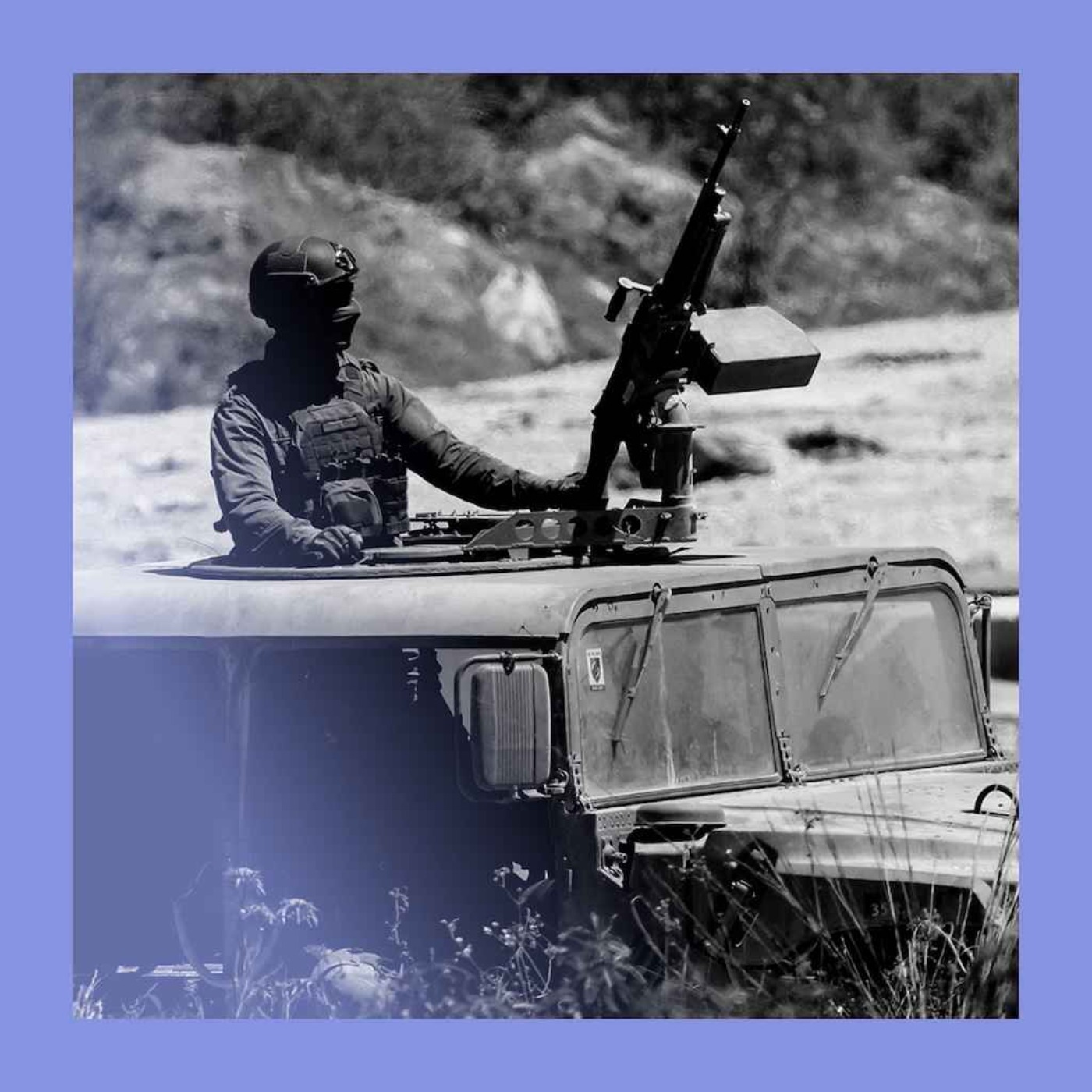
An embed with the IDF is usually something that you're there in a couple of hours from your home or office and spend a few hours out in the field and then you're back again. So it's something very short. You come, you meet the unit, there's the issue of the convoy. And most of the conv into the battlefields of Gaza or south Lebanon are relatively short, about 20 or 30 minutes. And you're in that sort of a tense moment when you're driving on rather unsecured roads. And usually they want to show you something, obviously a PR or propaganda purpose for these visits. In this case, they wanted to show this drone factory that they had discovered a few days earlier to make the point that Hezbollah, with Iran's support, still has a very significant military presence in southern Leban, which is a point that Israel has been trying to make against the ceasefire that Donald Trump and the Iranians have been trying to impose on Israel in Lebanon.
- [05:22]
Rosie Blore
So Israel's keen to show that its campaign in Lebanon against Hezbollah is justified. How does that play into apparent plans for peace in the Middle East?
- [05:33]
Anshul Pfeffer
So the backdrop to everything that's been happening in Lebanon and to our embed there is the talks that were due to start 24 hours after our visit to Lebanon, in Switzerland, between Iran and America reaching a longer lasting ceasefire and Lebanon is in a way a sideshow to this. But for Israelis and for Lebanon, it's very much an immediate conflict. And Israel went into Lebanon back in March after Hezbollah began firing rockets in support of or in solidarity with Iran, after the war began. And ever since, this war has been rumbling on. And when the Americans and the Iranians reached a deal a week ago, one of the clauses of the memorandum of understanding was also a ceasefire in Lebanon. Now, Israel was America's partner in the war, but it wasn't part of the negotiations. So they had this ceasefire foisted on them. And the point that they're trying to make now is that there is a real conflict going on in Lebanon with Hezboll still retaining these significant military capabilities to attack Israel. And Israel now has had its hands tied by its American ally.
- [06:46]
Rosie Blore
So is a ceasefire in Lebanon possible or feasible?
- [06:50]
Anshul Pfeffer
The ceasefire is held for the most part now for two or three days. There was one incident on Tuesday when two Lebanese were killed. It's obviously a very tense affair, and it's hard to see it lasting for long, and it wouldn't be existing now if it wasn't for a very intense American pressure on Israel.
- [07:07]
Rosie Blore
And why does Netanyahu not want a peace deal?
- [07:11]
Anshul Pfeffer
Well, I think in this case, it's not just Netanyahu. I think in this case, it's the entire Israeli defense establishment. They're seeing Hezbollah rebuilding its military capabilities in South Lebanon, close to the Israeli border. They're seeing the drones being used. And from their perspective, there isn't currently a diplomatic or a political arrangement that can deal with this. The Lebanese government may be willing to disarm Hezbollah at some point, but it doesn't have the capability to do so right now.
- [07:40]
Rosie Blore
Initially, Israel and America launched the conflict against Iran together, very much united. How has this difference of opinion over Lebanon affected that relationship?
- [07:51]
Anshul Pfeffer
Well, it has soured the relationship to a great degree. And we're seeing all these interviews that Donald Trump has been making, and also his deputy, J.D. vance. Where Israel has gone from being this trusted and close ally, now is being portrayed as this unruly child which needs to be chased and put in its place.
- [08:12]
Donald J. Trump
Donald J. Trump is the only head of state in the entire world who is sympathetic to the nation of Israel at this moment in time. And he happens to be the head of state of the world superpower. If I was in the cabinet of the Israeli government, I might not be attacking the only powerful ally that I have anywhere left in the entire world.
- [08:34]
Anshul Pfeffer
That's a very abrupt reversal of Israel's role in this. And most importantly, from an Israeli perspective, they've lost control of the event. Whatever it does is immediately reported by Iran. And Iran says this is something which is endangering the ceasefire, and we won't turn up to the next round of talks because of Israel breaking the ceasefire in Lebanon. And Israel doesn't really have a say in this. And this from Israel. Israel's strategic perspective is a huge blow.
- [09:03]
Rosie Blore
Anshul I think every discussion we ever have ends this way. But where does this all leave prospects for peace in the wider region in the Middle East?
- [09:12]
Anshul Pfeffer
Well, there are talks ongoing between America and Iran, and in Washington, there are talks between the Israeli and Lebanese governments about finding a solution to this situation. But right now, from being there on the ground, I don't think that this is going to solve the problem of Hezbollah and Israel in Lebanon. And it very much looks like this could be the trigger for another Middle Eastern war when Israel and Hezbollah just can't stop fighting against each other there.
- [09:40]
Rosie Blore
Anshul, thank you very much.
- [09:42]
Anshul Pfeffer
Thanks for having me. Rosie.
- [09:56]
AG1 Advertiser
Summer can throw off even the best routines, but AG1 makes it easy to keep one healthy habit consistent. AG1 is a daily health drink that combines a multivitamin, pre and probiotics, superfoods and antioxidants in one scoop mixed with 8 ounces of water. From late nights to long weekends and everything in between, AG1 offers a simple way to add consistent nutritional support to your day wherever the morning begins. Visit drinkag1.com theintelligence to get a free morning person hat and a free AG1 sampler in your welcome kit with your first AG1 subscription, an $82 value. That's drinkag1.com TheIntelligence this Economist podcast is
- [10:40]
Capital One Bank Advertiser
sponsored by Bill, the intelligent finance platform that helps businesses and accounting firms scale with proven results with AI powered automation. Bill isn't just moving money, they're simplifying financial operations. For nearly half a million customers, Bill has securely processed over a trillion dollars in transactions. That's proven infrastructure. Ready to talk with an expert? Visit bill.comproven and get a $150 gift card as a thank you. That's bill.comproven terms and conditions apply. See Offer page for details.
- [11:17]
Jason Palmer
Quick little dive into etymology. You know the climate phenomenon called El Nino? It goes back centuries. Fishermen in Peru noticed that every few years the anchovies they were fishing for in the Pacific just disappeared. It happened around Christmas time, so the fishermen named the event after Jesus in Spanish. El Nino, the Christ Child. These days, it's become common global parlance meteorological shorthand for things are going to be even more out of whack than usual this season.
- [11:51]
Katrine Braeg
El Nino is ultimately driven by a shift in the winds that blow above the equatorial Pacific.
- [12:00]
Jason Palmer
Katrine Braeg is our environment editor.
- [12:03]
Katrine Braeg
That shift in the wind causes a shift in the water underneath, and the net effect is that you end up with this pool of warmer water in the surface of the Pacific over the equator. On June 11 this year, the US National oceanic and Atmospheric Administration, which is an arm of the American government, announced that that switch had been flipped. So we are now officially in an El Nino event. There are a lot of indications to suggest that this El Nino is going to be a whopper.
- [12:37]
Jason Palmer
So when you say it could be a whopper, I mean, how is this measured?
- [12:41]
Katrine Braeg
El Nino is a vast band that is artificially defined in the middle of the equatorial Pacific. If the average surface temperature goes above 0.5 higher than a historical average, then that signals an El Nino year. The degree to which it rises above 0.5 is then a measurement of how strong the event is going to be. And the stronger the event, the stronger the impacts. So an event that is 2 degrees warmer than the historical average is considered a strong event. We've seen this a few times. The current record holder was in 1982, 1983, when that Nino index rose by two and a half degrees. There was also a really strong event in 2015, 2016. Currently, modellers are anticipating that the event that's starting this year, that will run into next year will be comparable to these two big events that I just mentioned. So the temperatures could rise to around 2 and a half degrees above the historical average. It could even, according to some models, rise in the range of 3 degrees C. If it were in that range, then it would be unprecedented in 75 years of tracking these things.
- [13:53]
Jason Palmer
So you said this starts essentially as a migration of waters. What's the rest of the mechanism? What happens after that and elsewhere?
- [14:00]
Katrine Braeg
So the size of the Pacific, the sheer mass of that water, basically means that these impacts don't just stay in the Pacific. You end up having a vast redistribution of heat and moisture that ripples out across the entire planet. Its effects are most felt in the tropics, but they can ripple out beyond. The most noticeable effect is that the world gets hotter. So during El Nino years, typically you see global average temperatures go up a notch. And the stronger the El Nino event, the greater the global warming signature. So typically, what you see in El Nino years are globally hot years. It's important to note that this is a natural climate cycle. So it's something that has always happened at the minute, of course, and in recent decades, it's been layered on top of global warming. Right now, it's layered on top of accelerated global warming. So you've got a natural climate event that typically means the world runs hotter than average during those years. And that's happening on top of global warming, which is also pushing temperatures up. So you're probably going to see some records broken in the next 12 months.
- [15:16]
Jason Palmer
So that's the global average picture, though. But what does it look like? Region by region, country by country, the
- [15:22]
Katrine Braeg
impacts are most felt across the tropics. Southern Africa, the Sahel, Central America, Oceania. They do ripple out to Europe and North America, for instance. But those impacts tend to be milder and more variable. It's also worth noting that some regions feel some very severe impacts of El Nino and other regions might benefit. So you get different rainfall patterns. In some places that means drought. In other places it might mean extra rain, which can be good for crops, or a glut of rain, which can be floods and actually destructive to crops. You can look at patterns in history. So for instance, in 2018, 2019, which was a relatively mild El Nino event, helped to fuel some of the worst fires in Australia's history. In 2015, 2016, which was a very strong event, you saw an estimated 60 million people worldwide who were short of food and needed food assistance. There were huge outbreaks of Zika in South America. You get these disease outbreaks because different weather patterns and different rain patterns change the distribution of disease vectors, mosquitoes, other insects, etc. The economic costs and benefits of El Nino years are kind of in the balance. You get these benefits from some crops, for instance, and some commodities might get a boost and others not. And so we've seen in recent decades some studies suggesting that on balance, there is no impact to global GDP in an El Nino year. And then some papers that suggest that there are decreases in global GDP on the order of several trillion dollars.
- [17:01]
Jason Palmer
That all sounds extremely uncertain in a whole bunch of ways. What, if anything, can we say concretely about what is likely to happen during this particular particularly nasty El Nino?
- [17:12]
Katrine Braeg
We know this is going to be almost certainly a very strong event. Some people are calling it a Godzilla El Nino. And so we should absolutely be anticipating very strong impacts. The warnings that are going out at the minute from places like the UN Food and Agricultural Organization are particularly about the food impacts. And part of the reason for this is because a lot of poor regions in the global south are already suffering from food insecurity as a result, for instance, of the fertilizer shortage, which is a knock on effect of the war in Iran and the blockade in the Strait of Hormuz. And then there's conflicts around the world which have already put a lot of people in very insecure situations. So El Nino is piling on top of that. And that's why a lot of these big international organizations are extremely concerned about what will happen as a result of this El Nino.
- [18:06]
Jason Palmer
So what's to be done in the way of preparation for all that then?
- [18:09]
Katrine Braeg
The advantage, if I can call it that, of El Nino is that we do have these regional patterns of impacts. You kind of know which regions typically are at risk of drought, which regions typically are at risk of floods and excessive rain. And so that means that you can do some things to prepare things like regions where drought should be anticipated can distribute drought tolerant seeds to their farmers. You can do things like store fodder for your livestock, store water for your livestock and for your people. There are measures that governments and agencies can deploy and almost certainly are, of course, to some effect. That preparation is tragically stymied by things like the global decreases in aid budgets, grim prospects.
- [18:58]
Jason Palmer
Thanks very much for your time, Katrine.
- [18:59]
Katrine Braeg
Thank you, Jason.
- [19:20]
Moeka Iida
At the beginning of this year, when Emperor Naruhito and the royal family stepped onto a balcony at the Imperial palace in Tokyo, they were met by tens of thousands of visitors waving Japanese flags and cheering. But it was Aiko, or Princess Toshi who made the crowd swoon.
- [19:40]
Jason Palmer
Moeka Iida is an East Asia reporter for the Economist.
- [19:44]
Moeka Iida
Some people in the crowd shouted her name and they were holding fans with her name written on them like you would see at a concert of a pop idol. Aiko's now 24 years old and she's one of Japan's most beloved royals. She's also the emperor's only child. But despite her popularity, Aikor can never inherit the throne. Succession is restricted to men and only passed through the male line. That's becoming an existential problem for Japan's Imperial family, which is the oldest hereditary dynasty in the world.
- [20:18]
Jason Palmer
Moeka, you say it's an existential problem. You mean the royal family is in danger of not existing?
- [20:25]
Moeka Iida
Yes, exactly. Just like the rest of the country, which is aging and shrinking, Japan's royal family is also running out of people. Japanese royals have seen a number of girls being born in recent decades, but they've had a shortage of men and there's only three people in line to succession. Realistically, if you consider their age, Prince Hisahito, who is the 19 year old nephew of the emperor, is the only realistic one.
- [20:51]
Jason Palmer
Unless they tweak the rules and allow women to be emperor.
- [20:55]
Moeka Iida
Yes. So a lot of people find the current rules archaic and that it should open up to women taking over the throne as well. And this is a topic that the government has been talking about. But conservatives are very resistant, and they also have a large sway on policymaking.
- [21:12]
Jason Palmer
That's fair enough. And we've talked about this a lot on the show. I know that Japan doesn't rank very well on our glass ceiling index, but there is a sense of change. Japan now has its first female prime minister, for example.
- [21:24]
Moeka Iida
Yes, exactly. Japan has seen a major glass ceiling being broke. So Takaichi Sanae became the country's first female prime minister last year. And that is a really big deal. But the irony is that she is a staunch social conservative and she is very protective about traditional values. She's opposed to female emperors. She's also opposed to things like allowing married couples in Japan to use different surnames, which is a big feminist topic. I do think the current rules are increasingly out of step with where the general public stands. In fact, if you look at the polls, 90% of people support the idea of having a female emperor.
- [22:05]
Jason Palmer
And that ties into the popularity that you say Aiko already has.
- [22:10]
Moeka Iida
I think society is more open to the idea of women taking a bigger role. But also, Aikor's personal popularity has helped encourage people to open up to the idea as well. So there's something about Aikor that has won people's admiration. People who are fans of Aikor says there's this quiet grace about her. She's calm, she's thoughtful. There's this natural warmth about her. There's even a comic book series that calls for Aikor to become emperor. And I've also spoken to a number of activist groups who support the idea.
- [22:41]
Jason Palmer
But it doesn't sound as if all of that public adulation is going to translate into real change the way you're talking.
- [22:49]
Moeka Iida
No, no, unfortunately not. But earlier this month, something did change. So Japan's political parties approved a proposal to amend the Imperial House law. And there are two parts to this. One is allowing female royals to remain in the family after marriage. And the second part of the reforms are more contentious. Just to step back and explain the context, after the Second World War, the Japanese royal family was significantly downsized, and a lot of the imperial family branches were stripped of their royal stat. And they have been living as commoners since for the past eight decades. They desperately want to avoid a situation when women take over the throne. So they're saying that we can look at these de royaled family members and recruit men from them and bring them into the royal family to expand the number of men that we currently have. This is a very controversial idea because from a Japanese public perspective, these people are basically strangers to the royal family. They say, instead of going all the way to do such things, why don't we just let women have the opportunity? Why don't we let Aiko or women take over the throne as well? But for now, that's something that remains very sensitive and it's very difficult to see that happen.
- [24:02]
Jason Palmer
Thanks very much for joining us, Moeka.
- [24:04]
Moeka Iida
Thank you so much for having me, Jason.
- [24:21]
Rosie Blore
That's all for this episode of the Intelligence. See you back here tomorrow.
- [24:44]
London Business School MBA Advertiser
To grow beyond limits and even beyond your aspirations, you need the London Business School mba. Ranked fourth in the world by the Financial Times, the programme delivers academic excellence and unlocks access to leading global businesses and a network of over 58,000 professionals. 86% of the most recent class accepted role within 3 months of graduating and the returns continue beyond today. Search Discover London Business School MBA to find out more.
- [25:14]
Capital One Bank Advertiser
With no fees or minimums on checking accounts, it's no wonder the Capital One bank guy is so passionate about banking. With Capital One, if he were here, he wouldn't just tell you about no fees or minimums. He'd also talk about how most Capital One cafes are open seven days a week to assist with your banking needs. Yep, even on weekends, it's pretty much all he talks about in a good way. What's in your wallet? Terms apply. See capitalone.com bank capital1NA member FDIC.