Loading summary
Transcript84 lines
- [00:00]
Fin AI Representative
AI is transforming customer service. It's real and it works. And with Fin, we've built the number one AI agent for customer service. We're seeing lots of cases where it's solving up to 90% of real queries for real businesses. This includes the real world, complex stuff like issuing a refund or canceling an order. And we also see it when Fin goes up against competitors. It's top of all the performance benchmarks, top of the G2 leaderboard. And if you're not happy, we'll refund you up to a million dollars, which I think says it all. Check it out for yourself at Fin
- [00:29]
Financial Advisor
AI, because you didn't just say, how can I provide these investments? You be how do I holistically provide everything? How do I bring in the legal, the accounting, all this, and do it at a price point? No one else is doing it.
- [00:39]
Creative Planning Representative
Learn more about how we approach wealth management@creativeplanning.com integrated.
- [00:49]
Jason Palmer
The Economist
- [00:52]
Narrator
Foreign
- [00:56]
Rosie Bloor
hello and welcome to the Intelligence from the Economist. I'm Rosie Bloor.
- [01:00]
Jason Palmer
And I'm Jason Palmer.
- [01:05]
Rosie Bloor
Today on the show, aboard a U.S. nuclear submarine and which products actually fight wrinkles? First up, though,
- [01:28]
Joel Budd
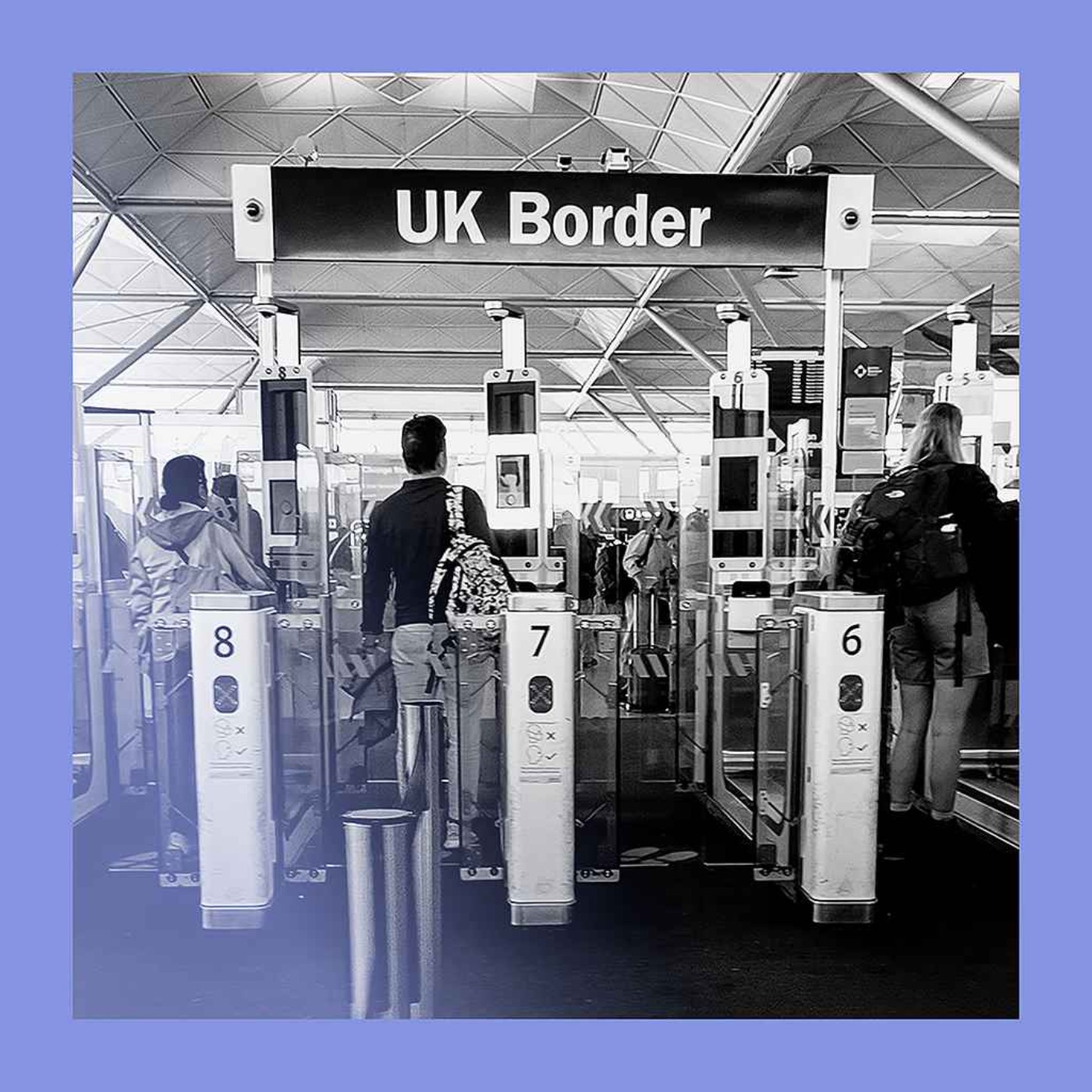
Immigration to Britain has gone through the most extraordinary boom and bust cycle.
- [01:33]
Jason Palmer
Joel Budd is our social affairs editor.
- [01:36]
Joel Budd
After the COVID pandemic, when Britain started to allow people to move freely into the country, the number of immigrants rose very, very dramatically, to the sort of levels that Britain has never seen. In the year to March 2023, more than one and a half million immigrants arrived in the country, intending to stay for more than a year or so at least, and many, many fewer left. So net migration, which is what Britain tends to obsess over, went above 900,000 per year. So it was as though a city the size of Birmingham had suddenly materialized in the country.
- [02:17]
Jason Palmer
Who were they?
- [02:18]
Joel Budd
They were a mixture. Some were Hong Kongers and Ukrainians because the British government had favored people from those countries, recognizing that Hongkongers were facing oppression and Ukrainians, of course, invasion. Some were students who were taking advantage of much more liberal rules about working after graduation. But quite a few of them were simply workers. Britain made it easier to get a work visa.
- [02:42]
Jason Palmer
So why was the British government at that time so welcoming to immigrants?
- [02:47]
Joel Budd
It's slightly strange because in a sense it was welcoming to immigrants because it had become unwelcoming to Europeans specifically. Britain left the EU in 2020, and in early 2021 it cancelled free movement. So before then it had been possible for a French person or a Polish person to simply move to Britain and take whatever job they wanted and it became impossible. So the government thought, well, hang on a second. Many of our industries have really depended on Europeans and the famous one was the hospitality industry. And we don't want to have nobody coming into the country to do those sorts of jobs in future. So what we will do is we'll make it easier for everybody to get a work visa. And what happened was very few Europeans took Britain up on that offer. So, like Polish migration to Britain completely collapsed, but many people from Asia and Africa did. The number of work and study visas given to Indians tripled between 2019 and 2022. Indians were the big group, Nigerians were the second biggest.
- [03:53]
Jason Palmer
So that's the boom of the cycle that you described. Now tell me about the bust since then.
- [03:58]
Joel Budd
After the extraordinarily high figures that we saw in 2022, 2023, British government panicked and slammed on the brakes and then threw the car into reverse. British governments, beginning with the last Conservative government and now the current Labour government, have made it harder to get into the country almost by any means. So they made it harder for workers to get in by moving the salary threshold upwards. In other words, you need to be earning more money in order to get a work visa. They've made it harder for spouses to come in, they've made it less attractive for universities to bring in lots of foreign students, they've made life harder for asylum seekers. And so in just about every way they've tried to crush the numbers because
- [04:49]
Jason Palmer
it's politically expedient to do so.
- [04:51]
Joel Budd
Yes, most British people think that there is too much immigration and most of the people who disagree with that think that the amount of immigration is about right. In other words, there are very few people in the country who think there should be more immigration. So it looks like a sort of one way bet for a government to just suppress immigration.
- [05:12]
Jason Palmer
But what about the argument from before that basically Britain's society needs those workers?
- [05:18]
Joel Budd
One of the things I was looking at in my article is, given that we had this enormous boom of people and then a bust, who were they? Because the government tends to describe them in pretty disparaging terms, tends to say, well, they were unskilled, they were often doing jobs in care homes, they were bringing their children, they will quite rapidly become burdens on the state and so on and so forth. When I looked in more detail at this huge wave of immigrants, they turned out to be doing surprisingly well so far. They tend to come in and start working and in the first year they earn less than average. But quite quickly their wages exceed the British national average.
- [06:00]
Jason Palmer
So the question here is at this moment, under these conditions, is this what the British people want?
- [06:06]
Joel Budd
It looked as though the government could do no wrong in suppressing immigration. That was what people seemed to be telling pollsters they wanted. And then when Labour proceeded to do it, the response was a kind of resounding raspberry. So Labour's position in the polls has not improved. If anything, it became worse. And Keir Starmer gave a speech that became somewhat famous. And this is unusual because Keir Starmer is not a good speaker. He's remembered for one speech where he said, immigration is turning us into a nation of strangers. And as it happened, there was a large poll that was kind of in the at exactly that time. And so we got to see how people responded to it. And the answer is that they moved away from the Labour Party. So the government slightly, mysteriously seems to be not being thanked for its very tough line. And it may be that the explanation is that voters who really are obsessed with immigration and want very, very much less immigration were never Labour supporters.
- [07:09]
Jason Palmer
A question for you, Joel, about the soul of the average Briton. Why the anti immigration stance in a general sense?
- [07:16]
Joel Budd
Well, I think British people are odd in the sense that they don't hate immigrants. They tend to think that once somebody has arrived that that person should have exactly the same rights as everybody else, they should be able to work and so on and so forth. They're not sort of viscerally opposed to immigrants. What they hate is disorder at the border. The type of immigration they really, really hate as a result is asylum. And particularly people who float over the English Channel in large inflatable boats and then claim asylum. Now, those folks are very small in numbers, about 40,000 a year, but they demonstrate the entire country is not controlling its borders. One of the slightly strange aspects of what the government is doing is that it's managing to crush the sort of immigration that's less nurses, care, home workers, engineers, students. While it hasn't so far managed to do very much about those really, really unpopular immigrants coming over the channel.
- [08:17]
Jason Palmer
Joel, thanks very much for joining us.
- [08:19]
Joel Budd
Thank you.
- [08:31]
Financial Advisor
Because you didn't just say, how can I provide these investments? You'd be, how do I holistically provide everything? How do I bring in the legal, the accounting, all this, and do it at a price point, no one else is doing it.
- [08:40]
Creative Planning Representative
Learn more about how we approach wealth management@creativeplanning.com integrated running a business means juggling a lot of moving parts. And when your communication tools can't keep up, things start to slip. Missed calls, slow replies, scattered conversations. They're not just frustrating, they're lost opportunities and revenue left on the table. That's where Quo comes in. Spelled Q U O. Quo is the 1 rated business phone system on G2, trusted by over 90,000 businesses. One shared business number for calls and texts so every conversation stays visible, organized and accountable. It works from an app or computer. You can keep your existing number, add teammates and sync your CRM, letting you scale without adding complexity. And with built in AI, Quo logs calls, summarizes conversations and flags next steps Even after hours Stop missing customers. Stop leaving revenue on the table. Try Quo free and get 20% off your first six months@quo.com tech that's quo.com
- [09:48]
Joel Budd
tech
- [09:50]
Creative Planning Representative
quo no missed calls, no missed customers.
- [09:58]
Narrator
Dive.
- [09:59]
Submarine Crew Member
Submerge shift at 150ft. Submerged shift at 150ft. Dive I chief of the watch over the 1 M C dive. Dive. 2. Blast on the diving alarm. Dive. Dive.
- [10:07]
Narrator
Overlord of Sea Dive. Dive. Two Blasted Dive. Alarm. Dive. Dive. An apex predator slips beneath the tropical waters off the Pacific Ocean, just off the island of Guam.
- [10:19]
Jason Palmer
Anton LaGuardia is our Diplomatic Editor.
- [10:22]
Narrator
Overlord of Sea Dive. Dive.
- [10:23]
Submarine Crew Member
2.
- [10:23]
Narrator
Blast the Dive alarm. Dive.
- [10:25]
Joel Budd
Dive, aye.
- [10:26]
Lieutenant Commander Asif Khan
Dive.
- [10:27]
Narrator
Dive. What exactly it's after on any given day is a secret. It could be trailing Russian ballistic missile submarines. Or it could be watching Chinese military exercises around Taiwan. All vents open. I'm aboard the USS Annapolis, one of 49 attack submarines in the American fleet. Together, they embody America's supremacy of the underwater world, the last domain in which it has a clear military lead over China. But this advantage is under threat. Having built the world's largest surface navy, Xi Jinping is now transforming his country's submarine force to challenge American might. The essence of undersea operations is stealth. Above all, to hear and not to be heard. Submarines sense their surroundings mostly by sound. As Lieutenant Commander Asif Khan, the weapons officer, explains,
- [11:39]
Lieutenant Commander Asif Khan
we hear everything. Our hydrophones are incredibly sensitive. They pick up noises down to the individual shrimp that are making their little noises. We can hear fish eating coral. We can hear dolphins, whales. We can hear schools of fish. All of this noise comes to the hydrophones
- [12:01]
Narrator
on board the Annapolis. Sound hygiene is constantly enforced. Wear tennis shoes. Don't slam doors. Listen for changes in mechanical noise. American submariners once joked the Chinese subs could be heard from America's west coast. But now China is closing that gap. To start with, it's making it easier to find American submarines with an underwater grade wall of sensors stretching from space to the sea floor. It's also making its own boats harder to find with a new generation of quieter nuclear submarines, probably built with Russian technology. And last, it's building submarines faster than American can manage. In the coming years, China's attack submarines could roam across the Pacific and beyond, posing new dangers to American bases at Guam and the west coast and to aircraft carriers at sea. They will be threatened not just by ballistic missiles fired from the Chinese mainland, but also by cruise missiles fired from underwater. For now, though, Commander Clinton, enriched the captain of the Annapolis, thinks American subs can still keep China at bay.
- [13:23]
Commander Clinton
I think what we bring is a deterrent force. The rest of our adversaries can account for our surface ships, they can account for our air force and our planes. But what they can never account for is how much combat power is ready and willing to be employed from beneath the ocean.
- [13:40]
Narrator
As we sail out of the of Apra harbor in Guam, the wartime shipwrecks that lie below are a reminder of the island's strategic importance.
- [13:50]
Commander Clinton
You head straight from here, you would wind up right about just south of Taiwan, just north of the Philippines, due west from here.
- [13:57]
Narrator
So you really are close to potential action.
- [14:01]
Commander Clinton
We're close to really anything that the country wants to accomplish here in the western Pacific we can get to in
- [14:07]
Joel Budd
a very short period of time.
- [14:08]
Lieutenant Maya Solis
Time.
- [14:14]
Narrator
Living Underwater and working eight hour shifts for months on end, Captain Em's crew of about 150 sailors live in intimately close quarters, taking turns on sleeping bunks.
- [14:27]
Lieutenant Commander Asif Khan
For example, there are 84 racks in total on the submarine for the crew. And that's not.
- [14:33]
Narrator
There are more than 84 people.
- [14:35]
Lieutenant Commander Asif Khan
Yes, there's 130 enlisted sailors on the submarine. So to get that split, it means that you have to hot rack. One sailor gets out, takes their linens, puts them away and another sailor throws their linens onto the still warm mattress, jumps in, goes to sleep.
- [14:55]
Narrator
With nuclear fuel that lasts three decades or more, American submarines generate their own air and fresh water. The main limit on the duration of their patrols is food. The Annapolis gets underway not just with a full load of weapons, but with a full load of bananas hanging from the pipework and jars of peanut butter jammed between seats. Sailors on the Annapolis have to tell superiors whether they want to receive bad news from home while underway. Assuming information reaches the boat, the crew did not hear the result of this year's super bowl until days after the event. All this makes for an unusual environment, not least for Lt. Maya Solis, the sole woman on board.
- [15:42]
Lieutenant Maya Solis
I wanted to be tip of the spear. And I realized I didn't want to be in a desert in the middle of nowhere waiting for war to happen. I wanted to be out there doing something where the things are already happening. You can feel the sense that what we're doing is a important.
- [15:56]
Narrator
Women have been stationed on attack boats in Guam only since last year. But the change has posed no real problems.
- [16:03]
Lieutenant Maya Solis
It's really just simple. We're just adults. You just kind of knock twice on the door, see if anybody's in there changing. It's a pretty small area as it is. It's really a non event, which has been great.
- [16:14]
Narrator
Still, she's had to contend with men's habits.
- [16:17]
Lieutenant Maya Solis
The boys here were peeing with the door open. Nope. Like, I had to teach them how to shut the door when they went me.
- [16:25]
Narrator
In years to come, Lieutenant Solis and her colleagues will be stretched increasingly thin. The American Navy needs two Virginia class submarines every year to replace older Los Angeles class boats like the Annapolis. And the commitment to supply Australia with submarines. And the requirement rises to 2.3 attack boats a year. At present, America is managing little more than one. Making everything worse is a maintenance backlog that keeps a third of American attack boats idle underwater. As in other domains, drones could take up some of the tasks currently performed by submarines. They can dive deeper, surveil longer, and carry additional weapons. But they are hard to communicate with. For the foreseeable future, America will still rely on expensive crude submarines like the Annapolis, not least because actually using weapons still requires human control, as I learned when I was invited to take part in a torpedo drill. This lever knob right here. Yep. You're gonna lift it, and you're gonna pull it towards you. You're gonna feel a click, and you're gonna hear it as well. Yeah, I want to hear and feel that click. Let go of it. Okay, right. And then it'll. It'll go. So lift, pull.
- [17:47]
Creative Planning Representative
Yep.
- [17:47]
Narrator
And then let go. And when you do it, you should say shooting tube three. Okay, so I pull up. Lift up. Pull it back. Shooting. Let go. Did you hear click again. Let go. You didn't bring it back on. It didn't click. It just went back. Try again. One more time. There we go. I sunk your ship.
- [18:25]
Submarine Crew Member
That's it.
- [18:26]
Narrator
Sir, I can join your crew, please, anytime. Happily. Have you anywhere. Thank you very much.
- [18:57]
Ainslie Johnston
So I've brought in with me to the studio today a few bottles of serum and a skin cream.
- [19:05]
Rosie Bloor
Ainslie Johnston is a science correspondent they
- [19:09]
Ainslie Johnston
have pretty complicated names. We have emulsion of 0.2, ester of all trans retinoic acid. We have vitamin C, we have salicylic acid. All very chemical. These names might be familiar to people who care a lot about skin care, but does anyone know what they actually do?
- [19:32]
Rosie Bloor
Ainsley, obviously, I'm desperate to hear from you which ones actually work, which ones have scientific backing. But just before we get to that, just explain to me what it is that happens to skin as we age and why we get wrinkles.
- [19:49]
Ainslie Johnston
Most skin aging really is caused by the breakdown of these very important proteins in our skin. So these are things like collagen and elastin that really form this structural scaffolding of our skin. And if they break down, that can lead to wrinkles and sagging. There are two main drivers of this breakdown. One is simply the passage of time, but the other is environmental damage. Your skin is the barrier to the outside world. Things like pollution can be harmful to your skin and also, in particular, ultraviolet light. Around 80% of skin aging in white skin is thought to be down to uv, according to the University of Manchester. In darker skin, where there's more melanin, that actually provides some degree of protection. But for white skin, really, UV is the biggest driver.
- [20:43]
Rosie Bloor
And is it actually possible to reverse that aging, or is it just possible to slow it down or change how it looks?
- [20:52]
Ainslie Johnston
There is some evidence that actually some of the damage is at least partially reversible. So the product that has the best backing is actually something called tretinoin. It's a drug that is a derivative of vitamin A. And it was originally developed as a treatment for acne. But dermatologists began to realize that people who were using tretinoin on their skin not only had fewer spots, but also had fewer wrinkles. So they thought perhaps this would work as an anti wrinkle treatment. And since then, there has been lots of research showing that it does affect the skin in ways that seem to at least partially reverse the aging process. It thickens the epidermis, which is this very thin layer of the outside of your skin that seems to reduce fine lines. And it also stimulates collagen production in this structural part of the skin, in the dermis, which is the deeper layer. The downside is that it's prescription only.
- [21:47]
Rosie Bloor
And why is it prescription only if it works for other things?
- [21:51]
Ainslie Johnston
Well, it is just very irritating to your skin. It can cause redness and peeling and things like that. But there are options if you want to have the similar effects, but with an over the counter cream, such as. So there are a whole host of milder retinoids. Retinoid is the class of chemicals that tretinoin is a part of. So these are things like retinol and retinal, and they are available in lots of different over the counter creams. Both retinol and retinal, once they are in contact with the skin, are converted to tretinoin on the skin. But they are just generally a little bit milder. They don't cause so much irritation. There's a whole host of different varieties of these creams in a whole variety of different price points. Generally what you're paying for is something that's more stable chemical, that's less likely to break down in the bottle. And also they maybe convert more easily to tretinoin once they're on the skin. Although they are a little bit milder than the drug itself, they can still cause some irritation. So generally it's advised if you want to start using them, that you should begin with a lower concentration and work your way up. But even very low concentrations, so 0.04% of retinol still seems to be effective.
- [23:07]
Rosie Bloor
So we've heard quite a lot about retinoids over the last few years. Other things that we can also use
- [23:14]
Ainslie Johnston
there are, as well as vitamin A, retinoids, there is also vitamin C. It's an antioxidant, works in a slightly different way, but it also seems to reduce wrinkles and hyperpigmentation, which is another sign of aging. The downside of vitamin C is that it is very unstable. It can break down very easily in creams, can be quite expensive, or it can be difficult to store. The other big ingredient that you'll see on a lot of creams are peptides. Generally they are short chains of amino acids. They're often developed by cosmetics companies, which means that some of the research is funded and conducted by these companies. They tend not to have as much scientific backing as things like vitamin C or retinoids. But there is evidence that some of them encourage these structural proteins. Some of them slow the breakdown. There are some that even work, like Botox, to kind of relax facial muscles as well.
- [24:10]
Rosie Bloor
Ainsley, I now know why you look so young. Do you have any other tips for us for looking after our skin?
- [24:16]
Ainslie Johnston
The dermatologist that I spoke to stressed that when you are trying out something new, you need to give it a bit of time. But definitely the most important thing is prevention rather than attempting to reverse the process of aging. As I said, UV is the biggest cause of skin aging. So the best advice is just wear sunscreen.
- [24:39]
Rosie Bloor
Ainsley, thank you very much.
- [24:40]
Ainslie Johnston
Thank you, Rosie.
- [25:00]
Rosie Bloor
That's all for this episode of the Intelligence. See you back here tomorrow.
- [25:23]
Financial Advisor
Because you didn't just say, how can I provide these investments? You'd be how do I holistically provide everything? How do I bring in the legal, the accounting, all this, and do it at a price point no one else is doing it.
- [25:32]
Creative Planning Representative
Learn more about how we approach wealth management@creativeplanning.com integrated high interest debt is one
- [25:38]
Submarine Crew Member
of the toughest opponents you'll face unless you power up with a Sofi personal loan. A Sofi personal loan could repackage your bad debt into one low fixed rate monthly payment. It's even got superspeed since you could get the funds as soon as the same day you sign. Visit sofi.compower to learn more. That's sofi.com p o w e r loans originated by Sofi Bank NA member FDIC terms and conditions apply. NMLS 696891.