Loading summary
Transcript62 lines
- [00:00]
CBOE Announcer
When your options are limited, so are your opportunities. At cboe, the global exchange that pioneered options trading, we offer more ways to move with the market. From VIX and SPX options to global market data solutions. CBOE helps investors diversify, manage risk and stay ahead of whatever the market does next. CBOE Life is better with options, your investments could be too. There are risks associated with SIBO company products. Review the disclosures and disclaimers@cbo.com USDisclaimers that new thing?
- [00:32]
GNC Host
Yeah, we've got it. The Drop by GNC bringing you all the newness that matters. Hand picked by the pros who actually know what's up and what's proven to work, we keep you on top of the trends and dialed into what's next. Whether you're crushing it at the gym, leveling up your game or thriving every day, the Drop by GNC is where the latest solutions in health and wellness land first. Nonstop innovation and fresh finds daily explore what's new and what's next on the Drop by GNC.
- [01:06]
Jason Palmer
The Economist.
- [01:13]
Rosie Blore
Hello and welcome to the Intelligence from the Economist. I'm Rosie Blore.
- [01:18]
Jason Palmer
And I'm Jason Palmer. Every weekday we provide a fresh perspective on the events shaping your world.
- [01:28]
Rosie Blore
We've asked it before and we'll ask it again. What will artificial intelligence do to the employment of real sentient human beings? Man versus Machine we report from the middle of the fight
- [01:42]
Jason Palmer
and our culture editor joins us with an examination of the quiet heroism present in the memoir of Giselle Pellicot. But first,
- [02:13]
Noah Snyder
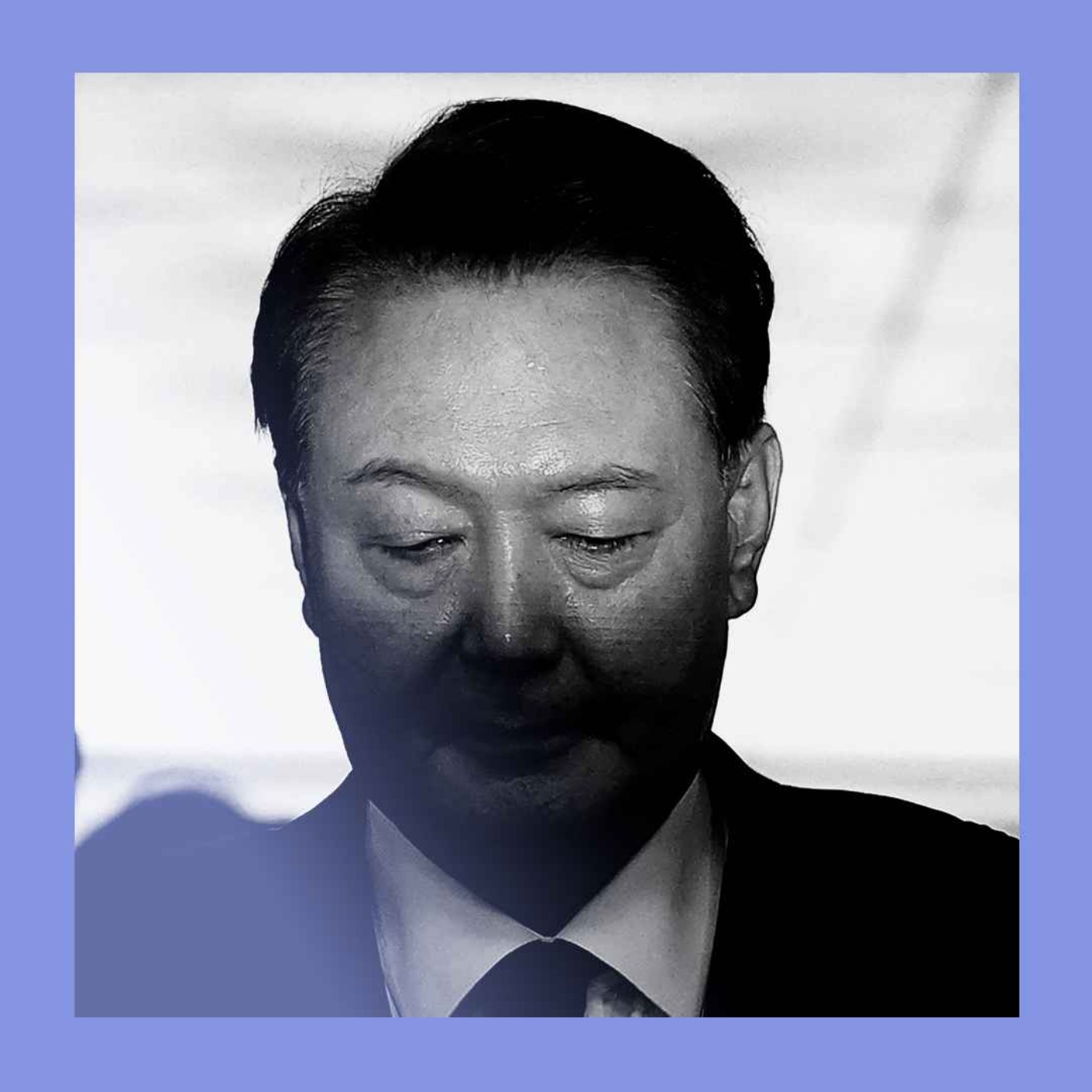
South Korea's disgraced ex President Yun Suk Yeol finally had his big day in court today in connection with his failed attempt to impose martial law on the country just over a year ago.
- [02:27]
Jason Palmer
Noah Snyder is our East Asia Bureau chief.
- [02:30]
Noah Snyder
The death penalty was on the table, but in the end he received only a light sentence of life imprisonment for his role as the leader of an insurrection. He's likely to appeal the verdict, but neither his appeal nor this sentence will resolve the deeper fissures that his actions have helped cause in South Korean society.
- [02:56]
Jason Palmer
So let's wind back a bit, Noah, to get a history of how we got to this point.
- [03:01]
Noah Snyder
The story really begins late on December 3rd of 2024, when then President Yoon appeared across TV screens in South Korea and declared martial law. He sent troops to seize the national assembly, the country's parliament, and also to raid the National Election Commission and the opposition forces in parliament, the left leaning Democratic Party, mobilized very quickly to try to stop him. Lawmakers rushed to parliament. They pushed past the soldiers with guns who had surrounded the building, and they made their way into the chambers to vote at 1am to overturn martial law. The military thankfully withdrew without any shots fired, without any violence in the streets. Protesters came out by the thousands to support the opposition and to push back on the president's power grab. And by around 4am, Yun was back on TV, reluctantly accepting the parliament's decision and agreeing to back down. But that was, of course, just the beginning of this process, which has now led us all the way to this court verdict.
- [04:13]
Jason Palmer
And what about between then and now? When last we spoke to you, you said this had magnified or at least cast some light on some divisions in South Kore society.
- [04:23]
Noah Snyder
That's right, Jason. This incident always showed two sides of South Korea's democracy. On the one hand, there was this resilience, this ability to mobilize in defense of democracy and institutions that proved able to withstand this kind of assault on the very democratic foundations. But at the same time, on the other hand, this was both the product of and has helped to fuel really deep polarization in South Korean society. Both sides of the political aisle have come to see each other as kind of mortal enemies locked in existential combat. And far from resolving those divisions, again, this incident and the fallout from it has really exacerbated them.
- [05:11]
Jason Palmer
That is to say that Mr. Yoon still has his supporters. There are still people who think that what he did was right.
- [05:17]
Noah Snyder
Yes, Jason, there are still supporters, and a rather large number of them on the South Korean right. In the wake of the martial law, Yun's former party, the People Power Party, the main conservative party in South Korea, has essentially split into two warring factions of its own. There's a camp that really defends the former president that says that his actions were justified because the opposition, the Democratic Party, had been so obstructionist in parliament. And these folks, they call themselves, quite literally the Yoon Again crowd. And then there's also another faction, you might call them the Yoon Never Again faction, which is saying this is just fundamentally wrong what the former president did. And even if he's on our team, we need to stand up for some underlying principles. And this is a red line that we can't cross as a party. And so this split has essentially created an identity crisis within South Korea's conservative movement. And it's left a huge open space for maneuver for the Democratic Party, the left of center party, which now controls both the presidency and the legislature.
- [06:29]
Jason Palmer
So this has become the story of the ruling party, becomes a fractured opposition. But do you have a Sense of whether the pro Yun, the UN Again types have the upper hand, or the other way around.
- [06:39]
Noah Snyder
So far, the UN Again types have had the upper hand. Jason Right after Yun declared martial law, the then leader of the party, a man named Han Dong Un, came out and opposed the president. He broke with the leader of his own party and in fact played a pretty important role in stopping martial law on the night it happened. But the vast majority of the lawmakers in the PPP boycotted the vote to overturn martial law and opposed Yun's impeachment. And when it came time to select a candidate to run in the snap presidential elections last June, they chose not Mr. Han, who had come out again to oppose martial law, but a former minister from Yun's government who'd been largely apologetic. And since then, since they're drubbing in that presidential election, they've chosen as the leader of their party another member of this UN Again faction. And the party has chosen to go in this direction because there's a really loud and influential kind of far right fringe that's emerged. A lot of online commentators, YouTube rabble rousers who've managed to demonstrate that they can bring people to the streets and that they can swing support from the base of the party. It's kind of a surreal world. A noxious mix of ideas about election fraud, conspiracies and anti communist rhetoric around China and North Korea, and a sprinkling of evangelical Christianity. And when they get together in person, as they do for regular protests in central Seoul, they adopt a lot of the imagery of the MAGA movement from America, things like Make Korea great again hats and chanting Stop the steel. And so in a lot of ways, it looks like martial law has become a bit like January 6th in America's Republican Party following 2020. There's a blank of the party that wants to make the defense of martial law a kind of a litmus test for the party's leadership. And again, so far they're holding the upper hand.
- [08:49]
Jason Palmer
And I suppose then for the Uniguen types, today's verdict just kind of makes him more of a martyr. It sort of entrenches their views that it's them against the rest of the where do you see this going? Will that flank of the party gain more and more power?
- [09:04]
Noah Snyder
I don't think this verdict is going to change the minds of the people who have been supporting the president all along. What might finally change it is experiencing defeat at the ballot box. Their agenda may be popular again with this fringe of the party's base, but it's not popular with the broader public. The PPP's support ratings are wallowing below 25%. By and large, the South Korean public thinks that what President Yoon did was wrong. The party will face a verdict at the ballot box for the first time in June, when South Korea elects its mayors and governors and local legislators. And many political analysts expect a huge defeat for the ppp. So that may be a moment when the party is forced to reckon with the course it's taken and start to reform itself from within. But the process of resetting the party from within will take a lot of time, and in the meantime, I think it means two big things for South Korean politics. One is that the lack of an opposition means that there are few checks and balances on the current ruling party, the left of center Democratic Party and its president, Lee Jae Myung. So they have both a free hand to pursue their agenda, but also no one to blame if they can't deliver results to voters. And the second is a worsening of this polarization problem that we've been discussing. Jason, I think it's going to be hard for the country or for the two parties to start healing the divide and bridging the gaps between them if there are still divisions within the parties themselves.
- [10:46]
Jason Palmer
Noah, thanks very much for joining us.
- [10:48]
Noah Snyder
Thank you for having me, Jason.
- [10:54]
Jason Palmer
Foreign.
- [11:04]
CBOE Announcer
Looking for More Investing options? Meet cibo, the exchange that pioneered options trading. With exclusive trading products like VIX and SPX options, CBOE can help you trade in any market environment. There are risks associated with CBOE Company products. Review the disclosures and disclaimers@cbo.com USDisclaimers that new thing?
- [11:22]
GNC Host
Yeah, we've got it. The drop by GNC bringing you all the newness that matters. Hand picked by the pros who actually know what's up and what's proven to work. We keep you on top of the trends and dialed into what's next. Whether you're crushing it at the gym, leveling up your game, or thriving every day, the drop by GNC is where the latest solutions in health and wellness land first nonstop innovation and fresh finds daily. Explore what's new and what's next on the Drop by GNC.
- [11:57]
Rosie Blore
When ChatGPT arrived in 2022, it excited and terrified in equal measure. For many of us, it's brilliant to be able to outsource or speed up some of the daily drudge of a job. But it's worrying too. If a machine can do it and they don't even need to sleep, what's the point of us. The head of the IMF recently warned that AI is hitting the labor market like a tsunami. Some reckon that half of all entry level white collar jobs could be wiped out.
- [12:29]
Alex Domash
There's a lot of fear right now about what AI is going to do to the white collar workforce. And it's true that it could wreak havoc, but I think it's much more likely to reshape jobs rather than to erase them altogether together.
- [12:42]
Rosie Blore
Alex Domash is our economics correspondent.
- [12:46]
Alex Domash
I think the proper way to think about this is that the future white collar office is going to look less like a robot and more like a cyborg, where AI and humans are jointly working together.
- [12:59]
Rosie Blore
We've heard so much about an AI apocalypse. Where's your optimism coming from?
- [13:04]
Alex Domash
So I think it is useful to do two things. First, it's useful to actually look at the data and see what's happened over the past three years. And then second, it's useful to look at past technological revolutions and what happened during those. So if you actually look at the data over the last three years and what happened to white collar jobs, you actually see that white collar employment has increased by 3 million jobs, whereas Blue collar employment has stayed relatively flat over the first three years. Certain occupations that have often been casted as the victims of AI, think software developers, paralegals, radiologists. These are occupations that share a lot of overlap with the capabilities that AI can do. And yet we've actually seen that these jobs too have seen massive employment increases over the last three years. Software developers are up 7%, radiologists are up 10%, and paralegals have actually seen employment increase by 20% over the last three years. So there's been large employment gains, but then wages too. We see that white collar workers continue to earn one third more than blue collar workers, which says that there is something distinct about office work that continues to command a wage premium over blue collar work.
- [14:09]
Rosie Blore
What has been the impact in the past of technological change with new technologies?
- [14:14]
Alex Domash
There are always dire predictions for what the future of work is going to look like. Even during the computer age, you had Nobel Prize economists predicting that the white collar workforce was going to be completely eradicated. Obviously, that's not what we've seen. What we've seen instead is that computers, the Internet, have been a boon for white collar workers since the early 1980s. Employment in white collar work has more than doubled. Real wages have increased by a third for white collar workers since the early 1980s. I don't want to oversimplify. There has been some Job displacement because of computers. Usually this is in routine work that is easily codifiable. Think typists, which were completely wiped out. But that has been completely overcompensated by two other effects. The first is the reshaping of work. So very rarely were full jobs completely amenable to automation. And what you saw instead was that certain tasks would be automated and workers would then take on new roles that were actually higher productivity, higher value added. A canonical example of this is air traffic controllers, where flight data could easily be automated by software. And that allowed air traffic controllers to actually focus more on higher value added activities, such as judgment, such as coordination. The second effect has been the creation of new work in new jobs altogether. And this has been overwhelming since the early 1980s. And it's important to emphasize that these new jobs do not just occur in roles that are quote, unquote, computer roles. Instead, what happens is the entire white collar workforce is adjusted. And so you have things like E commerce, which spawns all types of new jobs in logistics and supply chain coordination, in digital payments, and you see new roles that you couldn't even think about 30 or 40 years ago.
- [16:06]
Rosie Blore
Isn't it still possible that AI will be different?
- [16:10]
Alex Domash
Yeah, so the thinking goes, and where the fear comes in is that because AI is so much more powerful than past technologies, that it's going to slowly creep up the value chain into ever increasing complicated tasks. And I think that this view does not hold weight for a few reasons. First of all, AI, even with the impressive capabilities that it has today, it can still fully automate very, very few roles. And so there was a report that came out by Anthropic late last year that found that in 4% of occupations could AI automate 75% of the job, and that there were very few roles where AI could automate 100% of the job. And so what this means is oftentimes we oversimplify what a job actually is. Job consists of many different tasks. Some of them will be automatable with AI. But what this will do instead, similar to past technological revolutions, is it will shift the sort of work that people are doing. So, yes, data analysis, coding, a lot of these cognitive tasks will be able to be automated by AI. And the most likely effect is that jobs will then continue to adjust, expand, and the sort of work that humans are doing will continue to shift. And this is something that actually, if you look at the data, you're already starting to see in the labor market.
- [17:31]
Rosie Blore
So what does that data show?
- [17:33]
Alex Domash
We found that a lot of the jobs that combined both technical work and human skills think roles that involve a lot of coordination, such as project managers, information security analysts. These occupations have actually seen employment expand by more than 30% over the last three years. So there is a subset of occupations that are really, really expanding rapidly. The only group of occupations that we actually saw shrink over the last three years were occupations that could be considered routine back office roles. So secretaries and administrative assistants, for example, have seen employment shrink by 20% the last three years. This is of course a concern, but we see it more as a continuation of a past pattern rather than a structural shift because of AI.
- [18:24]
Rosie Blore
Alex, does this mean we can stop worrying about the destruction of white collar jobs?
- [18:29]
Alex Domash
I know I've been painting a somewhat optimistic picture. I think that there is certainly risks as well that are important to acknowledge. The first is that models are becoming ever more capable. There are a lot of benchmarks that show the capabilities of models. And the most recent models by anthropomorphic their cloud models can now do software tasks continuously for more than five hours. And the rate at which these models are increasing over the past couple years has doubled every seven months. So there is this one concern is that the models just continue to get better and better. The second concern that entry level jobs are the ones that are most highly vulnerable and highly exposed to what AI can do. So interns, entry level analysts, programmers could see possible disruption and thinking through what this means for career ladders for workers who are just joining the labor force is something that should be taken seriously. And then the third concern is that a lot of the jobs that we have seen employment decrease the most over the past three years, such as these back office occupations, are also the workers who are least adaptable to finding new work. And so a lot of thinking needs to be done in how to help workers that do lose their job because of AI, how to help them transition into new roles. But with that being said, overall, I think despite all of the dire predictions and all of the calls for a white collar jobs apocalypse, I do believe that white collar work will continue to adjust and most probably it will continue to expand as well.
- [19:59]
Rosie Blore
Alex, thank you so much.
- [20:01]
Alex Domash
Thank you, Rosie.
- [20:05]
Rosie Blore
And to hear more on how AI is changing jobs, I urge you to listen to the new series of Boss Class, hosted by Andrew Palmer, which is all about how artificial intelligence may or may not upend real intelligence in the workplace.
- [20:33]
Alexandra Sewich Bass
I'm Alexandra Sewich Bass, and as the Economist Culture Editor, I read and watch a lot. I'd like to recommend a few things that you might consider reading or watching that are either getting a lot of attention or will be and things that maybe you should avoid.
- [20:51]
Jason Palmer
So with that in mind, what have you got for us today?
- [20:53]
Alexandra Sewich Bass
I'd like to recommend a new book that's out, a memoir by Giselle Pellico called A Hymn to Life. She is an accidental heroine who writes about her experience in the public eye. And the book raises some really interesting questions, like. Like how well do you really know your partner?
- [21:10]
Jason Palmer
So tell me why it is you've chosen this book this week.
- [21:13]
Alexandra Sewich Bass
Gisele Pellico has become a feminist Joan of Arc. She was the face of a very high profile rape trial that captured the attention of people around the world.
- [21:24]
Jason Palmer
Right. So this was the woman whose husband drugged her, raped her, got men off the Internet to do the same. We learned a lot of the details, horrifying details of the case at the time. What does the book say beyond what we already know?
- [21:39]
Alexandra Sewich Bass
It really helps us understand a woman who portrays herself as an every woman. She comes from very humble origins. She was about to celebrate her 50th wedding anniversary when her husband was caught at a supermarket upskirting, taking photos of other women. And so she's brought into the police station and finds out what is an absolute nightmare, which is that her husband is not who she thought he was. And she spends a lot of the book, it's a bit like a detective story, trying to piece together what happened when things went wrong and how she might not have seen it. While the crimes that were committed are extraordinary in their scale, she deals with very ordinary emotions, like how do you make sense of happy memories when someone has betrayed you? What happens to a family? And so we really got to know both the details of her immediate suffering after she found out about the crimes, but then also the character of the woman who was this public face of feminism and standing up against sexual violence.
- [22:50]
Jason Palmer
And I mean, tell me more about the character that is revealed. This is someone who has to have all these revelations under the hot lights of the press.
- [23:00]
Alexandra Sewich Bass
What I found really interesting about the book is that she deals very explicitly with feminism. She says, I really just wanted to improve my life. I was interested in creating a happy family, which was not at all her experience growing up. She grew up very poor. She lost her mother to a brain tumor when she was 9. And so she talks about how some people were reading Simone de Beauvoir's the Second Sex. She had no pretense of even picking up a copy. And yet, because of her experience, so many people feel A great connection to her. And so she portrays herself as an accidental heroine, but someone who was happy to rise to the occasion. She talks about how she was originally not going to open up her rape trial because you have a right to confidentiality. And it was while she was on a walk that she realized that she wanted to make this public. She has a very famous line, shame has to change sides. And so she had this extraordinarily grueling experience of having all 50 men, plus her husband glaring at her in court because they were all tried together. But how she felt like it was a really important gesture to raise awareness of her experience and what so many people have gone through with less headlines and attention and support from other people.
- [24:24]
Jason Palmer
And so what do you think the average reader will take away from reading this story?
- [24:28]
Alexandra Sewich Bass
I think that it's this question that's very haunting of how well do you know your partner or your husband or your wife? And I think that everyone, including Giselle Pellico, when she was asked this by the investigator before he revealed what had happened, people feel very confident in their gut instincts. I think it raises some very troubling questions. Thankfully, not many people will experience the scale of what Giselle Pellico, but people will experience gradations of it. And I think that her book deals very sensitively with how to navigate trauma and how to create another life after your life has been irrevocably changed by someone else's actions. I will say that part of why the book is very interesting is not just because she is a strong woman, but because of what it represents in our culture. Right now we have two of the five top selling nonfiction books in America are stories of either betrayal in a marriage that's Bell Burdens strangers or exploitation. We saw Virginia Jeffrey Epstein, victim, publish a posthumous book. Both are selling extremely well. So I think there's a thread right now in our culture of reclaiming narratives for women who have been marginalized and feel that they have been mistreated. And the public is very interested in their stories.
- [25:52]
Jason Palmer
Now moving on in the recommendations here, you often bring us also an anti recommendation if you will, a thing not to read or watch or experience. What have you got for us?
- [26:01]
Alexandra Sewich Bass
So our culture team has been discussing Weathering Heights, which is newly out and we have made it a what not to watch. Have you seen it, Jason?
- [26:11]
Jason Palmer
I have not, but now I won't, I guess Tell me why not.
- [26:15]
Alexandra Sewich Bass
So I have to say that perhaps I was a bit biased because I read the book and was not a fan of the book, nor was the Economist when it came out. It was not a glowing review at the time, but this film takes the book almost as light inspiration. And this is fan fiction. So a relationship that is not consummated in the pages of Wuthering Heights ultimately is consummated everywhere across the screen for the entire long duration of the film. So people who like the book, I think will be disappointed, and people who are not necessarily interested in an erotic and depressing film should avoid it.
- [26:58]
Jason Palmer
Alexandra, thanks as always for joining us.
- [27:00]
Alexandra Sewich Bass
Thank you, Jason.
- [27:19]
Jason Palmer
That's all for this episode of the Intelligence. We'll see you back here tomorrow.
- [27:42]
CBOE Announcer
Looking for more Investing Options? Meet Cibo, the exchange that pioneered options trading. With exclusive trading products like VIX and SPX options, CBOE can help you trade in any market environment. There are risks associated with Sebo Company products. Review the disclosures and disclaimers at sebo.com usdisclaimers that new thing?
- [27:59]
GNC Host
Yeah, we've got it. The Drop by GNC Bringing you all the newness that matters. Hand picked by the pros who actually know what's up and what's proven to work. We keep you on top of the trends and dialed into what's next. Whether you're crushing it at the gym, leveling up your game or thriving every day, the Drop by GNC is where the latest solutions in health and wellness land first non stop innovation and fresh finds Dates daily. Explore what's new and what's next on the Drop by GNC.