Loading summary
Transcript127 lines
- [00:05]
Jason Palmer
The Economist. Last year, my colleague Katie Bryant was visiting her partner's family in Lithuania. In the kitchen, she found a pamphlet. Every household in the country has received one. On its cover, a cartoon of a nuclear family. Mom, dad, two kids. On their laps, big bold lettering. If war or crisis comes, we'll what should I do? It's filled with practical advice about first aid kits and stockpiling food and having an emergency plan and so on. But it's the introduction that's revealing. As our long history and current events in the world have shown, security and independence need to be constantly defended and strengthened. It goes on to talk about how to survive the first three days until public authorities restore essential services or provide the necessary assistance. What's hinted at here is made concrete later when it mentions occupying forces for Lithuania and the other NATO member Baltic states. For the alliance's chief, Mark Rutte, there's only one force causing concern.
- [01:11]
Katie Bryant
Conflict is at our door. Russia has brought war back to Europe and we must be prepared for the scale of war our grandparents and great grandparents endured.
- [01:26]
Jason Palmer
I'm Jason Palmer and this is the Weekend Intelligence. NATO is already a bigger club because of the war in Ukraine. Sweden and Finland fast tracked their way in after the war started. Four years in and the worry is only growing about what Lithuanians, including Europe's Defense Commissioner Andreas Kubilius call Day X.
- [01:47]
Mindaugas
We need to remember that if day
- [01:48]
Katie Bryant
X comes and Putin decides to test Article 5 somewhere in the Baltic region, we shall face the aggression of a Russian battle tested army which is now much stronger than it was back in February 2022.
- [02:02]
Jason Palmer
Katie went back to Lithuania to see what preparedness looks like today. Beyond the regular forces and the NATO backstop. She spent time with a civilian army in freezing Baltic temperatures, asking not how the state, but how communities and families and individuals are confronting the threat of invasion.
- [02:43]
Mindaugas
Leapshe Rudoniki. There are a lot of mushrooms here. You know, we have like beautiful forests, we have beautiful lakes and.
- [02:52]
Katie Bryant
Which is your favorite mushroom?
- [02:55]
Mindaugas
Baravikas.
- [02:56]
Katie Bryant
Oh, yeah.
- [02:57]
Mindaugas
How come you can, you know, it's this mushroom my grandfather told me when he was like little and he was working like a shepherd. They pick them and they were, let's say, cooking them on the fire. Just, you know, you don't need nothing. You just cook them for a few minutes and then you eat them.
- [03:17]
Katie Bryant
As you might be able to tell from the gunshots in the background, Mindogas and I sadly aren't in a forest picking mushrooms. We're at an army base in eastern Lithuania, standing in the middle of a model town. There's a stone house opposite an empty school building and a replica church. The buildings are connected by an underground tunnel. Fake casualties painted with lifelike wounds are being carried through it as we speak. Encircled by a pine forest, it's an eerie spot. Next to us, there's an empty playground. A child's swing is creaking in the wind. Army packs pull piled at his feet.
- [04:02]
Mindaugas
Our unit is. How to say? Simple, simple, simple troopers. We're just trying to understand and learn how to penetrate the buildings and everything, just to be prepared, just to be ready and know what to do.
- [04:19]
Katie Bryant
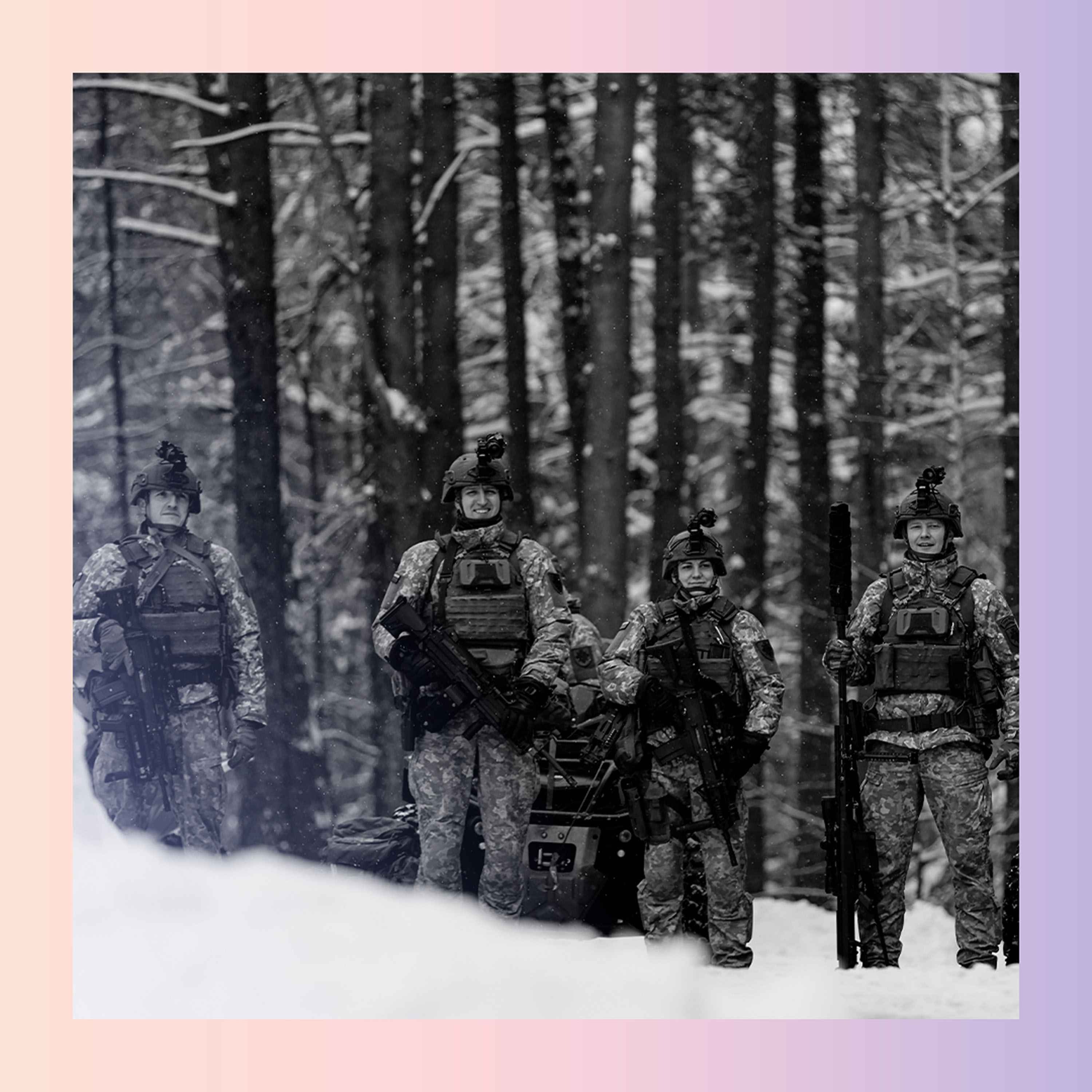
Mindaugas is a member of the Riflemen's Union, a voluntary paramilitary organization first established during Lithuania's war for independence in 1919. It was dissolved during the Soviet occupation and reformed in the 1990s. The organization trained civilians to defend their country. Membership has doubled since the start of Russia's full scale invasion of Ukraine. On most days, Mindaugas is running an engineering company. But yesterday, after being dropped into the forest by armored vehicles, he was learning how to clear enemy trenches.
- [04:58]
Mindaugas
We were dropped by the Bradleys, Then we walked and we stormed the trenches.
- [05:05]
Katie Bryant
And today he's about to secure the school building and underground tunnel while under simulated enemy fire.
- [05:13]
Mindaugas
It was nice. It's good weather. Nice company.
- [05:17]
Katie Bryant
His eyes are glinting as he says this. The sun may be shining, but it's also minus 11. The exercises involve wading through fresh snow with his rifle and supplies. The majority of these riflemen, like Mindogas, are in middle age. They're fathers and husbands from all walks of life. I realize one of them is a bartender from my hotel. As they're loading their guns and stocking up on simulated grenades, many have frozen beards and eyelashes. I follow Mindogas and the others through the school building, clearing it room by room before climbing down into the underground tunnel. My partner is Lithuanian and we visit his family a couple of times a year. With each recent trip, war has felt closer. There have been more signs for bomb shelters, more German soldiers on the streets on their first permanent deployment since World War II. And more talk of what people here call Day X. What would you do if that day comes? Russian tanks roll over the Lithuanian border to close the gap between Belarus and Kaliningrad or attempt to push into Estonia under the pretext of protecting its Russian speaking population. You wake up in the morning to alerts on your phone of a new boy in Europe. What do you do here on the border? They have a plan.
- [07:17]
Virginius Vitalius Vilkalis
In 1988, I joined the Saudis movement for independent and 100,000 population. They gathered to the meetings. Somebody must make orders on the streets. I managed thousands of people. We created structures and it was the beginning.
- [07:36]
Katie Bryant
Back in the late 1980s, Vigenius Vitalius Vilkalis helped organize Lithuania's movement against the Soviet Union.
- [07:43]
Virginius Vitalius Vilkalis
You know, I was younger and I didn't feel no fear. A lot of cocktails and at that time a lot of smokers. We smoked. I don't know how we survived.
- [07:59]
Katie Bryant
Thirty years on, he's moved from the street to the halls of power. He's now the director of the Mobilization and Civil Resistance Department at the Ministry of Defence.
- [08:10]
Virginius Vitalius Vilkalis
To manage alone people is very difficult job. You have to make structures.
- [08:17]
Katie Bryant
He's still working against the Kremlin, only now in an independent Lithuania. It's Virginius job to prepare the people for a potential invasion.
- [08:27]
Virginius Vitalius Vilkalis
Civil protection package. Cyber security, of course. Minister of Defence provides cybersecurity education for business entities. Because it's very important in case of cyber attacks. Physical security is very important because if we are speaking about unknown situation, about mobilization, martial law.
- [08:45]
Katie Bryant
It's a huge task.
- [08:47]
Virginius Vitalius Vilkalis
Approximately 100 state mobilization tasks to fulfill state significant functions.
- [08:53]
Katie Bryant
He works with organizations outside of the government, prepping them for mobilization too.
- [08:58]
Virginius Vitalius Vilkalis
NGO who in peacetime works do crisis job. Food Bank, Red Cross, Caritas Multi Theory and we are part of us.
- [09:09]
Katie Bryant
And he coordinates with institutions to get key workers ready.
- [09:14]
Virginius Vitalius Vilkalis
There are also workers, clerks, personnel who works in critical infrastructure, doctors, policemen. For them, they say open for you, your frontline will be the same. You have to continue.
- [09:27]
Katie Bryant
A lot of his planning is focused on the days immediately after an invasion.
- [09:31]
Virginius Vitalius Vilkalis
Everyone at home have to have surviving of food for three days and nights.
- [09:38]
Katie Bryant
Three days and three nights. That's how long the government anticipates it would take to get things back up and running effectively. Many Lithuanians I speak to have a plan for Day X. Some already have evacuation bags packed. A few told me they would leave the country. Others plan to get their family out while they stay behind to help the resistance. One father told me he's built a house off grid where his children could be safe while he serves with the Riflemen's Union. But Linus Kriala knows that plans can go out the window when chaos strikes.
- [10:28]
Linus Kayala
Of course, no plan survives the reality of shock. And hopefully it's never going to be employed the plan itself. But I think you have to have a conversation of what to do. When you open your mobile phone and it doesn't work, there is no network connection. And you try to have some fresh water and the tap is not working and you want to go to a supermarket and it's not there, it's closed. This would be a huge shock for a lot of people. And I think you cannot kind of prepare for this scenario fully, but at least you have to have a conversation about it and at least have a bag ready for 24, 48 hours or 72 possibly hours, not to be as susceptible to the change of circumstances as you would be in case it ever happens.
- [11:13]
Katie Bryant
Linus is a security analyst. He also makes TikTok videos explaining this new reality Lithuanians find themselves in. On camera his manner is clear and calm as he outlines the looming risks from President Putin's Russia.
- [11:32]
Linus Kayala
Russia's war of aggression against Ukraine is of existential importance for the Baltic states as well, primarily because Putin always maintained that his ambitions go beyond Ukraine.
- [11:44]
Katie Bryant
Putin consistently talks about the war in Ukraine as a struggle against the west as a whole. It has become central to his ideology and he has never personally accepted the end of the Soviet Union or the independence of the Baltic states.
- [11:58]
Linus Kayala
Unless Ukraine succeeds in defending itself and also defending Europe as a whole, we could face a strong enemy, even if weak economically, weak possibly socially and politically, but still strong militarily, which clearly pursues imperialistic ambitions and sees that as its own raison d', etre, like a way of continuing its own existence.
- [12:21]
Katie Bryant
And Putin plans to increase that military capacity at an alarming rate.
- [12:26]
Linus Kayala
That's the most worrying part, which includes Russia's military buildup and future plans of having a military extended to 1.5 million troops, or maybe even going further than that.
- [12:37]
Katie Bryant
Putin's calculations will ultimately depend on the United States. President Trump's threats towards Greenland cast doubt on the very future of NATO. For small frontline states, it's an existential problem.
- [12:51]
Linus Kayala
We want every Lithuanian citizen, no matter the age, education, physical readiness, to have a place in countries defense, because that would be a very important signaling to Russia also that you will not be able to succeed here.
- [13:06]
Katie Bryant
This is known as the doctrine of total defence.
- [13:09]
Linus Kayala
We will fight you. We will fight you as a country that has a military, but we will also fight you as a society, which is a very strong deterrent factor, I think, and I do think Russia understands it.
- [13:22]
Katie Bryant
In the hope of deterring attack, every citizen should get ready to resist. So once you have your survival bag packed, you have a choice to make. Do you leave? Do you stay and keep your head down, or do you stay and resist?
- [13:48]
Mindaugas
I think the main thing is just to stay out of the cities. The cities are the, let's say, that's where the people are mostly killed.
- [13:57]
Katie Bryant
Mindaugas, the mushroom lover who runs an engineering company, is choosing the final option. In the event of an invasion, the Riflemen's Union would become part of the military. He has a plan to keep his young children safe so he can go to the front line.
- [14:14]
Mindaugas
Just before this exercise, my daughter put me, let's say, on the table and talked with me about everything, while fighting and everything. And I had to talk with her that understand that if we will be prepared, nothing will happen.
- [14:32]
Katie Bryant
For mind, it's memories passed down of Soviet occupation that drive him to military resistance.
- [14:39]
Mindaugas
I think we lost like 70% of our, let's say, family. My grandfather's brothers and sisters were killed or sent to Siberia. So we have, let's say, strong will to. Not to stop, not to stop. And sometimes we are exhausted. But you're thinking that you need to do this, you have to do it.
- [15:06]
Katie Bryant
Between 1944 and 1953, 300,000 Lithuanians were deported to Siberia and other distant parts of the Soviet Union. The aim was to decapitate society's leadership. Political leaders were targeted, but also authors, poets and teachers. Mindaugas family fell victim to the purges because they were landowners. In total, over a quarter of the population was deported, murdered or forced into exile by the Soviet regime. Society was hollowed out.
- [15:46]
Mindaugas
I'm talking with my children about the sacrifice, because it's hard for them, for me also. But they have to understand that freedom is not cheap. What we have here, somebody paid by blood. So that's. That's the main thing. If you want to have something, you have to pay for it. So if you want freedom, you have to pay by blood. Just is what it is. Life is life.
- [16:21]
Katie Bryant
If day X comes, not everyone would be willing or able to fight. So some people are finding different ways to resist an invasion. The Ministry of Defence runs civil resistance training courses. There are over 30. Just in the week that I'm visiting, my fixer and I head to Jurbakas, a town in eastern Lithuania. The training is at the local hospital, a squat beige building opposite a cemetery and a small wood. There are about 15 women on the course. Lots of them are wearing white hospital jackets. Hi, nice to meet you all. I'm Lavarianat. Thank you so much for having us. Today, my introduction is met with severe stares. Luckily I spent enough time in Lithuania not to take this personally. The atmosphere soon relaxes. The instructor, Vaida, runs three of these training courses every week. At first sight, the session could be confused for a normal first aid class. There's a dummy torso in the corner to practice resuscitation. That's until the PowerPoint clicks through to a carefully labelled diagram of a bullet tearing through bone. Vaida tells the group that there is armed war and there is unarmed war. She runs through advice for survival, from what to pack in an evacuation bag to how to build psychological resilience against disinformation online. Then she moves on to talk about resistance. Her focus is on understanding the dangers and acting where you can. She highlights the different ways you could disrupt enemy removing road signs and blocking the street to slow them down, or collecting information on enemy weaponry. Her PowerPoint cycles through different types of armored vehicles, guns and drones and how to recognize them. The women in the room are quiet and focused. Vaida hands out black tourniquets fastened with Velcro. She tells everyone it's necessary to tie them as fast as possible to prevent the victim from bleeding out. The woman sitting next to me fastens hers quickly and shows me her handiwork. She tells me she's tied bandages before, but this is her first time tying a tourniquet. She looks pleased with it, but says it isn't fast enough. Vaida gets everyone to discuss different scenarios around an emergency. For example, you live with your 12 year old child and elderly 80 year old mother. When the crisis starts, your car is being serviced in the garage. What do you do? Ruta, the woman sitting next to me, is asking and answering a lot of questions. We stay behind. After the session, Ruta tells me she's a nurse at the hospital and she lives next to a forest nearby.
- [19:42]
Ruta
There is a nice view from our window. We see deer, we see foxes. We see far into the distance, horizon, sunsets.
- [19:52]
Katie Bryant
Sometimes, outside her home, she hears strange sounds.
- [19:58]
Ruta
The sound is faint, but we recognize it. That type of sound, I recognize it's not cars. It's just from the training ground. All kinds of bullets, all kinds of explosions echo to us.
- [20:20]
Katie Bryant
Ruta's home is close to the border with Kaliningrad. Noises from Russian military exercises drift through her patch of forest. So she understands the threat Lithuania is facing and tells me she wants to support the resistance.
- [20:39]
Ruta
I want to help. You have to. I am patriotic, yes, I'd go to war.
- [20:48]
Katie Bryant
I'm about to ask another question when I realize that she's crying. She tells me her mom is 82 and lives alone. Her father died recently. If an invasion happens, Ruta is a frontline worker. She would have to be at the hospital and she's worried about who would look after her mother.
- [21:17]
Ruta
I will have to go to work. As far as I understand, it will be mandatory for me. I have a sister who lives close by. Maybe somehow we would come up with something. I don't know.
- [21:39]
Katie Bryant
Sitting there with Ruta, I think about my partner's parents who live on the edge of a wood in northern Lithuania. I realize I have no real comprehension of the trade offs and decisions involved in preparing for war, or of what it actually means to stay and resist instead of flee. As we leave, Ruta tells us to ignore her tears.
- [22:09]
Linus Kayala
It obviously makes people anxious living here in the Baltic states and in the region, because it seems that there is no easy way of dealing with it. And we are living in a permanent kind of environment of insecurity.
- [22:21]
Katie Bryant
Linus Kayala, who spends his days helping people understand the growing danger, has witnessed this anxiousness firsthand.
- [22:29]
Linus Kayala
I had a case of walking here in Vilnius and the woman approached me a couple of months ago and her question was very blunt. She asked me whether my daughter is still in Lithuania.
- [22:40]
Katie Bryant
Linus has a 15 month old baby daughter. It felt like more of an accusation than a question.
- [22:46]
Linus Kayala
The question was whether I still think that Lithuania is safe for my own family, because I do talk about security issues. So probably they think the people or the women that asked me the question thought that I maybe knew something more. And if my family is already out of Lithuania, that means, well, something could happen in the nearest future.
- [23:20]
Katie Bryant
Like Mindaugas, Linus had family members who were deported to Siberia during the Soviet occupation. But for his generation, millennials and younger, life in Lithuania was, until recently, one of optimism.
- [23:35]
Karolis Vishnowskas
I was surrounded by care, by warmth. I lived in a cozy home where everyone is doing stuff for me as if I would be the last generation.
- [23:46]
Katie Bryant
Karolis also grew up in an independent
- [23:49]
Karolis Vishnowskas
Lithuania at that time, like 1990s, early 2000, in Lithuania you had this idea that the history is totally over and we are just moving towards this bright future westwards, like Go West.
- [24:02]
Katie Bryant
But when he was in his 20s, at his final year of university, things started to change.
- [24:07]
Karolis Vishnowskas
The Russian attack of Georgia was the first sign. And then it kept on coming closer
- [24:13]
Linus Kayala
and closer to us Lithuanians.
- [24:15]
Katie Bryant
I speak to give different dates for when the danger from Russia became real to them. For some, it was the war with Georgia in 2008 or the annexation of Crimea in 2014. For many, it was the full scale invasion of Ukraine in 2022.
- [24:32]
Karolis Vishnowskas
And then Ukraine, of course, brought it back. And suddenly all of this memory, which is in the blood, it becomes alive.
- [24:41]
Katie Bryant
Carolus realized that the relative peace and stability of his youth was coming to an end.
- [24:46]
Karolis Vishnowskas
This poison empire brought. It doesn't evaporate so quickly, you know, generations, you need generations. But I have two small kids by now, and I see the danger that all of these history books, all of these family stories which I heard from 1940s, 1950s, we might just go into this vicious circle. Well, I don't want that because it makes no sense. I lose. I lose purpose. I don't understand then what this world is about.
- [25:24]
Katie Bryant
Those family stories from dark eras of Lithuania's history inform the films Karolis makes today. In 2019, he made a film about a Lithuanian geographer from the 1930s, Kazis Pakstas. Watching the rise of Nazi Germany on one side and the Soviet Union on the other, Pakstas proposed creating a backup Lithuania. He even drew up plans to move the nation to Madagascar.
- [25:54]
Karolis Vishnowskas
When I read his story, and I read how he been walking around Lithuania, the corridors of lithuanian ministries in 1938 and 1939, ringing a bell like crazy and saying, the end is coming, we need to do something. And nobody believe him or they were ridiculing him. That felt like me, because I had this feeling for quite some time. But when I was saying it to people, I would see that they would look at me skeptically, like as if I'm being paranoid, but sorry to say, everything fulfilled.
- [26:27]
Katie Bryant
This fear for Lithuania's future led Carolus to join the Riflemen's Union. Like Mindaugas and so many others he serves in their armed resistance unit.
- [26:37]
Karolis Vishnowskas
When I'm in an exercise in the forest, and I think if that would actually come and. And my kids would need to choose between having no father, but having a father dead for the right cause, and having a father who somehow chose to shut up and retreat and, you know, swallow it, and. Which I saw in my family like I saw in a lot of people I knew this generation of my grandparents, my parents, the generation that kept silent for quite some time.
- [27:22]
Katie Bryant
If Lithuanian independence is threatened again, Carolus wants to leave a different legacy for his children.
- [27:30]
Karolis Vishnowskas
I don't want my kids to grow in that. And I've been watching children of Lithuanians who collaborated and children of Lithuanians who died. And of course, for a small child, it's a great loss to lose a father, parents. But somehow, after some time, those people of parents who did something, who did not obey, they were more human, more dignified, more free.
- [28:18]
Katie Bryant
Carolus has thought long and hard about the kind of person he wants to be. If Dex comes about, what kind of father he wants his children to remember when he's dead and gone, whenever that may be. Like Rutte, he's facing up to the sacrifices and personal costs of resistance. It's something that many people I meet here simply aren't yet ready to do. And I can understand why people want to avoid the subject of an invasion, why families and even politicians across Europe have skirted this topic altogether. But for some people, that reality arrives into their lives anyway, whether they're ready to address it or not. In a small village in southern Lithuania, the local library has been turned into a control room. Men in suits are hunched over laptops, cables looping over piles of laminated library books. A couple of army guys are milling about. A woman from the Ministry of Defence shows me around.
- [29:31]
Odetta
There are several consultants from different institutions from Ministry of National Defence and also we have representatives from Minnesota Minister of Environment.
- [29:46]
Katie Bryant
And I think maybe that's the end.
- [29:48]
Odetta
We also have representatives from Lithuanian armed forces.
- [29:54]
Katie Bryant
They're all here to settle a dispute which has come to a head this week. The government wants to build a new military training ground here in Captiamistis. The proposed area would affect 90 homes. 13 families would definitely have to leave. 77 are in the non shooting area. They can choose whether they would like to stay or sell their homes to the government. But many in the community are staunchly against the proposal. So today the government has taken over the local library to run one on one consultations with homeowners. So in this space we have meetings and consultations.
- [30:35]
Odetta
Right now.
- [30:37]
Katie Bryant
Captiamistis and the surrounding area is part of the Suwalki corridor, a stretch of land between Belarus and Kaliningrad. The region has been cited as a potential target for a Russian invasion. A strike here would cut the land connection between the Baltic states and the rest of NATO. Back in the library, residents are waiting in the corridor for their consultations. There's a table piled with the pamphlets on how to react in a war next to a bowl of Ministry of Defence branded sweets. Some residents I speak to are confused, angry and upset. None of us want this training ground and we don't really need it. Others, however, are behind the government's decision. I trust the Lithuanian military.
- [31:33]
Mindaugas
I trust that if they decide that
- [31:34]
Katie Bryant
it's needed, it's needed. Next door to the library is the local history museum, where I meet the manager and curator, Odetta. At first she's wary of speaking to me. We talk with the mics off for a little while. Before she agrees to an interview, she tells me she grew up here under the Soviet Union. She remembers there were constraints, like not being able to celebrate Christmas, but overall
- [32:06]
Odetta
it was an ordinary life. And it's just that our family was not touched by either exile or other such terrible things.
- [32:15]
Katie Bryant
Odetta raised her children here. One of her sons recently moved back home.
- [32:22]
Odetta
We set our home up as we have dreamed all our lives. And in fact, a year or two ago, my husband and I were talking and said, how nice we made our dreams come true. We are surrounded by beautiful nature, beautiful life, and we do not want anything else in life.
- [32:44]
Katie Bryant
She doesn't deny the threat from Russia, but for her, it isn't enough to make her uproot her life. And she's emotional at the idea that to some people, this makes her an enemy of the state.
- [33:00]
Odetta
I do really love Lithuania. I do love my country. I raised my children and taught them to love their country, to love nature.
- [33:11]
Katie Bryant
Before we leave, Odetta gives me a quick tour of her museum. Her demeanor transforms. Her shoulders are now bouncing in excitement.
- [33:23]
Odetta
All this was created from scratch for Odetta.
- [33:27]
Katie Bryant
Leaving her home right now for a future invasion which may not happen, is not a price she's willing to pay.
- [33:41]
Odetta
All the time I imagined that my house was my fortress. All misfortunes remain outside the door. When you get back, when you come home and you feel good, you feel safe, you know that nothing will ever happen to you in your home. It's a shame, but we don't feel that security anymore. We don't feel it at all. The thing is that probably we won't hear the peacefulness and the sounds of nature anymore. When I imagine. I don't imagine anything. We live and wait.
- [34:25]
Katie Bryant
Odetta's not alone. Opposition to this new military ground has spread well beyond the local community. Residents told me that people from outside the area have been turning up at town hall meetings criticizing the plans. Later this week, the president and major politicians from opposition parties are descending on the area. Objection among the local community has accelerated into debates about the nature of Lithuanian defence against Russia, with some people questioning the lengths that society is willing to go to. This year, Lithuania's government plans to spend almost 5.5% of its GDP on defence. That's among the highest in Europe. To some people, that means trade offs, diverting spending that could go towards local communities. Hi, Nicholas. And these divisions, according to the man I'm calling en route to our next stop, are being amplified by Russian disinformation.
- [35:30]
Mikolas Katkas
So usually I kind of have a habit of my analysts to kind of go through the, through the signals which is happening and beginning of December we see that there's a new topic trending on Russian language propaganda channels. It's a specific thing. And also on some tiktoks, some TikTok accounts, we see that there is a polygon of military based topic trending.
- [35:50]
Katie Bryant
Mikolas Katkas studies how Russian information networks infiltrate Lithuanian media. He tells me about the role they've played in this escalating debate about the military ground.
- [36:02]
Mikolas Katkas
Russians do what we do usually in the state of kind of uncertainty. They're usually trying to come up with a ready made, trying to hijack the decision. So they sell cryptocurrencies, crypto scams by day and night or something like that.
- [36:14]
Katie Bryant
These accounts frame the debate as the local people against the state. Focusing on the divisions between the regions in Lithuania and the center of government. The aim is to exacerbate existing tensions in society, to sow division and mistrust.
- [36:37]
Mikolas Katkas
In the second stage, the old Lithuanian, I would say anti government people are joining it. And these people is a wide collision between, you know, natural government haters and just, you know, just people having difficult political opinions. Two people who have been convicted of or have some ties with Russian kind
- [36:54]
Katie Bryant
of propaganda, fabricated claims are promoted to turbocharged dissent. Nicholas's team found false assertions about the potential health damage from the site and the impact on the environment.
- [37:08]
Mikolas Katkas
People who started by asking questions which were very obvious, like what's going to happen to us, why the government is not speaking to us. They become propaganda broadcasters kind of of parroting the talking points which were first formulated in the Russian telegram groups.
- [37:24]
Katie Bryant
Russia linked accounts are also pushing the idea that the training ground is useless and wouldn't help against an invasion anyway. A claim I heard echoed by Odetta.
- [37:37]
Odetta
I don't think a training ground will provide security. If it were some kind of defensive fortification, it might provide security.
- [37:49]
Katie Bryant
Miklas work is a reminder that society here and across Europe is already under attack. Your emotional response to the idea of an invasion, your trust in the government and willingness to serve, is in itself another front line. Karalis, the film director who became a rifleman, sees his country increasingly conflicted over the looming crisis.
- [38:19]
Karolis Vishnowskas
I think that is one of the key divisions in society. What to do in case they do
- [38:25]
Ruta
attack
- [38:29]
Katie Bryant
as the nation grapples with onslaughts from Russian bots fuelling rows over military grounds. For Carolus, this is as much about internal conflict as external pressures. He tells me about Lithuania's two national symbols which for him represent the dueling impulses in Lithuanian identity. The first is a mounted warrior, the
- [38:52]
Karolis Vishnowskas
man on a horse, the knight, which is called Vitus. And it's this like, energetic warrior type.
- [39:02]
Katie Bryant
I see this everywhere I go. It's on Lithuania's coat of arms. Some of the riflemen had it stitched into their uniforms. There was one from the interwar period in Odetta's museum, which had been hidden in a beehive during the Soviet occupation. It's even on the mod's suites at the consultation meetings in Captiamistis. That's the part that wants to stand up and fight. But then there's this symbol, which is
- [39:29]
Karolis Vishnowskas
this thing called the Sorrowful Jesus. Rupin Toyeles the. The wooden God who sits like that.
- [39:35]
Katie Bryant
Carol has put his head in his hands to demonstrate the pose. This is another figure I recognize, the pensive Christ. I've seen it carved into churches in Vilnius.
- [39:46]
Karolis Vishnowskas
It's a constant shift between those two stages, I think, either being totally passive and silent and calm and not too talkative and alone. If you hop on a bus somewhere in the province, people would just sit far away from each other. But then at some point they become also very, sometimes even aggressive, energetic. Then you might say, when things need to be done, usually they wait until the last point. But then they act. And when they do act, they can act in a collective way, unify somehow. Me, myself as a personality. I'm more of a sorrowful Jesus, probably. I would feel totally comfortable sitting with a book the whole day at home, not talking to anyone, not, you know, I'm fine with that. That's my natural me. But I would want more of Vitus at this point, and less of a sorrowful Jesus, I would say.
- [40:48]
Katie Bryant
So Carolus has made his choice to listen to the warnings from history, to spend his weekends with the riflemen in the forest on behalf of the future he wants for his country and the legacy he wants to leave his children.
- [41:02]
Karolis Vishnowskas
I lived abroad and I missed home. This is my home. And when I'm saying that, I don't mean that it's the best place on earth. It's not that it's the best society or whatever, but it's just feeling of home, you know, Like I know that I won't feel at home anywhere else.
- [41:21]
Virginius Vitalius Vilkalis
And
- [41:24]
Karolis Vishnowskas
if I need, I need to defend my home.
- [41:37]
Katie Bryant
I came to Lithuania because of alarm bells ringing across Europe. But the trip has reminded me what I love about it. The huge smiles that erupt unexpectedly from serious faces, the sound of pine trees knocking together. No matter what Putin, or indeed Trump does next. This country is already changing. Ruta and Odetta's beloved forest. The peace they cherish so much is being filled with sounds of war. A generation raised in peace looking west is now raising their children under the shadow of invasion. And a generation that grew up with stories of Siberia is wondering just how fragile their freedom is. Sam,
- [43:12]
Jason Palmer
Thanks for listening to this episode, which was reported and produced by Katie Bryant with help from Carolus Vishnowskas, fact checking by Noah Flora, and sound design by Nico Ralfast. The Executive producer of the Weekend Intelligence is Gemma Newby. If you know someone who might enjoy listening to this or any of our other episodes, you can now share them with non subscribers. Go to the Episode page in the app or on our website and select Give as a Gift. We'll all see you back here on Monday.