Loading summary
Transcript57 lines
- [00:00]
Financial Advisor
Then I thought, what if I've scaled businesses? What if I scaled my philanthropy? What if I did as much in one year as I've done in my whole life?
- [00:07]
Creative Planning Representative
See how your wealth could have even
- [00:09]
Podcast Narrator
Greater meaning@creativeplanning.com Impact from globalization to innovation, sustainability to market volatility, there's always more than one side to a story. Explore different perspectives on today's most important business and economic issues with the Flipside podcast from Barclays Investment Bank. Hear two research analysts in a lively debate and get insights from every to further inform your view. Listen to the flip side on your favorite platform.
- [00:44]
Creative Planning Representative
The economist.
- [00:50]
Rosie Blore
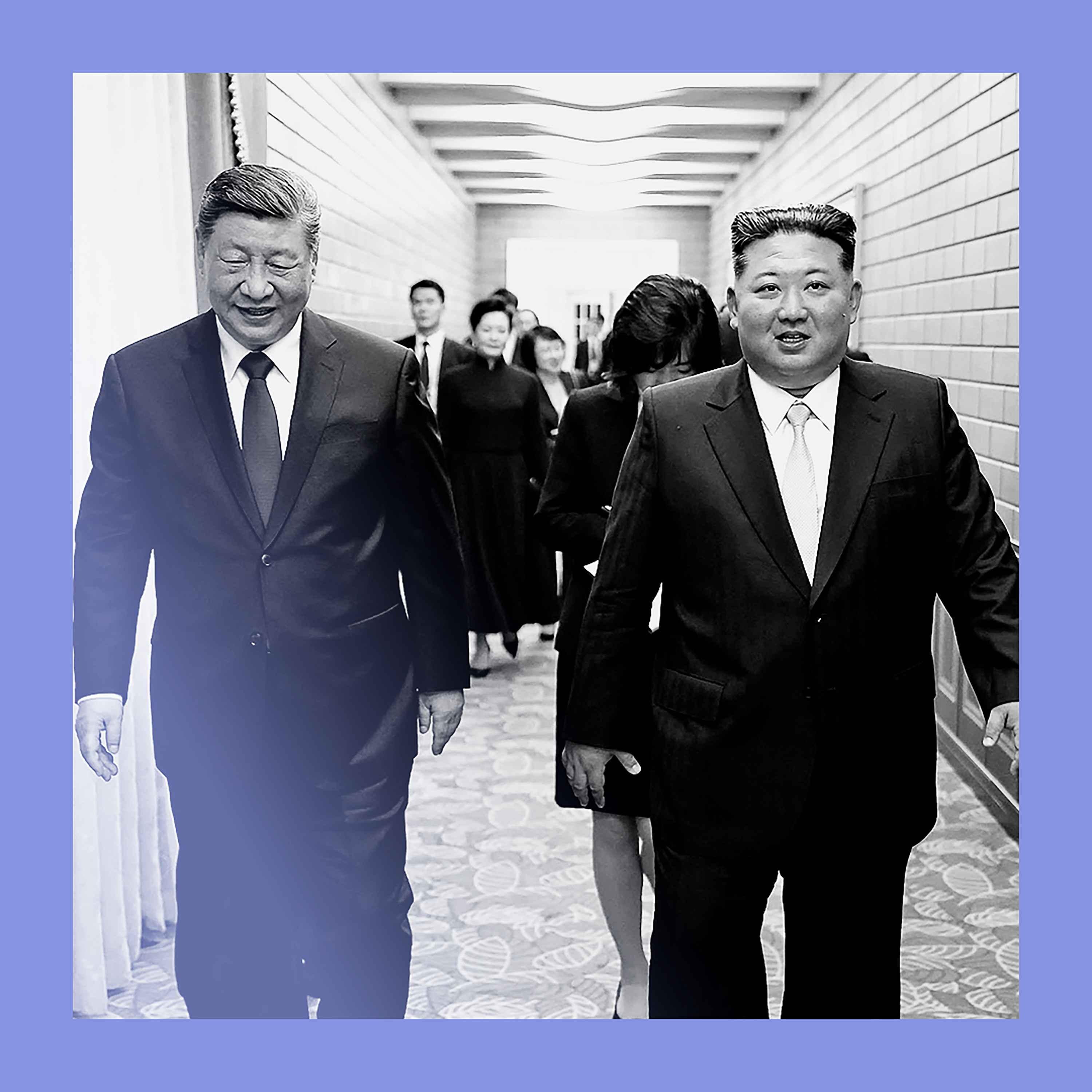
Hello and welcome to the Intelligence from the Economist. I'm Rosie Blore. Today on the show, life under rebel occupation in Congo and Japan's Indian restaurants are under threat. But first, North Korea and its neighbor China have long been allies, but it's been seven years since Xi Jinping last visited Pyongyang. Yesterday he arrived capital to streets lined with supporters, waving flags and letting off balloons. He and North Korea's leader, Kim Jong Un planted a fir tree together to symbolize their enduring and evergreen friendship. Much of the world may be hoping Xi Jinping can rein in North Korea's nuclear ambitions, but Xi has other priorities.
- [02:01]
Jeremy Page
Xi Jinping's last visit to North Korea was back in 2019, and at that time, China, along with Russia, was actually helping the United States to put pressure on Kim Jong Un to halt his nuclear weapons program.
- [02:15]
Rosie Blore
Jeremy Page is host of Drum Tower, our China podcast, and our chief China correspondent.
- [02:21]
Jeremy Page
Today, that is no longer a focus for Xi Jinping. He is much more worried about Russia's growing influence in North Korea and about preparing for another potential summit between Kim Jong Un and and Donald Trump.
- [02:36]
Rosie Blore
So aside from welcoming crowds and displays of prowess, what are we actually going to get out of this visit between Xi Jinping and Kim Jong Un?
- [02:47]
Jeremy Page
I think there's going to be a lot of talk about the history of the relationship, fighting together in the Korean War, everything they've been through since. We're actually just approaching the 65th anniversary of the signing of that mutual defense treaty back in 1961. And so that's probably one of the reasons the visit is happening now. I think there'll be some talk about expanding economic links and transport links, more flights, perhaps more train journeys between the two. Possible there could be some mention of Chinese investment in North Korea, but I think in a way it's what we don't hear about, which is more interesting because they're not going to be talking about Russian influence, and they're not going to be talking about nuclear weapons.
- [03:29]
Rosie Blore
What exactly is the state of North Korea's nuclear capability?
- [03:33]
Jeremy Page
Now, North Korea is understandably not very transparent about all of this, but international experts reckon that North Korea has about 50 to 60 warheads. And South Korean officials recently estimated that North Korea could create enough fissile material for an additional 10 to 20 warheads annually. We also know that Kim Jong Un has tested more than a dozen intercontinental ballistic missiles since 2019, which was the last summit with Donald Trump, which ended in failure. So we know that he's got a lot closer to developing the ability to deliver those warheads, maybe even as far as the continental United States. And it's pretty clear that he is determined to hang on to that nuclear arsenal. In fact, just before Xi Jinping's visit, Kim Jong Un talked about expanding North Korea's nuclear weapons program. And in fact, just on the eve of Xi Jinping's visit, Kim Jong Un's sister, who's also very powerful, decl declared that North Korea's nuclear arms status was irreversible. Kim Jong Un has obviously been watching what's happened in Iran extremely closely and is no doubt feeling thoroughly vindicated in his decision to hang on to his nuclear arsenal rather than to negotiate some deal with the United States.
- [04:53]
Rosie Blore
How does China, and specifically Xi Jinping, feel about North Korean nuclearization?
- [05:00]
Jeremy Page
I think Xi Jinping is still worried about it for a number of reasons. He's concerned that North Korea might threaten or even attack South Korea, one of China's biggest foreign investors and trade partners. China has long been concerned that if North Korea developed a fully fledged nuclear arsenal, then Japan and South Korea, which are both American allies, could acquire nuclear weapons of their own, which would not be in China's interest. But I think he has concluded now that China cannot use its leverage to convince Kim Jong Un to give up his nuclear arsenal without risking total economic collapse there. And China has long feared that because it thinks it would lead to a unified, democratic and pro western Korea. And that could also bring American troops, of which they're about 28,500 in South Korea at the moment, right up to the eastern land borders of Russia and China. I think Xi Jinping's also concluded that whereas in Donald Trump's first term, he was hinting that he might take military action against North Korea if it didn't come to the negotiating table, the United States would no longer risk a military strike like that because North Korea's nuclear arsenal has expanded significantly since then. But also the United States is now bogged down in the Middle east and has really learnt how hard these kind of military operations can be.
- [06:29]
Rosie Blore
There's concern from China about growing Russian influence in North Korea. How deep is the connection between North Korea and Russia?
- [06:40]
Jeremy Page
So that's also a very deep relationship. Moscow was North Korea's other main patron during the Cold War. After the Soviet collapse, Russian support waned because Moscow just didn't have the financial resources. But Russian influence in North Korea has expanded a lot since Kim Jong Un decided to send troops and actually some missiles to help with Russia's war against Ukraine. And in exchange, Russia has provided financial and other assistance, which has really bolstered the North Korean economy and helped with its conventional military buildup. And perhaps even more significantly, Russia has in effect acknowledged North Korea as a de facto nuclear weapons state. In fact, Sergei Lavrov, Russian Foreign Minister, even declared that it was a closed issue.
- [07:28]
Rosie Blore
As you say, there have been a number of conflicts since Trump and Kim Jong Un met. What does Trump make of North Korea's nuclear capabilities now?
- [07:39]
Jeremy Page
Again, hard to tell. It might depend on the day of the week. But he has referred casually to North Korea as a nuclear power, which you could say implying recognition of its nuclear status. Officially, though, the Trump administration still calls for the denuclearization of the North Korean peninsula. And in fact, when Xi Jinping met Donald Trump in Beijing in mid May, the White House readout from that meeting said that the two leaders had confirmed their commitment to denuclearizing North Korea. Interestingly, China's statement did not echo that language. It just said that they had discussed the Korean peninsula. Donald Trump has also indicated that he would be willing to meet Kim Jong Un again. But I think the catch is that this time Kim Jong Un has made it very clear, most recently in a speech in September, that if those talks are going to resume, America must explicitly drop that demand for denuclearization. And now, with Russia and China back on his side, I think Kim's bargaining position has never looked stronger.
- [08:47]
Rosie Blore
Jeremy, thank you very much.
- [08:49]
Jeremy Page
Thank you, Reggie.
- [08:53]
Rosie Blore
This week's drum tower visits another part of the world in which China has an interest in the 2010s. Many Chinese businesses rushed to invest in Africa in the hope of making it the new factory of the world. This week's episode of our China podcast takes a look inside a Chinese run factory in Ethiopia and discovers why that hoax has faded. That's out later today. You'll need to be a subscriber.
- [09:26]
Creative Planning Representative
This message comes from Jackson. Taxes aren't something you can only think about once a year with investments. Planning for tax day is year round. Fortunately, Jackson offers tax efficient products. Visit Jackson.com for more information on how our products can make your tax bill a little bit less painful. Jackson is short for Jackson Financial, Inc. Jackson National Life Insurance Co. Lansing, Michigan and Jackson National Life Insurance Co. Of New York Purchase, New York let's be
- [09:52]
Arm and Hammer Advertiser
honest, if you have a cat, you've probably wondered what your house smells like before guests walk in. Thankfully, Arm and Hammer cat litter helps take that worry off your plate because not all litters are the same. Arm and Hammer Hardball cat litter gives you long lasting odor control plus strong clumps that make scooping quick and easy with low dust too. It's a five in one litter made for busy people helping your home stay fresher every day so you can feel confident opening the door for family and friends. Candles, air fresheners not needed here. Odor control is Arm and Hammer cat litter's job, not yours. Be guest ready with Arm and Hammer Hardball Cat Litter. Find it now at Walmart or Amazon.
- [10:37]
John McDermott
Yeah, I'm a journalist. I have my accreditation here. As a journalist who covers the entire African continent. I've crossed a lot of borders in my time.
- [10:50]
Rosie Blore
John McDermott is our chief Africa correspondent.
- [10:53]
John McDermott
That said, my recent experience in Goma on the border between the Democratic Republic of the Congo and Rwanda was definitely among the most unusual. So was that the Rwandan side or was that yes, this. Was not my first trip to Goma, but over the past year and a half getting there has become much trickier. In 2025, Goma was retaken by M23, the rebel group that's been locked in an on again, off again conflict with the Congolese government since 2012. Several times I tried to return to the city and every time I was denied. It seemed like I was on some kind of list. And then out of the blue, a few weeks ago, an invitation landed in my inbox. Which is how I found myself getting frisked by a group of machine gun toting militiamen.
- [11:52]
Cornel Nanga
We need to know what story and areas we would like to visit because officially no one had authorization of going everywhere. Or if you would like to go out of Goma.
- [12:07]
John McDermott
I finally made it back to Goma, but this time there was a new sheriff in town and I was there to meet him.
- [12:18]
Rosie Blore
Okay John, I'm dying to hear about this meeting, but before that, just remind us exactly who M23 are.
- [12:25]
John McDermott
They are one of more than 100 rebel groups in Eastern Congo, but they are the Most Notorious. Since 2021, they have ripped through the region, taking village after village, town after town. And then little more than a year ago, they took a couple of big cities, Bakavo and Goma. Now they control an area about the size of Greece and home to roughly 15 million people.
- [12:51]
Rosie Blore
So essentially, you're saying that M23 has launched a civil war in the Democratic Republic of Congo?
- [12:58]
John McDermott
Yes, it's partly a civil war. M23 is a Congolese rebel group led by ethnic Tutsis. It notionally wants to overthrow the government in Kinshasa. But it's also another type of war. It's a proxy war, because M23 is backed by Rwanda across the border, itself led by a Tutsi elite, and it is supporting its clients to project power into this region. It says it feels threatened both by the Congolese state and by this other armed group called fdlr, led by Hutus, who trace their origins way back to the rwandan genocide in 1994. It is a long, complicated and torturous history. And now there's been this new shift, and that is M23 not just fighting a war, but trying to build a state within a state.
- [13:47]
Rosie Blore
So what does that mean in practice? How is M23 actually trying to build its legitimacy?
- [13:54]
John McDermott
Well, one way it's trying to do that is to present itself as a responsible custodian of the abundant mineral wealth in this part of Central Africa and to position itself as somebody that the west in general and America in particular can do business with. And that is, let's just say, an audacious idea, given that it's not a formal government and most of its leaders are under American sanctions, including the head of M23's political wing, Cornel Nanga, who I met on my trip.
- [14:27]
Rosie Blore
And was he a man of audacious ideas? What was he like?
- [14:31]
John McDermott
You know, he's quite an avuncular fellow for somebody under American sanctions. He's a little chubby, he's a little jolly. He's got a recently grown kind of whitish beard, which, I joked, made him look like Santa Claus. But whenever I were to ask him a more difficult question about M23's end goals or its human rights abuses, you got that kind of steely glint of somebody that is a really, really tough operator, to say the least. What he wanted to talk about was his new pitch to the United States.
- [15:07]
Cornel Nanga
They want mineral. Come. Let's discuss. We are Congolese, and those minerals are ours. They are in the region where we are controlling and, you know, What? Congo? DRC as a country is divided by two, and this region is already stabilized. No more insecurity in this region, no killings in this region. We are activating a new administration. We have a political offer to have a DRC as a business land, the land of opportunity, and business land for everyone that want to do business.
- [15:52]
Rosie Blore
So, John, how do those claims, a land of opportunity, a place of stability, actually hold up?
- [15:59]
John McDermott
Well, that's what I was curious about and so keen to finally get to Goma to discover. When I left Mr. Nanga's meeting room and took a walk around town, I was struck by certain parallels with Kigali, which is the capital of Rwanda, next door. And that's an African city which is quite renowned for being clean, orderly, business friendly, efficient. Just little things. Such as. The city was much cleaner than I remember it, and that's because residents were telling me, well, they're now forced every Saturday to spruce it up. And the chaotic motorbike taxi drivers that I remember from last time, they now all wear helmets and they've got vests. There's also a new police force, which looks suspiciously like that in Kigali as well, Just chatting to ordinary people. The sense was that petty crime at least was down. Security made it a little bit easier to do basic business, whether you're the owner of an electrical shop or a woman who's selling fruit and vegetables on the street.
- [17:13]
Rosie Blore
So that's all sounding actually quite positive.
- [17:16]
John McDermott
Yeah. I think we need to hold on a minute, though. I mean, the true picture is much messier, and the idea that Goma and the Wider region that M23 has taken is some kind of land of opportunity just doesn't quite stack up. The economy is in the pits, all the banks remain closed, and every small business person I spoke to said they were really struggling. And then you have a really atrocious human rights situation. Groups such as Human Rights Watch and Amnesty International have documented abuses on both sides of this war, even in the marketplace. I was having women whisper to me, they're taking our boys, which is a reference to the allegations of forced recruitment. And these rights groups have also documented widespread sexual violence and summary executions as well.
- [18:04]
Rosie Blore
So where, in the end, do you think that leaves ordinary Congolese and their prospects for the future?
- [18:11]
John McDermott
Well, not for the first time in their history, they're grimly caught in the middle. This is a part of Central Africa that has had some of the worst luck on the planet ever since the 1990s, if not before. There's been one war or another one Rebellion or another. The state is barely present. There is near constant instability. And now, on top of that, you have what I was speaking about on this podcast the other day, an Ebola outbreak. And I got a glimpse of the true scale of the humanitarian disaster when I visited a medicine sans Frontiere hospital in the foothills of one of the volcanoes on the outskirts of Go. They'd only recently opened, so there was a long line of women who had brought their young children to be weighed and to be fed.
- [19:04]
Cornel Nanga
So the kid is fighting against TB and malnutrition.
- [19:18]
John McDermott
I met this one lady in particular. Her name was Kavira, whose story just kind of summed up the extent to which so many ordinary Congolese are getting violently buffeted by both sides. So she was living in a refugee camp before M23 took the town in 2025. And then in that chaos, her husband's motorbike, the thing that he relied on to make money, was stolen by a pro government militia. And then M23 rocks up, closes her refugee camp, and tells her to go home to her village, despite the fact it is in the middle of a war zone 200 kilometers away. So she's getting harmed by the government, she's getting harmed by M23, and now she's here, waiting for some basic food rationing with two young kids, both clearly starving. And it felt silly or certainly insufficient. But I asked her whether anything was changing under M23's leadership, and my translator gave me her response.
- [20:22]
Cornel Nanga
There's nothing good, no change. There is nothing positive, since.
- [20:36]
John McDermott
It's exciting for a journalist to go to a place like Goma to feel like you're bringing some important information to people. But then I leave at the end of it. Kvyra, like many millions of Congolese, are stuck there. So for all the talk about mining or minerals, what's been lost, I think, in all of this is the plight of ordinary Congolese trapped in the middle of this awful war.
- [21:07]
Rosie Blore
John, thank you very much.
- [21:09]
John McDermott
Thank you.
- [21:25]
Moeka Iida
On a recent evening, I visited a Nepalese Indian restaurant in East Tokyo called Himalayan Caravan.
- [21:32]
Rosie Blore
Moeka Iida writes about Japan.
- [21:35]
Moeka Iida
The place has been around for two decades. The owner, Sanjay Sahani, is from Nepal. He first came to Japan as a chef back in 2006, and now he runs the place himself. His curry and naans go for just a few dollars, and they pull in a steady crowd, from office workers to pensioners. He lives nearby with his wife and three children. He speaks fluent Japanese, and after 20 years, he calls Japan home. He tells me his regulars and neighbors are all like family. Compared to Western countries, Japan has very little immigration. Foreigners make up just 3% of the population, compared with 15% in the OECD, a group of rich countries. But people like Sanjay are far from rare, and they're often a key part of community life. Indian curry restaurants, like the one he runs are everywhere. Japan has somewhere between 4 and 5,000 of them, more than the number of McDonald's. That's despite Japan having a tiny Indian population. Many of these Indian curry places are actually run by Nepalese people. You find them not just in cities, but in remote rural towns as well. But now they're in deep trouble. Since last year, Japanese politics has turned hostile towards immigration. As part of a broader crackdown, the government tightened the rules for the business management visa, a type of visa that a lot of foreign restaurant owners rely on. When the government changed these rules, they had a different target in mind. Many Japanese, especially conservatives, had grown suspicious that some wealthy foreigners, especially Chinese nationals, are exploiting the visa by setting up shell companies just to get residency. The humble curry house was never the point, but it's become an unexpected casualty. In October, the government raised the visa's capital requirement from 5 million yen, or roughly $30,000, to 30 million yen, or $190,000. It also requires that applicants employ at least one full time Japanese worker or a permanent resident. Existing holders have a three year grace period, but people are worried what happens after that, because a lot of these curry shops, like a lot of businesses in Japan, may not be able to reach that threshold. I spoke to Andrew Katri, who runs another curry house in Tokyo. She says because of aging and a shrinking labor force, even Japanese firms can't find Japanese workers. So how are people like her supposed to. She has a point. If you walk into a convenience store in Tokyo these days, you're more likely to spot a Southeast Asian worker than a Japanese one. If these restaurants disappear, the broader laws would be cultural as well as economic. A lot of Japanese people are fond of these curry houses. And in fact, I'm a fan as well. I go regularly. Some Japanese people have even launched an online petition titled Stop the 30 million yen rule that is destroying Indian curry shops. It's gathered tens of thousands of signatures. Back at Himalayan Caravan, Sanjay is sloughing out naan and stirring pots of curry for a hungry crowd. He says that if these restaurants disappear, it would be a loss for Japan as well. Immigrant cooks are what gives Japan its extraordinary culinary range. And this variety and diversity is what makes the city streets feel alive. If these restaurants disappear. That's something Japan won't easily get back.
- [26:05]
Rosie Blore
That's all for this episode of the Intelligence. See you back here tomorrow.
- [26:25]
John McDermott
Foreign
- [26:28]
Arm and Hammer Advertiser
let's be honest. If you have a cat, you've probably wondered what your house smells like before guests walk in. Thankfully, Arm and Hammer Cat litter helps take that worry off your plate, because not all litters are the same. Arm and Hammer Hardball Cat Litter gives you long lasting odor control plus strong clumps that make scooping quick and easy with low dust too. It's a five in one litter made for busy people helping your home stay fresher every day so you can feel confident opening the door for family and friends. Candles, air fresheners not needed here. Odor control is Arm and Hammer cat Litter's job, not yours. Be guest ready with Arm and Hammer Hardball Cat Litter. Find it now at Walmart or Amazon.
- [27:06]
Financial Advisor
You didn't just say, how can I provide these investments? You'd be how do I holistically provide everything? How do I bring in the legal, the accounting, all this and do it at a price point no one else is doing it.
- [27:14]
Creative Planning Representative
Learn more about how we approach wealth management@creativeplanning.com integrated.