Podcast
EHA Unplugged
Hosted by European Hematology Association · EN
In these EHA-produced podcasts, experts share with you their hematology knowledge and stories. With "EHA Unplugged" we would like to give you the opportunity to unplug from your computer screen, while still learning, by listening to interviews, clinical cases, monologues, and more.
31episodes
Episodes
Newest firstAll episodes
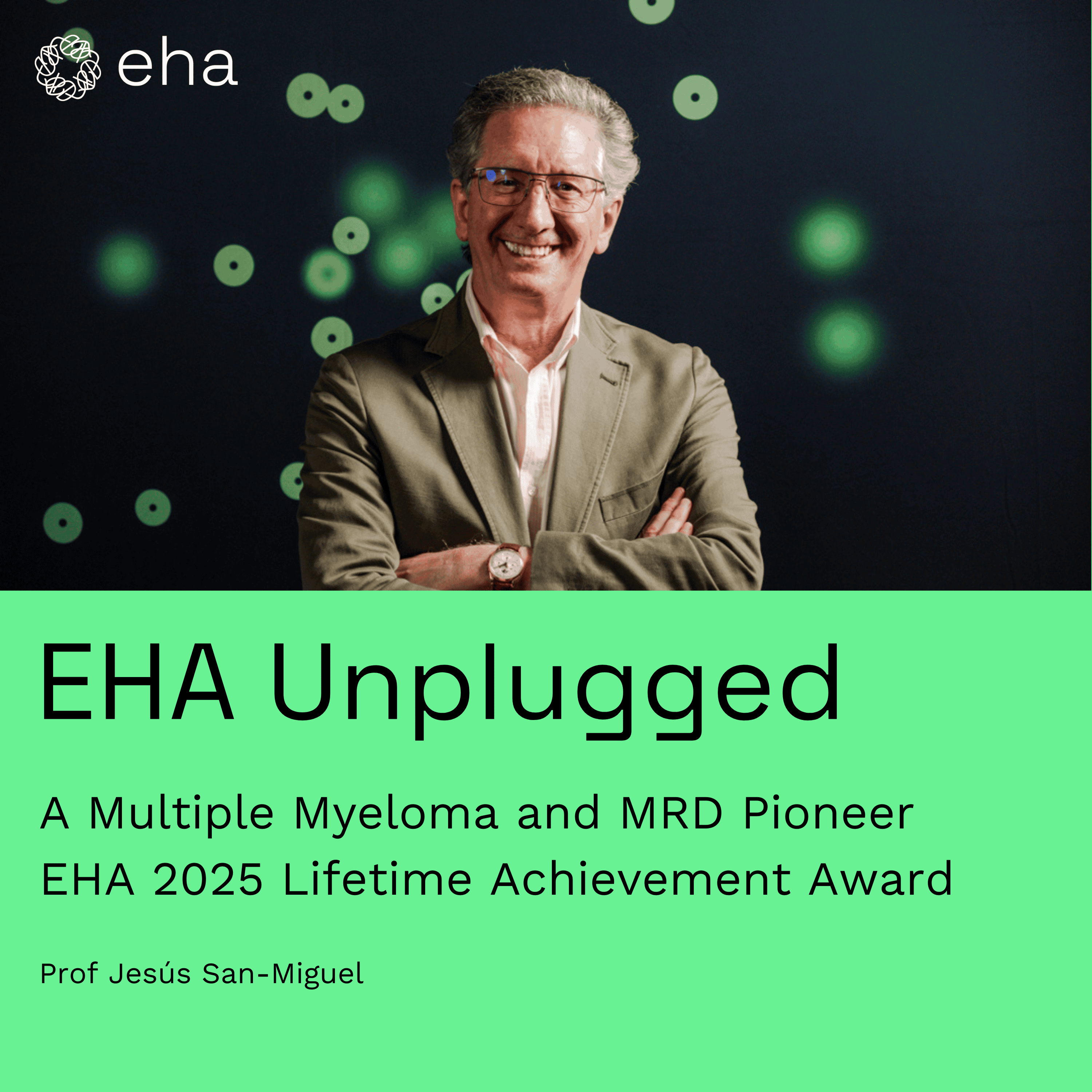
A Multiple Myeloma and MRD Pioneer: EHA 2025 Lifetime Achievement Award (Prof Jesús San-Miguel)
Nov 2100:26:39Tap to summarizeJoin us for this inspiring interview with prof. Jesús San-Miguel from Clínica Universidad de Navarra in Spain who discusses his extensive work to improve care for patients with multiple myeloma. Prof San-Miguel’s research and clinical contributions have shaped the current treatment landscape for multiple myeloma. For his contributions, he has received the 2025 EHA Lifetime Achievement Award. Tune in to hear his thoughts about the future of multiple myeloma management and the crucial role that collaborative research will play in it.Host: Isabel Olivera-Martinez, PhD, Medical Writer Guest: Prof Jesús San-Miguel, Clínica Universidad de Navarra, SpainLearn MoreWhat did you think of this podcast? Share your opinions with us in this short feedback survey.https://forms.monday.com/forms/d02e52896815eef59ecae09fb74dd78f?r=use1Would you like to explore more eLearning or podcasts? Please visit the EHA Campus.https://ehaedu.org/CampusSubscribe, share, and review this podcast to be able to address topics you enjoy and like to listen to.Follow EHA on Instagram: https://www.instagram.com/EHA_Hematology/Facebook: https://e-h-a.link/facebookLinkedIn: https://www.linkedin.com/company/eha/Email us: education@ehaweb.orgSubscribe to receive the EHA Educational Updates via https://eha.news/subscribe
Transcribe →
First-line Treatment of Primary Central Nervous System Lymphoma (PCNSL) (EHA2024)
Dec 27, 202400:18:22Tap to summarizeIn this podcast, Dr Elisabeth Schorb from University Medical Center in Freiburg, Germany, discusses the first-line treatment of primary central nervous system lymphoma (PCNSL), which has seen tremendous advances in the last years. PCNSL is a rare condition, and because of its location prompt diagnosis and timely treatment are of the essence. As for other hematological diseases, treatment of PCNSL today is based on two pillars: induction treatment and consolidation treatment. Listen to Dr Schrob describe her clinical experience and contributions to the international clinical trials that have shifted PCNSL prognosis from a disease with short life-expectancy if left untreated to a curable disease. And get inspired by Dr Schorb’s appeal to “stay tuned, stay in touch because your investigator-initiated ideas can make all the difference”. Guest: Dr Elisabeth SchorbThis episode is part of a series of lectures recorded at the EHA congress in Madrid in June 2024. This podcast containing accompanying slide content is available as a video on Spotify, YouTube, and EHA Campus. More lectures will be available in the future. Stay tuned!For more information about a past or upcoming EHA Congress, visit https://ehaweb.org/congress/Learn MoreWhat did you think of this podcast? Share your opinions with us in this short feedback survey.Provide FeedbackWould you like to explore more eLearning or podcasts? Please visit the EHA Campus.https://ehaedu.org/CampusSubscribe, share, and review this podcast to be able to address topics you enjoy and like to listen to.Follow EHA on Instagram: https://www.instagram.com/EHA_Hematology/Facebook: https://e-h-a.link/facebookLinkedIn: https://www.linkedin.com/company/eha/Email us: education@ehaweb.orgSubscribe to receive the EHA Educational Updates via https://eha.news/subscribe
Transcribe →
Optimizing Global Care for Women with von Willebrand Disease (VWD) (EHA2024)
Dec 21, 202400:22:23Tap to summarizeWith the increasing scrutiny of healthcare pathways for women, this podcast provides a timely plea by Dr Michelle Lavin from St. James’s Hospital in Dublin, Ireland, to optimize global care for women with von Willebrand disease (VWD). In this podcast, Dr Lavin gives a passionate appeal for more international collaboration and increased awareness to improve care for women and girls suffering from bleeding disorders. As challenges facing women with these disorders are multiple, including diagnostic inequalities and suboptimal treatments, the solutions are also multi-factorial. Listen to dr. Lavin give her recommendations to provide the best possible care, based on the findings from the Annual Global Survey of the World Federation of Hemophilia, World Bleeding Disorder Registry and other data. In Dr Lavin’s own words: “there's momentum behind Women's Health”, so tune in to participate. Guest: Dr Michelle LavinThis episode is part of a series of lectures recorded at the EHA congress in Madrid in June 2024. This podcast containing accompanying slide content is available as a video on Spotify, YouTube, and EHA Campus. More lectures will be available in the future. Stay tuned!For more information about a past or upcoming EHA Congress, visit https://ehaweb.org/congress/Learn MoreWhat did you think of this podcast? Share your opinions with us in this short feedback survey.Provide FeedbackWould you like to explore more eLearning or podcasts? Please visit the EHA Campus.https://ehaedu.org/CampusSubscribe, share, and review this podcast to be able to address topics you enjoy and like to listen to.Follow EHA on Instagram: https://www.instagram.com/EHA_Hematology/Facebook: https://e-h-a.link/facebookLinkedIn: https://www.linkedin.com/company/eha/Email us: education@ehaweb.orgSubscribe to receive the EHA Educational Updates via https://eha.news/subscribe
Transcribe →
Iron and Infections: Back to the Future (EHA2024)
Dec 13, 202400:17:46Tap to summarizeIn this lecture from EHA2024, Prof Domenico Girelli from University of Verona, Italy, discusses the complex relationship between iron metabolism and infection. As an essential element for physiology of all living organisms, iron is involved in many vital processes, including our immune responses to infections. Since the pathogens themselves also depend on iron to survive, the resulting host/pathogen “battle” for iron is one of the key determinants of outcomes of most infectious diseases. Interestingly, this dependence of pathogens on iron may offer a much-needed solution for multidrug resistance (MDR) of microbes, which poses a significant and growing challenge for the global healthcare. Tune in, to hear about the novel “metallo-antibiotics” and other clinical developments based on accumulating data about role of iron in infections. Guest: Prof Domenico GirelliThis episode is part of a series of lectures recorded at the EHA congress in Madrid in June 2024. This podcast containing accompanying slide content is available as a video on Spotify, YouTube, and EHA Campus. More lectures will be available in the future. Stay tuned!For more information about a past or upcoming EHA Congress, visit https://ehaweb.org/congress/Learn MoreWhat did you think of this podcast? Share your opinions with us in this short feedback survey.Provide FeedbackWould you like to explore more eLearning or podcasts? Please visit the EHA Campus.https://ehaedu.org/CampusSubscribe, share, and review this podcast to be able to address topics you enjoy and like to listen to.Follow EHA on Instagram: https://www.instagram.com/EHA_Hematology/Facebook: https://e-h-a.link/facebookLinkedIn: https://www.linkedin.com/company/eha/Email us: education@ehaweb.orgSubscribe to receive the EHA Educational Updates via https://eha.news/subscribe
Transcribe →
Long-term Outcomes in the Chemo-free era for Acute Promyelocytic Leukemia (EHA2024)
Dec 6, 202400:19:09Tap to summarizeJoin us for an insightful lecture by Prof Maria Teresa Voso from University of Rome Tor Vergata in Italy, as she discusses the advances in the treatment of a rare subtype of AML, the acute promyelocytic leukemia (APL). As the PML::RARA rearrangement, resulting in a fusion protein that disrupts retinoic acid signaling and PML function, is the hallmark driver of APL, it is used as target for APL treatment. Listen to Prof Voso as she talks about the scientific developments leading to significant improvements in clinical outcomes for patients with APL and the role of ATRA / ATO therapy, which combines all-trans retinoic acid (ATRA) and arsenic trioxide (ATO). Prof Voso highlights contributions of the late prof. Francesco Lo Coco, the significance of the EU-wide HARMONY registry and other collaborative efforts in establishing the optimal treatment regimens for APL. This podcast also provides insights into remaining open issues in the clinical management of APL, including high-risk APL for which the results of the much-anticipated APOLLO trial may provide some answers. This is part of a series of lectures recorded at the EHA congress in Madrid in June 2024. The podcasts in this series are better consumed in video form because of the accompanying slide content. More lectures will be available in the future. Stay tuned!For more information about a past or upcoming EHA Congress, visit https://ehaweb.org/congress/Guest: Prof Maria Teresa VosoLearn MoreWhat did you think of this podcast? Share your opinions with us in this short feedback survey.Provide FeedbackWould you like to explore more eLearning or podcasts? Please visit the EHA Campus.https://ehaedu.org/CampusSubscribe, share, and review this podcast to be able to address topics you enjoy and like to listen to.Follow EHA on Instagram: https://www.instagram.com/EHA_Hematology/Facebook: https://e-h-a.link/facebookLinkedIn: https://www.linkedin.com/company/eha/Email us: education@ehaweb.orgSubscribe to receive the EHA Educational Updates via https://eha.news/subscribe
Transcribe →
Thrombotic thrombocytopenic purpura (TTP): Is plasmapheresis history?
Nov 29, 202400:17:19Tap to summarizeJoin us for this engaging debate on the future of acquired TTP (aTTP) treatment chaired by Dr. Eleni Gavriilaki from Aristotle University of Thessaloniki in Greece. This discussion features Prof. Marie Scully from University College London Hospital in UK and Prof. Paul Coppo from Saint-Antoine Hospital in Paris, France. The debate centers on whether therapeutic plasma exchange (PEX) combined with immunosuppression, long considered the standard treatment for acute aTTP episodes, has become obsolete with the advent of new therapies. First Prof. Scully argues that plasmapheresis is indeed a thing of the past, citing its complexity and inherent safety concerns. Prof Scully predicts that the best alternative option will incorporate the use of recombinant ADAMTS13, caplacizumab and immunosuppression primarily with steroids and anti-CD-20 therapy. In contrast, Prof Coppo argues that a PEX-free strategy cannot be universally applied to all aTTP patients, regardless of clinical presentation and severity because there is insufficient data yet to support this approach, the availability of caplacizumab is not guaranteed. Tune in for this debate to hear further our experts’ views on the impact of treatment costs on availability and clinical decision making. Guests:Dr Eleni Gavriilaki Aristotle University of Thessaloniki, Greece Prof Marie ScullyUniversity College London, UCLH, London, UK Prof Paul CoppoSorbonne University and Saint-Antoine Hospital, Paris, France Learn More What did you think of this podcast? Share your opinions with us in this short feedback survey.Provide Feedback Would you like to explore more eLearning or podcasts? Please visit the EHA Campus.https://ehaedu.org/Campus Subscribe, share, and review this podcast to be able to address topics you enjoy and like to listen to.Follow EHA on Instagram: https://www.instagram.com/EHA_Hematology/Facebook: https://e-h-a.link/facebookLinkedIn: https://www.linkedin.com/company/eha/Email us: education@ehaweb.orgSubscribe to receive the EHA Educational Updates via https://eha.news/subscribe
Transcribe →
The Role of Artificial Intelligence in Hematology (featuring Dr Gregor Hormann)
Nov 22, 202400:16:20Tap to summarizeJoin us in this podcast episode to get a glimpse of what the future holds in the big field of innovation in hematology. With the help of our host, Dr Gregor Hormann (MLL Munich Leukemia Laboratory, Germany), you will be taken on a journey toward a future that is already here. Dr Hormann will discuss the many potentials of AI in hematology and oncology, including the automated integrated diagnostic tools, from morphology to chromosomal banding analysis in a few minutes, new classification algorithms, and innovative large language models (LLMs) assisting physicians in the diagnosis prediction. The take-home message? "AI will not replace physicians. However, physicians who use AI will replace those who don't." Host: Dr Wilson LimGuest: Dr Gregor HormannLearn MoreWhat did you think of this podcast? Share your opinions with us in this short feedback survey.Provide FeedbackWould you like to explore more eLearning or podcasts? Please visit the EHA Campus.https://ehaedu.org/CampusSubscribe, share, and review this podcast to be able to address topics you enjoy and like to listen to.Follow EHA on Instagram: https://www.instagram.com/EHA_Hematology/Facebook: https://e-h-a.link/facebookLinkedIn: https://www.linkedin.com/company/eha/Email us: education@ehaweb.orgSubscribe to receive the EHA Educational Updates via https://eha.news/subscribe
Transcribe →
From MDS to AML: Genetics of Progression (featuring Prof Lars Bullinger)
Nov 18, 202400:20:33Tap to summarizeTune in to EHA Unplugged for an engaging chat with Professor Lars Bullinger from Charité University Medicine, Berlin. He'll break down the latest in myeloid disease classification, discussing how new genetic insights are transforming our understanding of MDS and AML. Discover the hurdles clinicians face, the promise of innovative treatments, and the future of preventive medicine, including the impact of clonal hematopoiesis and cutting-edge sequencing tech. Host: Prof Kirsten GrønbækGuest: Professor Lars BullingerLearn MoreWhat did you think of this podcast? Share your opinions with us in this short feedback survey.Provide FeedbackWould you like to explore more eLearning or podcasts? Please visit the EHA Campus.https://ehaedu.org/CampusSubscribe, share, and review this podcast to be able to address topics you enjoy and like to listen to.Follow EHA on Instagram: https://www.instagram.com/EHA_Hematology/Facebook: https://e-h-a.link/facebookLinkedIn: https://www.linkedin.com/company/eha/Email us: education@ehaweb.orgSubscribe to receive the EHA Educational Updates via https://eha.news/subscribe
Transcribe →
Screening for Sickle Cell Disease (with Prof David Rees)
Nov 8, 202400:17:50Tap to summarizeJoin us for an insightful episode featuring Prof David Rees from King’s College Hospital in London as he discusses screening practices for Sickle Cell disease (SCD). Hosted by Dr Sarah de Vlieger, this discussion explores both antenatal and neonatal screening practices for Sickle Cell disease. The conversation begins with an examination of antenatal screening challenges, comparing various techniques such as carrier screening, amniocentesis, chorionic villus sampling, and emerging non-invasive prenatal testing. Prof Rees and Dr de Vlieger then address the complex decisions arising from these test results and the disparities in screening access across different countries and cultures. Moving to neonatal screening, Prof Rees emphasizes its crucial role in implementing early preventive measures. He advocates for the inclusion of Sickle Cell testing in general neonatal screening programs throughout Europe and aspires for screening to become more accessible in regions with higher disease prevalence. Host: Sarah de Vlieger, EHA Head of EducationGuest: Prof David ReesLearn MoreWhat did you think of this podcast? Share your opinions with us in this short feedback survey.Provide FeedbackWould you like to explore more eLearning or podcasts? Please visit the EHA Campus.https://ehaedu.org/CampusSubscribe, share, and review this podcast to be able to address topics you enjoy and like to listen to.Follow EHA on Instagram: https://www.instagram.com/EHA_Hematology/Facebook: https://e-h-a.link/facebookLinkedIn: https://www.linkedin.com/company/eha/Email us: education@ehaweb.orgSubscribe to receive the EHA Educational Updates via https://eha.news/subscribe
Transcribe →
The Environmental Impact on Hematology Practice (with Dr Stephen Hibbs)
Nov 1, 202400:12:58Tap to summarizeJoin us for an engaging episode with Dr. Stephen Hibbs from Queen Mary University of London as he discusses the environmental impacts of hematology. Alongside our host Dr. Sarah de Vlieger, they explore how climate change is already affecting hematology, emphasizing that these effects are being felt now rather than in the future.The conversation highlights how climate change alters aspects of hematology practice, such as the risk of transfusion-transmitted infections due to evolving disease vectors. Dr. Hibbs describes also the surprising link between extreme heat during pregnancy and an increased risk of children developing ALL (acute lymphoblastic leukemia). He further discusses practice-changing initiatives, like using sevoflurane instead of desflurane as an anesthetic to reduce environmental impact, and explains his work on improving the logistics of blood transfusions to lessen their ecological footprint.Finally, Dr. Hibbs encourages hematologists to focus on actionable steps to minimize their environmental impact, advocating for practical changes in clinical practices and increased awareness of the healthcare sector's contribution to global emissions. Host: Dr Sarah de VliegerGuest: Dr Stephen HibbsLearn MoreWhat did you think of this podcast? Share your opinions with us in this short feedback survey.Provide FeedbackWould you like to explore more eLearning or podcasts? Please visit the EHA Campus.https://ehaedu.org/CampusSubscribe, share, and review this podcast to be able to address topics you enjoy and like to listen to.Follow EHA on Instagram: https://www.instagram.com/EHA_Hematology/Facebook: https://e-h-a.link/facebookLinkedIn: https://www.linkedin.com/company/eha/Email us: education@ehaweb.orgSubscribe to receive the EHA Educational Updates via https://eha.news/subscribe
Transcribe →