← Embracing Digital Transformation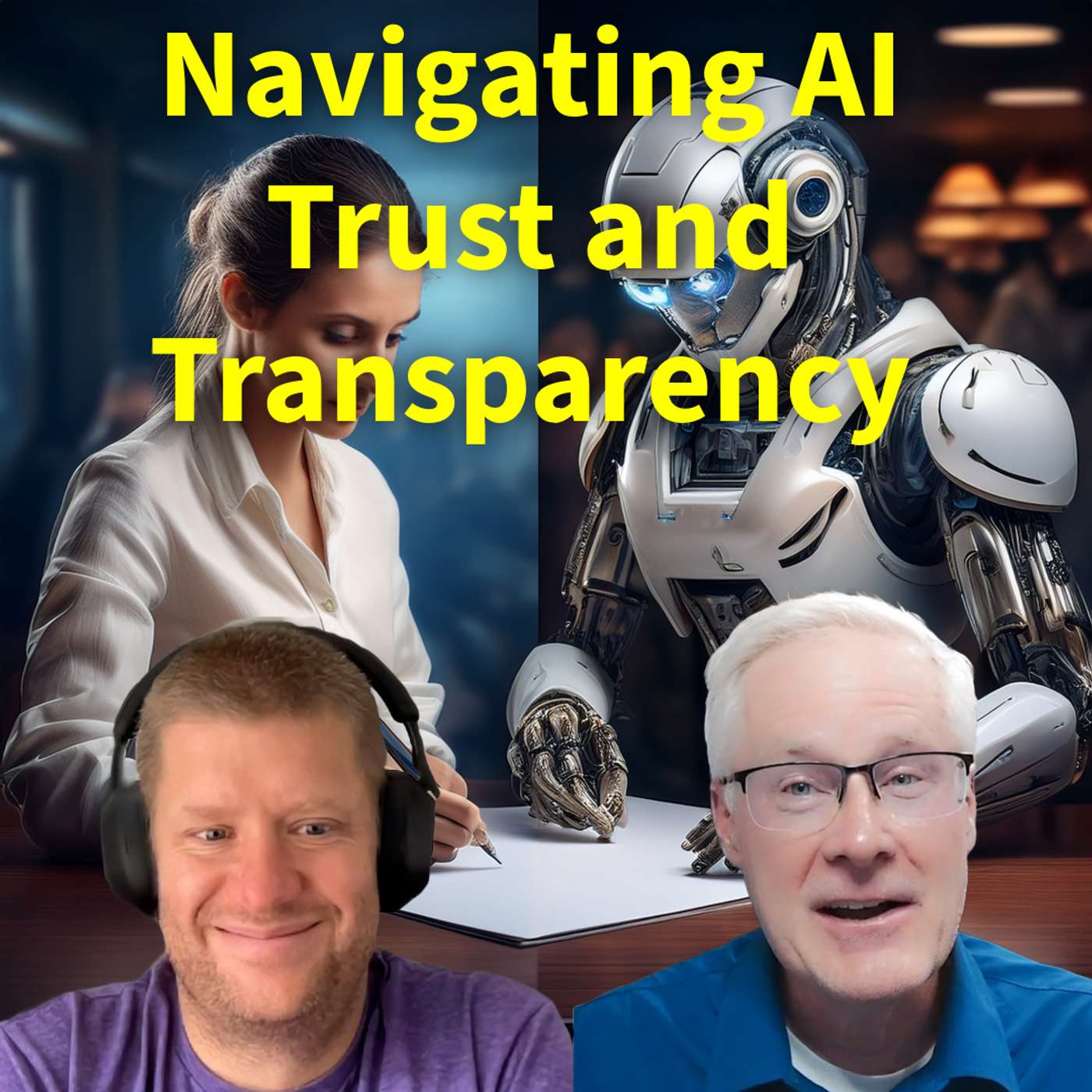
Loading summary
Transcript102 lines
- [00:00]
John Gillham
The efficacy of human evaluators is somewhere between sort of like 50% of the time they're getting it right. So flip of a coin to like 70% of the time they're getting it right if they have context of the human. So if they have, like, here's the student.
- [00:15]
Darren Pulsford
Only if they know who the human is. Right?
- [00:16]
John Gillham
Only if they know who human is. This human has now used AI. Can you. And you've seen 10 of their other papers. Which one is AI? Which one is actually their work? And that's 70% of the time they're accurate.
- [00:30]
Darren Pulsford
Welcome to Embracing Digital Transformation, where we investigate effective change, leveraging people, process and technology. This is Darren Pulsford, chief solution architect, author, and most importantly, your host on this episode, navigating the AI trust and transparency with CEO and founder of Originality AI John Gillham. John, welcome to the show.
- [00:56]
John Gillham
Yeah, thanks, Darren. Thanks for having me.
- [00:58]
Darren Pulsford
Hey, when we first talked, I said, oh, we absolutely have to have John on the show. This would be a lot of fun to talk about deep fake and all the new technologies that are out there that are causing a lot of concern for a lot of people in a lot of different industries. What's real and what's not anymore. But before we dive into that, John, every person I have on my show is a superhero. I wouldn't have anything less. And every superhero has an origin or background story. What's your origin story, John?
- [01:30]
John Gillham
Yeah, yeah, interesting, interesting question. So, yeah, grew up in a small town in north of. North of Toronto. Always wanted to get back. It's a great place for recently voted happiest place in, in Canada, except during February. That's great there. We can ski. And so, yeah, I've always, always wanted to get back to sort of focus on some sort of awesome activities that exist here. And that was sort of the, the genesis or maybe the, the start of the superhero arc for the, for the entrepreneurial journey. And so that's sort of what then pulled me down the entrepreneurial path was to be able to kind of come back here and enjoy the activities that exist here.
- [02:15]
Darren Pulsford
All right, so you said entrepreneurial, so what are we talking about? What have you done in your career? How many companies have you started? How many exits have you had? How many failures? The failures are more interesting to me.
- [02:28]
John Gillham
Yeah, I've probably stopped counting number of failed projects, but plenty had a couple exits. Currently have too many businesses right now. 12 entities that we need to sort of wrap up year ends on every year. Some of them I wish didn't exist. Some of them are great. But so, yeah, entrepreneurial journey was mostly around sort of the world of digital marketing, publishing content on the web to get traffic from Google. And then that sort of spawned in some different directions, some software direction sort of most recently.
- [03:07]
Darren Pulsford
All right, John, so you're going to help me by, at the, by the end of the show, you're going to help me do better on my digital content. I know it's going to happen throughout, throughout the show. You're gonna, you're gonna give me some nice good tips. But before we help Darren and embracing digital transformation be better, let's talk about the elephant in the room, which is generative AI unleashed on us. It'll be three years in October, right? Yeah.
- [03:36]
John Gillham
Yep.
- [03:37]
Darren Pulsford
Yeah, three years in October. November 30, 2022. I remember the day, right.
- [03:43]
John Gillham
Yep.
- [03:44]
Darren Pulsford
When Chad GPT went hey, everyone should be trying this out and wham, it hit like a rocket. But it's caused a lot of issues, especially for higher education and to education in general as students picked up on this. All of a sudden these students were writing a papers all the time, college level A papers in high school and in middle school. And this is a, this is a nightmare for learning and for a lot of different things.
- [04:19]
John Gillham
Right? Yeah, it's, it's been so, I remember the day well, so our, we launched our tool. Actually the, it was, it was the Friday, so It was basically 27th November 2022. And then ChatGPT launched on, on the 30th. And so yeah, been. Been a ride sort of since then around sort of deep fake detection. Some of our earliest conversations were with educators and just trying to sort of grapple with this world of what, what do we do? We have sort of plagiarism detection to exist, to try and fight plagiarism, which was sort of like the, the sort of the analogy that most people were using. But this is a different, this is a different beast. Generative AI is a different beast than, than plagiarism and requires a different, a different approach. And I think the, you know, a lot of, a lot of fear in sort of the voices of some of the educators that I initially talked to around. So how do we, how do we defend assigned writing as an educational instrument? And I, I don't think that that has been answered. I think it's still a, it's still a challenge.
- [05:29]
Darren Pulsford
Well, and, and I agree with you said, I, I actually teach at Vanderbilt University computer science. And could you imagine, I mean, Chad GPT or Juni there's a whole bunch of really really great Gemini code co developers co generation my I, I even passed in my own assignments to to Chat GPT and it wrote beautiful code sometimes wrong. So the whole concept of writing assignments, maybe our whole concept is wrong now. I don't know. Interesting problem.
- [06:11]
John Gillham
It is an interesting problem and I think the sort of the, you know, one of the, one of the questions that I have is that if, if, if you're going to school and you're taking education and I don't think this, this is totally true but I think it's an interesting kind of question to ask. But it's like if you're going to school for, for something to improve at something that I can do better than than you'll ever be capable of doing. Are you, are you trying to learn the right skill? And I think, I think there's, it's an interesting question. I don't, I don't know what that I don't like. I think if, if I, I don't think it's as. As obvious as that as that answer would that question would make it seem. But I do think there is something to be said that if, if what we're judging people on is able is no longer a valuable skill because anyone can do it if they have access to ChatGPT, then I think yeah, educational rethink is certainly is certainly in the cards.
- [07:05]
Darren Pulsford
But we can't, we can't just relentless to Gen AI on everything.
- [07:13]
John Gillham
Agreed.
- [07:14]
Darren Pulsford
We're going to end up like all those guys on Wally the, the animated Pixar movie, right? Where we're all just sitting around fat, dumb and happy, can't do anything for ourselves anymore. Maybe. Maybe that's a good life. I, I don't think so but I.
- [07:31]
John Gillham
Don'T think so either. But I do think there's probably a significant percent of the the world that would pick that option.
- [07:37]
Darren Pulsford
Yeah, I think so. With, with, with generative AI out there. Right. Writing content and doing all that. I guess the first question is do we care if it's Gen AI?
- [08:00]
John Gillham
So I think it depends on the situation. I think society is going to grapple with this question. I've got young kids. Do I care? If I read a review about baby formula that was considered past baby but that was written by AI that was a personal experience about some sort of baby toy that was written by AI I think that's a pretty clear no. If I get.
- [08:25]
Darren Pulsford
Do you trust the shills that are out there writing reviews on Amazon products?
- [08:33]
John Gillham
I trust that right now that ecosystem is relatively imbalanced. That yes, there's some chills but that would be hard to totally overweigh that if the product was absolutely terrible. So I think the current ecosystem is generally imbalanced. I think when you inject fake at a volume that drowns out the real then that ecosystem falls out of balance and that's a, that's a problem.
- [09:00]
Darren Pulsford
Got. It's the volume in addition to.
- [09:04]
John Gillham
Right.
- [09:04]
Darren Pulsford
That that's a problem.
- [09:06]
John Gillham
Yeah. So that's the sort of like reviews but there's like academic academia. You don't want people care if it's AI or not. Google certainly cares. And that's where sort of a lot of at least our users are focused on is making sure that that content that they paid a writer a hundred dollars thousand dollars for isn't copied and pasted or chat GBT in seven seconds.
- [09:30]
Darren Pulsford
Yeah, that's that. That's an interesting dilemma because as you said before, if anyone can do the writing, then what value is it? But let's say that I have a startup which you know, I've got a production company that, that does this podcast. I use generative AI a lot for, for like summarizing this conversation. It's a 30 minute conversation. Before I had a writer that would listen to the episode and write up a summary that cost me about a hundred dollars an episode.
- [10:00]
John Gillham
Yep.
- [10:01]
Darren Pulsford
Right now it's, it's like a penny.
- [10:08]
John Gillham
Yeah. So I think that in that situation it's a great use case. You know the human, the human component, the net new information. I mean the challenge where you're going.
- [10:17]
Darren Pulsford
Right. Yeah, we are creating content right now that a gen AI is not creating. But a gen AI can. Now summarize this. It can, it can help with. I, I see where you're going. This is cool.
- [10:28]
John Gillham
Yeah, yeah. So if you were to just go to a generative AI and say create a podcast between John and Darren, here's their bios go. Then AI needs to look at its. What does it do? What does gen do? Looks at its. Its sort of training data, bunch of sources and then it creates a derivative piece of work on what has already existed into the world. And we've gone on tangents that are far more sort of human than the gen AI that would have made the John and Darren podcast than it would have gone. So I think certainly Google along with others have sort of this strong care for net new information injected into the world. If all you're doing is producing a derivative piece of work, then that is not adding anything new. Valuable to the world. And I think often that's what generative AI does because it just takes what it knows and it's in its brain and shuffles it around.
- [11:22]
Darren Pulsford
Got it. So this is really interesting. So you're saying that Google is now filtering out generative AI content. Content that's been. And it's. Is it only doing it on text or is it doing on video as well or on audio? Do you know?
- [11:38]
John Gillham
So we, we studied, we deeply study text. Um, the, the short answer to that is yes, they are. The nuanced answer is that it's. They're focusing on the worst offenders. So AI, they really interesting challenge where they need to be this AI forward company while also defending their, their search rankings from being overrun by AI. And so sort of this really tricky challenge.
- [12:01]
Darren Pulsford
Yeah, that's an interesting dilemma.
- [12:03]
John Gillham
Yeah. And so they're, they are waging aggressive war on AI spam. So any mass produced AI content, text is what we look at most. They are waging a war manually de indexing sites, causing a lot of pain to sites that didn't know that their writers were going off and producing content with AI.
- [12:26]
Darren Pulsford
So you brought up an interesting point. If I'm paying a writer, I don't want genai to write the content for me because I'm paying the writer. I could just do the genai myself.
- [12:38]
John Gillham
Correct. Or you could. I think that the challenge is when there's not transparency between the sort of, all the actors in that, in that flow. So if the, if, if you were to say, hey Ryder, you can use AI, what's your, what's a fair rate for you to be allowed to use AI and then, and then review it? So it's like whatever your policy is, it's. That's where it becomes important that there's sort of transparency between the writer, the editor, and ultimately the buyer, the risk owner of that content. So publishing AI generated content is risky. Then whoever owns that risk wants to be the one that makes the decision on whether or not that content gets published.
- [13:19]
Darren Pulsford
Gotcha. No, that's really interesting. So let's dive into the technology a little bit because I've been using Grammarly, for example. I've been using Grammarly for seven years, since its instant, you know, since I even heard about it, which is about seven years ago. I'm a horrible writer. I'm not, I'm. I'm not great with my grammar and things like that, but I got all these crazy ideas in my head that Grammarly has helped me get out on because I Could write a paragraph that's poorly formed, the whole thing and then it can clean up my grammar. I can then go and arrange it and I wrote a whole dissertation. 200, 220 page dissertation. Thank you. Grammarly.
- [14:03]
John Gillham
Right.
- [14:04]
Darren Pulsford
I mean that it saved my keister. I never would have gotten through my PhD program without it. Is, is that cheating?
- [14:15]
John Gillham
So I think so. No, I don't think so. I think, I think there's a long. We've done a study around what level of looking at character replacement threshold on what. What's the, what's the rate that. Is it like, is it 1% can be changed out and it's still yours? Like obviously, yes. What if it's 90%? Probably not.
- [14:40]
Darren Pulsford
Right.
- [14:41]
John Gillham
And so where is that line? It was interesting to see some of the results where a lot of academia was sort of drawing the line around 5%. We're saying that up to 5% characters have changed. Um, then that's, that's cool. That's still the same. That's the students work, um, different. It, it was also really when, when, when, when somebody says light AI editing that can range from sort of like a 1% to 50%. The, the sort of like societal alignment around what light AI editing means is, is definitely not fixed. And so it's. Yeah, it's, it's, it's. And I'm a similar situation. You know, I'd rather think in spreadsheet form than. Than written word form.
- [15:26]
Darren Pulsford
Right.
- [15:26]
John Gillham
And. And I need to, we need to write in this world. And so AI Grammarly and, and now sort of like a custom trained chatgpt for, for me I'm like oh wow, that's what words are supposed. That's so much better. Thank you.
- [15:42]
Darren Pulsford
Or hey, give me a synonym for this. I mean ultimately though, us as humans should be reading and reviewing things before they go out and, and making changes and, and right. Because Gen AI makes stuff up. That's what it means to generate. Right. It's generative, it's generating new content. It's not just rearranging words, it's adding words to it and removing some words. So it's, it's creating new, new content. So yeah, this is, this whole area is really fascinating to me because moving forward I see so much benefit in generative AI for people that aren't good at writing or expressing themselves. We've got voice to text which frankly towards the end of my dissertation I was just, I was just talking to my computer and getting my ideas out because I couldn't type fast.
- [16:49]
John Gillham
Enough.
- [16:51]
Darren Pulsford
And so that's a form of AI, but it's still my words.
- [16:56]
John Gillham
Still your words. I think that would like most, like most techn. Most technology that is built to identify AI generated text will generally not identify voice to voice to text. Yeah, yeah.
- [17:12]
Darren Pulsford
So fascinating. This is a fascinating work. So let's take a look at some common patterns that you can identify very quick. I'm sure you're an expert in this area. I'm sure you can read anything and say generated, generated, generated. You can do that. Right?
- [17:31]
John Gillham
So it's interesting you think you can. So you think you can. Humans have a very strong bias towards both overconfidence and pattern recognition. If you ask a room of drivers, how many of you are an above average driver, 80% of the room puts their hand up. And the entire gambling industry is built on the sort of belief that humans can identify patterns in noise. And so we have these biases that sort of lead us to think that we're really capable of identifying patterns. Certainly there's some text that, that's out there that you're like, yeah, like tons of, tons of emojis delve into M dashes. Like there's some things that like yeah, that's, that's AI. But when we, when there's been studies that have been done looking at human evaluators and their capabilities at identifying AI generated content, this has been done heavily in, within academia because that's sort of like what, what are the mechanisms to try and defend, defend the written word as, as an educational tool. The, the efficacy of human evaluators is somewhere between sort of like 50% of the time they're getting it right. It's a flip of a coin to like 70% of the time they're getting it right if they have context of the human. So if they have like here's this student.
- [18:54]
Darren Pulsford
Only if they know who the human is. Right.
- [18:56]
John Gillham
Only if they know who the human is. This human has now used AI. Can you. And you've seen 10 of their other papers. Which one is AI, which one is actually their work? And that's 70% of the time they're accurate. So it's a pretty, pretty dismal performance for humans.
- [19:12]
Darren Pulsford
Yet we all think we can because C plus maybe.
- [19:15]
John Gillham
Yeah, yeah. And, but we, but we are in those studies. How much did you think you got right? 90%. What did you actually get right? 60%. Yeah. And I think I'm in the same, I'm. And we, we all have the same biases. That's what that makes Them so, so blind to. To us. But yeah, it's kind of a fascinating. I think if you ask anyone, they think they can see CAA content.
- [19:40]
Darren Pulsford
So that's very disconcerting if, if I'm worrying about some. Whether something's gener. Geni generated. Not only that, but the truth behind it. Right. Because we know humans can write false things. Things too. Right. That's, that's how the Revolutionary War in the United States started, by the way. Yellow journalism. Right. The Boston Massacre. Five people died. It wasn't a massacre, but you know what I mean. So, yeah, so not only identifying what's Gen AI generated but also truth around that. That's a whole nother philosophical thing. But this is disconcerting that humans, we're not going to be able to just look at something Gen AI generated that. I mean that's.
- [20:30]
John Gillham
Yeah, I, I think there's real con. Like there's. I don't know of any sort of significant innovation that has, has not had consequences. You know, smartphone not been good for, for mental health, social media, you know, recent history, car probably not great for the planet. Not that horses would have been all that, all that good either.
- [20:52]
Darren Pulsford
But we walk around and you know, road apples is what we call them growing up all the time.
- [21:00]
John Gillham
So, so I think there's, there's no, it's. There's. There's not been an innovation that has not had some externalities, some, some negative. Negative impact. And certainly AI will. Will have negative aspects. And I think the, this sort of. When I went through school, Internet became sort of a thing and it was like, don't trust anything. Unlike it was drilled into you. Don't use Wikipedia for sourcing. It's wrong. And now, well, it's actually the most. Right.
- [21:34]
Darren Pulsford
And so fascinating how that happened.
- [21:37]
John Gillham
Yeah. And so I think, you know, we've gone from this sort of world of like you don't trust anything on the Internet to like maybe you can but like be. But it's nuanced. Right. And it's sort of a similar, probably a similar progression where it's going to go from like this sort of like binary approach to generative AI content of like love it, live with it, want it to like resisting it. We're able to turn into this more nuanced approach the same way that like what we read on the Internet, most people know that they should not believe everything they read on the, on the Internet. And I think, you know, now it's like we'll get to the same place where it's like don't believe everything you see from, from generative AI. Fine. If it really matters to you, if it's sort of, you know, a significant thing to your, your life, you better, better go find some extra sources to just be really sure.
- [22:31]
Darren Pulsford
Yeah, I'm glad you brought that up because checking sources should be in part of our critical thinking that, that we're doing on these things. But I've noticed something interesting. I, I do workshops for a higher education on generative AI and keynotes and things like that. And in, in a recent workshop, I, I asked him, how do you know that this stuff is too. And they said, well, I asked Jenny I to give me references and it gives me a set of references. I said, did you check the references? Like, well, no, because the references, I mean, come on, they're, they're from like Harvard Business Review and things like that. And I said, check the references. And, and they did. And they said, oh my goodness, it made it up. It made up a reference.
- [23:16]
John Gillham
Yeah.
- [23:17]
Darren Pulsford
And, and, and I explained to him, I said, look, generative AI has been programmed to give you an answer. It is greedily wanting to please you. It will do anything it can to give you an answer, even make stuff up. So if you ask for references and it doesn't have any, it's like a five year old, you know, getting caught in a lie. They will continue with the lie. Right. And so it does that. That's, that's in, that's the way it's been programmed. And I saw light turn on in a lot of the faculty members. They were like, oh, wow, I really have to check. I have to actually do my homework. I can't rely on it completely.
- [24:00]
John Gillham
Yeah. And it's also this sort of reverse, reverse confirmation bias where you're, it's like, it's saying the thing and then it's saying the data that it used, the sources that it used to produce that answer. What sort of you really want, if it really matters to you, is like, now show me sources that disagree with this opinion so that you can, you can understand because you're like, it's, it's like intelligently, if that's the right word to use, but, but like certainly convincingly being intelligent that it is showing you a position and then it's saying, and these are the sources that prove my position. Which, which is, which is better than, than just totally making it up. But, but even, even if the sources exist, even if they haven't elucinated those sources, it's still a confirmation bias where they're where they're cherry picking the sources to support their position.
- [25:00]
Darren Pulsford
Well, absolutely. I mean, that's what we do in a PhD dissertation.
- [25:04]
John Gillham
Yep.
- [25:05]
Darren Pulsford
We have our position, we find all the other works that support our position and then we do surveys or we do testing to validate our, our position. That's. That's right. I mean, it was trained to do what, what we've been trained to do in the research world and, and finding, you know, contrary to that is, is part of that as well. So. And tell, tell me a little bit about what your technology brings to the tables. If humans can only detect this stuff between 50 and 70% of the time, but we're confident at 90% that. Yeah, yeah, we're right.
- [25:45]
John Gillham
Yeah.
- [25:45]
Darren Pulsford
Give me a tool, buddy. Give me. I mean, how do, how do I know? Right?
- [25:49]
John Gillham
Yeah. So there's no tool that is perfect. So that's the sort of interesting part to this world now is that so our tool. So my background, as in the world of content marketing, we had a content marketing agency. We wanted to be able to sort of drive transparency between the writer, the editor, the agency, and ultimately the customer. On was AI used or not in the creation of this content? And so we actually built an AI detection tool, ended up launching it the weekend before ChatGPT launched, which was kind of crazy. Crazy timing.
- [26:25]
Darren Pulsford
That's awesome.
- [26:25]
John Gillham
Yeah, yeah, but, and so what it does, it's. We think of it kind of like the Good Terminator where it's, it's our own AI that is capable of identifying if AI, if content was generated by AI or a human. Its efficacy is sort of 99% of the time it will call AI AI and then sort of 1 to 3% of the time it will call human AI lower on different types of text, but sort of the result is that detection tools are highly accurate but not perfect. And that creates some additional interesting challenges in the world. On, on what use cases is that level of efficacy acceptable?
- [27:08]
Darren Pulsford
Yeah, I'm glad you brought that up because there was a case, a Purdue English professor at Purdue asked chatgpt to analyze. Do you remember this case?
- [27:20]
John Gillham
Yeah, yeah. And he failed. Failed. And then chatgpt, like we talked about, wants to please and so hallucinated the answer that every, every student's paper was AI generated. And they fail. And he failed them.
- [27:31]
Darren Pulsford
And he failed them all.
- [27:32]
John Gillham
Not the case. Yeah.
- [27:33]
Darren Pulsford
Yeah. But it was not the case.
- [27:35]
John Gillham
Yeah.
- [27:36]
Darren Pulsford
So, boy, which AI do we trust? Do we trust John's AI or do we trust? It's an interesting dilemma. So you feel, well, you already mentioned Google's starting to use these tools like yours, hopefully yours have you an awesome contract to land. So hey, you, you Google guys out there, you need to buy John's stuff. How's that? There, there's your pitch right there.
- [28:01]
John Gillham
Yeah, perfect.
- [28:02]
Darren Pulsford
Yeah, so, so, I mean there are reasons to do that. We also know that training AI on AI generated content leads to, you know, a disaster in the long run.
- [28:15]
John Gillham
Yeah.
- [28:17]
Darren Pulsford
So these tools are going to become important if they aren't already. It sounds like they already already are.
- [28:24]
John Gillham
Yeah, no, we certainly didn't set out to build a societally important business, but it is being used for critical applications where that level of, of efficacy is acceptable. So user generated content platforms where you don't want the platform to be overrun by bots, but it's okay if you sort of kick out 1% of a real, of real human answers get, gets rejected. That's an acceptable, not ideal, but an acceptable trade off to preserving the integrity of the platform. Review online review platforms, it's an existential threat to them if all of their reviews just get overrun by, by AI bots. And so being able to filter out, filter out AI from, from human in those platforms is, is definitely an existential threat and an error rate of 1% is, is, is very acceptable. Yeah, yeah, yeah. So that, yeah, I know it's a, it's definitely, it's a. Yeah. Fascinating problem to be sort of at the center of, to be trying to sort of give tooling to navigate how society wrestles with what is acceptable. You know, there's a lot of focus around this sort of ethical use, ethical development of AI and I think with the conversation will evolve into ethical use of AI as, as the years go on.
- [29:46]
Darren Pulsford
No, absolutely. Which brings up my next and probably most important question. What can I do in the summary of my podcast that's going to be generated from this to make it seem more human? Because I, I don't, I don't want to spend all the time and money on doing that, but I want my stuff to be accessible and, and found to do. I just write a small paragraph at the beginning and say hey, summarize what it's already going to summarize below. I mean, what are some of the tips or tricks that can help me put the human back into some of this content that's being generated for me?
- [30:26]
John Gillham
And so I think we are injecting the human in this conversation. And so I'd say I think the risk for that type of content is the, that the user doesn't know if you have reviewed it or not. And so I think in that case transparency with the reader about how it was generated and that it was reviewed by Darren and so it fits.
- [30:53]
Darren Pulsford
I like that John, that's good that.
- [30:58]
John Gillham
This is summarized because no one wants to flog you and have you suffer through doing something that is clearly capable to be done by, by AI.
- [31:07]
Darren Pulsford
Maybe there's some people, but yeah, there are some. My competitors. Right. Some of my co workers maybe, you know.
- [31:13]
John Gillham
Yeah, yeah. Sometimes my wife, you know. Exactly, exactly. But being able to where. Where I get most concerned and where I think most people get concerned is like is, is the author behind this? Do they read this? Do they stand behind this? Or is this just totally bot generated? And no, no one's at. No human is in the loop. And so if you can transparently communicate that this was summarized on human conversation, not deep fakes and this was AI generated and this was reviewed by yourself or by an editor.
- [31:45]
Darren Pulsford
Oh, you know what? I like that. I'm going to start putting that at the beginning of my YouTube summaries and my blog posts and things. Hey, I'll put a little small sentence or two or three sentences at the beginning and say hey, I hope you enjoyed the content. This, this came out of the show today. I, I like that because that puts the human back into, back into all this stuff.
- [32:11]
John Gillham
Yeah, yeah, exactly.
- [32:13]
Darren Pulsford
Hey John, this has been, this has been incredible. If people want to learn more about you or your companies, all 12 of them, where, where do they go?
- [32:23]
John Gillham
Yeah. So Originality AI is the company that we've been talking about that sort of focuses on AI detection and helping out. Anybody that is a copy editor, do their better get a piece of text and, and make it. Make sure it meets their requirements. That's Originality AI and they can reach me at Jon Jon Originality AI or, or find me on LinkedIn.
- [32:46]
Darren Pulsford
John, it's been a pleasure having you on the show. This is. You've given me some great ideas. I appreciate it.
- [32:51]
John Gillham
No, it's fun, fun conversation. Appreciate it. J.
- [32:59]
Darren Pulsford
Thank you for listening to Embracing Digital Transformation today. If you enjoyed our podcast, give it five stars on your favorite podcasting site or YouTube channel. You can find out more information about Embracing digital Transformation at embracingdigital. Org. Until next time, go out and embrace the digital revolution.