← Embracing Digital Transformation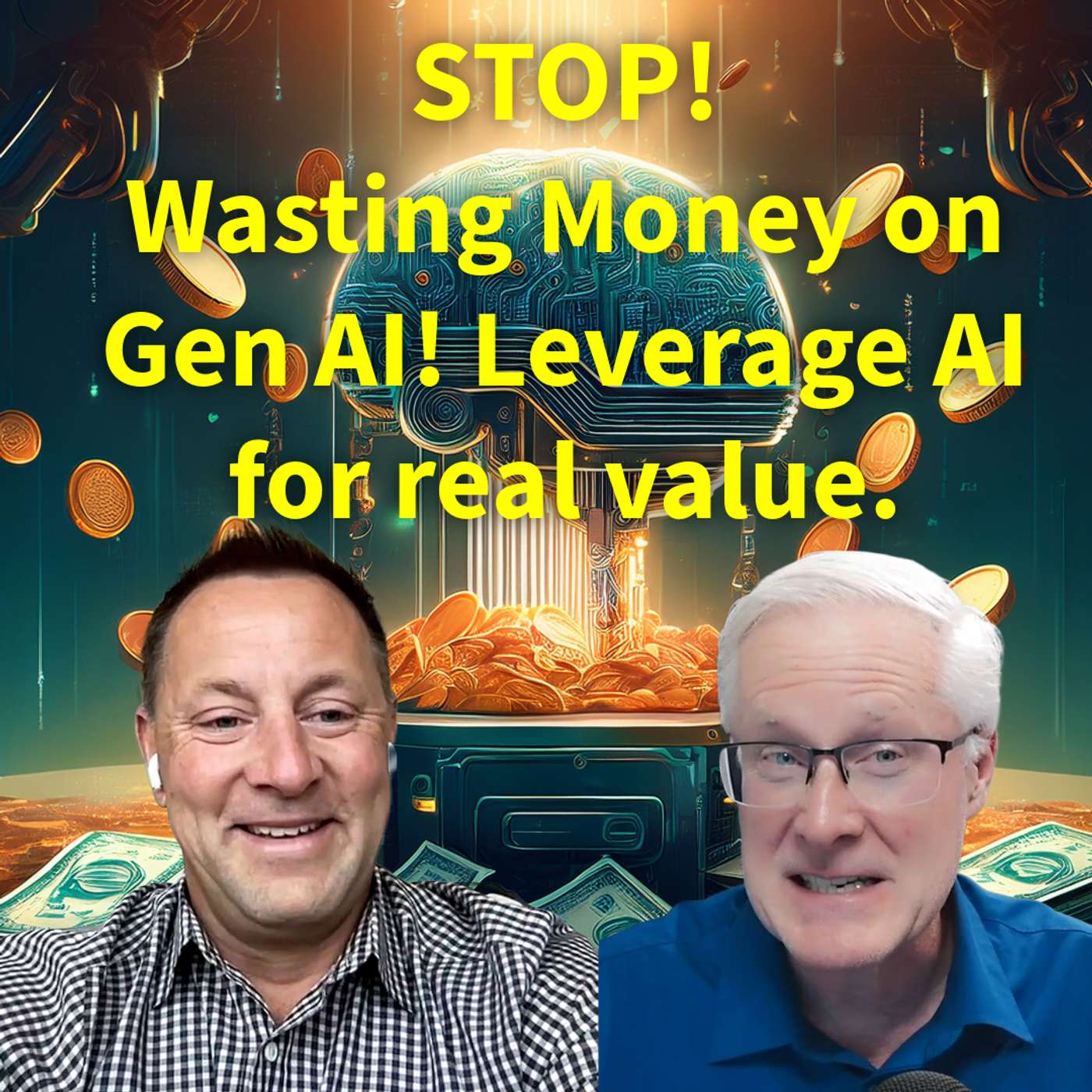
Embracing Digital Transformation
#282 Stop Wasting Money on GenAI! Leverage AI for Competitive Advantage
00:38:46
Loading summary
Transcript114 lines
- [00:01]
Andrew Brooks
One of the phrases we use is take ground. How can you use AI to take ground new services, new offerings? That possibility exists right now where people can say, oh, I'm entering a new market that I wouldn't have thought I could because I have unique expertise coupled with AI for efficiency gives me the opportunity to bring this new capability out.
- [00:26]
Darren Pulsford
Welcome to Embracing Digital Transformation, where we investigate effective change, leveraging people, process, and technology. This is Darren Pulsford, chief solution architect, author, and most importantly, your host on this episode. Stop wasting money on Genai. Instead, start leveraging it for real business value. With special guest Andrew Brooks, CEO of Contextual IO. Andrew, welcome to the show.
- [00:53]
Andrew Brooks
Thank you. Great to be here.
- [00:55]
Darren Pulsford
This is a really hot topic because Gen AI is changing the world, so productizing or moving into production is a big deal. And I'm really excited to dive into this topic and some of the learnings that you bring. But before we do that, everyone knows on my show, I only have superheroes, and every superhero has a background story. So, Andrew, what's your background story?
- [01:20]
Andrew Brooks
Gosh. Well, I'll hit a couple things. Number one, have built and sold a couple of technology companies. If you happen to have a Samsung SmartThings device, meaning a Samsung TV or fridge or washing machine. I was one of the co founders of SmartThings. So if you love it, then you're welcome. If you don't love it, I apologize. But that was.
- [01:43]
Darren Pulsford
I love it, Andrew. I love it. It's a. It's a great tool. So way to go.
- [01:48]
Andrew Brooks
Yeah, that's. That's that one superhero activity I've engaged in. I've. I was one of the first folks, kind of top 100 folks to finish what's called the World Marathon Challenge, which is you run a marathon on all seven continents in seven days. So starting Antarctica, South Africa, Australia, Asia. Boom, boom, boom. Seven days and banged out seven marathons.
- [02:13]
Darren Pulsford
Okay, wait, wait. That's not a superhero. That's crazy stuff.
- [02:19]
Andrew Brooks
That is.
- [02:19]
Darren Pulsford
How do you run? Yeah, wait, wait, we got to back up. Say, how do you run a marathon in Antarctica?
- [02:26]
Andrew Brooks
So there's a Russian research station where they land these planes on basically an ice airfield. And you got off the plane and they, you know, you started running. And what was fascinating there is when you're running into the sun, it's actually quite warm. The sun is hitting the ice and it's bouncing off you. And then you turn and you're running away and you're freezing because it's actually quite cold out. And so you run around this maybe Six loops around a four mile airfield just around the ice. And then when you're done, you go into a. They basically live in shipping containers is what it is. You go into one of the shipping containers and there's, you know, some, some individual who speaks Russian who's serving food and is like, you know, do you want. Just pointing. Do you want some of that? You've just run a marathon, so you're like, yeah, I'll take whatever, whatever it is. Right, exactly. So, yeah, that's how you do it.
- [03:20]
Darren Pulsford
And then you hop on an airplane and you're to South Africa.
- [03:23]
Andrew Brooks
Back to South Africa. So, you know, first marathon, you know, 5 degree temperatures. Next marathon, it was like 85 degrees in South Africa, in Cape Town. So a little bit of a juxtaposition between, between those experiences.
- [03:36]
Darren Pulsford
And you do it in seven actual days or there's some time in between.
- [03:41]
Andrew Brooks
Nope, seven days. As soon as you're done, you're back to the airport, you hop on the jet, they take you to the next place, and on and on and on.
- [03:50]
Darren Pulsford
Man alive. So, gosh, there's so many questions around that. Fluids. You got to have fluids. I mean, obviously you guys are under some health.
- [04:02]
Andrew Brooks
There's a doctor. Yeah, there's a doctor on the plane to just kind of make sure people aren't dehydrating there. People were getting IVs in the back of the plane who were struggling a little bit. You know, my big problem is I, I tend to stop eating solids during the, the marathon. I, I moved to just drinking Gatorades. And that's not the best way when, when you have to do seven of them. You got to keep your, your calories, calories up. And they did not have. It was kind of not marathon specific food on the plane. You know, it's like, here's your fish dinner. And it's like, I, I don't know that that's what I want. Do you have any pasta?
- [04:39]
Darren Pulsford
Yeah, give me as much pasta as you can.
- [04:41]
Andrew Brooks
Exactly, exactly.
- [04:43]
Darren Pulsford
Wow, Andrew. It's amazing, right? I mean, I've had some really cool guests on the show. I had a guy that claimed Everest.
- [04:52]
Andrew Brooks
Nice, nice.
- [04:53]
Darren Pulsford
I had three opera singers now on the show. They didn't sing for me, though. I. And now I've got one of the, The. You guys have a special name, right?
- [05:03]
Andrew Brooks
It's. It, it's the. There's a world Marathon Challenge club. And I. There's like some badges that I have sitting on my wallet.
- [05:10]
Darren Pulsford
So. That is so cool. Hopefully our listeners appreciate that we'll see. Send me some pictures. I'll put them up on the website. We'll make sure we, we add up the video here.
- [05:21]
Andrew Brooks
We'll. We'll get one from Antarctica so you can kind of see what that was.
- [05:25]
Darren Pulsford
Yeah, that'd be so cool. All right. So, Andrew, even though I'd love to talk for the next half hour about that.
- [05:31]
Andrew Brooks
Yeah.
- [05:32]
Darren Pulsford
My audience really wants to hear also about, hey, you've been through some of these technology shifts with smart things. You were early on the IoT mobile, mobile space. Gen AI is a little bit different, don't you think?
- [05:51]
Andrew Brooks
You know, it's, it's, it absolutely is. You know, perhaps, you know, most critically, because unlike some of these prior technology shifts where it was like, okay, you're a small business and you do not have a website. You need to have a website. You can get a website and the website's going to do the thing you expect. It's going to convey the information that you put on that. Your phone number is not going to change, your address isn't going to change. These are things that you're presenting or if, you know, with SmartThings, if we built a mobile app that you press the button, your lights should turn on and your lights would turn on. Gen AI is different in that it's not entirely fixed, it's not entirely predictable in terms of how it's going to take on the task that you give it. And so that kind of manifests in a couple of ways from our perspective. One is discomfort for companies. Right. Like, can I trust this? Yeah. Is it going to do something that I don't expect? How much control can I give it? How much autonomy can I give it? Is it causing more harm and more work than actually the efficiencies that I would want? And so the power is unbelievable. But, but that small difference from previous technologies, where at least it was kind of an understandable and predictable outcome, has really changed the landscape from my perspective.
- [07:18]
Darren Pulsford
Well, and you mentioned something else. I mean, we're seeing Gen being used for things no one even thought of for sure.
- [07:25]
Andrew Brooks
Yeah.
- [07:26]
Darren Pulsford
So it's even a more profound technology shift than maybe Even in the 90s with the dot com boom. Even though that, that was profound too. I mean, who would have ever thought E Commerce. No one. Right. In fact, I remember my wife at the time said, why would I ever get on the Internet? And Amazon shows up to my day. Several. My house, several times a day now, of course.
- [07:51]
Andrew Brooks
Yeah, absolutely. Absolutely.
- [07:52]
Darren Pulsford
Thanks to Contextual I.O. for sponsoring this episode. Contextual delivers high ROI answers for businesses of all sizes. They do this by combining powerful workflow orchestration and automation platform with a bunch of pre built solution patterns and expertise to help take your AI project from POC to actual value.
- [08:15]
Andrew Brooks
People think of Gen AI as ChatGPT right now. They think of, oh, I go and ask it a question, it spits out an answer. Maybe they have a perception that AI is a chatbot that they're experiencing on a website that is frustrating them because they actually want to talk to a human and get something solved. Some of the perceptions of what it is are I think a little misdirected. We tend to work with companies who are trying to find AI solutions that are process, task operations, back office stuff, invoice processing, looking at pictures of work orders, you know, identifying if you know, quality of work is going off. All these other ways than just like write me a haiku about pickles, you know, that somebody might do with, with ChatGPT. That's, that's the reality is that this, it's a very strong tool for intelligence, but it's no different than having an intelligent human. You have to think about what is the role it's playing, what information does it have and how is it affecting change in its world.
- [09:21]
Darren Pulsford
Well, I, I think there's one fundamental difference with Gen AI than what the other tools that we've had in the past, and you already mentioned it, it's like having a human in there because for the first time in our history, I don't need a computer scientist to talk to a computer for sure. Right. Which is a big, huge change. Right? Because even people say, yeah Darren, but we've had Google and I could do a Google search. Yeah, was a computer scientist that wrote search algorithms and even really good search prompts in Google were an art, something you had to learn. And the way that you talk to a computer was very different. Now it's human language is our interface, right. To a computer and, and our human language is not a great communication technique for exactness.
- [10:20]
Andrew Brooks
Correct. Well and you kind of nailed an interesting point there, right? You could watch people five years ago and see the difference between somebody who was good at searching, right. They knew what actually they needed to type into the search bar, the critical things and then good at scanning results. Right? Like okay, is this it, is this it, is this it? Click. And that's the thing I want that, that was a skill that you had to apply. And now anyone who can phrase a question even poorly, the AI can understand. What are you, what are you seeking what are you trying to get right? But then a few things happen. It might be verbose in its response to you. And therefore you got to consume a lot of information to actually get to the. Get to the point that it's trying to make.
- [11:02]
Darren Pulsford
Fraud, for example. Right?
- [11:03]
Andrew Brooks
For sure. I mean, we, we. A lot of our work is zip it, quiet down, just do the thing I asked you to do. I think that's exactly right for us as systems developers. The extension of that is, for the first time, you don't necessarily have to write. You're not writing code, you're not writing formulas, you're not writing prescriptive business logic to get an outcome. You're just asking this thing to do. I don't have to, I don't have to tell an AI how to categorize or do regex searching on fields to say, what is this? Is this in this one of these five categories? Are you telling me what the categories are?
- [11:45]
Darren Pulsford
Yeah, to me, it's a very strange. It's like a new processor that I can use to do things that before I would have to write several hundred lines of code or thousands of lines of code to interpret data. Now, you know, it's. So I think it's opening up a lot of new things around, specifically business automation and making me actually rethink some of my processes. For sure.
- [12:15]
Andrew Brooks
Yeah.
- [12:15]
Darren Pulsford
The processes that we have there a lot of times were created because of the limitations of the tools or the people working with the tools and that interface between them. Because of those limitations, I have process that was there to handle and manage those limitations. Some of those limitations are gone.
- [12:37]
Andrew Brooks
Absolutely. I mean, just a few years ago, we were working with a landscaping company and they would get tickets from their clients saying, hey, the tree branch is hanging down, can you trim it? And that was basically using a bunch of regex patterns that were written in code to try to figure out what is this person asking us to do? Is it an emergency? A tree branch hanging down? Might not be, but a tree branch, it blocking the handicapped parking spot is. You would try to interpret this stuff. All of that code, to your point, hundreds, maybe thousands of lines of code goes away. Where I can now just say what I'm concerned about is what is this thing? You know, how severe is it, how much you know, how should I take action against it? Those three prompts and you get the answers back that you want.
- [13:29]
Darren Pulsford
So with all this, with all this new tool that we have some of the fundamental software engineering techniques, and not just software engineering, but product development techniques, need to come into play because right now I think you are you. You may even have the statistics. There's new ones that just came out this week. How many gen AI or AI projects fail to go production from PoC to production? The number is dismal.
- [14:01]
Andrew Brooks
Yes. And I think that's the. We all know the hype cycle and adoption curve and maybe we're on the backside of the hype cycle and we're in some disillusionment right now. But to me that represents the opportunity. Right where now is not the time to be. To be fearful. Certainly it's the time to understand why did they fail. Right. What was the expectation versus the outcome? Was an ROI measurement kind of built into the story from the beginning or was this just more. It's cool and it's a science experiment or a parlor trick that's part of good stewardship of new technologies.
- [14:43]
Darren Pulsford
Well, and I think you hit it right on the nose. It's the parlor trick. Right? How many, how many millions of dollars have been spent to look at cats in disco outfits?
- [14:56]
Andrew Brooks
Correct. Well, that's a way. That's a waste.
- [14:59]
Darren Pulsford
That's a real waste of time, right?
- [15:00]
Andrew Brooks
Yeah, exactly.
- [15:01]
Darren Pulsford
Another quick shout out to Contextual IO. Thank you for sponsoring this episode. Again, Contextual delivers really great AI ROI for businesses of all sizes. They do this through workflow, orchestration, automation, platform, pre built solution patterns, and most importantly, their expertise in taking proof of concepts and scaling them to production. Let's head back to the show.
- [15:28]
Andrew Brooks
Yeah. I mean, I think anybody who's used imagery generation from Genai recognizes it doesn't spell things right. It messes up words and stuff. You're not going to create your next advertisement just with using one of the standard models and say, oh, this is what I want it to look like. It'll look at 80% great, but there's going to be the 20% that you wouldn't put out there in the world. So I think it's about finding the project that does matter. And for us there remains a human in the loop element here that is part of the project. The human in the loop might be a new interface or it might be a new way that the humans are policing or managing or responding to escalations from these AI tools. I think too often people think, oh, this is going to be great, it's going to all go away. And then you get one or two problems which is going to be true in any system or process, and they lose faith. And that's partly because they didn't have the Strategy around what is the fallout mechanism? How does the human interact with this? What overrides need to exist.
- [16:38]
Darren Pulsford
So this goes back to what we learned in rapid application development to deployment from the 90s right in the dot com boom. Do you think all those things that we learned really do still apply? Because it seems to me like things are moving so much faster than they did in the 90s. We haven't hit the three year birthday of Genais being unleashed on the world. That's in November 30th of this year is year three.
- [17:09]
Andrew Brooks
Yeah.
- [17:10]
Darren Pulsford
And we've got several multi billion, multi hundred billion dollar companies that have been formed in the last three years. Yeah, this is moving super fast. So.
- [17:21]
Andrew Brooks
Yeah.
- [17:21]
Darren Pulsford
Do I have time?
- [17:24]
Andrew Brooks
Yeah. I mean. So I mean clearly as you look at, you know the, the, the a, the revenue multiples might be excessive in certain companies, but tabling, you look at the cursors of the world where they're over $100 million in ARR. Our engineers use products like that all the time. There's no question that they're adding significant value and they deserve to exist and they deserve to be valued exceptionally high. I think the projects that you see failing again, it might be what was the rollout strategy? What was the supporting strategy? What I don't think is the right answer right now is wait, when we work with clients we're always seeking a can you carve off one employee to start down this path to be the person who's interacting with this AI most aggressively and giving feedback. And by the way, that person then is going to become an advocate. They're going to become the individual in the organization that's the cheerleader of this. And then you two, and then you grow that way. I think some of the projects that get canceled and you have such this failure rate are maybe the eyes were bigger than the stomach in terms of the scope of what they were trying to take on the expectation. And number two is they did a rollout where you caused consternation and fear amongst the individuals who were going to have to be participants with this. And as a result they resistance came up. And you know anybody who's gone through organizational change, if employees are resistant, it's not going to work. You're going to suffer. Yeah.
- [19:07]
Darren Pulsford
But well here's. I just had an interview with the CEO of FreePiks. Right. One of the largest free downloading stock image sites in the world.
- [19:20]
Andrew Brooks
Yep.
- [19:21]
Darren Pulsford
Can you imagine when Dolly has done to them?
- [19:24]
Andrew Brooks
Yeah. Absolutely terrifying.
- [19:27]
Darren Pulsford
Yeah, he pivoted. He had to. And I thought it was fascinating because his employees were like, what, looking to him like, our jobs going to be safe. So for, for them, they did an incredible pivot, by the way. Right. Because they're mixing stock images and generated images and meshing them. It's pretty brilliant what they did.
- [19:49]
Andrew Brooks
That's awesome. Yeah.
- [19:51]
Darren Pulsford
And they focus not on image creation, but on what they're really good at. So how, as an executive, do you help your organization do the same? Is the big question I have is because you can't, you can't stand still even if your employees want to, and they're worried about their jobs. If you stand still, you die. In this case, you perish. I guess parish is a better word.
- [20:19]
Andrew Brooks
You know, I'm a pretty big technology optimist generally, and I don't believe that technology, looking back to the Looms and the Luddites, has actually ever caused mass job extinction. New opportunities emerge, new roles emerge. Generally where we see the best advocacy and we tend to focus on middle market companies. So take that with whatever grain it represents. But we see these opportunities where you have individuals who are doing kind of very rote, repeat, not terribly value add. They don't feel great about at work. They don't feel like geniuses doing receiving. They're pushing paper around, pushing paper around, keying stuff in, categorizing stuff. They don't feel great about it because it doesn't represent kind of where the value that they believe they could bring to the organization is. And so we seek those opportunities to say, if we took this burden away, how would those roles and resources change? Would you offer new products to your customers? Would you be higher touch with a customer in a way that actually causes them to buy more, to expand services? And invariably people want to do creative human things. And of course LLMs can do creative things. Like I said, haiku about pickles is totally achievable. But humans want to do that as well. That's our nature. We don't want to do rote and repetitive work. Work. And, and those are some of the things that we can, you know, hopefully shift.
- [21:57]
Darren Pulsford
So. So this brings up another. This brings up another problem that I've seen. Right. I see some CEOs that don't think like you, where, hey, how can I free up some of my people's time so that they can focus on more value added to grow my company?
- [22:14]
Andrew Brooks
Yeah.
- [22:14]
Darren Pulsford
Instead I see CFOs taking lead on this saying, we're going to cut costs.
- [22:20]
Andrew Brooks
Cut, cut, cut. Yeah. I mean, obviously 9,000 Microsoft employees that were Cut. And there's a big question, is that driven by AI? And so to be clear, I do believe there will be job loss and then job gain and there will be transition and that pain will happen with that. And I don't want to be not empathetic to any individual who is impacted by this. I will say if you're looking as a company and you look at these AI first organizations that have millions of dollars of revenue per employee and amazing multiples as a result, they didn't get there just by cutting costs. And I don't think your average organization, you can only grow EBITDA so much by cutting costs. You have to grow the top line. And one of the phrases we use is take ground. How can you use AI to take ground? New services, new offerings? That possibility exists right now where people can say, oh, I'm entering a new market that I wouldn't have thought I could because I have unique expertise coupled with AI for efficiency gives me the opportunity to bring this new capability out.
- [23:42]
Darren Pulsford
So this is interesting to me because I'm thinking of some old companies. I work for Intel. Right. Intel's going through a massive restructuring right now. How can we use AI to take more ground? That, that is something I'm glad you brought up because our CEO is talking about AI. But we do have to, we do have to restructure. I've. I've noticed in especially large companies, I also do a lot of work with government. When the bureaucracy gets in the way, they can't, they can't move.
- [24:15]
Andrew Brooks
Yeah.
- [24:15]
Darren Pulsford
So when you get, when you get gen AI that comes in from the side, it just bogs down even worse is what I've seen.
- [24:24]
Andrew Brooks
Yeah. And I think you're hitting on something that, you know, I've been thinking about and our organization thinks about, which is where does AI live? In an organization, we would classically say AI is not an IT project. This is not an IT thing because it has kind of transformative impact across different organizations, different disciplines, across everything. Kind of sits people, process technology, AI, maybe it's like a fourth pillar of organizational success. And I think you got to kind of look at where the bog downs are. Is IT because it's stuck in IT and their backlog of projects is pretty high. They, you know, it is not one of those, like if you do an exceptionally good job, people are, they don't know you exist. Yeah, we expect that. It's like dial tone, right? You expect. Well, I mean, I guess people don't have dial tone anymore.
- [25:27]
Darren Pulsford
You are absolutely right, Andrew. When I was a cio, my ultimate goal was no one knew that we were there.
- [25:33]
Andrew Brooks
Correct, Exactly.
- [25:34]
Darren Pulsford
And that was not the case.
- [25:36]
Andrew Brooks
Yeah. And it's impossible for AI right now because it is going to do some unexpected things. And there's a lot of concern around what data it has to have access to to be effective. And so I think if it enters through that organization, you get some barriers, you get some delays. At the same time, if it enters through a sales organization or a product organization, there is concerns about security and where's my data going and what protections do I have. And so there's a lot of fear that. And fear is paralyzing for any organization. That's. It's always the case.
- [26:15]
Darren Pulsford
And I have seen that. In fact, that's what I based my career on, is a change agent. My first book was Secrets of the Change Agent. Right. So. And fear is paralyzing. And I've seen it not just with Geni. I saw it with the cloud movement for sure.
- [26:34]
Andrew Brooks
Right.
- [26:34]
Darren Pulsford
Yep. I've seen it in several, several of those types of movements. Containerization did the same thing. It paralyzed people. I don't know what to. Because I don't want to make a mistake. So what would your advice be to those organizations that don't want to make a mistake?
- [26:49]
Andrew Brooks
Yeah, I mean, this is where it comes back. We certainly counsel. How can you narrowly define a task, function or process that is where you can understand it's got a standard operating procedure enough. It can be documented, it can be understood. The data flowing through it is semi transactional. You can put a human in the loop to observe it and watch it. And you can do kind of a staged rollout in a way that is powerful. We work with a customs brokerage firm and they process something that are basically importer security filings, ISFs. It's what you have to file with U.S. customs to bring a container on a ship into the United States. And the challenge for them is a million different customers, a million different ways that their customers send them this information. Right. Okay, well, can AI help with that? Can it standardize it? Can it ingest it? Can it automate the processing of it? Yes. Okay, let's start with importer A who has a fixed scope and we can watch it and they're going to be good participants. Oh, great, that's working. Let's go to B, C, D. And then you grow from there. I think that kind of the ability to A, they can measure the ROI impact because they know how much they were paying to manually process these and they can see what the automation is. So the calculation of impact is easy to do. B, they can control the scope of it as it rolls out in a way that gets them comfortable. And C, like I said before, that, you know, that the person who's managing client A, who's now using it is suddenly a cheerleader of. This is making my life easier, my job easier. I'm able to focus on the things I'd like to focus on, which is, you know, helping my clients with sourcing decisions or whatever that might be. And, you know, they could become a, you know, provider of, of of health certifications for local products, whatever that is. You know, that's the transition that we see working well and, and how people get over the fear.
- [29:07]
Darren Pulsford
So I, I love that approach because, and, and I think the first step to approach, you've already mentioned, get started.
- [29:14]
Andrew Brooks
Yes.
- [29:14]
Darren Pulsford
Right.
- [29:14]
Andrew Brooks
Yeah.
- [29:15]
Darren Pulsford
You can't, you got to do something. You can't just sit there. But I like how you, you mentioned that the human is still the most important part of this whole process, certainly for right now of that. Yeah, right.
- [29:27]
Andrew Brooks
We, you know, I think I, I might have written a blog post about this. I can't remember. I certainly have an opinion about it. But entering 2025, anybody who was paying attention to this space was like, oh, all the hype is around agentic AI. And the whole point of agentic AI is it's independent acting. It can take autonomous action and make decisions. And it's easy to think about it. Still not great, right? I mean, it's easy to think about examples where it's like, oh, I am complaining to chatbot and agentic AI is saying, fine, I'm going to refund your money. Right, Fine, I'm going to refund your money. So that's autonomy. You've got some agentic decision making happening in there. Maybe it gets on a roll and just refunds everybody's money. That's a fast path to people being not happy with the thing that they just put out into the world. And so I think there's levels of autonomy, but the human in the loop really matters still. And we think of it as like, how do you 10. You've heard of the 10x developer? How do you 10x any employ with this as an enabling tool and capability set?
- [30:39]
Darren Pulsford
I love how you said that. There's a term that's being coined right now. I work with a bunch of professors because I teach at Vanderbilt University as well. And we're coming up with this term called the augmented, which I Love this word because it's like, I know AI and I know my field and it makes me 10 times more effective because I'm not doing minutia. I am now a directing. I'm, I'm being augmented by these AIs. So I get more work done and more rewarding for me personally. Andrew, if people want to find out more about you and your company and things like that, where do they go?
- [31:30]
Andrew Brooks
So we are contextual IO, There is also a contextual AI founded by a gentleman who actually invented something called rag, which is a big part of AI. And so a friend of mine, but we'recontextual IO and the reason that is the name people may have heard of something called a context window. And that is basically how much information can the AI have to take action on. We are big believers that coming back to like, you know, getting into the sausage making of making these solutions work is, you know, if you give AI a ton of context and ask it to do a lot of things, you might be inviting, you know, what they call hallucinations or unexpected answers. Right. And so we think heavily around how do you break it down in the same way you wouldn't give, you know, you wouldn't necessarily give a human a, you know, here's a million documents and here's too much of a task. You break it down into individual tasks. That's why, you know, ticketing systems and task management exists for humans is we need kind of that segmented set of work. And the same is true with, with AI systems as we see them be successful is how do you break down the context and the context window that you're giving it to the task that you want done. And oftentimes that a system is five steps, it's six steps. It's not just one big step.
- [32:53]
Darren Pulsford
Well, I think you hit that. I love how you said that because I've noticed the same thing. A lot of people are like, if I write my prompt big enough, it'll do everything.
- [33:03]
Andrew Brooks
You might be engaging in counterproductive actions, you might actually be causing more harm. And obviously there's skill to that, there's testing to that. It's interesting with AI, the concept of an AI systems, the concept of traditional test harnesses might change. A test harness for software might be, we're going to inject all these different test cases and it better get to the word blue at the end. That's the answer, no matter what. But maybe Topaz is an acceptable answer from an AI standpoint point. And so you know how the how the, you know, how the AI systems result in an acceptable outcome is a different way of testing. And the more narrow the task, the better you're able to, you know, put some throttling around that and put some control.
- [33:58]
Darren Pulsford
So you come in, you come in with your team because you guys are great. Context engineers is the new term.
- [34:05]
Andrew Brooks
There you go.
- [34:06]
Darren Pulsford
It used to be prompt engineering, now it's context engineering.
- [34:08]
Andrew Brooks
There you go.
- [34:09]
Darren Pulsford
So you guys understand how lalms be behave based off of context and constraining. So if people are trying to automate back office and do automated agentic tasks, they give you guys a call. You help build up those agents with context around that and that, and that's, that's one of your strength, that's your superpower for your company.
- [34:31]
Andrew Brooks
Yeah, I think organizationally that is we, we do, we have kind of two sides to us. We do have a platform which would be classically considered an AI orchestration platform. It's a low code visual platform, so you're dragging and dropping little nodes on a pallet. And we have a set of templates that we think help accelerate most of these challenges. Just taking as an example, can I use AI to do document extraction? Well, if you give ChatGPT an invoice and tell it to give you the invoice amount, some of the line items, it'll probably do a good job. If you give it 2000 different variants of invoices with information all over, it's going to fail at a certain rate. Document prep, staging, that assessment of quality of the document that's part of what we have in our platform. That then makes our ability to provide context engineering faster and easier. We do both of those. We bring our platform to play where we think it makes us fast and our knowledge to play where we, we know it makes us experts.
- [35:38]
Darren Pulsford
So this is awesome. I think you hit a sweet spot in, in this emerging technology. I can't even call it emerging anymore. It seems like it's so old, right? But, but it's not, it's only three years old. It's so young still. It'll be an interesting decade for sure. A 2020 decade will be a fat, starting with a black swan event followed up by a industrial revolution that, that we have seen since the Industrial revolution in the late 1800s.
- [36:11]
Andrew Brooks
It's, it's fascinating right now, I think, you know, I have a son who's a, about to be a senior in college and he was working on something and I was like, well, have you, have you tried, you know, one of the different models to get this done. He's like, ah, we're not really supposed to use AI. And I was like, what are you talking about? Like, that feels counterproductive to what? Like there's no scenario where you're going to enter the job force where you would not be doing or you're not going to be used.
- [36:37]
Darren Pulsford
And you know what? And I've been talking to my fellow professors about that exact thing. There's a huge shift in higher education.
- [36:44]
Andrew Brooks
Yeah.
- [36:45]
Darren Pulsford
We've got to train. We've got to train people to think critically and to get the mundane stuff being done by Gen AI. I totally.
- [36:52]
Andrew Brooks
Yeah. So it's interesting. We do a lot and I would encourage all companies to do this. An employee will have a dialogue with an AI agent to do discovery about a topic or theorize how to approach something or how to solve something. And we share those threads quite a bit within our organization where the mandate is to read the thread, see the thought that went into it, see the, the thinking and the kind of constructive process that your colleague went through. It will then get you to an answer. But it's not just the answer. We want people to come along with the reasoning. And I think that's important. You have to be willing to. It's not just ask, answer. Sometimes it's ask, answer, clarify, dig deeper. What about this?
- [37:40]
Darren Pulsford
Yeah, I like what you're saying there. Yeah, that's awesome.
- [37:44]
Andrew Brooks
It helps.
- [37:46]
Darren Pulsford
Hey, Andrew, thanks for coming on the show. This has been wonderful.
- [37:49]
Andrew Brooks
Absolutely.
- [37:50]
Darren Pulsford
And I get to talk to one of the super, Super World marathoners.
- [37:54]
Andrew Brooks
Well, you're crazy, Andrew. There were certain. Certainly many folks who were faster than I was during that trip, but I got it done. That's the important thing.
- [38:03]
Darren Pulsford
So I could. I could probably do a marathon on a bike.
- [38:10]
Andrew Brooks
An E bike as well, so.
- [38:11]
Darren Pulsford
An E bike? Yes, any bike.
- [38:13]
Andrew Brooks
Yeah. There you go. There you go. Well, no, this was great. I appreciate being on and I look forward to talking more.
- [38:20]
Darren Pulsford
Sounds great. Thanks, Andrew. Thank you for listening to Embracing Digital Transformation today. If you enjoyed our podcast, give it five stars on your favorite podcasting site or YouTube channel. You can find out more information about Embracing Digital transformation@embracingdigital.org Until next time, go out and embrace the digital revolution.