← Embracing Digital Transformation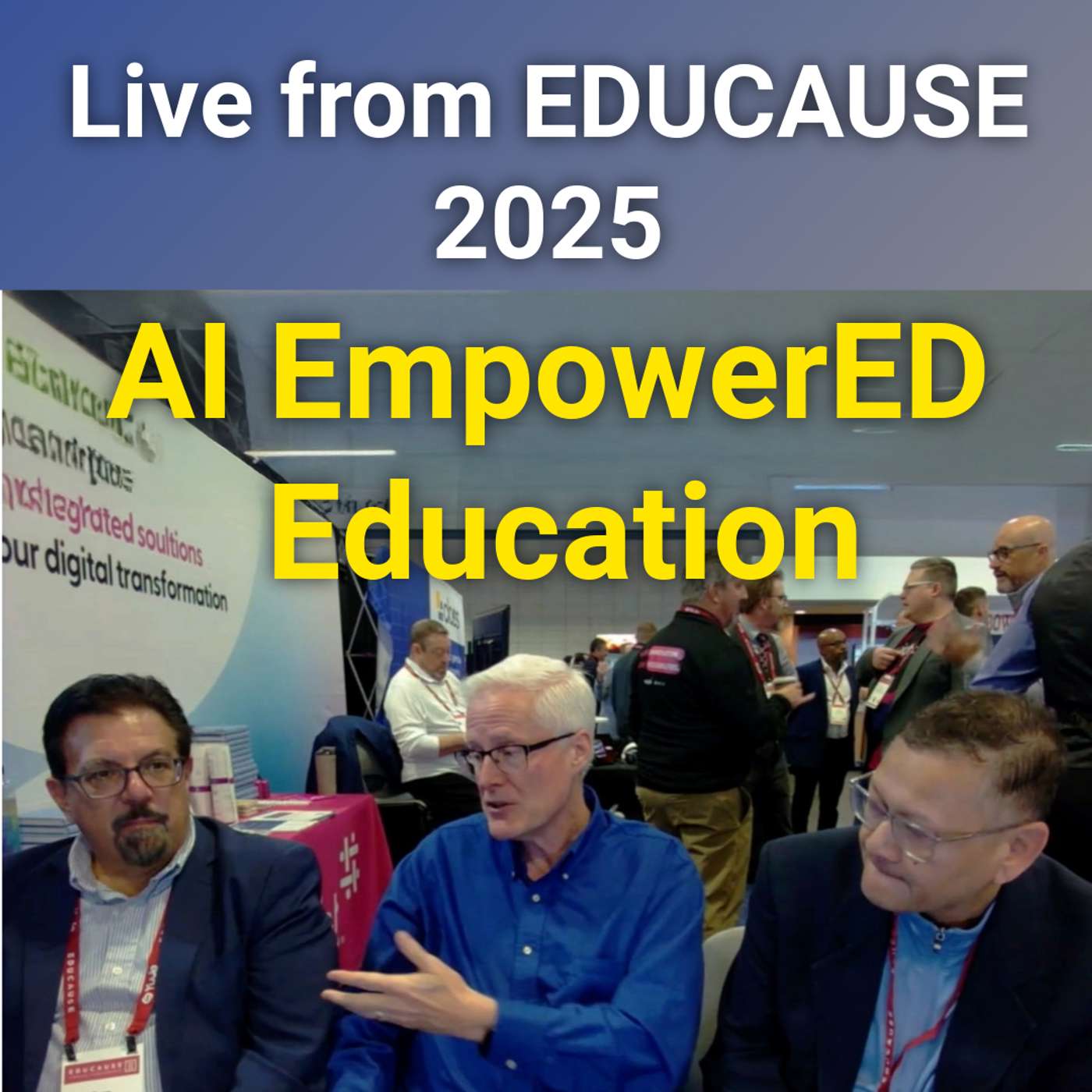
Loading summary
Transcript89 lines
- [00:00]
Anshul Sonek
So this is where we have to truly empower faculty. I'm so delighted that we put a name called Empower because the focus is faculty empowerment with this view. Now that is a whole different notion vis a vis what we see here. Hey, use my tool. I have the best tool for productivity. It's a whole different conversation. That's a game changing conversation which I hope faculties realize. The true power has to be in the hand of faculties.
- [00:26]
Dr. Darin (Host)
Welcome to Embracing Digital Transformation where we explore how people process policy and technology drive effective change. This is Dr. Darin, Chief Enterprise architect, educator, author, and most importantly, your host. Live from Educause 2025, unleashing AI empowered on higher education with Dr. Carm Taglienti, CTO from Insight and returning guest Anshul Sonek from Intel.
- [00:58]
Dr. Darin
Carm, angel, welcome to the show.
- [01:01]
Carm Taglienti
Great to be here. Thank you, Ram.
- [01:02]
Anshul Sonek
Hello, sir.
- [01:03]
Dr. Darin
All right. So angel, you've been on the show before.
- [01:05]
Carm Taglienti
Yep.
- [01:06]
Dr. Darin
Carm, you have not. And so everyone knows on my show that every person I have on the show is a superhero. Every superhero has a background story. We've heard Angel's background story.
- [01:18]
Carm Taglienti
What about yours? Oh, man. Okay, so let me see. So at one point, I want to say it was political election, this was. But at one point we created the exit polling using AI for this particular election. Unfortunately, our candidate. Presidential elections, this particular candidate didn't win. But man, we created this amazing AI system that went behind it. Before, AI was really poor and again, I'm not going to tell you what it was because we lost, but it is written about and it's really cool. But I could have been like the super cool like numbers guy if this particular candidate was won. So.
- [01:56]
Dr. Darin
Well, so you would have been on cnn, you would have been on Fox News and didn't have all that stuff. But.
- [02:01]
Carm Taglienti
And it would have been, oh my God, the numbers. That's why we won. And. But instead now it's like. Well, it didn't quite work the way we expected it to.
- [02:09]
Anshul Sonek
But it's not.
- [02:09]
Carm Taglienti
It's not the AI's fault.
- [02:11]
Dr. Darin
Is it your fault?
- [02:12]
Carm Taglienti
I don't know.
- [02:13]
Dr. Darin
Can I have you on the show if you had something pale?
- [02:16]
Carm Taglienti
I'm not saying a word. No, I'm just gonna. I'm gonna be quiet.
- [02:20]
Dr. Darin
So Carm and I have. We should be recording. Every Friday we meet and just kind of have fun talking. We do.
- [02:29]
Carm Taglienti
It's amazing.
- [02:31]
Dr. Darin
So I'm gonna joke around with Carm a little bit. He's. He's awesome. He didn't explain though that he's A professor at what, two or three universities, right? Yeah.
- [02:40]
Carm Taglienti
So I teach at Otis University. I'm a principal instructor there. I teach in technology topics, of course, AI being modern in cloud computing. And I'm also the academic director of WI Coast University, where I manage a portfolio of classes related to AI and innovation. So that's really fun. I also teach for emeritus, where basically it's a secondary education usually targeted at the working professional, but in this case teaching AI machine learning to folks in Singapore, in Asia. So it's really cool. So I kind of get this global perspective, which is amazing. And they compare that to a CTO for public sector here at Insider.
- [03:24]
Dr. Darin
So I mean, it's really interesting because you and I have similar careers for sure. Technology first, right? And then we moved into NT academia.
- [03:35]
Carm Taglienti
We love it.
- [03:35]
Dr. Darin
Because we love it. Yeah, I do too. I do too. So, and then Anshel, of course is kind of is coming back on the show. Right? You were on the show previously with Hernan from Lenovo, who Hernan has a completely different. He started in academia first and then moved into the private sector. So we got really cool, interesting perspectives on AI and education, which is what we want to talk about today. And specifically we want to talk about the joint venture that Lenovo, intel and Insight have put together to accelerate AI education. Is that the best, Is that the best way you can prove it?
- [04:19]
Carm Taglienti
Yeah, I mean, I think today, and we're just integrating everything together. You guys did all the hard work and it is amazing if you see it. But what it is is it's availability. And I think in a lot of ways, organizations or educational institutions, they don't.
- [04:35]
Dr. Darin
Know where to start.
- [04:36]
Carm Taglienti
So it's like, where do I start? But if we can provide something to them that gives them a place to start. And a lot of the great reconstitute Darren yourt putting everything together and just making it available to us. And the concept allows us to be able to say, go to a community college or any secondary educational institution or even K12 and say we have materials that can run on a laptop on a. No, you could use a server if you really wanted to, but it's really super accessible, easy to use, low barrier to entry, which I think is amazing. We loot that today for AI education because there's a huge gap forming between what education is able to do and where AI is going to college.
- [05:15]
Dr. Darin
Well, so Ansel, let's talk a little bit about the curriculum and show, because we really didn't talk about the curriculum much. And then so on the Curriculum side we talked a little bit about, you've been developing this for seven years. Like, but I mean, so is it only just a. I'm. I'm. I'm teaching people how to do AI or how to develop AI. What, I mean what, what did you target?
- [05:43]
Anshul Sonek
Right. So worldwide, only 2% people in the world of work become AI researcher, engineer, developer. Rest 98% people who go into the world of job or the world of work, broader, more than job, livelihood, entrepreneurship, everything. They all have to use AI to build solution or at least use it responsibly for their work, business, so and so forth, right? So what we are doing is in order to really make AI truly accessible, truly demystify and democratize AI for everyone, we are offering a range of AI skill set for the people to meet where they are. So if you are just a AI power user, you want to know AI, use it in a responsible fashion. We have a curriculum for that. You are using AI for your businesses, right? And you want to build solution for work. Then we have AI skill set it for various industry functions like marketing, sales, purchase, supply chain, trade for specific targeted industry, healthcare, manufacturing, agriculture. That or you may be wanting to become a full fledged AI solution builder in your organization, right? In today's time, you don't have to be an AI engineer or AI developer to build a solution based on your business lead. Then again, no know all this curriculum enables you to become an AI creator, not just AI passive consumer. So the operating philosophy is. And that's what you know. Most of the higher education professors like K go through the stress because people come to professors and say hey, you know my AI solution is very good, sign up for this and I will solve all your problems. Right? For a professor, it's not going to work like this. A, you yourself are learning, so you yourself are going through the huge learning change.
- [07:37]
Dr. Darin
2.
- [07:37]
Anshul Sonek
The shelf life or the half life of the content is changing very fast. Because technology is changing very fast, right? Earlier we used to talk about a five year life cycle. Now we are talking of a two year life cycle and very soon it's coming down to less than a year life cycle. How does an average professor sitting in a rural university somewhere in the country continuously change it? So what is happening? Is it putting additional stress on a faculty? If a faculty like CALM has to develop a curriculum from a scratch on air for agriculture, right? It will easily take two year time to just learn and understand and build it. So this is where we are really shrinking the curriculum deployment time and offering a range of options to the professors so that they get a complete, open, modular, interactive, integrated immersive teaching learning material so that they can have the faculty material, student material, use cases and activities, quizzes, assignments, assessment, jupyter notebooks, all packaged in one container so that they can actually adapt change suit to their classroom environment and access infrastructure. Be it at a laptop, be it in a classroom server, whatever ways, be it in their own content management systems and deploy it so the deployment time goes down. So this is where we offer more than 1100 of our of content. That's the R&D's we are doing. So think about it like an intel inside model. We are providing to a real faculty, like calm so that they can just take it, they can change it, adapt it, fit it to their classroom requirement and go and deploy it.
- [09:22]
Dr. Darin
So what, so what I'm hearing there is with all this curriculum, let's say that I teach at UC Davis. UC Davis is known for its agriculture. Right. Agriculture school. Especially around wine. I mean it's incredible there. So if I'm an ag, if I'm an ag professional. Yeah. My subject matter expertise is wine.
- [09:43]
Carm Taglienti
Yep.
- [09:44]
Dr. Darin
I don't have to become an AI expert.
- [09:46]
Anshul Sonek
Absolutely right.
- [09:47]
Dr. Darin
With this curriculum because it, I'm not going to say dumb, sit down. But it does, it makes it simple. So. But now I can start leveraging AI in and I don't have to become an AI expert. I can start leveraging it. So are you seeing this in where you're teaching because you teach AI, you don't teach how to use AI, you teach how to create AI. Right.
- [10:10]
Carm Taglienti
Right. Yeah. Because I think we're, we're trying to, as Angela said and as you're alluding to it. So if we're moving from this model of there's theoretical AI machine learning, grower, you, you know, oh, that PowerShell gets bottled or Chatbot piece. And then there's sort of the practical application side. And the practical application side is really what we're trying to focus on. You should have a good understanding of what's happening behind the scenes because there is the issue of having to understand should I trust the results. So you should know what usually is going on behind the scenes. But in the grand scheme of things, it's about how am I going to apply this to my particular domain. And I. The thing that you don't want to do as the instructor is I don't want to have to say take all the core material and then model, create that, but also adjust it to the way I want to Teach for my particular curriculum or my suffect area. And I think that's the beauty of this. So a great example of this is getting ready for entrepreneurs. I pulled together the materials Amtrak had sent me, I put it up into canvas and I just said how long is it going to take me? It took me like half a day. So now everything. I have four modules, there's three modules that I upload into Canvas. I created an IC pronounce to it. I imported the quizzes and the assignments and the materials to be able to do is super easy and we can. If you put in the show notes. Well and.
- [11:30]
Dr. Darin
Exactly. Yeah, yeah. It's really interesting because I teach abandoned bulk.
- [11:34]
Carm Taglienti
Right.
- [11:35]
Dr. Darin
And so you sent me the export F in canvas and I'm glad you spent half a day. I spent five minutes and I had an incredible course. Thanks Carm. Right. But what we've done by taking all this great curriculum, taking tools that professors use every day like canvas and also additional work that Carm has done on creating the environment for the students to actually get their work done. A button click, literally the whole environment set up for your students to do the assignments. No more two or three weeks of your students going oh, I can't get it to compile, I can't get it to run because oh, you have the wrong library. You need to. That's gone.
- [12:27]
Carm Taglienti
Right.
- [12:27]
Dr. Darin
So now the students can focus on learning how to leverage these new tools more effectively. So ultimate easy button. That's what we've been focusing on, right?
- [12:38]
Carm Taglienti
Yeah. Yeah. The one thing that I will mention on top of all about it is easy but the side we didn't talk too much about where do we run all this? So we're running it all now. Canvas is a web based application but beyond that everything else will run on your local laptop. So we made it so that it could run on a. Currently it's a Lenovo machine running the intel chipset which allows us to run a basically a container that supports the Jupyter notebooks part of what we do. And then also there's a reasonable lament that's really manageable for a large model. Underlying Kubernetes distribution is but in general we can run any vocal model so that you never actually have to go out to a cloud based service for example, which is pricey, which you all understand. So it makes it so much easier for a student to run disconnected if they really wanted to or for us to create maybe a low cost mechanism for educators to be able to teach these concepts without breaking the Bank.
- [13:42]
Dr. Darin
Well that's something that I actually got in my class this semester because I've been encouraging my students to use generative AI more and more and they came back and said, yeah, hey Dr. Darren, it costs money to use the public gen AI. And I said why are you using public gen AI? You should be using private. And they're like, what is that? So I'm like oh wait, I thought everyone knew about private gen AI. They don't. But this is really cool with what we've done together as an organization. Or is there three organizations working together? We bundle this so we can get rid of the barriers and grease the skids so that if I'm in agriculture I don't need to know all the inner workings of this stuff. I can turn it on, I can have private gen AI or I like to call it personal if it's running on my laptop. I think this is really cool. I think this is going to be groundbreaking in education in the future. So my next question on this is where do you see the future going in education around AI? Oh yeah. How is that going to change?
- [14:48]
Carm Taglienti
Well, I think the entre probably hit on it at least when he was talking about what we're trying to build. I think it's, you need to make sure that things are kept up to date. So basically we see that compression in terms of the advancement technology so those kinds of about structural approaches that we're talking about give you a mechanism for deployment, distribution but also hands on.
- [15:13]
Dr. Darin
And.
- [15:13]
Carm Taglienti
We can do that quickly. So then if we keep doing that then we just focus on the new things that are coming and how to make them available. And then I think the innovations for retell also allows and others allow us to be able to run things on our laptops, desktops, whatever and to be able to do these in a more accessible way without again having to pay a lot of money. So it's sort of moving in the direction of easily accessible and really the ability to try things out as opposed to just read about them. And then I also think that eventually we're going to move down to this, you know, different modalities like instead of typing we're going to be talking instead of communications with a screen, maybe it's an avatar. I do think of course next year is definitely going to be a Gentex. So we'll run local with Gentex and I know some folks here at intel are already working on this. How are we going to, we'll put this into our curriculum. We'd put agentic Right in. So we'll start going into the agentic world and making sure that we can advance our ability to learn by leveraging technology that's become available to us and.
- [16:15]
Dr. Darin
It'S easy to use as well. So let's talk about some of the new, the new stuff because Carm said, hey, someone's got to do the new curriculum. Yep. Right. So we're looking at Ansel. Right. Because this is where it comes from now. Right.
- [16:39]
Anshul Sonek
I think the way AI conversation is evolving over a period of time, especially the faculties have this inner fear or the inner tension. Hey, what will happen to me if AI can become truly agentic AI and everything can be delivered in a self based agentic way. I think as we invest or we do more and more R and D into the new curriculum, we have to ground ourselves or remind ourselves that we are doing this for an actual human faculty. Like now the human faculty, the high tech part is important, but there has to be high touch power. So you can't really teach agentic AI to a nursing school by saying that. Go and watch a one hour video and and then a nursing student will do it. So you have to make sure that the faculties are truly empowered. Right. So there is a content side of it with this new curriculum like Agent TKI and more advanced LLMs and stuff like more advanced disciplines which are coming in and so and so forth. But also from a pedagogy or in this case more andragogy side, we have to create a very safe high touch environment so that subtleties can really implement it with the all types of diverse students. Now this is where you know you have to have some. The learning happens in the brain when there is some friction and hence there's a true interaction between student and faculty. A good faculty will not just dump the content through a self paced model or with just Agent Ki in front of all students. A good faculty like calm will make sure the student and faculties have a deep interaction so the student discover the purpose. Ultimately what's headed where we are headed to your point, the conversation has to shift from a product and the productivity to real purpose, discovery and really personal development so that the true student who's coming to calm with the hope that hey, calm as a good faculty. You're helping me become future pro. You're helping me become more successful for the next 40, 50 years, which is totally unknown and known. Right. So what's that new behavior between Kaam and his students? Right. This is where we have to create a very deep engaging high touch models. So from the quantum standpoint, what are these new cognitive impacts? What does AI mean for educators? When agentic AI come, when new and new technology topic come in, what are the new and new delivery models evolve? I think those two are the good R and D topics which we are paying a lot of attention to.
- [19:11]
Carm Taglienti
Right.
- [19:11]
Anshul Sonek
How do we think with AI? What does it mean as an assessment when you know a lot of things you can already to your point what you do very well. You just ask students to learn on your own beforehand before they come to you physically in a classroom. And then you are not giving them a traditional assessment. You are really asking them a challenging question. Okay, what would you really want to ask? Be differently today so that they get maximum benefit of 45 minutes with Zoom.
- [19:38]
Dr. Darin
This is a fundamental shift though in the way that we've been educating though because I not only talk to Carm, who's an educator, I talk to other educators as well. And when I bring up some of Darren's crazy ideas because I'm not an educator, I'm becoming an educator, you're like wait, no, I like to lecture. And I'm like why are you lecturing? Because I record my lectures and they go out ahead of time. But this high touch interaction, isn't that going to mean though that as I can't have, I can't have 500 students and have a high touch. So that's a fundamental shift in higher.
- [20:21]
Anshul Sonek
Ed because so MIT did a very good research a few months back and came up with this whole research question if to heterogeneity what is making calm different and unique and sustainable for next 30, 40 years? And we used interact with Anshul differently. So this is where we have to truly empower faculty. I am so delighted that we put a name called empowered because the focus is faculty empowerment with this B. Now that is a whole different notion of visa vis what we see here. Hey, use my tool. I have the best tool for productive is a whole different conversation. That's a game changing conversation which I hope faculties realize. The true power has to be in the hand of faculties.
- [21:41]
Dr. Darin
But, but, but is is that that's a major shift in the way higher ed is organized today. Sure.
- [21:47]
Carm Taglienti
I mean our state standard mechanisms for teaching either transfer or understanding transfer learning. Did it work? The classical assessments I think have to eventually change into something more which is personalized which is if I'm teaching you about a particular topic area, how am I able to understand or assume that you've learned it by maybe it's by some kind of interaction, which would indicate to me that you know the material based on your own subjectivity. And now we're getting a little bit more philosophical. But I think in the grand scheme things, that's where it has to go. Because I can no longer just say use the rope mechanisms or determining whether or not you knew a topic area. Like, could you answer the question correctly? Does that really, you know, does that really tell me that you understand the topic? Probably not. But I think we maybe have the opportunity now with these new techniques. I'll call it AI but maybe there are cognitive. More cognitive style mechanism is to be able to truly understand. Did you pick up on what I was teaching for the transfer learning modality or mechanism and does it work? And that's, I think, where we need to go now. We'll go slowly, of course. We can't go too fast because we can't just be like, oh, here, go talk to the avatar and have a nice day and I'll talk to you later. It's feels like you learn something.
- [23:08]
Dr. Darin
Yeah, no, I like. I like high touch. Yeah, we really need to emphasize that more.
- [23:14]
Carm Taglienti
Yeah. Because it is interaction. I think that's how you look. Everyone learns like we're learning right now just by interacting.
- [23:19]
Dr. Darin
Yeah, exactly. But. All right, so I'm going to go to practicality.
- [23:22]
Carm Taglienti
Okay.
- [23:23]
Dr. Darin
Greshman, college experience. Bio 100, my Biology 100 class. There were 1500 students.
- [23:32]
Carm Taglienti
You memorize?
- [23:33]
Dr. Darin
Yeah.
- [23:34]
Carm Taglienti
Yes.
- [23:35]
Dr. Darin
Yeah. No, no, that's exactly what it was. If I'm a professor, let's say I'm going to teach Bio 100 at Vanderbilt University. They probably don't have Bio 100. It's probably Bio 1000 or something. Yeah, right. How do I interact with 1500 students? I don't. Yeah, we have a scale problem. How do I fix the scale problem? Or do I even care?
- [23:57]
Anshul Sonek
No. Such a good question. So in this case, instead of a didactic way of teacher here at the center and 1500 students, where you're distributing knowledge, then you have to kind of reconfigure your classroom interaction. And this is where the core of future of work is. Learning and work remain very social. So then the responsibility of a faculty is how do I organize this 1500 students in small teams and groups. There a lot of learning of the elementary content, whatever biology content you may be teaching, they can do through the group exercises and interaction beforehand. And when they come to you, from a future of work standpoint, as a faculty, you're a coach instead of a didactic instructor. And they are really Giving you a real project or a real learning what they have done and where you as a coach are challenging them to push their team learning, not digital learning, to the next level. Now this is where you have to also reinvent yourself. What does it mean for me as a biologic teacher to be coaching a biology subject with AI? Now that is a new capability. Now this is exactly where we are seeing when we see a digital transformation fail across the organizations. People are taking digital transformation as a technology transformation topic alone. No, it is a people transformation.
- [25:12]
Dr. Darin
People transformation.
- [25:13]
Anshul Sonek
Right. So technology can be very revolutionary while people are very evolutionary. People behavior takes time. This is exactly that. You as a good faculty, how do you really role model that? How do you make sure that teams which are getting formed are very diverse, they are able to challenge each other. If I'm a biology faculty and I'm trying to bring in a new topic like bioethics in AI, right. I will say, hey, interact within your team. Can you understand and identify the new human rights challenges or bioethic challenges which are not parks tool as a faculty or this will put up a little bit of a cognitive, you know, stress on the student to come up with something that they have never thought, which they believe you as a faculty have never thought and come back and push you. Now your ego have to be that point of time. Very, very resilient to say, hey, I don't know, I don't know. But let us discover, let us build this together. That's a whole different capacity creation and capability creation.
- [26:08]
Dr. Darin
So this we're talking about a fundamental cultural shift.
- [26:11]
Anshul Sonek
Yes.
- [26:12]
Dr. Darin
Do you think academia can handle that?
- [26:16]
Carm Taglienti
I don't know so much that academia can handle it. As much as it's an imperative, we have to handle it. If there's any kind, we become irrelevant. Right. I don't think there's any other way around it. Or if we don't, I'll use like Geoffrey Moore ism. But it's. If we don't cross the chasm, we're going to fall into it. Because I think if we don't get there and we don't really understand how we can augment our own learning and understanding through these mechanisms, then eventually it's not so much that we become irrelevant, but it's like it will become more about those that understand and those that don't modality. And I think that's a problem for us as a society. So I think we have to, you must get there in terms of truly understanding what is the essence of learning. How can we really continue to enhance our own human intellect. And I know I'm getting real esopharen here but that's kind of what we're talking about.
- [27:14]
Dr. Darin
Right.
- [27:14]
Carm Taglienti
We're trying to how do we change things to make them more relevant but also to partner with AI techniques to advance our own understanding. And I think that's really important and relevant. So that instead of it's just like classic, we would always say craft for learning means that we all entrely know exactly what Darren knows and Darren knows exactly what Kern knows. We all know the same thing. It's like. But we may be faced with a problem and solve it three different ways. Yep. Because we have all taken different paths. Yeah, they may all be successful, it may be the same target. But in general it's like we've taken different approaches because of our subjectivity. That's human intellect, that's how humans learn. We have to embrace that I think and do more with it. And I think it's possible now with these we can scale with AI techniques, we can scale with large volume processing and data capabilities. So I think we can get there. It's going to take some time but you know the work you guys are doing amazing in terms of helping us to start on the journey.
- [28:13]
Anshul Sonek
It will take time and we have to remind university leaders that ultimately the faculty, he will bring the change. If we start saying that, hey, just go online and figure out yourself to just a self paced learning model. Maybe small, 1 or 2% people will get it. But for you to get a large scale digital transformation for the wider society, that's where I personally believe faculty empowerment is the right step to take.
- [28:50]
Dr. Darin
You know, listening to you guys talk about this it I have 10 kids. Yeah, right. All my kids learn differently which is shocking. You would think they would all have similar. No, they all learn very differently. But in school the way that education is set up is it teaches one way. Right. It peanut butters. So some of my kids in elementary K12 did really, really well. But then when they got to college the learning style is different in college and they had a harder time in college. And then some of my kids that had a harder time in K12 where hey you sit and just pay attention when they get into college and it's more experience and project based, they're thriving. So I'm like wow, we got a big huge problem here. I think AI can now deliver education for all the different modalities of learning. So now I can have that individual experience with a professor and maybe we need to Re change name for professor or teacher to mentor.
- [29:55]
Carm Taglienti
Yeah.
- [29:56]
Dr. Darin
Or coach. Right. Like we're starting to see with some like Alpha Schools is a great example. I'm a huge fan of their model which is AI with AI with a coach. So you get someone there motivating you. You have that high touch, the personal high touch instead of a professor standing in front of a classroom. I think that model just won't sustain its moving forward.
- [30:20]
Carm Taglienti
Yeah, I agree. Fast. Yeah. I think we've already seen the classical lecture model is already starting to become less popping. Where I do you in one of the places where I teach I do lecture for two to three hours but that's becoming less common. It's more of these small bite sized chunks of knowledge and then being able to practice what it is that you're learning. So teach a concept, understand how the content can be applied and then practice not to say so absorb it. Now the way that we can do it is different. Now you can give an assignment and hope that it works. But you don't know that. But I think what is the these immersive techniques that you're describing? I can actually to be there as a, I use the Microsoft term copilot but it's as a copilot or coach. Maybe AI can help support that or the what was the professor now is sort of making sure that you're learning the things that you should be learning and then helping to guide you on the right path which that's a really good role for those that are more learned in this space. Help to guide you down the path. Not so much create the instructional design for do this, do this, do this, do this. That's more of the I need to guide you down the path to get to the target and you one of your 10 kids is going to learn differently. So I need to sort of use baby use AI or understand you more officially to be able to guide you based off of your the way you learn, your preferences, your subjectivity, your experiences, whatever.
- [31:52]
Dr. Darin
So I really think that this model, the stuff that we're creating, the new curriculum coming from Intel Insights, ability to make it easy to consume, will give us more humanity and education in the future. I think the future is bright and I think we can actually elevate society as a whole because we can reach a lot more people that have different ways of learning. Instead of oh you got your PhD, that means that you sat and read a lot and wrote a lot which is what a PhD is. But now we can start educating more and more people and elevating society as a whole. I think this is incredible. Yeah.
- [32:33]
Anshul Sonek
And one more additional point around this model which I want to highlight for the audience today and leader in the university system or a community college system, they need to take a separate decision for the faculty development, for the curriculum development, for the training, for the IT infrastructure and for the integration services. Now imagine the stress for the leader, himself or herself who is going through this transformation and taking five different point of diseases. It's very difficult. Now what this model allows you as a leader is really bring all together faculty development, content development, curriculum development, training side of it, integration side of it, infrastructure modernization side of it. And on top of it, keeping your AI data private, safe, local so that your data remains yours. You create your own competitive advantage for your own local innovation capabilities. All that with a very well defined, well packaged solution whereby instead of going to five different places, you bring it together.
- [33:36]
Dr. Darin
So the easy button is here, the easy buttons here.
- [33:39]
Carm Taglienti
And it is a journey. It's not going to happen in one day. Yeah. And I think that's the real important part of all of this is why we're talking to the people today is let, let's get on the path because they can't wait any longer.
- [33:51]
Dr. Darin
Love it. Guys. Thanks for coming on the show. This has been incredible.
- [33:54]
Carm Taglienti
It's been.
- [33:55]
Anshul Sonek
Thank you so much.
- [33:55]
Dr. Darin
We always have fun. We always have fun.
- [33:57]
Carm Taglienti
This is awesome.
- [33:58]
Anshul Sonek
Thank you.
- [34:02]
Dr. Darin (Host)
Thanks for listening to Embracing Digital Transformation. If you enjoyed today's conversation, give us five stars on your favorite podcast, podcasting app or on YouTube. It really helps others discover the show. If you want to go deeper, join our exclusive community@patreon.com embracingdigital where we share bonus content and you can always connect with other change makers like yourself. You can always find more resources@embracingdigital.org until next time, keep embracing the digital transformation.