← Embracing Digital Transformation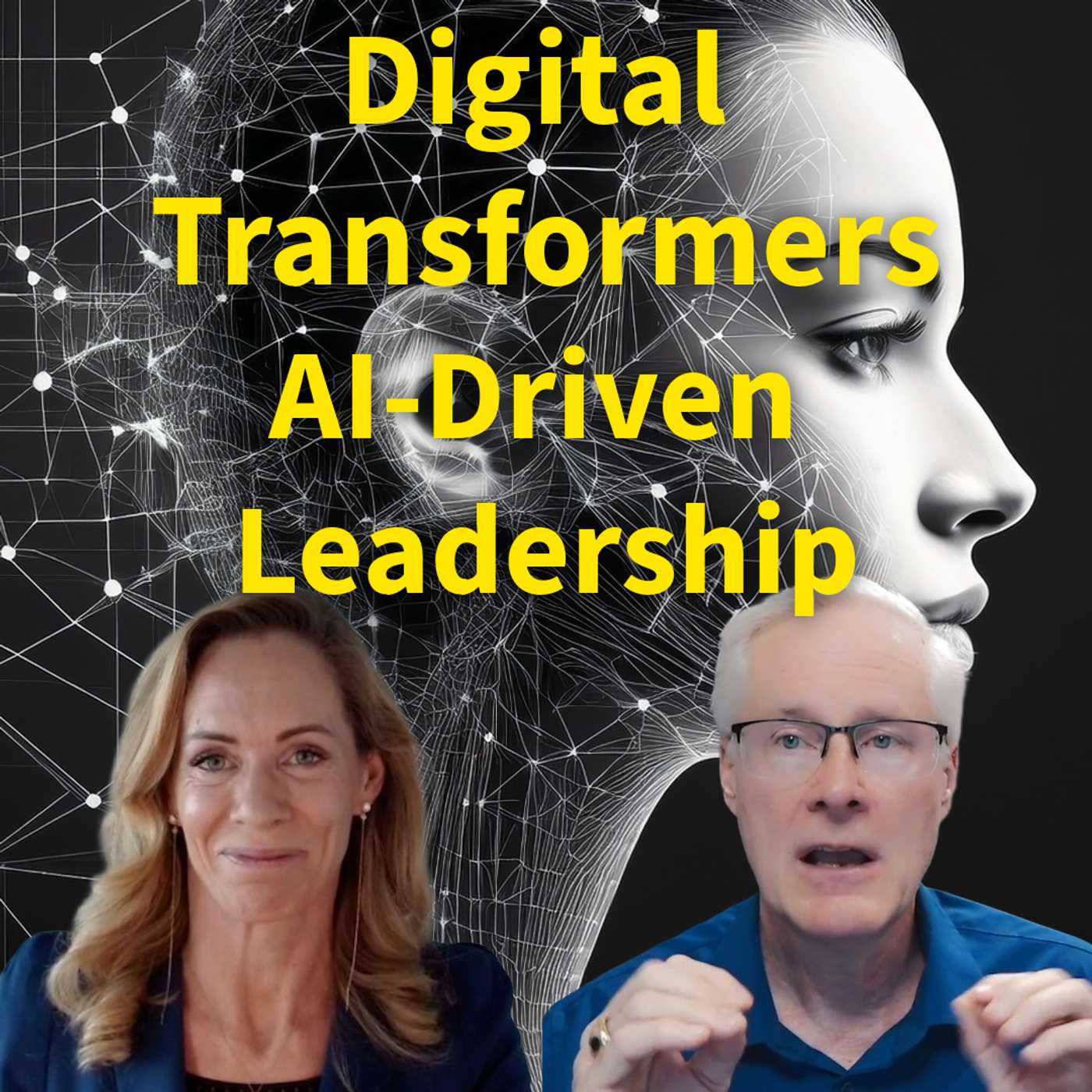
Embracing Digital Transformation
#308 How Digital Transformers Win: Louisa Loran on Culture, AI
00:31:32
Loading summary
Transcript96 lines
- [00:00]
A
I would start by asking you, how do you intend that your company makes money in the future?
- [00:06]
B
Keep doing what I'm doing.
- [00:09]
A
Well, then we would probably look at that market that you are serving today. Will that exist in the future or will someone else serve it better than you? I think a lot of people are saying I make money today and therefore that's fine.
- [00:24]
B
Welcome to Embracing Digital Transformation where we explore how people process policy and technology drive effective change. This is Dr. Darren, Chief Enterprise architect, educator, author, and most importantly, your host on this episode, How Digital Transformers Culture, AI and Leadership With Change agent and executive coach Louisa Loran. Louisa, welcome to the show.
- [00:57]
A
Thank you so much. Great to be here.
- [01:00]
B
Hey, we had a great intro call. I says, oh, we have to have Luis on because this is a great topic that needs to be addressed. Of course.
- [01:08]
A
Right.
- [01:09]
B
Otherwise we wouldn't have it on the show. But even more importantly, everyone that listens to my show knows that I only have superheroes on the show and every superhero has a background story. So Louisa, what's your origin story?
- [01:23]
A
Well, thank you. I. I think everyone's a superhero. Just some people haven't really found it yet.
- [01:28]
B
Yes, I like that. I like that a lot.
- [01:31]
A
I, I would say that people would probably say I'm a superhero because I can be very sharp but always kind at the same time. And I think that has really come from the combination of being born in probably like the most fairy tale country of the world in Denmark, but always had a global mindset. My career has been built across three very different industries, across Mod Hennessy and Diageo consumer brands. And there I worked in several different continents. After that I went to Maersk, so a logistics and shipping conglomerate. Very, very different environment. Also super interesting. And then I've spent four years at Google.
- [02:11]
B
Again, different all over the place. Louisa.
- [02:15]
A
And I really think that curiosity to see things from different sides means that I always am keen to understand where are people coming from and how do they see the world and have empathy for their view on things. But I would say that also means that one sift out a lot of things that are just not relevant and interesting.
- [02:37]
B
Well, well, that's interesting because you work for companies that have very different industries. Very different cultures would be my guess.
- [02:45]
A
Yes.
- [02:46]
B
And, and, but both corporate cultures and then also country cultures too, right?
- [02:52]
A
Absolutely, absolutely. I think, I think that's really what's been curious about this and interesting and, and why I'm now actually in my fourth chapter here, bringing that to a wider audience because I do see how many of business. Mistakes and decisions are simply made because one does not have access to the information on the other side of the, of the pattern. And especially of course in a world where a lot of activity and investment is going into digital transformation, AI investments, et cetera, that shift from having represented that within a traditional corporate and getting on the other side, understanding it from a Google perspective, I firmly see that it's fundamental strategic decision, leadership decisions, et cetera that are actually the biggest hindrance is not which piece of tech you deploy.
- [03:40]
B
Well, that's that, I mean that's, that's very interesting because we're in the throes of a lot of mistakes right now. Let's just be, let's be brutally honest, right? There's a lot of big corporations out there making huge strategic disasters in their investments in just tech because they're, they're just being. I've got to jump into the AI bubble or I'm going to miss it. But they're missing it anyway. Why, why is that?
- [04:06]
A
Well, I think, I mean, just to, to bring some perspective, my last role at Google was strategic business transformation for EMEA's largest customers. So all of these companies have long tenure successful businesses, et cetera, and had made significant investments into Google but also into other technology platforms. And we came in and we were trying to understand maybe why they weren't getting the returns they were expecting or helping them reach that next level. I will say without exception, the answer was never technology. It could be that there were technology tweaks after looking into it. But, but I think what's going on right now is that people have built a success and now the, the rules of the game are somewhat changing and instead of understanding which of my capabilities from the past do I deploy in this new world, I see two behaviors. One is I have to jump onto everything, just join, just try. And in that process, maybe I'm giving away my gold or the opposite of saying that's the enemy and I'm protecting myself, I'm building up walls. And of course neither are going to pave the path to you being part of that technology enabled future.
- [05:18]
B
Well, I mean it, this is a, I've always heard the term success breeds complacency. Right. So is that where we're kind of sitting?
- [05:30]
A
Where.
- [05:30]
B
Because if I'm successful, my old strategy, even though it might be a bad strategy, I don't know that it's bad. Right. Especially when it comes to adopting new technologies.
- [05:42]
A
Yeah.
- [05:42]
B
So, so I, I like how it's almost binary. Right. It's I've got to move or, or I'm, I'm digging in my heels.
- [05:51]
A
Yeah.
- [05:51]
B
Where do I find the in between?
- [05:53]
A
Yeah, I, I, I'm clearly a change maker. And previously I always said I want to work with people who want to change and who aspire for more or whatever it may be. I think now the situation is such that no one can say they are not willing to develop themselves or to change because the world is moving at such a pace that if you don't, you will by default get left behind. But I agree with the point that, that a lot of the successes, a lot of the knowledge that's been built into organizations, into systems, et cetera, is unfortunately not necessarily tuning the models of the future at current time because of that complacency. And I think we can also see the cultural differences around the world of those who have rested on laurels that happen. Successes that happened 50 years ago are now realizing we maybe would have, should have slept slightly less. Right? And I think that's really where I find this time incredibly interesting, incredibly important. I am a geek at heart. I'm curious about all the technology, but I still say that most often that is not the real question. Most often the question is, what's the proposition your company has and how can that be relevant in a future? New revenue models, new technology, whatever it may be.
- [07:23]
B
All right, so I'm an executive. Let's put on our executive hat. I'm executive. I'm looking at the crossroads here because it's a major crossroads. I, I think even bigger than the 90s and the Internet and even the mobile revolution. This one's a lot bigger. What's my first step? And let's say that I'm very ultra conservative in, I've been doing fine. My company, it's 40 years old. Everything's been working like clockwork. I'm making good money, but not everything's going great. What do I do?
- [08:03]
A
I would start by asking you, how do you intend that your company makes money in the future?
- [08:09]
B
Keep doing what I'm doing.
- [08:11]
A
Well, then we would probably look at that market that you are serving today. Will that exist in the future, or will someone else serve it better than you? I think a lot of people are saying, I make money today, and therefore that's fine. But if you try to project yourself into a future where some of these things that are small initiatives today have reached a scale, why would people still be with you if they are still with you? Because of legacy and past behavior that could maybe last your personal Executive tenure out.
- [08:42]
B
I only care about the next five years. Right. So I'm okay.
- [08:45]
A
Right? Yeah. No, I, I will say I had the pleasure once being invited into a forum of top, top, top executives. It was a very senior room. The wealth in that room was significant. I was there to represent the conversation about cloud and we talked about how to operate the business in the different ways enabled by cloud technology. And it was a polite debate. It was, I would say, highly scripted in going into it. But of course the Q and A opened it up and I left the room and I was thinking this was a funny conversation because the information had been served, but I had a sense that it hadn't fully landed. As I was walking out the room, a very senior, very, very, let's say, prominent gentleman followed me out and he, he basically said to me like, just so you know, it wasn't that we didn't hear you, we're just deciding whether we can postpone it till after we have retired. And oh gosh, I was like, well, on one hand I really respect you for your honesty and thank you for telling me because that could have been a head spinner forever.
- [09:56]
B
Oh yeah.
- [09:58]
A
But I think that that is going on in many businesses today and I don't think we should be playing a blame game towards these individuals because I said there's a reason why they're there. But we need to make sure that the different business models that technology companies deploy today, that cloud computing can create that Edge and Web3 and all these would enable, step into that world now and try to work back. I'm not saying you should throw out the baby with the bath mortar, but your question, if you were executive and I said, imagine a world where Web3 is deployed at scale, how would you make money then? And we would have that conversation as a hypothesis.
- [10:39]
B
I like this approach. I like this approach and I think, I think you hit it on the nose. A lot of the executives are like a little bit paralyzed and maybe it's too much change for them with everything going on that they're like saying, if I can just last for the next five years until I retire and just keep the boat steady. Because once you're at that point you become highly risk averse. Unless you're Elon Musk, right? Who, who cares? Risk everything. Right. But not a lot of people have that kind of personality that, that can take on that much risk that are willing to lose everything. Right? There aren't a lot of people. So.
- [11:22]
A
But, but I think, I don't think we, we should at all be pointing fingers because they are there, because they have protected something quite well. Right. They have deselected a lot of threats in the past. I think there's a lot missing in the communication between those who go out and say, this is the only new future and this is how it happens, and those who say, I'm scared and therefore I'm not really listening to talk about actually, how could this be different? I mean, I. Many businesses spent the last two years doing use case lists for AIs, right. So they spent and they had workshops and they brought in people, and at the end of the day, 18 months later, 90% of them ended up with the same list. Right. Did you need that process? Probably not. You could have started by working on the culture in your organization to say, let's test this internally. Let me stop asking you questions about some of the things I used to ask that I expect you to be in control and let you learn, let you play. And then you come back to me and say, what has it served you? Over time, the organization will learn how to search documents in a different way way, and silos will be broken down so that it's no longer one department defending against the other, but actually a shared knowledge and shared database that they can then start saying, how can we bring this externally? How can we serve our customers better? But I think there's been a reverse behavior in many instances.
- [13:06]
B
Yeah, I really like this approach because what you're saying is you're creating a culture of experimentation, a culture of trying new things out and making it safe, right? To say it's okay to do this because I. I think we all know culture. Culture eats everything for lunch, right? In an organization, it eats process, it eats technology and everything. So if you change the culture first, then the new use cases will evolve on their own, right?
- [13:37]
A
Yeah, yeah. But I think the combination of saying, I empower you, I unleash the collective intelligence, I give you the tools to test with, I give you access to data, whatever it may be, and here's the direction we're hoping to go in. Because I also find that there are a lot of people now that everything looks like a nail if you only have a hammer, right?
- [13:59]
B
Yeah, yeah, yeah.
- [14:00]
A
Let's put AI to everything. No, let's discover together in the direction of where our future revenue is likely to sit.
- [14:11]
B
That's a lot of. That's a lot of guessing.
- [14:15]
A
I don't think it's guessing if you look at it from. I need to continuously learn because everything that comes back to you am I close from where I intend to be. And this also teaches an organization a behavior where they can be more agile. Because what we're also seeing now, of course, is that as everyone deploys more and more AI into their businesses and into their models, you don't know whether your competition or your partner is going to come up with something tomorrow that's significantly better than yours. And then you need to make a decision which is very normal in the tech world, very unique, very rare in a traditional world that says, do I actually choose to use them instead of mine and focus on building something else.
- [15:01]
B
So that that leads to an organization understanding their core strengths and their principles even better than they have in the past.
- [15:09]
A
Exactly, exactly.
- [15:11]
B
Otherwise they easily get distracted. Right. I mean, we saw, we've seen this in large companies. Well, in some companies, I go back to Kodak. Right?
- [15:21]
A
Yeah.
- [15:21]
B
A lot of people don't know Kodak invented the digital camera.
- [15:25]
A
They certainly did.
- [15:28]
B
They don't exist anymore. Not, I mean, because they felt that that was outside. They are a film company. That's what they were. So they missed it. But boy, that's a tough, that's as tough to strategic decision. Right. Is this technology coming in that disruptive that I need to change my core? Because Kodak core was film. They were chemical. They were a chemical processing company.
- [15:56]
A
I could tell you when, when I was at Maersk, the transformation we drove there was very, very significant. Maersk was a conglomerate that had ports, ocean shipping, a small freight forwarding business, and oil and energy. And there was a decision to sell off oil and energy and the belief that you needed a business that was less cyclical. And also because there was a perception of where energy was going to move. So good foresight on that side, then what was left was transport and logistics. And what we did was spend time with our customers to try to understand actually where does adjacent revenue sit? Where do we have pain points that could actually be enabled in that part of the journey that we represented? It was very obvious where some of those adjacent businesses sat. Because of course, the more you move into handling and supply chain optimization, et cetera, the higher the cost versus a commoditized movement from A to B. But that dilemma of saying how do we actually show them that we are optimizing for their benefit while we know that the main business we are handling is something that is very functional at the core, not very different from an infrastructure provider in the tech space that also has services on top. But I think what we were very clear on was how do we use the strength of the fact that we do hold some infrastructure to show that we can service them better while continuously demonstrating the benefit of having the adjacent services with us. We were also very clear when actually there were parts of the business that were not required to be connected to those who held the infrastructure. And I think this is, I said it's, I saw it in the physical space there afterwards, I saw it in the digital space and infrastructure. But these journeys of saying where does money get made in the future? I think is a, is a mindset that is very much neglected in strategic planning in that journey, of course there will be years where, you know, you may need to take a dip. The incumbent's dilemma in order to shape the future. And just having that awareness I think is lacking in a lot of strategic decisions today.
- [18:11]
B
Well, do you think that's because we're so short term focused? Is that one of the reasons why I'm not willing to take that dip? I kind of blame Wall Street a little bit on this because of the quarterly type of mentality. Is that play into this?
- [18:28]
A
Yeah, I, I'm, I'm really not one for blaming because I think the whole point is Wall street listens to what we show them. Right? That's true, that's true. A pressure of immediate return. But as an exec, you also have the accountability to say this is how I'm going to make my short term return, this is how I'm going to make my long term. And so it's better on the journey, not just surprise surprise, we didn't hit our target. And then when they come and ask you can say oh, but because our attention was over here, because it's a logical argument to say I'm moving to this space that ether has increased loyalty, higher margin or whatever it may be versus saying I'm sorry I didn't hit my target. And I think that a lot of companies right now either expecting the large scale text to build models to solve business level problems or expectations expecting their software providers that have existed for decades to upgrade when really the knowledge sits in many of these large conglomerates and they have an opportunity to say I'm going to define the future. That doesn't mean that they should service models for the entire industry, but they have an ability to have a share of a product or a partnership or many of those forms. So I think we should be saying more leaders who are willing to have, let's say more portfolio products within their remit.
- [20:08]
B
So do you see then consolidation happening? I mean we saw it. In the, in the 90s with the Internet, we saw consolidation happening across multiple industries. So do you think that's, that's the way that organizations are going to be able to survive large ones, by consult, by purchasing and partnering, forming these large conglomerates?
- [20:33]
A
Honestly, I don't know. And I also, with all due respect, don't think that's the key point. I think the key point is those who have access to the knowledge today, how do they use it? And either you can do that through a conglomerate and use that control, or you can go more of the, let's say, more techie mindset of saying, how do I build ecosystems?
- [20:58]
B
That makes sense. So that's just a technique. That's just one of the techniques. It's understanding the. Understanding the future. Man, that's. Boy, you got to put on your Nostradamus hat or something. Right. To figure out what's going on.
- [21:15]
A
Or, or you just need to train your ability to continuously learn. Right. And not be afraid of whatever future that is because we don't know where it's going to go. But those who panic are the ones who haven't trained themselves in being curious, looking wider, partnering, expanding, prioritizing, deselecting, but also then redefining themselves in that new world. As you said, Kodak died not because they didn't see the vision, they died because they didn't invest in it and because they couldn't redefine themselves in that process. If we look at other companies that are really good, they have redefined themselves multiple times.
- [21:56]
B
Are there certain industries that do a better job of this than others? Are there some really good examples where you see industries that tend to be more adaptive that we can look at as an example?
- [22:10]
A
I think that we see that consumer industries get the push from consumers faster and therefore get forced to move faster. So, of course, as a Dane, Lego, I think, is a great example of a company that was really, really functional bricks at one point in time, then it was more. I'm expanding into toys, then it was games, then it was music. But at its core, it's a version of LEGO the whole way through. Right.
- [22:36]
B
That is it. Yeah. When you think about that. Yeah, that's. That's very true. Lego is iconic. Everyone knows it. But yeah, they produce movies now.
- [22:45]
A
Right? Yeah. And that is understanding that the revenue of the future doesn't just sit in bricks anymore.
- [22:54]
B
Yeah. But core fundamental. They sell bricks.
- [22:57]
A
Yeah, yeah.
- [22:59]
B
Interesting. Very interesting. So, all right, now let's say I'm on the other end of things. I was conservative Now I am not an Internet startup because that's a whole different type. I'm, let's say I am in the Silicon Valley and I'm always pushing, pushing the edge because we had this at intel. We had a CEO that was always pushing out there, drones. We had lots of things but, and, and they were going in lots of different directions to see what would hit. Right. The, the concept of let a thousand blossom or let a thousand flowers bloom and then pick the winner.
- [23:38]
A
Yeah.
- [23:39]
B
Didn't work for us. Right. Because we, we're suffering because, because of those decisions.
- [23:46]
A
Yeah.
- [23:46]
B
So what do I do in this case? I'm more aggressive.
- [23:50]
A
Yeah. I, I, I, I will say these are some things I've experienced throughout many decades of, of working with different industries, different executives. But it became crystallized when I had to share it wider now and I put it into the book I've just launched. It has those four behaviors I briefly mentioned. Expanding ambitious. Sorry, envisioning ambitiously, which you definitely hadn't have an intern.
- [24:14]
B
Right.
- [24:16]
A
Collaborating with curiosity also does exist. Steering decisively, that's where one needs to learn from the traditional companies, where you have a clear view of how do I prioritize, how do I staff for the future, how do I communicate in a way where both internally and externally people can follow the change I'm going through and how do I embody with presence. So I would say it's the two last ones that the Silicon Valley teams need to really spend time on because I've seen it as well in great companies, everything can be solved, but if everything's a priority, nothing is a priority.
- [24:54]
B
Yeah, yeah.
- [24:56]
A
So that awareness of saying it's still this direction we're going, this is still what we're aiming for. So lovely idea you have there. We're going to not focus on that, but please deploy your thinking in this direction. That messaging of saying your contribution is valuable here. But we're missing this piece. Does anyone have this piece? Just leaving it out there. It creates a, a set of mushrooms growing. But no one said that they really wanted a, a full field of it. They just wanted one big tall one. Right.
- [25:38]
B
This is interesting because the, the last two points are very highly visible, which a lot of companies in Silicon Valley like to protect their ip, so they don't, they don't project their, their future very well.
- [25:53]
A
Right.
- [25:54]
B
I think that was one of the problems at intel was it was like we've got all this stuff, oh, you know, out there, but we, we don't want to show people our long term Goals.
- [26:02]
A
Right.
- [26:03]
B
Because our con, our competition will know what they are. And then, you know, but, but I.
- [26:08]
A
I do think if you think of some of the, the like, if, if you listen to how War Buffett prioritizes, he doesn't say what he's going to invest in, but he still sets an intent and his team knows what is expected of them. Right. I think it's the same point. You don't need every detail because chances are you don't know every detail because you don't know what's going to develop into it. But you give people a sense of direction, a sense of purpose, a sense of ownership. And I think that's what also happens, lack of ownership. When people can just invent their own thing because then that's what they own. They don't own Intel's future, they own their own idea.
- [26:44]
B
I, I like that a lot because that, that ownership and accountability in the digital transformation is, is key. I've seen this myself several times. If there is no owner.
- [26:55]
A
Yeah.
- [26:56]
B
And no accountability, then nothing happens. It just sits there, like you said, like mushrooms. It's just.
- [27:04]
A
Yeah. And I think this point on, on, on embodying your change. Naturally, if you are a younger company, you haven't had the expertise in doing that. Right. You need to practice as an individual, as a leader. Like before, I was this type of leader. Now I'm this type of leader. How do I behave in a different way? How do I create the comfort for others to follow me? And that we can talk about on a very personal level, but we can also talk about it in a digital and data environment where everything is out there and you need to look at who do I connect to, which data do I bring in here? Because when someone is solving a mathematical problem, we all know the answer will be different depending on which data sources they pull in. So standing here and saying, I'm comfortable, I'm leaning into this and I have this knowledge, if you want to connect to me, you can.
- [27:55]
B
Now that I, I really like this collabor, this collaboration idea that you're coming up and frankly, generative AI allows this to happen even more easily.
- [28:05]
A
Absolutely, absolutely. But I also think. What?
- [28:08]
B
Sorry, no, go ahead.
- [28:11]
A
No, I think what Generative AI also does. It also, it lifts the floor. Right. If you are lazy, you could just use that. But those who are good enough to say, this is the prompt I'm giving you, this is, these are my expectations. No, I deselect that. No, I want a different data source. Da da da da da. It becomes an Accelerator. So at current time, there are still a large part of the world that says thank you for the ease and now we're just going to be lazy. But those who truly understand it as a tool, as a laptop or a calculator or some of the other tools we've had in the past, they suddenly are not confined by their own learning space if they are able to write, ask the right questions.
- [28:53]
B
Right, yeah, I've, I've, I've noticed that. And I had someone else talk about that on a podcast that's, that's actually come out last week, which was AI seems to be increasing the chasm between the lazy and your high performers. I shouldn't call them lazy, but they, I mean your, your mid performers and high performers. That chasm is growing because the tool is, is so valuable if you actually invest some time into using. Otherwise. Yeah, you can skate along right on the bottom.
- [29:28]
A
Right. Yeah.
- [29:31]
B
So, hey, this, this is all real fascinating, Louisa. If people want to reach out and learn more from you, how do they do that?
- [29:40]
A
Well, I would love if they could because I will also learn in that process for sure. Of course, I would encourage them to go buy my book. It's interesting and daunting to bring a book to the market for the first time. It's called Leadership Anatomy in Motion. And it is really that because it's on the premise that everything is within you. You have the eyes to envision, you have the lungs to expand, you have the arms to steer, and you have your spine to actually move forward with Facebook. Yet agility. So Leadership Anatomy in Motion can be bought on any platform, on Amazon or wherever you buy, of course on LinkedIn, but as well on luisaloran.com where I'm also sharing some of the experiences I'm gathering along the way. I would love to continue the dialogue with more listeners.
- [30:24]
B
Louisa, this is, this has been great. It's a new perspective. I love it now. It's gotten me thinking about my own business and with the podcast. Oh, what? How am I going to make revenue out of this? Well, I need to figure that out anyway. And how am I going to make.
- [30:41]
A
Revenue in the future conversation as it develops in your head as well?
- [30:46]
B
Yeah, yeah, absolutely. So, hey, thanks, Lisa, for coming on the show.
- [30:50]
A
My pleasure, Darren. Thank you.
- [30:57]
B
Thanks for listening to Embracing Digital Transition Transformation. If you enjoyed today's conversation, give us five stars on your favorite podcasting app or on YouTube. It really helps others discover the show. If you want to go deeper, join our exclusive community@patreon.com embracingdigital, where we share bonus content and you can always connect with other change makers like yourself. You can always find more resources@embracingdigital.org until next time, keep embracing the digital transformation.