← Embracing Digital Transformation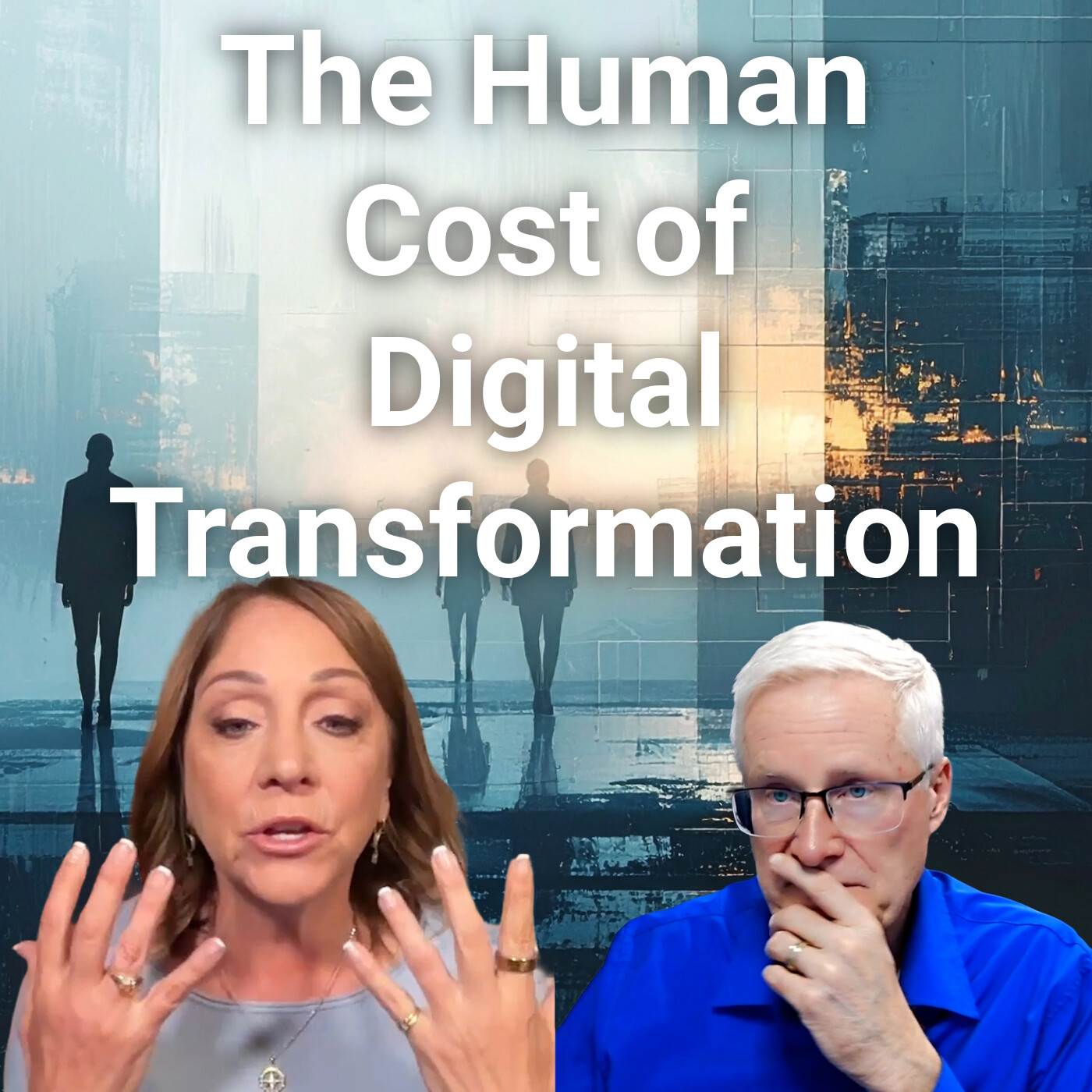
Loading summary
Transcript76 lines
- [00:00]
A
I talk about the perfect storm and some companies, Darren, are getting better, but most are not and most are resisting. So the companies are resisting reality and employees are resisting reality. And I think this shakeup is going to get worse before it gets better.
- [00:22]
B
Welcome to Embracing digital Transformation, where we explore how people process policy and technology drive effective change. This is Dr. Darren, Chief Enterprise architect, educator, author, and most importantly, your host on this episode, navigating the new workforce landscape with Margaret Graziano, executive coach, author and superhero. Margaret, welcome to the show.
- [00:56]
A
Thank you. Thank you for having me, Darren.
- [00:59]
B
Hey. Everyone that listens to my show knows that we always do these weird introductions. Darren's a weird duck that way. And everyone knows that I only have superheroes on the show and every superhero has a background story. So, Margaret, what's your background story?
- [01:17]
A
Okay, my background story that makes me a superhero, I would say. Kid of a lovely household until I was 8. And then my dad took a turn for the worse and engaged in massive drug abuse. And we had to become survivors. And I really tuned into a higher power and found myself in a little bit of a pickle. When I was 20 years old, I was pregnant, I had to get married, didn't want to get married. And a year later, the guy had 22 jobs. He wasn't supporting us. He just couldn't function. The man I married, a product of my not being able to understand what right looked like as a kid. And I made a powerful choice. And that choice was, my choice was go downtown, collect aid. And they told me you could stand in line for two days and never get the aid or. And the alternative was take a straight commission job, which my, my draw. They borrowed me $5 an hour and I did that straight commission job. And it turned out being a remarkable 20 year career in recruiting. And I think I became a superhero for that little boy. I provided for him, I provided a good life. I loved him. My son David. And I became an extraordinary recruiter. And I did that, like I said, for 20 years. And it could have went very different.
- [02:57]
B
Oh, yeah, it could. I mean, you, you strapped on your boots and got to work, it sounds like. Or you could have just curled up in a ball and. And would be defeated, basically. I mean, those are your two choices, it sounds like, right?
- [03:12]
A
Yeah. And it, you know, that I think that that goes for even at 12 years old. So what happened from like 9, 10, 11, 12, 13, 14 all the way till 20 years old was a precursor for when push came to shove. Am I going to be a victim to this terrible mistake I made or am I going to go do something about it? And I've carried that grit, that integrity, that perseverance through my entire career.
- [03:46]
B
That's an awesome, awesome story. I don't know what else to say about. I mean, I'm glad you're on the show. Obviously a superhero. Margaret, let's talk about recruiting. Let's talk about the change. We're seeing a massive change in hiring and recruiting. And. And I've had a couple people on the show that talk about this, but we still haven't. We still haven't pinpointed exactly what's going on in the industry right now. People are blaming AI. That's not everything. People are blaming the Trump administration. That's not everything. People are blaming post Covid I. There's a whole lot of stuff going on.
- [04:31]
A
Okay, so just to be clear, what.
- [04:32]
B
Do you think is going on?
- [04:33]
A
Yeah, so just to be clear, I'm no longer in recruiting. However, part of the services of my company is we support selection, employee selection, especially on the leadership side, for culture. So what I think is going on is a amalgamation of a lot of moving pieces. We have an aging workforce, the gray wave, and people are aging out. And we have organizations that weren't really looking out on the horizon to say in the year 2025, we're going to lose a third of our workforce and we better have a succession plan. So many companies call me and say, we have no succession plan and six people on our leadership team are leaving, retiring this year. So I think that's part of it. Another part of it is all this resistance of millennials and Z's, and they're high maintenance and they want purpose and meaning. And instead of doing something about it, we're going to make them wrong. I think that is another pinnacle of. They're now 60% of the workforce, and by golly, they want purpose. Meaning. Meaning flexibility. They're not going to steal from their life to go work and make someone else rich. And they're clear about it where my generation, we did what we needed to. I just told you my story. I worked straight commission and I worked a lot of hours and I did what I needed to do.
- [06:06]
B
You're next gen then.
- [06:08]
A
I am. I am. I'm on the border. Right. My sister says you are not a boomer because I'm 1964. So another thing that's happening is the World is Flat was a great book and a real book. And this is when I first made the choice to get out of recruiting. It took Me about eight years after reading that to do it. But I knew we were going to have the level, the field was going to be level. And so now anybody, any age, can work from anywhere.
- [06:42]
B
Anywhere. Yeah, yeah. The whole market's changing.
- [06:45]
A
They can get paid well to work. This is my home studio. I put a studio in during COVID and I gave up a bedroom. Now some days I wish I could rent out the bedroom or rent out the studio, and I can still do that. But, like, you can work anywhere. So now we have an aging, an aging intellectual capital. The people that know how these companies work, they're leaving. They had no plan. We've got the new comeuppance and they're saying, I want the work, but I can work differently than my predecessor. Predecessor work. I don't have to work as many hours. And if you don't want to give me what I want, I'll go work overseas from my house. You also have a lot of people who are disillusioned with politics and with how our country is being run. Whether you're a Dem or a Repub, people are pissed off on every level for how what is going on. It's just not humane, this, this craziness. So you've got that, this, this. And the news, whether you're for or against the news, is pummeling our. Our attention.
- [07:57]
B
So you see it as paralyzing. A lot of people, mostly companies, are paralyzed. Individuals, I don't think are nearly as.
- [08:06]
A
Paralyzed, both because these average. The average human and companies hire humans and humans work at companies. The Average human gets 140,000 bits of information spewed at them every day. And. And if they're on social media, you just go on and boom, boom, boom, boom. And they're barraged. And our little prefrontal cortex, you know, it's magnificent. It has its own superpowers. But when it gets overloaded, we experience cognitive scattering. The brain can only hold on to 120 pieces of data a day. And then the brain sorts out what of those 120 matter. What, what don't matter. So you've got all of these things happening. Then you have this external. And it's not just in our country. There is an upheaval in almost every country, and people are just unhappy. Now you have an economy that it's costing more and more money to buy bread, to buy gas, and people aren't making more money. What else? Oh, and then you have AI. And here's the deal with AI. Part of the problem is companies think some Leaders in some companies think AI is the big solution, it's the holy grail. But the problem is AI needs to be run by people. And if people are afraid of AI, they're going to say, sure, I'll do it, I'll do it, I'll do it. And then they'll go. So we use to do our manual for a retreat I just led and it was beautiful. But companies think AI is the solution. People are afraid of AI. I use AI every day in my work. It's good, but it's not great. You need this two way ability to tweak.
- [10:03]
B
Yeah. You need to interact with it. Right?
- [10:05]
A
Yeah. And we're about, in the workforce, I think AI can do the low level, itty bitty tasks. It can't think for people, it can't do well.
- [10:19]
B
So isn't, isn't this a problem though? I mean, because you describe the problem really well. I have all this intellectual property that's in this aging workforce that's leaving. I have all these young people that are trying to enter a workforce where there are no jobs because AI has taken those bottom jobs. Yep. Right. So I have this knowledge gap that's, I'm going to lose all this tacit knowledge that's in an organization. It's going to just disappear. Unless higher ups reach down and pull these, these entry level people up into mid level and they're going to have to pull them up quickly. But I think there's some resistance because no one wants to dedicate their life to a company.
- [11:09]
A
Well, that's right. So now we have this, this free agent and so we're seeing a lot more. So I came out of recruiting and staffing. I actually think my business is going to shift in the next three years to provide fractional executives because people who are in their late 40s and 50s, they're saying, Do I really want to give the only years I have left the best years to a company that's going to require me to be there 60 hours a week? And then the other thing is the younger people in my generation and my predecessors, having people skills was pretty important. And if you didn't, you didn't really make it. And this book by Daniel Pink to Sell is Human is all about we have to develop the people skills in that new generation. And if a company doesn't want to pay for people to develop people skills, those people will not be ready to step into higher level roles, including telling AI what to do. Because if you work with artificial intelligence, your clarity has to be so Pristine with what you need done. If you talk in circles, you're going to get circles back from this and.
- [12:34]
B
You won't even know it.
- [12:35]
A
Right, right.
- [12:36]
B
Well, you know, that's.
- [12:37]
A
You know it when you start working with AI because it gives you back exactly what you said. And you're like, well, I know I said that, but I didn't mean that. I meant something else. So I think we have a perfect storm. I talk about that in my first book, Ignite Culture, in my book that's coming out March 1st, align culture. I talk about the perfect storm. And some companies, Darren, are getting better, but most are not and most are resisting. So the companies are resisting reality and employees are resisting reality. And I think this shakeup is going to get worse before it gets better.
- [13:17]
B
Do you see a symptom of that shakeup on these mandates to move people back to the office?
- [13:23]
A
Oh, I think that's the dumbest idea I've ever heard. I think.
- [13:27]
B
But I mean, we're seeing this in corporate America, but people are leaving.
- [13:31]
A
People are quitting those jobs. They're coming back until they find something else. And even though they're mandating it, employee engagement is tanking. When I first sold my recruiting company, employee engagement was like 30% are engaged, 70% are not. It's worse. And it gets worse every year. Here's the thing, just because somebody's sitting next to you doesn't mean they're going to work harder. They're going to work harder because you believe in them, because you're investing in them, because they believe in you, because they're investing in their future. But the why remote work doesn't work for so many people is the employees lack the grit, the discipline, the perseverance to come into the office to say, I'm on. And management lacks the rigor to have real conversations for action and have conversations when action is not taken. So that's not going to get better until people get better, no matter where they sit.
- [14:40]
B
Well, and you just said it can't. It can't just be a management pro. It's not a management problem by itself. It's a people and a management problem.
- [14:49]
A
Yes.
- [14:49]
B
And so how do.
- [14:51]
A
How do you.
- [14:52]
B
I mean, how do you and I. Let's talk about it. Right? Because my show is about digital transformation. People's the number one issue in digital transformation. I. How do we tackle this big, huge chasm that's being formed that is going to tank productivity across. Across the nation?
- [15:11]
A
It already is. And it's. What we see is workflows well, okay, so it's people, it's process and it's technology. We know this, right? But the people is the wild card because you have to understand what is a human system, how does a human system ignite or what, what douses the fire? So when you understand people and you understand the four core motivations of people and the two spiritual motivations of people, which the four core, I'm going to say it's. They need certainty. They need to know AI isn't taking their job. Because if they think AI is taking their job, every moment of time they have at work, that isn't being under the gun. They're looking for another job. Wake up, smell the coffee, or they're working somewhere else on your dime. Two, they need creativity. They need to experience non mundane, non routine. We call it genius. They need to feel like they're using their superpowers, their genius at work. Three, they need to feel they belong to something that matters. I wear my compass because I'm always looking at what's my North Star. To liberate the human spirit at work. For people to be liberated and am I living it? People need to know they're connected to a bigger purpose and they need to feel they belong and they need to feel appreciated, respected and loved. You know, like, let's just treat people like they want to be treated then. The two spiritual needs are our growth and contribution. They need to feel like their role really matters and that they're doing something that not only makes them better, but it makes the company better. And that they're stretching themselves, that they're growing, that they have a future even if they're on a contract position. And when we're only worried about commanding, controlling, get your arse back in the office, do what I said. You know, we feel like we're a cog in the wheel and even when I was recruiting, people quit jobs. But we see a lot more people, especially women, leaving the workforce and then leasing themself back to companies as consultants. It's.
- [17:38]
B
It's as consultants.
- [17:39]
A
Massive.
- [17:41]
B
So do you see this trend continuing to move in that direction?
- [17:44]
A
Oh, yeah.
- [17:45]
B
Or do you see it whiplashing back?
- [17:47]
A
No, I. I don't think we're ever going back. So if you know Maynard Webb, he wrote a book, and I believe the title now, Maynard Webb was the founder of PayPal and he wrote a book about the free agent world. So he was, you know, he was a visionary, just like Thomas Friedman. And the world is flat.
- [18:07]
B
Right?
- [18:08]
A
Everything is changing. And I think we're going to have to be even better to our people, give them a better experience. If we want them to play with us, if we want them to spend their life force with us, we have to watch the energy. So I said, understand the. You said, what do we need to do? I said, you got to understand the human system. So what motivates people, what inspires people, what do they need? And how do I build a future, whether they're with me forever or for six months or a year or two years. So that's a piece of it. We also have to understand that when people's talent isn't used, they go into boredom and boredom causes mishegos at work. Nonsense. Then we have to understand what causes conflict at work. Over 70% of people working say that they believe their stress is caused from workplace conflict. This department, that department, this girl, that guy, not doing what I want. So we have to teach people to behave under stress, pressure, uncertainty. Because if we go back to my comment about the cognitive scattering and all the information we need, this emotional intelligence that Dan Goldman talked about, it's out the window right now. And so we have to double down on what's the difference between reaction and response. We have to teach, teach people response agility how to deal with all this conflict, this stress, this uncertainty. We have to arm them with tools. Then the two top competencies that organizations are saying they need is resilience, toughness, the ability to take a licking and keep on ticking, and agility. That's why we call it response agility. You can't just say, oh I'm going to hire people like that. You have to train people, you have to onboard them to be response agile. And you know what, you need an environment conducive of learning. So that's the people side. And we haven't even talked about workflows so many times. We go into companies and we do work with the people. My company does culture. We also work with processes. We recently.
- [20:29]
B
Oh you, you have to, you can't have, right?
- [20:32]
A
We worked with a company that had, that has a big cumbersome process and lots of breakdowns. When we did the analysis, it turned up after two days. We learned 110 people touch that process in a month.
- [20:46]
B
If you, if that's a lot of.
- [20:49]
A
People and if you do the, the, the math and you use the formula, you'll see that 110 leads to 6,000 opportunities for breakdowns in communication over the course of a year. So it's like we built this process when we didn't have the level of technology that we have available now. So here's what people do. And you know this, Darren, because this is your field. They jump to throw in technology to fix the problem, and they bypass people and then they make the problem worse. So it's like we need people. You need to look at the process, you need to lay out the process, you need to, to exemplify red flag, all the breakdowns. And then you need to say, how do we make this process streamlined? And what are our, you know, what are our red flags? And then we get a software that works for that. We don't throw a software in to a broken process. And that's.
- [21:51]
B
Well, but, but that happens all the time.
- [21:53]
A
It does.
- [21:54]
B
I've seen it.
- [21:54]
A
And it's time to have. Or spiral.
- [21:56]
B
It's even worse.
- [21:57]
A
It spirals disengagement. And then people are like, this place is so screwed up.
- [22:06]
B
Well, and now you're throwing AI into it saying, oh, AI is just going to automate all this. You just automated a mess.
- [22:13]
A
Yes.
- [22:15]
B
Which means it's going to run faster.
- [22:16]
A
Yes.
- [22:17]
B
The mess that runs faster, that causes more problems faster.
- [22:20]
A
Yes.
- [22:23]
B
Well, I mean, you, you can't, you, you described exactly what I'm seeing in such an eloquent way. I appreciate that, Margaret. All right, so if I have a company and you're going to come consult with me, or you consult with companies and individuals, or companies.
- [22:41]
A
Um, it's always companies. But I, but really our work is done.
- [22:45]
B
It's an individual inside a company.
- [22:47]
A
I get. Yes, our work is done with people. So I want to just give you the formula that I'm talking about.
- [22:54]
B
Yeah, let's hear it.
- [22:55]
A
And it's about communication channels. It's really powerful, but people have to be willing to admit it. So it's called N times parentheses, N minus 1. So 50 times 49 divided by 2. That's the opportunity for breakdowns. So if you have 12 communication channels and you take 12 minus 1 divided by 2, or I'm sorry, 12 minus 1 is 11. 11 times 12 divided by 2, you get 66 opportunities for breakdowns. But in most companies, there's way more than 12 people that touch a process.
- [23:43]
B
Oh, yeah, of course. Yeah.
- [23:44]
A
And it, it, it seems in the, in the field of od, organizational development, organizational effectiveness, executive coaching, intuitively you get it. Too many people is too many problems. But technology has accelerated faster than the behavior in the workplace. And especially think about if Maynard Webb was right about the free agent mentality, if all these statistics are right and that now all these people are working globally and they're not in the office, and we can't command and control them in the submission. Our process needs to be leaner. Our process needs to be stronger. So this lean and Kaizen, even though it was created for manufacturing, we now need to bring it in.
- [24:31]
B
Oh, yeah. Well, yeah, yeah. I'm a big dimming fan where that all came from. I totally agree with you. It's kind of. It's almost like back to basics we forgot, which is, I think, is kind of funny. There was a big push for everyone to get their MBA.
- [24:46]
A
Yeah, yeah.
- [24:47]
B
There's MBAs all over the place, but no one's practicing what we learned. Some basic.
- [24:54]
A
Okay, you want to know the root problem? It's an exaggerated sense of urgency. Get there now. Get there fast. Who cares about all that other stuff? And then what you see is people doing this and then working gazillion hours. Now, here's the part we didn't talk about. Another piece of the human system. People are starting to get sick, and science is now saying stress causes. Stress is ease. Doctors. When you go to a doctor, the doctor's like, how many hours are you on the Internet? How many hours are you working? How screwed up is your company? And people are starting to say, oh, my goodness, I am in a toxic environment, and it is causing the environment in my body to be toxic. I'm not doing it anymore. We didn't have that knowledge of neuroscience or how stress causes dis. Ease. We didn't have that 20 years ago. We didn't even have it 15 years ago. Now let your fingers do the walking. And people are saying, I don't want to diet because of my job. There's a book out there called Dying for a Paycheck. It's powerful. It's really powerful. I think you should interview that person. We need to start taking control over our own life. And if we're the CEO, read the first four chapters of my book and take control over how you're leading. Because if you need people, people will not want to be by your side. If you're a loose cannon, if you hurry up and get there really fast. And we don't need a plan nobody wants to spin out at work. No one.
- [26:33]
B
Yeah, no, no, I hear you. I hear you. Margaret. This has been really, really fascinating. You've added such great knowledge to the corpus of embracing digital transformation. So I appreciate you coming on today. If my audience wants to find out more or engage with you, Margaret, how do they do that?
- [26:52]
A
MargaretGraziano, dot com is easy. And then my book is Ignite Culture. It's available on my website, on Amazon, on Audible, and I think you'll enjoy reading it because it is about the future. And mostly, Darren, 90% of our work is in digital transformation.
- [27:12]
B
Well, yeah, yeah, absolutely. So, Margaret, thanks for coming on the show. I sure appreciate it.
- [27:16]
A
Thank you.
- [27:22]
B
Thanks for listening to Embracing Digital Transformation. If you enjoyed today's conversation, give us five stars on your favorite podcasting app or on YouTube. It really helps others discover the show. If you want to go deeper, join our exclusive community@patreon.com embracingdigital where we share bonus content. And you can always connect with other change makers like yourself. You can always find more resources at embracingdigital. Org. Until next time, keep embracing the digital Transformation.