Loading summary
Transcript68 lines
- [00:00]
A
I mean, you know, years ago, we talked about the globalization and how work was being distributed around the world, and that's even accelerated with the advancements in technology. And now more and more to AI tools that can do real work.
- [00:17]
B
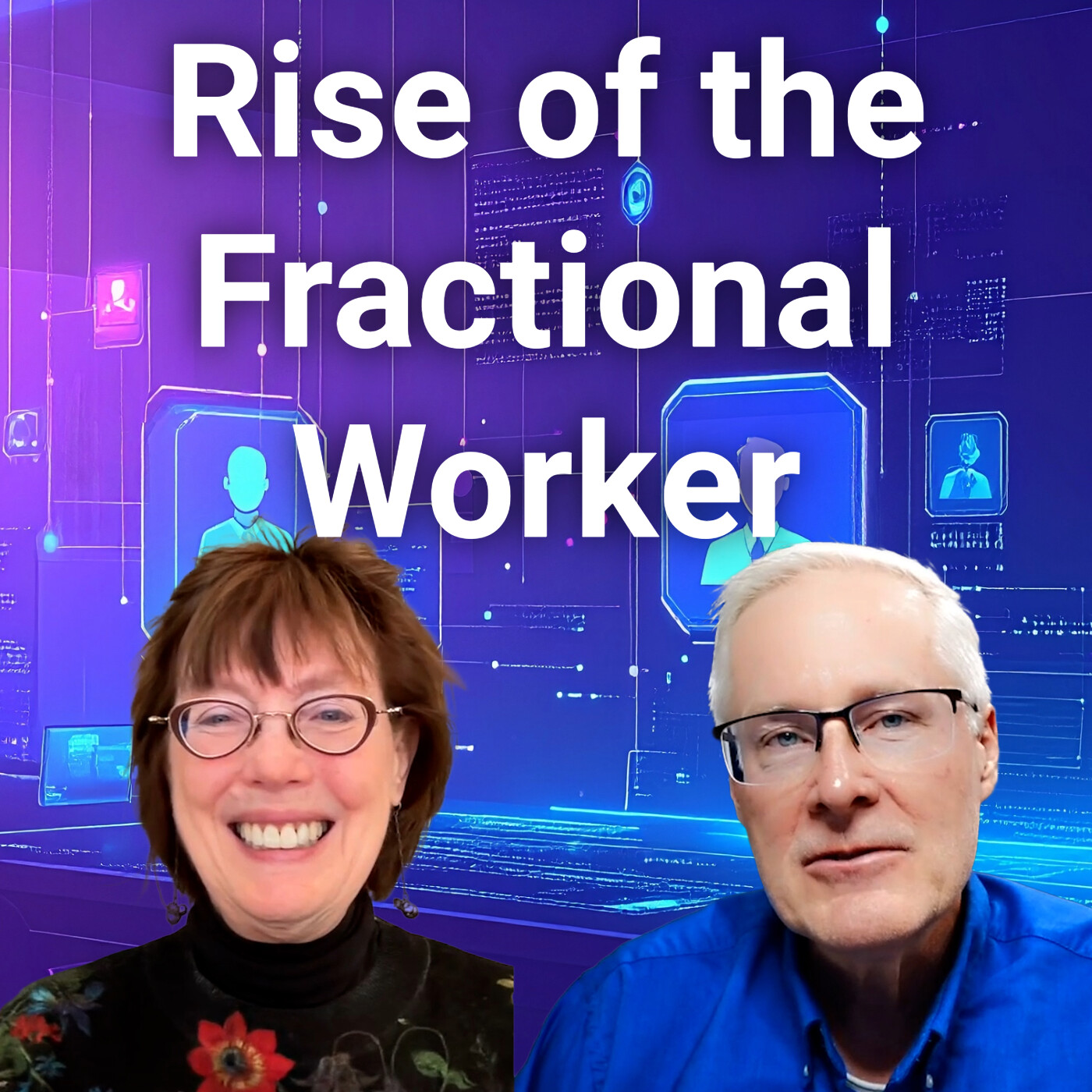
Welcome to Embracing Digital Transformation, where we explore how people process, policy, and technology drive effective change. This is Dr. Darin, Chief Enterprise architect, educator, author, and most importantly, your host on this episode, the Rise of the fractional Worker, with special guest gig economy expert and fractional worker evangelist, Elizabeth Ice. Hi, Elizabeth. Welcome to the show.
- [00:51]
A
Well, thank you so much. I'm so glad to be here today. Thank you, Dr. Darren.
- [00:55]
B
Hey. I was really excited when we. When we first talked, and I said, oh, I most definitely have to have Elizabeth on the show. This will be an entertaining topic today on fractional work, and the whole industry is changing, so getting in front of that, I think is critical. But before we drop into that, everyone that listens to my show knows I only have superheroes on the show. Every superhero has a background story, an origin story. So, Elizabeth, what's your origin story?
- [01:29]
A
Well, superhero. Wow. What a way to start the day. Well, you know, it's interesting. I am an entrepreneur today, and I never thought I came from a business background or an entrepreneurial background. My parents were both educators. And what was interesting about my childhood is we never lived longer than three to four years in one place. We moved, and in retrospect, my dad was an entrepreneur in education because he was a teacher, then a principal and a superintendent of schools and a university professor, and we moved every time instead of typically staying in one place, which many educators do. So even though I was the first kid to go into business, I really feel like my roots of entrepreneurism was. Was the fight my family, you know, brought me up.
- [02:19]
B
We.
- [02:20]
A
We moved, and we were resilient. We had to learn how to adapt and be open to change. So I think in a sense, that's kind of a superpower, being able to adapt, to be flexible and get people a new environment.
- [02:33]
B
Yeah, especially. Especially right now in. In the world we're living in, everything's in change. Everything's in chaos. If you're not resilient, you just curl.
- [02:42]
A
Up in a ball.
- [02:45]
B
And. And hope for the best. I. I don't know. I mean, so I have the opposite. I grew up in the same house.
- [02:52]
A
Oh, wow.
- [02:53]
B
And my parents lived in that house 35 years. And my dad was a dentist, but we lived out on a dairy farm, so he was a gentleman farmer, which taught us kids a lot of grit. Right. No, get up early in the morning. Yeah, exactly right. And not to make money. My dad said I had that place to grow kids, so he did a great job with that.
- [03:19]
A
So I know that was a great story.
- [03:21]
B
So let's talk about resilience a little bit. In this economy that we have, we're seeing a major shift from staying at the same company for 35, 40 years and retiring. That promise that our parents in business made, and probably even when you started, Elizabeth, that was the goal, was you find a big corporation, you move up the corporate ladder, and you're there for your whole career, right? Yeah.
- [03:47]
A
And that was. That was the, I guess, the first part of my professional life. I was in the insurance industry. And, you know, a lot of people kind of like shake their heads when they. When they hear the word insurance industry. But, you know, the world goes around because there's insurance. You know, it's really just another way of financing risk and advancing your business. I was in the commercial lines area, and it was fascinating, you know, to learn about different businesses, to know which ones are prone to losses and which ones aren't, you know, based on their operations. It was just really fascinating. But, yeah, I worked for big companies during the time when, you know, they. They actually had relocation policies. They moved to places, you know, which was, you know, actually a benefit to both the, The. The worker as well as the company because of the diversity of experience and exchange of talent around the. And you don't get that as much in a virtual environment, you know, so it's. It's a harder environment for, especially for, I think, younger people, to advance and gain the breadth of experience that I was able to have.
- [04:50]
B
That's a really interesting point I've never thought of, Elizabeth, because I. I was relocated a couple times for the big businesses I worked for. And, yeah, you get a completely different experience. So much different than doing it virtual. Right. When you're living in the culture. When you're living. And when I say culture, I was never stationed overseas, but growing up in California in the same house for, you know, my whole life, basically. And then all of a sudden I'm thrown into Toronto, Canada, where things are cold, right? Because I grew up in California, they're cold. And then I spent time in the. In San Francisco Bay Area, in Arkansas. Completely different cultures, business cultures and new people. It's a very exciting and highly educational experience.
- [05:43]
A
I totally agree. I went from Buffalo, New York, to New Orleans to Oklahoma City, to Cleveland to Chicago a couple of times, to Minneapolis to Long island to New York City to Bermuda. I mean, it's just, it was, it was just a world of difference every single time. You know, not only your co workers, but also the clients you were working with were different and, you know, settling into a new place. It was, in retrospect, I'm really a gift. Yeah.
- [06:15]
B
But that's not happening like it was.
- [06:17]
A
No.
- [06:19]
B
So what's going on today? What are you seeing out there? Because you're not in big corporate anymore, obviously you're seeing some change. So what are you seeing out there?
- [06:30]
A
Well, you know, to go back to what you started with, I think nowadays younger people really are thinking about portfolio careers and having multiple streams of income at the same time. You know, not only because it's okay to have more than one job, you know, if you will, but people are worried and I want to have multiple revenue streams so. Because there isn't the ability to rely on that big company that you might ultimately have a pension with and is going to take care of you. I mean, even today, looking at the headlines, you know, AI and you know, the layoffs that are coming, you know, from the people that ran technology in the past for technology companies. So you just never know what's around the corner. And I think people have gotten to be feeling a little more the need to be self reliant, which is, I think created an interesting dynamic because companies, the large companies, you know, they want stable workers when they want them, but then they want to be able to make changes when they need to, you know, or perceive that they need to. You know, it's, it's. So those are hard choices. And so I think that that's ushered in between technology, which has enabled all of this Zoom meetings and all the technology platforms out there. It's ushered in a whole new world of work. I mean, years ago we talked about the globalization and how work was being distributed around the world and that's even accelerated with the advancements in technology and now more and more to AI tools that can do real work.
- [08:14]
B
You know, when you were talking about that, it hit my, it tickled my brain a little bit in that a hundred, one hundred and twenty years ago we had the Industrial Revolution kickoff.
- [08:24]
A
Well, maybe even 150 years ago, where.
- [08:27]
B
People went from portfolio careers. If you were a farmer, you didn't just farm wheat, you farmed wheat and soy or whatever and you were self reliant. Yeah, right. And we moved into the Industrial revolution where big companies now provided work for people. Now we're almost doing an anti, we're moving back to portfolio careers. Right. We're, we're farmers of data, I guess. I don't know, independent. But that's an interesting, that's an interesting dynamic that were experiencing.
- [09:09]
A
Absolutely. You know, and I, I, I, it's, it's just a very disruptive time.
- [09:16]
B
It's very disruptive. Yeah.
- [09:18]
A
And then you had something like Covid, you know, you know, throw that in a couple of years ago. And for many small businesses, they were really very local businesses before COVID And really, when Covid happened, it forced people to learn how to be virtual businesses, how to be remote businesses, to set up e commerce shops and things like that. So it forced a lot of small businesses into the world of technology, which may or may not have happened had it not been for Covid. But everyone was in the same place. You didn't have a choice. And the companies that survived were the ones that learned how to utilize technology to further their business.
- [10:00]
B
Yeah, it was an interesting time for a catalyst. Right. For digital transformation and.
- [10:08]
A
Yeah.
- [10:08]
B
So where does that lead us today? That was five years ago. Sit. We're coming up on six years.
- [10:14]
A
I know, right?
- [10:15]
B
March 13th, 2020. I remember the day. We're coming up on 6 years since that event happened and changed the world. It really did change the world fundamentally. And now we're seeing. What are the effects of that on, on the workplace. Elizabeth, what are you seeing?
- [10:35]
A
Well, you know, this kind of launches me into, you know, the area of work that I've become specialized in. You know, after moving around in, in the corporate world, I up and joined a startup 24 years ago, a tech startup in New York. And it didn't succeed for a variety of reasons, but really that's what launched me into entrepreneurship. I knew I didn't want to go back to work for a big company because I enjoyed the freedom and the excitement of plowing the ground.
- [11:05]
B
You got the adrenaline pump, didn't you?
- [11:07]
A
Totally, totally did. So I decided to do some consulting for smaller businesses. And that's not my particular jam, as they say these days. But what I discovered was that while I had a really broad background from corporate America, I would get clients where I needed some additional expertise to help round out my skill set. And I discovered freelancers. And, you know, 10, 15 years ago, when I started to hire freelancers, people thought freelancers were just people who couldn't get real jobs. Yeah, professionals. And no one thought twice about an accountant or a lawyer being a contract worker. They don't think of them as freelancers, but they were contract workers, which essentially what freelance work is. And so I discovered that this enormous wealth of talent out there that was freelancing and there were a number of platforms at the time. Elance and Odesk were the two biggies, which now are upwork. And no, you know, no one had ever heard of. There wasn't a fiverr at the time. So there's been a lot of evolutions in platforms. But I became kind of a power user of the platforms at the time to find freelancers to round out my project teams. And what was interesting is my clients started to ask me to find them a freelancer because they liked the ones I had. It gave them a whole new view of what a freelancer could be, that it was a professional skilled at a particular thing. And so that's what really started this whole process for me is understanding the talent that's out there in freelancing. And today everyone doesn't blink when you hear the word fractional. But 10 years ago, that wasn't even a word anybody understood.
- [12:53]
B
That would someone that got laid off from a big corporation that couldn't find a job. That's what it was, right?
- [12:59]
A
Yeah, exactly. And so I think that, you know, on top of the things we've already been discussing about the move to virtual, you know, and the. In the changes in how companies operate and the instability in the job market, more and more people start with a side hustle and then when they feel confident that they can support themselves, you know, choose to leave corporate and do that thing. And some have multiple businesses. And I think younger people are starting businesses in college and, and being influencers or writers or whatever. You know, there's so many options to distribute your value to the world and figure out a way to monetize that value. And so I think that we are in a completely different world. Big companies hire tons of freelancers and you know, there's big pro. In fact, you know, my sense is the upwork, their target client is increasingly an enterprise client while they have offerings down market as well. So I think that everyone's realized that the flexibility of freelance talent and the quality of freelance talent out there is a real option both for the worker as well as for the company large and small.
- [14:21]
B
You know, this is really interesting because you mentioned two aspects to this change. One is the individual and making that jump into freelancing and fractional. For more seasoned. We'll use the word seasoned professionals like yourself and I. Right. That could be. That could be very scary. Right. When we first do that. But for younger people, that may be all they know.
- [14:49]
A
Yeah.
- [14:50]
B
Right. So how, let's talk first about the, the Gen X and the baby boomers, right, that are out there a little bit, you know, people that are already, you know, engaged in corporate life. How do you make that transition? Because it's always itching in the back of my head, how much can I trust the big corporation, right? Because hey, layoffs come, layoffs go, and you're just, you're just a number, right? AI is going to decide who gets hired and fired in the, in the future. So how do I make that, that jump without being forced to make that jump?
- [15:30]
A
Well, you know, I, I think it's probably best not to think of it as a jump. I think of, think of it more as is multiple paths at the same time. And you know, any corporation is going to want your full time devotion, you know, during business hours. And I think that's gotta be respected as they're paying, providing salary, benefits, whatever the deal might be. But on the side, people can start developing other options, whether it's writing for a living or consulting or cat sitting, you know, whatever it might be. I mean it's, I think that there's, there's an expanded view of the world that it's not so much nine to five, you know, or eight to four. I mean, it's like you, not that you can make your own hours if you have to be there for a company or for the company's clients, but you know, increasingly you can do multiple things with technology. You can have, you can have your own website, you can, you can have a substack account. I mean, there's so many different things that, that people can do. And I think that while I've not lived as a Gen X or Gen Z or millennia or any of that, I think that that's the mode these days. I mean, they're thinking of other things to do to monetize value in their dorm rooms. And so when they move into a job which can still be enormously valuable in terms of salary, experience, opportunity, they're doing other things anyway. So I think that as some of those side things take off, it's a natural path as opposed to a leap. Not for everybody. It all depends, you know, to me it all depends on, it all depends on your entrepreneurial skills. I mean, there's no safety net when you're an entrepreneur. I mean, you've got to make it work. There's no one to pass the buck to. And so not everyone's suited for that. I think some people are suited for A more stable environment, you know, corporate environment and finding security in that kind of environment means keeping your skills up. So you're kind of ahead of the curve, if you will, and not, not being complacent, that your job's always going to be there because you just don't know.
- [17:45]
B
So I think that, yeah, what are some of those skills? Because you mentioned a. The entrepreneurial skills. What are some of those skills that, because you can develop skills so some people have imminately in them, but so what are some of those skills that people could develop to, to be more resilient? I guess resiliency is probably the top one, right?
- [18:05]
A
Well, it is. But you know, I think of what I, where I would start is more interpersonal skills and networking skills because I have found that networking is not a bad word. Networking can be fun if you're curious. You don't, if you go into it with the objection objective of being interested in the other party and learning what you can, it's amazing what you do learn and how maybe not at that moment, but down the line those connections that you make pay off not only in terms of just the value of learning other people, but opportunities do come from that. And so I think that networking needs to be an important component of everyone's lives, whether you're in a big corporation or not. And the more now the larger network is, the more quality your network is. Not just, oh, I linked up with, you know, half a dozen people on LinkedIn, but that you build genuine relationships. Those are the. Genuine relationships are the things that lead from one thing to the other. And I, and I found no matter what it is I try to accomplish, you know, you can't just kind of ask ChatGPT how to go do this if it's like you end up depending on these people and people. So I think that, that that's the foundation is to not be afraid of building a network. It's not selling. You're just curious and you're talking about what makes you tick and you find alignment. And I think that that is a, is an important skill. And to, and to, I mean, it's like when I, when I go to a networking meeting and maybe a different kind of meeting I've not been to before, I go look for the person who's not talking to anybody, that person's happy to talk to me because they're, they're kind of feeling lost too. So there's so many ways to get started without feeling like you have to go talk to the most popular girl. Or boy, you know, in the room.
- [20:05]
B
You know, oh gosh, this is bringing you back middle school and high school. Oh, so I love that, I love.
- [20:12]
A
That, that, that networking.
- [20:14]
B
Yeah, I see that in, in my own career, that's how I got jobs, was through networking.
- [20:19]
A
Yeah, and you still do. I mean that's, that's the way around AI is.
- [20:24]
B
Yeah, yeah. Your network. I love it. Okay, let's flip to the other side which is on the corporate side. Right now I've got. Where do I go to find these fractional workers? Let's say I'm a mid sized company, my focus. Let's say that I am a, I don't know, let's pick a steel door in frame manufacturer. Right? Maybe I do $30 million a year. So I'm a small mid sized company and I hear all this AI stuff. My website looks like it was done by my nephew. Where do I start? How do I, how in the world do I find freelancers? Where do I go? Who do I talk to? Besides calling Elizabeth? Right.
- [21:20]
A
Well, I think that there are plenty of choices and I will say not in a self promoting sense. It's good to talk to some people in your network that understand the fractional world that operate in it. Whether it's a staffing company or a recruiter or HR professional. Those are all people that have experience with this world. Because whether you're talking about a $30 million business or a $300,000 business, going to a big platform and typing in, I need a fill in the blank, you're going to get matched with. I mean, it's good information in, good information out. It's the quality of your prompt, you know, to use ChatGPT terminology, you know, you're going to get 5,000 resumes that matched whatever you typed in. And what, what a horrible thing. How do you go through 5,000 resumes? It's not productive and you don't even know if those are good matches. You have to do all this curation. So yeah, so there's, I think, I think people are kidding themselves when they think, oh, I will just go do it myself. Because you know, there's just plenty of. In a big corporation you have hr, you have people helping you to prevent bad, costly hires and you'd have no protection, you know, working with platforms. So I think it's useful to talk to people in your network that have experience that can help you know where to go and how to, how to curate. And curation starts with proper definition of what you need. Because if you start With a proper definition, you're going to do better matching with the candidates that, that you know are, are close to what you're looking for.
- [23:06]
B
No, I, I, I love that I, it, it's almost like online dating. Yeah, right. You gotta know what you're looking for and a lot of times it's your friends are gonna introduce you to someone. Right? Yeah. So it's the same, it's the same kind of concept that goes back to that networking thing. What are some of the best practices or pitfall. Let, let's talk about pitfalls first on going with a fractional team that you need to watch out for.
- [23:37]
A
Well, I think first and foremost is really figuring out what is fractional work and what is full time work. I mean fractional does not replace full time. I mean when you get a company of $30 million like you just revenue that you just mentioned, you know there's going to be a staff to that firm. And I always talk in terms of core and non core work and I kind of define core work as that work that a client pays you for that delivers value to the market and that's the work that you probably need full time people doing. They're committed, they have a stake in the company, whatever it is, and they're there, they're part of your brand. Non core work is where I think fractionals are particularly useful. Whether it's, you might not need a full time cfo, but you might need a controller and a part time CFO that could be contractual. I mean no one thinks twice about really accounting or attorneys or lawyers. Yeah, but those are fractional workers. You use them when you need them. Very few companies need a general counsel and so it's the same kind of philosophy. What is the work that you know, isn't day to day that's crucial to the lifeline of my company. But you still need skilled help, you just don't need it full time. And to me that non core work is the place to look first because it's not directly touching a customer or the value stream.
- [25:12]
B
I like that. And finding your core is probably the most important thing you can do there, right?
- [25:20]
A
Some people, yeah, there's so many methodologies out there, but I just think it's really simple. What does your client pay for that's core? What do you, what's a cost to you that is necessary to support delivering your value? That's the non core stuff. It could be still really, really important to your company. But that's to me that's where to look first. Okay, that.
- [25:43]
B
That makes sense. Any concerns around intellectual property? Because fractional workers, right, they're working for lots of different companies. So if your IP is core, then. Right, you don't want fractional workers creating all your ip, I guess is what I'm saying.
- [26:01]
A
Yeah. No, I mean, some of you can. Some of it you can deal with, with contracts like work for hire and, and things like that, but that still doesn't mean that your work's protected. And even with AI today, is your work protected? I mean, you know, so I think it's a bit of an alarmist thing. I think it's real. But again, if you've got ip, then that's something that people that have a vested interest in protecting that should be the ones working with it. And then you should create a working relationship with less sensitive, less risky materials. You know, a lot of people come to me and they talk, what should I outsource first? And I always say, wade in. Do a little bit at a time. Get used to it. Start with the lowest risk stuff. You know, don't put your intellectual property at risk. You know, do the things that, you know are more commodity kind of. Kind of works. Those are the things to start with until you develop confidence. I mean, in time. I mean, the best freelancers, they want steady gigs. They're not interested in looking for a new gig every two months. So if you build a relationship, you go into it building a relationship with those fractional workers and trust them. Build trust both ways. And the freelancer has to like working with you the same way you need to look like working with the freelancer. I mean, it's a relationship. And I think that if you build those relationships, you know, properly, you know, your IP is as protected as it's going to be. I mean, there's no assurance that somebody works for you, doesn't leave and takes your. Takes your material.
- [27:47]
B
Absolutely. All right, so if I'm dealing with fractional workers, I have to be a little bit more on my toes about my processes. Or do these fractional teams that you bring in have their own processes and I'm paying for that as well? Like. Like having an accountant. I don't know what the accounting best practices are. Right. I mean, that's why I'm hiring. So where's that fine line between your processes and the processes coming in with the fractional team? It's. I've got to manage this. This is not something that I just say, oh, whatever you say is fine. That just doesn't cut it.
- [28:28]
A
Right? No, exactly. So Process is really at the heart of being able to delegate. And I'm going to take an aside to say that I think that something I call the delegation engine is really the fundamental answer to your question. And to me, the delegation engine is thinking broadly about the idea of delegation. Delegation can be. Delegation to process is a thing because you're establishing a protocol for how you want work done to deliver the value the way you want to deliver it. So even if you've defined only a handful of processes for your business, make sure they're the right ones that really are the ones that reflect how you want to deliver your value to the market. After you've defined process, then you pick your tools, and then the tools are the things that fit your process, not the other way around. A lot of people buy tools, then try to retrofit their organization to the tool. And I think that's backward. And only after you've outsourced to process, then to tools, then should you outsource to people. And that's the cleanest way to think about it. Because if you've identified your process, then you tell the freelancer, this is how I want the work done. Now, plenty of freelancers are really good at process and because they've had to be. So you can ask a freelancer to help define your process, but it's something that the business should always decide, yes, this is how I want to do it, rather than just accepting somebody else's way of doing business. But you know, freelancers will fill in the gap, fill a vacuum. If there's no direction, they'll go, well, let's do it this way. But hopefully they're always asking the client's permission, like, does this make sense to you? Does this work for your business?
- [30:14]
B
Hey, this has been really, really fascinating. And I see a whole new emerging marketplace for all of this. It's going to be an interesting, interesting time in the next 10 years to see how these big corporations and because we still want to provide value, and sometimes you need a big corporation to provide value. Like at intel, where I work, you can't do fractional fabs. I can't go because I got to raise $20 billion to build a fab. Right. I can't do that part time on the side.
- [30:50]
A
Right. But there will be a lot of.
- [30:52]
B
Fractional workers that will be providing a lot of value in that whole value chain. So this is a really fascinating shift in our economy that I'm really excited to see what happens.
- [31:05]
A
I am too. It's fun to be in the middle of is.
- [31:08]
B
So Elizabeth, if people want to find out more from you or engage with you, how do they reach out to you?
- [31:15]
A
Well, I'm on LinkedIn, Elizabeth, ICE, as you can read on the monitor there. But my company is called Results Resourcing because we do that. We resource results for solopreneurs and small employers in particular using vetted virtual freelance teams in the United States and Canada. So we're all about helping entrepreneurs realize their vision and achieve the impact that they want. So my website is results resourcing, it's.com or.net and on LinkedIn connect with me and love to talk to entrepreneurs and help them figure out how to scale their business.
- [31:51]
B
This is awesome. Elizabeth. You're at the tip of the spear, changing the world one client at a time. So.
- [31:59]
A
So thank you.
- [31:59]
B
Thank you for being that entrepreneur and being out there at the tip.
- [32:05]
A
Thank you so much. I appreciate the chance to talk to you about it.
- [32:08]
B
Darren, Thanks for listening to Embracing Digital Transformation. If you enjoyed today's conversation, give us five stars on your favorite podcasting app or on YouTube. It really helps others discover the show. If you want to go deeper, join our exclusive community@patreon.com embracingdigital where we share bonus content and you can always connect with other change makers like yourself. You can always find more resources@embracingdigital.org until next time, keep Embracing the Digital Transformation.