← Embracing Digital Transformation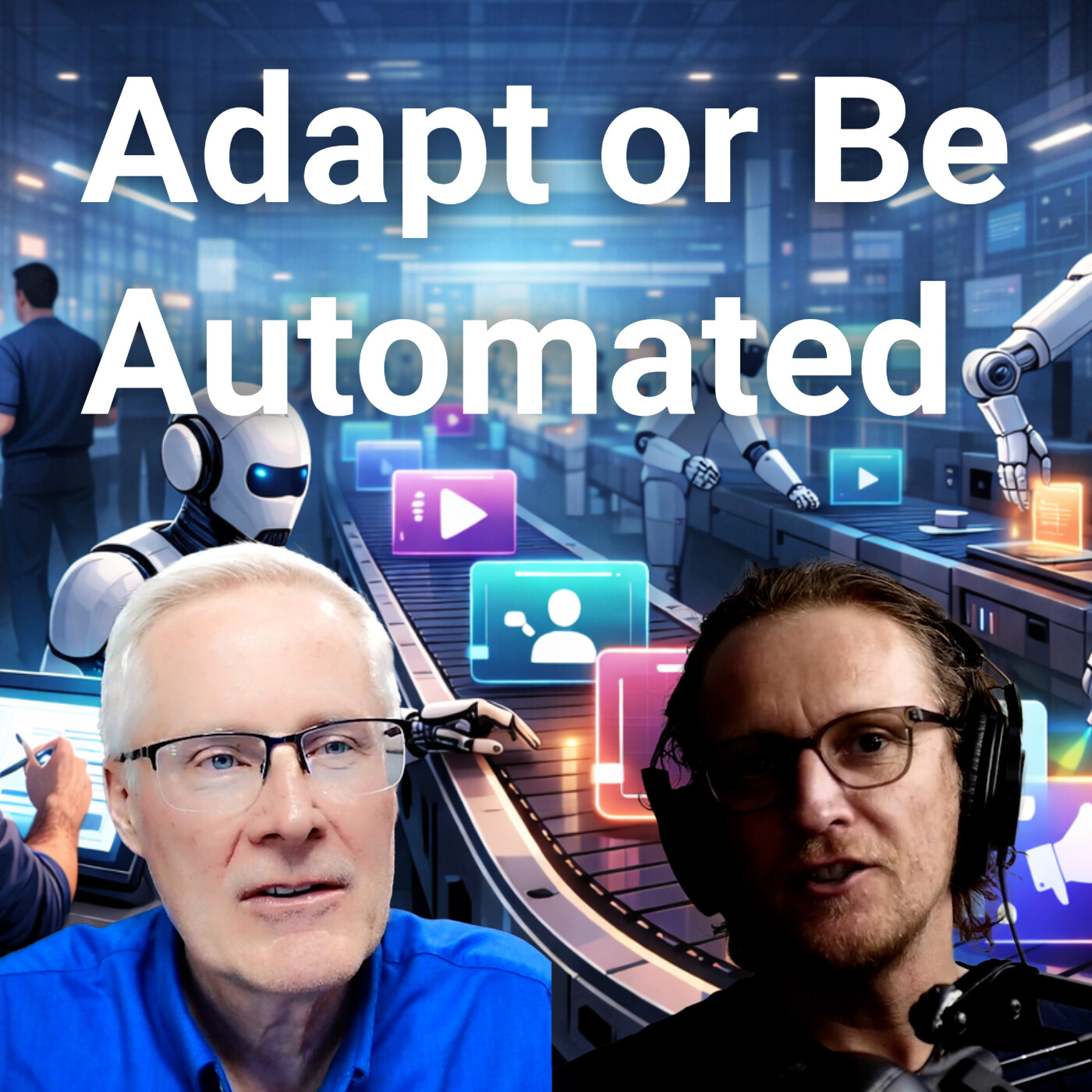
Loading summary
Transcript74 lines
- [00:00]
A
Is you're really good at using a specific tool or piece of software, you're incredibly deleted, become irrelevant. So the skills you need are being able to adapt. I think flexibility and comfort working across different areas is the most important skill people need.
- [00:23]
B
Welcome to Embracing Digital Transformation, where we explore how people process, policy and technology drive effective change. This is Dr. Darren, Chief Enterprise architect, educator, author, and most importantly, your host on this episode. AI workflow, automation, augmenting marketing teams with Pete Gosling, founder of Gosling Media and Design Tech. Pete, welcome to the show.
- [00:58]
A
Very pleased to be here. Thank you.
- [01:01]
B
Hey, this. This is a really hot topic right now. AI, workflow, automation and everything around all that. But before we get started into that, everyone knows on my show, I only have superheroes on the show, and every superhero has a background story. So, Pete, what's your background story?
- [01:21]
A
So, yeah, my name is Pete Gosling. I'm an Englishman in New York. I studied traditional animation at university. Puppet, you know, stop frame animation actually did work experience. Yeah, Bob, the build a lot. Yeah, it certainly does. It certainly does. Yeah. So I always loved animation, that art form, and I went into it knowing it was like a dying thing. And it's something that I've been thinking about a lot recently with AI, about how 3D model animation got replaced. Toy Story came out just as I was starting university anyway, so we'll come back to that. But I studied animation and immediately sold out and got into digital marketing and advertising, making animated flash banner ads. So I told myself it was an animation job and that was enough for me to sleep at night. Yeah. And then over the last 20 years, I've basically been working in ad tech in one way or another. So sometimes in house, sometimes for an agency, but in and around creative and advertising or the infrastructure. Like, I worked at a couple of companies where it's more like the tech delivering the ad rather than the creative itself.
- [02:46]
B
So you've seen huge shifts in, I mean, very. You've seen a couple disruptive, you know, technologies. And so is this one different that we're going through right now, the AI one, or is it very similar?
- [03:02]
A
It is, but there's definitely, like, similarities. So, you know, when I first, as I said, like the animation, I worked with traditional animators and they had to sort of reskill. The knowledge they have for animation is transferable, but they're doing it via a computer rather than, you know, moving puppets. So that was kind of an interesting one. And also when I graduated, it was 2004, so the Internet had been around for A while, but the sort of big shift in websites becoming, you know, more mainstream and standard, a lot of the companies were, a lot of the companies I worked with were struggling to get that sort of website going. It was all kind of hand coded back then. My first job was making, we had Flash, some animation software tool. Yeah, yeah, I, I was, I loved it because you could code and design and animate all in one software. But the other big shift was VHS to dvd. So another company I worked at for a short term contract during like a summer was that they sold educational videos to schools. So they, their office was just wall to wall VHS cassettes. That was their inventory and they were going through the process of getting rid of it all and sending them out as DVDs. And then you know, a few years later I lost touch with them. But I imagined all of that became irrelevant. Yeah, video streaming became a thing. So it's yeah like the digital or analog to digital across different mediums I've sort of witnessed firsthand and been touched. I've always enjoyed pushing things like video streaming was never really a thing. But Flash let you do video streaming. Yeah, it did. It was like the first platform that you could really get any kind of quality video on the Internet.
- [05:16]
B
Yeah, that. So you've, you've been kind of on the bleeding edge of things. This AI revolution though, this is something different. Would you agree with?
- [05:26]
A
I would, yeah. So the similarities are it's slightly other changes, but it's happening 10 times or 100 times faster. So the other ones you could kind of see what's coming and adapt and it was only affecting like one industry or one component at a time. Like the digital digitization of analog media obviously touched lots of things, but that took a long time to happen. AI, it's like every job in every industry much faster than before I think is the biggest difference. But the actual skills that you need or skills that you need to nurture kind of are the same. I've always been a big proponent of working across different areas. So when I was, you know, first 10 years of my career, everyone told me that you have to specialize to make the most money. So become like really good at after effects or really good at like vector illustration. And I always enjoyed working across multiple formats and different platforms and software and experimenting. And like now you being a specialist is very risky because you get replaced. Like if the value you're bringing to someone to make money is you're really good at using a specific tool or piece of software, you're going to become irrelevant. So the skills you need are being able to adapt. I think flexibility and comfort working across different areas is the most important skill people need.
- [07:19]
B
I, you know, I, I agree with you there that that Renaissance man, the generalist, is really having a rise now and being adaptable. I, I, I totally see that in my career too.
- [07:33]
A
Yeah, I mean, it's, it's interesting and I think outside of like, you know, some like, content and creative production, but just in regular, I shouldn't say regular. In other jobs, I think people benefit from like, if your job title is one thing, look to like the left and right of your swim lane. What are other people doing? And try and sort of broaden your impact or knowledge or understanding of a, of a company's needs. I think we'll make you more hireable or protect your position a lot more if you're. Because what's going to happen is obviously that everyone's trying to sort of reduce their headcount. It's happening already. I've got clients today that are just completely redoing their roadmap and headcount planning. And it was going to be the, the ones that survive, lack of a better word, are going to have to manage more jurisdiction within their departments using AI, almost like delegating it to junior staff. So I think a big thing that, another big thing people need is delegation is really, really hard to do it effectively. And if you're going to be working with AI agents across these different tools, you're essentially delegating work to the AI. And I've been, you know, I started my agency seven years ago, and in my career, I work from junior designer. Designer art director.
- [09:07]
B
Yeah.
- [09:08]
A
And you learn from people how to, you know, manage your team, grow a team, delegate tasks. I still find it really hard. Like today I'm literally a roadblock for a project because I haven't completed a brief for the designer to work on it. So you, you're going to have people that are put in positions, but you're basically a manager from day one. Like a junior person is going to be expected to use these tools. And I, I always just consider it a delegation. So, you know, it's a leadership piece here.
- [09:42]
B
It's interesting you brought that up because on the previous podcast that I just recorded right before yours with Elizabeth, she said the same thing. She said one of the key skills in the future will be delegation, the ability to delegate both to fractional workers or to an AI or to, you know, so that's interesting that you both said similar things. So let's talk about your work and what you do for clients. It's all around AI automation and primarily in marketing support, correct?
- [10:22]
A
Yeah. So I've got kind of two areas. My, my sort of. I started the agency seven years ago, very much like a traditional creative agency, focused on B2B marketing materials. So supporting marketing activity with the creative assets, like the design, very quickly pivoted to do full service marketing because that's where the budget actually lies within a company. So basically became a full service marketing agency. But then over the last three or four years, the writing's been on the wall, at least I've been seeing it. And I always tell people I want to put myself out of business rather than someone put me out of business. So I've been very active in terms of building tools and staying on top of all the AI breakthroughs so that I can use those in my day to day work. Still doing client services, but in a way that's getting more efficient and, you know, improving the output and I can see where it's all heading. Right. So there is a kind of existential threat to the business unless I pivot. So, yeah, the last year I've been doing a lot more work with clients on how they can incorporate AI into their workflows, not just on the design side. So marketing mostly. But marketing automation is a thing that's been around for a very long time, but it's still very manual, like they call it marketing automation. Like in HubSpot or Salesforce, you have sequences,
- [11:59]
B
but it's still very manual.
- [12:01]
A
You can actually automate it now, like the AI can, rather than just a decision tree. The AI can make decisions. Right. So you've got to have it done in a certain way and guardrails in place. So. But it's very exciting what you can do in terms of. Once you've got the sequence correct, it's amazing. You just have to be diligent with how you piece it together.
- [12:29]
B
So, Pete, what value then does an organization like yours bring? You're going to train me up on how to do this all myself on AI, do you move up the value chain and if so, what is that new value that you're now creating?
- [12:46]
A
Yeah, I mean, so today, right now, the workflows are. I'm not training the teams to build them. So every marketing department, every company, there's activities that they wish they could be doing, but they don't have the bandwidth to do it. So rather than replacing completely something they're doing today, one example is they produce white Papers and in depth guides and they'll promote them on LinkedIn and you know, they'll set up campaigns around it. But ideally you're taking that content, breaking it down into infographics, email sequences, you know, like atomization of the content. But it takes time and resources to do that. So most companies will, you know, everyone knows that's the best practice, but it's just a lot of work to create all those assets. So one of the workflows is basically breaking a long form piece of content into different segments. Yeah, assets, basically.
- [13:49]
B
Yeah.
- [13:50]
A
But then you can also say we want to promote this in manufacturing industry in particular, rewrite the elements to be focused on manufacturing or even like to the client level, like I'm meeting with Acme co rewrite this to be relevant to them. So the AI can, once that workflow is set up in terms of how to produce those assets, you can then inject very specific things throughout it to make them, you know, the personalization at scale is the goal for marketing.
- [14:32]
B
I, I really like that, that approach because I never thought of the marketing workflows as taking, you know, one piece of content and creating lots of other pieces of, or assets from it. Right?
- [14:45]
A
Yeah, yeah.
- [14:46]
B
I mean that's beautiful for Gen AI, right? Gen AI can do that all day long, right?
- [14:52]
A
Yeah, yeah. It's just what I was saying about you have to be careful with the sequences. It's. You do still have to be quite prescriptive in the prompts.
- [15:02]
B
Right.
- [15:02]
A
Otherwise you get generic garbage. Right. So there's a lot of tools, there's countless tools out there that will like write you a blog post, but they're garbage, mostly majority. So the sequence that I'm talking about is literally, it's probably like five different workflows. Each has like three to five AI calls in it because it's, it's pulling the context. Like what is the unique piece that this company's their brand voice and their expertise. You've got to capture that and inject it into the content and make sure that the target audience is front of mind. So there's a lot of submitting it to the AI and then getting another AI to critique it and then a third one to make the edits that the second one recommended. So I always think of it like a full marketing department. You have that, you have copywriters, you have the editors, you have the directors.
- [16:06]
B
I was going to say those are roles that we see in normal marketing departments.
- [16:10]
A
Yeah. So what the approach I like is think of just like a really specific Use that adds value to what you're doing today because if you try and just replace what you're doing straight away, you know, things have to still get done in the day to day.
- [16:28]
B
Right.
- [16:28]
A
So I like this idea of it. It's almost like a side channel, like a special forces versus the full army skunk works.
- [16:37]
B
Special forces. Yeah, yeah, yeah, yeah.
- [16:39]
A
And then over time you can add in more and more of these and
- [16:45]
B
yeah, no, I, I really, I really like that approach. It's, it's, it, it makes it so it's not so disruptive.
- [16:54]
A
Not disruptive. And internally doesn't cause friction.
- [16:59]
B
Yeah, well, and, and that's, that's the key thing until all of a sudden those AI bots are doing more and more of the work and your organization. So this requires an organizational change eventually.
- [17:12]
A
Yeah, yeah. So it depends on the size of the company as well. So the company I'm doing this for only has I think three people on the marketing team.
- [17:21]
B
Oh yeah, well, they're unwelcome. Right.
- [17:24]
A
But at previous companies I worked at, there were 40 people in the marketing team and we were still overwhelmed. Right. There's always more work to be done. So I don't think there's ever a limit to the amount of work that's available to a business. And so, yeah, I mean, look, companies can definitely see this in flow. Think, well, why do I need these five people? I think that's a very silly approach. If you're building a company from scratch, yes, you should be thinking about AI from the ground up. But if you've got people with like institutional knowledge, they've got specialist knowledge of the, you know, the product and the industry. If you're giving them AI in the right way, that's just a massive TEDX multiplier for them. The mistake most companies are making is they're just giving here, use ChatGPT or Gemini in your current workflow. That's optimizing something that isn't designed for AI. It's never going to be good.
- [18:24]
B
So this reminds me a little bit of in the 90s and early 2000s when we started outsourcing everything to lower economic areas. Right. Geographic areas. And it was like people are replaceable was the concept. But you and I both know that unless I have good delegation skills and the knowledge is transferable, then that doesn't work.
- [18:54]
A
To this day, I mean, I've, I've used every remote service. I had two full time employees in the Philippines for a year doing marketing work and I've used a lot of the sort of on demand freelance platforms and all. All roads always lead back to having a core team that understands the business, understands the client, that that knowledge is, is not replaceable unless your product is literally just like punching holes. And it's the same hole every time. Anything remotely creative. You need people that understand the product and the industry because you can't design a good solution to something. You know, if you're like on the other side of the world and you've never met the client.
- [19:42]
B
So that's the same thing with, with generative AI then too. Right. I can't just plug them in for anything. I still need subject matter experts that
- [19:52]
A
the context makes such a massive difference. Like if you do a prompt and say, you know, you could have a very specific long prompt saying write about, I don't know, printing press history. That's top of mind. Just because of the innovations we've been talking about.
- [20:10]
B
Yep.
- [20:12]
A
But if you, if you're just giving it that, even if it's a detailed prompt, it's still pulling from the entire Internet, like global knowledge, every single piece of knowledge. So of course it's going to be generalized and. Yeah, not good, but just sort of attaching a couple of PDFs that are maybe like educational research or. So it's something that's more like very specific to what you're looking for. Like research papers about printing. I don't know, whatever it might be, but if you give it that context, it just instantly makes it a hundred times better the output.
- [20:52]
B
Because you're constraining the model basically with, with those documents. Right. You're saying, I don't want you to give me all the world knowledge. I want it to be about printing presses in Northern California, where I live. Right. History of printing in Northern California.
- [21:16]
A
Yeah. Yeah. It's probably not the best example, but that's why the marketing content works so well. Because typically companies have tons of content. It's just not packaged for marketing. Like before the company starts, you have a business plan, you have investor presentations, you have all this content. There's so much content companies have. And then when it comes to the marketing campaign, they're like, well, we don't have content for it. You really do is just how you package it. So AI is very, very good at taking source material and reconstructing it in different ways.
- [21:51]
B
Yeah. And packaging it or even organizing it.
- [21:54]
A
Yeah, yeah.
- [21:56]
B
Which. Yeah, I can imagine. I mean, I work at intel and we produce so many white papers every single day. Right. And I can't even imagine our Marketing team is like overwhelmed. So now they reach out and go old school and do personal contacts. Oh, who should I talk to to find out information about this? Even though we have a huge repository full of content, no one can find anything.
- [22:24]
A
Oh my God. The amount of duplicate labor in businesses. Like so the biggest company I've ever worked for, I think at 800 people. So I've never worked.
- [22:31]
B
Oh my goodness.
- [22:34]
A
I'm definitely one of the startup side. But, but even then, like the amount of content that is produced, say the CEO's presenting at an event, like a corporate event, all this work gets put together for the slides, like the head of marketing, the head of sales, like hours and hours, the event happens and then that deck is never seen again. That, that's been a pet peeve of mine for a very long time before AI. Just so much wasted effort. It's not wasted because that event probably led to a big deal being made by sales. But that content should live somewhere and be part of the machine that it then spits out stuff relevant in the future.
- [23:18]
B
Yeah, I totally, totally agree with you there and, but so many organizations, both big and small just don't have a handle on all that. All this data.
- [23:27]
A
It's hard.
- [23:28]
B
Yeah, it's hard. Is AI helping in that respect at all? Do you see how it can help?
- [23:35]
A
So I think the problem is people are trying to use AI with existing workflows and processes. The AI is transformational, but it's really the, the process management is the key thing for me and I think so many AI tools or projects have failed. Like that MIT study, 95% never made it past pilot. Yeah, it's gotta, it's gotta, it's gotta make sense. It's gotta have buy in at the right levels. It can't just be top down and it can't just be like someone, oh, I found this online, let's implement it. There's gotta be a real strategy to it, otherwise of course it will fail. I mean I've been responsible for rolling out new project management software. Nothing crazy, just changing what from Jira to Asana and just at every step there's friction. Right. So it's hard to implement something new at a company, let alone something like AI where everyone's got strong opinions and no one really knows the right answer. So yeah, that's why I like this like splinter sidearm sort of thing where you're just sort of proving out things step by step. More like agile development cycles than a full like his AI. Like, you know.
- [24:58]
B
Yeah, no, no, I, I, I see exactly where you're going. In fact, I did a project with the U.S. census Bureau and we, we, oh, wow. It's, it's the first Operation Chicken Cooperation, which has a history behind it. Because Operation Chicken Coop was this project that a small group of people were working on on the side that no one could see because we were building it behind a chicken coop idea, right? And this goes into the former CIO at the U.S. census Bureau. He grew up in West Virginia. And he goes, if you wanted to build another house on your property that you wanted to rent out to people, you build it behind the chicken coop because no one wanted to look over there and see what you were doing, right? And then when it was all done, then you tore down the chicken coop and everyone could see it, but it was already there and no one could contest it. So that same concept as what you're saying, start a little thing on the side, it can run in parallel with other groups. It's not disruptive at all. You can prove out new process, new new tools and all that there. And then when it's working now, you can flip the switch and move over.
- [26:07]
A
Yeah, I love that. Yeah, that's cool. And I mean, the clients that I've been doing these with, so much of it is just down to nailing the process that, like, if you really sit down and think about it, okay, if we wanted to automate a process we've been doing for 10 years, no one's ever sat down and actually whiteboarded that out or discussed it. It's just kind of evolved as the company's grown. And so the hardest part often for me is getting that process that they want to automate. Like 10 people involved, each of them do their own things their own way. This person's out sick. I do it a slightly different way. Like, so the AI piece, yes, obviously transformative, but the automation, like, the workflows and connecting, like, is the wealth of information that you can connect together via API number one. That's getting easier and easier because AI, the model context, mcp, yeah, MCBM makes huge difference. So I've done, I'm on the creative side, but I'm very tech. I love tinkering with tech. So I've been pulling APIs into, you know, dynamic websites for decades. So it takes work, right, to set up the API, call, get the authentication, you gotta the slightest mistake in your request and you get an error back. Hours and hours of hours of work to. And everyone's API documentation is slightly different. These MCPs it's like you just connect to that and then I want you to access all of the contacts from Germany and it doesn't. Probably the biggest time saver for me more than the generation of text and things. Being able to interact with APIs just via an MCP, like a single request is incredible.
- [27:59]
B
Yeah, it's huge. I, I totally agree, totally agree. So Pete, what, what do you feel are some of the biggest impediments to these adoptions? Right? What? You know, you talked about the MIT study, which is quoted a lot. What, what do you, you're in the trenches, you're in the middle of these things. What do you think are the biggest impediments that you see blocking from, from true adoption from that POC or that, that little, you know, skunk works that's going on on the side? The, you know, I think that's a
- [28:41]
A
big piece of it getting people to buy in. Like, so I kind of feel like it has to be an outside party because otherwise if it's like a colleague. Everyone has an opinion. Especially with AI where there's no playbook, it's new technology. You need someone who's really thinking about this stuff and you know, people set up teams and labs and things to do it, but sitting next to the person that's actually doing the work, it's got to be like a piece at a time rather than like a big. Trying to roll out big changes across the board. I keep going back to like if I'm junior, even like mid level or even senior, whatever. I, I'm an employee and you know, you're seeing all the news about layoffs, you're wary of AI, you're probably excited about it in some way, but mostly hesitant and don't want to know about it. So you put your head in the sand and you're not really staying up to date, which is understandable because it's. The pace changes so fast. So I think buy in is one of the hardest. But then there's also. Okay, well which platform do you commit to? Because you can't sign up with all of them and implement across the corporation. So. Gemini. I've actually been really impressed with the latest ones. I've started using Gemini instead of Claude and OpenAI for everything, to be honest, but because like billing and compliance, all that sort of stuff like Microsoft and Google, they're already in the company, aren't they? So.
- [30:24]
B
Yeah, yeah, yeah.
- [30:25]
A
It's much easier to purchase an add on for Office or Google apps than implement a new vendor like Anthropic or something. So, yeah, like it's, it's the, it's the people part of the.
- [30:42]
B
The people is the hardest problem.
- [30:44]
A
There's a lot of P's, but you got to make sure people are feeling the value of it and not, oh, I'm just training something that's going to do my job in the future.
- [30:54]
B
Replace me.
- [30:55]
A
Yeah, well, because I hate the co pilot. Sorry.
- [30:59]
B
No, go ahead.
- [31:02]
A
They're branding it all as co pilot, Microsoft in particular. But they're all kind of saying it's like your partner. But like you all hear those stories where you. They bring in a junior person, you train them on what you do, and then this person gets fired and the company saves lots of money because the junior person could do it. I think that's what's kind of happening. Right. It's like they're giving us all these tools at huge cost that they're losing money because they're getting us to train them how to do what it is we want to do. So I like to think, like, to succeed and sort of get ahead of this, you want to be like the air traffic controller and then AI are the pilots and they're kind of semi autonomous. You're not sat next to the AI in that plane. You've got to be that level of. You're directing them, directing it. Yeah. This idea of a co pilot, I think if people go down that two thighs, you got to think like, no, I'm the leader managing a team of AI.
- [32:08]
B
I like that approach. I think that's more sustainable for an individual and also for a company. So, hey, Pete, this has been great. If people want to reach out and learn more from you and your experience or use your services, how do they reach out to Pete?
- [32:26]
A
So Design Tech AI is the best place to go.
- [32:30]
B
Okay. DesignTech AI Pete, again, thanks for coming on the show. This has been very insightful. You're right down in the trenches. You're feeling this every day. And it's great because you mentioned people, process, policy and technology, and that's what my show is all about. So thank you.
- [32:46]
A
Love it. Yeah. Thank you so much.
- [32:54]
B
Thanks for listening to Embracing Digital Transformation. If you enjoyed today's conversation, give us five stars on your favorite podcasting app or on YouTube. It really helps others to discover the show. If you want to go deeper, join our exclusive community@patreon.com embracingdigital where we share bonus content. And you can always connect with other change makers like yourself. You can always find more resources@embracingdigital.org until next time, keep embracing the digital transformation.