← Embracing Digital Transformation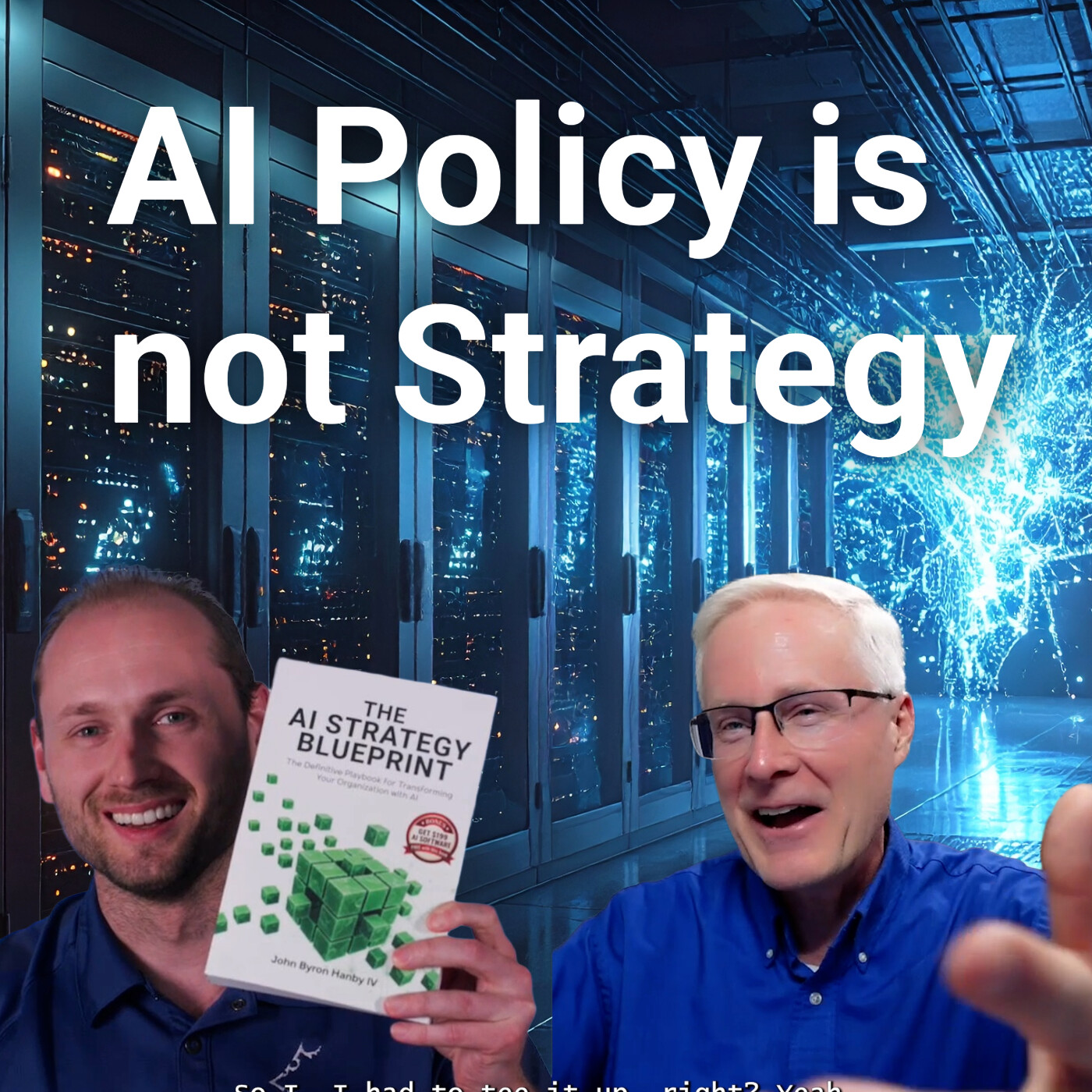
Loading summary
Transcript104 lines
- [00:00]
A
And I think that that's a really tangible example for where this is going because that kind of transformation is happening across every industry. Whether you see it or not or whether it has happened yet. It's coming.
- [00:16]
B
Welcome to Embracing Digital Transformation where we explore how people process policy and technology drive effective change. This is Dr. Darren She Chief enterprise architect, educator, author, and most importantly your host. On this episode. From AI policy to AI strategy, how leaders actually get started with returning guest John Hanby iv. Hey John, welcome back to the show.
- [00:50]
A
Good to be here, Darren. Thanks for the invite.
- [00:52]
B
And we had such a great first conversation. There's so much more to talk about. So I said we've got to have John come back on. We'll take care of it and get it done. Great background. You got an incredible background. So those that are listening, you got to listen to the first episode in the series. John's got an incredible background and I'm not going to spend time on it because we got too much to talk about today. Let's dive right into how do I, as a business owner come up with a genai policy and strategy? Because I, I'm gonna, I'm gonna throw big corporations under the bus a little bit. When Jenny, I first came out it was don't use, then it was use freely, then it was use with caution. And in, in some organizations they went through like 12 iterations of this and all it was was a policy with no strategy behind it whatsoever. And now I'm seeing big corporations lock everything down. I mean literally nothing can go in and out of ChatGPT. They're monitoring all traffic going in and off your laptops because they're worried about intellectual property leakage and data leakage, which I totally get. So, but that's not a strategy, that's a policy. So how do I move from that policy to a true blown strategy? What steps do I need to take? How do I get started?
- [02:23]
A
Well, that's a good tee up, Darren, because I actually just happened to write a book on that very topic.
- [02:31]
B
You mentioned it last time, so I had to tee it up. Right. Yeah.
- [02:34]
A
I didn't know if you knew that it was called the AI strategy blueprint, but in fact it is. So the background behind this book is everything that you just described is exactly why I wrote the book. So the AI strategy blueprint was taken from literally thousands over 2000 customer AI workshops, training sessions and strategy sessions that I had done with my team over the last really two and a half years since we were bringing genai to the market. In a big way. And throughout all of those journeys, there were so many golden nuggets of insights and information that came through listening to these different customer challenges, the ways that we would design the solutions, that it ended up being something that I thought would be very worthy of putting a definitive guide. At least for the next year until, you know, things change 100% again.
- [03:31]
B
Yeah, exactly.
- [03:33]
A
For about a year. So the background behind the book is it takes the reader through every key inflection point across the transformation, and it's applicable for a CEO, a cio, all the way down to an individual contributor who's advocating for some kind of AI transformation. And doesn't matter what industry, doesn't matter what size business. So at a high level, some of the key things that we talk about in the book. First, first of all, why it's important, right. There's a lot of skepticism, especially today, around why do I care about generative AI? We see it in the news all the time. Almost a trillion dollars, maybe more, has been spent in the industry. MIT comes out with a study in research saying that 95% of those investments were a total waste and only 5% are seeing value. Right. So you got this big disparity of trillion plus dollars, no value, and you know, where, where does it meet? So, you know, the book unpacks, like, where we're going with all of this. What's the actual potential? Where are some tangible examples of where generative AI has actually worked and is bringing real business value today? And then I unpack that and say, like, look, this is the trajectory that we're going on in the future. I'll do a tie back to our last episode. So I told you about my film career and background.
- [05:07]
B
Yeah, yeah, yeah, yeah.
- [05:08]
A
So there are new technologies that are coming out now. There are a lot of different options for generative AI video. Google has one. V03, OpenAI has one with Sora. There are others. Cling is another one that just came out with their third iteration. The stuff that you can produce with these generative AI video models today is stuff that, you know, with my background in corporate film production, like, I know how much this stuff would have cost to do the old school way, which was with the camera on set or on a green screen, you know, visual effects, all that stuff. Tens of thousands, hundreds of thousand dollars for some of these shots. And if you have the right prompt and a little bit of patience, you can create the perfect version of the shot that you're looking for for like less than $20.
- [06:06]
B
That's amazing.
- [06:07]
A
And, and, and this is going to totally change the film industry. And there are unions and other things that are kind of going to try and stop it. But, you know, the, the train has left the station, like it's going to happen. And that's just one example. And it's probably the example that most people can relate to enough because they've seen what a Hollywood movie looks like. You've probably seen an AI generated video clip. And the fact is, if you can't really tell the difference, that means it's working, Right?
- [06:39]
B
Yeah.
- [06:39]
A
You're doing what you'd expect. A year ago, you could totally tell the difference between an AI generated video,
- [06:45]
B
like too many fingers on a hand or an extra arm.
- [06:50]
A
Yep. Or, or, or, or the mouth would move in weird ways.
- [06:53]
B
Yeah, yeah.
- [06:54]
A
But, but today almost all of that is gone. And, you know, if you're willing to spend a couple dollars per video clip, you can use the best models that are out there to the point where it virtually is gone. And if you want to use the cheaper models. Right. There's still a little bit of that there. But, you know, fast forward a year, they're all going to be that good. They're all going to be believable, and you'll be able to create whatever you can imagine as long as you can describe it. And I think that that's a really tangible example for where this is going because that kind of transformation is happening across every industry, whether you see it or not, or whether it has happened yet, it's coming.
- [07:41]
B
Okay, so with, with all that change, there's, There's a lot to unpack here. One is, as an executive or a business owner, how do I know what to take advantage of? And then as an individual employee or an individual just in the world today, I'm not going to have a job. That's where the fear is. So your book to me could apply to individuals and companies things.
- [08:10]
A
Right.
- [08:11]
B
So. All right, so, John, we've talked about all this great stuff. A little bit of fear. I, I don't, I don't think it's as much fear for me as it is opportunity, because I guess I'm an opportunist or an entrepreneur. Yeah. See, there's the difference.
- [08:27]
A
Right.
- [08:27]
B
Different words for the same thing.
- [08:29]
A
Right.
- [08:30]
B
I, I see huge opportunities in front of me, but how in the world do I get started? I, there's too much, too much going on. So how do I get started? What, What's.
- [08:42]
A
If I were to go through your
- [08:43]
B
book in my very first step what do I do?
- [08:46]
A
Yeah, great question. So I think you're right. Signal to noise is a big issue right there. There is so much noise out there and finding the signals is difficult. So let me kind of outline it for you with the, with kind of like a high level overview of the chapter. So first one we talked about and pretty good amount of detail which is why it matters, why people should be paying attention to this. The next chapter is AI Education and Literacy. That's by far the most important thing. The best skill that any person or any company can build right now is AI understanding. How do you talk to the AI? How do you get it to do what you want? I'll tell you right now for, for all of your audience members out there and I'm going to say this with a lot of love, if you're using any of the chat AI solutions out there today and it is giving you an output that isn't very good. It's not the A.I. that's the problem, it's the way that you're talking to the AI.
- [09:44]
B
That's a nice way of saying it.
- [09:48]
A
And it's true. These models are so good. Now you know, there have been quasi IQ studies that have been, you know, testing the models and you know, we're talking about anywhere from 140 to 160 IQ on average that these models are able to output as long as they're prompted properly. And so one of the things I talk about in the book is how important it is for every human to understand how to prompt that AI. Because hu, I believe in human ingenuity. Like we, we can come up with things, right? And, and we can do problem solving and we can articulate some, you know, amorphous concept and put it into words. Now that may be a little bit of a process, but the AI can actually help you with that. It's amazing to see how much I now I am using the AI to help me ideate new products. What I'll do is I'll, I'll literally pull up a voice memo on my phone and I'll be on a walk or you know, doing something and I'll, I'll be recording and I'll just be ideating. I'll say like, I've got this challenge, I want to solve this kind of problem. These are the ideas that I have and I'll take that and I'll put it into the AI and I'll say act like a, you know, master's in Business Administration, Fortune 50 CEO1 with 30 years of background in technology and ask me a series of 20 follow up questions based on what I have shared so that you can fully understand my idea and then give me a plan back and then it'll process, right? And It'll ask me 20 really good follow up questions and then I will pull out my phone again, I will record another voice memo and I will answer each of those 20 follow up questions and then I'll submit that. Maybe I'll go back and forth one or two more times if I want something really specific and then I press go at the end and I get the most incredible, smart, like perfect. Exactly what I'm looking for, business plan or strategy or product.
- [12:04]
B
That first step is education. How, how do I learn how to prompt it? And I've done the same sorts of things. I, I go on voice, voice command with like chat GPT on long drives and we have a good two or three hour discussion and yeah, we get great results out because I'm using it as an assistant, as someone to bounce ideas off of. So that's kind of that first step. So education. Totally agree. All right, now I've educated myself. Now what do I do?
- [12:36]
A
Okay, so the next chapter is the longest chapter, Change management. Because it's not enough to educate you. You are one person in your company, right? The responsibility as a leader that you have is you have to make it accessible and desirable for everybody in your company to want to do the same thing. You mentioned the fear concept, like am I going to be replaced? And the answer is yes, you're going to be replaced by somebody that knows how to use AI better than you. That's, that's the risk right now, right? There are people that are going to embrace it and adopt it and they're going to be able to 10x their output and their creativity and their workflow. Because everything else that was mundane and boring has been automated. While the person who doesn't adopt it is going to be stuck doing the old boring stuff and you know, deliver one tenth of the work product and the company is going to look right. And so the best thing for job security, for future career growth right now is capitalize on this amazing opportunity where 90% of the workforce still today, you know, doesn't have a good sense of how to use these AI tools. So you can be instantaneously in the top 10% just by spending a little bit of time educating yourself. And now the cool thing is as a leader, right, encouraging your organization to embrace that kind of spirit. I'll give you an Example, one of the things I write about in the book that we're also doing within my company, every week we have a, an all hands meeting where we will present my, my team will present all of the cool things that they've learned over the last week with AI that is directly applicable to their jobs. So this, we, we just had this this morning and some of my marketing teams were talking about how they're able to, you know, create better, faster case studies by doing a couple of things and taking some of their meeting notes and putting it into the AI securely with some other, you know, prompting that they've created. And they've created a library now of different Personas that they want to use for, for, you know, a CMO Persona and a brand consultant Persona. Right. Things like that.
- [14:58]
B
Well, they're creating, they're creating team members.
- [15:01]
A
That's right, yeah. Yeah, we're creating virtual team members out
- [15:05]
B
there that they can use. That's pretty cool.
- [15:07]
A
Yep. And, and then we've got our developers, they're sharing about how, you know, they found some new AI prompt that will create flag flowcharts for their application architecture so that, you know, we can have marketing and product visualize better what's going on in the code. And so it's this free sharing of ideas. But then what we did and, and we've been experimenting with this and it's gone really well, is there's a prize every week, so we, we vote together on who had the best idea and, and the best suggestion. And it's, you know, it's all for fun.
- [15:40]
B
Right.
- [15:40]
A
But, but then the person walks away with a $50Amazon gift card. It's just like a tiny thing. Right. And it's getting people to share and yes, they would have shared this stuff anyway.
- [15:51]
B
Oh, no, but money, money, money's a good incentivizer. Yeah.
- [15:54]
A
The whole bringing people together. Right. And having something fun with an outcome and making it just a little competitive to the point where people want to bring their best stuff forward and it's also pulling the rest of the team. You know, we didn't really have any laggards because we're an AI company. But, you know, there are people that definitely use the AI more than others in the business, but it's a driving function now to say, well, if this person is having such a great time, and, and they're saying they literally saved three hours doing this, I should probably try it out too, because I don't want to waste three hours on that task again. Right. And, and, and so it's that peer exchange of knowledge. So that's the change management chapter. Then we get into governance. Right. And not governance as in the overbearing, limiting governance that creates problems. But, you know, having governance a way that's productive. Right. I'll give you an example. And you kind of alluded to this before. Organizations started by saying don't use anything. Then they went to, you can use whatever. Then they went to use whatever cautiously. Then it's don't use whatever. And now it's, we just realize we're probably better off to just stop everything until we figure it out. And like, that is a perfect example of really bad governance because it didn't set a tone that was reliable. And again, going back to the 10, 2070 concept, you know, 10% algorithms, 20% infrastructure, 70% people, the governance structure that these organizations had implemented at the beginning, understanding it is a new technology. People are all figuring it out. We certainly didn't have all the answers, you know, three years ago, but we have the answers now. And the answer now is don't create so much churn for your employees, especially if you haven't rolled anything out yet because you've been figuring it out. Now is a great opportunity to do it right the first time and think through thoughtfully what makes sense and what are going to be those artificial barriers that are going to protect the company as well as hinder and create concern, worry and frustration within your organization. I'll give you an example. A lot of companies today say you can use these AI tools except for this part of your job, right?
- [18:23]
B
Yeah, yeah, that's what I've seen.
- [18:25]
A
And the challenge with that is, well, great, I can do half of my job with it, but I can't do the other half. And that line is kind of blurry.
- [18:36]
B
So what do people do?
- [18:38]
A
Well, there's a lot of mistakes.
- [18:40]
B
Yeah.
- [18:41]
A
I mean, that's what it comes down to. Right. And we talked in our last episode about the importance of data security. Right. If you remember, I think it was 2023, early 2023. ChatGPT had been out for a couple of months. There's this big thing in the news about how some Samsung engineers.
- [18:57]
B
Oh yeah, yeah. I've quoted that on the show a couple times.
- [19:00]
A
Yeah. It put the confidential intellectual property of Samsung, which by the terms of service, that is now owned by OpenAI. And you know, so like, that's a perfect example of don't put confidential information into one of these free AI tools. But what happens is the line gets blurry and what it does is it creates a lot of churn and fear for the employees because every, Everybody wants to keep their job, right? Nobody wants to get fired. Nobody wants to have a demerit. So there's hesitancy around actually fully embracing these tools because they don't trust the process.
- [19:42]
B
So that puts, that puts employees in a really tough spot. Because I want to learn these tools, so I'm valuable because if I don't, someone else will and I'll be replaced. But if I do use the tools outside of these fuzzy boundaries that have been established, then I'm not. I'm going to get a demerit and maybe get fired. What a horrible place to be in for a lot of employees. But I think it's not just employees. I think big businesses are in the same position because of data privacy laws.
- [20:16]
A
They're stuck, too.
- [20:17]
B
They're like, well, what can I use in these generative AI? So what do I do, John? I'm, I'm, I'm, I'm in a bad spot.
- [20:26]
A
Well, we, we do have a solution. I mean, we, we built a company around making these.
- [20:31]
B
Around this solution, right?
- [20:32]
A
Yeah, it's a problem, right? It's a problem that everybody has. So the, the short answer, because I don't want to turn this into a sales pitch, right? So the short.
- [20:41]
B
No, I won't let you do that. I promise.
- [20:44]
A
We built a completely local and secure AI. It's called air gap AI. Right. It's physically air gapped, meaning that, you know, you can still run your Internet browser and do everything that you do on the, on the laptop or desktop. But the application itself, all of the AI happens completely local on your device, which means no data is ever sent anywhere else.
- [21:15]
B
So I can get all the benefits that I currently have with large language models. Well, maybe not all of the latest and greatest, but sufficient enough to get my work done. All running on local servers or a laptop.
- [21:29]
A
Yeah, like an Intel AI PC kind of thing.
- [21:31]
B
See, there's the pitch right there. So Core Ultra 5, Core Ultra 7, or you can go all the way to the Ultra 9. All right, there's our pitch for the day.
- [21:42]
A
Yeah, so it's really cool because, I mean, I'll give you an example. And we didn't even expect that he was going to say this, but there was an executive at CES in January from Dell, and he was interviewed and he was a senior vice president, and they asked him, what's the coolest thing that you've seen with these AI PCs, you know, this year? Or seeing as being the thing that's going to be the thing that captures the market this year. And he literally said Air Gap AI. He called out the brand by name, which was really cool.
- [22:14]
B
That is super cool, man.
- [22:16]
A
Congratulations. I haven't even never met the guy in person. I sent him a nice thank you note on LinkedIn afterwards. But you know he, he got ahold of it through our partnership, you know, with Dell and he's been using it. And what he describes is because he's the head of marketing, he touches all of the sensitive communications on the products well before they are released. And he says whether he's on an airplane and you know, airplane WI fi goes out. I literally had that as an issue on the plane ride back from New Jersey last week. Or it's because you can't trust a third party with this super confidential pre market that could be considered SEC regulatable information because it could impact the stock price. You can't trust that to a third party. So you need something that's local and secure. So the Air Gap AI runs the AI and the large language model on that chip locally. And nothing ever leaves.
- [23:14]
B
Nothing leaves.
- [23:15]
A
And so the cool thing about that is tying it back now to the positioning for the companies and the employees. If your AI runs locally and securely then you don't have to worry about what you're putting in it anymore because it's no different than your company email being saved on that device.
- [23:32]
B
So some of that fear now goes away. Completely gone and unlocks, unlocks all the potential that you could have with the
- [23:41]
A
creativity for that employee, that human. Because that human can say I'm going to experiment. I'm not going to get a demerit. I'm not going to get in trouble by what I put in it. I don't have to worry about, you know, having a mistake. I can, I can be free with it and learn and, and there is no failure risk. Like I'll give you an example. We, we have an opportunity that we actually sold this to the federal government specifically I can't tell you who, but
- [24:11]
B
I understand that it's one of the
- [24:13]
A
top intelligence agencies in the federal government.
- [24:15]
B
It's a federal agency. Yep.
- [24:18]
A
And they looked at our code and you know, they're like super rigorous. Right. As you can imagine.
- [24:24]
B
Oh yeah.
- [24:25]
A
We sent them our documentation and our code. Two weeks later they came back and approved it with zero follow up questions.
- [24:32]
B
That's incredible.
- [24:33]
A
Which is unheard of for, for, for an intel agency. And the reason is because it's completely offline there's no connection, so the security is a breeze. So whether it's our version of that or, you know, some other company's version of a local, secure AI, as long as it's running completely on the device within your network, secured by your existing IT policies, it makes your employees feel safe. So they can start to learn, they can boost that AI literacy and you can have a governance policy that's more focused around, like, how you should implement it, rather than the restrictions around what you can and cannot do with it.
- [25:14]
B
Okay, I love that. All right, so let's move beyond governance because we're going to run out of time again. So what's, so what's your, what's your next step? Yeah, I know. What's your next step, John?
- [25:26]
A
So, I mean, there are a couple of them, but I'll just bundle it into this concept of data management and data control.
- [25:37]
B
Right.
- [25:37]
A
And that's different from governance because enterprises have a lot of data. A lot, a lot of data, and it's a mess and it's a disaster. And the problem with all that data is if it's inaccurate, out of date, or unreliable, or there are too many duplicate versions and variations floating around, then you're going to have an issue around feeding that data into an AI, because an AI is simply a regurgitator, an amplifier of the information that exists.
- [26:10]
B
So bad data in, bad results.
- [26:12]
A
Out. That's right. Garbage in, garbage out.
- [26:14]
B
Yep, got it. Yep.
- [26:16]
A
So we spent a lot of time talking about how an organization can clean their data, the thoughtful processes around it, and then, you know, more tactically, I spend probably about half of the book towards the middle sections talking about, you know, you figured out your governance and your security, right. Which, which is essential. You figured out the AI literacy and the change management aspects, like checked all those boxes. The next step is like, well, what are you actually going to do with the AI? Because there are so many things that you could do. Right. And, and that one trillion dollar number of how much people have spent on things with less than 5% success.
- [27:02]
B
Yeah, yeah, right.
- [27:03]
A
Making sure that you're picking the right things to work on is, like, really important because clearly it hasn't been done very well.
- [27:17]
B
Right, right, I agree.
- [27:19]
A
So with that in mind, understanding what kinds of use cases are the right ones to pursue first, that, that's, that's a big focus in the book. So I'll give you an example. I'm all for super cool, innovative, sexy AI use cases. We do a lot of them. But I will tell you And I'll tell every company that we work with and that we consult with do that 10% of the time at least when you're started, right. You can have your skunk works, your experimental stuff, your moonshots, like, yeah, put some money in there because it's important and that will be valuable. But those efforts are going to take 12 to 24 months to materialize. And while that's going on, a, the market is changing so much that what you started building two years ago is not even relevant.
- [28:10]
B
Yeah, yeah.
- [28:12]
A
But even more so than that, you're forgetting about and leaving behind the rest of your workforce. And this goes back to that AI literacy. Like if you're a hundred thousand person organization, imagine what you could do if every single one of your employees was skilled enough with AI to the point where they could say one hour a day.
- [28:37]
B
Like that's amazing.
- [28:38]
A
The amount of benefit that even that can bring to an organization at any scale. Right? That's five hours a week per person that you could save and get back. I mean, that's, that's incredible. Right? So if, if you got a 40 hour work week, five hours, right. That's 1 8th of your time. So with, with that in mind, you're, you're basically increasing capacity of your workforce by 12.5% just by saving an hour a day. Like that is huge.
- [29:13]
B
That is massive.
- [29:13]
A
And yes, it is a soft roi. But what's important about that to keep in mind is that that compounds and now you can grow your business 12 and a half percent without taking on any more talent. Right. It opens up so many new potentials. So I think the use case that I emphasize for companies, especially the ones that are just getting started and even the ones that are very far ahead, is I'll ask them point blank, first question. You know, once we get into the strategy, does every person in your company actually know how to use AI and are they using it today? And we're never going to get 100% coverage, right? But if the answer is less than 80%, then there is work to be done.
- [29:58]
B
Because your first target is that. Yeah, no, that may. That makes sense.
- [30:02]
A
Secure local chat assistant. Because it's not sexy, right? Analyzing documents and pulling out all this information and synthesizing new legal briefings and whatever. Like, yeah, boring, right. It scales and it's huge and we've got major opportunities for it. But that's for one part of the organization, right? It's a, it's a laser, it's a pinpoint and it'll bring a ton of value to that one department and team, but you're forgetting about the other 95% of the workforce.
- [30:32]
B
Yeah.
- [30:32]
A
So building it up, getting to that large scale. Right. Enabling that team to scale together so that then you can capitalize. Because once you have that understanding and that enablement at scale, people are going to get excited about using the AI tools. It's not going to be a force feeding anymore. It's going to be, I can save time and now I can win. And we can win together.
- [30:55]
B
Absolutely. All right, John, we are out of time again. So if people want to find your book, where, where can they find it? On Amazon.
- [31:02]
A
It's on Amazon. AI Strategy Blueprint.
- [31:07]
B
AI Strategy Blueprint. Yep. So. All right, John, thanks again for coming on the show and we most definitely. We'll talk to you again in like three months when everything's changed again because AI is changing so quickly.
- [31:22]
A
I'll have another book probably by then.
- [31:24]
B
Yeah.
- [31:24]
A
Yeah, probably.
- [31:31]
B
Thanks for listening to Embracing Digital Transformation. If you enjoyed today's conversation, give us five stars on your favorite podcasting app or on YouTube. It really helps others discover the show. If you want to go deeper, join our exclusive community@patreon.com embracingdigital where we share bonus content. And you can always connect with other change makers like yourself. You can always find more resources@embracingdigital.org until next time, keep embracing the digital Transformation.