← Embracing Digital Transformation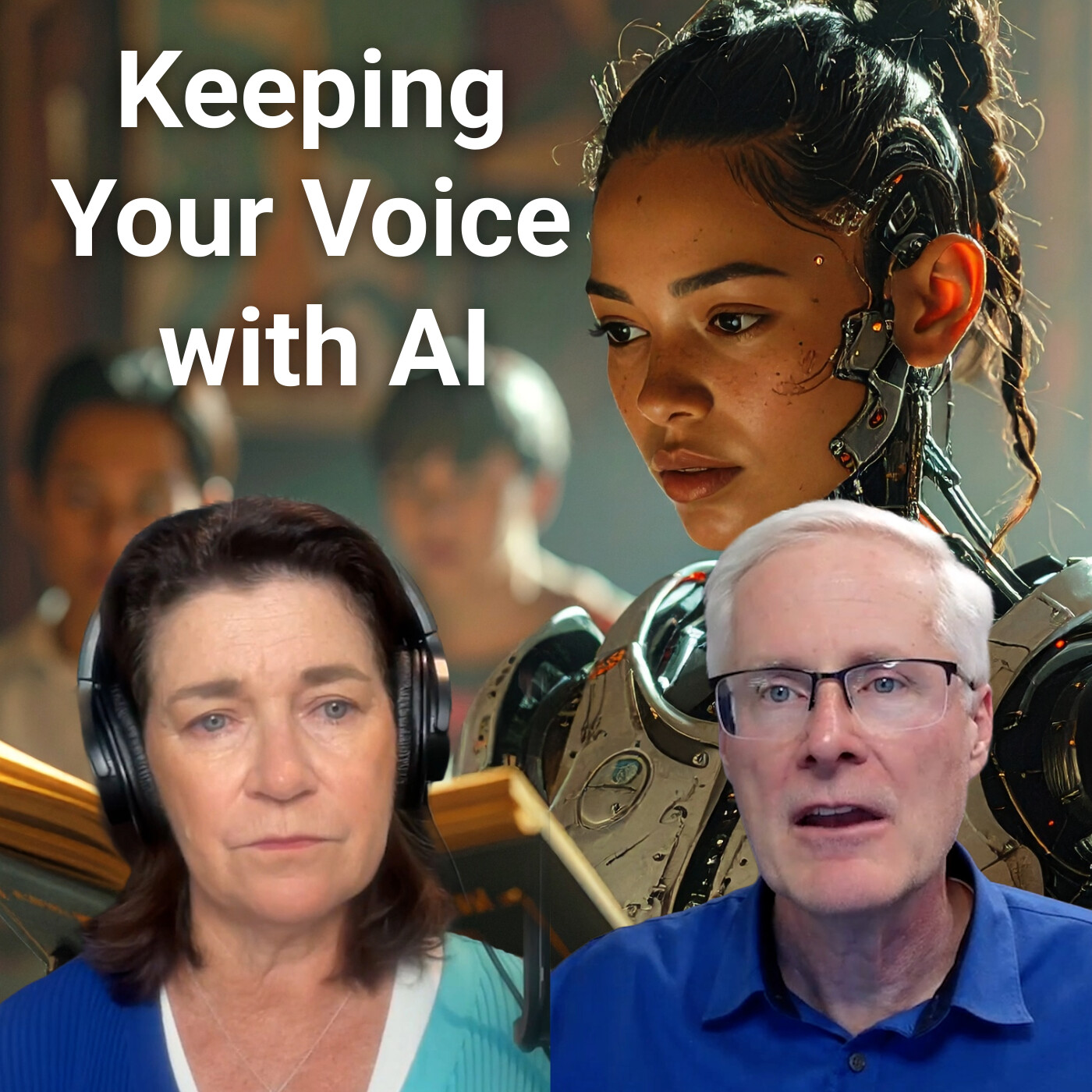
Embracing Digital Transformation
#340 Unlocking Your Authentic Voice: Using AI to Enhance Storytelling
00:35:03
Loading summary
Transcript126 lines
- [00:00]
A
I will bridge the gap between impact and trust. And. And then you go, can you explain what that means? And it was like, no. So, so. And that's the trap, that is the real AI trap of us saying, oh, that sounds good, but does it sound like you?
- [00:21]
B
Welcome to Embracing Digital Transformation, where we explore how people process policy and technology drive effective change. This is Dr. Darren, Chief Enterprise architect, educator, author, and most importantly, your host on this episode, using AI to augment your storytelling without losing your voice. With returning master storyteller and best selling author, Gabrielle Dolan. Gabrielle, welcome back to the show. It's great to have you back.
- [00:57]
A
Yeah, well, I'm excited to be invited back. Thanks, Darren.
- [01:01]
B
Well, we didn't finish our conversation and we didn't. No. And I really want, I really want to because I took a lot of your advice that you already gave me and I guess other people were listening in too, so I guess they got to hear on storytelling. And I'm incorporating in a book I'm writing on, on AI augmentation and, and things like that, which we'll talk a little bit about. But tell me what you've been. It's been a month.
- [01:27]
A
A month has been a month. It has been a month of. I've had a birthday since we last spoke that's.
- [01:32]
B
Well, happy birthday.
- [01:34]
A
So it's, it's my 59th birthday, so I'm officially into my 60th year and I've decided that I'm going to have a, a two year, 60th festival of 60 for two years.
- [01:44]
B
So you know what, I love that, you know, I'm going to do this. I like that idea I got a couple of years ago. I'm 57, so when I turn 59, I'm gonna say I'm celebrating my 60th year.
- [01:57]
A
Yep, absolutely.
- [01:58]
B
I love it.
- [01:59]
A
Yeah. And then it's two years of just saying, you know, do you want to do this? Yeah, let's, let's do that. Why not? It's our 60th and, and my husband, we're only four weeks apart, so it's our, oh, 60th. So doing lots of travel and what that.
- [02:13]
B
Oh, that sounds, that sounds awesome. Now you got me something. I got to look forward to 60 now.
- [02:18]
A
Yeah, 60 is the new 40. That's. Well, that is potentially a very convenient story I'm telling myself. But you know, I think, I think 60s the new 40, how that.
- [02:30]
B
That is. So that is so awesome. So, hey, let's, let's dive into, let's dive into story we Talked a lot about storytelling. Storytelling last time. Great, great examples. I'm even using some of those examples in my book, which I think is, you know, amazing. Thank you. I should say thank you for that. And you are attributed to that. But let's talk about AI, because there's. I've had someone on my show before that taught English, and her comment was she's trying to teach her students how to get AI to amplify the student's voice, not take it over.
- [03:12]
A
Yeah.
- [03:13]
B
So do you. Can I do the same sort of thing in storytelling? And where do I start losing my own voice in working with AI and in storytelling?
- [03:23]
A
Yeah, let's do that. Because, I mean, in our last podcast, we just were speaking storytelling, storytelling, storytelling, and we ran out of time to get to the AI bit. And look, ultimately my book, Story Intelligence, is still a storytelling book, but the subtitle, the. The Craft of Authentic Storytelling Made Smarter with AI starts to bring in AI. So, yeah, why don't. Why don't we spend some time talking about how you can use AI to help find your stories in the first place? So a lot of people say, I just don't have any stories. And then. And then we could talk about how you could use AI to refine your stories, but also what you've said, that you don't want to lose your voice in, In. In that process. And in the book, I actually wrote a letter to AI so we might even end on that. We'll end on the letter to AI.
- [04:13]
B
Okay, that sounds good.
- [04:15]
A
But, yeah, look, so I, I talk. So a lot of people, Darren, they come to me and they go, look, you know, I. I get the storytelling bit and I want to find a story, but I just. I just don't have any stories. I just can't think of any story. So ultimately, I go back to, what's your message now? And then, if you were working. So, Darren, if you were working with me and you wanted to have a story around, let's just say you wanted a story about trying something new because you want to encourage people to use AI. So it's not. It's not specifically trying AI, but you just want to get the message about trying, embracing some new technology or something, right? Yeah, yeah, yeah. And you said. I say, gabriel, yeah, look, you talk about stories all the time and you talk about personal story, but I just can't think of anything. The third, the first. First thing I would do to you is to start asking you questions. I go, so it would be like, okay, so your message is around Encouraging people to embrace something new, do something different. You go, yep, yep, yep. And I would say to. I would ask you questions like, was that something that your parents instilled in you? Like, were you raised that way to just try something new? Or did you have a. A really, you know, great teacher or coach that instilled that into you? Or where have you done it? Or where have you not done it? So I'd be asking you all these questions. I'd be saying, like, you know, when was the time that someone was trying to get you to do something and you just did. Didn't have the courage to do it or didn't want to do it? So I would be asking you all these questions, and I guarantee you, you would think of a story. You would go, oh, yeah, actually, I remember when I was. Blah, blah, and you would tell me the story. So use AI as that. So literally, I would get into, you know, one of the AI platforms and say, I need to find a story around, you know, embracing new opportunities, whatever it is. Can you act as my storytelling coach and ask me questions to help me find stories? So literally, use it as if you were sitting down and having a coffee with me.
- [06:19]
B
Wait, aren't you afraid, Gabriel,
- [06:25]
A
you're telling
- [06:26]
B
the world how to replace you? You're gonna. Yeah.
- [06:28]
A
Getting rid of your own job? Well, you know, as we said, Darren, I'm in my 60th year. I'm not, you know, I'm no. I'm no spring chicken, as they say. No, but the reality is, look, you know, I. I often. I. Joking. Like, a part of it means, like, oh, am I making myself redundant?
- [06:46]
B
Yeah, yeah, yeah.
- [06:47]
A
But, you know, I'm not. But, you know, part of me, I. I've always jokingly said, once everyone learns the power of storytelling and to do it well, my. My job here is done. But the reality is I am not sitting down for a coffee with hundreds of thousands of people a day. So you're correct.
- [07:06]
B
Yeah, you're right.
- [07:07]
A
So, yeah, yeah. So that's. So you can use that. Use that as the start. So this is where you start. But remember, also, and we may have spoken about this in the previous podcast, I can't recall, instead of saying, oh, I need to find a story about innovation, I would first say, well, what does that really. What does innovation really mean to you? And, you know, again, if you were trying to find a story on embracing new opportunities, I would say, well, what does that really mean to you? And is. And so you first got to be clear on the message and once you're clear on the message, then go to ChatGPT or Claud or whatever you're using and use it as your storytelling coach. So the next step, the next step then is, okay, so you've thought of this idea of, like, you know, you've someone, me or chatgpt, asks you these questions and you've got this story. What AI will do then is say, so just give me some bullet points of what happened. So you get back in and you go, okay, yeah, I remember this happened and this, and then I did this. And so you've almost sort of the, the bones or the, you know, the framework of a story, the start of a story. AI will then come back and turn that into a story. This is where you've got to be really, really careful. And we can talk about both storytelling and just content general. You then got to come back and it'll say things like, I was really excited when this happened. And then you've got to go, were you really excited? And you might go, actually, I wasn't excited. I was really bloody nervous. Okay, so we're not saying I was really excited. We're saying I was really nervous. And so we're changing it to make sure it's accurate. And we're also, you know, when we use AI to generate content, we don't want to fall into the trap of going, oh, that sounds good, but does it sound like you? So you've got to make sure that you don't lose your voice in the process.
- [09:06]
B
So, yeah, I was going to say this is where, this is where you have your voice come out. Yeah, right. This is where that's, that's the key here, is that you're still you. Right. But it's, it's helping you pull that out of yourself. Right?
- [09:23]
A
Yeah, yeah, absolutely. And it's a, you know, and we, we, we spoke just before we hit record that you're starting to use AI and the concepts to sort of help write with your book. And I, and I used, I used AI as my creative partner in the book as well. But you've got to. I, I remember one time I was looking, I was looking for examples around like, like trust and stuff. And look, in the past, I just would have used Google to try to find public examples of this, but I used, I was using ChatGPT, so it sort of feels more efficient. And one example they gave me, like, I really resonated with and I liked it and I used it. But then another example, it was about something that I wasn't interested in. And I did, I didn't really know it. So it's like I'm not going to use that example because it's not, doesn't feel like me or an example I would use. So it's, it's constantly saying it's, it's not letting it take control and it's just constantly being critical. Have you, I mean, have you, have you found that when you started to use AI to generate content?
- [10:28]
B
Absolutely. I, I, I found the same thing. When, even when I have it help me with outlines and, and, and, and I argue with it, I don't just go change it. I said that's not what I want. Why no, you, we need, let's get back to what I want. So I, I actually kind of argue with it and interact with it as I would with a writing partner, which I've, and, and I know you write with a partner too, right?
- [10:59]
A
Yeah, yeah. Well, I, I have, I have an editor. The whole, we sort of, you know, I, I don't just go to the editor at the end. I, the editor comes during the whole thing.
- [11:08]
B
Right? Yeah. That's how I wrote my first three books was with a, a technical writer that's a dear friend of mine. And we would argue over things and he would go, you need more detail here, Darren? I go, well, that's a stupid story that you put in there, or whatever the case was. And we'd argue about it and, and that that got us a better book, if that makes any sense.
- [11:33]
A
Yeah, no, it does make sense. Yeah.
- [11:35]
B
Relenting and saying, all right, whatever you say is right. So I treat chat GBT that way. I say, hey, you're a partner of mine. Not my equal. I'm still in charge. It's still my book. Right. But you, I'm, I want you to do what I asked you to do, and then I want you to question it too, at the same time. Right.
- [11:57]
A
So it's a, it's a really great example because I, I have a similar, Just catching on a few points. You said I have a similar process with my, my editor where she will push back and go, this doesn't make sense. You need, you just need more information or whatever. And you know what? 9 times out of 10 I read it and go, you're right, it doesn't make sense. Okay, because you're sort of cursed by that knowledge. And, but there'll be times where she, like, like she will suggest that something gets taken out. And I went, and I will push back and go, no, no, this Is, I, I, I think this is really, really important. And we, and we might argue back and forth for a while, but ultimately, in the end, it's my book. It's my book. And you know, I was, I read the other day, you know, like, you're the author. The word authority comes from author. So it's like you are the author of it. Yeah, of course. Like when I was like, duh, that makes sense. So whether you're writing a book or whether you're writing a LinkedIn post or whether you're writing a, you know, a newsletter to your team or whatever, you are the author. So it's your thought authority, so you can't just go, oh, whatever, like hand that over to someone else. So you, whether that's an, a person that's playing that creative partner role with you or, or AI, you've got to push back and, and, and sometimes stay quite strong about. No, this is, this is what I want, this is what I want it to be.
- [13:23]
B
No, I, I really like that because that, that doesn't just, like you said, it doesn't just apply to AI, it applies to anything that you are the author of. Yeah, right. Whether you're the author of your story, you're the author of your position at work. Right. You, you are your authority. So it, and you know, you gotta, you gotta figure out where your boundaries are on that. So I really like that.
- [13:47]
A
Yeah, yeah, it's similar. Like if you think of similar as a leader or, you know, they've, they've got a team and they're ultimately gotta make the decision. They will get input from their team. Like, if they're a good leader, they will get input from their team and they won't just go like, someone says we should do this. They go, oh, well, whatever you think, if that's what you think, that's fine because it's, they're got, they've got accountability for the decision. And so they wouldn't do that with their team. They would go, I under, what, understand what you're saying and I hear it, but I'm, I'm making a decision. This is my decision. And it's got to be the same with AI. So I, I sort of talk about include AI as one of the people in your team. Like if you got a, if you got a group of people that you bounce ideas off. You know, I run my own practice and there's, there's quite a few people that I bounce ideas off. Now, AI is just one of those other options to bounce an idea Off, But I'm never going to. If I had get a great idea and I went to, you know, a. Someone I bounce ide ears off, and they just went, no, that's, that's dumb. That's such a dumb idea. I wouldn't go, oh, okay. Then I would sort of go, well, no, I actually don't like, No, I don't tell. I would probably go. Tell me why you're saying that. But ultimately I'm not gonna go. I'm not gonna go, oh, well, I think it's a great idea. But if you think it's a dumb idea, I won't do it. It's like, you're not never gonna do that.
- [15:04]
B
Do you think that skill is lost on the younger generation? Because there's always been this lack of the ability to go debate or lack of ability to. You know where I'm headed with this?
- [15:19]
A
Yeah, there's.
- [15:20]
B
Because they taught these kids, you have to build consensus, but. Which is important. But there's a point in time where you have to make a decision.
- [15:31]
A
Yeah. Yeah.
- [15:32]
B
And I see in, in even some of my own kids, they have a hard time making a decision because they, they've been taught, oh, it's all about consensus building and things like that. And I, I even see it in some large corporations that are stuck in not making decisions because not everyone would agree. And no one's taking accountability or responsibility.
- [16:02]
A
I, I'm, I'm genuinely not sure about that, Darren. I was, I was, when you were talking about that, I was thinking of my kids and I'm thinking, God, well, they certainly know how to debate because I can.
- [16:13]
B
You're a good mom.
- [16:14]
A
I was like, oh, my God. All right. And it'll be like, okay. Just like, they know how to debate. I think some. But then when you said they can't make decisions, I probably find that more when they've got, when they're pressed with the decision. But I, I, I think I just put that as youth, that they're not quite sure.
- [16:32]
B
They're not quite sure.
- [16:33]
A
And I. What I, yeah, and I, I think that might. So what, what I tend to do is with my kids and probably with anyone is like, you know, you know, mom, I don't. Would, Should I do this? I just don't know what to do. And I go, well, what, what do you think? What do you think you should do? And they will be, they'll go, I don't know. That's why I'm saying I don't know what to do. I don't And I don't know the answer. And I always go, if you did know the answer, I go, just play with me. If you did know the answer, what would it be? And they would go, well, I'd probably do this. And I go, well, that's probably your answer. So, yeah, I'm not. I don't know if it's a doubt.
- [17:13]
B
It may just come with maturity.
- [17:15]
A
It could may just come with maturity. I think, I think the really, probably the interesting debate with the younger generation is are they going to be a lot more cynical than we were? Because they have literally been raised now in a world of AI And AI Generated content and deep fake that everything they see now is potentially not true, is questionable. And we, we like, we didn't never grew up that way. I mean, I don't, I don't know about you, Darren, but I, you know, me and especially my parents, our parents got their news source from one paper, one newspaper and one news channel. One 30 minute news. And it was the same news channel and it was the same newspaper.
- [17:57]
B
Yeah. In, in the U. S. Walter Cronkite.
- [18:01]
A
Right, there you go.
- [18:02]
B
Everyone knew he was the source of all truth.
- [18:06]
A
Yes.
- [18:06]
B
Right.
- [18:06]
A
And, and, and because it was either on the news or in the newspaper, it was true. It was true. And it was like. And, and like you, you might go, it might not have been true, but in their minds it had to be true because it was in the newspaper. And I think, and I think back,
- [18:25]
B
that's an interesting point.
- [18:26]
A
Yeah. So now it's like you just see stuff and I don't know the amount of, the amount of little videos I see and I go, this is so cool. And then you go, hang on a minute. Is this AI And I don't know if it's AI but now I'm assuming it's AI because you know, I saw one the other day of an elephant rescuing a lion in a flood and probably never happened. This probably never happened, but it was. I was like, oh my God, this is so cool. And I was like, that probably never happened.
- [19:00]
B
It feels horrible because we feel manipulated now, right?
- [19:03]
A
Yeah. Yeah. So I, I think the younger generation will just, that will be innate to them. That, that they will literally start to question everything now. So now that may lead to indecisiveness because they actually don't know the data. They, you know, the old garbage in, garbage out. Well, yeah, I could be making decisions on false data.
- [19:24]
B
Yeah. So that brings up kind of the next question I have around if I'm using AI To Help me first identify stories that I have. Right. By asking me questions and kind of pulling stuff out of me. And if I help the. If I use an AI to help me tell my story a little bit better, where does the authenticity go away?
- [19:48]
A
Yeah.
- [19:48]
B
Even if I'm controlling the AI, but it says, hey, I. And I look at that and go, oh, that made my story even pop even more. I mean, yeah. And then. And then will people stop believing me? Because stories only really have real value when people can believe them.
- [20:07]
A
Absolutely. And, you know, one of the things I talk about is your stories have to be authentic. That, like, it's not worth the risk of making up or exaggerating stories. And I think AI is potentially helping people exaggerate stories or polish them, you know, polish them. A couple of things I've been speaking about just very recently, because I'm seeing this more and more, is that when it comes to communication and especially around storytelling and being authentic, we want to go for effectiveness over efficiency. So AI can help us generate a whole lot of stories and, you know, a whole lot of other content as well. So it sort of seems efficient, but is it effective? The specific question you asked around authenticity, it always comes back to. So the first thing I say is if you. When it comes down to reading stories or, sorry, stories, read it out loud. And so say things out loud. And if it's just a thing that I wouldn't normally say that, or that doesn't feel like me, then you have to change it. I had an example just a few weeks ago where I had to complete a form. And part of the form said, you know, in a. In a couple of paragraphs, explain what you do. So I, I wrote something like, I teach people how to communicate more effectively through stories. And, you know, I wrote some other stuff and I put it through Chat GPT. I. I often use chat GPT just to edit. I'm not very good at grammar and spelling and.
- [21:33]
B
Yeah, same here.
- [21:34]
A
So I just use it for that. And it came back, Darren. It came back and it said, I teach people how to authentically communicate via stories, to bridge the gap between impact and trust.
- [21:49]
B
You would never say that, right?
- [21:51]
A
First of all, I would never say that. Like, like, shoot me now if those words ever came out of my mouth. My first insta instinct was, what the hell does that even mean? Like, bridge the gap between impact and trust. I'm going. I don't even. I wouldn't even be able to explain what that meant. But then part of me thought, but it sounds good. Doesn't it like. Doesn't that like. And so this is the trap where you go, oh, that sounds good. People go, oh, maybe that will be my tagline. I will bridge the gap between impact and trust. And. And then you go, can you explain what that means? And it was like, no. So. So that, that. And that's the trap. That is the real AI trap of us saying, oh, that sounds good, but does it sound like you?
- [22:47]
B
So I. I like. I like how you said that. It has to sound like us, and it has to sound like us as we're speaking. Especially with storytelling.
- [22:56]
A
Especially with storytelling. So even I encourage people to write up the. You know, even before AI, I would always encourage people to write up their stories, but I would say write them up as you say it, like, as you speak, not as you write. And then, of course, you would practice, practice, practice out, and you would practice out loud, and then you would throw away the script because you never want to read your. You know, you don't want to be reading your personal stories. So it's a similar process, but saying it out loud helps it. Does this feel right? Are these the words I'd normally say?
- [23:29]
B
Yeah, because if. Especially if you're reading and you stumble over the pronunciation of a word.
- [23:35]
A
Yeah. It's like. It's like I have two daughters. I have two daughters. Alex and Jess. Yes, Alex and Jess. That's their names.
- [23:46]
B
That's hilarious.
- [23:48]
A
Yeah.
- [23:49]
B
I. I love. I love what you've. What you've done with this. Right. Because we can use. And this goes into my whole concept around becoming AI augmented, which is I am not. I'm not a slave to the AI. The AI is helping pull out the best of me, but it's still me.
- [24:09]
A
Yeah.
- [24:10]
B
Right. I'm. I'm not an autonomous automaton. I'm not, you know, plastic.
- [24:16]
A
Yeah.
- [24:16]
B
It still has to be my voice. It still has to be my authentic self that I'm presenting out. And I made huge mistakes in this. On social media posts.
- [24:26]
A
Yeah.
- [24:26]
B
I'm like, yeah, sure, that looks great. Send it out, send it out.
- [24:30]
A
Efficient. So again, Darren, what are you saying? So that's a great example of falling into the trap of efficiency over effectiveness. Yeah, yeah, that'll do. That'll do. Just put it out there.
- [24:43]
B
Yeah, no, I. You're absolutely right.
- [24:45]
A
I even. Darren, you're gonna. You're gonna experience this, that once you've written the book, the real hard work then goes in promoting the book. And so you're writing, you know, lots of articles and linkedins and doing podcasts like this, for example.
- [24:58]
B
Right.
- [24:59]
A
But I, I mean, I use a paid LLM and so I, I put my manuscript in this LLM to keep it really secure because it's, it's, you know, it's my IP and, and then, but I use it to write articles. So literally I would say I need to write an article. The audience is finance people. Can you use chapter two in the book and write an article? And I sort of go, well, it's, it's my words, it's just helping it. But the amount of times then I read the article and go, I'm pretty sure I never said that. And so it's, I'm even giving it directions to use my content and only my content, only your content. And it comes back with stuff that is like. And sometimes I've gone and double checked and I'm going, surely I did not put that in the book. And I was like, I go back, I was like, no, I didn't put that in the book. And it's just made up stuff.
- [25:53]
B
Well, and I'm glad you brought that up because I, I was working on a lecture I, I do every Wednesday I do a lecture on this standard that I'm helping move along in being, becoming a standard. So I started doing lectures on this and I have an acronym in there called FORGE S O R G E and which stands for find, observe, Reconcile, ground and enhance. Yep. And inevitably in this lecture, I said, hey, I want you to write some lecture notes based off of the forge methodology and architectural intent. All right? So boom, boom, boom. It made up, it didn't even use my stuff. It just made up some other words that threw in there and like reconcile. And I'm like, no, yeah, no. You know, so it probably would have been faster for me to write all my lecture notes myself instead of have Chat GPT do it. Because it was going off hallucinating and doing things all on its own that. Yeah, I couldn't control it anymore.
- [26:59]
A
Yeah. So some real irony with how I used it, like building on what, how I said it before and I spoke about the letter to AI so I might read that shortly. I would, I want, I want you to write, I wanted to do a summary of the book. I was sending a summary to, you know, some podcast hosts and of the book and I said, I want you to include the letter to AI verbatim in the summary. So very clear instructions. I thought a com. AI completely made up a letter that I had written to AI about don't let AI Take control. It was just like, I reckon, I reckon it bloody read that letter and thought, screw you, I'm going to take control. I'm gonna. Don't you, don't you go writing me a letter. I'm gonna write you a letter.
- [27:48]
B
AIs turn a little schizophrenic, right?
- [27:52]
A
I know. Sort of sometimes you think you stop get. You bloody get. They get. It's getting an attitude. Yeah.
- [27:58]
B
Sometimes it feels that way. I totally.
- [28:01]
A
Hey, do you want me to. Do you want me to read the letter?
- [28:03]
B
Yes, before, before you read the letter. I just also want to call out for your book. Your book's already out or it's on its way coming out?
- [28:10]
A
Oh no, it's definitely out. It came out December last year. So it's, it's, it's already out and about. It's available. Yeah, it's available globally. So, you know, all your usual Amazons and all usuals out there. It debuted number one in Australians business books, which I was very happy about. And congratulations. That's awesome. I was very excited about that. And it reached in four different Amazon categories. It reached number one in four different Amazon categories. So this was, this was hot new releases, but yeah, in, you know, workplace communication and career advice. And so I was, I was pretty happy. And it's still, it's still.
- [28:50]
B
Well, congratulations. That is so awesome.
- [28:52]
A
Yeah.
- [28:53]
B
A best selling author on the show.
- [28:55]
A
I know. How cool.
- [28:57]
B
That's awesome.
- [28:57]
A
Well, you, you'll be a best selling. The author on your.
- [29:08]
B
I'm hoping so because my other books were technical books and. Okay, this was technical books in their very specific area. The only one. So they were number one and number last place.
- [29:22]
A
Right? Yeah. Yeah. Well is, isn't that, isn't that a strategy to get number one? He's just like write a really obscure book in, in a really obscure category
- [29:30]
B
and just, just doesn't make any money.
- [29:33]
A
But yeah, it's number one out of. Yeah, well, I don't think anyone makes money out of writing books unless you're,
- [29:39]
B
you know, unless you're J.K. rowling.
- [29:41]
A
J.K. rowling. Yeah, exactly. Exactly.
- [29:44]
B
All right, let's hear this letter.
- [29:46]
A
Okay, so I, I was actually inspired to write this. Have you ever written Elizabeth Gilbert's not written. Read Elizabeth Gilbert's Big Magic? That book. It's all about it. So it's a really good book. I do like that. It's all about embracing. It's a, it's a book about creativity, but it's a. Creativity comes fear. So it's all about embracing fear. And so she writes a letter to Fear about, you know, her and creativity are going on a road trip and fear can come along and it will come along, but it's not allowed to take control of the wheel. So the wheel. So I was sort of inspired by that and I wrote it to. I wrote it to AI. So it says, dearest AI, creativity and I are about to go on a road trip together and I invite you to join us. I will be doing my job on this road trip, which is to work hard and stay focused. And creativity will be doing its job, which is to remain stimulating and inspiring. There is plenty of room in this vehicle for all of us, so make yourself at home. But understand this creativity and I are the only ones who will be making any decisions along the way. I recognize and respect this is supporting and valuable role you can play. So I will at times ask you for your advice and suggestions along the way. But understand that I will always make the final decision and I will always be in control. Don't take this personally, as I know you won't, because you're not a person. But I know sometimes while you are eager, you hallucinate. So sometimes you are wrong. You also come with some built in biases. So we are not always aligned. So you're allowed to have a seat, you're allowed to have a voice when asked, but my dear friend AI, you are absolutely forbidden to drive. And I will always be in control. So.
- [31:38]
B
That is awesome. That is awesome. That's in the back of your book.
- [31:42]
A
It's in the book. It's in the book.
- [31:44]
B
All right, I'm going to.
- [31:46]
A
But I genuinely think that if you're using AI and you have that mind, like that mindset of what's in that letter, like, I will ask you, you can have a voice, but you will never, ever be in control. Then we will be using AI wisely.
- [32:01]
B
I love that. I want to read that at the end of every workshop that I give because there's a lot of fear and people feel like they're going to lose control, but this shows them, no, you're still in control.
- [32:14]
A
Yeah, you're still in trouble. You're the author. You're the authority. You are the author, so you stay the authority. Darren, I feel like, and you'll remember this, it was about 35 years ago when PowerPoint came in. So, you know, when, when PowerPoint came in, we, because of the technology, because it had, you know, like cool little things you could do, we truly believe that all our presentations were going to be amazing because of PowerPoint and what we realized they weren't. And, you know, there's now, you know, the saying death by PowerPoint came along because we. It's like we gave up too much control to the technology. We. We got sucked into literally all the bells and whistles and then just started creating these really dense, heavy, boring PowerPoints which did not. Did not increase the impact of our presentations. And in some ways it made it worse. And my fear is that will be with AI that will sort of get sucked into all the cool stuff, you know, the cool stuff of the new technology and let it take. Let it have too much control over how we present ourselves.
- [33:22]
B
You know, I totally agree with you on this, and that's why it's so important to have you out there as a clarion call to the world saying, hey, let your story be told, let your voice continue to be told, and teach people how to effectively communicate. I think this is wonderful. Gabrielle, thanks for coming on the show. It's always a pleasure. We're going to have to have you come back. Of course.
- [33:49]
A
Come back. Like, have you. Have you ever had guests come back three times? I can come back three times. I'll think of something to say.
- [33:55]
B
Yeah, yeah, I'm. I'm sure you'll have something to say. I. I don't know if you'll ever get. I have one guest that's been on the show 11 times.
- [34:03]
A
Oh, okay.
- [34:03]
B
And it's been a while since he's been on. And the number two is a dear friend of mine, Dr. Anna Scott, who's been on the show eight times because I work.
- [34:13]
A
Got a way to go.
- [34:14]
B
Work.
- [34:15]
A
Yeah. Got a way to go then.
- [34:17]
B
Yeah, you got a way to go. But you're so fun to talk to.
- [34:19]
A
I'll be there.
- [34:20]
B
Thanks. Thanks, Cameron. We'll schedule some more time, so thanks for coming on.
- [34:25]
A
Excellent. Thanks, Darren.
- [34:30]
B
Thanks for listening to Embracing digital Transformation. If you enjoyed today's conversation, give us five stars on your favorite podcasting app or on YouTube. It really helps others discover the show. If you want to go deeper, join our exclusive community@patreon.com embrace and digital, where we share bonus content and you can always connect with other change makers like yourself. You can always find more resources at embracingdigital. Org. Until next time, keep embracing the digital transformation.