← Embracing Digital Transformation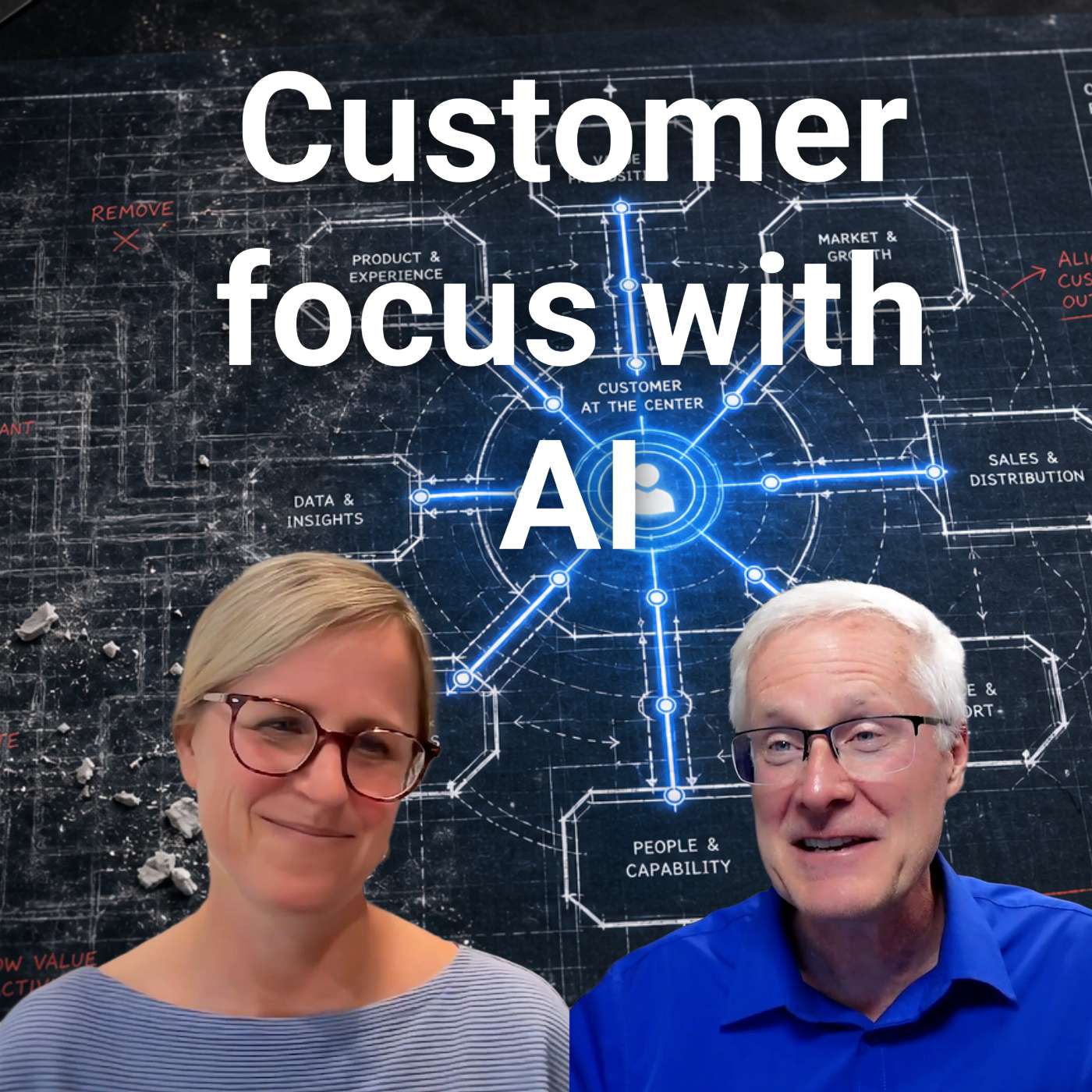
Loading summary
Transcript90 lines
- [00:00]
A
Welcome to Embracing Digital Transformation. Before we dive in, I wanted to personally thank you for listening. Many of the ideas we discuss on this show inspired my new book, AI Augmented Teams. If you're looking for practical ways to combine human expertise and AI to achieve better outcomes, I think you'll find it valuable. Learn more at Paydar AI Books. That is P A I D A R AI Books. Now, let's get started with the show.
- [00:30]
B
Just bringing the old motions with us because they didn't align to the needs of the new products. And so we had to do a reset to be able to really build it for what it needs to be. And that really came from, like, timing pressures and instead of, you know, stick to what we knew, we decided to try something different. And then we went back and said, nope, we knew this already. Reset.
- [00:58]
A
Why this matters to you? Many leaders are still treating AI as a way to shave time off existing workflows that may improve efficiency, but it rarely changes customer experience or competitive position. In complex regulated industries, the real challenge is not speed alone. It is redesigning the system so the customer gets the outcome they actually need with less friction. If you want to understand what it looks like to use AI as a business reset rather than a software add on, this conversation will give you a useful lens. Let's get into it. Welcome to Embracing Digital transformation. This is Dr. Darren. On this episode, AI can redesign the operating model, not just automate it. With Kristen Nunnery.
- [01:45]
C
Kristen, welcome to the show.
- [01:47]
B
Thank you. Great to be here today.
- [01:51]
C
Hey, it's been a while since we talked last. It's been some time, so a lot has probably transpired. But before we drop into our, we're going to talk about engaging with our customers better and AI and its role and all that. We're going to have a lot of fun today. But before we do, everyone that listens to my show knows that I only interview superheroes. I only have superheroes on the show. Every superhero has a background story. So, Kristen, what's your background story?
- [02:23]
B
Oh, gosh. I. First of all, superhero. You're setting the bar high for me today.
- [02:29]
C
No, that's what I've been told. Everyone that comes on always a superhero. So you may not know it, but maybe we'll discover it today. You never know.
- [02:40]
B
Well, a little bit about me. I am entrepreneur at heart. Started my first business in college. Incredibly passionate and driven about the problem our business is here solved today because of personal high school experience. But I am. I love to create. I'm a problem solver. I love sports. I love Dogs. I am. You know, even in my adult days, I'm still playing sports multiple times a week and can't get enough of it. Love adventure. I known to go out in an RV every now and then or spend time outdoors or, you know, and go travel and enjoy life.
- [03:19]
C
So, you know, I recently had a guest on the show that interviewed from an rv.
- [03:26]
B
Amazing.
- [03:28]
C
With the Starlink. It's amazing what you could do now, right? That's absolutely amazing.
- [03:33]
B
It is.
- [03:34]
C
So. I know. So you talked a little bit about your experience as a teenager. Can we touch on that a little bit? Because that is so profound in what you do today.
- [03:45]
B
Yeah, yeah, yeah. So when I was in high school, youngest of three, it's parents weekend at college and parents are visiting brothers there. So I'm in charge of the house. And unfortunately the house burned down that weekend and basically a total loss. And long story short is my parents trusted their insurance broker. They bought the insurance policy they recommended and that turned into a three year battle with the insurance carrier before the claim was paid out. And just a really tough situation for our family in many, many ways. And so I sort of lived through the pain of that and the stress, the disruption, the emotional elements that go with it, all of that. And what we do today with the business is to protect people from the exact same thing, just all in the B2B world. So it really hits home. It's meaningful because it's really. While insurance compliance might feel really boring, we're actually here to really protect people from living through that experience.
- [04:50]
C
Okay, you are a superhero. You absolutely are. I mean, you took tragedy, tragedy, and now you're turning that and helping other people. That's incredible.
- [05:01]
B
It gives a lot of drive behind it, a lot of meaning, a lot of passion. So as an entrepreneur on the tough days, it definitely is a motivating factor.
- [05:10]
C
I'm glad you brought up the tough days because I think a lot of other entrepreneurs, they see and they listen to the show and things like that and they're like, wait, everything's all great and how. And are you rainbows and unicorns? No, it is a tough, a tough slog. A lot of, A lot of times
- [05:28]
B
as an entrepreneur, it is, it is no question about just, you know, I think it takes a lot of grit. It takes a lot of motivation. You just really have to believe in what you're doing to be able to work through the challenging days.
- [05:43]
C
Yeah, absolutely.
- [05:44]
B
I'm not a sprint. And it's, you know, has its roller coaster moments.
- [05:49]
C
Yeah, it, it sure does. I I totally agree. All right, let's talk, let's talk about the problem space that you're in, right. And how you're going to leverage AI or how you're leveraging AI to help. And let's talk there and then I'm going to toy around with the idea that what if you didn't have AI, what would it look like? But let's start with let, let's, let's play the game with AI. What, what first off, what problem space are you really solving? And then how's AI helping?
- [06:17]
B
Yeah. So problem space is companies hire us to make sure that when they hire contractors, suppliers have tenants move into their building, that that third party partner has the insurance they said they would. So that when things go wrong, because it always does, bad things happen and you know, accidents happen. Our job is to make sure that, that you know, that claim gets paid out and people don't end up in the disruption that I live through. So you know, I guess I almost might taking it the other direction. I know what the world is like without AI. Founded this company 16 years ago and have, you know, built the business pre AI world, being able to help support customers in this.
- [07:05]
C
Yeah, I imagine it was very, I imagine it's very time consuming and resource heavy because you, you, you're reading through a lot of different documentation and compliance regulations. I. That's a lot of work.
- [07:21]
B
Yeah, yeah. Insurance is a really complex world and when a claim arises, what matters most is the language buried in that policy that nobody wants to read or understand or attempt to interpret. So you are spot on. You know, a lot of the value we've been able to deliver to our customers over the many years is having people who just have incredible depth of knowledge and insurance that can support that part of, you know, that part of what we deliver to our customers.
- [07:52]
C
So is there a fear that I can just use Chat BD to tell me all this stuff? Because chatgpt does a good job with this stuff, doesn't it?
- [08:04]
B
Yeah, I Love that question. ChatGPT is gonna very siloed in what information can provide. I'm a big Chat GPT user every day, so don't get me wrong here, but in the, in the world we sit in, it's a lot more than just being able to ask the questions or upload some documents and get feedback. There's much greater workflows, contextual information knowledge that really takes a more specialized training of models to be able to support well versus just kind of going siloed to ChatGPT.
- [08:41]
C
So you brought up an interesting point I actually covered in my book that I just released. It's the subject matter expert is so valuable and with an AI sitting with a subject matter expert, you can conquer the world. Right. But that subject matter expertise is still required. The gen AIs, they don't have those. All that subject matter expertise and that intuition that we have that we've learned through doing what they always say, 10,000 hours worth of learning before you become a subject matter expert.
- [09:16]
B
So I couldn't agree with you more and actually like to give a little more story. We've, we've really transformed our business and the backstory is, you know, three years ago, it was about this time, as you know, AI is starting to progress. We stepped back and said this really changes how we can deliver to customers and it's an opportunity to redefine in our industry, redefine what good looks like. And we made a bold decision to say, hey, what if we take the 16 years of experience, the depth of knowledge, the understanding of the customer in and out, what works really well, what doesn't work really well, we have a product, we have to drive human behavior to get the results the customer is looking for. So you know, what does drive human behavior and what doesn't in a product and, and be able to then give ourselves a clean whiteboard to say if we put the customer at the center, we rethink like how we can deliver to them, knowing what their goals are and the outcome they want. What would this look like? And, and we did that. We gave ourselves a clean whiteboard. We built a brand new product really to redefine and transform and disrupt the industry we've led for 16 years. And that has given us the opportunity to really like reimagine and get very creative. That ultimately has allowed us to like deliver better. And I will say I, I very much underestimated how much value would come in that process from the 16 years of experience. And once we got to it, yeah, that became really clear that it's just a tremendous amount of value.
- [10:58]
C
So I mean, this is pretty disruptive. Weren't you a little concerned? I mean, I mean a clean slate that has, that's pretty, you don't get to have that opportunity very often.
- [11:12]
B
Yeah.
- [11:12]
C
And yeah, that, that must have been a, a very emotional. Is that the. Yeah, emotions must have been high at that time.
- [11:23]
B
Bold decision. A lot of risks that went with. It took a little bit to get, get everybody that needed to be on board with that, to be on board with that. And but at the end of the day, the conviction was so high on how we could deliver to the customer that it, it made sense, it was worth taking that risk. And yeah, emotions were definitely high. Being able to run through that and be able to, to say we're going all in, we're going to make this happen.
- [11:54]
C
Yeah. So how, how long did it take do you think? Because I'm guessing you were the point of the spear on this, right. You were out front. How long do you think it took for your whole team to have the same conviction that you have? Or maybe they never have, but at least follow without dragging their feet like, you know, like a two year old that doesn't want to go anywhere where they turn limp. We see that in business too, right? That passive aggressive and. Or how long did it take for all of that to kind of dissipate? Because I know at first it's there, right? I mean
- [12:33]
B
there have been stages. So if I think back on that, I'd first say like one, this was at a window in time. Like even our investors were not talking about AI yet. So this is just super early on. So to be able to get the leadership, get the board, get you know, key stakeholders saying yes to this, I mean that took a, that took a few months of a lot of conversations and a lot of evaluation and understanding of different paths we could take. And what made the most sense before we got that bond in, in terms of then there was kind of like a next stage. We actually, one of the things that we did at this point in time, this was such a bold move for us and where we needed to go. We also recognized, I don't know what you're getting at, that there would be a lot of value for us if we almost treated it as a startup within our own company. And so that's what we did. And so we, we really, we brought in a new team to go build this. We created new processes around it. So similar to how we built the product, we gave ourselves a clean whiteboard all around. What's the go to market motion look like? You know, how are we. Who's the team was this know across the board and that allowed us to really accelerate forward, give ourselves the wings to truly be able to redefine and reimagine. And now we're in that place where like more of the team is coming into this part of the, the organization and being able to now come support as we move it forward and as we're bringing more customers into this product. And so it's Been stages. I think that change management for the existing team, you know, that's taken time. Right. You know, you got to set that vision really well. You got to keep iterating it. You got to help support the. What's in it for me. You got to go through all the stages to be able to go through that change management. But. But approaching it in that way really allowed us to be innovative and bold and move quickly to lead the industry in this next AI wave.
- [14:45]
C
So that's really interesting because you built us. You built not just a solution, but a company inside your own company, and now you're moving your current company to it. So you're merging. So you've got an integration play now, which is an interesting thing you've got to deal with.
- [15:05]
B
Right.
- [15:05]
C
Dealing with an integration play is different, but you've got some velocity. It sounds like that you can, you know, and some inertia that you can play with. It's very cool strategy. I haven't heard very many people do a whole. You know, I've heard of incubation. Right. All right. Oh, you. You go do your own little thing over here. But all the heavy business processes are still sitting on top of it. You. You did something very unique here. It's very cool.
- [15:32]
B
Yeah, Yeah. I. I look back on it and, you know, that was guidance coming from. From some advisors of mine. I look back on it now, and I think that was probably the smartest recommendation they could have given me. And, you know, looking at what that's allowed us and empowered us to do because of that decision, I think. I think we'd be in a different place today had we not made that decision and it just.
- [15:57]
C
Absolutely.
- [15:58]
B
To go run. Yeah, yeah.
- [16:01]
C
Was there ever any. These are hard things because we're dealing with people. Was there any, Ever any jealousy possibility or did you see any jealousy with your current org and oh, there's your shiny new object over there type of thing? You know where I'm going with that, Kristin?
- [16:20]
B
Oh, yeah, of course. Of course. Yeah. You know, I think what's been. We've kind of. As we have gone, we've learned things, we've pivoted, we've learned, we've pivoted. And I think from this standpoint, like, there was some of that up front, especially as we're communicating out with the entire organization, what we're about to embark upon, what this is going to look like. And we kind of got into it and said, you know what? People really want to be fully invested in what they can own in their day in that moment of time. And so we really started to think about, like, okay, for the folks that are supporting our customers that are in our other products, like, really lean into the value that they're bringing to those customers, what they can own for the importance of this, their part is just as important as the people that are developing the new product or in sales and go to market for the new products. Like, what they are owning in the prior products, not prior. We still have it today. But in the initial product that we've supported so many customers on is equally as important. And I think we learned as leaders that we need to make sure that's known, that's heard, that's, that's celebrated. You know, they've got things to focus in on. They've got their goals to really be proud of and truly understanding why that's equally as important as what we're doing with the startup part of the business.
- [17:41]
C
The startup part. That's interesting because it changed. It sounds like it changed your management philosophy in a lot of ways as well. So this was a pretty big digital transformation. This is a pretty big transformation for the organization.
- [17:55]
B
Holistically, it's been significant in all ways and absolutely always.
- [18:00]
C
Yeah, that sounds like an incredible case study. I mean, we should write it up, send it to the Harvard Business Review.
- [18:07]
B
Let's do it.
- [18:08]
C
Be the shining star on how this all works, Kristen. Right?
- [18:11]
A
Love it.
- [18:13]
B
All for it. Let's go make that happen.
- [18:16]
C
All right, so here's the big hard question. What's one of the major missteps that you took and how long did it take for you to adjust? Because obviously there had to have been mistake missteps or anyone that you want to talk about. You don't have to.
- [18:37]
B
Happy to. It's part of the entrepreneurial life. You always make mistakes. You got to learn from them. When. When you can learn from others, mistakes, even better. So if somebody listens to this, that's why I'm asking.
- [18:48]
C
I'm trying to figure out so I don't do the same thing.
- [18:51]
B
We hit a point in time when we were bringing this to market where I think the pressures of hitting milestones and goals we had in front of us led to not following our own rule I just described. And we pulled some of existing systems, process team, et cetera, from our existing business into the new business and learned quickly there was a reason we kind of set that boundary for ourselves to begin with. And so that took then like backup, reset. And so a lot of that was like, go to market Motions, like building new tech stack. Building the motions, thinking about it, top of funnel all the way through of what does the customer really need? Making sure we weren't just bringing the old motions with us because they didn't align to the needs of the new products. And so we had to do a reset to be able to really build it for what it needs to be. And that really came from, like, timing pressures. And instead of, you know, stick to what we knew, we decided to try something different. And then we went back and said, nope, we knew this already. Reset.
- [20:04]
C
Well, I think that's a. That's a great lesson because there is that temptation right when you're behind or when timing pressures or maybe competition is catching wind of what's going on. And now they're starting, there's all this pressure, and you're like, ooh, easy buttons over here.
- [20:21]
A
Right.
- [20:21]
C
Because I already know that over there. That's a really tough thing to not bring in. And it looks like you guys did and said, whoa, wait, what we do? That's great that you learned it.
- [20:37]
B
Yeah, yeah. Looking back on it right now. So we've now been through, you know, several quarters of building new go to market motions tech stack for supporting, you know, customer acquisition, and some of the friction points we were sensing at first, we're now able to see that get unblocked and be able to really accelerate and be in the world we imagined with what this should look like. And so while it took longer because of that, it. It's fun to see it, you know, start to really take off.
- [21:09]
C
That's awesome. All right, let's talk about integration. Yeah. Because now you have two separate companies, basically, it sounds like it. You're starting to. Are you starting to merge them? Are you starting to, you know, have some commonality, or are you going to run them parallel until eventually, you know, your. Your older systems gets replaced by the new system. What's your. What's your strategy here?
- [21:38]
B
Yeah, so we're. We're really in like, early stages of bringing them together right now of, you know, and a big part of that is how are we supporting our customers? At the end of the day, it's all about the customer. Right. And so the first year go to market, we focused in on new customer acquisition. So we are bringing all net new logos into the new product. And now we are running the motions and beginning that process of giving our current customers that are in our other product an opportunity to upgrade into this new product. And so with that means looking at the organization holistically. Of now it's time to start bringing it together. And how do you do that? How do you kind of bring existing into the new systems, the new processes, the new culture, the new everything?
- [22:25]
C
That's a culture shift. That's tough.
- [22:28]
B
It is, it is, yeah. No small undertaking, but, you know, I'm an entrepreneur. I can't get bored, I guess. Right.
- [22:39]
C
That's a good way to put it. Would your employees say there's constant change happening in your company?
- [22:47]
B
I would say the folks that are on the startup team feel that we're in that startup world. You experiment, you pivot, you move quickly. The folks on the team that are still in the part of the business that was there originally, I think some of them are starting to feel it, but a lot of them are still in their day to day, not quite yet feeling that. And also I think one of our goals is to think about as a transition takes place to be really thoughtful of what that change management looks like and have the maturity of the motions that need to be there, the process, the expectations, be able to go through that well. So a little bit of a different path and what it's like for the that team to come along with us versus what the team in the startup world is living in. That is true startup life. Right. Really rapidly as you're learning and experimenting.
- [23:42]
C
I absolutely have to have you come back on the show, you know, a couple years from now.
- [23:47]
A
Right.
- [23:47]
C
When you've gone through the transition and you. Yeah. And look back because I think, I think what you're going through is fascinating and it will be really interesting to see how you pull it off because these are tough things, these are not easy things and it's almost you've done an interesting thing in doing it. And so I'm really interested to see the learnings from this because I think they're going to be really cool.
- [24:16]
B
Yeah, yeah, yeah. Be a lot of fun to come back and do a look back. I, yeah, I've got to give a shout out to the team because I think a big part of being able to do this successfully is just having fantastic people on the team, leadership and the whole team together. Because it does take. It's a unique scenario. Unique scenario and being able to really execute through that effectively. It just takes having a really strong team and the right players to be able to support what it takes.
- [24:44]
C
It's amazing because we haven't even talked about AI at all in your new product. But let's talk about it because I know that people are always interested. So if you started this three years ago. AI has changed quite a bit over the last three years, or, you know, large language models. So that means you're going to have to adapt to those changes as they're coming in. So like you said, startup team, how are you guys actually leveraging AI in your new product?
- [25:13]
B
Oh man, so true. You know, where it was our first days embarking upon this versus where it is today, it is wild how fast it is changing. And you know, our commitment of having the leading products in the industry and redefining means we have to stay on top of that. So we've gone through major changes already in the product. You know, as, as things are maturing in the industry as a whole to make sure that we really are staying on top of that. I'd say it's a huge benefit to be the one paving the way in the industry. It also has costs associated with it for that very reason. Oh yeah, that's just part of it. And so for us, making sure we are investing in that, continuing to lean in as models mature, as technology moves forward and be able to utilize it in ways that keeps us on the front edge is important. I say leading edge, not bleeding edge. I think sometimes for us, we like to, you know, take a little bit of time to test what's new, to understand is it really going to be applicable, you know, what's the practicality of investing and bringing it into the product. But there have been multiple things over, you know, the course of this where we've said, yes, we need to roll that in. So what does it look like?
- [26:35]
C
That's awesome. So are you guys using AI in your workflow processes, in the customer engagement itself? Is there like a AI of up front? So do I have AI engaging with the customer and doing back office, all the above? Are you guys have jumped full bore in or are you saving it for kind of the back end, keeping the human out front?
- [26:56]
B
What's not, not saving it for the back end? In fact, fundamentally for us, up until AI progressed the way it did, the best solution a customer could have to protect themselves from the claims was to like have a fully outsourced model where you're getting technology and a team. And that's what we led for many, many years. But at the end of the day, a customer actually that's not actually what the customer wants. Having another party in the middle of that process is not actually not ideal. And so when we gave ourselves a clean whiteboard and put AI at the core, it really actually in many ways is about how does AI empower the customer to get the results they want to get without the added friction of another third party in the middle?
- [27:44]
C
Oh, very cool.
- [27:46]
B
Yeah, we're almost the opposite of. It's not looking at backend workflows. It's putting it front and center on how it delivers the outcome to the customer. And a lot of our users then have the day to day experience with that.
- [28:03]
C
I like that approach because like you said, you said whiteboard, you meant whiteboard. You mean clean slate.
- [28:10]
B
Right.
- [28:10]
C
You put the customer in the center and then you said, what do they want? And then how do we give that to. That's really incredible and very risk taking. Um, so, man, this is a lot bigger change than I think most people realize. Because what I'm seeing with a lot of my customers, when they're thinking AI, they're thinking I'm just going to automate the processes I already have.
- [28:38]
B
Yep. I think that's 90% of what most folks are out looking at right now. And there's value in that, of course. Oh, of course.
- [28:45]
C
Yeah. But you're, you're talking fundamental shift in value. That's incredible.
- [28:51]
B
Yeah, yeah, yeah. It's really, it's what's given us that ability to go redefine an industry. And, you know, it's a lot of fun to be in that position and to be able to really, you know, lead the way in what good looks like in a new world.
- [29:08]
C
You know, the first thing possible in my mind is you are a superhero. It reminds me of the Incredibles movie because you're in insurance.
- [29:16]
A
Right.
- [29:16]
C
He was an insurance adjuster hiding, you know, his secret identity for sure. Kristen, you are a superhero. You're doing amazing things, taking your life experiences to make this really happen. I think that's, that's pretty profound. Pretty incredible.
- [29:31]
B
Wow. Thank you so much. I really appreciate, you know, enjoy being on the show and appreciate the feedback and encouragement.
- [29:38]
C
Hey, if people want to find out more about your journey and things like that, how can they find out more about you and what you've been doing?
- [29:47]
B
Yeah. So check out our website. Illumined I L L U M E N D A I my LinkedIn profile. A lot on LinkedIn that you can understand what we're doing, where we're headed. Of course, my contact information, you can find me in both spots. So would love to connect.
- [30:05]
C
Awesome. Kristen, thanks for coming on the show. This has been incredible.
- [30:09]
B
Thank you for having me. It was wonderful.
- [30:13]
A
This is what I take away from this interview. The biggest lesson is that AI is not just a productivity layer. It is an opportunity to redefine the business around the customer. Leaders should notice the discipline behind that choice. Kristen did not simply add AI to an old model. She protected a clean boundary so a new model could emerge. That matters because legacy processes are comfortable, but comfort is often the enemy of differentiation. The second lesson is that expertise still matters in regulated, high stakes environments. AI needs deep subject matter knowledge to be useful and trustworthy. The third lesson is about change management. If you build a startup inside an established organization, you must be deliberate about cost, culture, incentives and what each team owns. Otherwise the old operating habits will come back through the side door. Executives should ask themselves, are we using AI to automate our current process or are we willing to redesign the process entirely? Are we preserving the expertise that makes the outcome credible and are we preparing the broader organization to absorb the change without diluting it? Over the next several years, the companies that win will be the ones that use AI to rethink value delivery, not just execution. The memorable insight is simple. If you want different results, you cannot be afraid to build a different system.
- [31:44]
C
Thanks for listening to Embracing Digital Transformation if you enjoyed today's conversation, give us five stars on your favorite podcasting app or on YouTube. It really helps others discover the show. If you want to go deeper, join our exclusive community@patreon.com embracingdigital where we share bonus content and you can always connect with other change makers like yourself. You can always find more resources@embracingdigital.org until next time, keep Embracing the Digital Transformation.