← Embracing Digital Transformation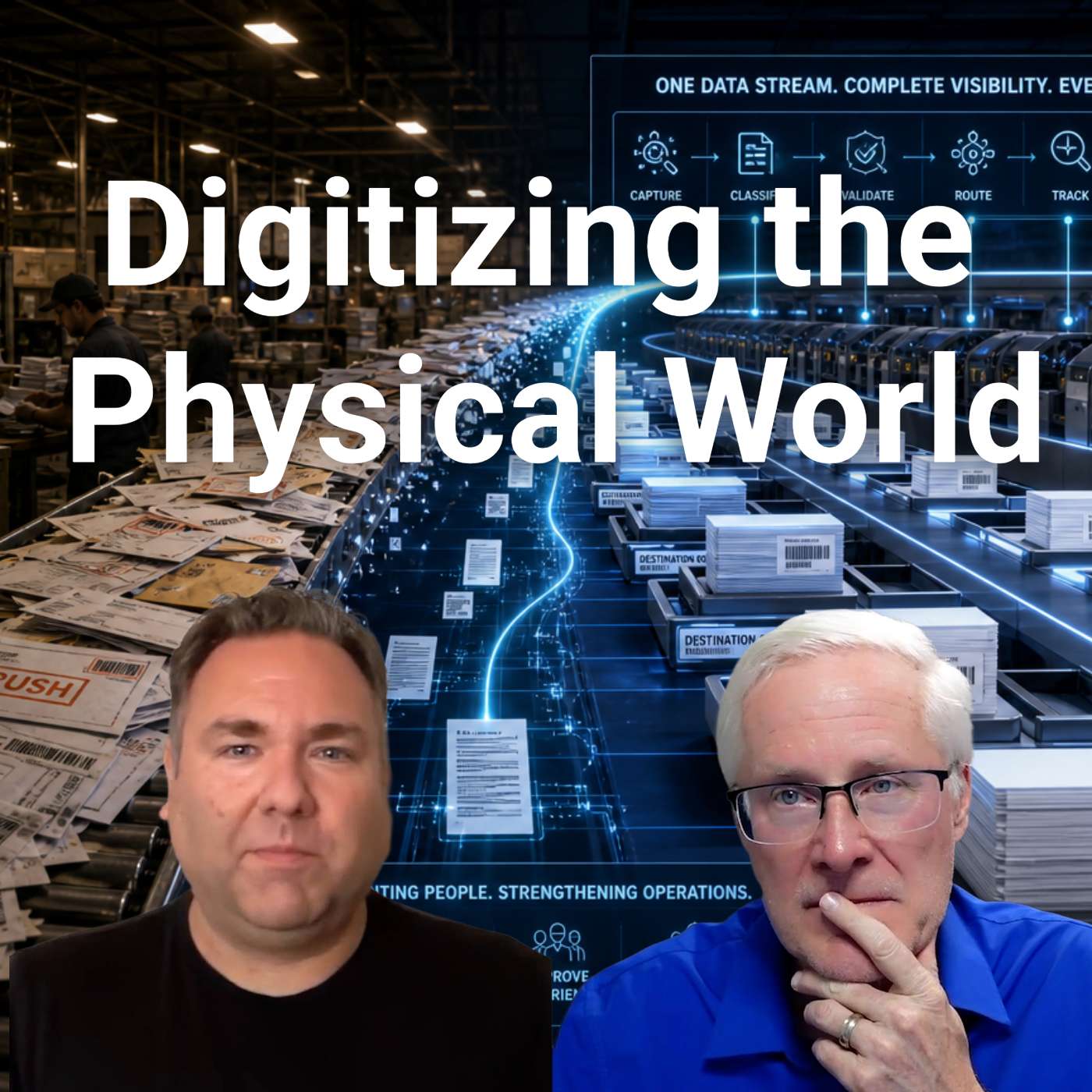
Embracing Digital Transformation
#369 How to Automate Manual Operations Without Breaking Compliance
00:34:02
Loading summary
Transcript57 lines
- [00:00]
A
Welcome to Embracing Digital Transformation. Before we dive in, I wanted to personally thank you for listening. Many of the ideas we discuss on this show inspired my new book, AI Augmented Teams. If you're looking for practical ways to combine human expertise and AI to achieve better outcomes, I think you'll find it valuable. Learn more at Paydar AI Books that is P A I D A R AI Books. Now let's get started with the show.
- [00:30]
B
Company didn't contract in employees. In fact, our growth was so much of a hockey stick that we were able to reassign people and reallocate job duties without contracting the company. And so that was the beauty of this was that I was able to show look, everybody is just going to be doing something different.
- [00:53]
A
Why this matters to you? Legacy operations are under pressure to move faster, prove compliance and use data in real time. The challenge is not just modernizing systems, it is changing how work gets done without breaking the business or losing the people who know it best. This conversation shows how even a physical regulated operation can become more agile when leadership treats transformation as an operating model, not a software installation. Lets get into the interview. Welcome to Embracing Digital transformation. This is Dr. Darin on this episode, how to digitize an analog workflow without losing your team with James Gilbride.
- [01:39]
C
James, welcome to the show.
- [01:41]
B
Well, thank you so much for having me.
- [01:43]
C
Hey, we talked. The first time I met you was years ago and we've talked a couple times about your business and I watched you progress, grow your business into something spectacular. And, and then I said, you know, I really need to have James come on the show and tell his story. But before we do, everyone knows and if you've listened to my show, you know what, the question's coming up. I only have superheroes on the show and every superhero has a background story, an origin story. So James, what's your origin story?
- [02:19]
B
Oh, well, you know, being a late Gen Xer and early millennial, I'm in this very odd decade of time where the computer was very prevalent and ubiquitous. As part of my growing up and as part of my schooling, I took a very big interest into using the computer and using learning the languages of the computers that were around me. Mostly the Apple Iie was where I started. And then moving on into high school, I got a work release into a work release program where I was able to go to school half day and then go to a business half day. And that started as an internship and that started my work into the professional world. And so I started at 17 at the the Mormon Church office Building in Salt Lake City, Utah in their informatics department. And it was the oddest thing. Nobody had ever placed or requested to be placed there. And especially as a teenager. There was no teenager.
- [03:32]
C
You were there with a bunch of old guys, right?
- [03:34]
B
Yeah, it was just a bunch of old guys. And so I had to get a sign off from the member of the First Presidency or the office of the First Presidency in order to be working there. Several interviews, they were confused as to what I was even trying to do.
- [03:50]
C
And.
- [03:51]
B
And so ultimately, after several weeks of going back and forth and getting in, even then when I was getting my photo taken for my first ID badge at 17, you know, the gal was like, I have no category to put you in. And so I ended up, you know, they're like, we don't have a category for an intern. It's, you're a professional. And so I was a professional and had access to all buildings and all areas. And it was, it was.
- [04:22]
C
That's pretty cool, James.
- [04:23]
B
Yeah, it was a fun beginning. And so that carried on, you know, and I worked with a lot of computing technology there. Everything was on novel and so that got me interested in that whole process and Lotus and then it takes into. I got recruited for a.com in Virginia at 18 and on a paper tiger, paper millionaire moved across country. 18, 19 worked for this organization. It was a ISP DSL startup and worked in their network operations center and did token rings through Cincinnati was my main area.
- [05:07]
C
Oh my goodness.
- [05:08]
B
And ultimately that bubble burst and I went to college. And so once I went to college I was able to. I decided I'm out of technology. I don't want to be anywhere near technology. And so I went into psychology and philosophy as my major. I wanted to be a clinician, sit there and enjoy people and be away from this, be away from all the binary and bits. That didn't work well because while I was in college I got into the, you know, went to the University of Utah, went into University of Utah Healthcare System and. And became a computer professional at Huntsman Cancer Institute and worked my way up the ranks there, which ultimately got me into healthcare informatics, which took me further in my career into dental or insurance informatics and managing that, doing coding. C&ASP was on the tail end. C&SQL was starting to rule the world. Then ultimately, yeah, I got to a point where I'm like, gee, I don't. I'm. I either need to stay here at that organization was Dental Select. I was a chief technology officer there. I needed to Stay there for the rest of my life or I needed to try something else. And one of our vendors was in print and mail and I thought what a fantastic way to get away from technology would be to go work for a print and mail organization. And so I, I reached out. The owner and I had developed a personal relationship and so he, he hired me on as the chief technology officer there. And then within one year I was the president and within four years I was the CEO. So here I am and we do nothing but technology.
- [07:07]
C
Yeah, James, this is hilarious because you're about five or six years behind me as far as age wise. So I was envious of guys like you because you had all this technology so young compared to me. Right. I got my first computer when I was 12 and it was not an apple IIe. Right. It was a leading edge. No, it wasn't even that. It was an IBM. Not even a microcomputer mini, which is bigger. People know a mini computer from IBM in the, in the late 70s, early 80s was the size of a desk and they had 12 inch floppy drives that you had to use two hands to insert it in. So I was envious of you guys that got the micro computers, as we called them at the time.
- [07:57]
B
Absolutely.
- [07:58]
C
Where it fit on top of, on the desk. Right. So very cool background. But technology always came back and bit you and you tried to get away from it a couple times. Why is that the case? Why do you think it always came back to you?
- [08:19]
B
It was one of those. I was reminiscing with my wife recently about this because that was the big thing when we were dating while all of this was. I was still in college and I was like, I need to be out of technology. Because technology was all consuming for me. I was always interested in the latest thing. I was always interested in the latest trend, the bleeding edge. And I've had equally employees under me who were really annoyed in my early managerial time because I constantly was changing for the sake of change. Like hey, this came out. Like when VMware came out, I'm like, everything's going to VMware. They're like, it just barely came out. I know, but we're moving everything to it. Oh well, Hyper V is now out, so let's move over to Hyper V. I was just a change for the sake of change kind of guy. My age and speed have now driven that away. And I'm like, just please stay the same for at least a year. And I'm good.
- [09:21]
C
Well, you're, you're a CEO now the stakes are different than a CTO. CTO. You're supposed to, you know, hey, new technology CEOs different story, right?
- [09:32]
B
It is. And yeah, you have more considerations, you have more distractions, more stability that you need to maintain. And so all of that does factor in. But the consumption of technology was always an issue for me and that's why I wanted out. I wanted something more analog. I like writing in my paper journals, I like reading a paperback book. And, and once I get the itch to go into technology, it does become, excuse me, it does become very consuming.
- [10:03]
C
Okay, so you're a technology addict obviously, right? So you try, you try to avoid it, which is, which is good. But so you move to pretty high tech, right? Dental informatics. Well that's, that's pretty high tech. To a print and mail company. Something I would consider not digital at all. In fact, back in the 90s, they were all saying email was going to eat the U.S. postal Service. It was going to eat it up, chew it out and spit it out and we wouldn't have Mailman anymore. That was the big concern in the late 90s, early 2000s. But you have a thriving company that just bets on mail, on, on mailing things. So how in the world did that happen?
- [10:56]
B
Yeah, so mail is a very interesting situation. There is a lot of digital technology that goes into mail and a lot of people take that for granted. And I was one of those at the beginning. Right. I thought that going into mail, print and mail was going to be the most analog process ever. Not in order to complete a mail piece, you have to adhere to a lot of guidelines. Some of those guidelines, of course, are data manipulation, data scraping. You want saturation rates for your postage, you want to lead that, the digital information gathering for your customer to let them know who they're reaching out to, what their rates of return are going to be based upon that. And so yeah, when I go from when I joined my current organization, when I joined, we were a small family owned business, still our family owned, but a very small business. And it was a lot of analog work. You had what we work orders were captured on paper, the paper then followed the other paper that we were printing around and then it was tallied at the end with accounting and you had, you know, the day led to the week, the week led to the month and so forth. I couldn't stand for that. And so it was, let's now turn this into a digital process. Let's build a massive database. We have our customers information, we know what they're trying to do. We know the data by 6am for the most part. Let's digitally process and get everything into work orders. Let's anticipate what the postage is. Let's do the weights and thickness measurements and the ink coverage measurements. That way we can do proper costing for supplies. That way we can do proper viewpoints of what the postage is going to cost for the, the customer. I mean we're doing, to give you a concept, in a week we do roughly 30 million, actually more than 30 million print impressions per week, more than 4 million completed mail pieces and, and spend about 3 1/2 million dollars in postage. This is just on a week. We go through more than seven truckloads, 53 foot semi truckloads of paper in a week.
- [13:26]
C
And that is crazy. That is crazy when you start looking
- [13:30]
B
at how to manage all of this. Once we introduced technology and a great database and data gathering now all of a sudden that daily work that went into accounting, that became a weekly work which became a monthly work. Now it was, oh, in real time, that transaction is settled, the bill is off. In the mail, so to speak. It's actually delivered electronically. Everybody on the floor works from tablets. They move work from printer to printer from pickup with the post office to our pre sort house. They, they can pick it up digitally and request those. And we host over a billion with a B images and documents for our customers inside of our platforms like banks, credit unions nationwide, brands that you would recognize. They API into our products of things that we're printing for them to put onto customer portals as a seamless transfer. All of this is data. All of this was transformative for our organization to take us from a small organization to growing exponentially in a very short amount of time.
- [14:42]
C
And it allows, you weren't a, you, you wouldn't be able to do that without having a really strong propensity for technology first off. Yeah, right. And then a strong architectural mind to architect this because this is a pretty complex system. This was not simple.
- [15:06]
B
Yeah, no, you're correct. And I think that was the part I was, I was really lucky in the sense that the owner of the organization really believed in technology. That was the one thing it was like he didn't have. He didn't have all of the answers himself, but he loved investing in it. You know, back you used your example of when a computer was the size of a desk. You know, this was, you know, they were using Apple computers of course for graphics design when, when those were 20, 30 machines and it was like that was a common occurrence. And he loved investing in it for the purpose of helping and assisting the customers. And so taking that skill that, you know, that. That love of the game for him and turning that into something actionable, you know, saying, hey, I can take a $5 million company and turn that into $168 million company in a matter of five, six years, just by embracing more technology. That was very appealing. And that was something that, you know, he was willing to invest in. He was willing to, you know, belay all the other things that was going on and said, let's go and do it and I'll forever be grateful. But he let all of those, all of those dreams that I just had, and all the employees, you know, fell along with the dream.
- [16:28]
C
They.
- [16:28]
B
They saw the vision and it was wonderful.
- [16:30]
C
Well, that. That was the next question I was going to ask because a lot of times when you go through a digital transformation, which they did, you need executive buy in, which you had, which is awesome. However, I have seen them stalled because middle management torpedoes a digital transformation or the individual contributors do because they're concerned about their jobs. Is this going to replace what I did? Because you did replace people's jobs, obviously, right? I mean, all your accounting team, they were doing a lot of grunt work every day and every. Every week and every month, what they were doing changed dramatically. Right. So this was not. This was not just a technology play. This was also a people play. How did you manage that part?
- [17:17]
B
I think that's where my degree in psychology and philosophy really came to help. It was ironic making that shift when I wanted it. I found early in my career post colle, I suddenly stopped being the individual contributor. And people looked at me more for managerial skill because I had, dare I say, the ability to communicate and the ability to connect with people through these. The skills that I learned through school. And when I was able to apply those particular mechanisms, the leadership capabilities really followed. I had some great mentors in the form of John Maxwell and Patrick Lencioni. I mean, I pretty much consumed everything that they have put out. And, you know, you're always able to. To access whatever you can in order to continue to figure out how do I get night. Just like you said, I needed the executive buy in. That was easy because, you know, money talks. I mean, the green at the top was great. Now you got to get middle management, who typically always feels forgotten and not part of an ownership, part of this process. How do you make this about them? And I do want to hit on one very particular point that you talked about the company didn't contract in employees. In fact, our growth was so much of a hockey stick that we were able to reassign people and reallocate job duties without contracting the company. And so that was the beauty of this, was that I was able to show, look, everybody's just going to be doing something different. Accounting, yes. To be very clear, the rate at which accounting in this example would grow in the old way is not the same as the rate it would grow in the new way, but.
- [19:12]
C
Well, yeah, yeah.
- [19:14]
B
And they all bought in. Over communication. Over communication I would give weekly and I still do. I give weekly newsletters to the entire company. I speak with everybody on virtually a bi weekly basis. Great executive team around me and we all have that same vision and I request and demand of them that they communicate to their employees the same speech, the same methodology. We have found that you do need to communicate something a minimum of eight times in order for it to fully be internalized. So the over communication was key. Everybody getting on. Not everybody survived at the very bottom, but I'm pleased to say the executives, the middle managers and just management leadership layer all stayed intact. But it was ironically, there were really squeaky wheels on the people who did the end jobs. Some of them just didn't want to make that transformation. And at the end of the day they, they were replaced by somebody who did. And that's always sad to see some long term people go, but yeah, yeah, we saw it.
- [20:35]
C
Well, my wife and I were actually discussing this because there's a major transformation that's happening now in the world, right, with AI and everything. And I'm like, well, I'm of the cloth that everyone would want a more meaningful job, right? But that's not true, right? Some people, I just want to do what I've always done because I know it, I'm comfortable with it. I don't want change at all and I don't want to be more valuable.
- [21:06]
B
It's strange, it's very idiosyncratic because you can sit with that person, which still happens today. We've acquired additional facilities in different states and brought them into our platform. And you get these individuals who to your exact point, it's like you can show them the roadmap, you can show them the history of that roadmap being enforced and implemented and what that's led to. And they're like, yeah, I see it, I don't want to be part of it, I just want to do this. And it's like, well, but we're not doing that. We're doing this and you have to say goodbye. Those are hard decisions.
- [21:43]
C
That's, that's tough as is. I've been an executive. That's. To me, that's one of the hardest things I've had to do as an executive is let people go. Agree. However, keeping them around will stall and torpedo progression. Right.
- [22:02]
B
In that case, that is indeed true. And, and that is as hard as it is to let somebody go. And I know it's a trope. The worst thing you can do is have somebody too long, the wrong person too long. You need to remove that person because that cancer does spread and they can start taking down people around them and, and it's a hard thing to do. You realize these are real people, real lives, a family and so forth. But you have to make that crucial decision and act.
- [22:38]
C
Yeah, that's tough. But getting your whole middle management team aligned is incredible because I rarely see that happen. Which kudos to you. It sounds to me like I need to go back to school. Don't tell my wife that I'm going to go back to school and get a psychology degree now, because that'll help me with. I won't do that. That's crazy. But it sounds like it worked for you. That's awesome.
- [23:04]
B
It worked.
- [23:05]
C
Yeah, that's awesome. All right, so let's talk about the future for you. Where do you see, because you're a technologist, you see what's going on in the world, but you have your CEO hat on, so you're a little more risk averse. There's more at play than being a cto. I understand that. Where is AI going to play in the future? Maybe not for your company, but for other companies. How do you see the adoption of AI impacting organizations your size?
- [23:37]
B
So my viewpoint on AI, my current viewpoint on it is to state that it is a great augmentation tool. It is. I, I do find it to be a fallacy when people do replace certain road jobs. I'm not talking about the like answering questions or doing auto attendance. I think that's a great use case for AI. But in an office setting, there is something collaborative about working, say with other individuals, but also getting the collective intelligence of other resources around you without having to wait weeks for a report to come back. And for me, that's how I use AI. I use it to review, say, executive plans, determine, hey, is this message that I'm communicating, this is where I'm trying to go. This is the message I'm communicating. How is this well going to be perceived. What are my language choices? One thing, but also what am I missing in terms of my growth goals? Where is the industry taking us? Are we on par with the industry? Using it as a CEO assistant has been invaluable to me. That's the biggest part.
- [25:00]
C
So you really do see it as augmentation more than replacement?
- [25:05]
B
Absolutely. In my use case and the comfort level that I currently am at embracing it, it totally is an augmentation. I, I love it to run reports, I love it to replace consultants. These are all really great use cases of it. It gives me where the industry is, that pulse. What is the product offerings? What is a price point that other people are doing? Run this report for me, do this particular research and also help me plan my week. Great things. It does absolutely great things.
- [25:39]
C
That's, that's incredible. And I'm glad you said that because I'm seeing way too many CEOs today only looking at AI and investing millions of dollars into AI to just replace their staff, which I think is a huge mistake. Agreeable because you lose all of that great knowledge which you were able to retain during your tran, during your digital transformation. Because I think we all know all that task and knowledge really sits in the middle management layers. That's where I think most tribal knowledge resides, is in those people that have been with you the longest and that have moved up into the ranks of your organization.
- [26:20]
B
I fully agree. And keeping and retaining that tribal knowledge and understanding the years of how this job was run, why this was this way. At some point that is a company intellectual asset and if it's important enough, it should be written down and captured somewhere. But it doesn't ever replace the tangible feeling of being able to talk to John or being able to talk to Deanna and get the information that you need. And in no place do I have a sitting here today do I have any plans in our organization of replacing our humans with an AI. And in fact, quite to the contrary, most of our contracts are with healthcare organizations, insurance organizations and government. We actually have to sign specific writers to our contracts stating that we will not use AI or induct their data into any AI model. And so that creates a lot a level of complexity. Oh yeah, you want to run your stuff through Grammarly or you know, make sure that you're spelling things right. And so you have to keep those in consideration.
- [27:32]
C
Well, that brings up a whole nother thing as, as a CEO, you've got day, you've got data governance, especially you. Oh my good you have a lot of data, data governance and data privacy laws that you have to adhere to. It sounds like it has a huge play in your day to day operations. How do you feel like AI can help with that or hinder that moving forward?
- [27:59]
B
So it's interesting, as you indicated, we have a lot of data governance, governance through government contracts that we have. Each state that we provide benefits for or the services for, they have their own governance. California of course is by far the most strict IT models, but basically the EU and so, but each one doesn't want to claim that one would supersede or envelop the other. They each want you to have your own governance program for each one. So we, we, our compliance team, you know, used to have to monitor and manage each one of these on a manual basis. But it is a great pivot point. There is a product that we recently employed about a year ago where they utilize AI in order to help with your ongoing and daily compliance. It's a. So we put all of our governance programs, they have these frameworks built into it and we upload our frameworks that we want to have monitored. There's still a CPA firm that independently monitors, nothing changes, but they utilize AI in an effort to go out, say to our Azure platform and say, okay, what are the permission changes? Was there a ticket, was there a security incident? Was there a log? And then they pull that information and they go to aws, they grab that information, then they go to all of our permission sets and sharing files. Did this person from that department have access? Was there a role based security issue? Did this person get onboarded or off boarded in an appropriate amount?
- [29:42]
C
That would take several humans weeks to figure out.
- [29:46]
B
And that's exactly right. So all of these things, we've been able to automate that portion through AI and monitor the metadata through AI to ensure the proper compliance of the data, proper permissions and securities or access. But they don't see the data itself. They don't have access to it.
- [30:06]
C
See, I love what you're talking about because to me this sounds like more roles are being created inside your organization because you have better access to the data that you have. About that, you talked about metadata, right? But it seems to me you're starting to already see the benefits of AI creating new opportunities for your organization, whether it's better compliance or being able to maybe even extend into new marketplaces because you understand the market better and, and the regulations that you have to operate in. Incredible. Incredible.
- [30:48]
B
No, and I'm grateful that you recognize that because again, one of the most frustrating parts, say even four or five years ago, when you had a customer come on inside of an industry, they had a framework that they wanted you to fill out a long hundred thousand whatever question questionnaire and you're like, well, but I already go through my SoC. I already go through my, I already go through my nist. I mean, what more could you possibly need besides nist, SOC and ISO? Well, you'd be surprised. There's a lot more that we need. And so this allows us to automate and crosswalk all of those frameworks into a central place and provide the proof and the evidence that we are in compliance in real time, not a year in arrears in real time.
- [31:39]
C
That's incredible. So, hey James, we're out of time. I can't believe it. We're having so much fun. People want to reach out to you or learn more about your company and what you guys do. And this is truly amazing because we took something as boring as mail. It's not boring. It's and incredible technology. And you guys are really on the forefront of something incredible here. So thanks for coming on the show. If people want to reach out to you, James, can they? And how do they do it?
- [32:11]
B
Absolutely. Certainly. Welcome any additional questions. The company I'm the CEO of is mailing.com you can visit us at mailing.com and also jaygilbrideailing.com is my email address and happy to answer any questions.
- [32:28]
C
All right. Hey James, thanks again for coming on the show.
- [32:31]
B
Thank you.
- [32:33]
A
Thank you James, for the insightful interview. This is what I take away from this interview. The larger trend is that digital transformation is moving from customer facing systems into the operational core of the enterprise. That means leaders need to stop thinking about technology as a layer on top of the business and start treating it as the business control system itself. The most important lesson here is that execution depends on three things. Working executive commitment, middle management, alignment, and a clear operating model for change. A second lesson is that tribal knowledge is an asset, but only only if it is captured, governed and shared. A third is that AI becomes valuable when it improves visibility, compliance and decision speed, not when it is used as a blunt instrument to reduce headcount. Leaders should ask themselves what manual work is hiding our true cost structure? Which roles are ready to evolve rather than disappear? What knowledge sits in people's heads instead of the enterprise? The next several years will reward organizations that use AI to strengthen judgment, not replace it. The memorable insight is transformation succeeds when technology amplifies the business and the people at the same time.
- [33:58]
C
Thanks for listening to Embracing Digital Transformation. If you enjoyed today's conversation, give us a five stars on your favorite podcasting app or on YouTube. It really helps others discover the show. If you want to go deeper, join our exclusive community@patreon.com embracingdigital where we share bonus content and you can always connect with other change makers like yourself. You can always find more resources@embracingdigital.org until next time, keep embracing the Digital Transformation. Sam.