← Embracing Digital Transformation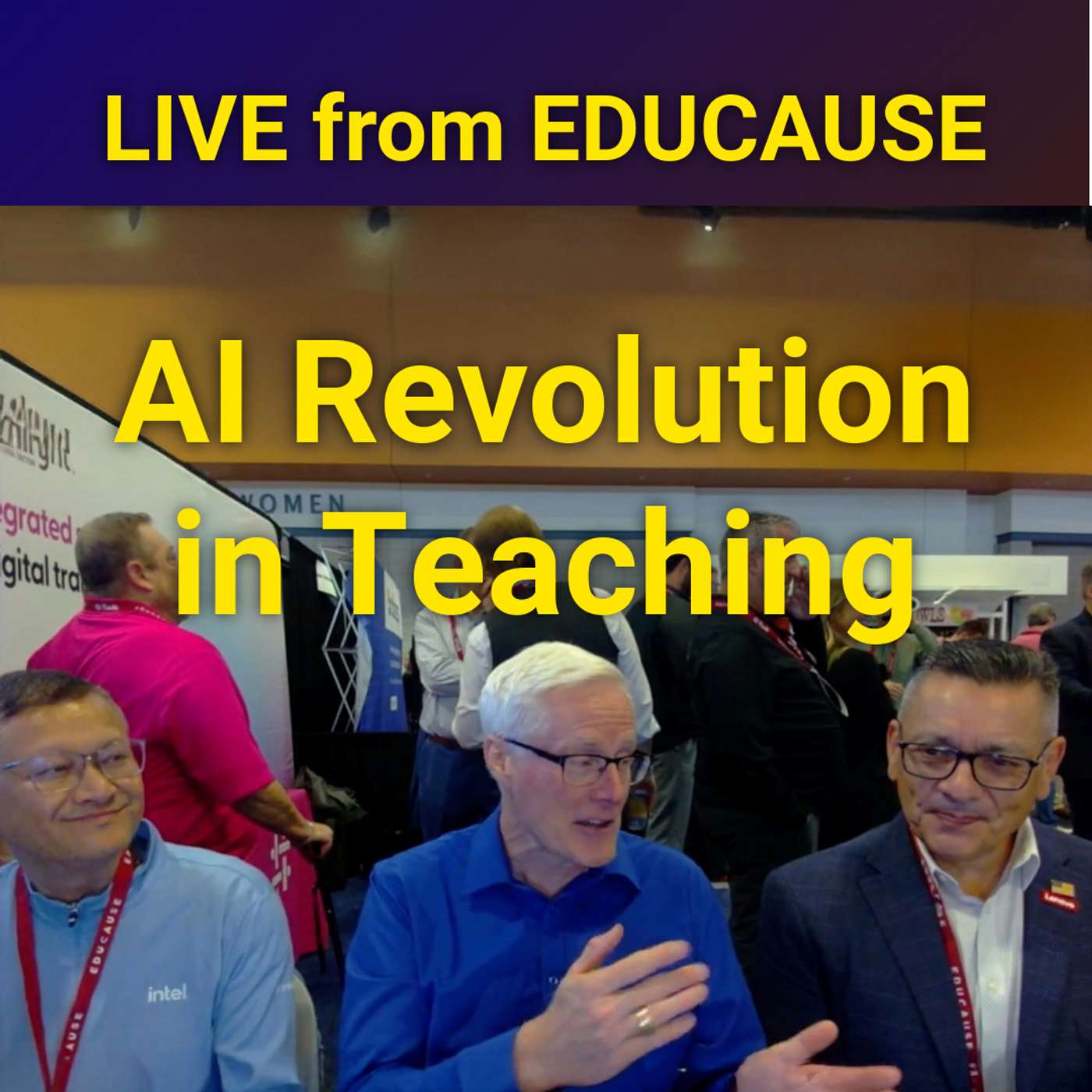
Embracing Digital Transformation
AI Education Revolution: Why Professors Must Evolve Now | EDUCAUSE LIVE
00:32:55
Loading summary
Transcript67 lines
- [00:00]
Anshul Sonak
It's changing so rapidly because AI is not just about learning and teaching AI or learning and teaching with AI, it's all about thinking within AI in a whole new way. Right. So that people are not just becoming a consumer of AI, but they can build something, they can solve something, they can create something, add value to themselves, their organization.
- [00:22]
Dr. Darren
Welcome to Embracing Digital Transformation, where we explore how people process policy and technology drive effective changes. This is Dr. Darren, Chief Enterprise architect, educator, author, and most importantly, your host on this episode. Live from Educause 2025, AI education revolution. Why Professors Must Evolve now with Anshul Sonak from Intel and Hernan Landono from Lenovo.
- [00:54]
Host (possibly Dr. Darren or another host)
Hernan, welcome to the show. Answer. Welcome to the show. Quick introduction. Hernan, can you give a quick introduction of yourself?
- [01:01]
Hernan Londono
Absolutely. Absolutely. First of, thank you for having us here. This is fantastic. I don't know if the audience can see or hear, but we're on the. On an exhibit floor and this looks amazing, all the activity here. So. Yeah. Hernel Londono, I'm the chief technology and innovation strategist at Lenovo and she's happy to be here. This is a good place to be today.
- [01:23]
Host (possibly Dr. Darren or another host)
All right, before everyone knows this, on my show, every person I have on my show is a superhero. Every superhero has a background story. Okay, so, Hernan, background story, real quick.
- [01:34]
Hernan Londono
Yeah, background story. Really quick. 25 years in higher ed as a CTO on CISO, also computer science professor. And for the past five years, I've been in the OEM space with technology companies helping higher education advance, the mission of education. But particularly we spend a lot of time on AI these days, and that's what we're doing here. That's a quick background about.
- [02:02]
Host (possibly Dr. Darren or another host)
That's awesome. That's awesome. In fact, my career is going the opposite direction of yours. I've been in industry and now I'm starting to teach. I've been teaching for a year. So I'm going to have to lean on you and say, hey, what am I doing wrong over here? Because I'm teaching computer science now. Love to do that.
- [02:19]
Hernan Londono
Love to do that.
- [02:20]
Anshul Sonak
That.
- [02:20]
Host (possibly Dr. Darren or another host)
All right, I'll take some tips later, but we also have Anel on the. On the show. Anel superhero background story and a little bit about yourself.
- [02:28]
Anshul Sonak
So, Anshul Sonak for Intel Corporation. I head Intel's public private partnership program, Intel Digital Readiness, which works with government and academia worldwide. Very passionate about education and workforce development. And thank you for inviting me, Darren, in your show. My background story, I happen to be the first principal engineer in intel, working for education and government and workforce development without an engineering degree. And that's a classical way of saying where education is headed, how the careers are blurring today.
- [03:06]
Host (possibly Dr. Darren or another host)
I love that you said that, because I'm starting to see that with AI as well in higher ed. Some of my computer science guys, they really need to go take some philosophy classes or critical thinking classes, because they're not great at critical thinking. Sometimes they get stuck in their thing. So big question here. How is AI going to play a role in education moving forward, and how has it changed in the past? So I'll ask you that one first.
- [03:34]
Hernan Londono
Okay, all right, good. Well, listen, so for education, AI has a little bit of a different path than for most other industries, because in education, we have to worry about a few things that others don't have to worry about. So everybody has to worry about how am I going to use AI, for example, operational efficiency. And that is part of what the education institutions have to worry about. But in education, we have to worry about how do we teach with AI and also how do we teach AI. So it's changing fundamentally. Some things related to how institutions of education have been operating in the past. I think we're just beginning to know what AI can do for all of us. It's happening super, super fast. But the fact that the Triobos are here talking about AI with insight, with intel and with Lenovo can tell the audience that we're beginning to see the change. And I think it's going to advance super fast.
- [04:39]
Host (possibly Dr. Darren or another host)
Okay, so you mentioned there's two parts of AI in education. It's how can we use it to teach, and then how are we teaching people how to use it?
- [04:48]
Hernan Londono
Yep, yep. That's the big differentiator today. And everybody else has to worry about how do we use it in education, we have a different mission. We have to prepare those that are going to be using it, but also we have to prepare those that are going to be teaching those that are going to be learning how to use it. So it's a kind of a complex element for education. And again, the people in this table, we're trying to figure that out together. So hopefully we have a good solution for all folks out there.
- [05:17]
Host (possibly Dr. Darren or another host)
Now, Anshul, you saw this coming, right? I mean, you saw this whole thing coming. So you did something about it around four years ago, right?
- [05:27]
Anshul Sonak
Seven years ago.
- [05:28]
Host (possibly Dr. Darren or another host)
Seven years ago, yeah.
- [05:29]
Anshul Sonak
2018, we started AI skilling worldwide for schools, community colleges, universities. I mean, the thesis is AI Artificial and Intelligence. So let's not forget AI is Not just a technology, the technology out there becomes a software. And everybody wants you to become a consumer of that. But it's truly a new intelligence, it's a new superpower. And when you say intelligence, there has to be a very significant role for education. Because with a new intelligence, with us as a new partner, everything, the way we live, the way we work, the way we play, the way we learn is changing. And let's not forget, working and learning remain a truly social experience. So it's not just a technology or a software challenge, it's a truly a new human machine partnership challenge. And that's where education plays a very significant role. If everything we are building as a knowledge, right? If AI can give you a quicker answer because of the product and productivity, what can we do different? What is that true residual heterogeneity. That's a term which MIT uses for your sustainable competitive advantage. What's unique inside you. And now that's where the true conversation is. How can you discover your passion? How can you discover your purpose as an individual, as an organization? And that's exactly where, as it said, it's changing so rapidly. Because AI is not just about learning and teaching AI or learning and teaching with AI, it's all about thinking within AI in a whole new way, right? So that people are not just becoming a consumer of AI, but they can build something, they can solve something, they can create something, add value to themselves, their organization. This requires whole new different skill set and mindset. The tool steps are becoming easier as you see the conference. But what's very important, and that's what Kent will bring on table, is new type of skill set, technical skill set, non technical skill sets, the non technical skill set, like ethics, explainability, understanding, biases, social, all that and more importantly the mindset. The organizational transformation requires new type of team, teamwork with agentic AI as you know, how do we really build AI as a team member in a very complex team environment already? What does digital transformation now mean? So these are some of the new conversations where education and workforce development experts need to bring in AI pedagogy and AI andragogy into the new teaching and learning practices.
- [08:15]
Host (possibly Dr. Darren or another host)
This change you're talking about sounds more profound than the Internet in the late 90s. Would you say that because that's when you started in education?
- [08:25]
Hernan Londono
That's exactly when I started in education. So I think that. So we have some similarities between what happened with the Internet, particularly what happened with the Browser in the 90s, and what's happening with AI right now. And the big similarity is in the 90s, we were afraid that if people had access to the browser, they were going to be distracted by access to the Internet and not doing their jobs. And we obviously very quickly found out this technology is transformational. It's an enabler for other operating models to take place and a new whole economy was created based on the Internet and the browser. So we have that history. AI is very similar. You know, we're having these conversations about is AI going to be replacing my job, is it going to be displacing? And you know, there's different answers for that. The big difference is AI is. AI's transformation is happening at a very accelerated rate. And so with the browser on the Internet, we had a few years to kind of figure it out. Okay, what are we going to be doing with AI? We're seeing people, we are outside the organizations already adopting the technology at a really, really rapid pace. And so internally in organizations, we're seeing the same pressure. We need to have these people enabled with the right skills. And this is where education comes into play. This is the conversation that we're having with angel with you and others around. Okay. How do we enable this change, these foundational change to happen from the education system? Because to Arshaul's point and your point, Darren, about critical skills. We don't need to just train people technically, we need to educate them. This is a tool set that you're going to be using now, but how do you continue to be a human in that conversation? And that's kind of what we're doing with community colleges and universities nowadays.
- [10:19]
Host (possibly Dr. Darren or another host)
Well, isn't there a big threat though, also? Because I've seen this with higher education. We already started before Genai happened. We had the big black swan event of coden.
- [10:29]
Hernan Londono
Yeah.
- [10:30]
Host (possibly Dr. Darren or another host)
And people started thinking, I really don't need to go to college. Yeah. Anymore. And I can still get a good paying job without a college degree. I can learn things online now because we learned that during COVID I don't need to physically go to the university. And people started, you know, doing their own education in a different way. So higher end is kind of in the, in the bullseye of, hey, it's at a crossroads. Then AI gets piled on. And I see a lot of university professors because I am one now.
- [11:05]
Hernan Londono
Yeah.
- [11:06]
Host (possibly Dr. Darren or another host)
And they're worried, they're worried they're not going to be relevant anymore. Why is anyone going to take my class? There's whole degrees that are being re looked at, even degrees I think that are highly valuable, like Computer science people are questioning, well, can I even get a job with a computer science degree anymore?
- [11:26]
Hernan Londono
Right, right, right. So I'm a computer scientist by training and from the 90s. And so I know how that feels today when I'm looking at the technology evolving so fast. But let me remind all of us of one thing. So there's a conversation we're having about technical training and yes, we need to train people continuously. There's a whole other conversation when you talk to hiring managers in the market and they tell you we really value soft skills today. And so this answer that AI is going to replace everything probably is not 100% on the money. The balance answer is how do we train people technically and instill in them the soft skills that the hiring managers are requiring? And you started in a fantastic note today saying, my computer science students, some of them don't have that critical thinking skills. And you try to instill those in them. And that happens not in technical training, that happens in education. Cool. Different things. And I think that's what we all probably are supporting and doing while at the same time making sure that people get the AI skills that they need to participate in the new economies. There is a new economy that is being created by AI.
- [12:46]
Host (possibly Dr. Darren or another host)
So Angela, you saw this coming and you created curriculum to help with those soft skills. I looked over all the curriculum. It's amazing. There's a lot of soft skill stuff in there. So is that because you didn't come from a technical degree that you thought that hey, maybe we need to do this.
- [13:05]
Anshul Sonak
So I'm a social impact professional and social impact program designer by my education qualification and to your earlier point, I mean higher education as an institution is probably best poised to become that lifelong learning place whereby as we are seeing, and that's what we thought world is changing from the older model of learn, learn, work, work, retire model to the different learn, work, work, learn continuous cycle. Now, learning and working both are social experiences. And that's why the higher education the place really require learnability reinvention. Now that's the place whereby to your point now, right, it's not just about a technical skill, but technical skill coupled with all the social skills, career growth skills so that students, the future workforce or the current workforce, they can really build this metacognitive abilities, not just skill. Because skill atrophy is the real argument. Skill change can happen, right? The skill life cycle is shrinking down, but the meta cognitive abilities, learnability, sociability, variability. There's three abilities which will hold you for the future. Proofing Right. You really require human to human interaction. You really require a good professor like Dr. Deren to whom I can go and say sir, I do not understand this or I'm trying to build this problem, but my data set is not very good. What should I do? Or I think my data set is all synthetic. It's not real data. You know, these are the potential problems I may face in future. What do you think? Now these are the kind of questions I should be asking to the real human quest rather than only to the AI chatbot. Because AI Chatbot, right. May have its own inherent data biases or people biases or model biases. Right. That's why I really need what we call as a. Not just high tech, but a high touch, interactive, integrated immersive educational experience. That's the role of a faculty. So that's what we really focus on, train the faculty for that.
- [15:17]
Host (possibly Dr. Darren or another host)
That's a big, that's a big role change for faculty. Yes, because I know, because I've taken other people's courses and adapted them to my own, which I'm grateful for, my previous professors, but what I found was their, their curriculum was set up to be almost at a distance. Yeah, right. I'm gonna lecture, you're gonna do the assignment and hand them in. I'm gonna have the auto grader take care of it. And there wasn't really this interaction. So the, and I think that's been the model for some time, right?
- [15:53]
Hernan Londono
It is, it is. So, so there is a, there is this transformation that happened in education problem for vast like 10 years. And it is this movement towards experiential learning. And that's basically how do you create competency? Because at the end when you teach, you don't want to teach, you want to create competency because that's what you need.
- [16:16]
Host (possibly Dr. Darren or another host)
Love that.
- [16:16]
Hernan Londono
Because that's what you need.
- [16:17]
Anshul Sonak
And the.
- [16:18]
Hernan Londono
In the professional setting, you can go tell anybody, oh, I learned how to cook this piece of meat and they say, well, cooker. Well, I don't know, I've never done it. I learned how to do it, but I've never done it.
- [16:30]
Host (possibly Dr. Darren or another host)
I read how to do it.
- [16:31]
Hernan Londono
There's no competency. So where we are right now, and by the way, with what Anshul has been working on for the past 10 years is of course creating the curriculum that embeds the skills but also creating the mechanisms to create competency. And that's where you are too with your students. Right? That's what you were saying. My professors taught me kind of arm's length and now we're having to come very close to the student to create the competency. And I just love it. It's a different space and AI requires that level of closeness because AI by default it's intimidating. It should not be, but by default it's intimidating. So we need to bring people closer and say it's not that complicated. Let me show you. Once they create that mastery, that competency, we're going to be able to have this pipeline of people that are trained and educated with soft skills and technical training. I mean, the world is going to change dramatically with that.
- [17:32]
Anshul Sonak
I want to add on his because he said some excellent points. So the premium is no more on learning and knowing anymore. The premium is from the future proofing standpoint, what can I do, how can I apply, how can I build? So do and apply is getting more and more premium from the workforce readiness standpoint than just learning and knowing with the static credential or certification. That's the role of a higher education. And that's where a good faculty comes up. That's point number one. The second point which is said, which is so true, the inclination intimidating point, right. There is this inherent fear inside people because technology can be revolutionary while people by design are very evolutionary. Right. And if you think from a future of work standpoint. Right. Hardly two or three people are going into AI training who are computer scientists or AI researcher, AI engineer, AI developer, the rest, 98% people who go into the world of work, our average professional throughout all industries, across all functions, and they get intimidated. That's exactly why a good faculty, the good institution with the good material and a good infrastructure, making AI safe experience, making AI very, very private. You know, that's exactly where what we are doing with Lenovo and our partnership is playing a role because we are bringing not just infrastructure with safety and privacy aspect of the, but this safe teaching, learning experiences with good content and the good training so that students can build something. The outcome, the workforce readiness outcome.
- [19:05]
Hernan Londono
Can I have a reaction to that? Because I think Anshul mentioned something that is very important and that is there is. There is a paradigm shift in how this new AI discipline needs to be taught and learned and the vehicle to teach it. It's complicated because AI although has been around for a very long time, it hasn't been prominent for a very long time. So there's not a lot of people that understand it to be able to derive the skills and the necessary content could teach it. And so the teaching mechanism, it's very important. So when you go out to education and you say you all need to teach AI and education looks inward and says, how many people do we have that is qualified to create this content in a matter of time that is relevant for the industry needs? Well, internally, we're realizing in education there's going to be a lot of heat that we can do that. So creating that vehicle with the content, the applied content, with the right level of skills, high competencies, it's building shortens that road. And that's what we're doing. That's basically where we want to get.
- [20:19]
Host (possibly Dr. Darren or another host)
So do you think that's going to change the types of professors that we have to be, more professors that are more practical, that have done it themselves? Because there's a lot of professors out there that are professional professors. I can teach anything because I'm a good teacher. Do you think that's going to change now where maybe I don't need as good of a teacher, but I need more of a mentor? Do you think that shift is going to happen? You know where I'm going with that. I don't mean to diss any of the professors.
- [20:52]
Hernan Londono
No, no, I think it's happened. I think it's happening right now very organically, just because it's a reactionary kind of effort. We're having a higher ed, we're having people external to institutions putting pressure on the institution to do better. I mean, what are the educos confines? If you look at the top 10 issues of higher education last year, one of those issues was trust. People external to the institution are saying, we want more value. And the value sometimes is predicated on the basis of can I really be competent by attending an institution of higher education? So that mantra that, that, that mission that you are, that you're talking about is one that is coming really naturally because we're building, rebuilding that trust on the basis of work back. We're going to get you competent beyond the degree. We're going to get you competent. And that's where we are. And that's what we're working on, by the way, which is. I love it.
- [22:05]
Host (possibly Dr. Darren or another host)
So, you know, this, this model that you're, that we've been talking about has already existed for probably over 100 years, maybe even longer, probably a couple hundred years with mentor apprenticeships and things like that. And we see that in other trades, like farmers and electricians or masons. Yep, things like that. That has been the, the way that they did things. Do you see that, that moving forward and how does higher education have a role in that now, because that's a completely different education mile. Do you see it moving all to that or not?
- [22:44]
Hernan Londono
Well, I think if we want to support, if we want to support competencies, there is no other way to do because you get your hands on how do you practice, right? And so we have these things in higher education, poll capstone projects and we have other sorts of mechanisms to practice things that are not real. But we know more and more that the more you practice in the real setting, the more competent you're going to be. That's one thing. The second thing is industry. So whoever is consuming the product of education is saying we need professionals with a high degree of AI skills. We don't need computer scientists, but we need people with the right level of AI skills. So it's an industry's best benefit to actually say bring those people into practice early because that's what I need. So we're seeing industry and higher ed partnering very closely on things like mentorships, internships, apprenticeships and that's going to continue to happen just to increase the level of competency. I see that just happening naturally.
- [23:53]
Anshul Sonak
So let me from a future of work standpoint, deep is this so AI researcher, AI engineer, AI developers, right? That's probably going to be very, very well structured whereby you have very clear cut technical path, right? What we are talking here is going beyond that if you have to think about AI solution builder. Now imagine a healthcare industry professional. Imagine a nurse, a real nurse. She needs a basic AI fluency skill, right? Because she needs to take the data or report the data using AI in a far more faster way so that she has her own employability. So be it healthcare, be it manufacturing, agriculture, transportation, retail, all these big job creating index cards and within that key functions like customer facing function, sales, marketing, purchase, supply chain, trade, finance. If you really put this two by two together, right, these are the guys who will need what we call as AI X like for their function. What does AI skill mean? What does AI mean for a finance professional? What does AI mean for a purchasing firm? That's where there will be a lot more job level demand coming up, whereby people have to be very, very dynamic. Which is where higher education as a, to my earlier point, lifelong learning platform. If you have a good higher education institution where people keep on coming, work to learn more. I'm working, but I'm learning. I'm learning and I'm working together positively. That's a true partnership where higher education can foster with the students and the workforce that will give them a conservative Zone. If I go beyond the provision builder and I just talk about power users. So you may be running a small business, you may be an entrepreneur. Right. And you are just imagine a flower shop and you are just a four people, very small business. Now if you use AI, you can use AI for better customer data management, better customer response, better price prediction, better inventory prediction. Because if it's somebody who's growing still the same flower shop in older ways and who has a lower profitability and then eventually you know, which is, you do not remain competitive. So these are some of the two new skill sets and mindsets we really need to build in for that kind of a power user. And even if you are not, you are just a consumer like my mother, you're using a Siri. That's it. Right. You still need to know a little bit. What can I do wrong? What I should not click? Right. How should I build basic trust? This is a bigger call to action. To his point, the trust part is probably the most critical part right now.
- [26:48]
Host (possibly Dr. Darren or another host)
So this is really interesting because we took those two AI, how we're using AI in education. We broke it into two more parts under educating AI. I think there's a third one which is I think higher education has an opportunity to contribute to society as a whole. Yeah. In having a continual education kind of thing. Because right now we rely on community colleges a lot too. Like if I, when I retire, I want to go become a photographer, I go take a photograph photography class. Right. At the community college. Why can't higher education have additional certifications? Right. Instead of being so rigid in I'm getting a bachelor's degree, I'm getting a master's, I'm getting a PhD. You got to jump through the hoops to get those still. But why not have certifications or.
- [27:41]
Hernan Londono
Absolutely.
- [27:42]
Host (possibly Dr. Darren or another host)
Continuing education type of.
- [27:44]
Hernan Londono
Absolutely.
- [27:46]
Host (possibly Dr. Darren or another host)
This would be incorrect.
- [27:47]
Hernan Londono
And I think the lines right now are glowing in two different directions. It's community colleges. So let me say this. Community colleges were in the business of technical training. Right. And two year degrees. Right. And now they're coming up with four years degrees. What you have to think about why and the why is this evaluation of are we just training people? Are we educating people? So we're now including in community colleges humanities and things that contribute to a very well rounded education. On the other side we have the higher education keys saying hey, we're not doing the things that community colleges were very good at, which is the training element, the certifications and all of that. So you're seeing everybody kind of Leveling and recreating this kind of place in the middle where all of that education that you're talking about, non traditional education is taking place. I think it's going to continue to happen at a rapid pace and I think AI, by the way, is fueling a lot of that.
- [28:50]
Host (possibly Dr. Darren or another host)
Well, and it's perfect for that sort of thing because you can do. I've been really following Alpha schools. I don't know if you've been following Alpha schools, y'.
- [28:59]
Hernan Londono
All.
- [29:00]
Host (possibly Dr. Darren or another host)
Yeah. And their whole thing is individual education, which I love. And that's where AI can really step in and help professors reach out to individual students on a one on one case much more effectively. And I think we're starting to see that in that middle ground, because in that middle ground I want special skills for my career. I can be an individual in this whole thing. I'm not just one of 10,000 graduates at YADA University.
- [29:32]
Hernan Londono
So there is this interesting thing. Everybody has different numbers. So there is a number down there. By the year, by the year 2030, AI is going to create a new economy that will add $15 trillion to the economy that we already have. And you have to think about how's that happen. And how that happens is AI is enabling the creation of totally new things that didn't exist before and it's transforming some that already existed. Educ. Right. So do we go and do traditional education or. There is a piece that is created in the middle now that is a new economy where AI significantly influences and helps deliver the education experience. And that's, that's what we are doing.
- [30:21]
Host (possibly Dr. Darren or another host)
Ansel, any, any closing parts on this? I mean, we haven't even talked about our partnership, but we can save that for another time. But that's good.
- [30:31]
Anshul Sonak
Yeah, I mean, I have to remind myself and my whole ecosystem that let's not think about AI only as a technology. AI is much more than a technology toolset. It's a whole new intelligence. There is a whole repercussion of skill set, which is where education is stepping up. But more importantly, there is a whole repercussion on mindset, which is where we require a true human machine and human human partnership. That's exactly why a good faculty, a good institution and a good student partnership comes in to really create a lifelong learning pathways. And that's where we need infrastructure, content, training, all coming together to create the magic so the students get into this mindset of learnability.
- [31:18]
Host (possibly Dr. Darren or another host)
So if people want to find out more about what we've done with Lenovo, what Intel and insight And Lenovo does. Where do they go to find out more?
- [31:27]
Anshul Sonak
Yeah, they can come and talk to us. They can guide to us for starter.
- [31:30]
Hernan Londono
Lenovo booth. We have the Lenovo booth. We have the inside booth. Lenovo is in the eight hundreds. Inside is thirteen hundreds. Wait around the conference. Darren is here. Angel, Hernan, come talk to us. We're happy to share with people what we're doing, which is fantastic, by the way. Be out there looking out for our announcements about AI curriculum and other offerings.
- [31:53]
Anshul Sonak
And connect with us on LinkedIn. I mean, if you want more information. Absolutely.
- [31:56]
Hernan Londono
Yeah.
- [31:57]
Anshul Sonak
That's the easier one. Yeah. Yeah.
- [31:58]
Host (possibly Dr. Darren or another host)
All right, perfect. Thanks, guys, for coming on the show. This is great. I love talking to you guys.
- [32:03]
Hernan Londono
Very interesting. And I didn't say this at the beginning of the show. Thank you for your service. Because now you're a teacher. That's a service.
- [32:11]
Host (possibly Dr. Darren or another host)
Oh, yes. Yeah. Sometimes it is.
- [32:14]
Hernan Londono
It is. It is. Being there knows that.
- [32:20]
Dr. Darren
Thanks for listening to Embracing Digital Transformation. If you enjoyed today's conversation, give us five stars on your favorite podcasting app or on YouTube. It really helps others discover the show. If you want to go deeper, join our exclusive community@patreon.com embracingdigital where we share bonus content. And you can always connect with other change makers like yourself. You can always find more resources@embracingdigital.org until next time, keep embracing the digital Transformation.