← Embracing Digital Transformation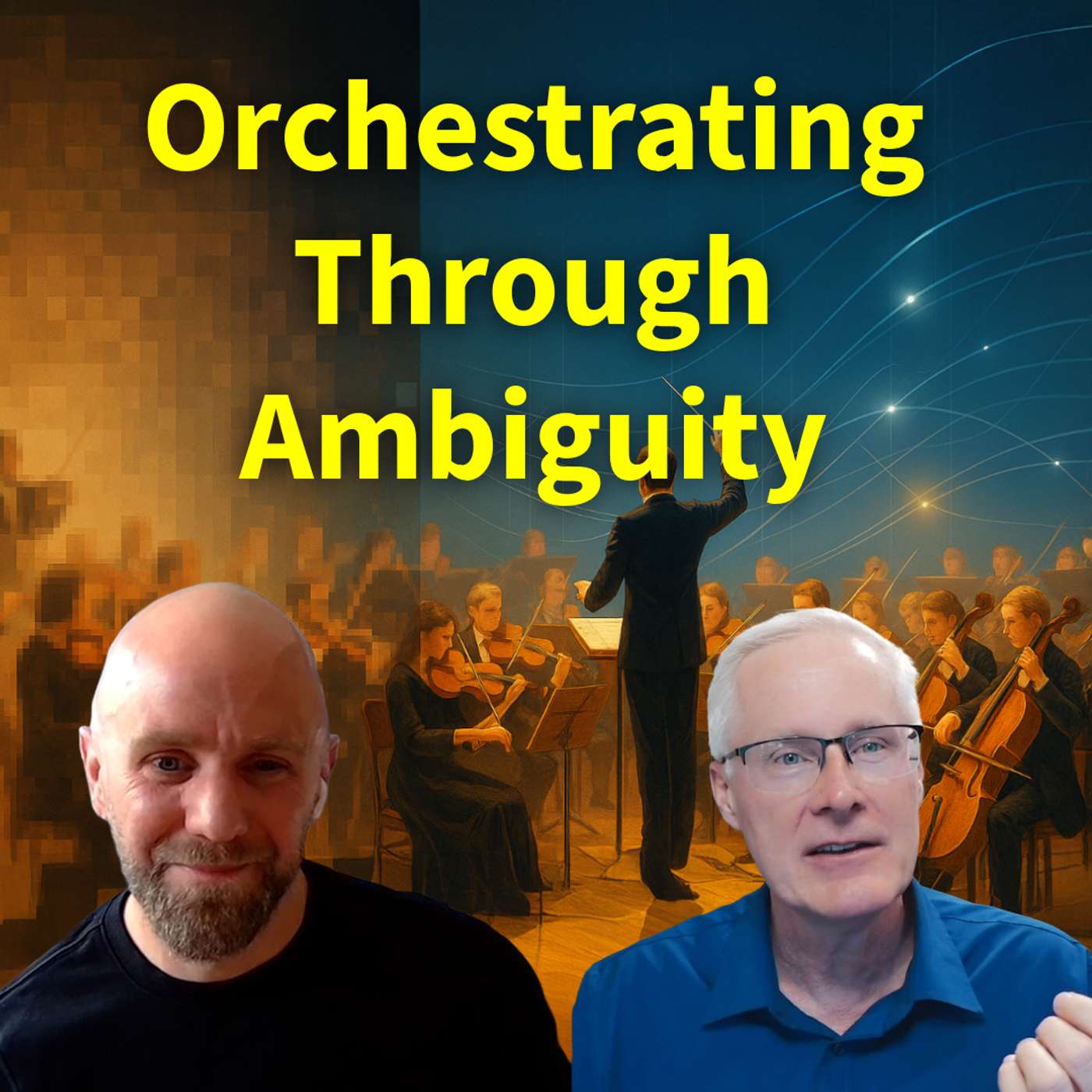
Embracing Digital Transformation
From Ambiguity to Action: Guiding Organizations Through Digital Transformation
00:35:31
Loading summary
Transcript130 lines
- [00:00]
Jason Zimmerman
Some of the research actually coming out of academia, but connecting to the real world is, you know, 80% of AI is failing to really take hold inside organizations. And, I mean, there's a. It's an evolving science. We're trying to understand exactly what it is, but it's, you know, like I said, I think it fits in really nicely with sort of the premise of your show.
- [00:24]
Dr. Darren
Welcome to Embracing Digital Transformation, where we explore how people process policy and technology drive effective change. This is Dr. Darren, Chief Enterprise architect, educator, author, and most importantly, your host on this episode. From Ambiguity to Action. Guiding Organizations through Digital Transformation with Jason Zimmerman, founder of Threefold Collective. Jason, welcome to the show.
- [00:57]
Jason Zimmerman
Hey, thank you and appreciate you. I mentioned this to you before, but I appreciate the platform you're creating and the voice that you're giving to all of us here. And, yeah, thanks a lot.
- [01:10]
Dr. Darren
Well, hey, thank you so much. It's been a lot of fun doing the show. And I've gone back and watched some of the early episodes. They were super rough. Do not suggest anyone go watch those episodes. I was like, yeah, I'm a little embarrassed, but, no, not enough to take down.
- [01:29]
Jason Zimmerman
So, yeah, no, that's good. Since I've joined, I mean, I love the voice you're creating. And I mean, as a listener myself, I mean, it's a really informative platform. You go from theory to the messiness of the real world, and people process technology. And so, yeah, I'm just real happy to join and add to the dialogue.
- [01:49]
Dr. Darren
Well, hey, thank you, Jason. And since you're a listener, you know, what question comes up next most.
- [01:54]
Jason Zimmerman
It's the. The question that gives me the most anxiety.
- [01:58]
Dr. Darren
Oh, so everyone knows on my show, I only have superheroes. Every superhero has superpowers. And a background story. Let's hear your background story first, Jason. Then we'll talk about your superpowers.
- [02:10]
Jason Zimmerman
Yeah.
- [02:10]
Interjecting Commentator
All right. All right.
- [02:12]
Jason Zimmerman
Yeah. So I actually grew up in the world of research, and my whole idea was actually become a PhD in economics and, you know, sit in front of a classroom and sort of, know, chase my own questions. And I had an advisor tell me that I should spend a little bit of time in the real world. That way, you know, understanding the messiness of the real world would actually better inform my research. And so I planned on taking a year off. And so I went into a consulting firm where I was doing economic research for government clients. And long story short, 20 years later, I've followed that path deeper and deeper. So I started in economic research. I moved into international M&A consulting. And I spent about a decade or so inside the financial services fortune 500 firm where I basically tried to answer the question of how to connect theory in the real world together. And like I said, you know, up top, that messiness is now where I live.
- [03:15]
Dr. Darren
Oh, that, that, that's a, that's an awesome story. I, it's interesting because I was gonna, I was gonna use the word academic sellout, but, but that. I won't use that word because you, you turned it pretty good because I, I know exactly what you mean. I'm like, yeah, maybe I should teach. And then, oh, wow, chase that shiny object. Chase that brass ring in Silicon Valley for a while. And now I'm back teaching, though, so I'm enjoying. Yeah, you've been enjoying that quite a bit.
- [03:47]
Jason Zimmerman
Yeah, I was gonna say we kind of came at it from the opposite directions, but I think that's part of the voice that is so interesting is how to connect those two worlds of, you know, what is theory, how does, how should it work and how does it actually work?
- [04:01]
Dr. Darren
And I think that's going to become even more important with generative AI and how it's embedding itself everywhere. It's shaken. It has shaken up academia quite a bit.
- [04:13]
Jason Zimmerman
Yeah.
- [04:14]
Dr. Darren
Because they're trying to be relevant and. Yeah, it's, it's, it's a tough situation right now.
- [04:21]
Jason Zimmerman
Yeah, well, I was gonna say, I mean, it's, it's shaking up the real world as well. It's some of the research actually coming out of academia, but connecting to the real world is, you know, 80% of AI is failing to really take hold inside organizations. And I mean, there's a, it's an evolving science. We're trying to understand exactly what it is, but it's, you know, like I said, I think it fits in really nicely with sort of the premise of your show.
- [04:47]
Dr. Darren
Well, and that fits in nicely with what we're going to discuss today. And that's techno technological change. How in the world do I keep up?
- [04:56]
Jason Zimmerman
Yeah.
- [04:56]
Dr. Darren
And this is not a, this is not a unique problem for today, but today it sure seems like it's accelerated.
- [05:03]
Jason Zimmerman
Yeah, it really is quite a bit.
- [05:06]
Dr. Darren
Right. But, but then I go back and, you know, I, my, my dissertation was on cybersecurity, and in between OT and it, cybersecurity. But a good portion of my stuff was researching previous industrial revolutions, and it was fascinating to go back and look how fast the automotive, the automotive industry grew. Just boom, changed everything.
- [05:36]
Jason Zimmerman
Yeah, absolutely.
- [05:38]
Dr. Darren
And we're seeing a very Seeing something very similar today.
- [05:42]
Jason Zimmerman
Yeah. You know, in some of the writing that I do as well and some of the conversations I have, I don't use the automobile, but I think that's a good one. I use, you know, the printing press or even calculators in terms of the impact that it had or even the fear that it created. And you know, from my side especially, you know, like I said, you know, the intersection of people, process and technology, AI is evolving so quickly and is creating, you know, just so much ambiguity in terms of, you know, where do humans fit in that, you know, that fear is really shaping the behaviors that I can see, at least from my seat mouse, you know, within organizations and how people interact with it.
- [06:25]
Dr. Darren
I'm glad you used the word ambiguity, because no one's used that on my show yet. And that's really what I'm seeing as well. There's, I, I, I've heard uncertainty, but ambiguity is a lot better word for that because it's so descriptive of what's really going on. And because of that, people are paralyzed, know what to do.
- [06:48]
Interjecting Commentator
Right.
- [06:49]
Jason Zimmerman
Well, and part of my work, it kind of evolved a little bit more beyond economics and, and really into behavior. And so, I mean, that was, you know, economics is, if it's hard, it is a social science. But once you start injecting the psychology of it, you start realizing that humans aren't as rational as the mathematics, you know, sort of suggest or tried to make us become. And when individuals lose control, they lose agency. They are shrouded in uncertainty or ambiguity. That's where that resistance really takes place. And, you know, especially for the work that I do at my firm threefold collective, the resistance we try to overcome. And so, you know, embracing digital, you know, change, that is what I'm trying to help organizations do if they want to move into the world of AI or any type of digital space. You know, it's, it's a little bit about that solution, that technology stack, how you want to, or what you want to create, but it's also just as important of how you bring that into existence. And that's where we try to, you know, tackle the ambiguity.
- [08:12]
Dr. Darren
So I love that because it tells me that you're going to learn from all the previous experiences, because what we're going through right now has happened before. It's just, it seems like it's faster now and more ambiguous. I love now I'm going to use that word five times in the next five minutes. Um, but it's so all the stuff that you Guys, you guys are in a sweet spot to help organizations through this really difficult time of digital transformation. That's kind of hyper change is what's going on. Because I've told organizations if you don't change, you won't exist.
- [08:52]
Jason Zimmerman
Yeah, I mean, it's evolution in that regard.
- [08:55]
Interjecting Commentator
Right.
- [08:55]
Jason Zimmerman
And I mean, if you go back around 30 years ago or so, John Cotter out of Harvard started looking at organizational change at scale, and what he found was roughly 70%, three out of four transformations would fail. And it wasn't the strategy themselves.
- [09:17]
Interjecting Commentator
Right.
- [09:18]
Jason Zimmerman
I mean, developing the strategy is tricky enough to begin with, but it was the implementation of that strategy. And so he kind of came up with eight rules or eight findings that informed that and summarized those were really related to human resistance, if we will.
- [09:36]
Interjecting Commentator
Right.
- [09:37]
Jason Zimmerman
To the interactions with people. And when you look at that, McKenzie has redone that study. PWC has done that study again in recent times. And this is where we start to get into around 80%. And so when you break around or break out, if you will, the, the, the reason for that increase, why we're getting worse at implementation over the past 30 years, it's because of the speed, the complexity, and AI, I think, just sort of tops them all. And you know, the fact that 80% failure right now with an AI suggests, you know, maybe we're doing okay, but I think as things ramp up, I think it's going to get even harder.
- [10:22]
Dr. Darren
So do we just give up?
- [10:25]
Jason Zimmerman
Not at all.
- [10:27]
Dr. Darren
Because 20. 20% success rate.
- [10:30]
Jason Zimmerman
At 20% success rate.
- [10:32]
Dr. Darren
That's awful.
- [10:33]
Jason Zimmerman
Yeah.
- [10:33]
Dr. Darren
So why, so why even, why not just close our doors and start a new company? Because it's, it might be easier to just completely start from scratch. Yeah. Or, or what is the success rate of starting from scratch? Do you know if they're.
- [10:48]
Jason Zimmerman
That's a good question. I don't know that, to be honest. I'm sure it's out there.
- [10:53]
Dr. Darren
Sounds like some research we gotta go do.
- [10:55]
Jason Zimmerman
Yeah, I was gonna say that's something that maybe you and I can partner on later on. But yeah, I will say, I mean, the nimbleness of starting from scratch.
- [11:02]
Interjecting Commentator
Right.
- [11:02]
Jason Zimmerman
The, the ability to ask deeper questions in ways that you, you maybe wouldn't otherwise if you were more established, shed.
- [11:08]
Dr. Darren
Off technical debt and to shed off those albatrosses. And not just technical debt, but process debt and organizational debt. All that. If you could get rid of all that, maybe I could move faster and be more nimble.
- [11:22]
Jason Zimmerman
Yeah, I mean, I would say, I mean, just experience will, you know, anecdotally will tell me know, I think you could. The challenger, if I can argue the other side, is going to be the financial capital to do it. Well, I mean, it's, yeah, it's, it's a very, it's not feasible, Right, Yeah, precisely, precisely. Well, and, and that actually brings up a study that just came out of Stanford, you know, a few months ago, I want to say, May or June, that is looking at sort of the, the deeper question of, of where AI actually begins to implement and is doing it well. And there's a lot of nuance in this study, but it's, it brings up a few different things. Is one, there is a sweet spot that sort of is the intersection of the capability of AI and the interest of the human themselves and what they want. And the insight there is that it's really about supporting the human. And you then compare that later into the research itself and you can break a lot of this down into a lot of interesting data points. But most of the implementations today are about replacing humans or not necessarily partnering with humans, but, you know, which is a huge something that is.
- [12:47]
Dr. Darren
Yeah.
- [12:48]
Jason Zimmerman
Which is the mistake. Yeah. And that's where I think the behavioral economics lens comes in of, you know, it's. What's the phrase, Culture eats strategy for breakfast.
- [12:59]
Interjecting Commentator
Right.
- [13:00]
Jason Zimmerman
And if there is that resistance, this is what John Cotter found. This is what some of the research recently is finding, that if you don't implement this the right way, culture will resist that change. But the more interesting piece is that there is a place where I'm going to misquote the numbers, but you know, upwards of 40% of the 1500 individuals and 100 plus job roles that they looked at, 40% or more want AI to take over some of the more redundant, you know, pretty substantial. Yeah. So there is interest and that's what was so fascinating about this study. It's just we're going about it the wrong way.
- [13:45]
Dr. Darren
All right, so what do I do if I, if we're going about it the wrong way, which way should I do it? Where do I find success? Because I'm sure you have the answer right, Jason, if you're right.
- [13:55]
Jason Zimmerman
No, I do. And. Yeah. You mean reach out to Threefold Collective to find that.
- [13:59]
Dr. Darren
Yeah, there you go. Yeah. Threefold Collective. All your problems solved.
- [14:14]
Interjecting Commentator
That's great.
- [14:15]
Jason Zimmerman
That's.
- [14:15]
Interjecting Commentator
Right.
- [14:16]
Jason Zimmerman
No, I mean it is tricky and you know, when you start to look at the 20% that are successful, I mean the, you're, you're swimming with the current, if you will.
- [14:25]
Interjecting Commentator
Right.
- [14:25]
Jason Zimmerman
Is you're trying to find where is that sweet spot in your organization and where are the places that, as we talked about with the automobile or the printing press, you know, it's, how can you use AI to elevate the human? And what a lot of people are looking for is again, getting rid of some of the minutia, the task oriented roles where the human can focus more on the creative, critical thought process behind it. And forming that partnership is very difficult. It's proving to be very, very complicated.
- [15:05]
Dr. Darren
Why is it so complicated? Why do you think?
- [15:08]
Jason Zimmerman
I think it gets back to. Again, this is coming from the behavioral economist in me. But when people lose the agency to make change, or when they are shrouded in ambiguity, the natural response is protection. Sit back and question it. And I think a lot of organizations on the whole, when I first speak to them, you know, I ask them the question, how does change take place in your organization? And a lot of senior executives will say up front, they change because I tell them to change.
- [15:43]
Interjecting Commentator
Right.
- [15:43]
Jason Zimmerman
They write paychecks.
- [15:44]
Dr. Darren
Oh my gosh.
- [15:45]
Interjecting Commentator
Yeah.
- [15:45]
Jason Zimmerman
And it's, I mean, they may not be explicit about it, but that's.
- [15:48]
Dr. Darren
Yeah, but basically that's what they say. I've got a carrot and I've got a stick. That's precisely what they say.
- [15:53]
Interjecting Commentator
Right, right.
- [15:54]
Jason Zimmerman
And so some of the things that I've been working on, and we can certainly get into this, I know you're familiar with network analysis and when you turn that onto, you know, an organization, it's called organizational network analysis. And what it allows us to do is to find where communication patterns are, trust patterns are, influence patterns are. And it allows us to create change not from the top down, but from the bottom up. And one of the stories I was telling you, which, which may be interesting, is we did a 15,000 person transformation that we were working with one of the large consulting firms and you know, they said, you know, an organization that size, it's going to take, you know, 10 years to do that using organizational network analysis. But, you know, executing this across traditional sort of implementation plans, we were able to do it in two and a half years. So it's a 4x increase. It's incredible. In moving from point A to point B across this digital transformation, all by flipping the script, trying to make it so that individuals at the bottom regain that control and develop that sort of understanding from the bottom up.
- [17:04]
Dr. Darren
All right, so I love it. In theory and practicality, 2 1/2 years sounds really fast. Gen AI is not 3 years old yet. Crazy, right?
- [17:17]
Jason Zimmerman
Yeah.
- [17:18]
Dr. Darren
If I want to make this move even faster, can I? But I'm. But I guess the question I have even before that is how long did it take for you to develop the organizational network map and how do you go about doing that? Because for computers it's easy, right? I can have a computer just follows things around. I can see where my traffic's talking to each other. With humans, it's very, very different.
- [17:46]
Interjecting Commentator
Yeah.
- [17:46]
Jason Zimmerman
So what I like to say is very much like beauty is in the eye of the beholder. So is trust, so is influence. Who I find influential may not be who you find influential. And if you take that thread, there's actually two flavors of organizational network analysis, one called passive and another called active. Passive is what AI can actually do for us today. And you might see this in Microsoft Copilot, for instance, license. And what that's looking at is it's looking at interactions. So it's saying, how are Darren and Jason connected? We may be on the investigation, send.
- [18:22]
Dr. Darren
Emails or texts or whatever.
- [18:24]
Jason Zimmerman
Email, text, whatever. Right, exactly. And by looking at that, we can start to develop the informal network of an organization. And that's going to give us certain clues on, like I said, how does trust, influence and communication kind of flow throughout the organization? But what it doesn't do is it doesn't yet bring in that sentiment analysis. It doesn't say, well, how does Darren feel about, you know, Jason's email?
- [18:50]
Interjecting Commentator
Right.
- [18:51]
Jason Zimmerman
Just because you and I are in the same room or exchanging conversation doesn't mean you trust or respect me. And if I tell you, hey, you know, we're gonna, we're gonna adopt this technology over here, you know, one of two things is either gonna happen. You're either gonna believe me and trust that what I'm saying, well, I'm gonna.
- [19:07]
Dr. Darren
Drag my feet and torpedo you, or.
- [19:08]
Jason Zimmerman
You'Re gonna drag your feet break. And so that's where we bring in the active organizational network analysis. And what that allows us to do is get back into that sentiment side. And so it's asking you specifically, how do you feel about these individuals in your organization? And what we're mapping now is the trusting relationships depending on the size of the organization. I mean, it's done through surveys. And so it's really just about response times more than anything. You know, we typically let these surveys run for maybe two to three weeks, but at the end of two or three weeks, we can run that analysis pretty quickly, find out where the, you know, influence centers are. And as I did in this 15,000 person transformation, what we did is we took those individuals and we made a technology academy out of it. And so instead of having the consultant come in and educate, we had a network of, you know, a hundred plus peers that already had established credibility, already had established trust, that people knew to say, I believe in this and here's what I want to teach you about this thing. And so these, you know, peers inside the organization became the adjunct professors, for.
- [20:28]
Interjecting Commentator
Lack of a better word.
- [20:30]
Jason Zimmerman
And what we're seeing is that people were more willing to listen and more open to the concepts that we're putting forward.
- [20:51]
Dr. Darren
So it's really interesting because I have this thought when I go and talk about change, I always talk about change agents, culture keepers, and assassins.
- [21:06]
Jason Zimmerman
That's it.
- [21:07]
Dr. Darren
And, and you have found, you have, you have found a way of mapping those three, because I imagine you not only find out who people trust, you also find out in those people that are trust, that are trustworthy, I guess it would be the right word that people trust. You find out which ones are willing to change. And those are your change agents and your culture keepers are those that are not willing to change. And then you gotta find the assassins, the ones that will fight every tooth and nail to prevent a change from happening.
- [21:39]
Jason Zimmerman
Yeah, you know, and this is a personal philosophy of mine. But yes, I mean, at the end of the day, and I'm, I'm. There's a lot of science behind sort of, oh yeah, persuasion and influence is. I like to refer to, you know, Dr. Robert Cialdini as an example if anyone wants to look him up. But what we'll try to do is we'll try to triangulate sort of what are the positive factors of change. And I will, specifically in the reports that I write is I will identify those individuals that can be supportive and we will keep the individuals who are more resistant, anonymized. And we do that intentionally because at the end of the day, we don't know why people are resisting. We don't know their personal motivations behind it. Um, but yes, you can identify it, certainly. But I, I think, you know, as the economist in me, I want to say what is the interjection or, or what is the incentive that we're trying to create? And in this sense, we're always trying to like, drive toward the more positive side. And you know, in, in our experiments and in the way that we've been seeing it with, you know, organizations, like I said, we can, we can accelerate adoption simply by flipping that script, letting change happen from the bottom up through, you know, the culture keepers through the, you know, positive change agents.
- [23:01]
Dr. Darren
No, I, I love the approach and, and I never thought to use a network mapping concept to do it, but I, I think it's, I think it's brilliant because now you can start seeing and you can also measure the impact.
- [23:13]
Jason Zimmerman
That, that you can measure the impact network has.
- [23:15]
Dr. Darren
Right?
- [23:16]
Jason Zimmerman
Yeah. And in fact, I'm, I'm working with a nonprofit right now where it's a 5,000 person nonprofit, international nonprofit in the educational space. And what we're finding is that there is a lot of centralized power and there's basically productivity loss across the entire network. And so we're using ONA on a more longitudinal type of study. So we're looking at it at various points in time, over time, to see how the network changes to become what is currently a more closed network, especially at the more senior level, and running experiments, if you will, to open that network up so that information flows more freely across the organization. And when that happens, that's where you start to find that, you know, you start to not just become more operationally efficient, but when you're trying to make change of any sort, especially around technology or AI, where it's, you know, there is a lot of ambiguity. You can tap into those informal communication networks very much like social media. I mean, we all know how, you know, things on social media, you know, sort of, you know, drive change much more quickly and much more deeply than sort of the traditional media outlets, for instance.
- [24:29]
Dr. Darren
So why haven't organizations done this before? I. Because I would think, hey, if it only makes sense if I can map out how, change, how, how to affect change in my organization through identifying, you know, the people, my change agents and culture keepers. Why haven't they done this before?
- [24:52]
Jason Zimmerman
And the simple answer is it's new. Network analysis has been around for.
- [24:57]
Dr. Darren
Network analysis has been around for a long time.
- [24:59]
Jason Zimmerman
Yeah, right. As, yeah, many of your audience members will know, especially in the technology space, cybersecurity, your background, that sort of thing, but applying it to the human network. It started out being called social network analysis and sort of has evolved into organizational network analysis. I mean, it's, you know, only a few years out of academia at this point. And you know, part partly why I'm interested in is my academic research background. And so I will say there's a lot of white space in this area. You're finding a lot of interesting applications from other firms, from other competitors of mine that are sort of creating this rising tide moment for, you know, the research itself. But I think when I, I bet you I've spoken to, let's just say a hundred people and maybe one or two have heard of network analysis and is variant inside the organization and its use cases inside a firm. And so it's, it's just really new. And I don't think a lot of, you know, consulting firms are, are using it. I don't think a lot of. Yeah, I don't think a lot of decision makers too.
- [26:07]
Dr. Darren
Right. I mean it's, I mean, I'm sending out surveys, I'm. Yeah, it's not a. I can come in in two days, have an answer which a lot of people want that, that quickly, right? No, it takes time. I've got to understand your organization. I've got to do surveys, I got to do some behavioral analysis and. Of the organization.
- [26:27]
Interjecting Commentator
Right?
- [26:28]
Jason Zimmerman
Yeah, I mean, and that's a really fair point. It does take time. It's not something that's going to sort of change on a dime, but when the complexity is large enough or, you know, when the stakes are high enough, you know, I'll put it this way. It's taken me three months, you know, with my nonprofit client, when it came to the 15,000 person transformation. I mean, it took us well over a year to really form the right hypothesis about the culture, to study it and to really begin to start to affect change. And when you break that out, what we're finding is, yeah, nine to 12 months of, of sort of analysis and a lot of executives that are expecting change right away might fall out during that period. But when you look at a 10 year transformation, we did that effectively in 18 months to really get to our stage of success. You know, you're starting to really see the ability to accelerate, you know, the change process.
- [27:30]
Dr. Darren
Well, this also, this also helps us understand why small companies with a smaller organizational network, it moves them quickly because I can understand those relationships in that network faster and more deeply than I can in an organization with 15,000 or 150,000, where those are very complex relationships and those are very complex networks. This is really fascinating.
- [28:13]
Jason Zimmerman
Well, and if you really break this out. So one of the examples I use all the time is Lockheed Martin skunkworks division. I mean, Lockheed Martin obviously at the time was a massive organization, but they had this skunk orcs division which was intentionally segregated off in the rest of the, you know, the organizational community.
- [28:32]
Dr. Darren
Isolated. Not just segregated, isolated. Right.
- [28:35]
Jason Zimmerman
Almost completely.
- [28:36]
Dr. Darren
No command call structure. Everything's their own little thing.
- [28:41]
Jason Zimmerman
Budgeting was different, the success measures were different. The way that they even interacted with each other. The way that the teams were even designed and created were completely different. The sociologists in me will say, well, that's a closed network versus an open network, and both of those have benefits and different designs. If you go Back to my 15,000 person transformation, by creating that technology academy, that's what we did. We ended up creating this small. And by leveraging the, you know, just the way that news travels, I want to say that formal versus informal communication. Informal communication travels somewhere in the neighborhood like four to five times faster than formal communication.
- [29:27]
Dr. Darren
It can just permeate the organization.
- [29:30]
Jason Zimmerman
And so that's what we're tapping into by isolating this technology academy, which again, by design, is creating agency. People can go in and study what they want, when they want. They had the opportunity to take electives into some of the more advanced technologies, for instance. But it was also closing off that ambiguity, Right. It was providing them a deep understanding of why we were doing this. They would then leave that isolated pocket and they would start to tell their friends and their peers about what they were learning. And you would find that people would become more and more interested in it. And so we can see, you know, the rates of, you know, getting into our academy were increasing. In fact, one of the biggest risks we had within this entire project was we didn't have enough capacity inside the academy to meet the demand that we were having. And we had to go back to the board and, you know, in a very positive way, say, you know, yeah, we need more support, we need more resources to, to drive this transformation forward. So.
- [30:36]
Dr. Darren
So it was all voluntary, which is very interesting as well.
- [30:41]
Jason Zimmerman
Yeah, right.
- [30:41]
Dr. Darren
Because that means you're going to do self selecting. You're going to have people that want to be there. They are the change agents or they want to make sure they're not left behind. Either one of those two.
- [30:53]
Jason Zimmerman
Well, I'll say there is a mix of the two. I mean, for 15,000 digital transformation, we 100% needed to have sort of what we called the core curriculum, which you'll learn, you know, from all of us going through education. You have to have that core curriculum. So we didn't have an option for that. We did have to stage that out in very structured ways. But once you move past that core, once you sort of understood the technology and the stack and the systems that we were in, the processes that we were and stilling, you could come in and do electives. And to this day, that system is still up and running, the academy is still operating, and people are coming in and Taking more advanced classes, getting certifications. It's sort of went beyond what we anticipated and is really becoming this kind of pull mechanism for individuals to come in and continuously educate themselves, not just on the latest and greatest technology, but how that technology related to that particular firm in that particular culture.
- [31:55]
Dr. Darren
It's almost like an indoctrination to change. Right. I mean, because you couch it as. As training, but what you're training them on is the direction you want them to go.
- [32:07]
Interjecting Commentator
Right?
- [32:08]
Dr. Darren
Very clever. Very, very, very clever.
- [32:11]
Jason Zimmerman
Well, and I think that's where, you know, like I said, for a lot of the things that, with topics that you and your other guests and even your listeners are exploring and questioning themselves is it's that intersection of people, process, and technology. And for me, from. From the side of the people side, it's, like I said, swimming with the current.
- [32:29]
Interjecting Commentator
Right.
- [32:29]
Jason Zimmerman
And those things don't live in isolation, but there's this messiness when those things combine that, you know, it's. To me, it's about that human resistance to change. How do we make sure, as you said, that the organization evolves, you know, continuously. It has to evolve, especially with the.
- [32:50]
Dr. Darren
It'll perish. And so. And I like the practicality of this because it's a design pattern. I use design patterns a lot. It's a design pattern for organizational change that I can use in any organization because it's a technique that is very applicable across several different domains, which I love. Hey, Jason, if people want to find out more about all this or contact you, how do they go about doing that?
- [33:18]
Jason Zimmerman
Well, so our website is the number three, but threefoldcollective.com I also write pretty extensively on substack about these topics, both in theory and sort of criticizing and dissecting some of the more, you know, more of the recent sort of issues that are going on. For instance, you talk about design. You know, Apple is changing its organizational structure. And so on my substack, you can find sort of a dissection of that, and that is called threefold outcomes@substack.com.
- [33:53]
Dr. Darren
Awesome. Awesome. Jason, thank you for coming on the show. We could talk for hours. I already know.
- [33:59]
Jason Zimmerman
No, I appreciate it.
- [34:00]
Dr. Darren
We may have to have you come back on the show and talk more in depth on how do I actually go about doing this, and more on organizational network analysis, which I think is fascinating. So I need to be schooled on it. I need to go back to school.
- [34:17]
Jason Zimmerman
Well, I think that's what's.
- [34:18]
Dr. Darren
So I'll tell my wife. I'll go get another. I'll go get another PhD in organizational management.
- [34:23]
Jason Zimmerman
If I could convince, you know, my partner to do the same thing, I one, I think she would leave me, but it would be, you know, curiosity is the great incentive.
- [34:34]
Dr. Darren
She's my wife has already told me I we can do that as long as and then the list is long of things that I need to, you know, take care of.
- [34:42]
Jason Zimmerman
Exactly. No, I appreciate you having me on it and just giving me, you know, a chance to sort of, you know, spread this with your audience and, you know, like I said, just engage in the dialogue with you. It's, it's been a real pleasure.
- [34:56]
Dr. Darren
Thanks for listening to Embracing Digital Transformation. If you enjoyed today's conversation, give us five stars on your favorite podcasting app or on YouTube. It really helps others discover the show. If you want to go deeper, join our exclusive community@patreon.com embracingdigital where we share bonus content. And you can always connect with other change makers like yourself. You can always find more resources@embracingdigital.org until next time, keep Embracing the Digital Transformation.