← Embracing Digital Transformation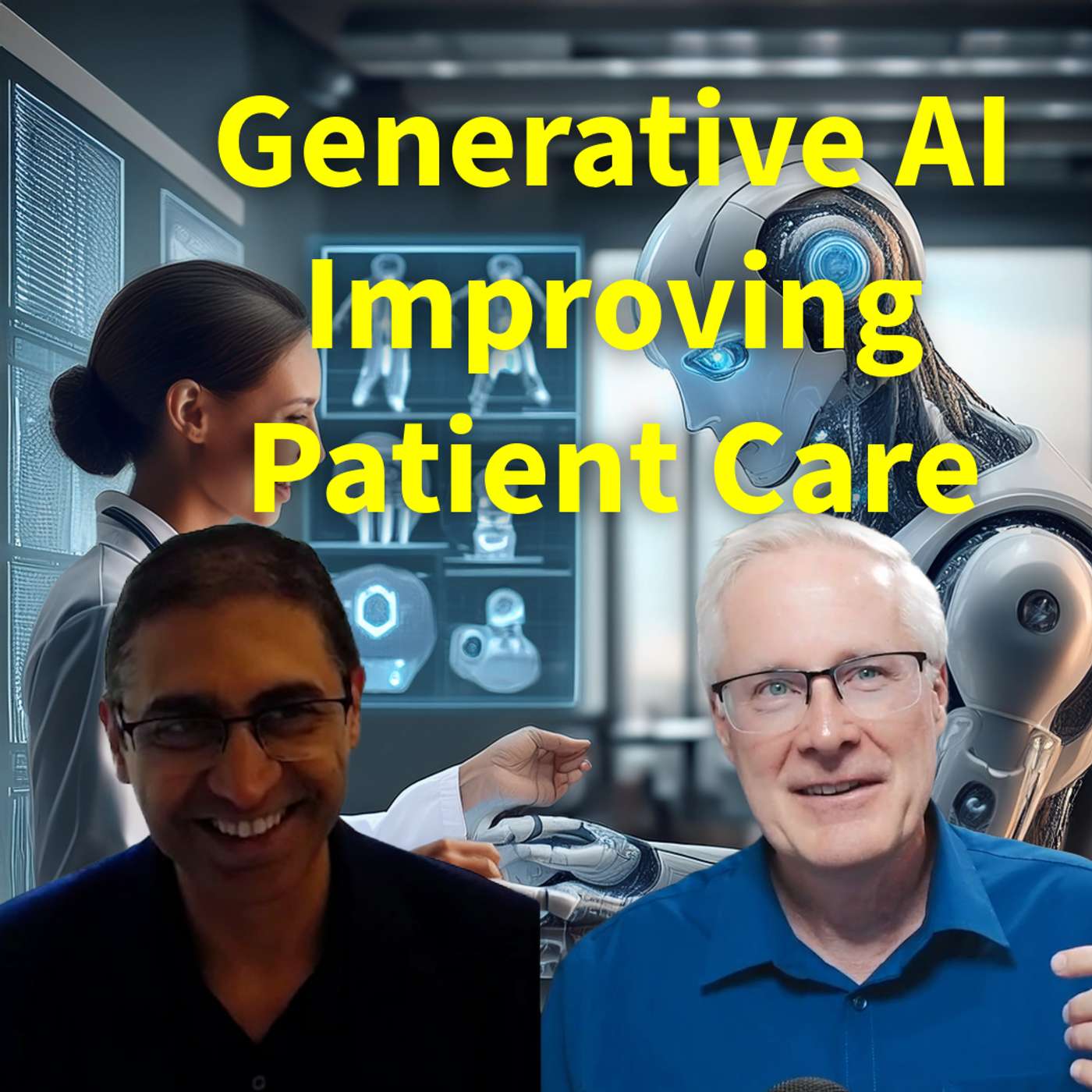
Embracing Digital Transformation
#284 Generative AI in Healthcare: Building Trust, Boosting Efficiency, and Shaping the Future of Patient Care
00:32:24
Loading summary
Transcript94 lines
- [00:00]
Rajan Kohli
Then maybe I can do certain things by myself, understill the guidelines.
- [00:07]
Darren Pulsford
Oh, this sounds like a nightmare for doctors.
- [00:12]
Rajan Kohli
Because what if I follow what ChatGPT says and develop something worse? Something more complicated. Complicated? Then what is my peer going to say? My provider going to say?
- [00:26]
Darren Pulsford
Welcome to Embracing Digital Transformation, where we investigate effective change, leveraging people, process and technology. This is Darren Pulsford, chief solution architect, author, and most importantly, your host. On this episode, Generative AI and Healthcare, shaping the future of patient care with returning guest Rajan Kohli, CEO of Situs Tech. Rajan, welcome back to the show.
- [00:54]
Rajan Kohli
Thank you, Darren. Thanks for having me. Thanks for not talking after the last one.
- [00:59]
Darren Pulsford
Yeah, well, of course I want you back. We had a great conversation. It's been what, six months, maybe longer since you were on.
- [01:07]
Rajan Kohli
More than six months.
- [01:08]
Darren Pulsford
Yeah, yeah. So, boy, this will be great to see how, how you think things have changed over the last, you know, six months when it comes to Generative AI and normally, as you know, I normally ask about your superhero powers, but we already know. We already know, Rajan. So let's dive right in. Let's dive right into what we're talking about today, which is generative AI in healthcare.
- [01:34]
Rajan Kohli
Yeah.
- [01:35]
Darren Pulsford
So from your perspective, because you're right in the throes of this, you do this every day.
- [01:40]
Rajan Kohli
Yeah, yeah, yeah.
- [01:41]
Darren Pulsford
Where. Where are we at today compared to six months ago?
- [01:44]
Rajan Kohli
You know, interestingly, I would have said six months back that in the short term, people are overestimating. In the long term, people are underestimating the impact. I think six months on, I'm still of the same opinion.
- [01:59]
Darren Pulsford
Same opinion. Oh, that's good.
- [02:02]
Rajan Kohli
But I think people are discovering what it will take to scale it now or what are the challenges which have, you know, impacted their scaling of Gen AI because so are you, are you.
- [02:15]
Darren Pulsford
Wait, are you starting to see then people moving from experimenting in little pockets of using Gen AI into actual enterprise level, institutionalizing it a little bit more now?
- [02:29]
Rajan Kohli
That is right. That is absolutely right. But also what we have seen is only about 10 to 15% of the proof of concepts actually make it to production. And there are reasons for why it is low, especially in healthcare, because you have to be super safe and super sure.
- [02:48]
Darren Pulsford
Well, that 10 to 15% is what we would expect is. I mean, that's pretty typical of new technologies, wouldn't you say? Or do you think this is too low still for how far along we are?
- [03:01]
Rajan Kohli
No, I think for something that is innovative and sort of requires change, it's not just improvement over what you Were doing it requires you to change the way you were doing things. Things I would say 10, 15% is not bad. But obviously in IT, in internal technology, unlike in venture capital, people have different thresholds. They don't expect 1 in 10 successes like they would do in venture capital. And that's why probably in internal IT people would tend to look for more success.
- [03:37]
Darren Pulsford
Well, see, that's an interesting dilemma that we have because the barriers to entry of Genai are so low that IT organizations are starting to look at it, but it hasn't been fully vetted yet. So they're experiencing what a normal VC would experience, where, hey, I'm a. 10% is okay in it, 10% is not okay. So this is a problem.
- [04:06]
Rajan Kohli
This is a problem. And the second thing is that obviously when 1 in 10 succeeds, but then that 10 has to give 100x the return. And typically to get that 100x return in internal enterprises, you need to do a lot of change. You can shoot for 100x better because you're not looking at 30% improvement now. You're looking at 500% improvement or 1000% improvement.
- [04:34]
Darren Pulsford
1000% improvement. Yeah.
- [04:36]
Rajan Kohli
Then you need to be willing to change the process completely. Completely reimagine the process with AI first lens. Now, how many of the enterprises are willing to do that? Especially in healthcare, where physicians, doctors, nurses do not necessarily have the same change orientation as maybe somebody in fintech firm or somebody.
- [04:58]
Darren Pulsford
Well, wait, Rajan, I don't want. My healthcare is different because we're dealing with people's lives, right? So you're like, oh, I'm going to take a risk on this new gen AI, on Darren's open heart surgery that I had last year. No, no, no, we're not going to do that.
- [05:18]
Rajan Kohli
Right on that here. If things go wrong, it's not your closure rate that drops. You actually lose lives.
- [05:26]
Darren Pulsford
So, yeah, people die. Yeah, yeah, people.
- [05:29]
Rajan Kohli
And our clients are very careful with that. And that is also one of the reasons why what we are seeing is that, you know, obviously people say quality and trust is very, very important. Also explainability is equally important.
- [05:42]
Darren Pulsford
Oh, I like, I like that. Explainability. Yeah. So, so, all right, so there's some, there's some things piled up against gen AI from these impediments from being adopted. But you're still seeing, have you seen any growth in the last six months?
- [06:00]
Rajan Kohli
Yes, a lot of growth. And I'll tell you why we are seeing growth. Right. Number one, unlike in some other industries where one of the biggest reasons to do this is cost. That's not the main driver in healthcare. And people tend to do things much more openly if it's impacting end customer experience. If it can impact revenue rather than just cost, there's a different driver for that if it can impact experience of doctors, nurses. So in healthcare, cost is a driver, cost is a outcome, sometimes a secondary outcome, but not the main driver for this particular decision. There are. Doctors are not going to lose their job because they are using Genai. Doctors will be able to see a lot more patients in a day if they're using Genai. Doctors will be able to make a lot more eye contact with the patient and have a better conversation if they're using genai. So the drivers are very positive and very motivating. And hence despite all the issue of data silos, multiple formats of data within the healthcare ecosystem, not enough standardization even in EHR to EHR movement of data. Despite all of these challenges and the fact that you know the bar for explainability and quality and trust is much more higher in healthcare, despite all of these reasons, there is a lot more innovation happening, a lot more acceptance happening in healthcare because of all the positive drivers that adopted.
- [07:52]
Darren Pulsford
So, so do you think, because you mentioned a couple things that, that I clued into the individual doctors using Gen AI is do you think you're starting to see more of that? Or it's, or it's widespread but not institutionalized. Does that make sense?
- [08:10]
Rajan Kohli
It is happening more and more and big credit should also be given to the EHR providers here.
- [08:17]
Darren Pulsford
Okay.
- [08:18]
Rajan Kohli
They're building some of this Gen AI especially you know, allowing doctors to not focus on note taking. Right. Versus so they're doing transcription.
- [08:32]
Darren Pulsford
The, the, the H. Like what are the, the EPIC and Cerner, they're, they're.
- [08:39]
Rajan Kohli
Now and Atena Health, all of them are this capability in their EHR system.
- [08:45]
Darren Pulsford
Well that is kind of nice because I have noticed different doctors over the last five years. Some have asked me if they could record our session and it was being transcribed. It was far more personable with, with the doctor because they were looking at me instead of at their screen asking questions. Right? Oh, I'm looking over here asking questions now they're looking at me and seeing and reading non verbal cues, reading all of that. Right. And, and really focusing on me instead of on my, on the computer in front of them. Right. So I think that's a huge, that's.
- [09:26]
Rajan Kohli
A huge class, huge positive. And the quality of ambient listening and note taking is very good. Very good.
- [09:34]
Darren Pulsford
So beyond note taking, what other things Are we seeing doctors? And I'm, I know I'm focusing just on doctors right now, but there's a whole nother realm in healthcare I want to get to. But every, the doctor seems to be kind of, and the pa right. And nurses, they seem to be kind of the front line of this. What other areas are we seeing them starting to use generative AI besides note taking and things like that?
- [09:59]
Rajan Kohli
I think they are beginning to see that in decision support systems. Yes, very much. We are working with healthcare systems where we build decision support systems for them where of course doctor is in the loop, doctor is the final decision maker. But there is a system and the system taps and this works on the knowledge graphs that we have built based on the internal care guidelines of that healthcare system.
- [10:30]
Darren Pulsford
Yeah, that's always been a, that's always been a tricky thing for me when I get into a healthcare system, right With a specific system, whether it's in, in Northern California where I live, it's Sutter health or it's dignity health or it's UC Davis or there's so many right here they have protocols that they follow and doctors just follow the protocols. Are we seeing with generative AI there being a little bit more flexibility for the doctors to say hey, I know what's best for my patient instead of following a protocol that some business guy put together, this is giving me some more guidelines that I can fit in but I can treat the patient like they're unique instead of I'm following. Does that make any sense?
- [11:22]
Rajan Kohli
That makes sense because it's no longer based on just hard coded rules. Hard coded rules based system doesn't allow individuality and doesn't learn real time from your actual prognosis or development of the disease. But a living system online system, a real time system would allow a doctor to compare contrast and a system that actually digitizes these rules in a way that can be integrated to a gen system will make it significantly better and adaptable system on real time basis, which.
- [12:03]
Darren Pulsford
Means hopefully fewer visits by patients. Meaning. Right. Because if I, I, I noticed this with. Oh, you think that's the next step?
- [12:14]
Rajan Kohli
That's the next step because that will happen when a lot more agency is given to the end patient which is possible. Now when the new ChatGPT 5.0 was launched, they announced that their specific focus is healthcare and where they are going with this is to give a lot more agency to the patient. Now as a patient, when I have full access to my EHR and I have confidence that I would be able to In a non intrusive way, in a HIPAA compliant way. Put all my EHR Data into a ChatGPT type system and then talk to ChatGPT or talk to my EHR, then maybe I can do certain things by myself, understill the guidelines.
- [13:07]
Darren Pulsford
Oh, this sounds like a nightmare for doctors.
- [13:12]
Rajan Kohli
Because what if I follow what ChatGPT says and develop something worse, something more complication, complicated, then what is my peer going to say or my provider going to say? So that's why at best this is a system that we should use to clarify what the doctor is saying or help simplify the language which a doctor is saying or use as a system that empathizes with me or nudges me to make sure I make sure I'm doing the right things, I'm doing the right things rather than anything more at this point in time I would say.
- [13:55]
Darren Pulsford
No, no, I agree to you there because I, I think it's funny because we've had some health issues in, in my family with me with open heart surgery last year and my wife has a brain tumor that we're dealing with and I was all over CHAT GPT on every test result I got back. I was like, so when the doctor came in, instead of saying, well, CHAT GPT said this, I asked ChatGPT to say what questions should I ask the doctor? And, and you know, the doctors were like wow, you knew the right questions to ask. I says it wasn't me, it was this over here. So I'm hoping that patients still rely on doctors, right? I mean they go to school, they learn the intricacies of, of health care, it's of, of medicine and of the human body that changes. ChatGPT just doesn't know, right? There's these nuances that, but doctors can be augmented by, by these chat GPTs. Right? By, by these gen AIs. Not just chat GPT but, but Gemini and Anthropic, all the other ones out there as well.
- [15:06]
Rajan Kohli
That's why I said look, don't make any decisions based on what a CHAT GPT tells you and not go to a doctor because you've already gotten some recommendation from CHAT GPT.
- [15:16]
Darren Pulsford
That's okay, good, we got that, you know, climb.
- [15:29]
Rajan Kohli
I do think the, the meter should move a lot more towards preventive medicine. That will happen because of all the, the devices that we are wearing and them indicating that right now a lot of them are not connected back to the EHR system, right?
- [15:49]
Darren Pulsford
Correct.
- [15:50]
Rajan Kohli
When I'm talking about what happens three years forward, I believe that would be One of the steps where a healthcare system and the data becomes a living system and there would likely be integration of all of these inputs back into EHR so that preventive action can be taken when needed.
- [16:09]
Darren Pulsford
Well, ideally that would be perfect, right, because. So I wear a watch now that monitors my heart all day long. It monitors my heart because I did have open heart surgery. It was a big deal, right?
- [16:21]
Rajan Kohli
Yeah.
- [16:22]
Darren Pulsford
But it monitors it, it puts it into my, my personal health record, right. Which is Samsung Health. I, I use Samsung. So Samsung Health. But that's not tied to the hospital's epic, right? Well, I think they use EPIC at my hospital or my primary care physician's, you know, system. He has access to all this stuff. But it would be nice if it were all together. So if there was an incident that it would call an ambulance for me right away, it would already know everything about me. So it wasn't just a generic ambulance coming to my house, it was a cardiac system. Right. That came to my house saying, hey, we know what's going on with Darren, we can see it, we can help him out before he dies. Right. I mean, that would be awesome. What is preventing that from happening today?
- [17:13]
Rajan Kohli
I think it is more to do with regulation and insurance because the moment it is connected with your ehr, then the responsibility moves over to the providers to take preventive action. I'm not saying that's the only reason.
- [17:28]
Darren Pulsford
No, but I agree with you there. Yeah. So do you think it's a technically.
- [17:33]
Rajan Kohli
Technical limitation, not a technology related issue?
- [17:37]
Darren Pulsford
It's technicality, not a technology. Because I believe, I believe the technology is there to make this all happen.
- [17:44]
Rajan Kohli
Yeah, it can happen. And where you do have software devices on your body there, you can track them on an individual basis. So why can't you track more of my health parameters? I think it will happen eventually. And there's enough benefit, especially with the focus now on cost reduction of healthcare. This is a big element to it, right. I mean 60, 70% of the actual cost of healthcare goes to the 10, 15% of extreme cases, which obviously is not right. I mean if we can prevent that type of concentration in so fewer cases by doing more preventive, that will absolutely help everyone.
- [18:33]
Darren Pulsford
I'm a huge fan of preventive now, especially now after open heart surgery. Right. I mean that's, that's just, I, I, I'm watching what I eat, I'm, I'm taking my medicine all the time. Right. And all that. This is really interesting. So it sounds to me for change to occur, we, we've Got the technology, we've got to change some process. But more importantly we got a systemic cultural problem that we have to change, that regulations and policy are kind of impeding this from moving forward to save people's lives. Is that what I'm kind of hearing?
- [19:11]
Rajan Kohli
Yeah, you're right. I would just add one more element which is around. I talked about explainability. But if you're going to go to more big system then you need real time governance. You have to obviously have another agentic system managing and governing this agentic system to ensure the right guardrails are there. So I would split compliance into compliance, regulation as one element, but quality, trust, explainability as another element of it.
- [19:44]
Darren Pulsford
I really like that division. Are there any concerns with one agentic AI governing another agentic AI?
- [19:53]
Rajan Kohli
There is no concern, but that's the only way to do it. Because agentic AI system is a learning system. If you have a non learning system trying to govern a learning system, then you know what's going to happen.
- [20:04]
Darren Pulsford
Oh yeah, yeah.
- [20:06]
Rajan Kohli
So that's the only way to do it. I think there is enough research though in early days to say that that is possible. And the models we have created, you can even take simple models like creating summarization.
- [20:21]
Darren Pulsford
Right, right.
- [20:21]
Rajan Kohli
With the summarization you are having another system check that summarization.
- [20:25]
Darren Pulsford
Check the summarization. So no, I agree. But then where, then where is the human fit in this? Because it sounds like, I mean normally you would want a human checking the summarization that looks correct and things like that, but that could bog down, that could slow down the systems. Right.
- [20:42]
Rajan Kohli
In healthcare it'll always be there. Like I gave you the example of notes, the healthcare notes. A doctor is eventually looking at them before accepting them. Right. We are not where it's a fully agentic system where the doctor doesn't have to see the notes and they get submitted and a prescription gets written and then a prescription gets sent to my pharmacy. There's a human in the loop at every step. That will still be the case, especially in healthcare because of what we talked here. It's about lives. So there'll be human in the loop.
- [21:26]
Darren Pulsford
An interesting point where, where the risk of a mistake is high because the risk of a mistake in healthcare is people dying. That's a very high risk. Right. Then human interaction and trust, accountability all have a role in playing in here. And that's where the human needs to be part of it. But how am I going to decrease all my costs? I, I mean one way to decrease cost is to get Rid of steps, get rid of some of the processes that are overbearing, which means I'm getting rid of some people. I, I mean that's ultimately what's going to happen, right?
- [22:09]
Rajan Kohli
Yeah. No, there are many places to get rid of this cost without impacting either the quality in fact enhancing the quality of care. Let's take example of the amount of overhead there is between the provider submitting the bills, invoices payer approving or disapproving and the to and fro between these two very, very critical players in our industry. Right. There's a significant amount of. And there is work already being done including using agentic AI or genai to reduce, you know, to predict denials, to reduce the number of denials, to submit the claims in a better form so that there are fewer denials. Because denials are not necessarily helpful to anybody. Right. So no, they're not. Who is to ensure that there are no denials or the right coverage is asked for and taken in the first coup. So there is cost to be cut there then second place to reduce cost is by allowing a doctor to address more number of patients by reducing their overhead. 30, 40% of their overhead goes in these back office activities that have nothing to do with actual patient care. Similarly in nurses, right, Nurses are extreme shortage. There's so much of back office work for ICU discharge for you know, getting people, patients onboarded onto a bed, etc. There's so much overhead at every function within healthcare that can actually be even agentic AI these.
- [23:46]
Darren Pulsford
So what, what you're really talking about is getting rid of some of the day to day work that people already do. That's kind of minutia that should be done automatically. It really should be right. And get healthcare providers to focus on the people instead of on the process. That's kind of what I'm hearing.
- [24:08]
Rajan Kohli
Third area is where patient interfacing apps, right. Today a lot of time nurses are supposed to call patient after discharge.
- [24:20]
Darren Pulsford
I don't know whether they called me after my discharge. Yeah, they did.
- [24:25]
Rajan Kohli
They did. Yeah there is. The virtual avatars are playing a very, very strong role in that type of work. And all research says that a good avatar is much more human like in their empathy compared to real human because it just has more time, right. And more resources.
- [24:45]
Darren Pulsford
Well no, I totally get it. I can't imagine some of these discharged nurses, right? Oh, I've got 10 patients to call at the end of the day and you know, I don't, I don't want to hear about all their Aches and pains that are normal. Right. I, you know, I gotta get home, I gotta, you know, and so, but if I have an empathetic avatar that will talk to me for a half hour and I can complain about, wow, I'm really feeling horrible. Right. I'm, you know, that we. I get it. That's in it. That's an interesting, that's an interesting one for sure.
- [25:23]
Rajan Kohli
These are strong areas where Gen AI is being used.
- [25:27]
Darren Pulsford
Yeah, very interesting. All right, so what about in the back office? I mean we talk about health care and the front line, which are our doctors, our nurses, our PAs, you know, the people working with the patients. What about the back office? I would think that this is the big area where we could really save a lot of time and money and as you mentioned earlier, re engineer some processes, think about exactly why did we do it that way and why should we continue?
- [26:02]
Rajan Kohli
No, no, absolutely. That is the biggest area of use right now. The early usage, the early live projects, they happen to be a lot of them in the back office for all the obvious reasons because the threshold for, you know, proof of burden is lower because it's operational. But also there is shortage of staff and just the load is very, very high. And there is roi. You can actually prove the roi?
- [26:34]
Darren Pulsford
You can? Yeah. You can measure it, right?
- [26:35]
Rajan Kohli
Yeah, the ROI is very measurable. So whether it is medical coding, whether it is revenue cycle management, whether it is denial management, whether it is looking at wrong claims or fraud abuse cases, big usage of early gen AI use cases in all of these.
- [26:58]
Darren Pulsford
Are you seeing hospitals and healthcare systems, are they readily adopting this or do have they established policies around, around this or is it still kind of the wild west where I think we're just trying things out still?
- [27:15]
Rajan Kohli
There is a big, I would say there are healthcare systems that are quite advanced that are beginning to use genai for this. But on the same hand, in the same time period there are healthcare system which are doing rpa. So now for them just doing RPA is providing them the benefit because they never did that in the first instance, right?
- [27:38]
Darren Pulsford
Yeah, yeah.
- [27:40]
Rajan Kohli
So you know, again, you always don't need like the biggest gun. If you can take some benefits through simple, easy rpa, you do that. But if you've already done that and big benefits can accrue through Gen AI, then you absolutely do that. So I can see we have a spectrum of clients all the way from those who are starting off RPA projects to those who are doing leading a gen projects in operational systems. At the same time, this is really.
- [28:08]
Darren Pulsford
Interesting because when I think of rpa, because I've done RPA work before, I'm taking a process that already exists and I'm automating it. Right? Pretty simple in the simplest form. It's. It's actually a lot of work. I shouldn't say it's simple, it's a lot of work. But with Gen AI, I might actually be changing my whole process. Right? And you kind of mentioned at the beginning of the show that I could see a huge productivity improvement with these reprocess re engineering where we question why do I have this process? What is the inputs and what is the outputs and why these are all important things. I should be asking how do I. If I'm managing right, a hospital, where do I. I get a quick win with rpa because it is kind of a quick win. I can get some return on investment in six months pretty easily. But Gen AI projects, they're going to take longer, aren't they? I mean, yes. So how do I balance. How do I balance that? Where. Where's the low hanging fruit you think I could go after first?
- [29:16]
Rajan Kohli
This is exactly how we look at it. We say look at the process and look at smart automation as your goal, which means you don't bring technology and throw it at the process. There would be some places where it's okay to do rpa, but there are some places where you should apply gen. So you decide the process. We have very good playbooks for all typical processes where we will say in this process, Jenny, I will give you this much benefit of this process.
- [29:49]
Darren Pulsford
Okay, so. So you guys, this is where I lean on someone that's gone through this before like you guys, right? And say, hey, help me to make some decisions, right? Where I can strategically place and, and improve based off of the different technology. I. I like that approach. Because Gen AI won't solve all problems and RPA won't. Rpa. I always said this to people. Yeah, I can have that highly inefficient process run automatically. Highly inefficiently, but automatically. Right? It's still highly inefficient, but it's running automatically. Right? That doesn't. Right. I mean that's. I've seen that time and time again as well. So you guys have kind of a list and an approach to go over this.
- [30:35]
Rajan Kohli
That's why we always say that you should be willing to look at the reimagination of the process. But that doesn't mean you will reimagine everything and apply gen only to everything there could be benefit for you in some cases doing rpa. And as you said, the ROI could be quicker in some of those cases. And you know, many times clients do need to show ROI as they invest more and more. So we will put together a nine month plan for them and you know, do some things here and then some things for medium term and something so long term.
- [31:07]
Darren Pulsford
Very, very fascinating. So hey Rajen, we're, we're, we're running out of time. If, if people want to find out more and reach out to you or where do they go? How, how do they reach out to, to you and your company?
- [31:21]
Rajan Kohli
Absolutely. The best way to reach out to us is through our website, ctstech.com we in fact have a separate section under that all about Gen AI and AI ctstechai.com so please do reach out through our website and we would love to answer any questions and queries that you have. And thank you for your time.
- [31:42]
Darren Pulsford
It's always fun talking to you because I get a really interesting perspective on healthcare that no one really talks about that much. Right. So thank you for coming on the show. I sure appreciate it.
- [31:54]
Rajan Kohli
Thank you Darren. Have a good one. Foreign.
- [32:02]
Darren Pulsford
Thank you for listening to Embracing Digital Transformation today. If you enjoyed our podcast, give it five stars on your favorite podcasting site or YouTube channel. You can find out more information about Embracing Digital transformation@embracing digital.org until next time, go out and embrace the digital revolution.