← Emergency Medicine Cases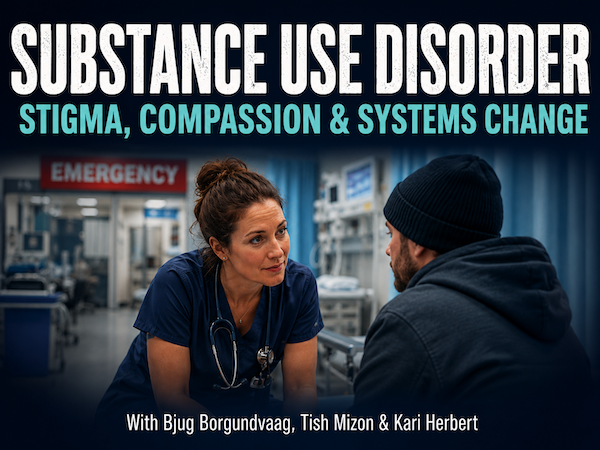
Emergency Medicine Cases
Ep 218 Substance Use Disorder in the ED – Stigma, Compassion and System Change
01:01:07
Loading summary
Transcript78 lines
- [00:02]
A
Emergency medicine is more than just ordered chaos.
- [00:04]
B
From the recess room to the bedside, we are witness to it all and
- [00:08]
A
we're here to help you prepare for it.
- [00:10]
B
Bringing you the brightest minds in emergency medicine from around the world for trusted, tried and true free open access medical education.
- [00:18]
A
I'm Dr. Anton Hellman.
- [00:20]
B
And I'm Dr. Katie Lynn.
- [00:21]
A
Katie, let's welcome the listeners from our amazing EM community to the Emergency Medicine Cases Podcast, shall we?
- [00:27]
C
Yeah.
- [00:27]
B
Or let's simply call it EM Cases.
- [00:30]
A
Okay EM Cases. EM Cases is brought to you by shremi, the Schwartz Reisman Emergency Medicine Institute that's a non profit organization dedicated to improving EM care through high quality research and education. The opinions expressed on this podcast are intended for information and education purposes only and should not be used to diagnose, treat or prevent any medical condition, nor should they be used as a substitute for medical advice from a qualified practicing physician. First, just a quick word from our sponsor Metricade, the experts in complex physician scheduling since 2012. I've been using Metricade's incredible scheduling system for more than a decade and it's been a game changer for me and my colleagues. Shift work comes with its challenges, but Metricade helps minimize the drawbacks by ensuring fair distribution of shifts while integrating circadian rhythm friendly recovery time into its methodology, preserving your precious sleep so that you can perform at your best. Go to metricade.com emcases to see how Metricade can make your scheduling fair and improve your sleep and your performance. That's metrocade.com emcases we all went into emergency medicine to save lives, right? We chase the rush of the resuscitation, the airway, the trauma, the septic shock, because those are the moments where our actions make a real difference. But there's another lethal, entirely treatable condition that some of us see on just about every shift that seldom gets our full attention unless the patient's crashing. And that is substance use disorder. I want to share a quote with you from more than a decade ago. And here it goes. Opioid misuse explodes in our face on nearly every shift, splattering the entire department with pain and suffering and addiction and malingering and cursing and threats and hospital security and meiosis and apnea and naloxone and cardiac arrest. That's a quote from Ruben Strayer, a frequent EM Cases guest expert and one of the first EM educators to bring opioid use disorder and substance use disorder to our attention at a talk he gave on the topic way back. Things have changed for the better. A Little bit since, but not nearly enough. The opioid epidemic is not going away. If anything, there are aspects of the epidemic that are getting more dangerous. So what do I mean by this? The opioid crisis is now being driven by an unpredictably toxic and illegal drug supply which is constantly evolving. Here's an example. There's a fairly new ultra high potency opioid called in Canada and the UK nitazine. But in the US, I think they pronounce it nitazine. And nitazines are 800 times more potent than morphine and 40 times more potent than fentanyl. And there's others. These substances potentiate the effects of opioids and are regularly found in injection site monitoring programs and are causing thousands of premature deaths of predominantly young people across North America, UK and Europe. Between 2016 and 2021, there were 27,000 Canadians who died from opioid toxicity. That's more than road traffic fatalities. In the US, 80,000 people died from opioid toxicity in 2021 alone. ED visits for opioid related harms have risen by 286% in those five years. And the trend continues. When we discharge someone with substance use disorder untreated, about 5% will die within 12 months. So why doesn't this trigger the same concern as, say, chest pain? That rules out for ACs, you know, for patients with chest pain who have a normal ECG and a pair of negative troponins who you're concerned about. Still, we typically provide them with close follow up, a prescription for ASA and detailed return instructions. And we try to educate them as best we can in the short time that we do have. So why do we seldom provide these things for patients with substance use disorder who have a 5% chance of dying in the next 12 months? Why don't we pay more attention to this unacceptable discharge mortality rate and fix it? Well, the answer is quite simple. It's because of stigma. In this podcast, we're going to explore why every ED clinician should care about substance use disorder, how stigma sabotages care and what we can do to change it. Drawing on research from our three special guests that we have on the show today, One of them you remember, probably from episode 87 on alcohol withdrawal, Dr. Bug Borgenvag. He's an emergency physician and EM researcher at Sinai Health Hospital in Toronto and the director of shremi. He's a friend and a colleague. Welcome back to the show, Bug.
- [05:15]
D
Thanks very much, Anton. It's always a pleasure to be with You.
- [05:18]
A
Yeah. Great. And two brand new guests to EM cases, Tish Meizahn and Carrie Herbert. Tish, let's start with you. Could you just tell us a little bit about your professional background and how you became interested in caring for people with substance use disorder?
- [05:31]
C
Yeah, so I've been working as a frontline worker in the health and homelessness field since 2017 and I wear many different hats. Currently I'm a sex work outreach educator on the sex work Initiative for Safety and Health project that supports sex workers and social supports, identify service barriers and increase uptake of stbbi, hiv, hep C, education, testing and treatment. I have personal familial experience in the realm of substance use disorder and I recognize that there wasn't very many supports and there was an entry that I was able to get into and this was the sector that really drew a lot of curiousness and also being able to support people in general.
- [06:13]
A
Okay, fantastic. Carrie, could you tell us a little bit about your professional background and how you got interested in substance use disorder and caring for people with substance use disorder?
- [06:20]
B
Yeah, absolutely. So I actually struggled with active use and substance use disorder for 10 years beginning at age 14. I was able to enter remission, I suppose, and am no longer in active use. Since stabilizing, I've worked in the field of substance use counseling. I began as an intern working at the program that I completed as a clinician client and then went on to move into the acute care setting when we discovered how helpful that might be.
- [06:53]
A
Fantastic. So this is pretty cool because we don't usually have non physicians on the podcast and I think this is a really cool opportunity to hear the voices of other healthcare providers who have lived experience with substance use disorder to really get a deeper understanding of what, what we're dealing with when we are caring for people with substance use disorder in the emergency department. So, you know, every ED doc has sort of this deja vu moment like a familiar name pops up on the tracker and they're back again for another overdose or withdrawal. And you think we've done this before, but the reaction says more about us than it does about them. Bug. Why should every emergency clinician see opioid use disorder as squarely something in our wheelhouse?
- [07:45]
D
I think it's a simple question, but a multi part answer. Anton. I think the first thing that we should think about as providers is these are human beings in front of us. These are people who deserve our care and our sympathy as much as if they came into the hospital having a heart attack or they were having a miscarriage or they were being diagnosed with cancer. These are human beings, and unfortunately, I think we often don't see them as such. The other thing that strikes me is just a tragedy is that there is treatment, really good treatment for many substance use disorders that's available and emergency physicians. And I want to make it very clear from the outset, not every person with a substance use disorder wants to be in treatment. And that's perfectly fine. The point I'm trying to make is we need to treat people like human beings. And for those people who are interested in treatment, there's excellent treatment available for opioid use disorder, for alcohol use disorder. These things are rarely prescribed. And the effects of our not taking care of those patients a all of their medical problems is terrible. They're much more likely to leave the hospital against medical advice, perhaps because they go into withdrawal, which prevents them from staying and getting appropriate care. And there's also simple cost effective in Ontario, at least where we live, Anton, covered by the Ontario government, treatment available for these conditions that really saves lives. Yeah.
- [09:19]
A
We're going to get into all the details of how to treat these patients effectively so we can minimize their morbidity and their significant mortality. One of the points, I think that's important also in exploring why every emergency physician should see substance use disorder as part of our wheelhouse is that the ED is often their only point of care. And really this is a critical opportunity for intervention, which often doesn't happen anywhere else for these people.
- [09:49]
D
I think for many people with substance use disorders, the emergency department is really their only point of contact. People don't go and see their family doctor because they use drugs. They don't go and see their family doctor because they're alcoholics or suffer from some other addiction. They end up in the emergency department, often because of harms caused by substance use, but they also end up in the emergency department, probably mostly with medical problems that need treatment and happen to have a substance use disorder. It's the only place where we really, as healthcare providers encounter people who have these problems.
- [10:25]
A
Absolutely. I want to talk a little bit about the ED as the last resort for these patients and the patient's point of view. Cish, you've interviewed dozens of patients who use drugs. You gave voice to people with substance use disorder describing their ED experiences. What did you hear from them most often? What was their experience most often?
- [10:47]
C
What I heard from individuals that we had interviewed was that they would rather die than go to the ER and be treated the way that they are currently Treated. We also heard that there was a lot of discussion and discourse around lack of pain medication and being believed. Additionally, there were concerns of being deprioritized and facing the stigma and stereotypes that come along with being perceived as the only thing in front of the physician being the substance instead of the person. We also heard that there were continuous chief complaints that created complexities. We also heard that they were often placed into the corner or shoved aside, or they perceived that there was a specific waiting area for people who use drugs or people experiencing mental health crises or experiencing homelessness. And so they would be segregated into that space and being heavily monitored by security or police and wait it out as if they're there seeking drugs. And that's the only reason that they're there, when in fact they have a raging abscess, they have mrsa, they have complex medical issues.
- [12:09]
A
That line that you said, I'd rather die than go to hospital, I mean, that should really kind of stop us cold. You know, if the system has become something people fear more than dying, then we. We've lost the thread of what emergency medicine really should be about. That's just profound.
- [12:28]
C
Yeah, it is. And hearing that consistently is very impactful. As a person who accompanies individuals to ERs, knowing that this is going to be the outcome and experiencing that alongside individuals is morally distressing.
- [12:47]
A
Can you provide sort of a positive counterexample?
- [12:50]
C
Yeah. There was one interview that we had conducted where the individual requested a specific hospital that was taken care of. They were taken to the hospital of their choosing. They were believed and they were heard and they were treated. And that is basically just the basics of going to the hospital that anybody with any condition would expect. So that is a positive outcome, I guess, that an individual was heard, believed, and treated.
- [13:19]
A
Yeah. Great. I mean, we covered how to practice in a compassionate way in a podcast with the late, great Barbara Tatum. And as we said in that podcast, you know, compassionate care isn't just something that makes us feel a bit better. It actually significantly affects the outcomes of patients.
- [13:40]
D
If I could just add, Anton, you know, a lot of healthcare providers complain, they feel burnt out. People's expectations are beyond what we're able to provide. We work in crowded, under resourced places. People feel fatigue in caring for patients. There's multiple studies that have shown that actually caring for people is protective against burnout. The simple act of caring about burnout, another human being and what happens to them is profoundly impactful, not just for the patient, but also for the provider. And being able to do something for somebody who really has no other place to turn is an incredibly gratifying experience that I think if more people did that, I think they might appreciate that.
- [14:33]
B
So over here in California, you know, that was a huge motivator to develop the type of program that I work for, and it has been so wildly successful. So we have measured those experiences, those negative patient outcomes, and in contrast, we've also been able to measure significant improvement in the moral injury on the provider side and then also positive patient outcomes on the patient side. As of right now, you know, our. Our focus on stigma reduction has had such an incredible impact, not only just on our hospitals staff, improving patient outcomes and satisfaction, but also within our community. You know, word gets around, people tell each other where to go and where to avoid, you know, and we have seen a shift in that understanding as we really focused on a shift in culture, culture of caring, compassion. And today we, you know, we've sort of cracked the code here. And we're finding that being very intentional in pouring in the education and the understanding into the providers and into the nursing staff has helped them feel equipped with tools that are helpful. Bridging that knowledge gap is working. It's working beautifully and we're excited to share that with everyone.
- [15:51]
A
I think this is a good place for triumphant music to start. Now, that sounds amazing. We're going to definitely get to the solutions. But before we get to the solutions, I want to talk a little bit more about the stigma and sort of unpack what stigma looks like on the ground in the ed. So, bu, can you tell us a little bit more about the stigma that you see in the ED and how it affects our ability to manage these patients?
- [16:17]
D
Well, I don't want to sell my colleagues down the river and throw anybody under the bus, but I think it's not unusual in emergency departments that when people, when homeless people come, people, mental health problems, people with substance use disorders come to the hospital, they can be held in different locations, often not brought into the emergency department at all. Just left in the waiting room, sort of hoping to. I see Tish and Carrie nodding their heads. Tish lives in London. Kerry lives in California. These are not unique problems to my emergency department or your emergency department. And I think part of the problem is people just, I don't know, they just don't seem to care about those people. You know, they'd be lying out there with a broken arm or septic or. How many times it's probably happened to you. I know it's happened to me. Somebody signed over a Patient when they've gone home from their shift. Oh, it's a person who's been using substances. I'm waiting for them to wake up. A couple hours later, they have a temperature of 40 degrees. And you discover they have an altered level of consciousness because they have meningitis, for example, or sepsis. So I think those are some examples that I can give you that I've heard from patients, if you read the transcripts. This is about a study that Tish and I were involved in along with others here in Ontario, where we did. It's a qualitative research project where we asked people who use substances about their experiences in emergency departments. Tish was one of the people who traveled around the province asking people those questions. And we also asked providers for their view about how they see this problem. And it's a common thread through all of those transcripts that I've read, that people, they feel that they're made other than they're left somewhere else because people don't want to deal with them or because they think they're trying to game them for drugs or substances. And that's not to say those things don't happen. That's happened to all of us. But I think the same way we have people who come with chest pain for other reasons that are not heart attacks. Right. We listen to the story first before we pass that judgment. I feel like we need to do more of that in the patient population that we're talking about today.
- [18:38]
A
Yeah. It's also in the language that we use. We say someone's a difficult historian or someone's a drug seeker.
- [18:49]
C
So I had a recent experience at the ER in my hometown with a client. And when we originally attended the emergency department, the handoff from EMS to nurses was. Was this the one from the park? And so I had an individual that I supported who was violently assaulted, most likely had a broken face, and. And attended the ER with her, as she would not. She would refuse. She didn't want to go to the hospital without somebody there that she was trusting and knew. So I accompanied her to the hospital, and those were the first words. And that kind of set her like she heard that patients hear that and then they start to perceive things and, you know, it becomes personal. And so that starts your treatment off immediately. So the language. You're right, Carrie, the language that we're using and the words that we're saying in front of patients or distantly that they can hear, that really impacts the way that they feel cared for or uncared for. Prioritized or deprioritized. And so, yeah, you're right. Being really intentional with our language is important. Caring is relational, and you need to have a good relationship to open the doors to care and conversation that are founded and grounded in mutual respect.
- [20:15]
B
Absolutely.
- [20:19]
A
All right, I'd like to move on to a bit of the research that you've done. So, Bug, you and your team have researched this topic, and the results really are quite intriguing. Could you just summarize for us your study and why? What was the approach? What stood out in it?
- [20:37]
D
So we did it. This was qualitative research. We used the participatory action research approach where we had people who were involved in the topic that we're discussing participate in the study. Every aspect of the study, the study design, the ethics approval and interviewing patients and analyzing results, which I think is terrific. We interviewed 51 people at four emergency departments across Ontario. We had big academic center, we had a busy community center, we had a smaller community center, and we had a rural center. And so we interviewed people in those communities. And so they were interviewed about their ED experiences. Within the last two years, we interviewed 22 emergency physicians, 19 nurses. And we use standard qualitative methodologies. And we asked about care experiences, interpersonal situation, and systemic factors that influence their care and their recommendations for improving it. We found a lot of. A lot of comments from healthcare providers blaming the system. It's overworked, not enough resources. Some people were honest and said, you know, I've been been tricked by patients in the past, and I'm suspicious that they want an opioid prescription from me. And once that's happened, once or something's bad happened, they've given somebody a prescription, and so they can't look past that. And then from patients, it's a lot of what Tish and Carrie have said. They come to the hospital as a last resort. They feel that they are somehow labeled immediately if there's anything on their chart about substance use disorder, if they've ever been there with a substance use disorder. There were people that responded to our interview request who had been on opiate agonist treatment and were stable and were not using substances illegally, who still come to the hospital and get treated as if somebody, you know, as if they're trying to trick somebody. It felt like people can't win once they have this problem, once they've been labeled with this problem.
- [22:50]
A
Tish, could you give us some more detail on what you found in the interviews from the study?
- [22:57]
C
So we definitely did find that a lot of the emergency, physicians and nurses were speaking about fear. They were fearful of patients because of past trauma. Perhaps there was an issue in the ER that had happened and they were. They were fearful of individuals who may be experiencing psychosis or they might not understand the current situation that the patient finds themselves in due to lack of lived experience. So they're uncertain as to why an individual is behaving this way or perhaps a perceived way and that is impacting their care. Physicians and nurses also stated that, yes, we don't have the proper education. We are here to provide emergency care for one chief complaint. We're unable to support holistically an individual. And that's a lot of the times that's what we have heard from individuals who are attending the ER that they're. They have multiple chief complaints and they're only there to see one. They can only get one issue addressed, and their cases are so complex and need such wraparound care that, again, we just don't have the resources for that. We had heard that, yes, we are flagged and that immediately impacts the way that we are treated. Ineffective pain management was a huge issue that people were just not believed, as we know that the tolerances of individuals who are using the toxic street supply, we know that their tolerance is so high. And a lot of physicians are nervous to prescribe pain management that even touches anything that they're experiencing, oftentimes following fellow prescribing guidelines or previous medications, they're not being followed. So if an individual is registered and rostered under the Safe Supply or safer Supply program, a lot of ER physicians are hesitant to touch that, as that is such a high dose that they don't feel comfortable in prescribing and administering in hospital. We also heard that patients feel that they're not being believed. That was a big concern. So all of those factors mashed into one is creating an environment for patient directed discharge. And I think that with an increase of education and a decrease of stigma and fear, we'd be able to increase the outcomes in a positive way. Lastly, I'd like to add that we did have some recommendations from the people who use drugs. And they had said, hey, we want peer navigators, just like what Carrie's doing. We want to have people who have lived our experience or walked in our similar shoes. We want to have them in ERs. We want to be able to have an advocate with us. We want to be able to have somebody to advocate that our pain is being managed. Our medical complaints are being treated with the same emergent care. As a 90 year old with sepsis, Absolutely.
- [26:24]
A
One of the things that intrigued me about the study was the feelings that patients had about where they were placed in the emergency department. So a lot of these patients are put in a hallway, and as Bug was mentioning earlier, sometimes they're left in the hallway for hours and hours and hours without reassessment. And the other place that patients are put are in the psych room, along with the patients who might be psychotic or severely depressed or what have you. And the location of where you are in the department often dictates to some extent what kind of care you're going to receive. Bu could you comment on where in the emergency department these patients should ideally be taken care of and how we can avoid just kind of reflexively putting these patients in either a hallway or a psych room?
- [27:13]
D
I think that the expression you were looking for, Anton, that I was taught 30 years ago is geography is destiny. Right. Depending on where you end up in the emergency department, if you're having a heart attack and you're in the ambulatory care area, that may not work out so well for you. And I think the same thing is true for people who use substances. I think they should be placed in a room that's appropriate to their medical problem and their medical complaint. If somebody's coming in and having chest pain, and I think we have to take them seriously, and I think that they should be on. If they should be on a monitor, if they didn't have used substances, they should be on a. On a monitor. If they do. It's tricky because it requires us to sit and talk and listen to patients and to make that determination. Right. We just can't make a snap judgment and label somebody and think that we know what the problem is and put them somewhere. We have to talk to people and really get an idea about what's wrong with them. And I think once we do that, we'll know where they're supposed to go in the emergency department,
- [28:18]
A
if you choose a regular stretcher in a monitored bed that kind of tells the patient, okay, you're here for medical care. And that small difference can really change their trajectory. You know, it's actually pretty similar to patients with eating disorders. We did a big episode on eating disorders. It was episode number 193. And we underlined the fact that eating disorders are both psychiatric and medical illnesses. And actually the mortality rate is not dissimilar to patients with substance use disorder. And when you approach eating disorders in the ED as serious medical illnesses as well, as psychiatric ones, then those patients are much more likely to follow their treatment plan. Their outcomes are more likely to be better. And I think it's pretty similar with patients with substance use disorder. All right, I want to talk a little bit more about the, the Bridge model that Carrie is part of in California. So this program that's proving that stigma around substance use disorder can change, essentially. So can you just describe it for us? What's the essence of it? How does it work to change our culture around how to manage patients with substance use disorder?
- [29:29]
B
Yeah, absolutely. So at our small rural hospital, we were part of the original four hospitals that piloted this program of bringing in substance use treatment into the acute care setting. So the bridge model really prioritizes the easiest access possible for somebody that is struggling with substance use disorder. We want to eliminate every barrier. We want it to be easier to come to us than the fight that you're having to fight to get your next use out on the street. And by doing so, we are engaging more individuals and having more positive patient outcomes. I think originally the thought was, you know, at towards the beginning of this, this wave of the opioid epidemic, the thought was, let's get bup on the streets. Buprenorphine, sorry, we use the term bup often. Let's get it available, let's get it in the acute care setting, and we can reduce the amount of fatal overdoses. And it has turned into something much bigger than that. So Bridge was able to expand from these four sites to 30 something hospitals. And now over 80% of all hospitals in California have adopted this program and this model. And so substance use navigators are a key component to this. The reason being is because, like Tish said, our people are looking for people that speak their language. One of BRIDGES co founders, Ariana Campbell, actually, she had this idea that putting in a navigator who thoroughly understood the barriers that, that are faced by these patients in engaging in outpatient care. And what a brilliant idea that was because I will tell you, I have lived in this space for eight years, and the nuances of how somebody is to navigate getting access is wild. It is ever changing. And there's a huge knowledge gap that I've identified. An example being ER provider thinking, well, this person needs detox. They should go to a detox program over here in California through our Medicaid system, which 90% of our patients at this hospital in our rural setting are on the Medicaid program, which, you know, over the last couple of years has changed to allow access to residential substance use treatment. For up to 90 days. Plus some people qualify for, like, a sober living or halfway house funding of sorts afterwards. And in theory, this was really, really great. However, when fentanyl became really popular on the street around 2021 into 2022, I started to realize, oh, my gosh. Patients who are using fentanyl that become pregnant can't be detoxed at the only facility that this county's Medicaid is contracted with because it's not an appropriate level of care. They will not take that person into their residential detox and residential until they've been fully detoxed. And so then these people we would, you know, we'd recommend come to the hospital, the detox program thinks you need a higher level of care. Come here, please. And we, we bring them into the hospital, in the hospital system, you know, first the nursing staff, oh, I don't know that we're the best place for this. And then the, you know, the ER doc, I think they need a different hospital. And then we attempt transfer. And all of the bigger hospitals say this isn't something that needs to be transferred for. And so this person, fentanyl that is pregnant, that is likely feeling a lot of emotional motivation, but also a lot of societal pressure to access treatment, is being told every place they go, not us, that we are not going to do this. And so that's just one of many examples of these nuances that change quickly. This was a problem that was born out of fentanyl hitting the streets. And this was at a time where people, we did not understand fentanyl and how it impacted our treatment options. It took us a couple years to really understand that. So the navigator role is really to keep up to date with these barriers and these nuances, these insurance barriers that change literally constantly. And so having a navigator that is really embedded in that place allows for a more seamless experience in the emergency department. We are able to assess for needs quickly and efficient based on the patient's current chief complaint, their insurance, their comfortability with being in the emergency department and then being able to navigate them in a way that nobody else in the hospital is ever going to be able to. And so in turn, we also are kind of naturally lifting a little bit of the burden that used to be placed on nursing staff and on the medical provider. What we found is the medical providers feel really well supported when the navigator can come in and tell them exactly what the plan is able to diligently plan for their upcoming appointments, identifying the barriers and resolving them prior to that patient discharging it helps the provider feel more safe. Let's say if we're trying to identify how to manage this person's very real pain, you know, somebody with substance use disorder gets hit by a truck, how are we going to manage this? Encouraging the providers? Well, yeah, their pain management is complex, but what if we calculate the MMEs? We can empower a provider to learn on the spot and then also feel supported on the back end that they're making a safe decision. And what we found is that that's really improved patient outcomes. It's improved satisfaction in the workplace for the nursing staff and the medical providers. And all it really has taken is just having one role. Just like we have a housekeeper whose one job is to take care of this one part. The navigator's role is to take care of caring for the patient with substance use disorder and ensuring all the other things fall in line. And suddenly we found that we've drastically increased follow up rates. Our engagement at six months is wildly high. We have found that the amount of individuals that are engaged in outpatient substance use disorder treatment has increased significantly, whether they're stable or not. This is also capturing people who maybe are only in that contemplation stage of change, but they're still engaging because they're still seeing a provider that is okay with honoring that part of them. So it's been wildly successful.
- [36:14]
A
So they're more likely to accept treatment, they're more likely to stay engaged in treatment. There's reduced ED violence, there's shorter lengths of stay. The staff is more satisfied. I mean, it really does sound like a win, win, win situation. Let's take a little break to hear from one of our sponsors, Metricade, the experts in complex physician scheduling since 2012. Metricade's expert schedulers are their secret sauce. These people truly understand the complexities of physician scheduling. They empower us by providing the tools we need to manage our teams efficiently. At the same time, they give physicians more freedom to share their workflow preferences. So schedules aren't just fair, they're actually workable. Metricade's system is built to make your schedule work for you. They take the stress out of shift planning so that you can focus on what matters Most. Go to metricade.com emcases to learn more about how smarter scheduling can work for you. That's metricade1word.com emcases so we've talked about the bridge program. We've talked about the research that shows how patients feel and how physicians feel about managing patients with substance use disorder in the emergency department. I want to shift now to what we can do to kind of reframe the narrative. So, Tish, how do we start shifting mindsets in the ED around caring for patients with opioid use disorder?
- [37:55]
C
Yeah, I think going back to what Carrie said a little earlier regarding patient person first language, I think that's really important. I think another tool that we could use is really understanding and being curious about what past experiences were for individuals. Like, really taking a moment to understand and learn the person in front of you instead of the crisis in front of you. Building a relationship at the beginning that is a mutual care provider patient relationship. Just being really curious, like, you're presenting as combative. But I could understand that as you're terrified. You're terrified to be here. You're scared of the outcome. You're scared of being treated like you are subhuman. Why? What's going on? What happened? Instead of like, we'll look at it as a what happened to you versus what's wrong with you kind of approach. Simple affirmations of I believe you, because that people have stated multiple times that they feel that they're not believed and that they're not heard. Taking a moment to validate that they are seen, they are cared for, they are heard, and that there are resources out there for them to access and really just seeing the person before you, not the problem, and offering to co navigate it alongside them.
- [39:29]
A
Yeah, you know, it's amazing what happens when we stop asking what's wrong with you and start asking what happened to you. You know, we can get a much better history that'll help inform our management decisions, not only for people with substance use disorder, but for any patient coming through the ED triage. So, yeah, getting that story rather than saying, okay, well, what brought you to hospital? What's the problem? Kind of thing. All right, I want to talk a little bit more about communication strategies and building trust. You guys have mentioned a little bit about trust and the lack of trust. And if we can build trust, we can help take better care of these patients. You know, we don't have a ton of time in the emergency department to take a really detailed history the way an addiction specialist might. But it doesn't take much time just to build trust with the patient, which, again, can be invaluable in truly helping them and preventing bad outcomes. Kerry, in practice, what works for building trust in, say, the first 60 seconds of the patient encounter?
- [40:30]
B
I always start by kneeling. And I know that that can be a little questionable to some in the way that we were trained to keep ourselves safe in the emergency department. And I will tell you that by taking a knee and, or squatting beneath, I will always make it a point to either be beneath the person or at eye level with the person. And I will always know their first name and I will always use it. I will always ask them, you know, if I'm introducing myself, I start with the first name that I have access to that might not be accurate. And so I ask them, you know, is it, is it okay if I call you this? And sometimes the answer is, oh, yeah, absolutely. And sometimes it's, you know, I don't know why my chart still says that. And in that moment, I already know, I already know that maybe there is a need for some advocacy here. What it sounds like in that moment is that person is feeling unheard and that they had intended for a change to be made that wasn't made. And this is just an example, you know, and still through that act of showing this person, I am here to hear you. And I don't think that I'm bigger than you, and I don't feel that you are asking me for something. I feel that I'm here to be in service of you. And it has worked beautifully. Absolutely beautifully.
- [42:00]
A
Okay, so you've talked a little bit about sort of body language and where you would sit or kneel to, to talk with the patient. We talked about how language is important. What kind of language do you use in those, in those first 60 seconds besides, besides asking permission to call the person by their first name.
- [42:17]
B
So I am trained in motivational interviewing. And I know that there's recently kind of attention brought to how motivational interviewing may be helpful for providers trying to engage their patients in treatment plans. I was originally trained for the purpose of substance use disorder treatment. And by prioritizing motivational interviewing, I'm focusing on open ended questions. And by doing so, I'm allowing that patient to feel empowered to share with me rather than checking off a list or kind of like battering with questions. It's, it's much more simple to say, you know, I introduce myself and then I ask, like, are you comfortable with me asking you about substance use? And they'll tell me yes or no and I'll say, how are you feeling about your substance use? And they'll give me an answer. And regardless of what that answer is, I will acknowledge and validate what that answer is. And sometimes the answer is, I feel fine about it. It's going great. Okay, or have there been any Consequences to your substance use is a question that I'll ask, and I do so in a very affirming fashion. It's very intentional because if there's harm being done, let's talk about it. What if we could reduce a little bit of it rather than just, you know, if you're using, oh, well, it's causing consequences in your life. It's less about that and it's more about how can I support you. If somebody tells me that they're not feeling good about their substance use, I ask them why and. And they're always very shocked. You know, their body language tells me they're confused at my question and they say, well, what do you mean? I'm here, aren't I? Yeah. Yes, you are. You are here. So how can I support you in that? And I find that it's been very effective in helping create some safety around the topic, encouraging the person to feel as though I am interested in what they have to say. I am not just trying to check boxes that are are necessary for documentation. I get everything that I need for my formal documentation in the form of discussion, and it creates a much easier flow to the conversation, I find.
- [44:29]
C
I also think that another important piece just to add there, Carrie, is thanking the individual for trusting you with that information. That's often something that I do. Hey, thanks for telling me that. I really appreciate you trusting me with that information and also encouraging the client to be a part of their clinical care as a team. They're a teammate in this, so include them in that. And that really encourages more conversation and more trust to be built.
- [44:59]
A
All great tips, they seem. On the one hand, it seems like it's so simple, but then I'm kind of dumbfounded that we don't use that. And I'm guilty as well that I don't use those kind of communication strategies all the time. And not just with patients with substance use disorder, but with all of our patients. I want to move on now to talking about how we can implement all the things we've talked about in this episode and influence system level change. Because it's one thing for individuals to practice all this stuff with good communication and understand what patients are going through, but it's a whole other thing to actually influence system level change. So let's start with the barriers to care bug. What barriers did the participants in your study identify to better care?
- [45:55]
D
Our main study was about experiences, and the main barriers to care, frankly, were stigma and the way patients are being treated. We've been doing some work at Our hospital around. You know, assuming you can address the stigma and you can speak to people with kindness and compassion, how do you look after them better then? And right now, for example, we're undertaking a process to see if we can come up with rational order sets for looking after people who are injecting drugs. How do you manage withdrawal in somebody who's using fentanyl? On the street, most emerged physicians are uncomfortable with injecting 8 milligrams of hydromorphone at a time, looking for a response and recognizing that it could take more than that. And they're, frankly, I think, unwilling to do it unless they know there's a standard approach that people have looked at and thought about. So we are working right now on developing a protocol for managing patients with opioid withdrawal, because we see that as a big barrier to try and help people stay in the hospital and receive the care they need. Think of a person with endocarditis from injection drug use who needs to stay in the hospital and get treated. Right. We have to keep them there. We have to be able to manage that withdrawal. The other thing that we're working on is developing an order set for managing pain in people who use substances, which is a different question. Really. Trying to keep people out of withdrawal is one thing. Managing pain effectively in somebody with a painful condition is another problem. And then the last thing that we're working on is we're working on trying to educate our users with how to initiate things like Suboxone and the emergency department carefully. For those people who would like to try treatment or are interested in treatment, emergency physicians need to understand how to do that. And one of the challenges with all of this is the landscape is changing rapidly. We went from injecting heroin to injecting fentanyl to injecting nidazines to injecting Xylazine. Right. Tranq. Other things that people are using, which is not an opioid drug. There's a huge lack of education and knowledge around how to manage all of these things. And so I see that as being a real important component of everything that we should try and do.
- [48:14]
A
Okay, yeah, great. So education and order sets for managing pain and for substance withdrawal are key. We actually covered all the details of how to prescribe bup In a previous episode on managing opioid withdrawal. So I do encourage our listeners to check that out. Tish, anything to add in terms of barriers to care?
- [48:38]
C
So with individuals who are experiencing substance use disorder and. Or are experiencing homelessness and. Or both, there are many Diverse barriers. So you have transportation barriers. Maybe the person doesn't have the opportunity or the means to get to hospital, perhaps. Maybe their tent is full of their worldly belongings and they are unable and unwilling to sacrifice their whole world to get a cheekbone X rayed. Withdrawal is like Bu said, that is a huge issue. Stigma is another barrier. Money is a barrier. The amount of times that I've supported patients in ER to stay is financial. I need to eat. I haven't eaten. What if I was assaulted outside somewhere and I'm missing my community meal? I. I have to go. I can't. What am I going to eat? Another barrier would be significant others. If they're outside and the individual is the main care provider to that individual, they're not going to stay because their partner or animals are outside and not safe. There are so many different diverse barriers that it's hard to pinpoint because it's so individual, so subjective. But it's important that emergency hospital staff and others who care for people who are marginalized understand some of those barriers.
- [50:04]
D
If I could just build on that. Tish, you know, the way to find all those things is to just speak to people, just ask them, right? So much of this is just about communication when somebody wants to leave. Okay, how can I help you? How can we make your care happen here? What's the barrier that's driving you away?
- [50:24]
C
It would be really important if emergency departments could add that level of triage to say, are you experiencing unsheltered homelessness? Are you experiencing substance use? And how can we co navigate that and even bump you up? Because again, the chances of them leaving are more when they're experiencing those comorbidities. Try morbidities, you know,
- [50:55]
A
So that's a bit about the barriers. I want to talk specifically about solutions. And maybe the best way to do this is just each of you maybe take a turn giving us one solution to the various barriers that we've discussed. So, Carrie, let's start with you.
- [51:12]
B
So I would say thinking about how to be able to hire a navigator of sorts in all acute care settings. The return on investment is incredible. We know that we're reducing readmissions. We just recently published the number 64% reduction in readmissions with a substance use navigator consult. And I would encourage anybody that might be interested in trying to resolve this problem and treat these patients and better to really prioritize a navigator in their hospital.
- [51:44]
A
Great one. And bug a solution that you can suggest to overcome one or more of these barriers.
- [51:51]
D
I think the most Important thing is conversation. The most important thing is seeing people as whole people and reducing stigma. And for myself, something that I keep in the back of my mind all the time when I see people have substance use disorders is just remind myself, if you had a heart attack today, your in hospital mortality is going to be a significant number, whether it's 7 or 8% in the next few days. If you send somebody home untreated or without addressing their issues with a substance use disorder, they have a 5% one year mortality. And those people who are going to die are most likely to die in the few days after you see them. So think about that when you're looking after people. Have a conversation with them about their medical problem. Treat them like a human being if you can. Gain trust. We don't have patient navigators in our system. We have experience in our hospital with a fantastic peer support program that really works to help us build trust with patients. So they understand that we're allies, we're trying to help them. It's amazing how effective that is. And then once you have the information from the patient, try and formulate a plan that takes into account all that information, whether it's medical things, whether it's treatment related things.
- [53:11]
A
Fantastic. Tish, your turn on solutions to the barriers we've discussed.
- [53:17]
C
Okay, so one of the facilitators for care would be to believe patients. Believe them when they say that they're in pain. Believe them when they say that they are. They have this prescription for this many milligrams of methadone and they've already taken it. Believe patience.
- [53:35]
A
Thanks Tish, that's a good one. We should believe what patients tell us. Seems like a simple, obvious thing. Carrie, your turn for another solution to the barriers that we face.
- [53:47]
B
Stigma reduction training has been super helpful in our hospital to address the barrier of stigma or biases. And this is not an academic understanding of what the word stigma means, more based in evidence based practices around how to actually reduce stigma.
- [54:04]
A
Fantastic. Bug, your turn. Another solution for U.S. education.
- [54:09]
D
There are lots of places where you can learn about how to look after people with substance use disorders. Learn about how to manage that withdrawal. Learn about how to initiate treatment on opiate agonist therapy, learn how to start people on naltrexone if they have alcohol use disorder. And find resources you can find in Toronto, for example, in Ontario you can look at the Medify website. There's a huge suite of resources available. Those are based on best evidence and they're the most up to date things that we have. Kerry's, organization. Bridge also has the tabs called on shift, so you can just go if you're. If you have a question about. Okay, what's the dose of naltrexone? What are the contraindications? What are the. How do I start people on macro dosing? Suboxone? How do I manage precipitated withdrawal? If that happens, all that information is there, so do a little bit of reading.
- [55:04]
A
Okay. And of course, we have all that information. Also on the EM Cases website, we've covered precipitated withdrawal. We've covered alcohol withdrawal extensively with Ubuga, actually in a podcast. 68, I think, was the number that we covered it in detail.
- [55:20]
D
How dare. I should not have forgotten the incredible repository of EM Cases information.
- [55:25]
A
Right, okay. And Tish, your turn. Another solution to some of the barriers we face to take good care of these patients.
- [55:35]
C
I think having or fostering a culture of calling in when we hear stigma or when we hear people that we work with alongside our teams use stigmatizing language or using labels, creating a culture of calling in and saying. Can we just pause for a moment wondering why you're saying frequent flyer or drug addict? Fostering a sense of trust to do better.
- [56:07]
A
All right, Carrie, your turn.
- [56:09]
B
Our focus on people first language, I find, you know, whether that be a simple campaign bringing attention to our use of language and how that often projects a certain type of experience around that person in order to improve the experience for both parties.
- [56:25]
A
Great. All right. And we'll do one last one for each of you. Bug. One last solution to make things better. And substance use disorder management.
- [56:36]
D
We're not always at our very best self for lots of reasons. Sometimes when I feel like I'm not at my very best self, I recall a story of a patient I'd looked after before. And I think to myself, the difference that compassion made. Listening, caring. I had a patient. It's got to be 30 years ago. It's a long story, but I finally ended up asking the patient, I don't understand. It was four o'clock in the morning. Please tell me why you're here. Like, I don't know what I can give you or do for you. And the patient said, how about a little compassion? And it hit me like a lightning bolt. And I thought, you know what? Too right? I pulled up a chair, I sat down, and I said, you know what? My job is to listen to you. You're 100% right. We had a very productive conversation. We solved her problem, and we both felt better for it. So I remember something where I could have done better or sometime when I did better and it worked out well.
- [57:32]
A
Yeah, that's powerful. And Tish, your last solution that you'll suggest
- [57:38]
C
come from a lens that people have had adverse experiences and they're protesting their current situation. This is not directed to you as a carer. You came into this field because you cared about people. We understand that. But people are escalated because they've had such horrible experiences. Try not to take it personally, but try to understand where they're coming from.
- [58:07]
A
Absolutely. And Carrie, your last solution,
- [58:11]
B
Taking a moment to pause and acknowledge that this might be an experience that is difficult for both of us. Taking a moment to intentionally going into this knowing that you're presence alone might be triggering to this person. And you can say that out loud and you can acknowledge that and have conversation with this person about how can I help this to be the most productive visit today.
- [58:34]
D
My final parting thought is just remember, compassion is the antidote for burnout. Caring about people makes you feel good as a provider.
- [58:44]
A
Substance use disorder is a lethal but treatable illness and we should treat every encounter like it's sort of like I'm going to say a slow resuscitation opportunity because these patients can be resuscitated from the state that they're in with a bit of compassion and knowledge and skill that I'm hoping we can all learn. You know, for many people who use drugs, the ED is their last resort and they delay all because of the past stigma that they've had and because of fragmented care. We really need to treat the whole person. You know, don't let the label eclipse the diagnosis. You know, fracture, infection, Michigan. They need the same vigilance as anyone else. It's important to think about replacing suspicion with compassion. The right language and environment are important clinical interventions. We need to build trust, trust fast with simple statements like I believe you, I've got you, I'm here for you, that sort of thing. Asking permission before discussing substance use and explaining why it matters and avoiding hallway or seclusion placements when safer, more dignified options exist. We talked about using respectful language in your documentation. That's important because other physicians and healthcare providers are going to see see that documentation and that having respectful language will help change the culture. Learn about how to manage patients in an evidence based way for substance use disorder. You know when to prescribe these medications, how to prescribe them, and understand the value that it has in potentially saving these people's lives. Ensure tight follow up like you would for chest pain. Patients, not just see your doctor. Let's remember, replace being judgmental with skill and those bounce backs will then become a bridge to care and recovery for all these patients. And just the last thing I wanted to say there was that system change is possible, but it really starts with us. So thank you so much, all three of you, for your insights and your expertise. I think this was a really interesting way of tackling a topic, bringing in two fantastic non emergency physicians to help us get a better understanding of how to take care of these patients the right way.