Podcast
eMotors: Electric Revolution
Hosted by eMotors Electric Revolution · EN
Innovation, Technology, and Tomorrow's Driving
Welcome to the podcast that explores the electric mobility revolution. Each episode takes you on a journey to discover the latest innovations, cutting-edge technologies, and driving experiences that are shaping the future of automobiles. An electrifying journey into the future of sustainable mobility. If you enjoy these episodes or find them useful, you can buy me a coffee through this link: https://buymeacoffee.com/emotorselectricrevolution.
75episodes
Episodes
Newest firstAll episodes
Rivian R2: Challenger
Yesterday00:08:33Tap to summarizeThe Rivian R2 is the highly anticipated mid-sized electric SUV designed to bring Rivian’s signature "adventure" brand to the mass market. Positioned as a direct challenger to the Tesla Model Y, the R2 distinguishes itself through a rugged, boxy aesthetic that prioritizes both form and function. Unlike its more urban-focused competitors, the R2 offers a substantial 9.6 inches of ground clearance and superior approach and departure angles, making it a true off-road capable vehicle in a segment often dominated by crossovers.At the heart of the R2 is a fundamental "hardware bet". While rivals like Tesla move toward a vision-only approach, Rivian has equipped the R2 with a robust sensor suite featuring 11 cameras and five radar sensors, emphasizing hardware redundancy as the foundation for its Autonomy+ driving system. This commitment to physical capability extends to its performance; the top-tier Performance trim delivers 656 horsepower, enabling a 0–60 mph sprint in just 3.5 seconds and an estimated range of up to 330 miles.Practicality is another area where the R2 challenges the status quo. It features innovative storage solutions, including a large front trunk (frunk), twin gloveboxes, and a unique roll-down rear window. The interior is designed for versatility, with all seats—including the driver’s—able to fold completely flat to accommodate indoor camping or bulky gear. With a starting price targeted at approximately $45,000 for base models, the Rivian R2 is more than just a new EV; it is a calculated strike at the heart of the electric SUV market, offering a blend of luxury, utility, and "swagger" that aims to win over both EV enthusiasts and traditional SUV buyers
Transcribe →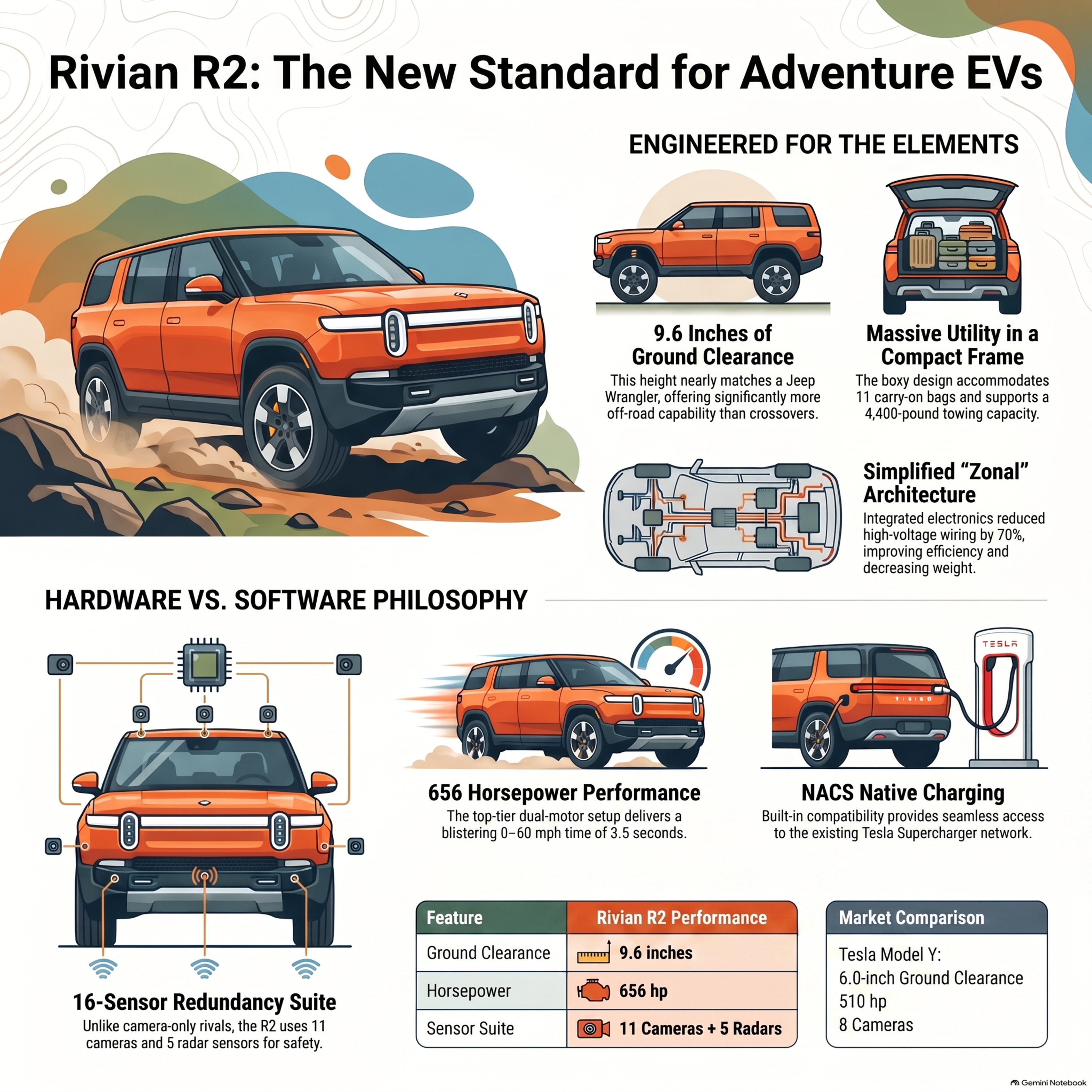
Rivian R2: The Rugged New Challenger to the Electric SUV Market
Yesterday00:05:00Tap to summarizeThe provided episode details the Rivian R2, a mid-sized electric SUV designed to offer a more affordable and accessible entry point into the American brand’s lineup. This new model emphasizes practical utility through its boxy design, featuring unique storage solutions like a disappearing seat system and a separate opening rear window. Unlike many urban crossovers, the R2 boasts superior off-road capabilities and high ground clearance, making it ideal for rugged adventures. Performance remains a priority, with the vehicle offering over 550 kilometers of range and rapid acceleration on high-end trims. By adopting the NACS charging standard, it ensures compatibility with existing infrastructure while directly competing with the Tesla Model Y through its distinct aesthetic. Ultimately, the R2 aims to balance durability and modern technology to appeal to drivers seeking a versatile, mass-market electric vehicle.
Transcribe →Volvo EX30: Minimalist, Mighty, Electric
2d ago00:08:27Tap to summarizeThe Volvo EX30 represents a bold entry into the compact SUV market, standing as the smallest car in Volvo’s current lineup and the one with the lowest lifecycle carbon footprint to date. This fully electric vehicle is a "sustainable powerhouse," utilizing recycled materials such as upcycled denim, woven flax, and discarded plastic window frames to create a premium, animal-free interior.Despite its compact size, it delivers "mighty" performance; the Twin Motor variant is the fastest-accelerating Volvo ever, capable of reaching 60 mph in just 3.4 seconds. The driving experience is centered around a pared-back, minimalist cabin where nearly all functions—from navigation via integrated Google Maps to climate control—are managed through a single 12.3-inch touchscreen. While the car is praised for its industry-leading safety systems and agile urban handling, long-term reviews highlight some modern quirks, such as a highly minimalist interface and a keyless entry system that can occasionally be temperamental. Overall, the EX30 is designed for eco-conscious urban professionals and small families seeking a blend of high-tech connectivity, distinctive Swedish design, and zero-emission efficiency
Transcribe →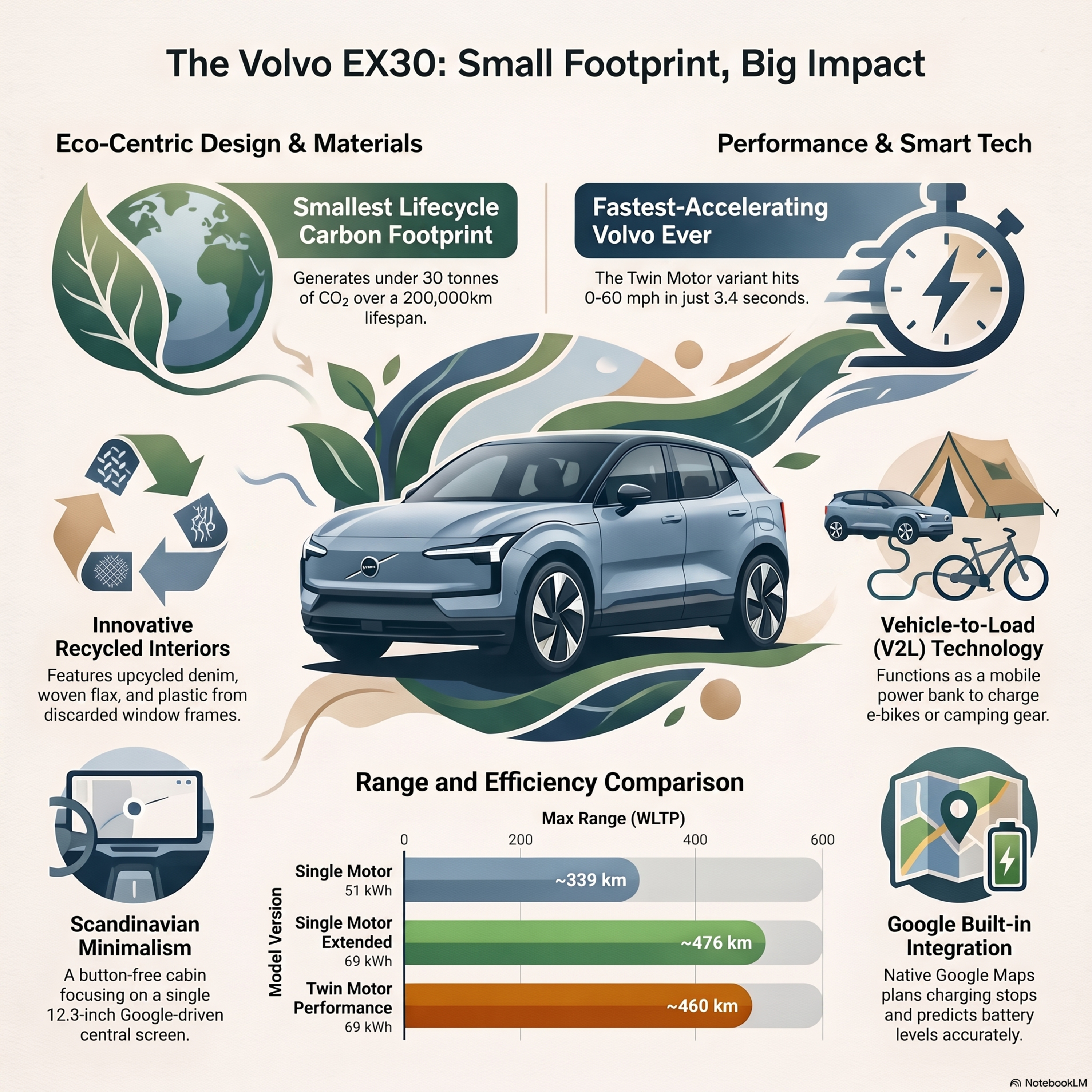
Volvo EX30: The Swedish Manifesto of Compact Electric Luxury
2d ago00:05:31Tap to summarizeThe Volvo EX30 is presented as a sophisticated compact electric SUV that emphasizes Scandinavian luxury, environmental sustainability, and modern performance. The source details a revised lineup featuring a new entry-level engine and diverse battery options, alongside innovative Vehicle-to-Load (V2L) technology for powering external devices. Inside, the vehicle prioritizes eco-friendly materials and a streamlined user experience powered by integrated Google software and safety-focused driver assistance. Designed for urban professionals and tech-savvy families, the car utilizes a native electric platform to ensure superior handling and spatial efficiency. Long-term value is highlighted through over-the-air software updates, reduced maintenance requirements, and robust battery warranties. Overall, the episode positions this model as a versatile, future-proof mobility solution that blends minimalist aesthetics with advanced automotive engineering.
Transcribe →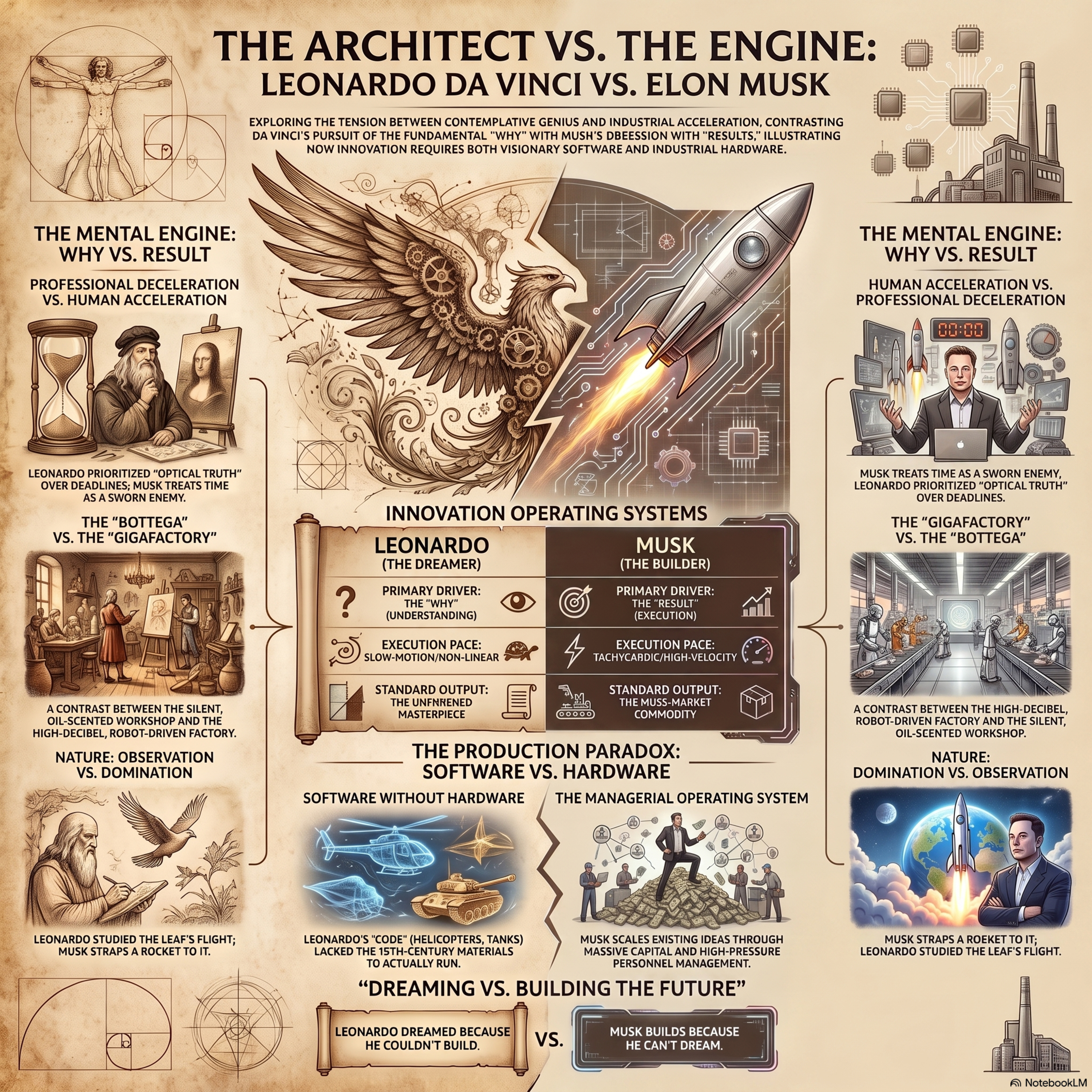
The Visionary and the Architect: Leonardo vs Musk
2d ago00:05:41Tap to summarizeThis source presents a comparative analysis between Leonardo da Vinci and Elon Musk, highlighting how their approaches to innovation differ despite their shared status as visionary figures. While Leonardo is portrayed as a contemplative thinker who prioritized understanding the natural world over completing projects, Musk is described as a high-speed implementer driven by efficiency and market dominance. The episode argues that the Renaissance master excelled at dreaming of impossible technologies that his era could not build, whereas the modern entrepreneur focuses on scaling existing concepts into mass-produced realities. Ultimately, the comparison suggests that Leonardo’s genius was rooted in philosophical curiosity, while Musk’s impact stems from his aggressive industrial execution and relentless pace. This contrast serves to illustrate two opposing methods of progress: one defined by the beauty of the unfinished idea and the other by the power of tangible results.
Transcribe →The Dreamer vs. The Builder: Leonardo vs Musk
2d ago00:07:42Tap to summarizeIn this provocative analysis, we explore the fundamental schism in the history of progress through two "omnivores of genius": Leonardo da Vinci and Elon Musk.The article delves into the contrast between the "Contemplative Polymath" and the "Industrial Accelerator". On one side, we find Leonardo—the "professional decelerator" obsessed with the "Why," whose brilliant concepts remained trapped in notebooks as "software" without the necessary "hardware" to run them. On the other, we see Musk—the "human accelerator" who acts as a managerial operating system, orchestrating capital and industrial scale to turn existing ideas into mass-market realities.From the silent, oil-scented Renaissance bottega to the deafening, high-decibel roar of the Gigafactory, this piece examines the "Paradox of the Patent": the realization that vision is inert without infrastructure, and that modern dominance belongs to the leader who can industrialize the dream.It is a journey through two incompatible velocities of the mind, culminating in a striking synthesis: Leonardo dreamed the future because he couldn’t build it, while Musk builds the future because he has no time to dream it.
Transcribe →EV Aftermarket Revolution: From Pistons to Modules
4d ago00:08:18Tap to summarizeThe automotive industry is currently undergoing a fundamental restructuring of its labor and value chains, moving away from a century of mechanical craftsmanship toward a digitized, modular industrial model. This revolution is not just about changing how cars are powered, but about how they are maintained and preserved for the long term.1. The End of the Traditional Mechanic The era of the "classical mechanical craft"—manually rebuilding cylinder heads, timing belts, or complex fuel injectors—is reaching its twilight. As internal combustion engine (ICE) vehicles have become increasingly complex due to stringent anti-pollution regulations (EGR valves, particulate filters, and variable geometry turbines), repairs are becoming economically unsustainable for aging mass-market cars. These artisanal skills are destined to become a high-priced niche reserved only for luxury or vintage assets.2. The Rise of Modular Regeneration Centers In the EV era, the traditional repair shop is evolving into a "modular regeneration center". In this "appliance-style" model, technicians no longer perform manual reconstructions of internal components. Instead, they use digital diagnostics to identify cell-level faults and perform modular swaps. This allows for the rapid replacement of exhausted battery cell blocks with regenerated units, returning a vehicle to 100% efficiency in just a few hours.3. The Democratization of Battery Technology The primary driver of this revolution is the democratization of power storage. Thanks to plummeting raw material costs and the rise of stable, long-lasting chemistries like Lithium-Iron-Phosphate (LFP), the cost of regenerating an accumulator is projected to align with or even drop below the cost of a complex ICE repair. Technologies like BYD’s Blade Battery exemplify this shift, offering high safety standards and longevity that can extend a vehicle's functional life significantly.4. The Battle for the "Right to Repair" This modular future is only possible through a political and regulatory framework that prevents manufacturers from creating "walled gardens". European Union legislation, such as the Right to Repair and the EU Data Act, is critical in ensuring that diagnostic data, software keys, and technical manuals remain accessible to independent workshops. Without these protections, manufacturers could use Digital Rights Management (DRM) and software locks to effectively mandate the premature scrappage of vehicles.5. The Reality of the 20-Year Life Cycle While modularity makes a 20-year lifespan theoretically possible, the revolution faces significant hurdles regarding technological obsolescence. Even if a battery is replaced, a car from 2026 may face "digital death" by 2046 as its sensors, infotainment chips, and charging standards become prehistoric. However, the synergy of modular design and open diagnostic standards ensures that a 10-12 year ownership cycle becomes exceptionally efficient and low-maintenance compared to the past.Strategic Conclusion The shift toward a "regeneration" model is inevitable. For the aftermarket industry, success depends on pivoting from mechanical grit to high-voltage expertise and software-driven diagnostics, ensuring that the electric family car remains a repairable asset rather than a disposable gadget.
Transcribe →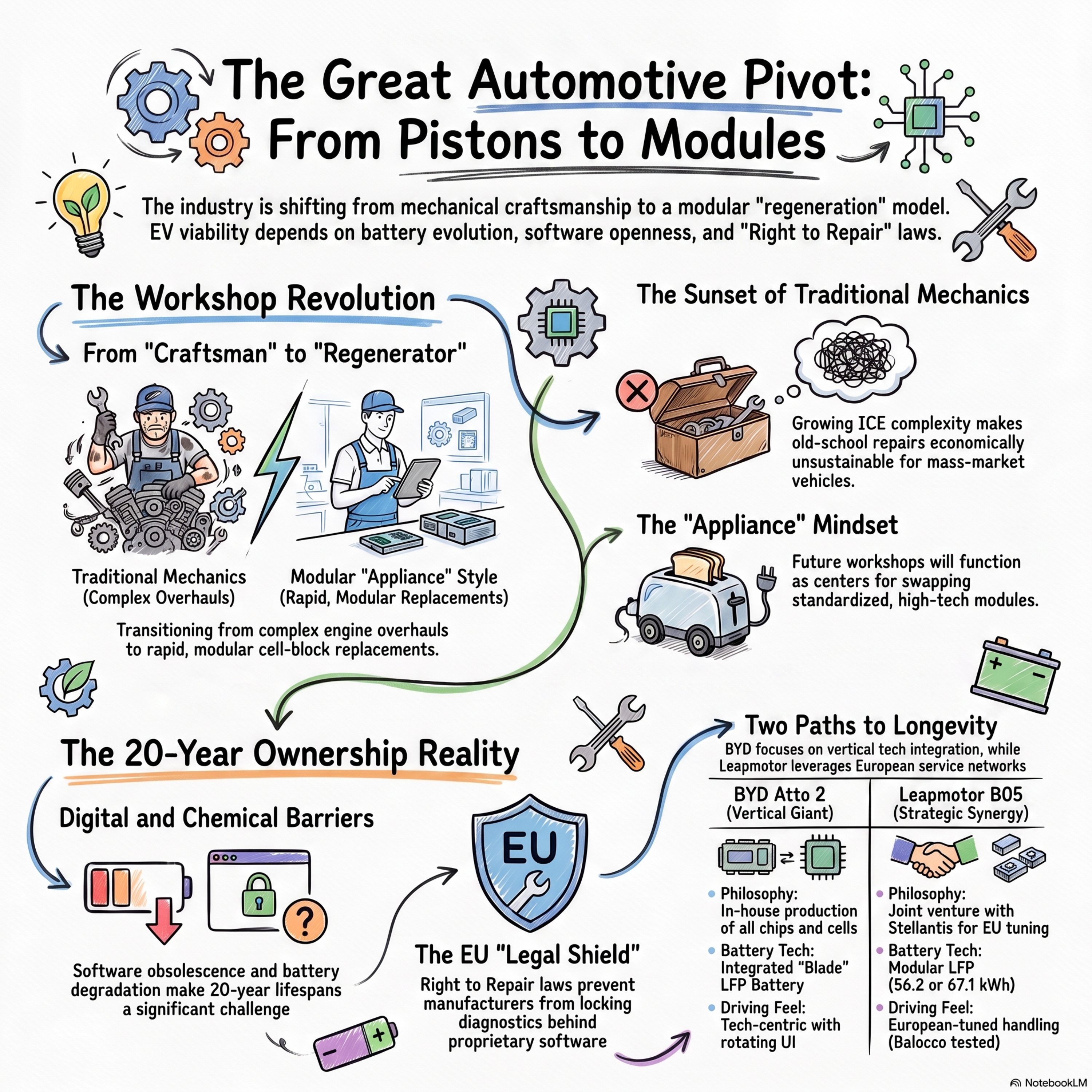
BYD Atto 2 vs Leapmotor B05: The EV Family Duel
4d ago00:05:33Tap to summarizeThis source provides a comparative analysis of the BYD Atto 2 and the Leapmotor B05, two Chinese electric vehicles entering the European market with distinct design philosophies. While the BYD is presented as a tech-focused compact crossover utilizing proprietary battery safety innovations, the Leapmotor is described as a dynamic hatchback featuring engineering refinements from the European Stellantis group. The source outlines key differences in performance, internal space, and driving mechanics to help families choose the model that best suits their lifestyle. Additionally, it offers a pragmatic perspective on long-term ownership, cautioning that rapid technological obsolescence and battery degradation make these cars ideal for a decade of use rather than twenty years. Ultimately, the overview serves as a guide for consumers navigating the evolving landscape of affordable, high-tech electric mobility.
Transcribe →Xiaomi’s EV Evolution: Redefining Mobility Through a Smart Ecosystem
4d ago00:08:32Tap to summarizeThis article explores Xiaomi’s strategic transformation from a global consumer electronics leader into a formidable innovator in the Electric Vehicle (EV) industry. At the heart of this transition is founder Lei Jun, who has defined this venture as the "ultimate entrepreneurial project" of his life, committing over $10 billion to bridge the gap between digital life and physical mobility,,.The "Smartphone on Wheels" Philosophy Unlike traditional automakers, Xiaomi treats its vehicles—such as the SU7—as "smartphones on wheels",. Central to this vision is the "Human x Car x Home" ecosystem, powered by the proprietary HyperOS,. This system ensures total continuity, allowing the vehicle to synchronize seamlessly with mobile devices and smart home appliances, creating a unified digital experience with zero latency,.Revolutionizing Manufacturing: The Beijing "Dark Factory" The sources highlight Xiaomi’s leap into advanced industrial production with its state-of-the-art facility in Beijing E-Town,. Operating as a highly automated "Dark Factory," the plant utilizes over 700 robots and massive die-casting technology to achieve extreme efficiency, rolling a new vehicle off the production line every 76 seconds,,. This "machine that builds the machine" approach has led to significant improvements in precision and weight reduction,.Proprietary Technical Innovation To maintain a competitive edge, Xiaomi has invested heavily in vertical integration and "hard tech". Key innovations include:The V8s Motor: A flagship electric motor reaching 27,200 rpm, positioning it among the fastest in global production,,.800V High-Voltage Platform: Utilizing Silicon Carbide (SiC) technology, this architecture allows for ultra-fast charging, recovering 350 km of range in just 15 minutes,,.Xiaomi Pilot: An AI-driven autonomous driving system powered by Nvidia DRIVE Orin chips and a multi-sensor array,,.Global Strategy and the Rivalry with Tesla The narrative also delves into the evolving relationship between Lei Jun and Elon Musk. Once an admirer of Tesla’s "trilateral formula," Lei Jun has now positioned Xiaomi as a direct rival, asserting that while "Tesla is strong, it is not invincible",,. By offering high-end performance with a superior "cost-performance" ratio, Xiaomi aims to disrupt the mainstream market and lead the transition toward the era of Software-Defined Vehicles (SDV).
Transcribe →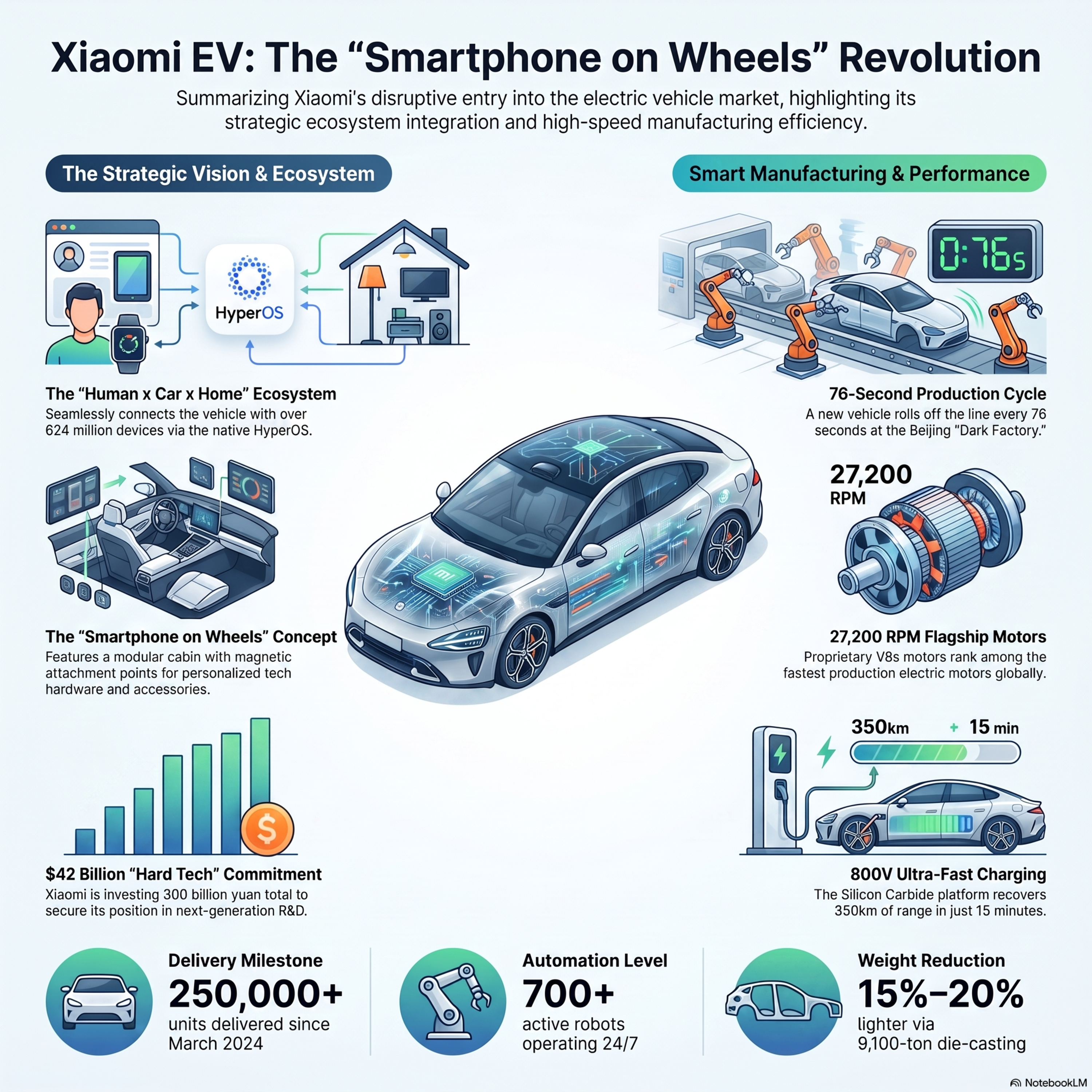
Lei Jun and the Xiaomi Electric Vehicle Revolution
4d ago00:06:47Tap to summarizeThese sources examine the strategic evolution of Xiaomi from a consumer electronics giant into a pioneering force in the electric vehicle (EV) market. Led by founder Lei Jun, the company treats its automobiles as integrated digital ecosystems rather than traditional transport, seamlessly linking smartphones and smart home technology through a unified operating system. The provided episode highlights how Xiaomi differentiates itself through proprietery high-speed motors, advanced charging architectures, and a modular interior designed for tech-savvy users. Furthermore, the documents contextualize this move within a broader global industry shift, where success is increasingly defined by software-driven capabilities and artificial intelligence. Ultimately, the materials illustrate a maturing market where Asian manufacturers are exerting immense pressure on traditional automakers through rapid innovation and aggressive pricing.
Transcribe →