Podcast
eMotors: Electric Revolution
Hosted by eMotors Electric Revolution · EN
Innovation, Technology, and Tomorrow's Driving
Welcome to the podcast that explores the electric mobility revolution. Each episode takes you on a journey to discover the latest innovations, cutting-edge technologies, and driving experiences that are shaping the future of automobiles. An electrifying journey into the future of sustainable mobility. If you enjoy these episodes or find them useful, you can buy me a coffee through this link: https://buymeacoffee.com/emotorselectricrevolution.
75episodes
Episodes
Newest firstAll episodes
Urban Icons Redefined: Choosing Between Luxury Comfort and Smart Innovation
4w ago00:08:17Tap to summarizeThis article explores the strategic "reset" of the European electric B-segment, where two iconic names return to the market with diametrically opposed philosophies. While both vehicles target the fashionable urban districts of cities like Milan and Paris, they represent a fundamental divide between traditional luxury and future-forward technology.The Lancia Ypsilon ("Premium Salotto"): Marketed as an Italian "living room," the Ypsilon focuses on elegance, comfort, and sophisticated design. It utilizes the mature and pragmatic Stellantis e-CMP platform, offering a high-efficiency 156 CV motor and a refined, furniture-like interior featuring the signature "Tavolino" central table.The Renault 5 E-Tech ("Pop-Tech"): Positioned as a high-tech "gadget" for the digital native, the R5 leverages a dedicated EV platform (AmpR Small) to maximize interior space and efficiency. Its standout features include a sustainable, rare-earth-free motor and advanced V2G (Vehicle-to-Grid) technology, allowing the car to function as a smart energy node for the home.The comparison delves into the technical trade-offs between the two, from Lancia’s superior 309-liter trunk capacity to Renault’s more welcoming rear passenger space and "veranda-like" luminosity. It also analyzes the pricing structures in the Italian market, where Lancia maintains its niche premium status through savvy financing, while Renault aims for mass-market dominance with a more accessible entry price and superior access to government incentives.Whether you prioritize the refined Italian "salotto" experience or a future-proof technological ecosystem, this analysis provides the essential insights to understand which of these electric contenders truly defines the modern city car.
Transcribe →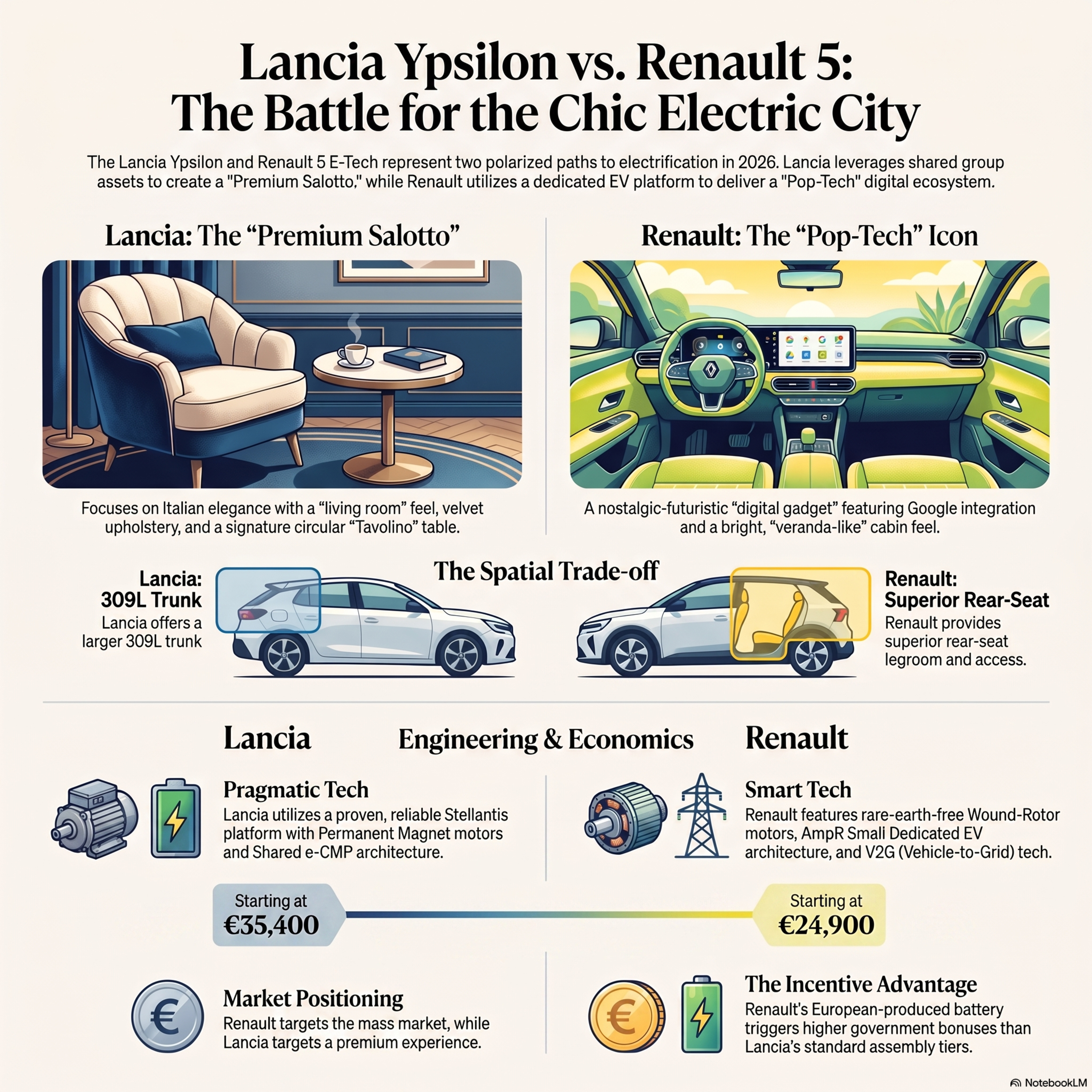
Lancia Ypsilon vs Renault 5: Electric Elegance Meets Innovation
4w ago00:22:23Tap to summarizeThis episode compares the Lancia Ypsilon Elettrica and the Renault 5 E-Tech, highlighting that the choice between them depends on design philosophy rather than technical superiority. The Lancia Ypsilon is presented as a premium, elegant option that utilizes a reliable, time-tested platform focused on comfort and Italian style. Conversely, the Renault 5 is characterized as a pop-tech icon featuring innovative, eco-friendly motor technology and advanced energy management features like bidirectional charging. While both vehicles offer nearly identical efficiency and energy consumption, they target different audiences based on their distinct personalities. Ultimately, the source suggests that the Lancia appeals to those seeking sophisticated tradition, while the Renault attracts drivers interested in modern sustainability and nostalgic digital flair.
Transcribe →MG GO! Concept - The semi-solid battery is the real deal.
4w ago00:07:55Tap to summarizeThe MG GO! Concept, unveiled at the 2026 Goodwood Festival of Speed, represents a pivotal moment in MG's strategy to redefine the electric B-segment. This compact electric hatchback serves as a direct preview of a production model—often referred to as the MG 2—which is expected to hit the market in 2027.Retrofuturistic Design and HeritageThe vehicle stands out with its "retrofuturistic" style, which intentionally moves away from anonymous modern shapes to create an emotional connection with the driver. Designed at the MG Design Center in London, it draws heavy inspiration from the brand's British heritage, specifically reimagining elements from the MGB GT, MG Metro Turbo, and MGZR. Key design features include:Smooth, clean body lines with a sporty stance.Large wheels and a marked rear diffuser.Balanced proportions that give it a youthful and approachable appearance.Enhanced Safety: The stable structure drastically reduces the risk of overheating or thermal runaway.All-Weather Performance: These batteries maintain high efficiency even in freezing temperatures, solving a common pain point for electric vehicle owners in winter.Ultra-Fast Charging: The system allows the car to reach an 80% charge in less than 20 to 30 minutes under optimal conditions.Longevity: Greater chemical stability ensures the battery loses less capacity over time, helping the vehicle retain its value.The SolidCore Technological RevolutionThe most significant innovation of the MG GO! is its SolidCore technology, making MG the first global automaker to introduce semi-solid state batteries to the European mass market. Unlike traditional lithium-ion batteries that use 20% liquid electrolyte, SolidCore batteries contain only 5% liquid, replacing the rest with solid materials. This technology offers several critical advantages:European Engineering and AccessibilityMG is positioning the production version of the GO! to be highly accessible, with a target starting price under 25,000 euros. To ensure the vehicle meets the specific demands of the local market, MG has utilized its new engineering center in Germany, tailoring the car's performance and feel to European roads and consumer tastes. By industrializing complex technologies like semi-solid batteries ahead of its competitors, MG aims to offer a high quality-to-price ratio that competes directly with established global brands.Coffee:https://buymeacoffee.com/emotorselectricrevolution
Transcribe →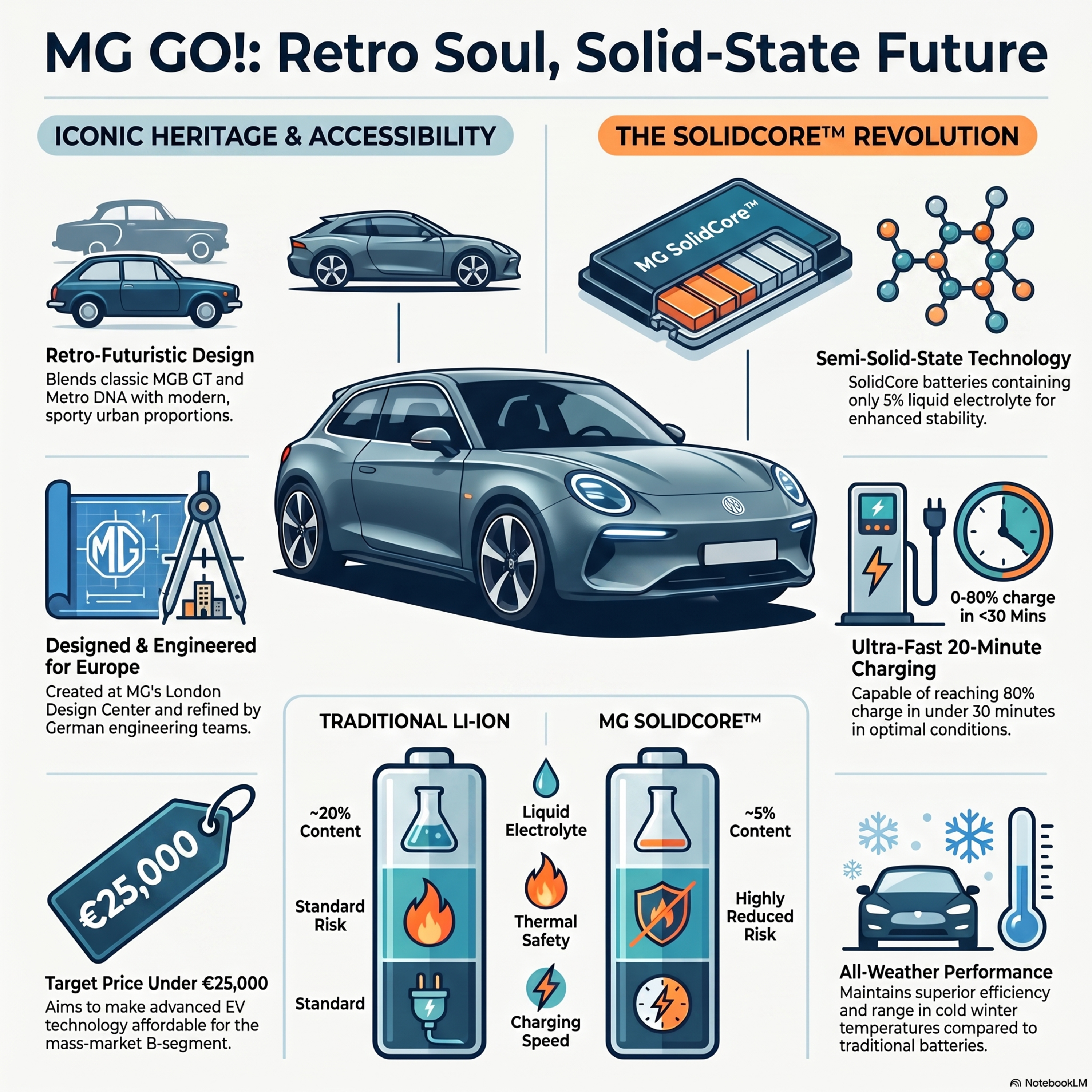
MG GO!: The Solid State Electric Revolution
4w ago00:05:33Tap to summarizeThe provided episode detail the unveiling of the MG GO!, a concept electric city car that previews a production model slated for 2027. This compact vehicle combines a retrofuturistic design inspired by classic British icons like the MGB GT with a goal of maintaining an affordable price point under 25,000 euros. A major highlight is the introduction of SolidCore technology, which utilizes semi-solid state batteries to offer superior safety, faster charging, and better performance in cold climates compared to traditional batteries. Developed with a focus on the European market, the car represents MG's ambition to lead the industry in mass-producing advanced battery tech. Ultimately, the sources describe a shift toward high-tech, emotionally engaging electric vehicles that do not sacrifice practicality or accessibility.
Transcribe →Electric B-SUV Showdown
4w ago00:08:11Tap to summarizeThis article provides a comprehensive strategic analysis of two major contenders in the electric B-SUV segment: the Skoda Epiq and the Jaecoo E5. The comparison highlights a fundamental "rational vs. innovative" dichotomy, pitting Skoda’s long-standing European engineering logic against Jaecoo’s tech-first, "digital-first" lifestyle approach.Key areas of the showdown include:Brand Philosophy & Target Audience: Skoda utilizes its "Simply Clever" heritage to target risk-averse consumers focused on functional reliability and residual value. Conversely, Jaecoo, a newcomer under the Chery umbrella, targets early adopters with high-specification standard luxury and disruptive pricing.Technical Architectures: The article details the strategic trade-off between battery chemistries. Skoda employs a tiered strategy, using LFP for entry models and high-density NMC batteries for the flagship 55 variant to achieve a superior range of 272 miles. Jaecoo opts for a consistency strategy with a single 61.1 kWh LFP battery across its range, prioritizing chemical stability over weight efficiency.Operational Efficiency: Skoda leads in efficiency with an official consumption of 13.0-13.1kWh/100km, aided by sophisticated aerodynamics and a lighter build. The Jaecoo E5 counters with robust performance, offering a 207 PS motor and a 0-62 mph sprint of 7.7 seconds.Practicality & Innovation: Skoda focuses on pragmatic utility, featuring a 9.8-metre turning circle and a 475L boot with clever storage solutions like an optional "frunk". Jaecoo emphasizes lifestyle features, including Vehicle-to-Load (V2L) capability, a dedicated "Pet Mode" for climate control, and a standard 540-degree panoramic camera.Commercial Viability: The Skoda Epiq enters the market with a lower starting price of £24,950, undercutting petrol equivalents. While the Jaecoo E5 is priced higher at £27,505, it offers a "turn-key" value proposition with an aggressive 7-year/100,000-mile vehicle warranty to bridge the "trust gap" of a new brand.Ultimately, the article recommends the Skoda Epiq for operational efficiency and infrastructure reliability, while the Jaecoo E5 is positioned as the ideal choice for those seeking high-specification standard equipment and modern technological utility.
Transcribe →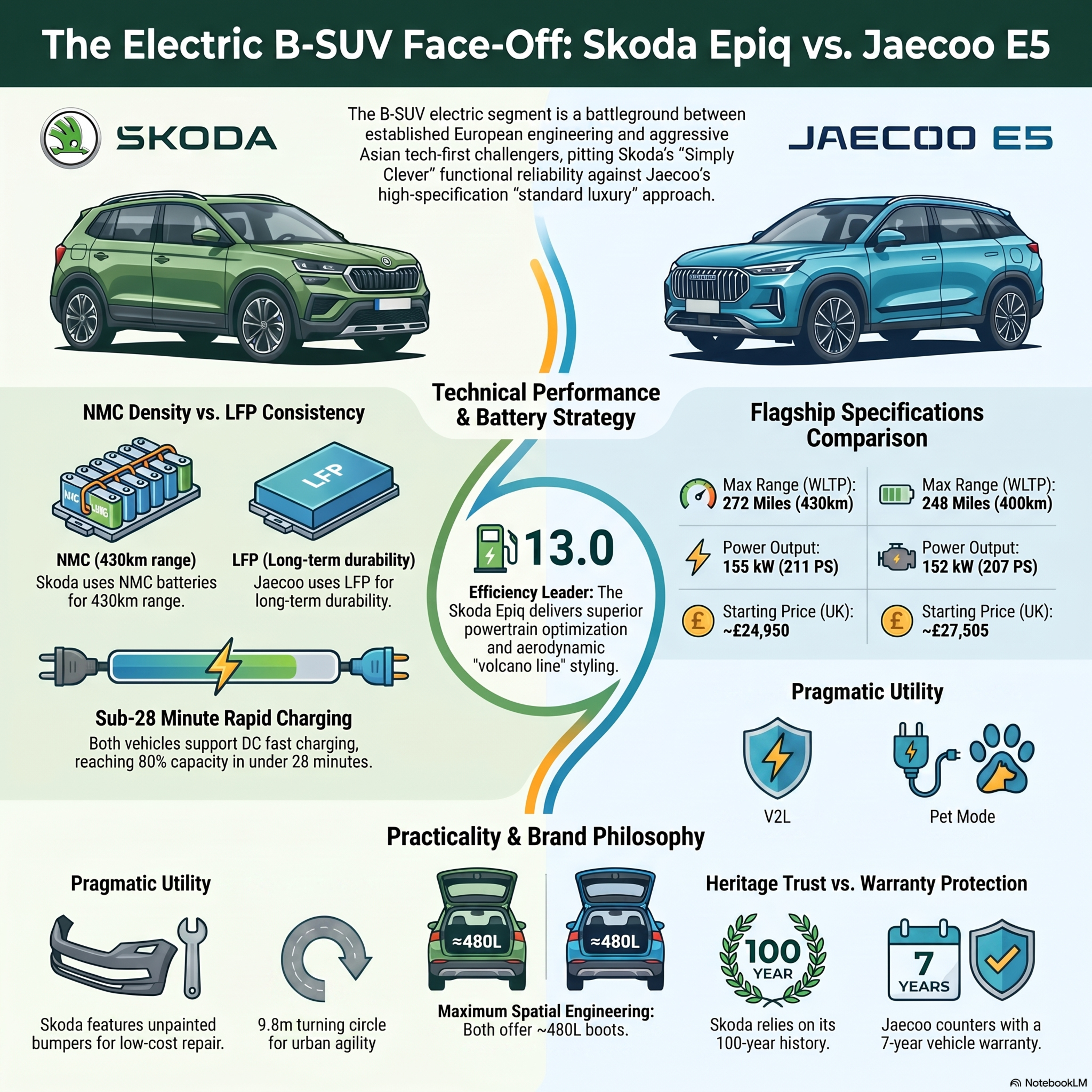
European Heritage Versus Asian Innovation: Skoda Epiq vs Jaecoo E5
4w ago00:05:47Tap to summarizeThe provided documents detail the market entry and technical specifications of two new electric compact SUVs, the Skoda Epiq and the Jaecoo E5. The Skoda Epiq is presented as a pragmatic, highly efficient European vehicle built on the Volkswagen MEB+ platform, emphasizing functional design and a low total cost of ownership. In contrast, the Jaecoo E5 is positioned as a tech-focused challenger from China that offers premium standard features like Vehicle-to-Load power and an extensive seven-year warranty. Technical comparisons highlight Skoda’s superior energy efficiency and tiered battery options versus Jaecoo’s high-specification, "all-in-one" value proposition. Ultimately, the sources frame the competition as a choice between Skoda’s established reliability and Jaecoo’s innovative lifestyle technology. This strategic overview assists potential buyers and fleet managers in navigating the evolving electric vehicle landscape.
Transcribe →The €15,000 EV Challenge: How Stellantis Plans to Disrupt the Battery Market
4w ago00:08:39Tap to summarizeUnder the leadership of CEO Antonio Filosa and the "FaSTLAne 2030" industrial plan, Stellantis is shifting its strategy to focus exclusively on battery-powered city cars for its Fiat and Citroen brands. This pivot aims to address the intense pressure from Chinese manufacturers by creating a high-efficiency production model that moves away from hybrid flexibility.The cornerstone of this initiative is the target price of €15,000, a "magic number" intended to achieve cost parity between electric vehicles and traditional internal combustion engine cars. This ambitious goal will be supported by the modular STLA One platform, designed to cut industrial costs, and the use of LFP (Lithium-Iron-Phosphate) batteries, which are more affordable for daily commuting.To ensure long-term independence and sustainability, Stellantis is diversifying its battery technology and supply chain:Sodium-ion batteries: Through a partnership with Tiamat, the group is exploring sodium as a cheaper, more abundant alternative to lithium.Circular Economy: The SUSTAINera business unit, in collaboration with Orano, focuses on recycling old batteries to recover precious materials like cobalt, nickel, and lithium, aiming for a "closed-loop" production cycle.Strategic Partnerships: Collaborations with companies like Leapmotor and Factorial (for solid-state batteries) are being used to maintain a competitive technological edge.Finally, the strategy includes a "modern vintage" emotional appeal, reviving iconic designs like the Citroen 2CV and the Fiat Panda to make affordable electric mobility more desirable to the general public. Stellantis plans to invest €60 billion over five years to become the European leader in accessible electric transportation.
Transcribe →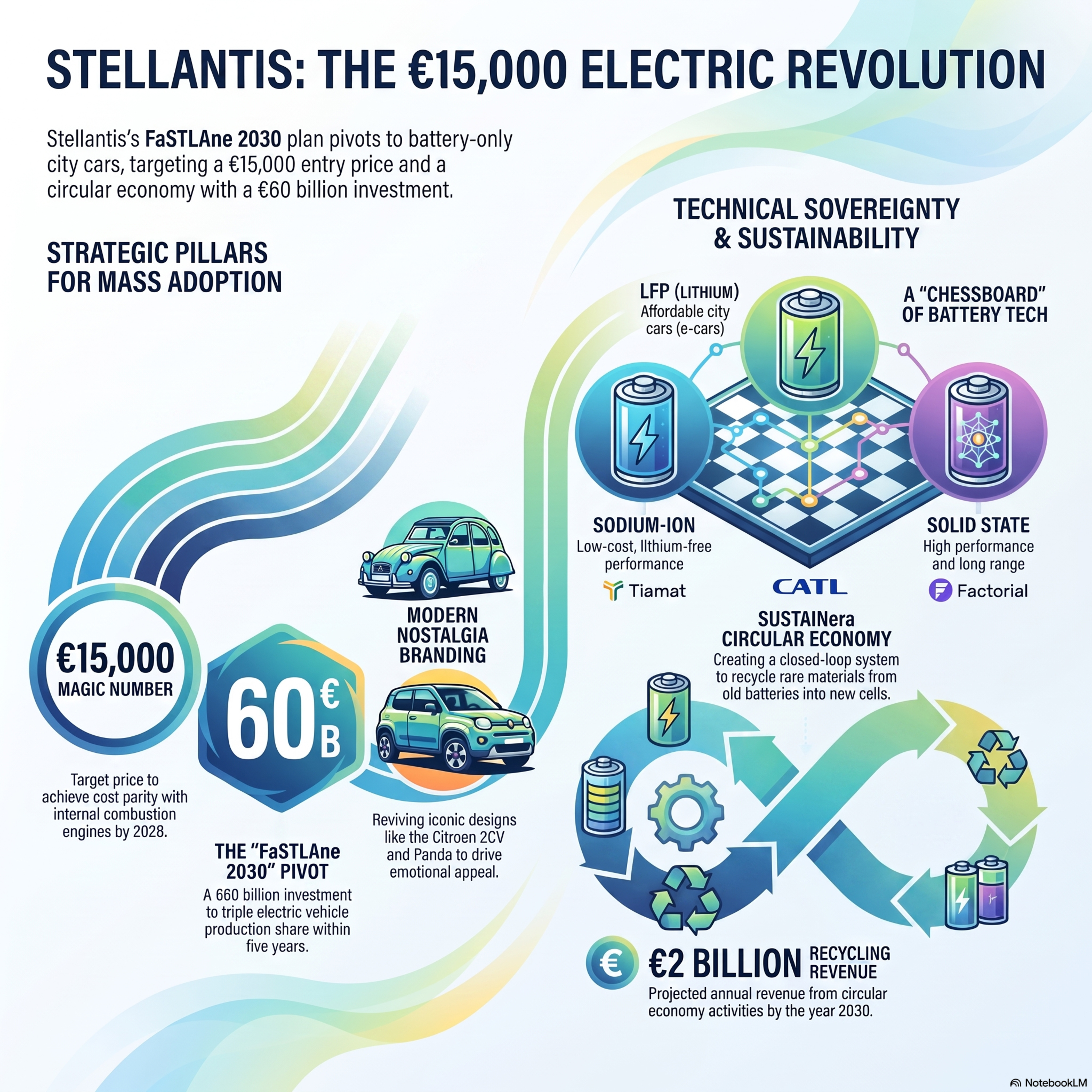
Stellantis and the Quest for the 15,000 Euro Electric Car
4w ago00:06:19Tap to summarizeThe provided episode outlines Stellantis' ambitious strategic shift toward producing affordable electric city cars specifically for the Fiat and Citroen brands. Under the "FaSTLAne 2030" initiative, the automotive giant is moving away from hybrid engines to focus exclusively on battery-powered vehicles to better compete with low-cost Chinese manufacturers. A central pillar of this plan is the goal to release an electric vehicle priced at 15.000 euros by 2028, utilizing cost-efficient LFP batteries and a modular production platform. To drive consumer interest, the company is leveraging "modern vintage" designs, including a reimagined electric Citroen 2CV and a new Panda. This massive 60-billion-euro investment aims to transform electric mobility from a luxury segment into a mass-market commodity accessible to the average driver. Ultimately, the source examines whether this combination of nostalgic branding and industrial efficiency can successfully redefine the European automotive landscape.
Transcribe →Electric Avenue 2026: The New City Standards
Jul 1400:08:45Tap to summarizeElectric Avenue 2026 explores the transformation of the Italian entry-level electric vehicle market into a sophisticated arena of specialized mobility. As of July 2026, the era of the "generic budget car" has ended, replaced by purpose-built electric vehicles that cater to specific lifestyle archetypes rather than a generic "average" buyer. This article analyzes the diverse architectural philosophies driving the segment: from the rational minimalism of the Dacia Spring and the comfort-centric approach of the new Citroën ë-C3 to the seamless digital ecosystem of the Renault Twingo and the feature-rich pragmatism of the Leapmotor T03. It also highlights the Geely E2, which utilizes a native EV architecture to offer premium space and refinement within a city-car footprint. Furthermore, the analysis examines the shifting geopolitical landscape, specifically the impact of the February 2026 UE-India Free Trade Agreement. This landmark deal facilitates the future entry of Indian manufacturers like Tata and Mahindra, promising increased competitive pressure and further diversification of choices under the €20,000 threshold. By matching technical specifications—such as native EV architectures and integrated Google ecosystems—with consumer personas, this overview provides a definitive guide to a market where accessibility is no longer a compromise, but a deliberate strategic choice.
Transcribe →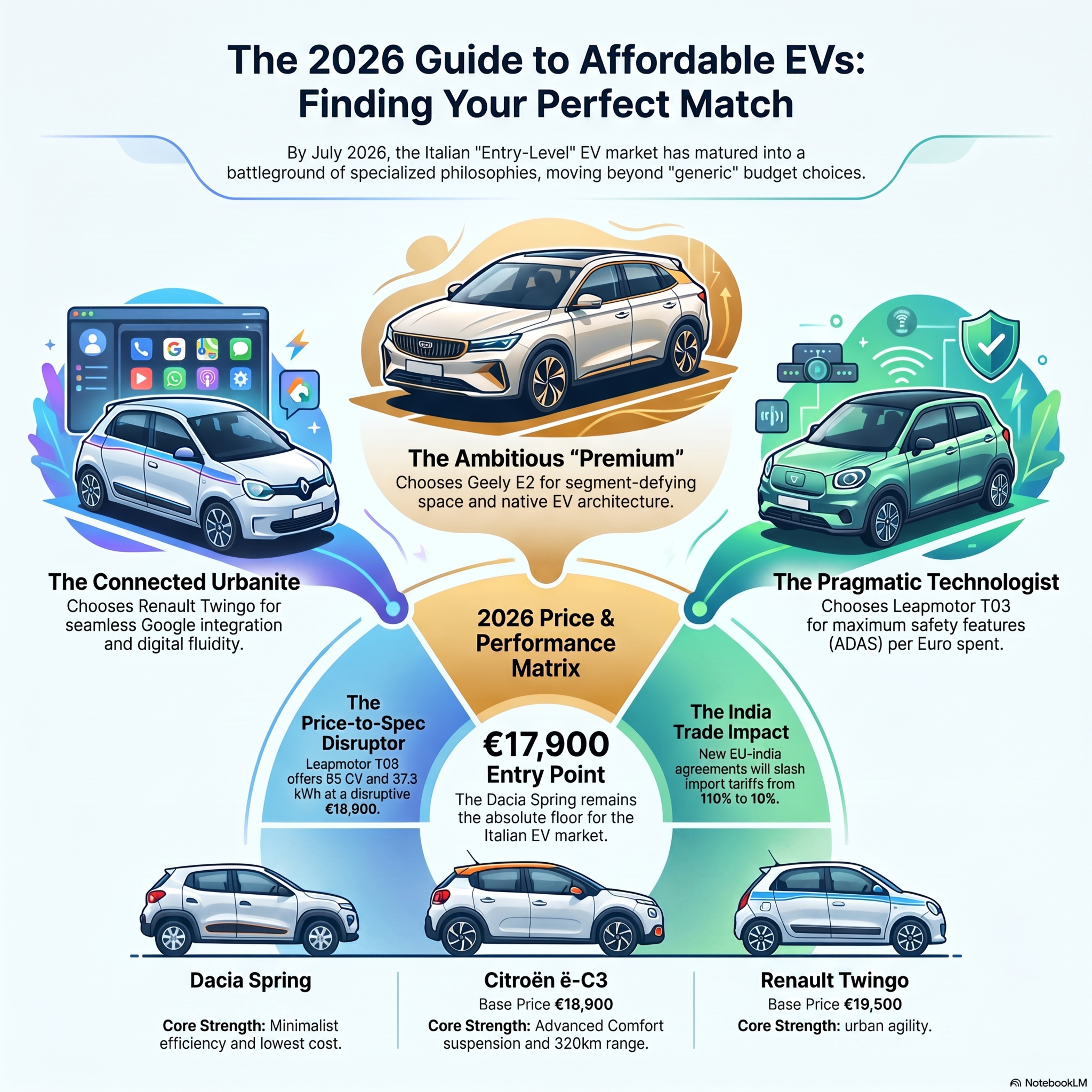
The Italian Electric City Car Landscape 2026
Jul 1400:05:48Tap to summarizeThe provided source outlines the competitive landscape of the Italian electric city-car market as of July 2026, highlighting four primary models designed for urban accessibility. It categorizes these vehicles based on their technical specifications, pricing, and unique selling points to help potential buyers find the right match. The Dacia Spring is presented as the most affordable and minimalist option, while the Leapmotor T03 focuses on providing high-quality technological features at a competitive price. Alternatively, the Renault Twingo appeals to users seeking digital integration via Google software, whereas the Geely E2 offers a more premium experience with superior interior space. Ultimately, the source serves as a consumer guide that matches specific driver profiles with the vehicle that best suits their financial and lifestyle needs.
Transcribe →