Podcast
eMotors: Electric Revolution
Hosted by eMotors Electric Revolution · EN
Innovation, Technology, and Tomorrow's Driving
Welcome to the podcast that explores the electric mobility revolution. Each episode takes you on a journey to discover the latest innovations, cutting-edge technologies, and driving experiences that are shaping the future of automobiles. An electrifying journey into the future of sustainable mobility. If you enjoy these episodes or find them useful, you can buy me a coffee through this link: https://buymeacoffee.com/emotorselectricrevolution.
75episodes
Episodes
Newest firstAll episodes
2026 EV Market Dominance
3w ago00:07:07Tap to summarize2026 EV Market Dominance explores the shifting dynamics of the electric vehicle industry during the first half of 2026, where market dominance is defined not just by sales volume, but as a stabilizing "anchor" for the entire sector. The article highlights how Tesla has secured a commanding position with over 10% market share and 165,871 units sold, largely through a "high-volume, low-variety" strategy focused on a few primary models.Key themes and data points in the analysis include:The Longevity Paradox: Contrary to the myth that EVs require constant aesthetic updates, "veteran" models are outperforming new entries. The Tesla Model Y, at six years old, remains the undisputed leader with approximately 110,000 units, nearly doubling the volume of its closest rival.The Power of Mature Platforms: The Tesla Model 3, which will be a decade old in 2027, maintains a top-tier podium position with 56,000 units, proving that reliability and infrastructure incumbency are more valuable to consumers than "fresh" designs.Challengers and the "Dominance Gap": While the Skoda Elroq holds the second spot with 57,000 units, most other EVs struggle to surpass the 50,000-unit milestone, a critical threshold for manufacturing efficiency. Notable newcomers like the Renault 5 recorded 45,000 units, falling short of initial market aspirations.Market Momentum vs. Legacy Struggles: Although the European EV market grew by 34.7% (reaching 1.59 million units), traditional German giants—with the exception of Mercedes—faced a difficult start to the year.The German "Price War": In a defensive maneuver, German brands have introduced more affordable electric city cars, such as the ID.Polo priced at 25,000–26,000 Euro. However, the sources suggest that unseating Tesla in 2026 remains "impossible" due to its decade-long head start in manufacturing optimization and brand equity.Ultimately, the article posits that true dominance in the 2026 landscape is won through the mastery of scale and the preservation of a product's relevance over time, rather than novelty alone.
Transcribe →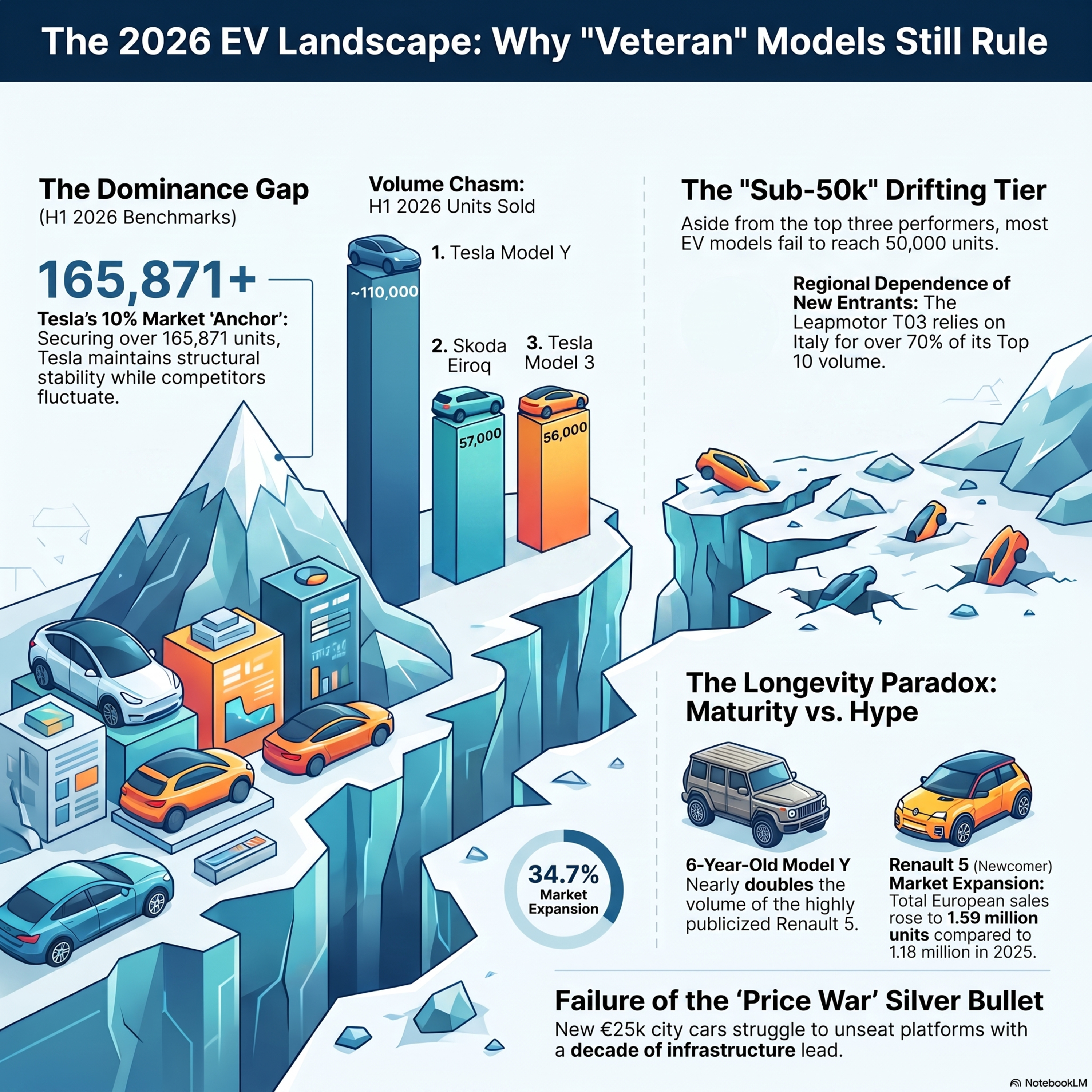
Tesla and the European Electric Dominance of 2026
3w ago00:03:59Tap to summarizeIn the first half of 2026, Tesla continues to dominate the European electric vehicle market, defying predictions that older EV models would quickly become obsolete. Despite its aging lineup, the Model Y maintains a massive lead over competitors like the Skoda Elroq, while the decade-old Model 3 remains a top contender. Although the broader electric car market grew by nearly 35%, traditional German manufacturers have struggled to keep pace with the American brand's sales volume. While new, affordable European city cars are launching to reclaim market share, they have yet to challenge the current leaders effectively. Meanwhile, Chinese brands have a limited presence in the top rankings, with only a single model appearing in the top ten. Ultimately, these findings suggest that Tesla's market grip remains unbreakable for the duration of the year.
Transcribe →Ultraviolette X-47: The World’s First Radar-Integrated Electric Crossover
3w ago00:08:34Tap to summarizeThe Ultraviolette X-47 is a pioneering electric motorcycle that marks a significant milestone in two-wheeler technology as the world’s first production bike to feature integrated radar technology as standard. Designed as a "Crossover," it transcends traditional motorcycle categories by blending the agility of a sportbike with the comfort of a cruiser and the practicality of a daily commuter.1. Advanced Safety: The UV HyperSense SuiteThe core innovation of the X-47 is the UV HyperSense radar system, which acts as a "sixth sense" for the rider.Radar Capabilities: Utilizing a 77 GHz rear-facing radar with a 200-meter range, the system provides a 150-degree horizontal field of view to monitor blind spots and fast-approaching vehicles.Active Alerts: The safety suite includes Blind Spot Monitoring, Lane Change Assist, Overtake Alerts, and Rear Collision Warnings that automatically trigger hazard lights to alert following traffic.Integrated Dashcam: It is equipped with an industry-first integrated dual-camera system featuring 1080p Sony IMX sensors for front and rear recording, crash-detection video locking, and live monitoring via a secondary display.Technical Specs: The motorcycle delivers 40 hp and a massive 610 Nm of wheel torque, enabling a 0-60 km/h acceleration in just 2.7 seconds and a top speed of 145 km/h.Range and Charging: It features a large battery pack offering an IDC range of 323 km. Charging is handled by a proprietary, world-first air-cooled onboard 1.6 kW charger designed to operate reliably even in extreme temperatures up to 55°C.UV Dynamic Stability Control (DSC): This centralized logic manages the interaction between power and braking. It synchronizes 9 levels of regenerative braking with a dual-channel ABS to maintain chassis composure and prevent wheel lock-up during heavy energy recovery.Rider-Centric Posture: The ergonomics are tuned for an upright yet active stance, which maximizes the rider's field of vision in urban traffic while reducing fatigue during long-distance touring.Digital Cockpit: The UV Vector TFT display serves as a digital co-pilot, tracking over 3,000 data points per second, including lean angles, energy usage, and real-time ride analytics.2. Performance and Dynamic ControlThe X-47 is built on a high-performance platform derived from the proven F77 architecture.3. Design and ErgonomicsInspired by aviation DNA, the X-47 features a forward-swept wing design and a rugged cast aluminum seat subframe.4. Market AvailabilityThe X-47 is positioned as a global product, with distribution in Italy and the DACH region (Germany, Austria, Switzerland) managed exclusively by Zero Center. While official European pricing is pending, it is expected to align with its sibling model, the F77, which starts at approximately €8,990. In the Indian market, a variant has been introduced with a starting price of Rs. 2.49 lakh.
Transcribe →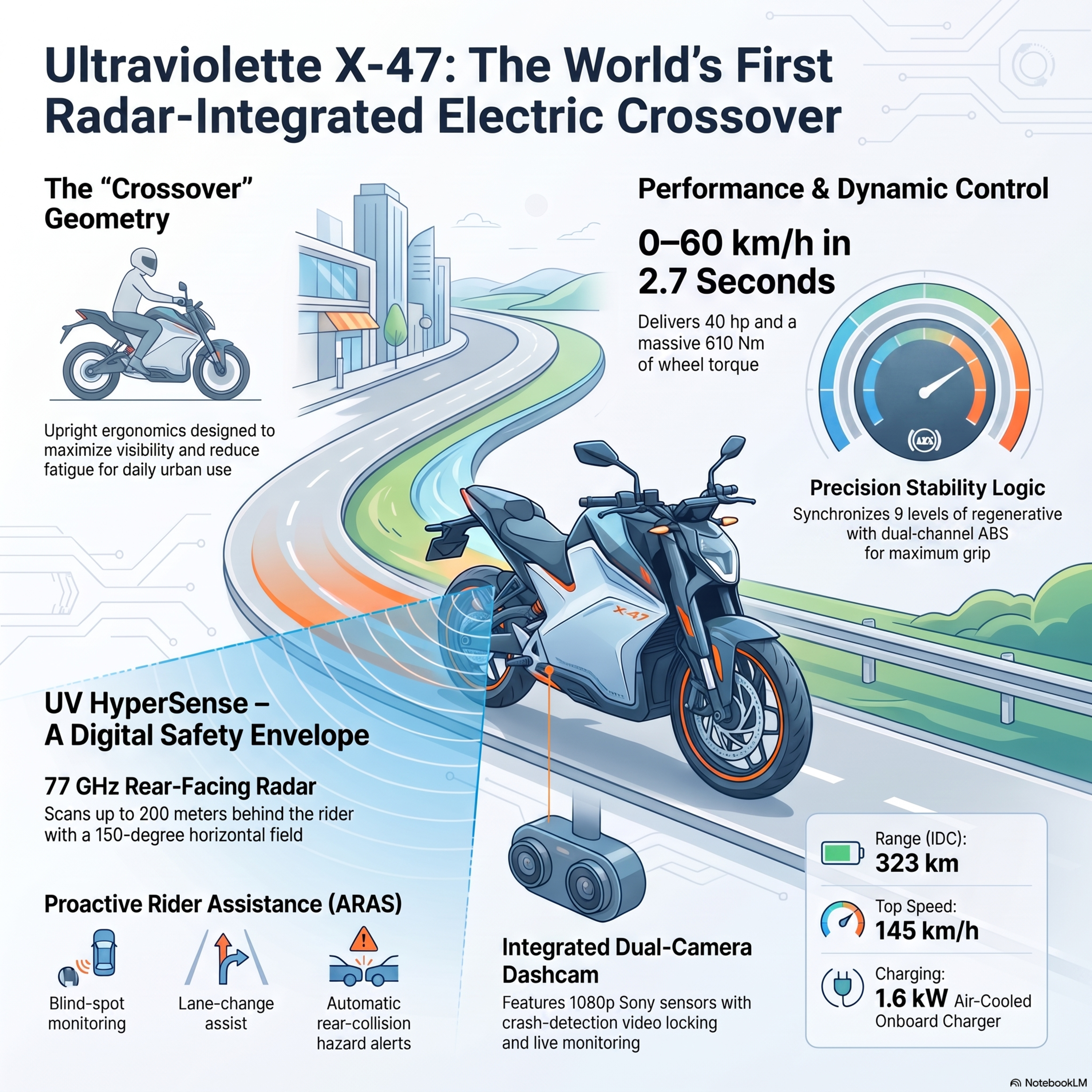
Ultraviolette X-47: The Radar-Enhanced Electric Frontier
3w ago00:05:38Tap to summarizeThe Indian manufacturer Ultraviolette recently introduced the X-47, a cutting-edge electric motorcycle designed for the European market. A standout feature of this vehicle is its integrated radar system, which enhances rider safety by constantly monitoring the surrounding environment. The motorcycle is engineered for daily versatility, offering an ergonomic upright seating position and sophisticated stability controls that manage power delivery and braking. Performance is further optimized through nine levels of regenerative braking and a proprietary air-cooled charging system. Backed by major global investors, the company aims to prove that Indian technology can lead the electric mobility sector on a global scale. While specific pricing is not yet official, the model is expected to align with the brand's premium positioning as it enters the German and Italian markets.
Transcribe →Beyond the piston
3w ago00:08:43Tap to summarize"Beyond the Piston" is a strategic analysis that examines the widening technological and cultural gap between the burgeoning Chinese electric vehicle (EV) sector and the traditional European automotive industry.The article focuses on the "Xpeng Paradigm," describing the company not merely as a car manufacturer but as a software-driven disruptor that treats the vehicle as a secondary hardware node for a primary AI platform. Unlike the "flawed genius" model of leadership seen in other EV pioneers, Xpeng is highlighted for its institutionalized R&D structure, which combines visionary ambition with the operational stability of a traditional corporation.Key themes explored in the text include:The Integrated AI Ecosystem: How the "car" is evolving into a functional node within a broader network that includes humanoid robotics ("Iron"), Vertical Take-off and Landing (VTOL) "flying cars," and autonomous robotaxis.Operational Agility: Xpeng’s strategy to commoditize consumer trust in international markets by rapidly building physical infrastructure—such as service hubs and parts warehouses—to match the reliability of legacy brands.The European "Cultural Brake": An analysis of how Europe’s (and specifically Italy's) mechanical heritage and attachment to the internal combustion engine (the "piston") have become a "Mechanical Anchor," hindering the necessary pivot toward a software-defined future.The Capital Velocity Gap: A concluding reflection on the massive disparity in investment and speed, suggesting that traditional European resilience may no longer be enough to close a gap driven by massive AI integration and rapid capital deployment.Ultimately, the article serves as a warning that the era of mechanical excellence as a competitive moat is ending, and the future belongs to those who can master the velocity of software iteration.EnjoyCoffee:https://buymeacoffee.com/emotorselectricrevolution
Transcribe →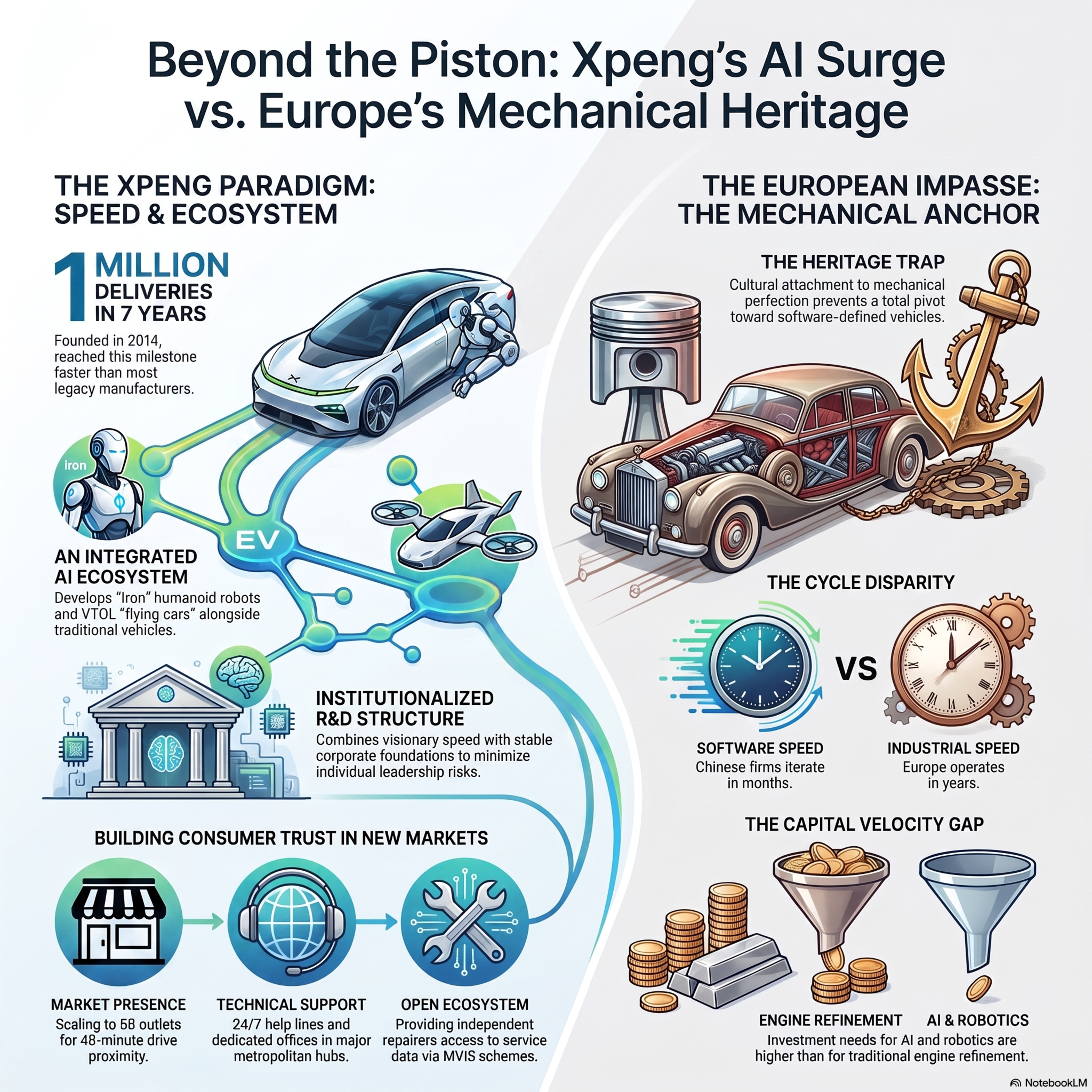
Xpeng: The Rapid Evolution of AI and Electric Mobility
3w ago00:06:11Tap to summarizeChinese electric vehicle manufacturer Xpeng is aggressively expanding its global footprint by transitioning from a startup to a major AI and robotics leader. During a recent event in Melbourne, the company detailed plans to significantly increase its Australian presence by doubling its showroom count and introducing four new vehicle models. Beyond traditional cars, Xpeng is investing heavily in advanced technology, including autonomous "flying taxis," robotaxis, and a sophisticated humanoid robot named Iron. The company aims to differentiate itself from competitors like Tesla by pairing high-tech innovation with a robust service and parts infrastructure. This strategic roadmap positions the brand as a diverse technological powerhouse rather than a simple automotive manufacturer.
Transcribe →The MG Cyberster – A New Era for the Roadster
3w ago00:08:16Tap to summarizeThe MG Cyberster is a unique blend of classic British roadster charm and cutting-edge electric propulsion. As the only fully electric roadster currently in series production, it doesn't just return MG to its sports car roots; it signals a shift in how performance and emotion coexist in the electric age.Performance and HandlingPower Configurations: It is available in two versions: a Rear-Wheel Drive (RWD) model with 340 CV and a 507 km WLTP range, and a GT All-Wheel Drive (AWD) version with over 500 CV, capable of a 0-100 km/h sprint in just 3.2 seconds.Dynamic Stability: The battery pack is mounted low in the chassis, creating a low center of gravity that ensures a planted and stable feel through corners with minimal body roll.Precision Over Noise: While it lacks the traditional engine "soundtrack," the Cyberster replaces mechanical drama with immediacy and clarity. Without engine noise, the driver can more easily interpret tire feedback and steering inputs.Visual Impact: The car is famous for its scissor doors and a driver-oriented cockpit that prioritizes a Gran Turismo philosophy—focusing on comfort and road pleasure rather than extreme lightness.Versatility: In urban environments, the absence of engine vibration makes the cabin a much calmer place, allowing the Cyberster to function as a daily companion rather than just a weekend recreational machine.Pricing: The RWD version starts at approximately €63,000, while the GT AWD is priced around €68,000.From Tech to Durable Good: Although EVs are often viewed as short-term technology, the Cyberster is positioned as a durable good. Because lithium cell costs have dropped by over 70% in the last decade, the future maintenance and battery replacement for these cars are expected to become significantly more affordable.The Cyberster succeeds by reinterpreting the past rather than replicating it. It proves that the "soul" of a sports car isn't tied exclusively to sound, but rather to the interaction between driver and machine through responsiveness and total control.EnjoyCoffee:https://buymeacoffee.com/emotorselectricrevolution
Transcribe →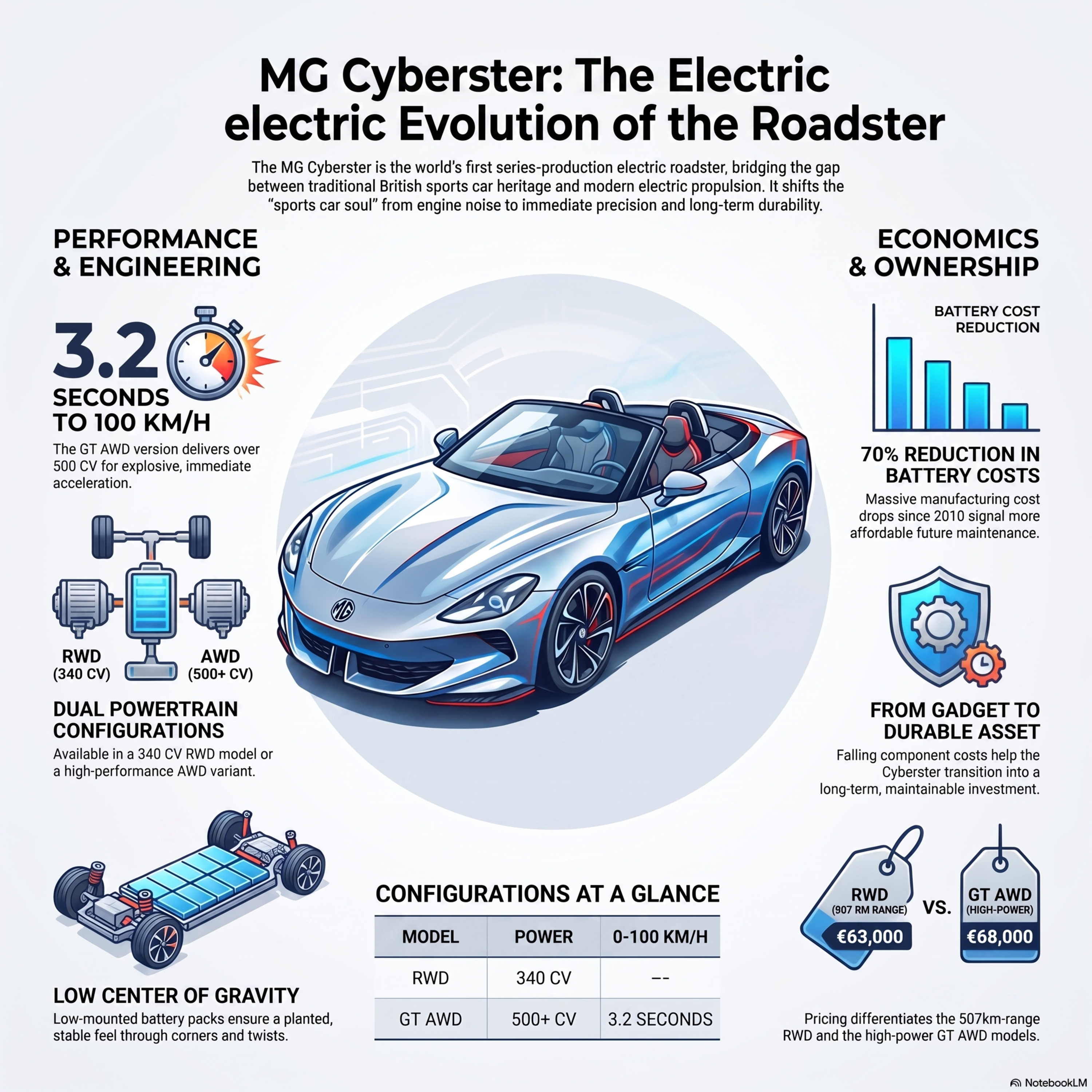
MG Cyberster: The Electric Roadster’s Emotional and Economic Evolution
3w ago00:05:27Tap to summarizeThe MG Cyberster serves as a modern bridge between the heritage of British roadsters and contemporary electric propulsion. This vehicle is available in two configurations, including a high-performance all-wheel drive version that emphasizes Gran Turismo comfort and striking visual features like scissor doors. While the initial price reflects its status as an emotional luxury good, the text highlights a paradox regarding how quickly electric vehicle technology evolves and its impact on long-term resale value. Interestingly, the passage notes that plummeting battery costs could eventually transform these cars into durable assets rather than disposable electronics. Ultimately, the source portrays the car as a strategic choice for enthusiasts who value distinctive design and the promising future of sustainable maintenance.
Transcribe →EV Ultimate Buying Guide: Segment by Segment
3w ago00:07:50Tap to summarizeThis comprehensive guide serves as the definitive roadmap for anyone entering the world of electric mobility. Based on years of hands-on experience and extensive research, it identifies the top-performing vehicles across every market segment to ensure you make a rational and informed purchase .The City Dwellers (Segments A & B)For urban environments, the Leapmotor T03 stands out as the most rational choice due to its exceptional price-to-feature ratio. For those seeking a bit more comfort and technological solidity, the BYD Dolphin utilizes Blade Battery technology to offer a more complete driving experience .The Mainstream Battle (Segments C & D)The core of the market is defined by the rivalry between software and charging hardware. Tesla’s Model 3 and Model Y are the undisputed leaders in efficiency and travel-planning software, acting as a "system operating on wheels" ,. Conversely, Hyundai (IONIQ 5/6) and Kia (EV6) act as the "athletes" of the segment, utilizing 800V architecture to achieve ultra-fast charging, going from 10% to 80% in roughly 18 minutes .Luxury and High PerformanceIn the premium sector, the Kia EV9 offers a democratized 7-seat luxury experience with 800V technology. For pure driving dynamics, the Porsche Macan Electric remains the benchmark for those transitioning to electric without sacrificing sporty DNA . Finally, the Ferrari Luce redefines the luxury frontier, combining 1040 HP with unprecedented dynamic control and 350 kW rapid charging .The Bottom LineYour choice ultimately depends on your priorities: if you value a seamless, autonomous travel experience, Tesla is your best bet. If you prioritize the "gold standard" of technology and the fastest possible highway charging speeds, look toward the 800V architectures of Hyundai, Kia, Porsche, and Ferrari .
Transcribe →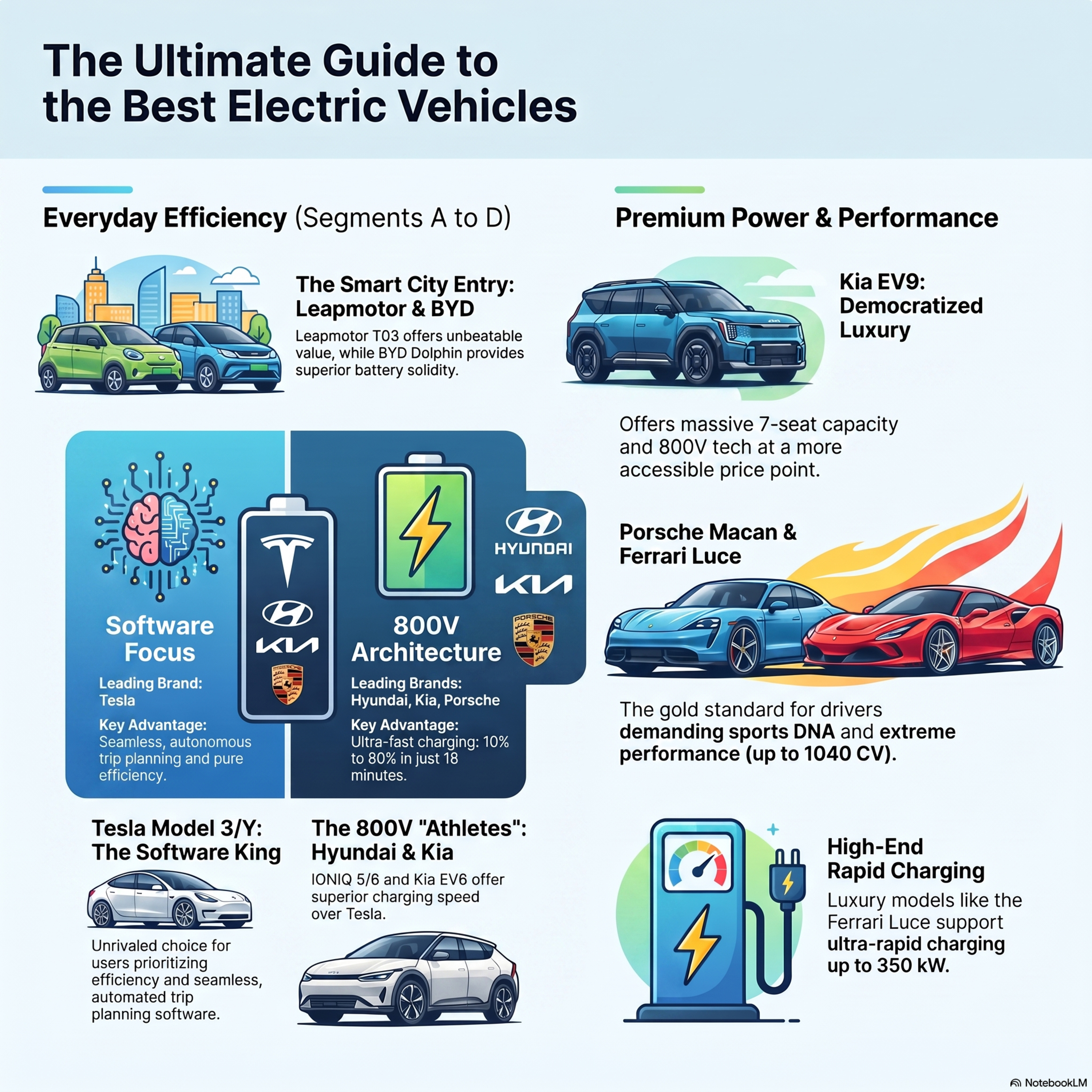
The Definitive Electric Vehicle Guide Segment by Segment
3w ago00:19:30Tap to summarizeThis source provides a curated guide to the best electric vehicles currently available, categorized by market segment and intended use. The author leverages personal expertise to recommend affordable city cars like the Leapmotor T03 alongside high-performance luxury models such as the Porsche Macan and Ferrari Luce. A major focus is placed on the technological rivalry between Tesla, which leads in software and trip planning, and brands like Hyundai and Kia, which offer superior 800V charging speeds. The overview highlights how consumers should choose between seamless software integration or rapid energy recovery depending on their travel priorities. Ultimately, the guide serves as a comprehensive resource for identifying industry leaders based on efficiency, spaciousness, and dynamic driving capabilities.
Transcribe →