Loading summary
Transcript43 lines
- [00:01]
Gordon Carrera
If you want access to bonus episodes, reading lists for every series of Empire, a chat community, discounts for all the books mentioned in the week's podcast ad, free listening and a weekly newsletter, sign up to empire club@www.empirepoduk.com.
- [00:29]
Alex
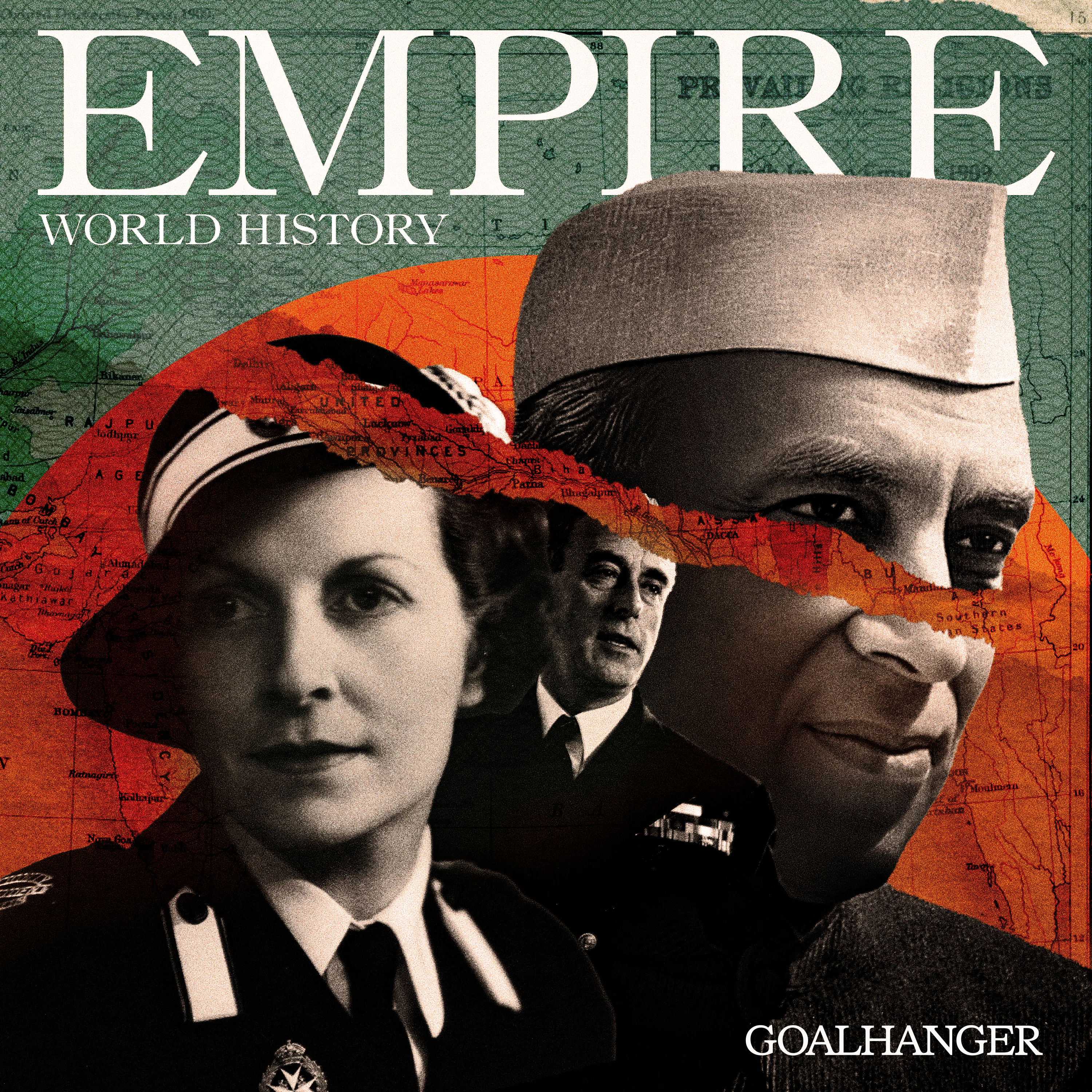
This week on our Empire Club miniseries, we're going carry on with the story of a scandal that shaped partition. Alex and I are discussing the unconventional marriage between the last Viceroy of India, Lord Mountbatten, and his wife, Edwina Mountbatten. Now, last week, you'll remember, we set up Nehru's life before he fell in love with Edwina. This week, we ask, how did the Mountbattens end up in India? To begin with, here's a clip from the episode where we discuss one of Edwina's many affairs of the 1920s and 30s. To access the full series, just head to MBA purdu uk.com empirepod uk.com and become a friend of the show.
- [01:10]
Co-host (possibly a historian or commentator)
She was young, she was beautiful, she was rich.
- [01:14]
Alex
Yeah.
- [01:14]
Co-host (possibly a historian or commentator)
She was married to someone who wasn't enough for her. She was probably gadding about a bit. And we put a pin, for instance, in Leslie Hutchinson and Paul Robeson.
- [01:22]
Alex
Why don't we put Paul Robeson and Leslie Hutch Hutchinson together to talk about? Because it will be relevant in a moment.
- [01:30]
Co-host (possibly a historian or commentator)
Even though these are completely different men.
- [01:31]
Alex
Yes. And so for those of you, I'm sure more people know Paul Robeson's name than Hutch Hutchinson, but Paul Robeson, an African American, huge on both sides of the Atlantic and very political as well.
- [01:43]
Co-host (possibly a historian or commentator)
Absolutely. I mean, Paul Robeson, really one of the most important, distinguished civil rights activists and so on of his day. Very political, also a communist, also, you know, international activist, also one of the greatest musical stars of his day and cinema stars. I mean, you know, you can watch him on screen. Incredibly charismatic, extraordinary man.
- [02:04]
Alex
Yeah.
- [02:04]
Co-host (possibly a historian or commentator)
Hutch was a jazz musician, also African American, also from that sort of background, but not really political in the way Robeson was. You know, he was much more of an entertainer. I mean, a legend in entertainment. Hugely famous at the time. The reason we're speaking of these two men in one breath, they're very different men is because Edwina was rumored to have affairs with both of them, but she was. There was an allegation printed in a newspaper in Britain, which was that basically a sort of royal woman was having an affair with a black entertainer.
- [02:39]
Alex
Right.
- [02:39]
Co-host (possibly a historian or commentator)
And this was so scandalous at the time that Buckingham palace forced Edwina to bring libel proceedings, which she did not want to do.
- [02:47]
Alex
I mean, that's an unheard of thing because the royals don't like being in the courts.
- [02:50]
Co-host (possibly a historian or commentator)
It's really unusual. But at this stage, you have to remember there was a lot more deference towards the royals. So when this went to court and Edwina actually testified, she so didn't want to. She didn't want to do any of this. And she testified there and said, you know, I've never met Paul Robeson, which was a lie, by the way. And apparently he was very upset about that afterwards, that she denied it. And, you know, and, and it was a sort of very controversial thing. But the newspaper did not defend themselves. They issued a full apology. They said, it's fine, we'll pay whatever damages. I mean, there was no case for the defense, even though it was probably true. But that's of course how this works because the idea of going up against the royals was impossible. And they offered to pay damages. She actually refused to collect the damages,
- [03:32]
Alex
which I think tells you she was just everything.
- [03:34]
Co-host (possibly a historian or commentator)
Yeah, it does, right? Yeah, she did. It's possible she had a face of both of them. Who can say? She gave Hutch a cigarette lighter engraved with her own initials, which isn't a very good way to hide it if you're having a thing with someone.
- [03:46]
Alex
I mean, she's billed as a very smart woman. This is not a smart move.
- [03:49]
Co-host (possibly a historian or commentator)
She doesn't care.
- [03:49]
Alex
She doesn't care.
- [03:50]
Co-host (possibly a historian or commentator)
I mean, you know, she was interested in interesting people. But I have to say, I mean, Robeson very obviously her type.
- [03:56]
Alex
So it's so her type and also an interest in Indian politics from Robeson.
- [04:00]
Co-host (possibly a historian or commentator)
Absolutely.
- [04:00]
Alex
Because you know, he not only a communist, not only agitating for sort of miners in Wales here, but the Indian Workers Association. He was like, he was really fascinated with any adjutant groups that were challenging the status quo.
- [04:14]
Co-host (possibly a historian or commentator)
I mean, hugely international figure.
- [04:16]
Alex
Yeah.
- [04:16]
Co-host (possibly a historian or commentator)
You know, so you can definitely see she.
- [04:21]
Alex
We really hope you enjoyed that clip from our members miniseries on the scandal that shaped partition. To access the full series, just head to empirepoduk.com empirepoduk.com Become a friend of the show.
- [04:41]
Carrington College Announcer
Your next chapter in healthcare starts at Carrington College's School of Nursing in Portland. Join us for our open house on Tuesday, January 13th from 4 to 7pm you'll tour our campus, see live demos, meet instructors and learn about our associate degree in nursing program that prepares you to become a registered nurse. Take the first step toward your nursing career. Save your spot now at Carrington.
- [05:05]
Co-host (possibly a historian or commentator)
Edu.
- [05:05]
Carrington College Announcer
Save for information on program outcomes, visit carrington.
- [05:09]
Co-host (possibly a historian or commentator)
Edu sci.
- [05:11]
Gordon Carrera
Why did we really go to war with Iraq?
- [05:14]
David McCloskey
And did Saddam Hussein really have weapons of mass destruction?
- [05:19]
Gordon Carrera
I'm Gordon Carrera, national security journalist.
- [05:21]
David McCloskey
And I'm David McCloskey, author and former CIA analyst. We are the hosts of the Rest Is Classified. And in our latest series, we are telling the true story of one of history's biggest intelligence failures. Iraq WMD.
- [05:35]
Gordon Carrera
In 2003, the US and UK told the world that Saddam Hussein had weapons of mass destruction. But they were wrong.
- [05:43]
David McCloskey
This wasn't a simple lie. It was something far more complicated, far more interesting, and far more dangerous.
- [05:50]
Gordon Carrera
Spies who believed their sources, politicians who wanted the public to believe in the threat, and a dictator who who couldn't prove he'd already destroyed the weapons.
- [06:01]
David McCloskey
In this series, we go deep inside the CIA and MI6, go into the rooms where decisions were made, and look at the sources who fabricated the intelligence that took us to war.
- [06:12]
Gordon Carrera
The Iraq war reshaped the Middle east and permanently weakened public trust in governments and intelligence agencies. And its consequences are still playing out today.
- [06:22]
David McCloskey
Plus, in a Declassified Club exclusive, we are joined by three people who are at the heart of the decision to go to war. Former head of MI6, Richard Dearlove, Tony Blair's former communications director, Alistair Campbell, and former acting head of the CIA, Michael Morell.
- [06:38]
Gordon Carrera
So get the full story by listening to the Rest Is Classified and subscribing to the Declassified Club. Wherever you get your podcasts,