← Endocrine Feedback Loop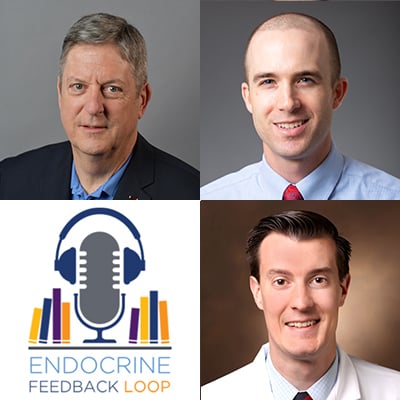
Loading summary
Transcript20 lines
- [00:00]
A
This is Endocrine Feedback Loop. I am your host Chase Hendrickson and welcome you to this Journal Club Podcast series brought to you by the Enderkin Society. Thanks for joining us as we explore an important article recently published in one of the Society's clinical journals. Welcome again to the Endocrine Feedback Loop podcast for our 55th episode. Today we look at a recent systematic review and meta analysis in the JCEM that tries to help us understand the role for T3 replacement in the treatment of people with hypothyroidism. This topic always generates lots of discussion and usually a fair amount of disagreement, so we were excited to take on this study. In this podcast we have not before looked at a meta analysis, so I look forward to that additional challenge as we as a group try to unpack the work that the authors did and how the decisions they made in setting up this investigation affect the results and conclusions in this paper. By way of a brief reminder, I host the Endocrine Feedback Loop and work at the Vanderbilt University Medical center as a general endocrinologist and medical Director. Back today as this month's regular contributor is Andrew Crawford. He works at the Dartmouth Hitchcock Medical center where he is the director of their Fellowship program. He teaches extensively at Dartmouth with scholarly interests that focus on enhancing quality improvement training for fellows. Importantly, his clinical interests focus on thyroid disease and he serves as the lead endocrinologist for the Thyroid Tumor Board at Dartmouth. Our guest expert today also joins us from New England. James Hennessy has had a long and distinguished career at the Beth Israel Deaconess in Harvard Medical School, having served as the Director for Clinical Endocrinology at bi. His expertise focuses on thyroid disorders with a particular interest in the treatment of hypothyroidism. You all as listeners will be very familiar with him from his numerous publications and talks on that subject. So, as usual, the perfect pair of endocrinology joins me today to discuss this thyroid article. As is also always the case, everything we say will be our opinions only and not those of our respective institutions or the Endocrine Society. This month we discuss Treatment Preferences in Patients with Hypothyroidism, which is a forthcoming article in the Journal of Clinical Endocrinology and Metabolism. Fabian Esberard de Lima Beltrau from the Federal University of Paraiba served as the first author and was joined by authors at several institutions in Brazil and at the University of Chicago. I will now turn the discussion over to Andy. He will highlight some of the key points that the authors make in their introduction as well as asking Jim to provide us additional background on those issues.
- [02:42]
B
Andy, thanks so much, Chase. It's a real pleasure to be with you again and talking with you and Jim. So, yeah, this was a really very interesting paper in terms of the way that it was organized. And so I'll start with just discussing some of the sort of the background information that the authors provide that really starts off with the treatment of hypothyroidism and how it's evolved over the years. I know this makes up a large part of my practice, as it does, I'm sure, for Jim, how to treat it. And certainly we have several options. And so the authors go through the history of it, starting all throughout the 20th century leading up to the present day, and kind of give the background about how levothyroxine has become monotherapy, has become the standard approach of therapy. But sort of looking back several decades, as many of us know historically and even experienced, certainly in our practice day to day, we see these anecdotal reports of how patients felt worse after transitioning off of desiccated thyroid extract. So this older preparation that patients were treated with, starting many years ago, over to levothyroxine monotherapy. And over time, there have been multiple randomized clinical trials comparing levothyroxine monotherapy alone to combination therapy, LT4, levothyroxine plus T3 or cytomel therapy. So I was wondering, you know, if Jim could give us an overview of some of the challenges related to particularly patients with normal thyroid function studies on levothyroxine monotherapy who may have symptoms, you know, that could be attributable to potentially a hypothyroid state, which would be sort of in contrast to what the labs tell us.
- [04:19]
C
Sure. It's a pleasure to be with all of you today and to be able to share some thoughts on this topic. I would say. All right, so we've titrated your TSH to normal, and then you still have some symptoms that could be seen in hypothyroid people. And I would refer all y' all to the reference from Okasime in Clinical Endocrinology way back in 2016, where they have this very nice table from the British Thyroid association that says here's some causes of persistent symptoms that people frequently think of as hypothyroidism symptoms. And until you've ruled all this stuff out, maybe you shouldn't be thinking about the thyroid. Maybe there are other things like obstructive sleep apnea or adrenal insufficiency or anemia. Or other end organ damage like cardiac et cetera, or even COVID 19 being the newest one on this list of reasons why patients might have symptoms that might be consistent with hypothyroidism. And simply because they're on thyroxine does not necessarily mean that those symptoms are actually due to hypothyroidism, as all of you have seen recently. And if you were reading JAMA and saw Juan Brito's paper looking at a insurance database for patients being treated with levothyroxine, Juan clearly demonstrated that over 30% of new starts on thyroxine were actually euthyroid people. And once people are started on thyroxine, if you ask them, what's your diagnosis, what do you think? They say, oh, my doctor told me I'm hypothyroid. That's why they put me on thyroxine. And as soon as they know a diagnosis, then they have some key terms to use if they'd like to research that. I put quotes around that further so that they know what they should be complaining to Andy about when they go in for their refills on their levothyroxine. So I would refer everybody to the Okasime reference, because that table really does provide a nice outline of things that the primary care community needs to be thinking about, usually before they think about thyroid, when it comes to people with a normal tsh and residual symptoms of one thing or another.
- [06:51]
B
Thank you so much, Jim. So I wanted to build off that a little bit to talk about, really, the background of the author study, which was previous randomized control trials, and the fact that some of them did have patient reported outcomes, which is really at the heart of this paper, which is all about patient preference of which preparation they prefer ultimately. But the authors described that a lot of the previous randomized clinical trials had essentially equivalent outcomes. And there were a lot of concerns that had been raised about being on preparations other than levothyroxine monotherapy, such as potentially multiple pills a day, such as if somebody's taking Both levothyroxine and T3, also fluctuating T3 levels. We know, of course, that the half life of T3 being much shorter than thyroxine is. And so these are some of the reasons, I think, that the guidelines have recommended prioritizing the treatment with levothyroxine monotherapy, but was hoping to get Jim's take on kind of the current status of levothyroxine monotherapy in particular, as pertains to the guideline guidelines. Our Current guidelines, for example, the American Thyroid Association.
- [07:56]
C
Well, that's a very legitimate question. I think, as you know, as the guidelines are updated at all times, all of these committees are putting great emphasis on the fact that they are trying to get as systematic an approach to looking at all the literature and finding a balance amongst them to get the very best predicted outcomes with various interventions. And the current Guideline is from 2014. And as you know, they basically have said levothyroxine is the, is the route to take. There's insufficient information to actually tout combination therapy before starting with levothyroxine therapy. And if indeed you combine that with the European suggestions for people who I would have to assume have had all of these other diagnoses ruled out, like the use of beta blockers or statins, et cetera, some of which cause patients to feel tired. After all that's been ruled out, then an experimental N of one trial could be pursued. But to avoid thyrotoxicosis. I think we're all kind of sensitive to the concept of not driving the TSH down into the cellar because we're aware of the cardiovascular circumstances and risks that that puts patients into, especially postmenopausal women where they'd also be losing lots of bone density as a result of that. So I think that the guidelines are being cautious and I think appropriate of saying, you know what, if you're not going to be ruling out all these other things that cause these symptoms, then you should be starting with levothyroxine. And once you've got your patients stabilized with a normal tsh, which should predict good long term outcomes, as you're well aware, then you'll have time to evaluate all the other things that could be going on with your patient, like obstructive sleep apnea, et cetera, et cetera, et cetera.
- [10:11]
B
Thank you very much. And one interesting thing that certainly we'll be talking a lot about in this paper as we continue to discuss it, is patient preference, potentially preferences for other regimens other than levothyroxine monotherapy, desiccated thyroid extract or combination therapy with both levothyroxine and T3. And so what we've seen in some of the randomized clinical trials over the years is a signal in some of these that potentially there could be preferences for therapies other than levothyroxine monotherapy. So the study purpose in this paper is to determine which treatment levothyroxine monotherapy versus combination T4 plus T3 or desiccated thyroid extract was most likely to be preferred when considering all the participants for the eligible randomized clinical trials. So I'll hand it over now to Chase to help us go through the methodology of the paper.
- [11:09]
A
Andy and Jim have already given us a nice overview there. I think you can already sense the controversy here. You probably were aware of it before, but I think you've got a good understanding of why we're wrestling with this and trying to get this figured out as we think about the methods. I want to start with thinking about several related terms. As I mentioned in the introduction, we've not looked at a systematic review or meta analysis before, so we'll take a few minutes to explain that. First of all, just to make sure we're all on the same page. While these terms are often used together, they do refer to distinct things, and they don't always have to be done together. Systematic reviews in particular primarily focus on how you identify relevant articles. You don't have to do them with a meta analysis, and often they're standalone and they are very technical. So they describe in often excruciating detail, as they're supposed to, exactly how the authors went about searching for articles, what their criteria was, the criteria that they use to include articles in their review, how they assess the quality of these articles. So it's a very standardized. But the goal of that is if you read the way that the authors did it and then you redid it, you would find the exact same articles. A meta analysis is then sometimes done, not always, but sometimes, once you've done your systematic review, if the studies that are included are similar enough, they're asking the same question and reporting the outcomes in the same way, you have the ability to combine the results that data together. And that helps you in several ways. One way is that if you have studies that have discrepant results, if you can combine those, it maybe actually tells you what is the the correct answer, so to speak. Other benefits of it include if you're having a bunch of small studies and individually, there's not enough subjects in any one study for there to be statistical power to have a good conclusion. If you combine them together, maybe you have sufficient statistical power to be more confident in your conclusion about a result. So those are a couple of the benefits and reasons that people will do a meta analysis. The authors did several very sophisticated approaches here. One of them is a network meta analysis, and that's building on a basic meta analysis. And what a network meta analysis allows you to do is to compare multiple different interventions. Even when the included studies didn't compare them all together. So Andy already mentioned that we're looking at three different groups. We've got levothyroxine by itself, we've got combo T4 and T3. Then we've also got desiccated thyroid extract. Not all of these studies looked at all three of them. They looked at some combination of them. But network studies allow you to combine all of that together in actual networks so that you can compare one to the other in combination. Then finally, a meta regression is helpful in a meta analysis when you were trying to understand what might be a driver of an outcome. We're going to get to this, but there's a question always comes up, is this because of how much T3 you're using? This question of, well, did we over suppress somebody? Is this just because they've got a low TSH that's telling us that they've got more thyroid hormone than they need? So, so a meta regression is going to help you understand. Are there any drivers that you can identify like that? Okay, so that's a high level overview of these things as we think about this study. So this is a includes the eligibility criteria. It's the RCTs of both parallel and crossover studies that compared levothyroxine monotherapy with some form of combination therapy. Really quickly, a parallel study is going to take a bunch of people who are on levothyroxine and then randomize them to get either levothyroxine or some version of combination therapy. And then you're just going to compare those two, that you stay in those two groups, whichever one you were assigned to randomly, and you're blinded. Crossover studies are considered even stronger versions because you are initially assigned to get one of those treatments, levothyroxine or combined, and then halfway through the study, you are going to cross over and you are going to switch your treatment to the other one. You're not going to know as a subject, you're going to be blinded. You're going to know that you switched treatments, but you're not going to know which one you were on first and which one you were on second. But then that allows comparison with the same individuals. And so you don't have to worry at all about confounding there. And so that's considered a particularly strong design. And as we'll see here, the authors appropriately focus on that whenever there's any discrepancy. So those, any of those two designs were included here. The authors were only looking at adults with overt primary hypothyroidism and the outcomes, as Andy's told us, already had to include patient preference. And as before with these two different study designs, the, the crossover made sense because you were on both. And so at some point you were asked, did you like the first one you were on or the second one you don't know which one was which. Parallel studies are a little bit harder to think about, but primarily it's if you were on levothyroxine and then you got treated, they just asked the do you like this new thing that you're on or what you were on before? Again, it's not going to be as strong because these, not all these subjects were on both. And so that's yet another reason to why the authors excluded them as they did some of this analysis, to see if that made a difference. The authors state that they follow the PRISMA guidelines. So those are the standard guidelines for how to do systematic reviews and meta analysis. So they did that for their search strategy, their screening, their data extraction, the quality assessment, all the things that you're supposed to do. And the authors provide good details on that in the statistical analysis. There's a couple of important things that the authors do. There's a couple different ways that they dealt with data heterogeneity. So this is a very common thing when you're combining different studies. These studies are done in different ways. They're looking at different populations. Sometimes interventions can be a little bit different. There can be many different aspects to them and you get worried if you're combining studies that are very different from one another, if you're putting them all together, it's possible that the answer that you get is not really very well reflective of any of the individual studies. So one of the ways that you, you do that is when you're looking at the results, as you look at the spread of these results, you'll calculate both P values and I squared values. P values. We're used to thinking of, oh, you, you want a low P value that's good, that tells you that these groups are different. This is a little bit backwards is because you don't want your studies to be radically different. Your hope is, is that as you do a meta analysis, is that these studies are looking at the relatively similar populations that you're getting results that are, at least in the ballpark, you don't want them radically different. And so you are encouraged if your P values are relatively high that tell your groups are not wildly different from one another. The I square. The I stands for Inconsistency So that's the opposite. So you don't want a lot of inconsistency here. That's worrisome. So you get encouraged. If you have low I square values, one of the things that you can do is if you have data heterogeneity. So if your P values and your I squared values are telling you that your, your studies are fairly different and you maybe shouldn't be combining them, but you're not sure which studies are the ones that shouldn't be included, a visual way to do that is a funnel plot. You just graphically plot out where these studies go and you just plot them together based on how big they are and was the result favoring one or the other. And it actually should, as you put them on dots on a page, create a funnel. And as if you have studies where these dots are outside of this funnel, it just gives you a clue of, okay, that's probably a study that maybe doesn't fit very well, maybe you can tell why. And you say, oh, they have a totally different population. This does not at all fit with the rest of these studies. You maybe aren't able to readily identify what that is, but that's how you approach that, that the authors then, as I mentioned before, do a meta regression. So they're trying to understand what might be the driver here. So the things that they look at that might be a driver of different results that they're seeing with the levothyroxine monotherapy versus one of a combination. So they're looking at the dose of the T3, they're looking at the duration of follow up, the age of the subjects, the difference in the final body weight and the TSH difference. And in just a second, Andy's going to tell us about those results. Finally, we've alluded to this before, but to be clear, with this network meta analysis, there are three different nodes that are being looked at. So this is not just comparison of one treatment to another. You've got three different comparisons. You've got levothyroxine monotherapy, you've got combination therapy with separate pills for levothyroxine and lyothyrenine. And then finally you have desiccated thyroid extract. So those are your three nodes in that network meta analysis. A lot of information to be wrestling with here. Andy's going to walk us through some of these results and I'll turn it over to him.
- [19:10]
B
Thank you, Chase. So as far as the studies that were identified and included in the paper, there were 11 studies from nine countries. Three of those were parallel and eight were crossover studies by design. And so these are the ones that met their inclusion criteria. The totals were 592 patients with combination therapy of some type, either the desiccated thyroid extract or T4 plus T3 therapy, and 543 with levothyroxine monotherapy. So we'll sort of go through the results step by step, hitting all the high points hopefully. So the authors note that the meta analysis of pool data from all of these 11 randomized clinical trials indicates a preference for combination therapy, again, that term meaning either desiccated thyroid extract or T4 plus T3 when compared to levothyroxine monotherapy. But they do note that there's a large amount of heterogeneity between these different studies, which could potentially affect the what they describe as the validity of the overall pooled estimate. And as far as the heterogeneity, some of the points that they bring up is the dose of the T3 as well as the dosing schedule and the prescribed ratio of T3 to T4. There was also heterogeneity in terms of the risk of bias, where four were deemed low risk of bias, six having some concerns of bias and one being identified as high risk. And the studies were quite heterogeneous as far as the percentage of participants that were listed as being no preference. So it's fairly high in some studies, as high as 50% and ranging from 11% up to that 50%. So what they did to sort of try to limit some of this heterogeneity or sort of try to statistically work around it and try to polish this data and remove some of the outliers was to do some of the sophisticated analysis that Chase went through. So they utilize these funnel plots to mark four studies as substantially contributing to the heterogeneity. And they then reanalyzed the data, which they describe as not affecting the pooled primary outcome result, and that finding was preserved when they also looked only at crossover studies. They also did the funnel plot again to remove three further clinical trials to limit the heterogeneity, and again the finding was preserved. One of the interesting things is they noted that when the TSH difference was less than 0.1, the preference was for combination therapy, but that when the TSH difference was greater than 0.1, there was no significant difference between mono and combination therapy. The authors note no significant preference in parallel trials. The authors do note that the power overall was strong. It was ranging from 74 to 98%, indicating that they had confidence in the ability to reject the null hypothesis, which would be that there's no difference in terms of preference. The difference in the final TSH values in the crossover studies was significantly associated with the results that they present that primary outcome. But other variables like the dose of T3, the duration of follow up, or weight differences were not found to be associated significantly with the result. And then moving on to the network analysis that Chase went through. And this is again something that compares multiple interventions for one condition, which in this case would be hypothyroidism treatment. They found that combination therapy and desiccated thyroid extract were preferred over monotherapy. When you look at crossover studies, only just the T4 plus T3 combo and not the desiccated thyroid extract preference remains significant. So I'm going to turn it back over to Chase to sort of lead us through the. The important conclusions of the study.
- [22:54]
A
Okay, so a lot of complicated things that were done here. These meta analyses are very sophisticated and so hard to think about and hard to wrestle with. How's this actually going to affect what we do? So we're going to try to sort through that and least give you our thoughts along the way. We will start with what the authors say, though. So they point out initially that there were other meta analyses that have already been done. There were three of them that tried to answer this question, and they reported conflicting results. They point out that their own study used more stringent criteria, had expanded statistical tools, and also included more RCTs. And so to quote them here, they say that the results indicate a clear preference for combination therapy over levothyroxine monotherapy, which was unrelated to age, but the dose of lyothyrenine, the duration of the trial, or the final body weight. They then go on to say what might be different about their meta analysis compared to these other three. So the first two they, they dismissed relatively quickly, which I think was legitimate in that they said, well, these other two didn't even look at patient preference, which was the focus of ours. And they also included other studies besides randomized rct. So. So they said it's not really the same thing here. One of them was, though, and they point out that the difference between their study and this other meta analysis, which concluded that there was not a difference between these approaches, was really the question that they were asking and how they designed the result. So this previous meta analysis that said that there was not a difference between these treatment options really did what they described as a binomial categorization. So they lunked people into two different categories based on their preference. And, and one of the preferences was that you preferred the combination therapy. And then the other group was that either you did not have a preference or that you preferred levothyroxine. So if you split people into just those two groups with this other meta analysis, they said, yep, not a difference between those two. 50. 50. The author said, we did something different here in this one. We had three different groups. So we said we split people. We didn't combine anybody. We said, if you're preferring levothyroxine, that's a group. If you are preferring combo therapy, that's a group. And if you do not have a preference, that's a group. And that's a much better way of doing it, according to the authors. And we found a difference when we did it that way. And I do think that's a very important point that they make, because I think that is a key distinction and a big part of why they found a difference when the other study didn't. And the authors, as you would expect, support and then argue for the way that they did their study as being superior. I wanted to get Jim's thought on this because I had this question as I was wrestling. Neither was was wrong. But you do get different answers depending upon the type of question that you're asking. And I tried to put myself in a clinical scenario thinking, okay, which one is really the question that I would ask when I'm seeing a patient. And almost always the question I'm asking is with a patient who is already on levothyroxine. Jim, you gave us that scenario before, and I'm trying to decide, are you going to feel better if I switch you to combination therapy? Yes or no. And at least in my mind, when phrased that way, that is the way that the other study that didn't find find a difference. That's the way that that's set up, not the way that this one is set up. Again, there's not a right or a wrong. It's just, how did they do this? So, Jim, thoughts about. About how we should be asking this question and the different ways these studies ask that question.
- [26:18]
C
Well, if the standard from the guidelines is to treat with levothyroxine, normalize the tsh, the second piece of that sentence is always and alleviate hypothyroid symptoms. If that's what our first thought process needs to be, well, then, okay, so we start everybody on levothyroxine. We titreat them to a dose where the TSH has been normalized. And then, as you're well aware, the peripheral tissues take a while to come to equilibrium with the replacement therapy. And so you'd probably have to wait for a while to see what symptoms are going to resolve and what symptoms are not going to resolve. And then when there are residual symptoms, then I want to offer the patient something that I'm convinced is going to be better than what they're currently utilizing. And, you know, not to get too regressive on this. For the 30% of patients who are on levothyroxine who were euthyroid to begin with, their symptoms didn't resolve because they weren't related to the thyroid in the first place. And with comorbidities and other types of things going on, many of the symptoms that we're probably looking at may very well not be thyroid related. But at the same time, I agree with you. If I'm going to be making a decision about, should I offer you something else, something different? Am I convinced that you're going to be better off on that than you are on the levothyroxine that you're currently on? And if you tell me that you were tried on a combination therapy, one type or another, and you say, no, no, no, I didn't like that. I liked what I was doing before. Is that no preference or preference for levothyroxine? If nothing changes, then there's really no preference because you didn't see a positive result from switching to another treatment. So I agree with you, or I think I agree with you in combining preference for thyroxine with no preference. Since almost all of these studies were done basically with patients on levothyroxine and they were stabilized and they had to be on a stable dose of levothyroxine for three, six or more months, and then they were randomized to the other treatments. They're all basically starting at that starting point. Levothyroxine normalized tsh, it's a stable dose for a long period of time. And now I'm going to randomize you to something that might be better, or maybe you're not going to feel any different at all. And if you don't feel any different at all, then it's not necessarily better.
- [29:02]
A
The authors then move on to wrestle with another issue, and that's. And while several of these studies, as we just discussed as Andy walked us through, have shown a difference in and patient preference, these studies have not been able to consistently identify differences in patient reported outcomes. So the Authors try to explain that and they admit that patient preference would intuitively be identified through patient reported outcomes. But the way that these patient reported outcomes are done, and this is in a very standardized fashion, that they don't allow patients to rank which of those is most important. And they suggest, well, that may be the reason why we're not seeing a difference. And if they could rank that, maybe that would show us something that we're not currently seeing. I'll point out, as in this aside, that with patient preference, that's also similarly dichotomous. It's a, did you like this one or did you like that one or was it not a difference? We don't have a sense of how strong that is. Was it a major difference? Was it a fairly trivial one and you're just trying to pick one? We don't have insight into that. Again, just because of the way that these RCTs that are the basis of this meta analysis, because of how those are done, the authors point out that a real strength of the study, which I think they're right on, is that that the included RCTs are all blinded. So the subjects didn't know what treatment that they were on. So they couldn't have been influenced by external factors in choosing one versus the other. They didn't know when they were on T3 because nobody told them. So they couldn't say, oh, I think I'm supposed to feel better, so I'm gonna say that I feel better or I think maybe that I do. So a placebo effect, in other words, and certainly agree with them. I think that's a strength and that was a key criteria for the studies that they included. But Jim, a follow up question for you on that is again, we've got to figure out how to translate this clinical practice. So in clinical practice, we, we don't do blinding. Patients know when they're on treatment, when they're not on treatment. So we, we have to deal with placebo effect. So again, let, let's, let's set aside the question of do you want to start putting a lot of your patients on T3? And let's just say for argument's sake that you're going to, how do we deal with this placebo effect? Because it's going to be very hard for any patient, this is a natural thing that happens for any patient to not think that they're feeling better with a newer medication or at least a strong risk for that. So any thoughts on how we might have to deal with that cl well.
- [31:14]
C
In my experience, patients who've reported to me that they were now on a combination therapy and they felt very much better have typically said it was just a life changing difference in the way that they felt. And I'm thinking about a patient that I saw just earlier this week and I'm refilling her T4 and T3 for her and someone else had started her on that, that, and she told me that she couldn't get out of bed because she was so incapacitated. But after she went on T3, T4, within a day or so she was just doing fine. And I'll leave it with that so that it's kind of a dramatic preference with I feel good now and I didn't before. And that's what I have come to expect when people have these very positive responses. I would point out that in all of these randomized controlled trials, the primary outcomes are all patient reported outcomes and more recently the Thypro 36 assessments. And those are patient reported outcomes, of course, but because it's been so clearly looked at and analyzed by psychologists and others who are expert in putting together surveys, it's now the standard for, well, if you can show a difference in fo, then maybe you've got something going. And the studies are not consistently showing an advantage in Thypro or other quality of life kind of assessments. And that's why the guidelines default back to all right, we've done all these randomized placebo controlled trials. We're looking at objective data to try to come up with. This has got the advantage here, that's got the advantage there. And as one or the other of you was pointing out, but from study to study, maybe something looks like it got better and then the next study, there was no effect on that at all, et cetera. So from a clinician's perspective, what you want to see is I prescribe something for you and I predict that you're going to get better and you will more often than not. But in this particular case, it's very difficult to do that. And as far as the preferences go, as you were, I think alluding to combining preference for levothyroxine and no preference together might actually be the clinically more relevant decision making point. Rather than splitting it out into, you can either express a preference for thyroxine or for desiccated thyroid extract or for a combination therapy, and none of these people who are professing no preference at all count. And so it becomes just one against the other. And my guess would be if I took Something with a little bit of T3 in it. Maybe I'd feel better too. I hope that answered your question.
- [34:16]
A
It did, yeah. And I think well illustrates that RCTs are appropriately the gold standard. It's the best that we've got as far as figuring out what we should be doing. But there can be challenges in how to translate some of them into clinical practice. The authors move on to list their limitations. They point out that the studies that were included here, there's a small number of them and, and didn't have a lot of subjects in them. They point out that that network meta analysis, it was mostly indirect, so there were not many direct comparisons between the different treatment options. They point out that ethnic diversity and polymorphisms were not considered in this analysis. Jim mentioned the issue of comorbidities. And then the authors point out here that only three of the RCTs considered comorbidities and that none of them are really looking at intestinal differences, trying to understand if there might be absorption variability. And then finally, the authors point out we've touched on this already, is that patient preference is measured as a binary outcome in these studies. The authors wrap up with a couple of points, what I would describe as their summary, and I'll quote them here. They say our comprehensive analysis found a consistent preference for combination therapy over levothyroxine monotherapy. They then move on to what I would describe as their implication. Again, I'll quote them. Given that the effectiveness and safety of levothyroxine plus lyothyronine and levothyroxine therapies are similar, physicians should consider using a model of shared decision making that respects patient preference when treating patients with hypothyroidism. We will get to the question of whether this should be changing our practice. But first of all, I just want us to think about the quality of this report overall. So, Andy, let's get your thoughts. You spent a long time and working through this article and analyzing it. What are your thoughts about the quality of this report overall?
- [36:06]
B
I think that in terms of the overall quality, there were some really interesting methodologies done to analyze a really heterogeneous batch of data. So I think it was really fascinating the way that the authors worked through that. I don't think that this will have a big impact ultimately on my own practice. I think it's very useful just to be educated on a lot of different viewpoints and new data that I wasn't aware of before and just being able to talk through that with patients to help Them make the best decision possible for themselves.
- [36:36]
A
Yeah. And before we get to Jim, I'd say I agree with you. I think as far as the meta analysis goes, and having looked at this, I think they did a good job of this. So technically, I think this was done. Well, these things are very complicated to do. I think you've probably picked up on that. So you have to be very careful to do these. Well, I think the authors did a good job of that. And I think as the authors point out, the real key here was the exact question that they were asking and how were they were looking at those outcomes. Are we considering people to be in two groups, or are we considering this outcome to be in three different groups? And how are you going to analyze it? And I think that makes all the difference. And said it before, this isn't a right or wrong. It wasn't wrong to do it that way. Wrong to do it that way. It's just what question do you want answered? And depending upon what that is, is you may get different answers. And I think that's well illustrated in this study and then the other meta analysis that the authors spend some time comparing themselves to. All right, Jim, so we're going to get your word as the final one here. So what are your thoughts? I'm particularly interested. You've fulfilled the role of maybe a bit of a skeptic here, so we appreciate that. But just give us your thoughts about the quality of the study and if this might change the way that you approach patient care.
- [37:43]
C
When I look at this, I'm overwhelmed with the statistics. I mean, I truly got bogged down into. I don't really understand what's going on here. And I really appreciate you explaining it to us. And that was very enlightening. Amazing statistics in this and as a change in my clinical practice, I don't think so, because I do believe that it should be the binary either. You're already on the thyroxin. Am I predicting that you're going to feel much better if I give you something else? I continue to be a little skeptical that that's really what's going to occur.
- [38:21]
A
And with that, I would like to thank Andy Crawford and Jim Hennessey for joining me for this month's edition of Intercom Feedback Loop. I learned a great deal and hope that you all did as well. Please join us again next month. And now you're in the loop. This has been Endocrine Feedback Loop. Endocrine Feedback Loop is brought to you by the Endocrine Society with Production Oversight by Brandy Brown and Andrew Harmon. If you want to like and subscribe, you can find us on Apple, Spotify, or wherever you get your podcasts. We'd love to to hear your feedback on this episode or the podcast itself, please email us@podcastren.org.
- [39:07]
C
Endocrine Feedback Loop is.
- [39:09]
B
A free service of the Endocrine Society.
- [39:11]
C
To learn more or to become a member, visit the society's website at www.endocrine.org.