← Everything Belongs: Living the Teachings of Richard Rohr Forward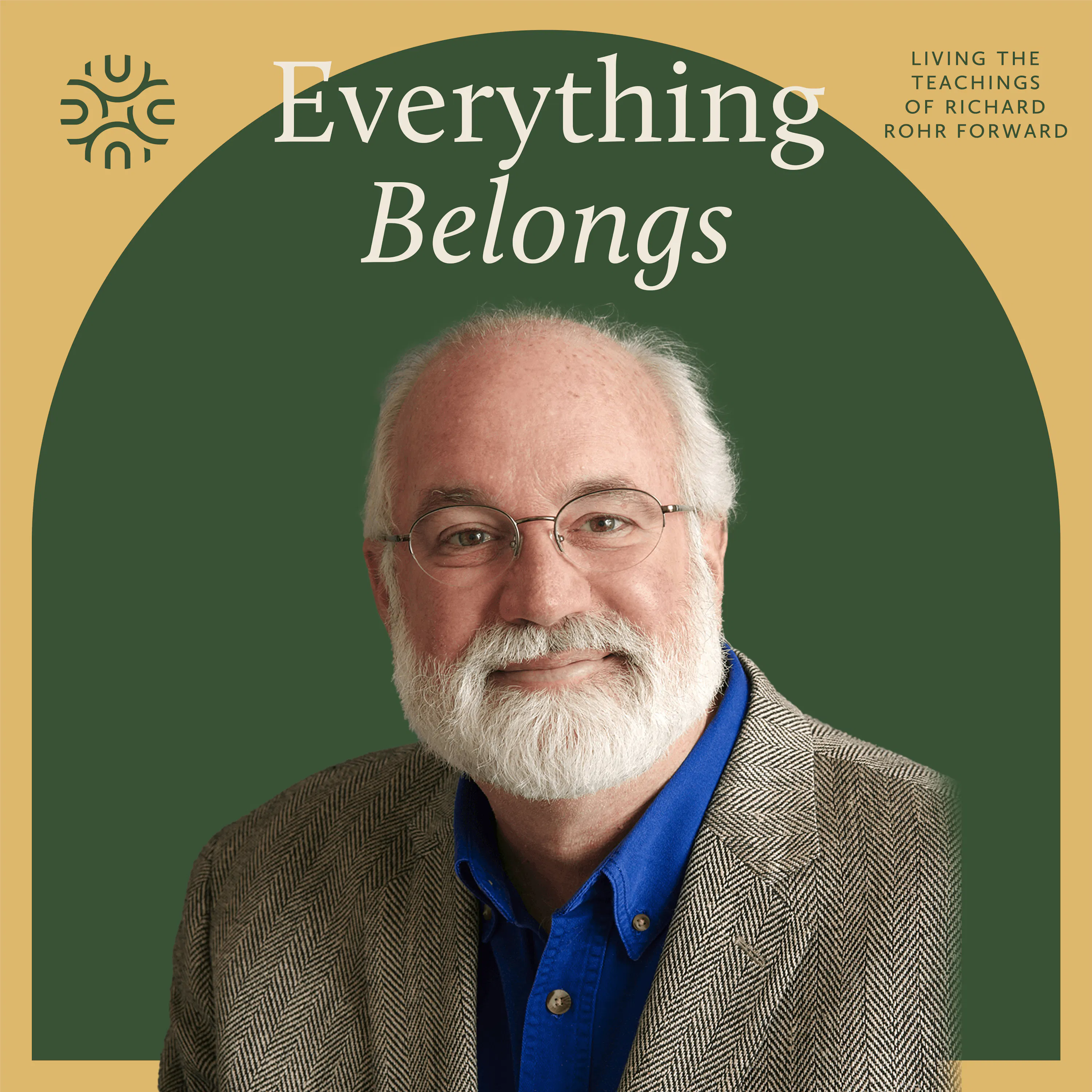
Everything Belongs: Living the Teachings of Richard Rohr Forward
Bonus: Fr. Richard and Greg Boyle Reflect on Lives Committed to Loving Action
01:17:44
Loading summary
Transcript219 lines
- [00:00]
Carmen Acevedo Butcher
You're listening to a podcast by the center for Action and Contemplation. To learn more, visit cac.org oh, my
- [00:08]
Mike Petro
gosh, My friends, welcome back to the Everything Belongs podcast, the podcast where we live the teachings of Father Richard Rohr Forward. As you know, each season of Everything Belongs, we take one of Father Richard Rohr's cherished books, and we go through it chapter by chapter. First, heading over to his hermitage, sitting down with him in his living room, and just having a conversation about that particular chapter. Then inviting a guest from the outside to have a conversation with us so that we can ask new questions and apply it to new situations and gain new insight. Now, this season has been very, very special because we are exploring Father Richard's newest and he claims, very last book, the Tears of Things. If you can believe it, we are about halfway through our exploration of this amazing book. Last episode we Talked about Chapter 4, Welcoming Holy how the Prophets Carry Us Through. We got to talk to Jungian psychologist Connie Zweig in one of my favorite conversations. Next month, we will be talking about chapter five, Jeremiah, the patterns that carry us across. We have an amazing conversation with Richard, one of my favorites. I know I say that every single time, but it's really true. And then we'll be talking to Dr. Walter Fluker. I cannot wait for you to hear that. But before we go there, there's so much happening in the world right now. The world is on fire. We had the passing of Pope Francis and the appointment of a new pope in Pope Leo. The Tears of Things debuted at number two on the New York Times bestseller list. And there's been so much interest. Richard has had so many conversations on other podcasts. He's had conversations with John Deere and Jen Hatmaker and Elise Lohnen. He's been on the Jesus Calling podcast and so many more. You can look them up, you can track them down. And in the midst of all, all these great conversations, we are so excited to share with you today a bonus episode, which is our precious teacher, Father Richard Rohr, talking not about a chapter, but about the entire book, the Tears of Things, with his dear friend, Father Greg Boyle, who also recently put an amazing book out into the world. Chapter Cherished Belonging, the Healing Power of Love in Divided Times. If you don't know this, Father Greg was a parish priest in gangland Los Angeles. And way back in 1988, he started an organization with the hopes of improving the lives of folks who were trying to get out of gangs in East Los Angeles. That organization, Homeboy Industries over the years has evolved into the world's largest and most successful gang intervention and rehab program. The work that they do is life changing. It is the gospel in action. It is everything Richard teaches in three dimensions in real life, taking the power of love to meet people in their anger and in their sadness and to help them heal and to change their lives by the power of what Father Greg calls cherished belonging. I cannot tell you how excited I am for you to hear the conversation of these two profound living embodiments of action and contemplation. This is the very first time they've recorded a conversation together, and I'm so thrilled that we get to share it with all of you as this special bonus episode. Now, as we always do, before we jump into that conversation, Paul Swanson and I are going to head over to Richard's house. We're going to hear from Richard his thoughts on the new Pope. We're going to hear how excited Richard is about how the book is going out into the world. And we're going to get to hear from Richard how excited he was to spend time with Father Greg. You'll probably get to hear me complain to Paul about how jealous I was that he got to go and be a part of this conversation and I had to stay behind. But like all of you, I get to listen with bated breath and just hear all the wisdom from these two profound teachers. And I got to tell you, I am so thrilled that you have been a part of this conversation around the tears of things with all of us and this continuing conversation about how love can lead us through our anger and our sadness to work to make love more real in the world around us. Without further ado, let's get into it. Let's head over to Richard's house and then can't wait for you to hear Richard and Father Greg in conversation. From the center for action and contemplation, I'm mike petro.
- [05:18]
Paul Swanson
I'm paul swanson.
- [05:20]
Carmen Acevedo Butcher
I'm carmen acevedo. Butcher.
- [05:22]
Paul Swanson
And I'm drew jackson.
- [05:23]
Mike Petro
And this is everything belongs. Richard. I know that one of the most precious moments that I'll never forget is that Paul and I were with you and all the staff at CAC gathered together for one of our annual all staff meetings, where everyone flies in from all over the country to be together. And in the middle of a conversation that you were having with the entire staff, we got the news that a new Pope had been chosen. And we got to watch you react to it in real time, which was Absolutely fantastic of a video.
- [06:02]
Father Richard Rohr
I was like a little boy in a candy store.
- [06:05]
Mike Petro
Oh, you are so excited. For folks listening, how are you feeling about the selection of the new pope?
- [06:11]
Father Richard Rohr
Ecstatic. Still this man is chosen.
- [06:16]
Mike Petro
I know you are such a huge fan of Pope Francis and still are. And you feel like Pope Francis legacy is in good hands.
- [06:23]
Father Richard Rohr
Is in very good hands. Maybe he's even in a unique position to take it farther. For Catholics of the conservative ilk who thought Francis was just a momentary anomaly, two popes in a row can't be wrong. You know, this is very helpful for what we've been trying to say since Vatican ii.
- [06:52]
Paul Swanson
You shared the motto of Pope Leo. Can you share that again here of your resonance with that?
- [06:59]
Father Richard Rohr
Yeah, it's just a little Latin phrase. In illo uno, in the one, unum one, we are one. In other words, in the one, we are one. He's saying, I'm not here to fight with. I'm here to create unity. Brilliant. Brilliant. I mean, a Hindu or Buddhist could say that. Any mystic would say that. So he has to be a contemplative or he'd never come up with such a motto.
- [07:38]
Mike Petro
One of my favorite moments, when they announced his name and no one in the room knew what it meant. You went an American.
- [07:46]
Father Richard Rohr
I did.
- [07:47]
Mike Petro
You did. You said they said there would never be an American.
- [07:50]
Father Richard Rohr
Well, I assumed that years ago there'd never be an American. You know, he has to be exceptionally good for the world cardinals to elect an American.
- [08:02]
Mike Petro
Well, you said the resistance to an American is because we already have too much empire.
- [08:06]
Father Richard Rohr
We don't need a Pope who's more empire. But he had proven he wasn't imperial. Yeah, it's easy to wake up every morning as a Catholic saint. Wow. I live to see the Church in good hands. Thank you, Jesus. Thank you.
- [08:28]
Mike Petro
Yeah, last question. You mentioned the significance of him choosing the name Leo.
- [08:35]
Father Richard Rohr
Leo. Leo XIII. The end of the 19th century. He was pope into the beginning of the 20th century and he was known as the Social Justice Pope. He began the tradition of writing social justice encyclicals, the most famous being Rerum Novarum, where he clearly said, the Church is changing sides. We've been on the side of management long enough. We are on the side of the workers. And in 1895, that was a revolution. We're on the side of the workers. He meant it. And he was from the Italian elite. So how he knew it so well and expressed it so well. But it was clear what Leo was trying to say by taking his name Gosh.
- [09:33]
Paul Swanson
Well, may we hold him in our hearts and prayers for this next season of leadership and continuing that ministry of encounter.
- [09:41]
Father Richard Rohr
I feel like too encounter, dialogue, synodality. To use Pope Francis word. He's already quoted it because he knows it isn't a common word.
- [09:52]
Mike Petro
What's it mean?
- [09:54]
Father Richard Rohr
Synodality to make all decisions in communal fashion. So for a Pope who has ultimate authority to say we're going to make decisions only after consultation and discussion and dialogue, that's huge. Huge. Now if we can only elect all popes from now on in that ilk to not allow them to be dictators and if some of it rubs off on would be dictators in America and the other countries because we're veering toward dictatorship. And so for him to emerge and model the opposite, Hallelujah. I hope some of the church rubs off on the political systems. Yeah.
- [10:49]
Paul Swanson
Amen. Thank you Richard for sharing about the Pope.
- [10:53]
Father Richard Rohr
Exciting.
- [10:54]
Paul Swanson
So exciting.
- [10:55]
Father Richard Rohr
It is.
- [10:56]
Mike Petro
It's great to get some good news
- [10:57]
Paul Swanson
in the world soon these days. Right? Right.
- [11:06]
Mike Petro
Everything belongs will continue in a moment.
- [11:15]
Carmen Acevedo Butcher
How can you embrace the prophetic path? Explore that question in our online course, the Tears of Integrating the Prophetic Path, based on Father Richard Rohr's best selling book of the same name. In this self paced online course you'll take a deep dive into concepts like radical grace, collective evil and the alchemy of tears. We hope you'll join us. Learn more@cac.org tearscourse that's cac.org t e a r-s c o u R S E We hope you'll join us for have We Been Here Ancient Wisdom for Days of disruption, a live 90 minute online gathering featuring Father Richard Rohr, Carmen Acevedo, Butcher, James Finley and our special guest author Kaitlin Curtis. Explore a diverse lineage of ancient contemplative teachers offering timeless wisdom for an uncertain future. A recorded replay is available and tickets start at just $5. Join us on Sunday, May 3rd. Learn more at cac.org herebefore that's C A C.org H-E R E B E F O R E the Divine Exchange online course from the center for Action and Contemplation is back and better than ever. This is now a self paced course featuring live calls with CAC's team. Spiritual seekers explore the Christian wisdom tradition through contemplative practice, reflection and embodiment guided by the teachings of Cynthia Borjo. Learn more and enroll@cac.org divine that's cac.org D I V I N E.
- [13:02]
Mike Petro
Father Boyle is a hero of mine and I experience him like a modern day St. Francis. From 1986 to 1992, Father Greg Boyle served as the pastor of the poorest Catholic parish in Los Angeles and the center of the highest concentration of gang activity in the entire city during the so called decade of death that began in the late 1980s and peaked at a third thousand gang related killings in 1992. In response, he, the parish and the community members founded what would eventually become Homeboy Industries, which employs and trains former gang members in a range of social skills and enterprises. Father Greg's catchphrase, nothing stops a bullet like a job reveals a foundational work of changing the outer circumstances and creating opportunities for those who might otherwise think that they were trapped in a cycle of violence. But eventually, Father Greg's work evolved over the years to move deeper into an inner change of identity supported by loving community. Changing the outer circumstances needed to be matched by changing the inner circumstances. You can see this in some of the titles of his many, many books. Some of my favorites including Tattoos on the Heart, the Power of Boundless Compassion, Barking to the Choir, the Power of Radical Kinship, the Whole Language, the Power of Extravagant Tenderness, and most recently the book that we'll talk about in this conversation, cherished the Healing Power of Love in Divided Times. Father Greg's work has been recognized across the world. He's received many awards, including but not limited to the California Peace Prize. He's been inducted into the California hall of fame. In 2014, President Obama named Father Boyle in a Champion of change. In 2024, Father Greg was awarded the Presidential Medal of Freedom. We are so excited for you to join Father Greg Boyle and Father Richard Rohrer in conversation with Paul Swanson on this very special bonus episode of Everything Belongs.
- [15:17]
Paul Swanson
I wanted to begin the way that I think every great conversation should begin, and that's with humiliation.
- [15:24]
Father Richard Rohr
Oh, my. Daily humiliation.
- [15:27]
Paul Swanson
You talk about your daily humiliation, Greg, you talk about humiliation as a compass of the what? As a compass.
- [15:35]
Father Richard Rohr
As a compass.
- [15:36]
Paul Swanson
So what can you guys tell me about the importance of humiliation? What is so great about humiliation?
- [15:44]
Father Richard Rohr
What a way to start. No one talk has ever started that way.
- [15:48]
Paul Swanson
You want to kick us off, Richard?
- [15:52]
Father Richard Rohr
Well, you know, as a Franciscan, that was just central. We were called Friars Minor to be a little one and not a great one. It was so basic that you feel like if you're untrue to that, you're untrue to Francis. But what's good about it psychologically is it just keeps you in proper perspective, especially now that we have the Webb Telescope and all. My God. What other responses? Appropriate. But humility. We're a little dot, huh, in this universe. That's all that comes to mind.
- [16:33]
Paul Swanson
Does humiliation always lead you to humility?
- [16:35]
Father Richard Rohr
Oh, no, I guess not.
- [16:37]
Paul Swanson
That's fine if it does. It would be.
- [16:39]
Father Richard Rohr
No. A lot of times I certainly see myself do it. You just fight it to prove it's not true. I'm not the terrible person you think I am. Probably that's the first ego response, is to defend the self. Naturally, we don't like it.
- [17:01]
Paul Swanson
How about for you, Greg?
- [17:02]
Father Greg Boyle
Well, I would say it jokingly whenever I say, well, humiliation is my compass.
- [17:06]
Paul Swanson
Yes.
- [17:07]
Father Greg Boyle
And it's kind of just, you know, like when I fell down the stairs last night and I was caught by Michael and saved from an untimely death, and then I felt humiliated. And then it always brings you back to some kind of anchor or grounding. Ignatius talks about the three degrees of humility, so. But again, I. You know, I think we morph humiliation and humility as sort of. They all get mixed sometime at some point. But anyway, it does lead you to putting first things recognizably first when you need to kind of go, yeah, in terms of the ego and being balanced and centered.
- [17:47]
Father Richard Rohr
If you don't somehow admire it, you'll fight it. You'll fight it. I do not deserve this humiliation, and
- [18:01]
Father Greg Boyle
I insist that I don't.
- [18:04]
Paul Swanson
I'd love to know how the two of you met. Was it a humiliating experience or was it friendly first encounter?
- [18:12]
Father Greg Boyle
Well, I always remember at the Religious Ed Congress, which is the largest in the world or something, in Anaheim. And we would be both there speaking, and people would come up to me and say, father Richard, I love your books. They would, you know, give him the homey handshake, you know, like Father Greg. But that's what I recall. And we would.
- [18:33]
Paul Swanson
Then.
- [18:33]
Father Greg Boyle
We would always end up seeing each other at some point during that.
- [18:39]
Paul Swanson
When you first met Richard, had you read his work before you met him?
- [18:43]
Father Greg Boyle
Oh, yeah, I've read all this.
- [18:45]
Paul Swanson
Did he live up to your expectations?
- [18:46]
Father Greg Boyle
Always.
- [18:47]
Father Richard Rohr
Yeah, always. Don't be nice.
- [18:49]
Father Greg Boyle
I remember, though, I was in Albert. This was not long ago. I was in Albuquerque, and I was in a church, and I was about to speak, and I have so incorporated Richard's theology that you don't always say, well, as Richard Rohr says, you know, it's sort of become part of who you are. And then I go, oh, shit. He's in the front row. So I think I peppered A lot of.
- [19:17]
Father Richard Rohr
As the great Richard Rohr would say,
- [19:20]
Father Greg Boyle
you know, if you don't transform your pain, you transmit it. But the heartening thing about that is homies at Homeboy Industries use that phrase.
- [19:32]
Father Richard Rohr
Do they?
- [19:33]
Father Greg Boyle
And they use it with each other. And if somebody had a fight and they go, here's the deal. If you don't transform your pain, they
- [19:41]
Father Richard Rohr
say that God bless.
- [19:41]
Father Greg Boyle
You're gonna just. They may not even say transmit. They might say, you continue.
- [19:47]
Paul Swanson
Pass it on.
- [19:47]
Father Greg Boyle
Pass it on or engage in it. I overheard that one day, and I thought, wow. I said, why are you not acknowledging Father Richard Rohr when you're saying this?
- [20:00]
Paul Swanson
We'll get sued by the copyright lawyer. I would love to ask you both about Pope Francis, who we lost this week. You know, he's no longer walking with us on this earthly plain, but has joined the cloud of witnesses. But he was a Jesuit who had the aroma of a Franciscan.
- [20:17]
Father Richard Rohr
Yeah, that's right.
- [20:18]
Paul Swanson
And you both have that.
- [20:21]
Father Greg Boyle
That's a great sentence.
- [20:22]
Father Richard Rohr
Put us together. Yes.
- [20:24]
Paul Swanson
I'd love to know for each of you. Greg, let's start with you, but what was it about Pope Francis that most inspired you or impacted you and the way that he lived out the gospel?
- [20:34]
Father Greg Boyle
Well, you know, I remember when he began his papacy, this is an odd reference, but Whoopi Goldberg said of him, with great admiration, he's all about the original program.
- [20:47]
Father Richard Rohr
You know, the original program.
- [20:49]
Father Greg Boyle
The original program. And I thought, well, that's true.
- [20:52]
Father Richard Rohr
What a good phrase.
- [20:53]
Father Greg Boyle
Even early, he's.
- [20:55]
Paul Swanson
He's.
- [20:55]
Father Greg Boyle
She said, he's going with the original program. So, you know, there was an acknowledgement that, you know, this was a return to the gospel kind of a stance, and on the margins and with the poor and the powerless. And that's the original program. And I always liked that.
- [21:14]
Father Richard Rohr
I do, too. I never heard that.
- [21:16]
Paul Swanson
That's a keeper.
- [21:17]
Father Greg Boyle
Yeah, but the Jesuit thing, you know, and the Franciscan things. So a Jesuit who picked Francis as his name, you know, so he was able to merge a lot of. I love the aroma. I think that's a good theoroma of the Francisco for you, Richard.
- [21:35]
Paul Swanson
What did Pope Francis kind of, you
- [21:38]
Father Richard Rohr
know, all that's been coming to mind these days for me is how will we ever match him again? Not that that's the goal, but it's going to be hard for people like me anyway to compare as radical as he was while holding such a sacral high priest role. It's just a rare, rare combination. And he did it without arrogance, but with a calm certitude that this was the original program. I want to use that great phrase. And if it is, then we don't have to explain it or apologize for it. We just implement it. He was an implementer of the gospel.
- [22:27]
Paul Swanson
It's fun to hold this kind of space of the Jesuit Franciscan piece. For me, personally, I was educated by the Jesuits and then have been working at the center at Creighton University, and then I've been working at the CAC for almost 20 years. So I hold both of these traditions very dear to me. So I would love to know.
- [22:45]
Father Richard Rohr
And he's evangelical.
- [22:47]
Paul Swanson
Grew up evangelical.
- [22:49]
Father Greg Boyle
Yeah.
- [22:49]
Paul Swanson
I'm very confused, obviously.
- [22:51]
Father Greg Boyle
Talk about aroma.
- [22:54]
Paul Swanson
Greg, I would love to know, what has the Franciscan tradition taught you that kind of added more to your Jesuit formation? And then, Richard, I'll ask you the same question in a minute.
- [23:06]
Father Greg Boyle
Well, you know, Francis is always about a return, for me anyway, to the marrow of the gospel.
- [23:13]
Father Richard Rohr
He uses that phrase.
- [23:15]
Father Greg Boyle
And that, for me, is helpful because when you're getting caught up in observance or adherence to. To certain things, you know, just the invitation back to the marrow. And that's a phrase I love and use, you know, of Francis. But even, like, working, you know, the experience of Francis with lepers.
- [23:36]
Father Richard Rohr
Oh, yeah.
- [23:36]
Father Greg Boyle
And a fear even that preceded his. That moment, which you would know better than me, but that always connected to my own 40 years with gang members, you know, who were essentially feared and lepers and outcasts and demonized and disposable and all those things. And yet there was this. It was a moment where he saw a leper and there was a dispelling of his own fear.
- [24:05]
Father Richard Rohr
He describes it in his testament. What before was hateful to me is so beautiful, became sweetness and life. Even the choice of those words, so positive. What before was hateful to me? He counts the embracing of the leper as the real moment of his conversion.
- [24:27]
Father Greg Boyle
Oh, really?
- [24:28]
Father Richard Rohr
Yeah. And that's where he founds the community down in the leper colony below Assisi. Have you ever been there? Yeah. Yeah.
- [24:39]
Father Greg Boyle
But it's not the movement from the hateful to the tolerable, you know, it's sweetness in life, which is pretty remarkable.
- [24:49]
Father Richard Rohr
It is, it is, yeah. He got it. He knew how to be a human being. That's the best thing you can say of Francis.
- [24:58]
Father Greg Boyle
But he also knew how to navigate, like, the church. I mean, because I always. Because, I mean. And again, I don't know this like, you know, it, but it seemed like he could somehow preach the gospel in a way that didn't wasn't a puddle.
- [25:15]
Father Richard Rohr
My tripartite description of growth is order, disorder, reorder. And he found a way to introduce disorder, a whole new model for religious life. All we had was monasticism, and he didn't put it down. But he said, this was my bachelor's thesis. Forgive me. Don't speak to me of Benedict. Forgive me, Benedictines. But he said, don't speak to me of Augustine. God has shown me a different way. And that he had that conviction. God has shown me a different way. It was hardly religious life really, by the terms up to that point.
- [26:02]
Father Greg Boyle
How does he interact with this moment that we're in? Following up on the. How would he, you know, like, you know, the post Francis time?
- [26:12]
Father Richard Rohr
I don't know. Yeah, I don't know. I know he would not get caught up in the polemics. He'd find a way to gracefully ignore it, I think.
- [26:26]
Paul Swanson
Well, I don't want to gracefully ignore the Jesuits. So, Richard, I'd love to know, what have you learned from the Jesuits that was a complementarian to your Franciscan formation?
- [26:35]
Father Richard Rohr
You know, I didn't grow up in any Jesuit world at all. But after the community started in Cincinnati, the Jesuits were my spiritual directors. I needed someone outside of my own community. And the Cincinnati province and Detroit province had Xavier University. From Xavier, and they all. I run out to a Jesuit house when it got hot. And the criticism, the opposition, it never. And not that the Franciscans fought me. They really didn't. They were afraid of where I was going, but they didn't stop me. But the Jesuits outrightly supported me. They were good to me, always trusted what I was doing. You know, we always thought you were certainly the smarter of the two orders. The smart guys joined the Dominicans and Jesuits, and we leftovers joined the Franciscans. So we looked up to the Jesuit attitude toward things. And if they said it was okay, it probably was okay. Yeah. So they were a grace to me always. And that continued through all my life, really.
- [28:02]
Paul Swanson
So my colleague Mike and I have been talking with Richard, going through each chapter of his latest book, Tears of Things. And we were recently talking about Ezekiel. And one of the things that Richard brings up in that book is how Ezekiel is a prophet and a priest and how that was kind of a unique space to hold both the prophetic role and the priestly role. And I know that both of you have been called a lot of things in your life, but I've also heard you both called a priest and a prophet. And that's a unique space to hold if we look at the tradition. Usually it's one or the other. So I don't want you to answer for yourself about how you hold that post, but I'd love for you, Richard, first, let's speak about Greg. How do you see Greg as holding both the priestly and the prophetic voice and embodiments in our times, in his life? Then I'll ask you to do the same for Richard.
- [28:52]
Father Richard Rohr
You hold them both gracefully, not pushing the priest role, not pushing the prophet role, just enacting them quietly. But truthfully. Well, maybe not so quietly. It's putting together order with disorder and knowing that they don't need to fight one another. The priest being order, the prophet being disorder. What seems like disorder, it's really leading to reorder. And I think you've done that for many of us by your enactment of a care for the street kids. Why is that not obvious? The prophet makes the unobvious obvious. And you've done that for many of us. So it doesn't look like something rebellious. But of course, of course, this is where, well, Pope Francis, what did he say? You need to smell like the sheep. What a great line, huh? You just smell like the sheep. No superiority judgments. Yeah, that's great.
- [30:13]
Paul Swanson
Great. Greg, how about you? How would you characterize Richard, holding both the priestly and prophetic?
- [30:19]
Father Greg Boyle
There's a thing you mentioned in your book about the movement from, you know, the Ten Commandments to the Eight Beatitudes.
- [30:25]
Father Richard Rohr
Eight Beatitudes.
- [30:26]
Father Greg Boyle
And so part of that is seeing as God sees. So there's a kind of. We get stuck in the Ten Commandments, as good as necessary as they are. It's a kind of how we think God thinks. But once you move to kind of this mystical place of how does God love? Which, you know, so Richard does that, you know, maybe the prophet points things out, but the hope of a humble priest is that you'll point the way that somehow, you know, what do we do next? How do we put one loving foot in front of the next? So otherwise priesthood sometimes gets stuck in observance. In observance. But it's interesting, what you just said was also about Francis of Assisi. It was like somehow. Oh, yeah, okay. Oh, I see that. That's kind of how it was presented, how he presented, you know, as opposed to, I don't know, flamethrower or something like that.
- [31:26]
Father Richard Rohr
We called it in the order soft prophecy, that our job was to be soft prophets, not railing.
- [31:35]
Father Greg Boyle
But what do you think about that?
- [31:37]
Father Richard Rohr
I like that. Just quietly living it. But visibly living it so the world could imitate and follow. It wasn't judging people, it was just doing it differently, almost necessarily on the edge of society, which was always in love with its own culture, its own superiority systems. There's hardly any exceptions to that.
- [32:06]
Father Greg Boyle
Yeah, yeah.
- [32:08]
Father Richard Rohr
Maybe Nepal or somewhere, but certainly the European nations where we inherited our Christianity from were built on superiority culturally.
- [32:23]
Father Greg Boyle
Yeah, but like in St. Ignatius, in the Spiritual Exercises on the meditation on the two standards, he has this thing where he just says, see Jesus standing in the lowly place?
- [32:36]
Father Richard Rohr
It says that.
- [32:37]
Father Greg Boyle
Yes. Let's like, see Francis kiss the leper. I mean, it's not like Francis or Jesus is saying, get your ass over to the lowly place. It's not that. It's just, see him standing in the lowly place. So it's evocative. You go, wow, why is he standing there? How does he seem to be standing there?
- [32:59]
Father Richard Rohr
How does he joyful?
- [33:02]
Father Greg Boyle
He's like, in the right place. He's there. It's not judgmental, it's not pointing. Get over there. And Francis, both pope and saint, you know, did the same thing. You know, if you're inviting people to joy and fearlessness, you do it by just standing where you need to be standing and people notice you there.
- [33:22]
Father Richard Rohr
Cards fall.
- [33:23]
Father Greg Boyle
Yeah. And they almost always fall in a way that people are. Want to emulate, that, want to somehow. I think once they're freed to be able to do that, where they go, yeah, I want to stand there too, because I want to feel what he's feeling. The joy, the nothing can touch me. A fearlessness. That's really freeing.
- [33:46]
Paul Swanson
Yeah.
- [33:46]
Father Greg Boyle
Fearlessness is so contagious, especially now. I mean, I think it is. People are saying courage is contagious. People are saying this now, but it's the same thing. It's a fearlessness that's not saddled with all this terror. It's like, no, we're going to move this way.
- [34:04]
Father Richard Rohr
Fear is so predictable. Once you have a lot to protect, once you have a lot to prove. When you don't have anything to prove or anything to protect except your own life, lifestyle, you're free, hopefully.
- [34:22]
Paul Swanson
Yeah. And we know that Jesus said repeatedly, do not fear. And I think it does speak to what you're both saying around. How do you stand in love? It is facing that fear, moving past it with the courage. It sounds like you need the fear to be present, to be courageous, to step into that love.
- [34:40]
Father Greg Boyle
You're not oblivious to what is, you know, the fear, but you're still moving.
- [34:45]
Paul Swanson
You Both have written marvelous books. In this time of a lot of folks living in fear, I think there's always times that people are living in fear. There's many reasons that that happens Then right now, you know, Richard with your book Tears of Things and Greg with your book Cherished Belonging, I read these books in tandem and they kind of. They read like old drinking buddies.
- [35:07]
Father Richard Rohr
They kind of wanted my straight.
- [35:09]
Paul Swanson
They kind of finish each other's sentences at times or drinks perhaps. But Richard, you talk about this prophetic pattern of moving from anger to sadness to love. And Greg, I felt like in Cherish Belonging, you're speaking to the field of love that can hold the anger and sadness.
- [35:27]
Father Greg Boyle
Yeah.
- [35:28]
Paul Swanson
And anytime we talk about love, you can feel like some syrup gets poured on and like it becomes almost overly romanticized. But the way that you both write about love in your books, you can feel the texture and the ragged roughness of what actually love entails. I would love just to hear your own. Your responses on like, how is your book centered on love? By adding textures to it, by adding skin to it instead of how love often gets overly personified or watered down, like when you distill, something becomes stronger. And I feel like love in both of your books is so strong, but it can be hard to articulate in an overly saturated world that talks about love in a very particular way.
- [36:11]
Father Richard Rohr
You know the phrase that returns, correct me if I'm wrong. Is it Tolstoy who said love is a harsh and dreadful thing?
- [36:20]
Father Greg Boyle
Dorothy Day would always quote it.
- [36:22]
Father Richard Rohr
Dorothy Day would quote it, but as always, she got it. She was so right. In this age of sentimentalization, of love being nice and sweet, I think that phrase needs to be spoken. And I think true marriage. Paul is a married man with two children. Well, it isn't harsh and dreadful, I'm sure, but you've still had.
- [36:51]
Paul Swanson
I'm going to tell her not to watch this.
- [36:53]
Father Richard Rohr
You still have the nights when you were awakened and the little fights with your wife and things where you have to choose against sentimentality. Love isn't a sentiment, it's a choice. It's a surrender. It's an allowing to move into something bigger than yourself. If you're not prepared for that one, it catches you unaware. It's hard to garner it at the last second. You'll normally give an ego response. First of all, it takes much of your life to learn how to love. I think because it isn't just a feeling, it's not opposed to feeling, but it enriches and deepens and expands feeling so the feeling is the same toward the enemy, as unbelievable as that sounds, as it is toward the friend. That's what you present so. Well, I think what I love about your teaching, Greg, is you give an objective basis for love. The inherent, inherent, inherent dignity of all creation and of every human being. If you don't make it inherent, human culture will whittle away at it and say, well, not here, not there, not you and not you. Yeah, exactly. And your work is such a positive choice for positive identity without making people prove it, prove that you're worthy. Grace is inherent. Grace is implanted in the subject by reason of its creation. I use the term original blessing. Well, you use a whole bunch of metaphors, but you certainly teach it. It's there. And it's not to be given and withdrawn. It's there.
- [39:10]
Father Greg Boyle
You know, I was on a podcast the other day where I said, love never fails. And the interviewer said, you know, our listeners are going to think you're naive, you know, And I. And I thought, well, I don't know how you prove that, except to say, I think people, if anybody stops to think about how that's been operative in their life, they go, yeah. You know, in fact, in the end, it's never failed, you know, and if it feels like it has, it's just not the end, you know, so it's not the end.
- [39:40]
Father Richard Rohr
Yeah.
- [39:41]
Father Greg Boyle
Yeah. So they. But somehow, wonderful. We don't have confidence in it, you know, and. And we do think that it's more savvy to not embrace love. Like, somehow it's. Your head is in the clouds at a time when we need to be doing some things that are concrete. But I don't think it cancels out concrete action. This is sort of the marriage of contemplation and action that you represent, you know, that that's. Yeah. That you have to kind of do this together so that when the ego kind of interrupts and you.
- [40:15]
Father Richard Rohr
You know, to be strategic and.
- [40:18]
Father Greg Boyle
And you catch yourself, you try to catch yourself so that you can return to sweetness in life rather than tolerating people, you know, no, it's. No, don't settle for that. Hold out for sweetness in life, because that's what, you know, a confidence in love as never failing will. Will really. It'll usher in that kind of moment of connection and kinship. I always talk about cherishing because love sort of gets lost. And I always say cherishing is love with its sleeves rolled up. It's about really seeing people. So at homeboy, you know, it's. You Want to create a place that's safe, where people are seen, so that they can be cherished. Because that's what is healing. That's how people are brought home to health and wholeness.
- [41:10]
Father Richard Rohr
Nothing else heals. What else would heal?
- [41:14]
Father Greg Boyle
Exactly. A homie texted me this morning, and just out of the blue, he says, I'm finding that the love here at homeboy is healing my soul. He said, well, I think, what does that even mean? You know, what is he experiencing that is soul healing? It's not one person. It's not his therapist. It's a kind of a bombardment of dosing of love that's really at a level of cherishing, where people feel known and seen and valued and a place where, you know, cherishing is not hard to do. It's difficult to remember to cherish, but it's not hard to actually cherish once you've caught yourself from winning the argument, or, what am I gonna do next when this person's right here with you? So there's a lot of things to catch, you know, which is kind of part of our own practice so that we're more attentive to, you know, how do you love and see as God sees? And though the air we breathe is a kind of a judgmental thing that's hard to shake.
- [42:26]
Father Richard Rohr
So true.
- [42:27]
Father Greg Boyle
You know, we say, you know what your problem is? You need to do X, Y, and Z.
- [42:31]
Father Richard Rohr
You need to join us.
- [42:33]
Father Greg Boyle
Yes. Or cut that shit out. You know, you're always trying to kind of refine their lives rather than love them. You know, working with gang members, walking with them has taught me that because it's. You're encountering real resistance, belligerence, battles. And then how do you kind of have a confidence that's part of the marrow that says love never fails? I know this is true, even if it feels like it's not successful in this moment, but it will ultimately be healing for everybody.
- [43:19]
Paul Swanson
You speak to that so well in your book and bring it to life. So many stories. I remember there's one where you talk about someone at homeboy saying, I've changed. And you write, but are you healed? And how. We don't want you to just change. We want you to be whole. And I think that's a difference of degrees. Often a lot of people, we would rather have someone change than be whole. But what I read in your book is it takes the cherished belonging for the healing to happen, and change almost flows out of that at a pace not always recognizable, but sometimes so. And so it is the conditions of cherished belongings that you see as the place of healing and also the place of change.
- [43:59]
Father Greg Boyle
Is that fair to say so? Even in the early days when we were saying nothing stops a bullet like a job, we thought, an employed gang member will never return to prison. And then even as we started a school and, you know, we thought, well, an educated gang member won't ever go back to prison. But then that was proving not true.
- [44:23]
Father Richard Rohr
Not always true.
- [44:24]
Father Greg Boyle
Yeah, but then we kind of landed maybe 20 years ago, 25 years ago, out of our 37 years, where we said, no, a healed gang member will not ever reoffend, period. And it's been borne out as truthful. So that's the emphasis. We do all the other things. All those things are secondary to the primary community of healing, where people are receiving doses constantly in a very repetitive way. It's the repetitious nature of reassurance, affirmation, affection, hugging. I mean, all these things. And so even if somebody relapses with drugs or returns to gang life for a moment or goes to jail, we used to fret. We used to say, maybe they'll come back. Nobody says that now. Everybody says, he'll be back. And they all come back. I'm not really aware of an exception, because they'll come back. Because once you've had a taste of having been cherished in a way that's authentic, it's so compelling. And you write so brilliantly about the 12 steps and how it's like our American contribution to spirituality, but it honors, you know, relapses. It's gonna happen. It works if you work it, you know, so all these kinds of notions that it's really about healing in a way that's very full.
- [45:58]
Father Richard Rohr
When you think of almost the entire ministry of Jesus is healing and teaching, healing and teaching. But we made the healings into miracle stories.
- [46:10]
Father Greg Boyle
That's right.
- [46:11]
Father Richard Rohr
To prove that this is a miracle, and that proves that he's the son of God. It's just the wrong track. It's just that healing is what it's all about. He wasn't healing them to go to heaven. He was healing them in this world. It's obvious. How did we miss that? The corruption of the gospel became this. Creating tickets for the next world instead of aliveness in this world. How did we do that? I guess we're all looking for something that's going to liberate us from the moment instead of allowing us to trust at this moment is also good. This whole reward, punishment thing just so limits the Gospel's possibilities. It's apocalyptic dualism, someone called it.
- [47:07]
Father Greg Boyle
We're still stuck in it. And how stuck? How do we. You know, that's why I think Francis Saint was trying to kind of say, no, this is the road. This is the way to kind of offset that apocalyptic dualism. Dualism, yeah.
- [47:25]
Father Richard Rohr
Tragic on both sides. You get rewarded so you do good so you can get a reward. Well, that prostitutes the notion of love. No, I do it for love because it's true, not because it's going to get me some.
- [47:42]
Father Greg Boyle
But it's not just church. It's also mass incarceration and all this. The punishment, reward notion.
- [47:50]
Father Richard Rohr
Gun culture. Yeah.
- [47:51]
Father Greg Boyle
It's pervasive. So there's a lot to address in it.
- [47:56]
Father Richard Rohr
So easier to talk with you. It's a delight to have someone who agrees with you
- [48:05]
Father Greg Boyle
for once.
- [48:07]
Paul Swanson
As the two of you have been talking, I've been thinking about the prodigal son story has come to mind. And it's often been interpreted almost as if the prodigal son leaves and takes the father's inheritance and the father doesn't know if he's going to come back. But when I hear you talking about everyone comes back at homeboy, it makes me think that what a beautiful interpretation of the prodigal son.
- [48:30]
Father Greg Boyle
Of.
- [48:31]
Paul Swanson
Of course they're going to come back. And how we're all the prodigal son, daughter, child, we're all going to come back and it's just a matter of holding that cherished belonging. I know a lot of folks, they see the fruits of your lives out in the world. They see the work that you've done, the books you've written, and you quote scripture in such a way that you can tell that it's something that you all live with and you work with. It's malleable. And you talk about the mystical filter and you talk about the Jesus hermeneutic as these ways of which how you interpret scripture, what you hang on to and what you leave behind. I would love to hear from both of you. How do you engage interpret scripture as you look at our times, as you look at the realities of our suffering world using the mystical filter of the Jesus hermeneutic. Greg, can we start with you?
- [49:22]
Father Greg Boyle
Well, our mutual friend Merabi starts, says once you know the God of love, you fire all the other gods. Well, where does the firing happen? And a lot of times that's sort of the mystical filter or the Jesus hermeneutic it comes with. You have a presumption of Jesus also quoting Scripture and stopping short of passages that I'm going to presume he didn't agree with. You know where he said, yeah, this is his own filter, his own sense of the God of love says, this is what I want to say to you. And the blind will see and the prisoners will be set free, and all these things. This is what I want to say to you. I'm going to leave out all these other things that I've fired, you know, and I think it's okay. But it's hard because speaking about the prodigal son, you know, I have this homie who loves you and reads everything you've ever written. And his name is Sergio and I call him my spiritual director. And he is every morning. We wrote this morning based on the readings. He said, you know, I don't know about forgiveness. You know, he says there's too much back and forth, back and forth, back and forth. I just believe in fourth, you know, he says, fourth is mercy. Fourth is the father running to his kids.
- [50:50]
Father Richard Rohr
Running. Yes.
- [50:51]
Father Greg Boyle
It doesn't want to hear any fake ass apology. It just wants to kiss him and hug him and sob. That's mercy. That's forth. And then he says that forgiveness waits anyway. It points to a fullness. I mean, you can do a whole thing on forgiveness, but there's something more full in mercy and that's closer to the God of love. So then I think that's how the filter works. Forgiveness is a perfectly wonderful theological notion, but as St. Ignatius says, the God who's always greater, which is always greater than this notion. So it's okay to say greater than forgiveness. Why would you settle for forgiveness when you could have mercy? There is a kind of a sense of. There's something out there that's even. Yes. Even larger than that. A larger love. So that's what we do, I think, as humans, is we hope to find the larger love. What's larger than my judgment of this guy? Well, sweetness, in life, that's larger than get your act together. There's something larger that's hard to do, but that's where you catch yourself. So you can, in your own practice, to be able to get to the running down the road, crying and hugging and kissing, you know, rather than. What do you have to say? Where's the apology? You know, where have you been? Yes, where have you been? What you do with all of my money? Yeah, yeah. So there's none of that. He could have settled for forgiveness. Yeah. But he held out for mercy, which is so gratuitous. Which is absolutely. Yeah.
- [52:34]
Paul Swanson
Richard, how does the Jesus hermeneutic. Hermeneutic. Help you find that larger love that Greg is talking about with his mystical filter? And do you have to change that filter every three months or how does that work?
- [52:48]
Father Richard Rohr
That's good. If you take the time to observe how Jesus interprets Scripture, he doesn't seemingly interpret every line as of equal importance. How do you develop that eye in people? That God cannot possibly be less than the most loving person I've met.
- [53:11]
Father Greg Boyle
That's right.
- [53:13]
Father Richard Rohr
And I've met some truly loving people all around the world who just know how to do it with grace, with freedom, with joy. It comes naturally to them. Well, I know God is at least that much. How could he be less so?
- [53:30]
Father Greg Boyle
Yeah, that's right.
- [53:31]
Father Richard Rohr
How could she be less than that? If you don't mind? Jesus just gives you all kind of permission, but I don't know why we don't take that permission and enjoy it. Instead, we use him to be an enforcer of the Ten Commandments. And he Himself, in the words we have recorded, says, well, you know, it all comes down to two. He said that. I'm not trying to be a reductionist or a heretic. It all comes down to 2. Love God and love your neighbor. Is that so hard to comprehend? The Ten Commandments are just morality 101, I think I say in the new book. They're necessary for basic civilization. You have to stop lying and stop stealing. We can't survive without the Ten Commandments, but we don't thrive. But you jump to the eight Beatitudes, you've got an alternative universe. Let's be honest. Doesn't make Sense to Washington D.C. to London either, to any of the empires. We like the Ten Commandments because they impose order, and that's good. But we've got his order combined with seeming disorder, which you have to not just forgive, but show mercy toward, as you just put it. That's reorder. That is reorder. That's enlightenment. And that's the work of God in the soul to show you how to do that till it comes naturally. It's hardly a choice. It's just a natural movement.
- [55:26]
Father Greg Boyle
But we don't start there, you know, like if we were to love God and love your neighbor, you know, if that was something that we led with that, you know, the Jesus hermeneutic, you know, if we led with that, then no one would have to tell anybody, you know, don't covet your neighbor's goat or something, you know, because you're so filled with a sense of alignment with the God of love. You go, yeah, nobody needs to tell me not to kill. So it's kind of backwards, you know, because I agree, you survive with the ten Commandments, you thrive with the eight Beatitudes. But we could have the church, I don't know, could have begun. It was all indictment, you know, it wasn't invitation. We could have invited each other to the glory of loving and finding your true self. And loving. And loving is your home and the joy of not being homesick. Because, yeah, loving is who I am. It's like in the New York Times, somebody was writing about resilience and said, we teach the wrong things in school. We need to teach resilience. But my experience at Homeboy is if people are being cherished, they are sturdy, they are resilient. You don't have to say, here's our 10 point plan to gain resilience. I mean, it doesn't mean you don't teach things, it doesn't mean you don't study things or talk about things, because that just helps you identify what's really happening. But I think it's absurd to think that we ought to be teaching resilience, whereas the byproduct of resilience are people being loved. You know this as a parent, you know, your kid becomes because he or she is so cherished. They know how to cherish, they know what to do. Nobody needs to say, oh, by the way, here are the ten Commandments on the lawn of the courthouse, just to
- [57:20]
Paul Swanson
remind you, because from that place of cherishing children, anybody can leave that community and go on the adventures of life and come back because they have that grounding. And as we round our conversation here, the books that you both have written really concretize contemplation and action through the patterns, through the live stories. And this is a book, you know, I think often in kind of spiritual circles or church circles, we take a lot of these books just into our head and both these books feel like they need to be kind of like pierced through the heart and out through the hands and the feet. How do you both hope that readers will practice your book? Richard, let's start with you. This time, how do you hope people will practice tears of things, this wisdom, prophetic pattern?
- [58:12]
Father Richard Rohr
You know, I look back at my too many books and I think one theme that's largely in all of them is growth, development, process, staging, even the Old Testament, New Testament, Old Covenant, New Covenant, what I call first half of life and second half of life. They allow for growth. You don't get it unless it's given to you and you're a receiver. So you have to teach people how to be in the receiving mode of love and trust it. And that often takes a while, especially if you grew up without it, which you do so well with. People who grew up often wounded by family itself. The place that should be the original school becomes the original wounding. And yet if the wound is, you know, the risen Christ is shown with his wound still intact, if the wound is the way through to resurrection, which I think is the message, then we've got our work straight in front of us. The healing of wounds, not the eliminating of them, the healing of them. And I think that's what you do so well in your work, Greg. But once you start with you shouldn't have wounds.
- [59:47]
Father Greg Boyle
Yeah, yeah,
- [59:49]
Father Richard Rohr
we're in trouble because we all do, even those of us who look like we don't, we know better.
- [59:57]
Father Greg Boyle
And essential to the healing, I think, is to welcome your wounds, because if you don't, you're gonna be tempted to despise the wounded. And it's the thing that keeps us separate, which was the kind of. The bankruptcy of the moral quest has never kept us moral, has kept us from each other. So how do you find a way to bridge this and name things correctly in the process? You know, because I think we don't understand, you know, even the Jesus hermeneutics that's trying to tell us, well, maybe let's put another name on that. The Pharisees are grumbling because he's having dinner with Levi, who's a public tax collector and sinner. They see sinner, but he talks about, you know, the doctor comes for people to bring health, so they see sin, but he sees health. If we name things sin when it's really maybe about health, that's liberating because then none of us are well until all of us are well. So how do we walk each other home to where we need to go?
- [60:59]
Paul Swanson
You know, that's beautiful. The very last question, and it's a question that you write in your book, Greg, so I'm going to start with you first. How do we keep vigilant hearts? Not because death is coming, but because life is happening in all the wild contours of the human condition.
- [61:16]
Father Greg Boyle
I think that comes back to our vigilance is born of our practice. So to the extent that you can be grounded and none of it's once and for all, nobody Sundays, I prayed five months ago and now I'm good to go. Well, whatever anyone's understanding of what that practice ought to look like or how it nourishes you is really a constant thing. Like, even the 12 steps, they'll say, one day at a time. And I always go, yikes, that's way too long. You know, because it's with every breath. How do you kind of sync your breathing to your cherishing really hard? Because we are the dog that sees the squirrel. Suddenly we're running over here and we lose contact with our anchor. So I think the practice is the thing that kind of keeps that true.
- [62:07]
Paul Swanson
How about for you, Richard? How would you respond? How do we keep our vigilant hearts open? Not because death is coming, because life is always coming.
- [62:13]
Father Richard Rohr
You know, I hope what we're teaching is how to be present. It's all about presence to the moment, to the person, to the situation. But in this culture, with so much, so many screens, and you even see it visually in the airport, everybody, myself included, are present to their screen. Not that that can't be a true presence also, but it's a strategic presence, not a loving presence usually. So if you can teach people how to be present, the rest will take care of itself. You'll know that. It's good. It's very good. What I love about your work, Greg, is I think we began with Genesis 3, the Fall, and everything was overcoming the fall, whereas Genesis 1 clearly precedes Genesis 3. It was good. It was very good. It's so clear. To begin with, original goodness is original delight, really. You can delight in things instead of trying to change things, fix things, reorder things, let them contain a bit of disorder, and that's reorder itself. It took me all my life to learn that, because by nature, I'm an idealist, perfectionist. I want it to be reordered quickly, and it's my job to get it there. Whereas if I can start with delighting in the original combining of order with disorder and saying they're both good, especially in their union, now I've got a positive starting place, but I'm still working at that. And that's not me being humble. It's just true. It's just true.
- [64:25]
Paul Swanson
We're back where we begin with humiliation and humility.
- [64:27]
Father Richard Rohr
That's perfect. End on humility.
- [64:30]
Paul Swanson
And thank you both for the way you've been elders to so many of us, up close or from afar. My generation and those below me and above me look to you both and need your guidance and wisdom and lived practice. You live it and to me that's the greatest gift of all as we seek to do the same in the way of Jesus. So thank you so much for being a part of this, guys.
- [64:53]
Father Greg Boyle
Thank you, Richard.
- [64:55]
Father Richard Rohr
God bless you, brother.
- [64:56]
Father Greg Boyle
A joy, a delight.
- [65:13]
Mike Petro
Listening to Father Greg Boyle and Father Richard have a conversation together. For me, it's like watching Batman and Superman on screen together. Like I can't tell you one, how many years I wanted to hear them talk back and forth and two, how much it so lived up to my expectations. What a fantastic conversation. What did it feel like to be in the room with them, having that amazing back and forth?
- [65:38]
Paul Swanson
I mean, it was a joy, it was a dream come true to sit with two elders of this tradition. And I think it was the first time that they've actually done anything publicly together and to be able to just ask the questions at this season of their lives where, you know, Richard's book Tears of Things had just come out and Greg's book Cherished Belonging hadn't come out that not too long ago. And there's so many things that dovetailed and they, they both carry such embodied wisdom from their own formation, from their own streams, you know, Greg from the Jesuits and Richard from the Franciscans. But like you said, there's so much overlap and it was just like kind of like watching them play catch with wisdom back and forth about. And how does this get real and concretized in daily life? Greg through his work at Homeboy Industries, Richard through his work, of course, starting with New Jerusalem, through the jail chaplaincy in Albuquerque and other activism in Albuquerque to and through the cac. Just an incredible lived examples of what does it mean to be faithful to the way that God is calling in your life and that they share that freely and with so much joy and humor. The way that each, each is so influenced by the gospel and how they see the world and how it changes them and their perspectives. To be able to poke things that shouldn't be poked, to laugh at things that priests are supposedly not to laugh at. It was a great gift and I, I hope that it lands on ears with that same level of openness and curiosity of what needs to be held on and how do we live these teachings further. It was a bummer not to have you there with us. Your presence was felt. I know I referenced you at least once in that conversation, but yeah, two giants in the room. I mean, how did it land on your ears when you heard it?
- [67:26]
Mike Petro
So I gotta say, if we talk about my favorite moments of the conversation, we Would be here for another hour. I will say this. One, it was so exciting. Two, it encouraged me to keep walking the path, you know, to see these two great teachers, one in his 70s, one in his 80s, who've been working this out their entire life, and to hear the trajectory of how they've done it. You know, it's been a life's work to get Richard to the point or for him to take us to the point that he turns around and sees this pattern of, you know, we start with how the world should be, and then we get angry when it's not that way. Then when we see how things really are, it breaks our heart and we weep and we experience the tears of things. But somehow that heartbreak leads us to love. And then from a place of love, we can show up and be prophets and do our work in the world in a sustainable way and walk the spiritual path. And then Father Grant Craig talking about the work that he's done in the world, where he starts with this idea, working with these folks that he loves, this community that he loves so much, that are getting out of gangs and getting out of prison. And he says, nothing stops a bullet like a job. And then he says, okay, well, it's not about that, right, with people. And what's the progression? Nothing stops a bullet like a job. Then moving on to the next thing that he says, okay, it's not about that. Folks need another layer of help and assistance. And then he moves it beyond that, and he goes, no, folks need another layer of healing. And then he finally comes to the point and says, no, what we need to do is we need to create a sense of cherished belonging and to see how in his journey, he's learned. And then you look at the tiers of things, and you look at cherished belonging, and you see how these books are two sides of the same coin. They're saying the same thing. They're meeting in the same place and taking us there. And what a gift. You know, folks who are listening to this podcast are probably going through the tiers of things. If you haven't read Cherished Belonging, I strongly recommend you put it at the top of your reading pile next. Or read it. Like you said, Paul, you got to read them hand in hand because they really, really do describe the same journey of just taking a heart broken open with love and then taking our healing and putting our healing in the service of the world and sharing that love. I just. I could go on and on. I was very inspired, and I was inspired to love more Real in my own life and in the world. So thank you for that.
- [69:54]
Paul Swanson
Oh, well said. And one of the through lines for me thinking about as you shared all that was just their deep humility, you know, the humility that's been learning from mistakes and the way that forgiveness is part of that and moving on and how all this creates this grace filled cherished belonging. Yeah, I find that so stunning when we have so many public examples of almost like a stifling or getting more jaded as one moves into their. Their elder years. And here we have these two vibrant elders holding on to their humility and owning their own imperfection. Yeah, that sense of love, like as you said, making love real in the world only gets larger. And it's not human perfection, it's our imperfection moving into the perfection of God's love. And that is so radiant in their conversation.
- [70:46]
Mike Petro
Gosh. And yeah, the joy that they both had in talking about, you know, the weight of this journey and the journey to make love more real in the world, this is not light stuff. And yet they brought so much levity to it.
- [71:01]
Paul Swanson
And what a gift that this community of listeners, we all join in together trying to walk this path, the tiers of things, to create conditions of cherished belonging, to make love more real and concrete in this world, in our lives, in our neighborhoods, in our families, in our relationships. That's the call, right? And we just gotta find our little part to play, you know.
- [71:22]
Mike Petro
We'll be back in a few weeks with our next monthly episode as we continue to explore the book. But I wonder what's a good invitation to leave our listeners with as they look for the opportunities in their own life to create cherished belonging, to let their own heartbreak at the tears of things guide them into a sense of cherished belonging. Paul, what do you think? How's that real for you in your life right now?
- [71:47]
Paul Swanson
What comes up for me is we just got a dog and we were walking. I was walking the dog in our neighborhood park and this park, there's now a few people who are homeless who are living in the park. And what does it mean? This was a question I was asking a friend. For me to be a neighbor to somebody who is a part of my neighborhood but does not have shelter, what does it mean for me to show up in a sense of cherished belonging for somebody who needs that and who just by proximity we are in relationship? I can rail against the depravity and hardship of what I see as homelessness in our communities, but what does it mean for me to be a neighbor in an issue and not just have it be an abstract. And that's the question I've been living into as I build relationship. And I want to begin with this sense of cherished belonging, not a sense of fixing. How about you? What comes up for you right now?
- [72:44]
Mike Petro
I think this thought's been in the back of my mind that when injustice feels so big that I can't do anything, I respond by getting real small and, and exactly what you're talking about. It's become not small in the sense of like powerless, but getting small in the sense of exactly what you're describing. I've been really, really wanting to connect more with my neighbors and pay attention to the people that I walk past on the street, stop and slow down and acknowledge the depth of humanity and the miracle that every single person is. And it's, you know, my next door neighbors are just days away from losing their very beloved dog of many, many years and thinking how can I help make this easier for them? How can I be a loving and sustaining presence in their life in even small ways when this matters? How can I get to know the new neighbor that's moved in across the street? How can I be supportive and loving? And there's bigger work to do and we do that work. But also how do these intimate close moments of human connection create a sense of charity belonging in the world right around me and let that sustain and inform the bigger work that there is to do when the world fears on
- [73:57]
Paul Swanson
fire the path of the prophet, tears of things helps create the conditions for cherished belonging. And what an invitation for listeners to see how they can step into that in their own lives. So thank you for bringing that question to everyone, Mike, and we invite all of you.
- [74:13]
Mike Petro
Look for the opportunities to create cherish, cherish belonging all around you and recognize that nothing's too small to be a miraculous opportunity to make love more real in the world. God Paul thank you for bringing that wonderful conversation to us listeners. Thanks for being here with us and we'll see you again soon.
- [74:40]
Father Richard Rohr
Foreign
- [74:44]
Mike Petro
thanks for listening to this podcast
- [74:46]
Father Richard Rohr
by the center for Action and Contemplation, an educational nonprofit that introduces seekers to
- [74:51]
Mike Petro
the contemplative Christian path of transformation. To learn more about our work, Visit us@cac.org Everything belongs is made possible thanks to the generosity of our supporters and the shared work of Mike Petro, Paul
- [75:06]
Carmen Acevedo Butcher
Swanson, Drew Jackson, Carmen Acevedo Butcher, Jenna
- [75:10]
Father Greg Boyle
Kuyper, Izzy Spitz, Megan Hare, Sarah Palmer,
- [75:13]
Mike Petro
Dorothy Abrams, Brandon Strange, Vanessa Yee, Cassidy
- [75:17]
Father Richard Rohr
hall and me, Corey Wayne. The music you hear is composed and
- [75:22]
Mike Petro
provided by our friends Hammock and we'd also like to thank Sound On Studios for all of their work in post production. From the high desert of New Mexico
- [75:31]
Father Richard Rohr
Mexico, we wish you peace and every good.
- [76:12]
Carmen Acevedo Butcher
Do you feel called to walk a more contemplative path? The center for Action and Contemplation is an educational nonprofit supporting the journey of inner transformation. Our programs and resources will help grow your consciousness, deepen your prayer practice, and strengthen your compassionate engagement with the world. Learn more about our resources such as publications, podcasts, email series and events@www.cac.org. Want to go even deeper into the teachings of Father Richard Rohr? Subscribe to our free Daily Meditations to receive spiritual and contemplative wisdom in your email inbox each morning. In 2026, our daily meditations theme is Good news for a Fractured World. Learn more about this theme and subscribe@cac.org daily26 that's cac.org d a I l y 26.