← Everything Belongs: Living the Teachings of Richard Rohr Forward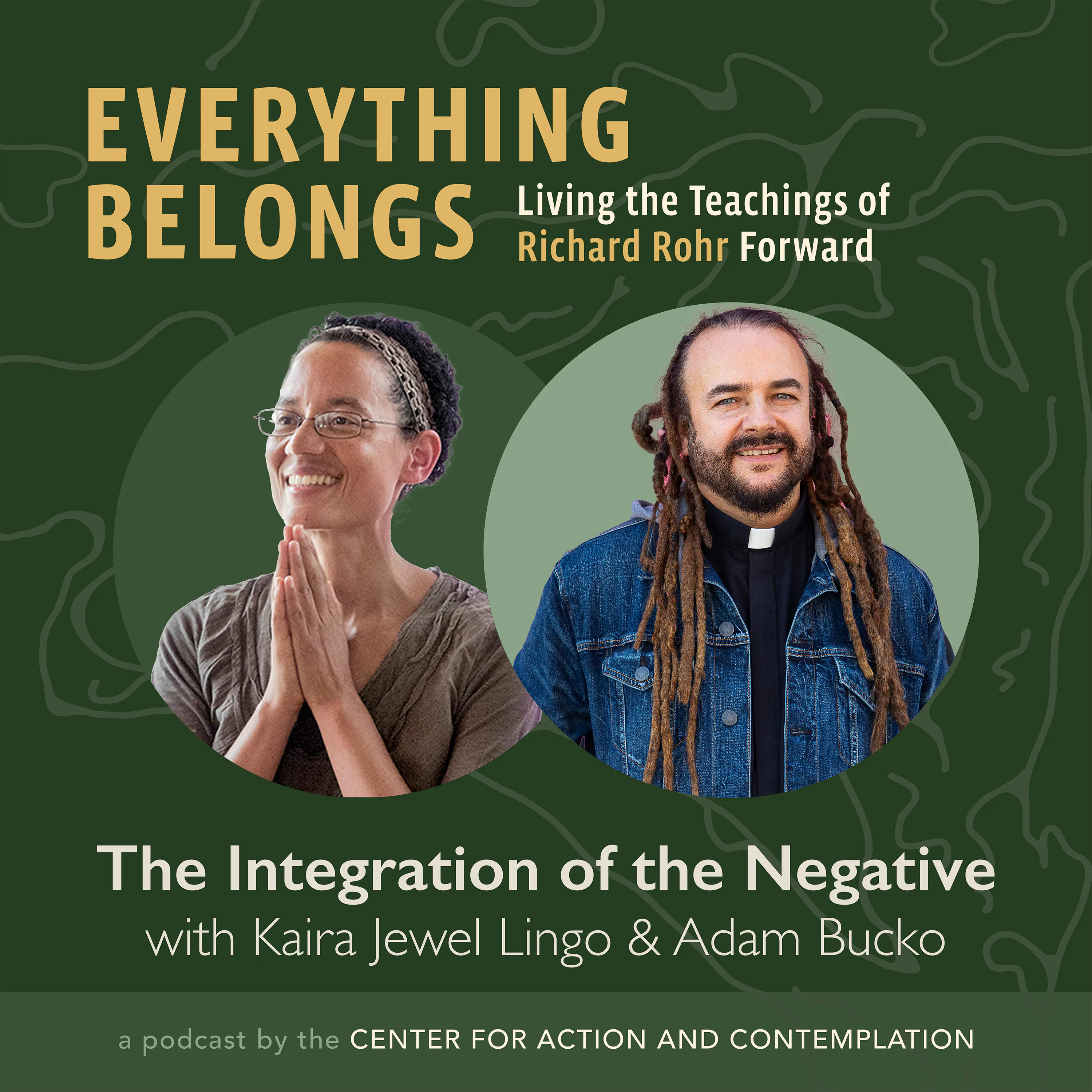
Everything Belongs: Living the Teachings of Richard Rohr Forward
The Integration of the Negative with Kaira Jewel Lingo and Adam Bucko
01:26:38
Loading summary
Transcript173 lines
- [00:00]
Kyra Jewel Lingo
You're listening to a podcast by the center for Action and Contemplation. To learn more, visit cac.org hey, friends.
- [00:08]
Mike Petro
Welcome back to the Everything Belongs podcast. We hope you've had a fantastic holiday season. We missed you. It's great to be here with you again, Mr. Paul Swanson. It's great to be here with you again, sir. I missed you as well.
- [00:22]
Paul Swanson
I missed you. Happy New Year. Good to be back together.
- [00:25]
Mike Petro
Right on. Right on. What a chapter to come back to. For those of our listeners who might be new, this is the Everything Belongs podcast. This is a podcast where we get to live the teachings of Richard Rohrer forward. So what we do together is we go through one of Richard's books. This season. We're looking at the book Eager to Love, chapter by chapter, Get a chance to go talk to Richard about that and then talk to some guests that can help us illuminate the chapter that we're looking at. But you absolutely do not have to be reading the book to listen along and probably to get quite a bit out of each episode. This week, we're back after the holidays to look at chapter seven, the Franciscan Genius, the Integration of the Negative. And goodness gracious, we have a great episode for you.
- [01:05]
Paul Swanson
Yeah, it's the combination of us first being in conversation with Richard and swirling around these ideas of what does it mean to integrate the negative and what does that have to do with genius? And how is this exemplified in the life of Francis and Claire? And of course, Richard sneaks in some Therese of Lisieux into the chapter. And as one of his favorite mystics, the conversation just, I feel like, explores territory that is natural to the everyday life and the foibles that we bump into by our own delicious and downright human way of interacting with the reality. What struck you about that conversation with Richard?
- [01:44]
Mike Petro
Well, first of all, what I appreciate and folks might not know is when we record these conversations, there's so much opportunity to deal with the fullness of reality, to integrate the negative by dealing with the technical challenges that we have, or the people who come to the door and knock in the middle of a recording, or Opie getting upset and barking at a duck or a bird or a car. It's this constant reminder to come back to loving everything that is. And I feel like this is one of the best undercurrents of literally everything Richard has ever taught in his entire career. So what a gift to do this while we talk about it with Richard.
- [02:25]
Paul Swanson
Yeah, it really is. The fertile grounds of contemplation is integrating the negative. Everything that comes our way over the horizon, whether you first see it as good, positive, neutral, negative, but the welcoming of it, the allowing it to be in relationship with you, is a way of embracing reality. And that is part of the Franciscan genius is seeing wholeness and wanting to live into wholeness and not parcel up life into what we think is good, bad or ugly.
- [02:56]
Mike Petro
Yeah, it's so true. And like, what better guests to follow that up than Adam Bucko and Kyra Duolingo, who once again bring so much in their individual expertise. But there's so much beauty in how they interact with each other. And in that recording, we also got the chance to deal with technical challenges and the sort of foibles of. I think when it was all said and done, they were sharing a laptop and sharing a pair of earbuds, one button each ear, and it was just so beautiful just to recognize not only the big, bolder imperfections, injustices and challenges that face us, which are so real, but also the little friction points, little challenges that show up every day and give us a chance to sit back and laugh at ourselves and remember, as Richard says so well, the only perfection available to us is to embrace and love imperfection.
- [03:47]
Paul Swanson
Yeah. And we, we were joking that it was Therese of Lisieux who was tangling cords and unplugging things as a way to remind us to follow the little way. Don't let these persnickety thorns that we try to remove allow them to be there, because it is part of the reality. There is no perfection that does not include imperfection. And I feel like she showed up and gave us an assist on that one.
- [04:15]
Mike Petro
Yeah, those saints are sneaky. And so we'd say to our listeners, as you're about to jump in the time machine and go back with us in time a few weeks to Richard's house and sit in this great conversation with us and then have this fantastic dialogue with Adam and Kyra to let everything going on in your life join the conversation and in particular, the little frustrations, the little challenges, the technical difficulties, the mix ups and mishaps that have been sort of in your life today and this week, let them be a place of sacredness and an invitation to encounter and learning. Yeah. As you join us in that place, because God knows we're bringing our own into the room as well.
- [04:54]
Paul Swanson
Amen to that.
- [05:01]
Mike Petro
From the center for Action and Contemplation, I'm Mike Petro.
- [05:05]
Paul Swanson
I'm Paul Swanson.
- [05:06]
Mike Petro
And this is Everything Belong, Chapter seven, the Franciscan Genius, the Integration of the Negative is what we're gonna be talking about today. Richard, thank you yet again for inviting us back into your living room. Thrilled to be sitting here with you and Opie, who's keeping a watchful eye outside just in case he needs to bark at anything. I have to tell you a story, Richard. This week, there was a group visiting on campus, and I had a wonderful conversation with a woman who told me that she was an Enneagram One and she'd struggled with being a perfectionist her entire life. And she said, I know that Richard is an Enneagram One.
- [05:56]
Richard Rohr
Yes.
- [05:57]
Mike Petro
And I assume he's struggled with that his entire life. And she said, is there a book Richard has written for Enneagram Ones? And I jokingly responded and said, probably everything Richard has ever written.
- [06:10]
Richard Rohr
Very good.
- [06:11]
Mike Petro
It's for Enneagram Ones.
- [06:12]
Richard Rohr
Thank you.
- [06:13]
Mike Petro
And maybe. Maybe Falling Upward might be especially helpful. And what we're talking about, this chapter, the integration of the negative. Richard, has it been hard for you as an Enneagram One, to wrestle with integrating and accepting the imperfect?
- [06:31]
Richard Rohr
It's been the center of my life. Inner struggle. Always seeing the wrong of everything and not knowing how to erase it or eliminate it or not let it drive the show in myself and in almost everybody else and everything else. Like these leaves I keep noticing in the cottonwood here in my front yard, in this branch that reaches out most closely to my porch. So many of the leaves are already starting to be eaten up. It's toward the end of the summer. And these beautiful cottonwood leaves, there's some little insect chewing on them, chewing on everything.
- [07:27]
Mike Petro
And does that bother you?
- [07:29]
Paul Swanson
Yes.
- [07:31]
Richard Rohr
Why did they take away the perfect leaf? I want it to be perfect.
- [07:37]
Mike Petro
Sounds like Jonah losing the vine at the end of the Jonah scene.
- [07:40]
Richard Rohr
You want it to be perfect.
- [07:41]
Mike Petro
You want it to be perfect, and you want people to be perfect. I appreciate the honesty in that. I think one of my favorite sentences that you've ever written is that the only perfection available to us is our ability to embrace the imperfect. Right.
- [07:54]
Richard Rohr
Inclusion of the imperfect. That's right.
- [07:57]
Mike Petro
I think about this moment in the life of Francis that's so moving to me, where he's really coming out of his rich, spoiled, noble phase and stepping into becoming the St. Francis that we will all know and love. And it's that moment where he rushes up and embraces the leper. Right. He's been afraid of lepers his entire life. He's looked away from them because they're potentially contagious, ugly, and smelly. Ugly and smelly.
- [08:24]
Richard Rohr
See, he was a seven. He liked pretty things.
- [08:28]
Mike Petro
And, yeah, might have been a four, I don't know.
- [08:30]
Richard Rohr
But, no, he wasn't a four.
- [08:34]
Mike Petro
But he rushes up and he grabs this leper. And he hugs him and he kisses him. Gives him some money. And that changes his life, I think.
- [08:42]
Kyra Jewel Lingo
Right.
- [08:43]
Richard Rohr
According to his own account in the Testament. What before was hateful to me. Became sweetness and light. Yeah.
- [08:53]
Mike Petro
And then he. He works with lepers, I think, for the rest of his life. Question, Richard, is. What has it been like for you to embrace the leper in your journey? How has it been for you personally. To really integrate the negative. And embrace what has been hard and ugly or unpleasant?
- [09:12]
Richard Rohr
I don't think I did it very well at all. In the first half of my life. I just. I kept seeing how we Franciscans were not living the life anymore. How the Catholic Church was not proclaiming the gospel anymore. And that became my instinct toward reform. But it also became an instinct toward righteousness. But I couldn't live built New Jerusalem or this place. If I didn't have that holy dissatisfaction. Holy dissatisfaction just has chewed me up. It's not supposed to be that way. That isn't it. That isn't it. And then the other voice. Well, who do you think you are? If people much smarter than you and older than you. Now, the trouble is, now I'm old. I used to defer to older people. Now I'm one of them. It was living in a holy tension constantly. That showed itself as being very pious and conservative. And I found out only in later years. Many of my guys who were in the seminary with me saw me as pious. I'd be in chapel at off hours of the day. Or walking in the cloister. Walk, saying my rosary. Really above and beyond the call of duty. And yet I didn't believe much that the community was emphasizing as important. I didn't rebel against it, but I didn't pay any attention to it. And that lasted all my life. Probably why I live here in Hermitage now. The regular community life. Forgive me, brothers, but it just bores me to death. The things we talk about and are concerned about. And the comforts we enjoy. I enjoy plenty here. So I'm in no position to deem superiority. But the present model of church. And the present model of religious life. Both seem to me unworthy of their magnanimous claims of us being the one true church. Which you Protestants had to suffer from. And religious life. That we're a refined version of the gospel. Well, maybe it Produced a number of people. Inside of every community, there's a number of people who are a refined version of the gospel. And that attracted me to the whole theme of the Remnant, because even with us, it was never the whole. It was just scattered. In each group were a few who got it, a few who lived it, a few who loved it. And when that became enough, when that became okay, I'm grateful for that. And I don't think I'm ever Opie.
- [13:00]
Mike Petro
Okay, thank you.
- [13:01]
Richard Rohr
Are you disagreeing with me?
- [13:03]
Paul Swanson
Opie's a Dominican.
- [13:05]
Richard Rohr
Opie. You're getting enough of it.
- [13:08]
Mike Petro
He's identifying himself as one of the few who get it.
- [13:10]
Richard Rohr
You know, what you can do is let him out. There's a dog walking through the yard. Undoubtedly.
- [13:16]
Mike Petro
Oh, my gosh, Opie. Thank you for defending us.
- [13:18]
Richard Rohr
It doesn't belong there. This is his yard.
- [13:21]
Mike Petro
It's imperfect.
- [13:21]
Richard Rohr
See, he's still a one.
- [13:23]
Mike Petro
He's still a one.
- [13:24]
Richard Rohr
A barking dog.
- [13:25]
Mike Petro
All right, don't go get in a fight.
- [13:27]
Richard Rohr
Do you see a dog out there?
- [13:32]
Paul Swanson
He's a tough guy.
- [13:33]
Mike Petro
He's just. He's just letting the world know that.
- [13:36]
Richard Rohr
He'S defending the yard. This is his yard.
- [13:39]
Mike Petro
He's growling at those.
- [13:40]
Richard Rohr
Hear him growling at those ugly leaves.
- [13:42]
Paul Swanson
It's a real motor he's got.
- [13:44]
Mike Petro
What's interesting, in hearing you talk about, I can't help but think of what we were talking about in the last episode, which is paying attention to different things, that alternative orthodoxy. And at the end of that episode, you talked about focusing on the path of descent and the little way. Did I?
- [14:03]
Richard Rohr
Yeah.
- [14:03]
Mike Petro
And how that takes us out of perhaps getting distracted by the wrong things.
- [14:11]
Richard Rohr
That's a good way to say it. Distracted by the wrong things. But it's an allowing. Like when I could allow in my little schema, my little narrative of the meaning of life, when I could allow a remnant to be more than enough, I was free. I didn't need every Francisca to buy into my vision. I didn't need every member of New Jerusalem to be turning in their paycheck on Friday nights. I didn't need the staff at CAC to all be contemplatives or even interested in it. Then I was free. So remnant theology yeast, to use Jesus word is very important for me, for my own liberation. Because if I'm going to wait for Christendom before I can be happy, I'm never going to be happy.
- [15:24]
Paul Swanson
This connects to something in the previous chapter, which I'm going to bring back to this chapter. But you Talk about these three freedoms of Franciscan spirituality, of making sure that it. It helps keep God free to do what God will do without cornering God into a box.
- [15:39]
Richard Rohr
God free.
- [15:40]
Paul Swanson
And keeping oneself free from within the structure to not be. Have to bend solely before the structures that be. Or an organization that there's. There's a freedom to operate. And the third freedom.
- [15:53]
Richard Rohr
Freedom to make mistakes. That's it. Yes. Freedom to experiment. Yeah. And that my whole life has ended up being.
- [16:02]
Paul Swanson
Which feels like how it should be as a someone on the Franciscan path. And then this third freedom of contemplative prayer to kind of connect those two, to make sure that you're keeping God free and how one relates and participates in God. That God is not bound. And also not to be bound to a structure and to allow the integration of the negative to be a place where God freely participates as well. And it takes a contemplative practice in mind and prayer to be able to see with God's eyes into those freedoms. I love that passage.
- [16:36]
Richard Rohr
Well, thank you.
- [16:37]
Paul Swanson
And, you know, you've talked about Teresa Lazieux and for a book on Franciscanism. You talk about Teresa a lot in this chapter.
- [16:43]
Richard Rohr
No, the Carmelite.
- [16:44]
Paul Swanson
Yes, the Carmelite. And you've talked about her little way. And I want to kind of connect the two, or ask you to connect the two between the little way and Francis, because you talk about how Francis kind of teed her up seven centuries earlier.
- [16:58]
Richard Rohr
That's it.
- [17:00]
Paul Swanson
And she's got this sweet little saying. And, you know, I struggle a little bit with her just because sometimes it does feel overly saccharine, but the sweetness holds such depth, too, that I don't want to lose just because there's so much honey in it. I don't want to lose the work that's been put into it. And she writes, you know, whoever is willing to serenely bear the trial of being displeasing to herself, that person is a pleasant place of shelter for Jesus.
- [17:27]
Richard Rohr
God. That's as contrarian as you can get. That's the opposite of the cult of innocence version of Christianity. Bear the trial of being displeasing to yourself. How many of us can do that? I will be pleasing to myself by being liberal or being conservative. Both are the same trap.
- [17:55]
Paul Swanson
What I think about with this quote and what you've been saying is it de Centers what we think of ourselves as being the North Star, good or bad.
- [18:03]
Richard Rohr
Yeah.
- [18:04]
Paul Swanson
And allows the negative to be.
- [18:06]
Adam Bucko
Yes.
- [18:06]
Paul Swanson
To be integrated in a way where the invitation is fuller. Participation. Not trying to pull the Weeds and wheat and separate them.
- [18:14]
Richard Rohr
Yes.
- [18:15]
Paul Swanson
But allowing it all to grow and forgiving reality for what it is. Wow. Where do you see any. Any further teasings out of, like, how Francis set the ground for Teresa to. To kind of see with her own Carmelite spirituality, these Franciscan roots?
- [18:33]
Richard Rohr
Well, if you read the book, not that you have to, it's not necessary for Sal, but chapter seven is called the Franciscan Genius, the Integration of the negative. There's two quotes that I begin with that I've treasured for years. When I first did a critical study of Francis's writings, there's one of his writings is a letter to a minister, and there's a quote. You can show your love to others by wishing that they should be better Christians. That's the way it was given to us. And the scholar who taught said it is universally agreed. From the oldest text we have of that. There's a knot in there, and it was blocked out. Wow. You must show your love to others by not wishing that they should be better Christians. Wow. Makes 10 times more sense. But to the pious observer, oh, you show your love. I wish you were a better Christian, Blake.
- [19:48]
Mike Petro
I know. I'm working on it, Richard. I'm working on it.
- [19:50]
Richard Rohr
How is that showing love to anybody? It's just brilliant. Then Thomas of Celano was the great first biographer. In his second attempt at it, his second Life of Francis, he says, we must bear patiently not being good and not even being thought good. Now that I don't think they tried to change, but they just ignored. We must bear patiently not being good. I mean, I get great satisfaction at night when I lay on my pillow that I've helped somebody today and that I've had holy thoughts and didn't commit adultery. Bear patiently not being good. That's almost identical to that quote from Therese that you read. And I'm not aware that Therese had any great devotion to Francis, but she wouldn't have had a critical life of him. And not even being thought good. How consoling it is that everybody thinks you're good. Yeah, Comfort. What codependent comfort that is. Everybody thinks I'm really good. But take both of those away. You've taken away most people's ego structure.
- [21:36]
Mike Petro
Yeah. Well, it sounds to me. Like you mentioned ego structure. This sounds to me a lot like Jungian shadow work.
- [21:44]
Richard Rohr
Of course. But that's from Thomas of Celano's earliest first Life of Francis.
- [21:50]
Mike Petro
Wow.
- [21:51]
Richard Rohr
Not being good. I'm not that good. Only God is good. He quotes that in another place. And not Even being thought good. Mind blowing.
- [22:04]
Paul Swanson
Yeah. You know, I think about those quotes and how there's a necessary healthy ego structure that needs to be in place before you cannot think of yourself as good. And so I think about those who are in a place where they have a healthy ego structure. How would you, Richard, invite them to integrate the negative into their own lives, into living, into a whole heart?
- [22:27]
Richard Rohr
If I were their spiritual director, I would tease out of them any experience of failure or falling or sinning. How do you deal with your own sin? How do you deal with your own failure? And there it's all going to be encapsulated. How is your ego structure built on your own perfection or God's love of you? God doesn't love you because you're good. God loves you because God is good. That's the big transfer that has to be made. And most of us think well of ourselves. I know I do, because I feel I've done something good with my life. I became a priest. And to draw satisfaction from that is wrong, wrong, Utterly wrong. That's when you get into radical Christianity, when you can accept that switch.
- [23:37]
Mike Petro
It's been interesting for me the last few years because I've had a really hard, like, I can talk about imperfection till cows come home, loving my imperfections. Sin's been a real hard thing for me to talk about after I deconstructed my inherited faith tradition because it was used as such a weaponized way. And recently I've come around to thinking if my thought about my faults, my failures, my sins and my imperfections is anchored in this counterbalancing sense of my being overwhelmingly beloved.
- [24:07]
Richard Rohr
There you go, then. Why not keep going?
- [24:11]
Mike Petro
Then it makes it safer to do the work and to see my imperfection.
- [24:16]
Richard Rohr
And joy has a different foundation. You switched to your satisfaction really does come from God and God's goodness and not your own. And that very idea never even occurred to most Christians I've met. Not because they're bad, because no one ever taught that to them. You got to be good. That's first half of life. So God has to insert in your life some areas where you just can't be good. You're inherently judgmental, critical, lustful, covetous, arrogant. Arrogant, yeah.
- [25:13]
Paul Swanson
Well, thank you, Richard. You've given us, and I'm sure everyone listening a lot to chew on.
- [25:18]
Richard Rohr
And you ask so. Well, I say it better than usual and you two ask it. Thank you.
- [25:25]
Paul Swanson
Thank you, Richard.
- [25:26]
Mike Petro
It's a pleasure. Everything belongs. Will continue in a moment. Friends, today we are joined by two profound spiritual teachers who also happen to be a married couple. And I have to say their relationship is a teaching in itself. First and foremost, we're joined by Father Adam Bucko, who's a committed voice in the movement for the renewal of Christian contemplative spirituality and the growing new monastic movement. He's taught engage contemplative spirituality in Europe and the United States, and his most recent book, which is fantastic, is Let yout Heartbreak Be youe Guide Lessons in Engaged Contemplation. His work has been featured in major news outlets including Harper's Magazine, New York Daily News, and Sojourner Magazine, and he currently serves as a director for the center for Spiritual Imagination and the Cathedral of the Incarnation, serving Brooklyn, Queens and Long island in New York.
- [26:41]
Paul Swanson
The other half of that relationship is Kaira Jewel Lingo, a much loved Dharma teacher who has been practicing mindfulness since 1997. She lived as an ordained nun for 15 years, during which time she trained closely with her teacher, Venerable Thich Nhat Hanh. Her teaching focuses on activists, educators, artists, youth and families, and black, indigenous and people of color, and includes the interweaving of art, play, nature, ecology, and embodied mindfulness practice. Kairo Jewel teaches in the Plum Village Zen tradition and in the Vipassana tradition. She lives in New York. Her most recent book, co authored with Valerie Brown and Maricela B. Gomez, is Healing Our Way Home Black Buddhist Teachings on Ancestors, Joy and Liberation Adam and Kyra Jewel, welcome to Everything Belongs. It's a joy to have you here in conversation as we explore the themes of Richard's book, eager to love and particularly focus on chapter seven, the Franciscan Genius, the Integration of the Negative. It's so great to see you both. How are you guys doing today?
- [27:58]
Adam Bucko
We had some tech problems as you may recall from a few moments ago, so we're showing up in all of our imperfections.
- [28:09]
Kyra Jewel Lingo
Just perfect for this conversation.
- [28:12]
Paul Swanson
I couldn't agree more.
- [28:14]
Mike Petro
Oh gosh, it's so great when we talk about the integration of the negative. I know there's so many big things and so much suffering in the world, but it's also the minor inconveniences and the challenges. I'm reminded of Carl Jung saying that everything that irritates us can lead us to an understanding of ourselves. So thanks so much everyone for being in this space with us. I can't wait for the conversation that's about to unfold.
- [28:41]
Adam Bucko
Thank you for having us here.
- [28:42]
Paul Swanson
Yeah, it's a privilege and a pleasure and a fun thing for us to begin off with whenever we have guests on is just to kind of find out origin stories around one's first encounter with St. Francis or the Franciscan values. So I would love to ask both of you, when did each of you come to discover St. Francis or Franciscan values in your own life experience?
- [29:08]
Kyra Jewel Lingo
So I remember we would sing St Francis's song in the monastery in our Buddhist Plum village monastery. And this song, if you want to live life free, take your time, go slowly. It might have been from the song Brother from the movie Brother Sun, Sister Moon. I'm not sure, but I know we watched that film as monastics. We were in love with that film. And we actually visited a Franciscan monastery in Italy when we traveled on a teaching tour with Ty. And we were all so happy to be in brown because our robes were brown. Their robes were brown. And it was this lovely encounter. And we were all so pleased with each other. And I remember being so impressed that the monks had a cappuccino machine. All of us, we didn't have anything that luxurious in our Buddhist monastery. We just had tea. So we were like, wow, they have a cappuccino machine. It was Italy, after all. But I do also want to share that Jim Forrest, in his book about Thich Nhat Hanh, Eyes of compassion, talks about how when thay was young, he loved hearing stories of St. Francis. That was a beautiful thing that Adam reminded me of.
- [30:28]
Adam Bucko
Yeah.
- [30:28]
Mike Petro
Wow.
- [30:29]
Paul Swanson
That's so great. Adam, how about you? How did you first encounter St. Francis?
- [30:35]
Adam Bucko
You know, growing up in Poland, I probably. I must have seen his, you know, paintings of St. Francis and statues of him, But I don't really remember any of that. The first image that I remember is in 1980s, my parents and I went on a pilgrimage to the shrine of the Black Madonna of Czestochowa. And at that time, it was still before the communist system collapsed. So it was really going on a pilgrimage. There was this sort of act of resistance. And I remember being there and seeing all kinds of pilgrims walking into the city and approaching the shrine of the Black Madonna. And I saw this group of Franciscan brothers who were walking barefoot, and all of them had long beards and long hair. And I was just like, holy crap, what is that? You know, who are those guys? And they just seemed so free, and they were accompanied by a lot of young people. And so that, for me, was this kind of striking image that really just stopped me and made me think, because, you know, on one hand, there was this official church with all the clergy, nicely dressed, you know, beautifully polished sermons on the other hand, were those guys who just seemed like. I didn't know what to make of them. But it was inspiring that someone could be so free in such a, I don't know, holy place. But at the same time, you know, their freedom was just like, it was fitting in very well, but it was so different and so countercultural. So I think that was my first really encounter where I started wondering, who is this Francis of Assisi? And later on, I remember my grandmother sent me a book in Polish. By then, I was already living in the States, the flowers of St. Francis.
- [32:43]
Mike Petro
I'm so excited to get to join this conversation with the two of you because one of the things I've appreciated in the last year is that in rebuilding the Living School here at the CAC and in our Essentials of Engaged Contemplation course, you both show up and share two beautiful conversations with us. And so I actually am going to have a question for each of you based on that. I can't help but think as we're starting off talking about the integration of the negative. And, Adam, you've referenced your upbringing in one of those other conversations. You made a comment that intrigued me when you said that growing up in the culture that you grew up in, and we were talking about great love and great suffering in that conversation, you said, growing up in the culture that you grew up in, you are actually more acclimated to finding the value in suffering and hardship than love and beauty. Would you share a little bit with our listening audience about that and how sort of how it acclimates you to the integration of the negative?
- [33:38]
Adam Bucko
Yeah, you know, my wife and I, she's via positiva, I'm via negativa. I think that that's how it works. And when we're on our best, we help each other to stay balanced. You know, I think, you know, when you look at Polish saints, all of them have been like martyrs. There is this sense of, you know, that all of us, you know, because Poland has such a kind of traveled history, and just recently I saw some statistics that between 1939 and 1989, in the land between the two totalitarianisms, between, you know, what was Soviet Union and Germany during 1930s, almost 20 million people were killed. So think about it. That's a lot like the land of my childhood was stained with blood, Polish blood, Jewish blood, Russian blood, German blood. And I think there was just this sense of trauma that lived in us, but there was also this sense of that pain can be sacred, that the pain that we Feel is connected to the heart of God, the heart of God that is breaking because we're in such pain, and God is feeling that deeply as well. So for me, pain early on was just really a doorway to the sacred. You know, I think later on, when I worked with young people experiencing homelessness on the streets, I realized. And that was really when I learned the meaning of contemplative prayer. Even though I studied contemplative prayer in other settings, it's really by accompanying people into the depths of their pain, removing all the buffers, and sometimes sort of breaking with them in that experience of suffering. I realized that when that happens, when our operating system cracks, there's an inflow of the Holy Spirit that just sort of flows in or arises in us. And we can consent to that because it always is interested in picking up the broken pieces of the world of ourselves and reassembling all of that into something that in us can become a gift that we can offer others, you know. So in that sense, I think via negativa or the negative has always been an entry point for me. At the same time, when I think about my journey, especially being in therapy in my 20s, having a therapist who was both a Jungian analyst but also a Zen teacher, I realized that on a spiritual journey, I was identifying with some kind of an ideal spiritual Persona that was in me. And I always wanted, like, seven steps to fix that Persona so it could. Could get enlightened. And what he helped me to realize by essentially helping me to undermine my sense of identity, is that within me, there are many different Personas or persons floating around. And each of them was equally real and equally helpful and equally needed if I can allow them all to speak to each other. You know, the crowd within me that is sort of competing for who's gonna get the mic and be in charge once they're brought into a relationship, that crowd can be converted into a community. And all of a sudden, things that we are afraid of, things that I wanted to push under and dismiss, become sources of empowerment and creativity and et cetera. So that was also very helpful. I'm not quite sure how all of this connects to your question, but that's what's arising.
- [37:44]
Mike Petro
No, that's profoundly insightful. And I appreciate the. As a fellow Jungian, I appreciate the insight that converting the crowd and the chaos inside of us into a community probably lends itself to us, creating community around us, I would imagine, in the midst of chaos and suffering. And I have appreciated the community that the two of you create together in your relationship and when you share the gifts of that with us. So thank you.
- [38:10]
Paul Swanson
Thank you, Adam. Something that you were just talking about around the brokenness is this entry point to kind of deeper connection with prayer and the way that there was this Persona of perfection that you were maybe idealizing and seeking to become. There's so many ways in which that feels like one of those threads throughout this chapter of perfection and imperfection. And Richard brings up Teresa Lisieux around the little way. I'm wondering how does Therese's spirituality speak to both of you and your own distinct spiritual paths and the overlapping ways that you share in that essence of a spirituality of imperfection in that same spirit?
- [39:00]
Kyra Jewel Lingo
I really loved this part of the chapter. And I actually, the summer I first went to Plum Village, I went to Lisieux in France, and I visited the grotto dedicated to Saint Therese of Lisieux, and I read a little bit about her. There was Pilgrim's welcome, like, house and a library. Anyway, that was, like, very meaningful to get to actually connect with her spirit there. I remember when I. When I was about to ordain as a nun, I had just so idealized all of the monastics, and I was expecting to become this angelic, completely peaceful person, like, as soon as I shaved my head and put on the robes. And in fact, the opposite happened. I found myself, you know, as a layp person living in Plum Village. We had the lay quarters, and we had, you know, freedom. We could come and go. And, you know, suddenly I was a nun, and I was in this much more tight quarters of the sisters. And there was a sister or two that I felt, you know, uncomfortable with. And you turn around in the bathroom, and there they are. You turn around in the common room, and there they are. And then they're in the dining room. And I just found myself, like, so much more irritable and angry and frustrated. And I was like, wait a minute. This is not at all what I thought was going to happen when I became a nun. And. And then I remember having this insight that, like, this was exactly why I had ordained, so that I could see all of these. You know, we call them seeds in Buddhist psychology. When they arise, you see the seeds of suffering, so that, you know, if. If I can't see them, I can't transform them. It was like I had wanted to do this big spiritual bypass unknowingly, right by thinking I would just always be peaceful as a nun. And it was like, actually, no. The whole purpose of becoming a nun, I realized very quickly, like, A month or two into this, I was like, oh, no, this is the whole reason is to see these things clearly, to see all the things that need to be transformed and, and held in humility and love and compassion and. And not judged. Like, I realized none of this was wrong. You know, I was exactly where I needed to be. And that's just a really beautiful teaching in, In Buddhism is that everyone has all the seeds. So there's this. In Buddhist psychology, there's 51 or 52, depending on which Buddhist school you're talking about. Everyone has all these seeds. They're wholesome seeds, unwholesome seeds. And all of the. The unwholesome seeds can be transformed. They're. All the seeds are organic, just like the wholesome seeds, they can get weaker if we don't cultivate them. But the unwholesome seeds, you know, the seed of violence, it can be transformed into compassion. And all of us have that capacity. So, yeah, this. This kind of seeing, you know, this most beautiful teaching of. Of Thai that we need our suffering, we need our. Our weakness, our unskillfulness, because that's actually the fertilizer for our awakening. So it's this sense of like, we. We need all these things that are in us because that becomes the compost for the flowers. So we don't want to push out away our suffering. We don't want to try to, you know, exile it, get rid of it. We actually need it. That is our very path of awakening. So another way that we often talk about it in the Plum Village community is no mud, no lotus. A lotus doesn't grow, you know, on marble, on sandalwood, on beautiful things. It grows in mud. So the lotus being the symbol of awakening in Buddhism, mud being all of our suffering. So it's really because of our suffering that we have the opportunity to awaken.
- [43:11]
Mike Petro
It's so good. No mud, no Lotus is my favorite of Thich Nhat Hanh's books. Adam, before you answer, this is great. Paul, this is a great chance to bring my other question. In Kaira Jewel, when we did the Essentials course, you shared this story, and it was just a little story, but I found it so inspiring about talking to your mother when you chose to join the community and she had some concerns and you shared with her about the Bodhisattva path and what it really meant that you were stepping into this community to take the vow of the Bodhisattva. Would you share if that resonates, if you remember what I'm talking about? Would you share a little bit with our audience about that?
- [43:50]
Kyra Jewel Lingo
Sure, yeah. So when I wanted to become a nun, so my parents had kind of taken Christian Bodhisattva vows. I mean, they lived in a community where they took vows of poverty and obedience, and we lived super simply and kind of against the stream. So that was her context. So when I said I wanted to become a nun, she was like, well, my only concern is, is that you will be hiding from the world, you know, escaping the world. And I said, actually, mom, it's the opposite. This vow, this. You know, this path to become a monastic is. Is taking the Bodhisattva vow of cultivating our own mind, of awakening and supporting all beings on their path to awakening. And it's totally a path of service. It's not one of abandoning the world. It's actually one of giving ourselves to the world 100%. And when she heard me say that, she was like, okay, I'm totally behind you. Go for it. So that was all she needed. And. And we were. We were on the same page from then on.
- [44:55]
Mike Petro
That's so great. I so appreciate that, and I appreciate what you just shared about giving yourself to the long, slow path of seeing the seeds. And I remember just a little bit later in that same conversation that I referenced, you said, in this Bodhisattva path, it will take countless lifetimes. And I think you said to help folks cross the river from suffering. And in the face of looking at. We have so much growth to do on our own, and there's so much suffering in the world. I so appreciate that long perspective of being willing to commit to the long game. Would you tell us a little bit more about that notion of taking countless lifetimes?
- [45:37]
Kyra Jewel Lingo
Yeah. You know, really, it's a teaching on not being attached to outcome and just not being attached, period. Like, you know, this whole spiritual endeavor is about letting go, letting go, letting go. That's all. But St. Francis, Sinclair, and Therese all talk about. But there's a beautiful poem in the Zen, Japanese Zen tradition saying, the many beings are numberless. I vow to save them. Greed, hatred, and ignorance are immeasurable. I vow to abandon them. It's like saying these things will constantly keep arising like it's almost an impossible thing, like what you're saying. But it. It's acknowledging the hugeness of the task, our smallness, and it's really like letting go of the self in that moment to say, it's not about me. It's not about a deadline. It's not about a timeline. It's not about success in any worldly sense. It's like, as long as there's suffering, I'm going to be there to support people and myself. Right. Because there's probably endless suffering in ourselves until we awaken. And so it's just this, like, boundless vow of wherever they're suffering, I'll keep coming back. I'll keep being there, keep trying to be responsive, knowing that I'm not going to end it, but I'm going to keep giving my heart, giving my best to. To respond compassionately wherever they're suffering.
- [47:15]
Mike Petro
Oh, that's so good. Thank you so much. Gosh, I'm so moved by the encouragement to do my part in the healing work and also to let go of my own heroic notion that I'm going to fix it all or solve it all. Goodness gracious, Paul, I hijacked your question before you could ask Adam to respond. Back to you.
- [47:37]
Paul Swanson
Back to Adam. Adam, what do you think when it comes to the sense of perfection and imperfection and the little way of Therese, how has that been part of your own? Kind of like that image, Kyra Jewel, that you said about the composting of the Persona, and then how that even becomes food for the seed and how our projected perfection can actually be a part of our spirituality of imperfection, of letting go. How has that shown up in your life, Adam?
- [48:07]
Adam Bucko
The St Therese has been sort of kind of my. My family's patron saint. I remember, you know, when my father was leaving the country, we all did the St. Therese Novena for, like, I don't know, 10 days, you know, on our knees every day. And it was all kind of in secret because what if the government comes to confiscate human, his passport, he's not going to be able to leave and all of that. So at that time, St. Therese was this sort of a lovely presence, either imagined or maybe we felt her in some way. But the older I got, the more I actually appreciate her actual teaching, you know, sort of taking away the sentimental from her teaching. And I wanted to share this particular quote from her that has been really important to me. You know, this is what she says. Jesus set before me the book of nature. And when I looked at it, I understood how all the flowers God created are beautiful, how the splendor of the rose and the whiteness of the lily do not take away from the perfume of the violet or the simplicity of. Of the daisy. If every tiny flower wanted to be a rose, spring would lose its beauty and there would be no wildflowers to adorn the meadows. And so for me, you know, this quote has been very beautiful because. And of course, for St Therese, it comes in a very specific context. You know, she's reading about St. Augustine, she's reading the Imitation of. Of Christ, she's reading about St. Teresa of Avila and John of the Cross. And she too, wants to become this great saint, like all of those ancestors of her, right? And she realizes that she's powerless, that she's not able to do some of the things that those other people were able to do. And that's when she comes up with this beautiful teaching about the elevator. You know, she says, and she lived in 19th century, so she says, well, you know, if you go to some homes of some wealthy people, you no longer have to take stairs. They have this thing called an elevator, and that can take you to the second and third floor. And so even if you don't have the muscles, you know, to make it to the second or third floor, somehow this little device, you know, can take you there. And she said that that was her discovery of the little way that instead of striving and trying to become perfect, we can just accept our imperfections, we can just accept our powerlessness. And then God becomes the power in us. All we have to do is just consent to this motherly presence that can sort of love us up, you know, and take us and transform us into who we need to be. And so for me, that is very encouraging because I feel like every day, you know, I fail at some things. Every day, things arise in me that, you know, are difficult to bear. Every day I see things in the world that just simply break my heart. And there's no way that I can change many of those things either within myself or in the world. But somehow, if I can come to terms with my inability, if I can come to terms with my powerlessness, all of a sudden I create space for God to be the power, for God to be the actor, for God to take over this little body of mine and use it in some way or form. So to me, that teaching has been very important. And I think the initial big lesson was again, when I worked with young people struggling with homelessness. Initially, you know, I wanted to be the expert who can help people fix their lives. And I was failing miserably. And it's only when I understood that I needed to show up for every person, in the same way that I show up for prayer, which is in this state of curious not knowing, in this state of powerlessness, in this state of complete understanding that I am nothing really. That somehow the spirit of God can do something with this nothingness and turn it into somethingness in a way where it can be useful. So that's been a big teaching for me. And I feel that, you know, we're so blessed to have St. Therese, and we also are so blessed to have Richard, who really popularized her teachings to so many, you know, even outside of the church circles.
- [53:18]
Kyra Jewel Lingo
And I wanted to just acknowledge another moment of imperfection of mine. I realized I didn't go to Lisieux. I went to Lourdes. That same thing.
- [53:28]
Adam Bucko
I totally knew that I was not there.
- [53:30]
Kyra Jewel Lingo
I was like, wait, what?
- [53:32]
Adam Bucko
The moment you said grotto, I'm like, okay, she's talking about Virgin Mary.
- [53:37]
Kyra Jewel Lingo
So there you go. My imperfection revealed.
- [53:42]
Paul Swanson
That's great. This reminds me of one of Richard's things that he talks about, about how he seeks out a daily humiliation each day as a recognition of his own need to be reminded of the guideposts on Little Way.
- [53:56]
Adam Bucko
I mean, doesn't this chapter say something how the only way to do is to just really accept our little, maybe small and big humiliations every day?
- [54:08]
Paul Swanson
Every day, yeah.
- [54:10]
Adam Bucko
Give me more.
- [54:12]
Mike Petro
I always tell Richard I don't have enough ego strength to ask for a humiliation a day, but I'll settle for asking for a chance to laugh at myself and have a moment of humor at least once a day.
- [54:22]
Adam Bucko
That's so lovely, actually, and I think so much easier to, you know, thank you for that, Mike.
- [54:30]
Kyra Jewel Lingo
It reminds me of my. A quote in. In my book, We Were Made for these Times. Opening quote from a Tibetan prayer. I don't have it exactly, but something like, grant that I may have the sufferings in. In right measure, you know, that I need to awaken, to continue to. To be on this path of. Of liberation. So it's actually requesting that those things come to us because we know they. They mature us, they ripen us.
- [55:08]
Paul Swanson
The one theme in that that I keep hearing throughout this is just this return to humility, like that. That spaciousness of littleness, limitation, inability, and none of those bar ability or power or possibility. But there's. There's a right sizing of ourselves within a larger community, a larger ecology. And, Adam, when you were talking about your work with the young folks, I would love to hear a bit more if there's any story that comes to mind around how, from approaching your work with those young folks from this posture of humility. And as you approach prayer, how did that change in how you were able to step into that role and step into that work from a different. You didn't say savior complex before, but I almost heard you about to say that, I swear, before. You talked about, like, how you were first approaching and how you later kind of enfolded your way from a very humble, humble transition.
- [56:09]
Adam Bucko
Yeah. I think it was Mother Teresa who said that you can become a pen with which God can write a love letter to the world. And I think that when we approach things with humility, coming to terms with our inabilities, with our powerlessness, something happens. And the work that is being done happens through us, but also to us. And that was my experience, you know, once I came to terms that I have very little to offer. And that doesn't mean that our skill sets are not helpful sometimes. It's just that we need to somehow decenter them and put them aside and create enough space for that impulse of God to arise in us. So the right words, the right way of seeing, the right interventions can just sort of spontaneously happen through us. But the trick with that is that then if we work in that way, we can't take too much credit for it. Because it's not really clear who's helping whom. Because oftentimes I felt like I've received just as much, if not more, than what I was able to offer. There's this sense of mutuality that, you know, whatever this thing is, it's also working on you. So for me, that was big shift in my work and also in my prayer. Because I understood then that to have a contemplative life. To have contemplative prayer is to be constantly. Or to live in a state of contemplative prayer is to be constantly living in that state of receptivity, curious, not knowing, bearing witness, and then also consent whenever the impulse of God, the presence of God. God is so kind of, you know, is felt in our lives. And that was a beautiful lesson. Of course, it doesn't mean that that's something you learn once and for all. It's a daily practice. And I think I know I have a tendency to keep on, you know, recreating myself and recentering myself. And I think that that is the work to constantly, as Kyra Jewel said, what this chapter sort of points to. The constant letting go.
- [58:37]
Paul Swanson
Yeah, that constant letting go and the ways that we consent to it. And slowly, over time, are sometimes able to see our own transformation or hear it reflected back in community. And something that the two of you helped me see. Externals can help our internals. Where you've mentioned the patchwork of Francis on his robes that he had this done to reflect what is like on this inside and how the Buddhist patchwork of his robes were taken from garbage heaps. How do you see those as instructive for how one might consider the pairing, the marrying, the integration of the external and the internal, of how one goes through their own humble walk in this way of integrating the negative.
- [59:27]
Kyra Jewel Lingo
I love reading the stories of St. Francis and how much he emphasized not lifting himself up, not being lifted up. I just want to read this from the chapter from Saint Therese of Lisieux. Whoever is willing to serenely bear the trial of being displeasing to herself, that person is a pleasant place of shelter for Jesus and I. It made me think of how when I was a nun, at the end of each three month rains, retreat, or sometimes we called it the winter retreat, which was the time in the year where as monastics we didn't travel and we kind of made a vow of stability. We all stayed in within the boundaries of the monastery, except for the shopper and if you had a serious doctor's appointment. And we really practiced more intensively together and studied. And at the end of that retreat, we always did the practice of shining light, which was where as nuns in our little hamlet, say 30, 40, 50 nuns, everyone gave everyone else feedback. We sat in a circle and when it was your turn, people had prepared, they were, had thought about what they felt were your strengths, what they felt were your weaknesses, and they told them to you. And someone took notes and you got a letter, a shining light letter at the ceremony that closed the winter retreat. Sometimes people didn't see their positive qualities clearly and it was very healing and helpful to have people point them out to you and to see what was appreciated also so you could know what to do more to make people happy. You got very concrete feedback. But then also we always took it as a real gift to be shown our blind spots. And we would kneel in front of the community on our knees and, you know, palms join and say, please shine light on me, please, you know, show me what I can't see about myself. And the practice for everyone was not to, you know, if you had a grudge against that person, this wasn't the time to let them have it. Like, we tried to really also be very, you know, discerning in what we would say. Like, we would never say something to hurt someone. We would only say it if we really, if it was coming from compassion and care and love. And we really just wanted that person to be even more beautiful in the Sangha, in the community. Not because we wanted to, you know, straighten them out or something, but so to get that from so many people every year, it was so profound. It was such a great support for each of us to kind of see those areas that were in need of more attention and maybe pruning as real blessings, as real, you know, like we. Then it was really clear for the next year what our path of training needed to be. When I read about that, the patches of St. Francis, it made me think of also the Buddha's robes in the time of the Buddha and, you know, many generations after that, which were all patchwork robes. So the monks would. And nuns would take pieces of scrap cloth from garbage heaps, you know, and refuse piles, and they would sew them together into a patchwork robe. And what was also the beauty of that image was if you go up high in India and any of the rice cultivating countries, and you see the rice paddies, they look like the patchwork robe of a monastic. So it was this also, this another way to be humble, to be like the earth, to be close to the peasants and the, you know, farming people, that what I wear on my body is. Is the way our culture and society, our earth looks.
- [63:37]
Paul Swanson
It's a marvelous, marvelous image. I think that it paints a vivid picture. And to hear about your community's practice, the holding of the external and the interior, and how those are gifts built on trust from that sense of stability. Adam, how about you? What comes to mind from the sense of the patchwork and the external enfolding into the internal and vice versa?
- [64:01]
Adam Bucko
You know, when I was training for priesthood, I was sent to a very old school, sort of quasi monastic community training place. It was that. And we were surrounded by just, you know, corn fields. And I remember this experience where I was. And, you know, I was a little bit older than most of the other people who were training. I've already had a life. I felt I knew how to do certain things. You know, I mean, I used to run an organization before that, so. And I remember the. The job that was assigned to me was to clean bathrooms in the library. And I was quite happy with that because I thought, I'm going to be surrounded by books, it's going to be very quiet. And so I loved it. And so then this guy comes in who's like his early 20s, and he's telling me, you know, how to clean bathrooms. And then he's standing there watching me, and I'm like, come on, dude. Like I know how to clean bathrooms. I've cleaned plenty of bathrooms in my lifetime. You know, you can just go and relax, you know, have tea or something like that. He's like, no, no, no, no, no, no, no. You think, you know, we have a very specific way of dealing with the toilets and the floor. I was just like, are you kidding me? You're a kid, you know, but it was sort of learning humility by humiliation. But I think, again, the sense of getting you into a mindset, that you were constantly being offered feedback. So, you know, in my training for priesthood, every time I opened my mouth, you know, reading prayers in the chapel, I would receive a little, little slip, you know, a little note in my mailbox, someone evaluating me. When I was assigned to ring the bell each day, especially the Angelus prayer, you would. It's a very specific way of doing it. And everyone else would stop. The whole community would stop and pray it in silence. I would get feedback as to whether the way I rang the bell, whether it corresponded to the prayers everyone was saying, you know, whether the rhythm was correct. And initially it was just crazy. I mean, I got very anxious. I felt sort of that it wasn't a very good thing. But after a while, when I realized that a lot of that feedback was actually being offered with love, I got to a place where I was looking for feedback. I was excited for people to show me things that I was not paying attention to. And in fact, I think that this is one of the difficulties with our spiritual journeys in this day and age, that so much of our journey is very kind of individualistic and sometimes for the right reasons. You know, we leave our churches, we leave our communities because some of them have been very toxic and not helpful at all, or maybe even. And harmful. But this is the beauty of being in community, that people can offer us both love and appreciation, but also speak truth to us when we need to hear it. And if we know that they are doing that with integrity, it's such a tremendous gift. Like Kairo Jewel said, you know, it really sort of directs your process of training. And so we try to do that with ourselves because, you know, we are a community at home, and our home is sort of a little, you know, ashram or something, at least with, you know, with our doggie too, even though she sort of practices with us too.
- [67:59]
Mike Petro
Oh, gosh, I love that so much. Friends, we could talk about this all day. We're just about out of time, but I'd love to. To close with just one more question about what you're sharing as we talk about community and talk about these patchwork robes that are sewn together from scraps, I can't help but connect that to what you said at the top of the call, Adam, where you've talked about taking the crowd inside of us and the chaos inside of us and turning that into a community and recognizing that some of the communities we find ourselves in require the same work. And seeing that you're doing that work together in your relationship and in your marriage.
- [68:37]
Richard Rohr
What.
- [68:37]
Mike Petro
What parting wisdom would you give our listeners for embracing the imperfection in themselves and especially in bringing the community that they are to the communities around them, which are, I'm sure, profoundly imperfect and embracing the negative?
- [68:54]
Kyra Jewel Lingo
Yeah, I think the smile is really important as a spiritual practice. When we see something arising in ourselves that maybe painful or embarrassing or, oh, my God, I can't believe I said that. Or this smile of the Buddha, the smile of someone who we can relate to, who's really not that caught up in the things that we're caught up in. And just this. The gentleness of the smile to be like, yeah, like, there. Whoops, I did it again. Or, you know, kind of.
- [69:30]
Adam Bucko
That's a Britney Spears song.
- [69:35]
Kyra Jewel Lingo
But just this kind of acceptance and lightness to. Yeah, I'm gonna. You know, if we just start. Start our day knowing we're gonna make mistakes today, we're gonna. We're gonna drop the ball. We're gonna, like, that's just a fact. And rather than brace ourselves and, you know, stiffen up trying to prevent it, like, to soften and loosen and just know, how can I learn from that? How can I grow from that? How can I give myself. Myself grace and give others grace, knowing that we're all doing our best? You know, that's one thing that a sister, our Abbess, said one time we were having a work meeting, gathering to then go off and do work, and she just gave us this beautiful teaching. She said, you know, everyone is always doing their best. So a smile, you know, for ourselves, for others, can really help us show up a little more gently, a little more flexibly for ourselves, but also, you know, with others in this kind of yielding way. Like, I. I like. One of the kind of guidelines we have in a lot of our communities is to assume good intentions rather than coming in, you know, with a lot of putting people in. In a kind of box that they must be thinking this if they're doing this. But to, like, what would it mean to say, well, what if I assumed. I mean, if we know very sure, for sure that they don't have good intentions and this doesn't count. But if we don't know, then to just assume good intentions and notice how that shifts our own, our own way of moving in the world, in our communities, when we kind of everyone's doing their best and we really don't know what's going on inside of someone, half the time, we don't know what's going inside of ourselves. So just that spaciousness and willingness to be curious versus lead with judging or projecting things onto other people.
- [71:43]
Mike Petro
That's so good. Thank you. Oh, my gosh, I love that. The smiling and. Yeah. Yes. I had a mentor who always used to tell me, assume positive intent. And it really does. It's so helpful. Adam, anything to add to that as we draw our conversation to a close?
- [72:00]
Adam Bucko
Yeah, I think what's been helpful to me is a teaching that I received from an old mentor of mine who was this kind of a renegade rabbi who worked with a homeless youth on the streets of New York City for many decades. And he said, you know, whenever difficult things arise in you, especially self judgment, when you really just feel super down, you know, just go for a walk and then especially go into the fields, stand by a tree, and just speak out loud to God, voicing all the difficult feelings, but like really vocalize it, give it to God, and then for the rest of the day, practice joy. And then he said, and again, after a while, those feelings will come back, do the same thing, set up specific times to just really embrace them and vocalize them and really just give them away to God. And then the rest of the time, practice joy. And so I find that very helpful at times when I can remember to do that, because every day waves of sorrow, waves of anxiety come our way, especially during, you know, at this time when the world does not feel very stable, where there's a lot of violence, a lot of conflict, so it's so common to feel those waves of sorrow. So just going into the fields. And he also said, and this was an old ascetic teaching, when you are vocalizing all of that, imagine all the leaves and all the leaves of grass and all the plants saying it with you, assisting you to bring all of those feelings to God, to lift them up, you know, So I think that's sort of my parting.
- [74:11]
Mike Petro
I appreciate all of that. I'm going to put all of those practices into effect this weekend. So thank you. Thank you. Thank you. Mr. Paul Swanson, would you like to. To bring us to a wise conclusion today?
- [74:24]
Paul Swanson
No, Pressure. I'm just so grateful for this time together that we could explore these themes. And there's so many routes and rabbit holes we could have gone down that would have as life giving and just as fruitful. And I think it's part of accepting our limitations and allowing what happened to be what happened and celebrate that as.
- [74:44]
Richard Rohr
We.
- [74:46]
Paul Swanson
Bring all the emotions of our daily lives to the beloved, to community and to the nature crying along with us and how we can show up in that humility, in that solidarity. So I have nothing but gratitude for our time together. Thank you both and thank you, Mike. This has been a real joy. Thank you.
- [75:07]
Mike Petro
Such a gift.
- [75:08]
Adam Bucko
Thank you so much.
- [75:10]
Kyra Jewel Lingo
Thank you. What a wonderful way to spend our life energy doing this. Thank you.
- [75:17]
Paul Swanson
Yeah. May we do it again sometime?
- [75:19]
Kyra Jewel Lingo
Yes.
- [75:20]
Mike Petro
Amen to that.
- [75:21]
Kyra Jewel Lingo
Yes.
- [75:34]
Mike Petro
Oh, my gosh, Paul. Rarely have I so enjoyed talking about embracing and integrating the negative and the challenging parts of our life.
- [75:43]
Paul Swanson
Those two are so great. It's so fun for us to be in conversation with Kyra, Jewel and Adam on this theme. Like we talked about starting that conversation, knowing we had just kind of come over some hurdles with the technical issues and then pouring into the conversation, allowing that to be a part of how we showed up. And some of the grist for the mill of that conversation. I think it couldn't have gone better because the cracks allowed the grace to slip in and allow our own imperfections to be a part of that joyous, joyous conversation.
- [76:18]
Mike Petro
Oh, my gosh, it's so true. You know, just coming through the holiday season and crossing into a new year, crossing over a birthday, I find myself always reflecting a little bit and getting a bit nostalgic. And I've been thinking a lot about the sweet spot between sentimentality and cynicism. And I feel like what I see with Adam and Kyra is eyes and hearts open to seeing and embracing all the reality of all the suffering in the world and not flinching, not running away from any of it, but. But still a willingness to find and bring joy into the midst of it. And not a passive joy.
- [76:58]
Adam Bucko
Right?
- [76:58]
Mike Petro
A joy that rolls its sleeves up and gets to work. It's such a gift to see how they embody that and invite us into it.
- [77:07]
Paul Swanson
Yeah. They're such wise teachers and soulful people and they always bring the gravitas of the concrete and the practical about how does this impact one's prayer life, one's immediate situation? And I think that's one thing that I take away from how they relate to one another and then also how they offer their teachings to us, but also they pick up where each other leaves off. And there's this wonderful recognition of not having to be everything to everyone but to hold their own post. And that to me is the beauty of what I think we call the mystical Body of Christ. Everyone doing their peace and recognizing their own limitations and gifts. I think sometimes we're really good at recognizing either our gifts or our limitations, but not both and allowing that to be part of the tapestry of what we create in community.
- [78:01]
Mike Petro
I love that as we draw this episode to a close and we send our listeners out with something to reflect on, I can't help but just be so moved by what you said, Paul. The gift of being willing to faithfully encounter our limitations, to recognize that we can't do everything. We said it in the episode. I think a big help in that is to practice. Richard says he asked for one humiliation a day. I said I'm not strong enough to ask for one humiliation a day, but I do ask for one moment of humor, an opportunity to laugh at myself, which seems to come more than once a day. And I so appreciated what Kyra Jewel said about the importance of smiling. So I wonder if we can invite our listeners to pay attention to those moments where a frustration or a failure can be an opportunity to step back and smile and maybe chuckle at your own limitations and imperfections. What do you think, Paul?
- [79:00]
Paul Swanson
I love that invitation because both are seemingly small things. To laugh at yourself and to bring a smile and externally that hopefully will bring one internally. And this is not performative, this is just to bring smile into your life as a practice. And I think that invitation is the subtlety of this chapter as well, of integrating the negative by being proactive in how we show up with laughter towards our own foibles and smiles, to our own significance and insignificance. I think that's a wonderful invitation.
- [79:35]
Mike Petro
Gosh, I love it. I I all this episode I was thinking of our recently passed teacher, a beloved memory, Dr. Barbara Holmes, who always reminded us there's a joy of naivete and spiritual bypassing. But there's a joy that's activism and gosh, listeners, we invite you into that. We'll see you again soon. Foreign thanks for listening to this podcast by the center for Action and Contemplation.
- [80:09]
Richard Rohr
An educational non profit that introduces seekers.
- [80:12]
Mike Petro
To the contemplative Christian path of transformation. To learn more about our work, Visit us@cac.org Everything belongs is made possible thanks to the generosity of our supporters and the shared work of Mike Petro, Paul.
- [80:27]
Kyra Jewel Lingo
Swanson, Drew Jackson, Jenna Kuyper, Izzy Spitz, Megan Hare, Sarah Palmer, Dorothy Abrams, Brandon.
- [80:34]
Richard Rohr
Strange and me, Corey Wayne. The music you hear is composed and.
- [80:39]
Mike Petro
Provided by our friends Hammock and we'd also like to thank Sound on Studios for all of their work in post production. From the high desert of New Mexico, we wish you peace and every good sa.
- [81:32]
Kyra Jewel Lingo
Do you feel called to walk a more contemplative path? The center for Action and Contemplation is an educational nonprofit supporting the journey of inner transformation. Our programs and resources will help grow your consciousness, deepen your prayer practice, and strengthen your compassionate engagement with the world. Learn more about our resources, such as publications, podcasts, email series, and events@www.cac.org.