← Everything Everywhere Daily: History, Science, Geography & More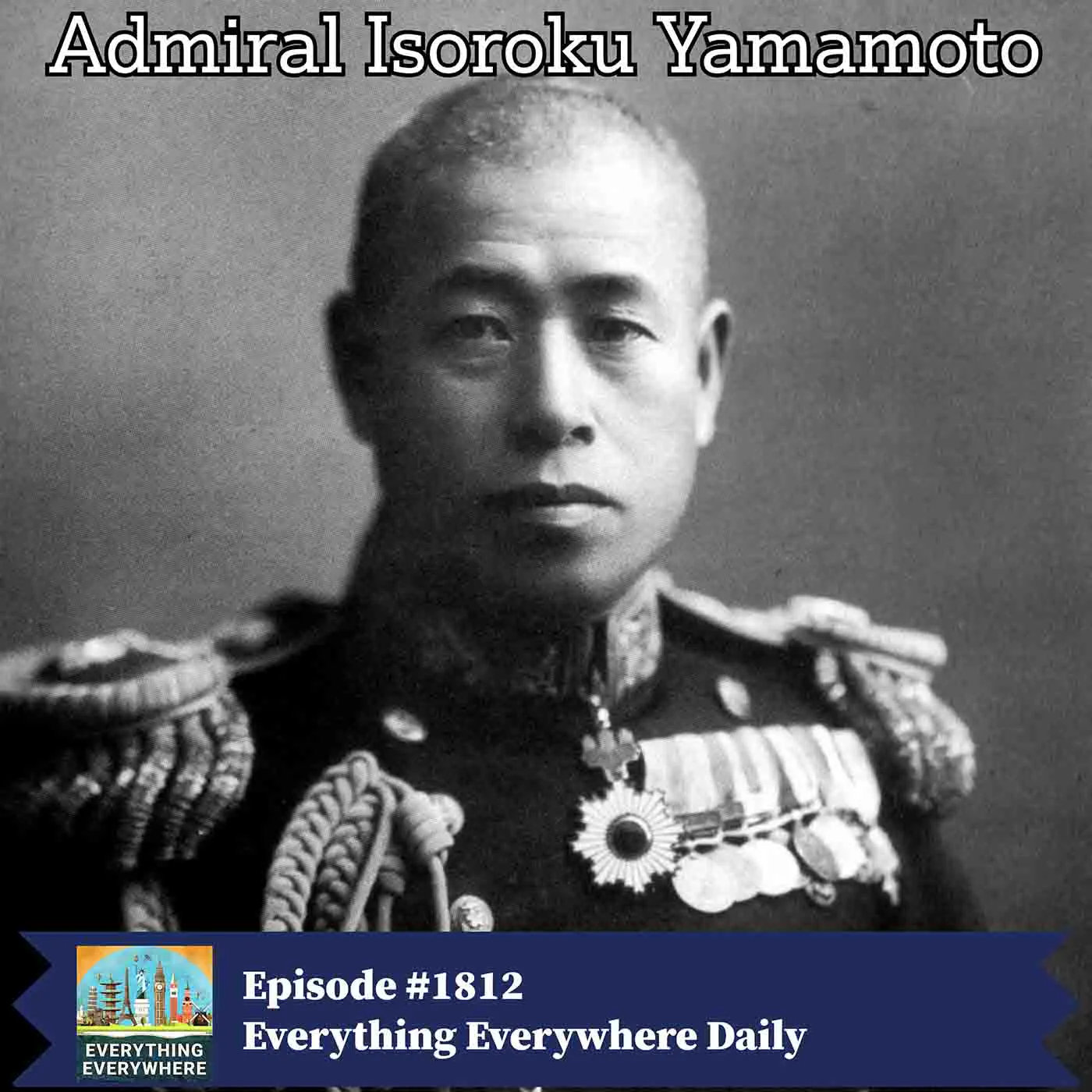
Everything Everywhere Daily: History, Science, Geography & More
Admiral Isoroku Yamamoto (Encore)
00:15:22
Loading summary
Transcript14 lines
- [00:00]
Host
The following is an encore presentation of Everything Everywhere Daily in the Pacific theater in World War II, the leader of the Combined Japanese Fleet was Admiral Isoroku Yamamoto. Yamamoto was villainized as the arch enemy of the American forces in the Pacific, and to be fair, he was their enemy. But there's actually much more to the story. Yamamoto was the loudest voice against going to war with the United States and was one of only a few officials in the Japanese leaders who actually spent time in the United States and understood the country. Learn more about Admiral Isoroku Yamamoto, his rise and tragic end on this episode of Everything Everywhere Daily. This episode is sponsored by Quince. It's summertime, and that means it's time to bring out the summer clothes. If you're looking to update your wardrobe this summer, I suggest you check out Quint's. Quints has all the things you actually want to wear this summer, like organic cotton silk polos, European linen beach shorts, and comfortable pants that work for everything from hanging out in the backyard to nice dinners. And the best part, everything with Quint's is half the cost of similar brands. By working directly with top artisans and cutting out the middleman, Quint's gives you luxury pieces without the markups. I recently needed a new duvet and I went to Quince and picked up a great one that looked much better than what I had before, and all at a fraction of the price I'd pay elsewhere. Stick to the staples that last with elevated essentials from Quince. Go to Quince.com daily for free shipping on your order and 365 day returns. That's Q-U-N-E.com daily to get free shipping and 365 day returns.
- [01:59]
Kristen
Quints.com daily hey Kristen, how's it tracking.
- [02:05]
Carvana Representative
With Carvana Value Tracker?
- [02:07]
Kristen
What else?
- [02:07]
Carvana Representative
Oh, it's tracking in fact. Value Surge alert trucks up 2.5%, vans down 1.7.
- [02:15]
Kristen
Just as predicted. So we gonna, I don't know, could.
- [02:20]
Carvana Representative
Sell, could hold the power to always.
- [02:23]
Kristen
Know our car's worth Exhilarating? Isn't.
- [02:28]
Carvana Representative
Tracking Always know your car's worth with Carvana Value Tracker?
- [02:36]
Host
When we view armies throughout history, we tend to personalize them through their commanders. For example, the American Civil War is often referenced as Ulysses S. Grant versus Robert E. Lee. The Battle of North Africa in the Second World War is often framed as Erwin Rommel versus Bernard Montgomery or George S. Patton. The ancient armies of Macedon are personified through Alexander the Great, and the armies of Carthage during the Second Punic War are just spoken of as being Hannibal. So it comes as no surprise that the Japanese forces in the Pacific were often embodied in the person of Isoroku Yamamoto, Commander of the Combined Japanese Fleet. It was Yamamoto who planned the attack on Pearl harbor, and it was Yamamoto who commanded the fleets against the American Navy at the Battle of Midway and the Battle of the Coral Sea. Despite his role as the leader of the Japanese forces fighting the United States, it was actually a position he accepted reluctantly. Yamamoto was born Isoroku Takano in 1884 in Nagaoka, Japan. His father was a samurai, and the name Isoroku actually just means 56 in Japanese, which was the age of his father when he was born. However, at the age of 32, after his parents had died, he was adopted into the Yamamoto clan, which was a high ranking samurai clan that served in the Nakaoka region. It was from this formal adoption that he took the name Yamamoto. At an early age, he decided to pursue a career in the Navy and graduated from the Imperial Japanese Naval Academy in 1904, ranking 11th in his class. Soon after graduation, he was selected to serve on the armored cruiser Nishin in the Russo Japanese War. He served with distinction and was wounded during the Battle of Tsushima, the lopsided victory over the Russians that I covered in a previous episode. He lost two fingers on his left hand, the index and middle finger, which earned him the name 80 sen. The joke was that a manicure at the time cost 10 sen per finger, and because he now only had eight fingers, it would cost him 80 sen. He quickly developed a reputation as being a good leader, and in 1913 he was sent to the Naval Staff College, graduating in 1915. He was then promoted to the rank of lieutenant commander. In 1918, he was married to a woman named Reiko Mihashi, with whom he had four children. In 1919, he was promoted to the rank of commander. So far, this is a very typical biography of an officer who was a rising star in the Japanese Navy, but not necessarily someone who would be worth an entire podcast episode. What happened next began him down the path that would put him in the history books. Having been promoted in 1919, he was sent to study at Harvard University in the United States. Yamamoto's time in the United States was part of a much larger policy that the Japanese government had adopted in the 19th century, known as the Meiji Restoration, on which I've done a previous episode. The Japanese decided that the only way they could survive was to abandon their traditional ways and adopt modern ones. That included industrializing, modernizing their military and learning the strategies and techniques from the Western powers. He studied at Harvard for two years, becoming fluent in English and taking time to travel around the country, learning about American culture and American ways. One of the things he learned was the immense industrial capacity of the United States, as well as its immense size and natural resources. He also realized that the industrial might of the United States would make them formidable if they were to ever focus it on military production. Yamamoto returned to Japan in 1923 and was promoted to the rank of Captain. Traveling to the United States did leave an impact on Yamamoto, but so did his position in the Japanese Navy. There were two opposing military doctrines in Japan in the 1920s and 1930s, and they were supported by the army and Navy respectively. Not surprising, the army took an army first view. They saw the Navy as just a means of transporting troops. Yamamoto and other members of the naval hierarchy took a navy first approach, which they felt was more befitting of an island nation. Via a strong navy, they thought that Japan could engage in gunboat diplomacy, project power further away, and protect their trade routes. The protection of trade routes was extremely important for Japan because they lacked many natural resources, such as oil. After Yamamoto came back to Japan, he also became a strong advocate of naval aviation, as he saw it as the replacement of traditional naval battleships. He even himself became a trained pilot. Yamamoto returned to the United States in 1924 as part of a delegation to the Naval War College, and in 1926 he became the Naval attache to the Japanese Embassy in Washington, D.C. he returned to Japan in 1928, where he was assigned as captain of the cruiser Isuzu and then as captain of the aircraft carrier Akagi. In 1930, he was promoted to Rear Admiral and was a special assistant to the Japanese delegation at the first London Naval Conference. He was later promoted as the head of the entire first Carrier Division and then was promoted to Vice Admiral, where he represented Japan at the Second London Naval Conference in 1935. In 1936, he was made Vice Minister of the entire Japanese Navy. Despite his steady advancement in the Japanese Navy, Yamamoto began to attract enemies. When Japan attacked China in 1931, he came out against the invasion. When Japan escalated the land war with China in 1937, he was against it. Also in 1937, when the Japanese accidentally attacked a United States ship, the USS Penay, on the Yangtze River, Yamamoto apologized to the US Ambassador to Japan. His continued opposition against Japanese aggression earned him the ire of Japanese nationalists as well as young officers in the army and Navy. He was publicly denounced by the Nationalists, many of whom wrote him death threats. Yamamoto came out against Japan, signing the Tripartite Pact with Italy and Germany, as he didn't see how it could possibly serve Japanese interests. Japanese nationalists became so irate with Yamamoto, they put a bounty on his head. The army then offered him military protection, but in reality, the protection was more to keep an eye on him, as the army supported most of the nationalist moves that Yamamoto opposed. On August 30, 1939, Yamamoto was promoted to be Commander in Chief of the Combined Japanese Fleet. The decision made by Admiral Yanai Mitsumasa, Minister of the Navy, was mostly made to protect Yamamoto from assassination attempts. According to Mitsumasa, it was the only way to save his life, send him off to sea. When Japan did sign the tripartite pact in September 1940, Yamamoto warned the Premier, Fumimaro Kono, that if Japan should get into a war with the United States, they could only expect success for six months to a year. After that, the industrial might and resources of the United States would overwhelm Japan. Yamamoto strongly discouraged a war with the United States, and he was perhaps the only person in the entire Japanese military hierarchy who had first hand experience and knowledge of the United States. On November 15, 1940, Yamamoto was promoted to the rank of Full Admiral. However, it was widely thought that Yamamoto's career was soon to be over. Hideki Tojo was appointed prime minister on October 18, 1941, and he was one of the primary opponents of Yamamoto on almost every Japanese policy from the previous decade. Tojo was an army man, supported the war in China and the alliance with Germany and Italy. Yamamoto was appointed the Commander of the Yokosuka Naval Base, which was considered a demotion. He was out of the way and had no real power. However, his appointment was short lived. Yamamoto was a popular leader who had connections in the Imperial family, and he was in fact, the best naval commander that the Japanese had. Despite his opposition to the war, he was given the assignment of planning the attack on the United States. Yamamoto's plan of attack was based on what he knew of American industrial capacity. Japan's only chance was a quick knockout punch and a decisive battle that would perhaps bring the United States to the negotiating table. The plan he came up with was the attack on Pearl harbor, which he had hoped would knock out the US Pacific Fleet while simultaneously attacking other ports throughout Asia at the same time. The attack on Pearl harbor gave Japan the six months that Yamamoto had hoped, but as you know, it wasn't enough. Yamamoto reorganized the Japanese Navy, putting more emphasis on naval aviation, including Land based flights promoting the production of aircraft carriers and discouraging the construction of Yamato class battleships, which he thought was a complete waste of resources. Yamamoto was involved in many of the biggest early naval battles with the United States, none of which proved to be the decisive knockout punch that he had hoped. His plan for the Battle of Midway ultimately backfired, resulting in a devastating loss of four Japanese aircraft carriers. The United States Navy leadership, for their part, recognized Yamamoto as a worthy opponent, many of them having met him at naval conferences in London or during his time in the United States. However, they also wanted revenge for the attack on Pearl harbor that he had planned and led. One major advantage the Americans had over the Japanese was that they had cracked the Japanese naval code. On April 14, 1943, the Americans intercepted an encoded radio transmission indicating that Admiral Yamamoto was to go on an inspection of Japanese forces in Papua New guinea and the Solomon Islands. This was in part an attempt to boost morale. After the Japanese lost the island of Guadalcanal, the decision was made to try to take out Yamamoto. The reasons were threefold. First was revenge for the attack on Pearl Harbor. Second was the hope that it would hurt Japanese morale. And third, they assumed that whoever took his place wouldn't be as competent. Just four days later, a squadron of 18 P38 lightnings was sent to intercept the plane carrying Admiral Yamamoto in a mission called Operation Vengeance. The mission was successful, and Yamamoto's plane was shot down over Bougainville island in Papua New Guinea. His body was recovered the next day, showing that he was killed instantly when a bullet hit his head. I'm going to cover Operation Vengeance in a future episode, as there was a whole lot to the mission, both politically and militarily. But I will say that it was an extremely risky mission because it risked exposing to the Japanese the fact that the United States had cracked their code. The death of Admiral Yamamoto was kept from the public for several weeks, and in the US the full details of the mission weren't made public until after the end of the war. While Isoroku Yamamoto was the architect of the Japanese attack on Pearl harbor and the head of the Japanese Navy for several of the largest naval battles of the war, few people realized that he was also the biggest proponent against going to war with the United States. He knew from his time in the US that the only hope Japan had of winning a conflict would be to try to win quickly and decisively, even if that probably wasn't going to work. When war became inevitable, he did his duty, but it was one that he didn't want to perform. Had Yamamoto's advice been listened to, the entire war in the Pacific may have been avoided, including the invasion of Manchuria. Instead, the proponents of war ignored him, which led to devastating results for Japan.
- [14:29]
Charles Daniel
The executive producer of Everything Everywhere Daily is Charles Daniel. The associate producers are Austin Oakton and Cameron Kieffer. I want to thank everyone who supports the show over on Patreon. Your support helps make this podcast possible. I'd also like to thank all the members of the Everything Everywhere community who are active on the Facebook group and the Discord server. If you'd like to join in the discussion, there are links to both in.
- [14:51]
Host
The show notes and as always, if you leave a review or send me.
- [14:55]
Charles Daniel
A boostogram, you too can have it.
- [14:56]
Host
Read on the show.