Loading summary
Transcript1 lines
- [00:01]
A
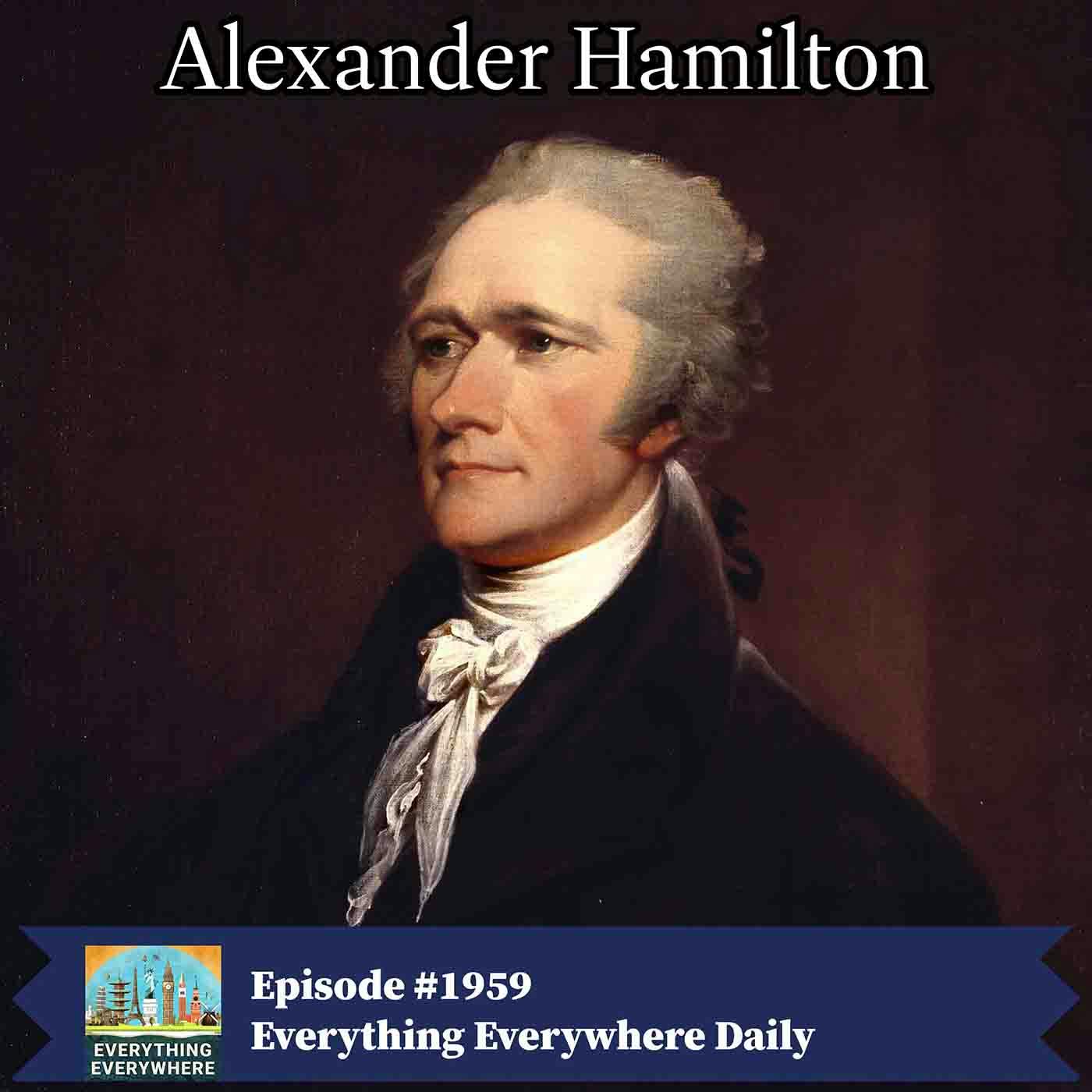
Alexander Hamilton was a Founding Father who has recently gained popularity due to the popular musical Hamilton. Hamilton was the first U.S. secretary of the treasury and was foundational in the formulation of American financial and government policies, many of which remain in place to this day. He is featured on the $10bill and is one of the most famous Founding Fathers who never held elected office. Learn more about Alexander Hamilton, the $10 founding father without a Father on this episode of Everything Everywhere Daily. This episode is sponsored by Quints. The holiday season is upon us and that means buying gifts for friends and family, so why not get something that's top tier but affordable? That's where Quince comes in. Quince has great items like $50 Mongolian cashmere sweaters that feel like an everyday luxury and wool coats that are equal part stylish and durable. And you'll pay a fraction of what you would from other retailers and their prices are literally listed on the Quince website. I just got an Australian merino wool sweater that looks great and cost only half of what it would have if I had bought it somewhere else. By partnering directly with ethical factories and top artisans, Quince cuts out the middleman to deliver premium quality ethical at half the cost of similar brands and often even bigger discounts. Give and get timeless quality staples that last this season with quince. Go to quince.com daily for free shipping on your order and 365 day returns. Now available in Canada too. That's Q-U-I-N-E.com daily free shipping and 365 day returns. Quince.com daily. This episode is sponsored by ExpressVPN. Did you know that Internet service providers, including mobile network providers, know every single website you visit? And in The United States, ISPs are legally allowed to sell that information to advertisers? That is just one of many reasons why you need to use a virtual private network, or VPN. ExpressVPN reroutes 100% of your traffic through secure encrypted servers, so your ISP can't see your browsing history. Moreover, unlike other VPN companies you might have heard about, ExpressVPN uses what they call Trusted Server architecture. Their server runs entirely in RAM with no hard drives, meaning that after a reboot, nothing persists and there are no logs. ExpressVPN's apps are available on phones, laptops, tablets and smart TVs. ExpressVPN now is a permanent home on my desktop and my Apple TV to allow me better and more secure access to more content. Secure your online data today by visiting expressvpn.comeed that's expresvpn.comeed to find out how you can get up to four extra months. Expressvpn.comeed Alexander Hamilton was born on the Caribbean island of Nevis in either 1755 or 1757. No one really knows for sure. He had a very rough start in life. He was born out of wedlock, making him a bastard in the Game of Thrones sense of the word. His father abandoned him and his mother around the age of 10. A few years after that, both Alexander and his mother caught yellow fever and his mother passed away, effectively making Alexander an orphan. Hamilton and his younger brother Peter then moved in with their cousin, but that cousin committed suicide shortly thereafter. After his cousin died, Hamilton and his brother were separated and Hamilton was housed by a merchant by the name of Thomas Stevens. He then began working at an import export firm that traded with New York in the New England region. During this time he had written a letter to his father. In the letter he wrote about a massive hurricane that had decimated the island. His tutor submitted this letter to the Royal Danish American Gazette, which impressed the publishers because of Hamilton's powerful writing. This letter was impressive enough that a fund was established to send Hamilton to the North American colonies to receive a better education. Hamilton moved to New York in 1772 and lived with a tailor named Hercules Mulligan. The two worked together in selling cargo with the money the duo made going to Hamilton schooling. In 1773, Hamilton enrolled in King's College, which is now known as Columbia University. While attending King's College, he roomed with a man named Robert Troupe. Troup would later speak about how, while he was attending university, Hamilton would often make arguments against British rule. The following year, Hamilton would anonymously release his first piece of published political writing. In 1774, Episcopalian Bishop Samuel Seabury wrote a series of Loyalist pamphlets attacking the Continental Congress, the most notable being Free Thoughts on the Proceedings of the Continental Congress, in which he argued that Congress's actions were illegal, harm, harmful to the colonies, and would lead to ruin. Alexander Hamilton replied in two pamphlets, most notably A Full Vindication of the Measures of Congress, which defended Congress and sharply criticized Seabury's Loyalist arguments. His second reply, titled the Farmer Refuted, was directly addressed to Seabury. In this, he critiqued Seabury's perception of the British Parliament and once again refuted his condemnation of the First Congress. In 1775, Hamilton was forced to cease his studies because of the outbreak of the Revolutionary War and the British occupation of New York City. During this time, he opted to join the New York Volunteer Militia on the side of the colonists and began studying military history and tactics. He was soon elected as an officer and once again began working with Hercules Mulligan and the political organization known as the Sons of Liberty. In 1776, he was appointed captain and fought in the battles of Harlem Heights, White Plains and Trenton. Hamilton's military service caught the eye of generals throughout the Continental army and eventually Hamilton was offered a position as George Washington's personal aide, where he received the rank of Lieutenant Colonel. As Washington's chief of Staff, he would regularly correspond with the Continental Congress, governors and other generals in the Continental Army. He would also draft Washington's orders letters and later issue orders of his own. Between December 1779 and March of 1780, Hamilton met his future wife, Elizabeth Schuyler, whom he married and had eight children with. While working under Washington, Hamilton was eager to see action on the battlefield as he sought military glory, believing it would enhance his social standing and improve his prospects after the war. In March of 1781, Hamilton grew frustrated and left Washington's staff. He stayed living by Washington's headquarters and continually pestered Washington with requests to take part in combat. His frustration culminated in his threatening to resign in July of 1781 if he was not given command of a battalion. Recognizing Hamilton's value, Washington placed Hamilton as a commander of infantry companies from New York and Connecticut, and as commander, he would play a large part in the Battle of Yorktown. Unlike what the musical claims, Lafayette did not pick Hamilton for the job. Instead, Washington sent him to lead the attack on Redoubt Number 10. Washington had ordered Hamilton and his men to use bayonets as they did not want to risk giving up their position. With a random accidental gunshot, Hamilton had his men unload their guns and run towards the enemy. The attack proved successful, with Hamilton losing only nine of 400 men. His actions were instrumental in the victory at Yorktown, which brought the war to a close. After the Battle of Yorktown, Hamilton moved back to New York City and became a lawyer in 1782. Later that year, he was also appointed to the Congress of the Confederation, the precursor to the United States Congress before the ratification of the Constitution. Not surprisingly, the extremely opinionated Hamilton immediately began to criticize the Congress. He was especially frustrated by the decentralization of the body under the Articles of Confederation. The Articles of Confederation served as the first governing document of the United States and proved to be impractical to run the country as the federal government had no way to enforce laws. The federal government was also completely reliant on voluntary funding from the states and had no means of collecting money. This made it difficult to afford or sustain an army. This was dangerous as angry soldiers could mutiny and top the already weak federal government. To address these issues, Hamilton sought to establish a strong central government capable of collecting taxes. As frustration amongst the soldiers grew, some began to march towards Philadelphia, where Congress was assembled to demand their pay. As a result, Congress relocated to Princeton, New Jersey, and Hamilton began drafting amendments to the Articles of Confederation that would grant the federal government more power. However, these amendments were never enacted. Hamilton resigned from Congress in 1783 due to his frustration with the Articles of Confederation. He moved back to New York and resumed his career as a lawyer, specializing, oddly enough, in defending British Loyalists. During this time, he also helped establish the bank of New York. In 1787, Hamilton became a member of the New York State legislature and was selected to attend the Constitutional Convention. Though Hamilton had been one of the main voices calling for a convention, he held little influence over the actual proceedings. Other members of the Convention were concerned about Hamilton's desire for a strong central government. One example of this was James Madison, who perceived Hamilton's ideas as being counter to the Revolution, as many of his policies would give more power to the wealthy. Another area of concern was his desire for the President to hold the position for life, giving some the impression that Hamilton was a monarchist. During the Convention, Hamilton did help draft the Constitution. He laid out much of the eventual system of checks and balances that would become a hallmark of the American system of government. Hamilton signed the preliminary document and then proceeded to campaign for New York to ratify it. During this time, Hamilton, along with John Jay and James Madison, wrote the Federalist Papers, which was a series of 85 essays published anonymously defending the proposed Constitution. Hamilton ended up writing 51 of these essays covering the executive and judicial branches, parts of the Senate, taxation and military matters. Hamilton, Jay and Madison's efforts proved fruitful when all 13 states ultimately ratified the Constitution. In 1789, Washington was elected the first President of the United States and chose Alexander Hamilton, his former aide de camp, to be the first Secretary of the Treasury. During his tenure as Secretary of the Treasury, Hamilton's primary objective was to stabilize public credit. To achieve this, he sought to consolidate state debt into federal debt, thereby making the system more streamlined and efficient. He also pushed for the government to honor contracts made with those who invested in government bonds. His final plan was to use a sinking fund system, which would allocate 5% of federal revenue to pay off the national debt. During his tenure, Hamilton also advocated for Congress to establish a national bank. Hamilton initially had trouble getting his financial plans passed in Congress. We don't know the exact terms of the agreement, but we do know that Jefferson, Madison and Hamilton reached an understanding for Hamilton to secure his votes in exchange for Southern members of Congress approving the national bank and allowing the federal government to assume state debts. The new Federal Capital district would be placed along the Potomac river on land that was part of Virginia and Maryland. In 1795, Hamilton resigned from his position as Secretary of the treasury and resumed practicing law. He also helped draft Washington's letter of resignation. The election of 1796 saw John Adams, a fellow Federalist, elected as president. Adams and Hamilton did not have the best relationship, but Hamilton did advocate for his election to prevent Thomas Jefferson from becoming president. It was during the Adams administration that Hamilton became engulfed in the greatest scandal of his career. In 1791, while he was Treasury Secretary, Hamilton had an affair with a woman named Maria Reynolds. During his affair with Reynolds, her husband had found out or potentially orchestrated the entire affair and extorted Hamilton until the affair ended. James Reynolds, the husband, was later arrested for counterfeiting. While on bail, he informed Congressman James Monroe that he had information regarding Hamilton's alleged abuse of his position and that he was engaging in illegal activity as Secretary of the Treasury. Monroe confronted Hamilton about this in 1792 and Hamilton was able to prove that the blackmail had been paid with his own funds. In the summer of 1797, Hamilton. A pamphlet was released that questioned Hamilton's activities as Secretary of the Treasury. He asked Monroe to disprove these claims, but Monroe refused and it almost resulted in a duel between the two men. The only reason a duel didn't happen was due to the intervention of Aaron Burr. To clear his reputation, Hamilton released the now infamous Reynolds pamphlet, a 100 page long document that detailed his affair to clear his name of corruption charges. In the election of 1800, Hamilton supported a Federalist rival of John Adams, Charles Pickney. At that time, the election process worked differently with the Vice President being the candidate who received the second highest number of votes. The Federalists had two nominees, Adams and Pickney, as did the Democratic Republicans who had the sitting Vice President, Thomas Jefferson and Aaron Burr. Hamilton openly campaigned for Pickney and expected votes to go to Pickney and Jefferson which would give Pickney the presidency. Jefferson and Burr defeated both Federalist candidates and tied for electoral votes with 73 each. This led to the presidential election being decided by the House of Representatives. While Hamilton didn't like Jefferson, he at least respected him. Hamilton, however, really hated Aaron Burr. After two months of deadlock in the House of Representatives, Hamilton influenced enough Federalist Representatives to support Jefferson, electing him as President, and I've previously done an episode on the election of 1800 if you're interested in a more in depth account. Having cost Burr the presidency, Burr demanded an apology from Hamilton for insulting his honor. And this wasn't just for campaigning against him for President, but also because Burr claimed that Hamilton had spoken disrespectfully about him during a dinner party. Hamilton refused to apologize. The two sent multiple letters before a duel was ultimately arranged. Before the duel, Hamilton wrote that he was going to throw away his shot and not fire at Burr because he wanted to be available for future political offices, which would be nearly impossible if he killed the Vice President. The duel between Hamilton and Burr took place at dawn on July 11, 1804 at Weehawken, New Jersey. Both men followed a ritual of a formal duel, met at the dueling grounds used previously for several other political confrontations, and exchanged fire. Hamilton is believed to have fired first and intentionally missed, while Burr fired a shot that struck Hamilton in the abdomen, shattering his ribs and damaging internal organs. Hamilton was taken back to New York where he died the next day. Burr technically won the duel, but faced public outrage, fled prosecution, and saw his political career collapse. Alexander Hamilton had a profound impact on the early United States, shaping him more significantly than almost any other Founding Father. As a soldier, he played a pivotal role in the Revolutionary War. As the primary author of the Federalist Papers, he played a large part in the ratification of the Constitution, and as the first Secretary of the treasury, he established the national credit system, supported federal assumption of state debts, and created the first bank of the United States. His vision of a strong central government and national bank system has largely been achieved, although he never lived to see most of it. So he is a lot more than just the subject of a musical and the guy who happens to be on the Ten Dollar Bill. The executive producer of Everything Everywhere Daily is Charles Daniel. The associate producers are Austin Otkin and Cameron Kieffer. Research and writing for this episode was provided by Olivia Ash. My big thanks go to everyone who supports the show over on Patreon. Your support helps make this podcast possible, and I also want to remind everyone about the community groups on Facebook and Discord. This is where everything happens that's outside of the show. As always, if you leave a review on any major podcast app or in the above community groups, you too can have it read on the show.