Loading summary
Transcript1 lines
- [00:00]
Host of Everything Everywhere Daily
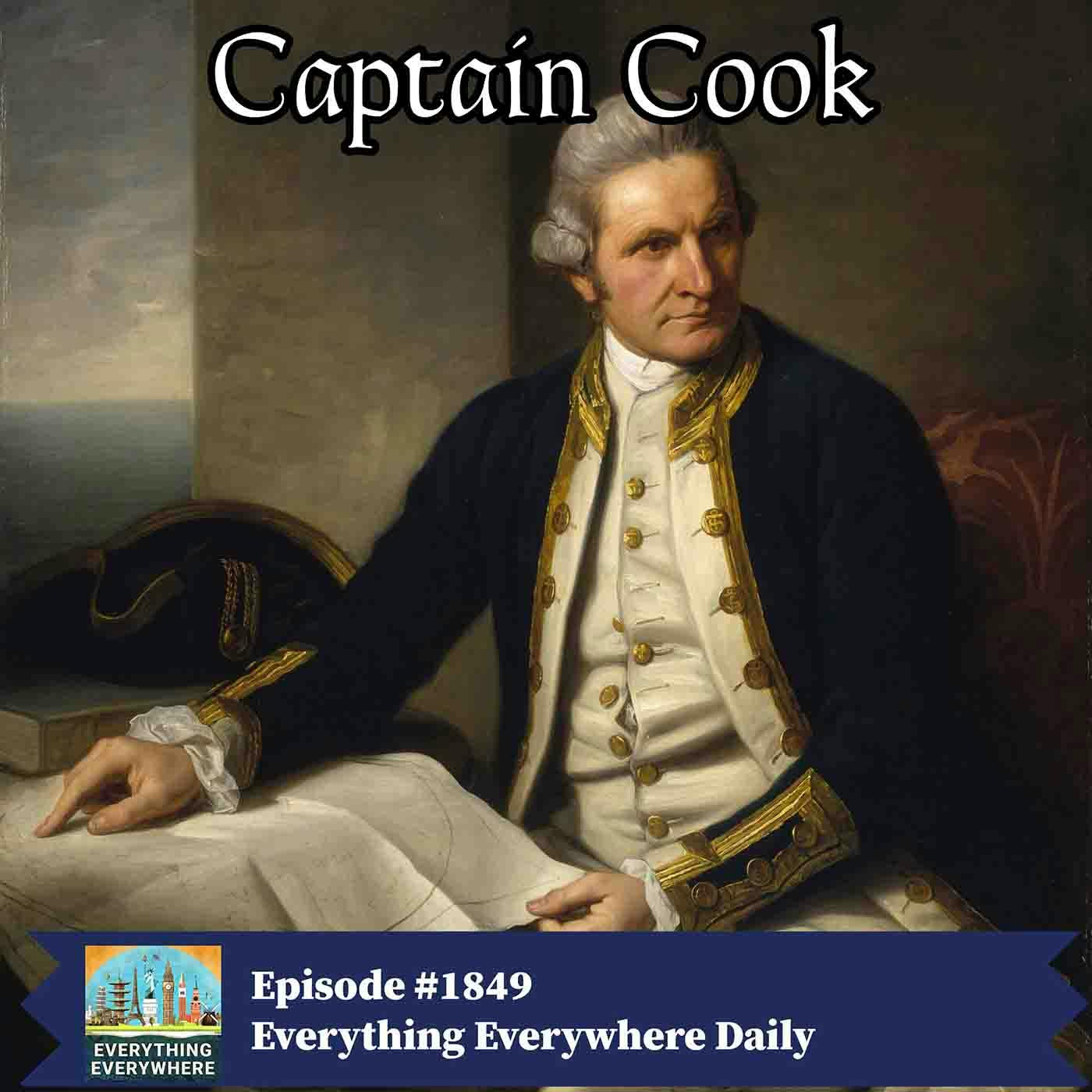
Captain James Cook was a British explorer, navigator, cartographer and captain in the Royal Navy, whose three major voyages of exploration between 1768 and 1779 greatly expanded European knowledge of the Pacific region. His detailed map, scientific observations and interactions with indigenous people left a profound impact on geography, ethnography and natural history. He left an indelible mark on the region and in the end, it killed him. Learn more about Captain Cook, his voyages and how his impact can still be felt in the world today on this episode of Everything Everywhere Daily. This episode is sponsored by Fiji Water. You've probably heard of Fiji Water and have seen it in stores. Well, Fiji Water really is from the islands of Fiji. Drop by drop. Fiji Water is filtered through volcanic rock 1,600 miles away from the nearest continent and all its pollution protected and preserved naturally from external elements. In this process, it collects a unique profile of electrolytes and minerals, resulting in more than double the electrolytes as the other top two premium bottled water brands, giving Fiji Water its smooth taste. Fiji Water's electrolytes are 100% natural and this water even has a perfectly balanced pH of 7.7. I've recently been trying to reduce my consumption of diet soda and I've found Fiji Water to be a great alternative. Visit your local retailer to pick up some Fiji Water today for your next backyard party, beach day hike, or even your home office. Fiji Water is Earth's finest water. This episode is sponsored by Mint Mobile. There are numerous subscriptions that you pay for every month. If you want to reduce your monthly spending, your only option is usually to cancel and go without. But in case of your phone, you can significantly reduce your costs while still enjoying almost the exact same service by switching to Mint Mobile. With plans Starting at just $15 a month, Mint Mobile gives you premium wireless service on the nation's largest 5G network. With Mint Mobile, you can use your same phone, phone number, contact list and even connect to the exact same towers and cellular network. The only difference is price and that's why I recommend Mint Mobile this year. Skip breaking a sweat and breaking the bank. Get your summer savings and shop premium wireless plans@mintmobile.com eed that's mintmobile.comeed.com upfront payment of $45 required equivalent to $15 a month limited time new customer offer for first three months only. Speeds may slow above 35 gigabytes on unlimited plan taxes and fees extra. C Mint Mobile For Details I've done many episodes on various countries and islands in the Pacific and I've mentioned Captain Cook multiple times. So I figured it was finally time to give the man his own episode. James Cook was born in 1728 in the small Yorkshire village of Marton, the son of a farm laborer. This humble beginning makes his later achievements all the more extraordinary as naval officers mainly were drawn from the upper class. In the 18th century. As a young man, he apprenticed with a shopkeeper before finding his calling at sea, working on coal ships along England's treacherous North Sea coast. This experience proved invaluable, teaching him practical seamanship and navigation skills that formal naval training often overlooked. Cook's transition from merchant sailor to Royal Navy officer was unusual for the time. He enlisted as an able seaman in 1755 during the Seven Years War. But his exceptional abilities quickly caught attention. Within two years he had risen to master of the HMS Pembroke, demonstrating the kind of rapid advancement that reflected both his competence and the Navy's need for skilled navigators. His first major contribution came during the Siege of Quebec in 1759 when he surveyed the treacherous St. Lawrence river in enabling British forces to navigate safely to their decisive victory. This work established Cook's reputation as a master of hydrography, the science of mapping waters and coastlines. After the war, he spent several years mapping the coast of Newfoundland, where his precision and scientific approach caught the attention of the Royal Society and the Admiralty. This laid the foundation for his selection as a leader of a new scientific expedition to the Pacific. Cook's first Pacific voyage began with a scientific mission that concealed broader imperial ambitions. The Royal Society aimed to observe the transit of Venus across the sun from Tahiti in 1769. On May 5, 1768, Cook was selected to lead the voyage before he had even achieved the rank of lieutenant. He took the exams to become a lieutenant the next day, which was the minimum rank required to lead a ship. The 1769 transit of Venus was actually a huge event for astronomers at the time, as it enabled them to apply the principles of parallax to calculate the distance between the Earth and the sun with greater precision than ever before. This measurement was essential for establishing the scale of the solar system and improving navigation and celestial mechanics. However, Cook also carried secret orders to search for the mythical southern continent to Terra Australis, which Europeans believed must exist to balance the landmasses of the northern hemisphere. His orders were only to be opened after the transit. Sailing aboard the HMS Endeavour with botanist Joseph Banks and astronomer Charles Greene, Cook first demonstrated his revolutionary approach to long distance sea voyages. Previous expeditions had lost enormous numbers of crew to scurvy, a disease we now know results from vitamin C deficiency. Cook enforced strict dietary discipline on ship, requiring his men to eat sauerkraut, fresh vegetables when available and citrus fruits. This attention to crew health allowed him to maintain an effective working force throughout journeys that would often last for years. On his first voyage, he didn't lose a single man to scurvy, which was an incredible accomplishment for the time. After successfully observing the Venus transit in Tahiti, Cook opened his secret orders and sailed south and then west. His methodical approach to exploration set him apart from previous navigators in the Pacific. Rather than making quick coastal surveys, Cook spent months carefully mapping coastlines, taking depth soundings and recording detailed observations of geography, weather and indigenous peoples. The voyage's most significant discovery came when Cook encountered the eastern coast of Australia. Unlike earlier Dutch explorers, who had found only the continent's western shore, Cook discovered the fertile eastern coast at Botany Bay. The ship's botanist, Joseph Banks, collected unprecedented botanical specimens, while Cook claimed the entire eastern coastline for Britain and he called it New South Wales. The voyage nearly ended in disaster when Endeavour struck the Great Barrier Reef. Cook's calm leadership during this crisis demonstrated his exceptional seamanship. Rather than panic, he systematically lightened the ship, plugged the hull and nursed the damaged vessel to shore for repairs. He returned to England in 1771, having been gone for over three years, and was promoted to the rank of commander. Cook's second voyage represented perhaps the greatest feat of ocean navigation in human history. His mission was to definitively settle the question of Terra Australis by sailing as far south as possible and systematically searching the southern Pacific Ocean. Terra Australis was not the modern day continent of Australia, which was known as New Holland at the time. The word Australia was later applied to it. In the 19th century, commanding the HMS resolution and accompanied by the HMS adventure under the command of Tobias Furneaux, Cook became the first navigator in history to cross the Antarctic Circle. He pushed further south than any human had ever ventured, reaching 71 degrees 10 minutes south before impenetrable ice forced him back. Through this systematic exploration, Cook proved that no habitable southern continent existed in the Pacific, finally laying to rest a geographical myth that had persisted since ancient times. But it should be noted that Cook never laid eyes on the actual continent of Antarctica. The voyage showcased Cook's evolution both as an explorer and an ethnographer. His encounters with Pacific Islander societies became increasingly sophisticated and his journals reveal growing respect for indigenous navigation and seamanship skills. In places like Tonga and the Society Islands, Cook observed complex political systems and advanced agricultural techniques. That challenged European assumptions about these being primitive people. His respect for Polynesians grew as he met more of them over time. His voyages were not designed to be ones of conquest, and he was given explicit instructions to conduct himself peacefully with local people and use violence only as a last resort. The voyage also demonstrated Cook's growing expertise in Pacific navigation. He rediscovered numerous islands found by earlier Spanish explorers, but his precise mapping and detailed descriptions made them accessible for future navigators. He returned home to England from his second voyage on July 30, 1775, having been at sea for another three years. After his return, he was finally elevated to the rank of captain in the Royal Navy. He was also honored for his achievements in navigation and the prevention of scurvy. He wrote a paper on his techniques for the prevention of scurvy at Sea in 1775, and for this he was made a member of the Royal Society and was awarded the prestigious Copley Gold Medal for his accomplishments. On his second voyage, he also brought with him a copy of John Harrison's H4 chronometer, which he was able to use to determine longitude accurately. Cook praised the device as it was what allowed him to create such accurate maps. Cook's final voyage, which began in 1776, tackled one of navigation's greatest challenges, finding a northwest passage connecting the Atlantic and Pacific through Arctic waters above North America. This route, if it existed, would revolutionize global trade by providing a shortcut between Europe and Asia. Sailing north from the Pacific side, Cook systematically mapped the North American coast from Oregon to Alaska. His chart of the region remained the standard for decades. Demonstrating his unparalleled skill in coastal surveying, he penetrated the Bering Strait and pushed into the Arctic Ocean until ice blocked his further progress, proving that any northern passage would be impractical for regular navigation. The voyage's tragic conclusion came during a return visit to Hawaii, which Cook had discovered and named the Sandwich Islands during his northward journey. After initially being welcomed by the Hawaiians at Kealalekua Bay, we where his arrival coincided with the Makahiki festival honoring the God Lono. Relations between Cook's crew and the islanders deteriorated when the Resolution sustained damage and returned to the bay. Shortly after leaving, tensions had already begun to rise. The situation escalated when a small British boat was stolen by the Hawaiians, likely as retaliation for previous thefts and mounting resentment. In response, Cook attempted to kidnap the ruling chief of the island of Hawaii, intending to hold him hostage until the stolen property was returned. This act was perceived as a grave insult and provocation as Cook tried to Lead the chief away. A large crowd gathered and violence erupted on the beach. During the confrontation, Cook was struck in the head and stabbed to death by Hawaiian warriors on February 14, 1779. His death marked the end of an era in Pacific exploration, but his crew continued his work, completing the voyage under the command of Captain Charles Clerke. Today there is a monument on the Big island of Hawaii near the spot where Cook was killed. I've actually visited it, and it's not easy to get to, but it is accessible if you know where it is and are willing to make the hike. The legacy of Captain James Cook can be seen all over the Pacific. Several landmarks around the world bear Captain Cook's name, reflecting the wide reach of his explorations in New Zealand. The Cook Strait separates the north and South Islands, and the country's highest mountain, Mount Cook, is also named after him. The Cook Islands in the South Pacific were named in his memory, even though he only visited some of the islands that now bear the collective name. In Alaska, the Cook Inlet near Anchorage marks the area that he explored while searching for the Northwest Passage on Canada's west coast. Cape Cook on Vancouver island commemorates his surveys in the Pacific Northwest and in Australia. James Cook University in Queensland honors his charting of the continent's eastern coastline. As a navigator and a seaman, his accomplishments placed him in the highest esteem in the British Navy. He was one of the best marine cartographers in history at that point. His insistence on crew hygiene, serving fresh food whenever possible, and administering specific dietary supplements dramatically reduced death rates from scurvy on long voyages, and this breakthrough made extended Pacific exploration feasible for the first time. The botanists aboard his ships on his three voyages identified over 2000 species of plants that hadn't been known to Europeans before. His impact on the Pacific region itself is mixed. While Cook's voyages were not intended to be violent or confrontational, such events did happen. 45 indigenous people were killed across the three voyages, and he lost 15 of his crew and his own life to native people in conflicts. He unknowingly spread diseases to many islands that had either little or no contact with Europeans beforehand. And while his journeys were not intended to colonize, the exploration and navigational maps from his voyages ultimately led to the colonization of almost every island in the region. Decades later, Cook's efforts laid the groundwork for British imperial expansion in the Pacific, particularly in the settlement of Australia and New Zealand. But what can't be denied is that the voyages of Captain James Cook have had a lasting legacy in the Pacific. His voyages laid the foundation for what would happen in the region over the next century and beyond. The executive producer of Everything Everywhere Daily is Charles Daniel. The associate producers are Austin Oakton and Cameron Kiefer. I want to thank everyone who supports the show over on Patreon. Your support helps make this podcast possible. I'd also like to thank all the members of the Everything Everywhere community who are active on the Facebook group and the Discord server. If you'd like to join in the discussion, there are links to both in the show notes and as always, if you leave a review or send me a boostogram, you too can have it read on the show.