← Everything Everywhere Daily: History, Science, Geography & More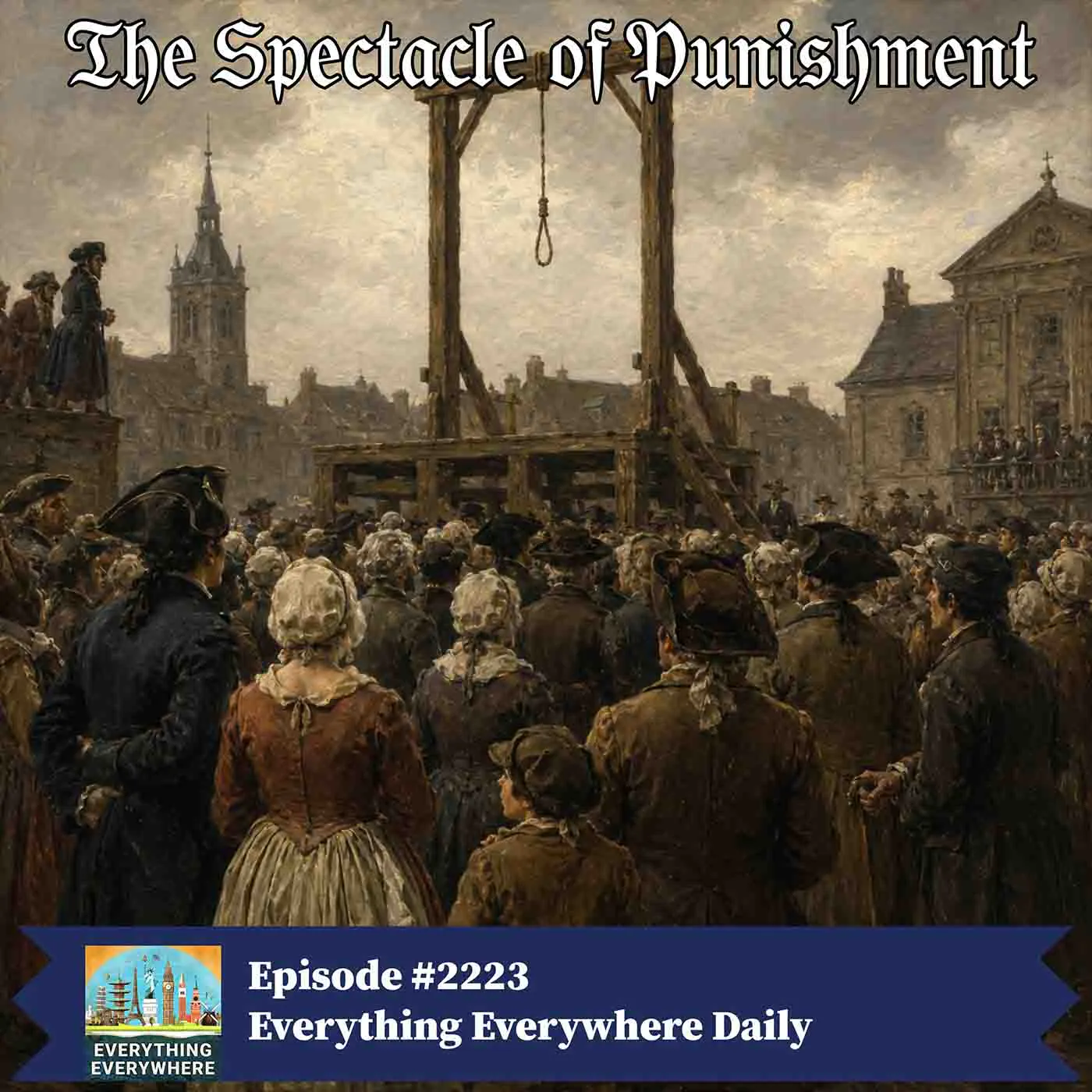
Everything Everywhere Daily: History, Science, Geography & More
Deterrence and The Spectacle of Punishment
00:13:34
Loading summary
Transcript1 lines
- [00:01]
A
The idea of crime and punishment dates back to the earliest human societies. But as societies have evolved, so too have punishments. Transitioning from overt public forms of discipline to more discreet methods. Whether it be public floggings and executions or security cameras in your grocery store, fear of punishment and deterrence has been the main tool to encourage citizens to follow the law. Learn more about the spectacle of punishment and deterrence on this episode of Everything Everywhere Daily. This episode is sponsored by Square. There's a local cafe I visit where paying is almost effortless. They use Square, and whether I'm tapping a card or leaving a tip, the whole process takes just a few seconds. That smooth checkout means the staff can spend less time wrestling with technology and more time dealing with customers. That's what Square does for businesses. It brings payments, point of sale, inventory, staffing and online sales together in one system. Its AI powered tools can handle routine tasks, while Real Insights help owners make smarter decisions. Square can work for someone opening their first location or a business expanding into several. With free plus and premium plans, transparent pricing and no long term contracts, Square helps you run your business more smoothly, bringing payments, operations and insights together in one place so you're ready for whatever next. Right now, listeners can get up to $200 off square hardware when you sign up at square.com godaily that's sq U-A-R-E.com godaily get started with Square and build a setup that works the way you do. This episode is sponsored by Babbel. As longtime listeners know, I've spent over a decade traveling around the world and have visited most of the countries on earth. As such, I know firsthand the power of learning at least a few words and phrases in the language of any country you might be visiting. I picked up a bit wherever I've been to, but it's always been a challenge if you haven't learned anything beforehand. And that's why I've started using Babbel. I've begun working on two languages that I've always been the weakest at, French and German. Babbel is built for real life, not vocabulary lists or verb charts, but real conversation. Practice lessons are quick, practical and built by more than 200 language experts, not AI. Babbel's award winning app has sold over 25 million subscriptions and is backed by a 14 day money back guaranteed. If you've got summer travel coming up, now is the time to start so you can actually use what you learn on the trip. Right now, Babbel is offering listeners up to 60% off. Go to Babbel.com daily. That's Babbel B-A-B-B-E-L.com daily for up to 60% off. Rules and restrictions may apply. The history of punishment can be traced back so far that it's impossible to determine when it started. Based on what we can determine, early hunter gatherer societies had forms of punishment to enforce social norms and behaviors. One of the primary functions of punishment is to deter other people from engaging in the same behavior. And to these ends. Within many societies, punishment has often been conducted as a public spectacle shown to the public, either blatantly like a public execution, or more subtly. In the medieval period, punishment was typically meted out publicly, intended to humiliate the individual perpetrator and to deter others. In medieval Europe, common forms of punishment included the pillory and the stocks, where offenders were restrained and exposed to ridicule. Public whipping, branding, mutilation, and forced parading through town were also used. More serious crimes could lead to hanging, beheading, being burnt at the stake, or breaking on the wheel. Punishments varied widely by region, social rank, and the nature of the offense. In Asian cultures, medieval torture was more psychological when compared to Europe. In China, a common form of punishment was ling chi, which was quite literally death by a thousand cuts. This form of torture was to prolong the pain for enemies of the state and traitors. This form of punishment was often carried out in public, serving as a gruesome display of the state's power to enforce discipline and preserve social order. In Japan, samurai culture relied on severe punishments, including torture and execution through methods such as boiling and crucifixion. The victims of punishment were often marched in front of crowds before being tortured. If they were being executed, the criminals heads were often put on display, again acting as a deterrent. Though the forms of punishment were similar to those in Europe, the purpose of the punishment in many Asian cultures was different. Unlike systems focused strictly on the individual, punishment in Asian societies frequently extended to the entire family. It was believed that punishing family members created an even greater deterrent to breaking the law and community rules. While the official reason for public executions was to serve as a deterrent and to mete out justice, public executions often became a form of entertainment. Executions were made into public events, in effect a product to be sold to the masses. But why was the public interested in seeing death and torture? According to a theory published in 1912 by Russian physician and psychoanalyst Sabrina Spielrein, humans are interested in witnessing the specific process of Unnatural death. Spielrein argued that humans possess both a negative instinct towards death and a positive instinct towards life. She believed that witnessing events like public executions heightens these instincts, making observers feel a stronger appreciation for their own lives as they watch another person's end. This same instinct can be seen when people slow down to view an accident on the road or go out of their way to witness the results of a natural disaster. One of the earliest examples of this was in the Roman Republic and later the Roman Empire, where the state marketed executions as public events to help cure public boredom. At these executions, there was often a huge crowd that was made up of people from all social classes. Perhaps an even better example of this is the French Revolution. One of the major events of the Revolution was the Reign of Terror, which saw the execution of tens of thousands of people by guillotine, who were often sentenced without trial or with flimsy the evidence. During the Reign of terror, approximately 2,600 people were executed in just Paris alone. That works out to an average of roughly eight executions per day. The rate was extremely uneven, however. From June 10 to July 27, 1794, around 1400 people were executed, averaging nearly 30 per day, with some days reaching about 50. Crowds gathered around the guillotine as victims of the revolution were wheeled out in carts, heads placed on the block and executed with the swift release of a blade. The crowds often gathered souvenirs from the condemned and were encouraged to celebrate the executions. They sang songs, danced and celebrated Madame Guillotine. The French had turned the executions into a spectacle, both serving as a deterrent to opposing the revolution, but but also as a celebration of the revolution's victory. Yet despite public executions being designed to deter crime or unwanted behaviors, that was not always the case. Instead, crime often increased despite public executions. In 19th century Britain, crime rates remained steadily high. While this pattern is evident historically, modern data further reinforces it. Although public executions have ended in most nations, a few countries, particularly Iran, continue the practice. Though far less common today than it used to be, these executions do still occur, enabling researchers to analyze their impact on citizens. In Iran, sanctioned public executions are carried out by hanging. Reports of the hangings are made a few days or weeks prior, informing the public of the name of the criminal and the location of the execution, meaning that they are invited to witness the event. Research published by the Islamic Republic News Agency in 2017 found that those who witness the event typically do not take the intended lesson from the execution. Instead, they may become more prone to violence. Those who witness the execution often have a Reduced sense of compassion towards other people, which actually encourages more violent behavior. For most countries, the practice of public executions began to die out during the 19th and early 20th centuries. Despite public executions demonstrating the power of the state and providing entertainment for the public, the ethics of the practice were called into question. People who opposed the practice questioned whether it actually served as a deterrent, and even if it did, whether it was right for someone to watch. For many, they found public executions to be uncivilized and. And barbaric. In most places, public executions and displays of torture are now prohibited. And while society no longer administers punishment publicly, the use of public methods to promote deterrence still exists, but in different and much subtler forms. Forms which at first may seem wholly unrelated to public punishments. The idea for this can be traced back to an 18th century English philosopher, John Jeremy Bentham, who developed a new form of punishment that he called the panopticon. The panopticon was a circular room with a single large tower in the center. The center tower could watch all of the cells placed along the entire circumference of the structure. And the idea was create a prison where a single prison officer could watch the inmates, Creating the impression that they're all always under surveillance. In Bentham's Panopticon, the cells had two windows. One of the windows would face the guard tower, While the other was meant to let light in. The tower was backlit by lights behind the cells. This was designed to make the tower look like a beacon of darkness. By keeping prisoners under constant visibility, the system enabled guards to quickly spot and respond to any disruption, fostering discipline through the perpetual fear of punishment. Despite constant visibility being the entire point of the panopticon, in reality, the prisoners weren't always being watched. There just aren't enough guards to watch every cell at every minute of the day. But it's the fear that they could be watched that gave the system its power. The panopticon prison that Bentham envisioned was never actually built. But similar designs do exist in modern times. Punishment can still be turned into a spectacle. It's just less obvious. Instead of having prisoners being paraded through cities for people to gawk at, we still do some things which everyone can see and feel. An example of making punishment a spectacle today Is the practice of the perp walk. When a suspect is arrested, law enforcement officials will often parade the suspect before the media. The suspect is typically handcuffed and led by law enforcement. Presenting an image of this could be you. To potential criminals, however, perp walks are few and far between. A far more common and subtle example of deterrence is surveillance, but not in a Panopticon. In many ways, our society has become a modern day Panopticon. Surveillance cameras are everywhere. Cameras are placed within almost any venue you can think of to give the idea that everyone is constantly being watched. The city of Seoul has 24 surveillance cameras per 1,000 people, Los Angeles has 12, and the most surveilled city in the world is Hyderabad, India, with 79 cameras per 1,000 people. While surveillance might seem very different from viewing a public execution, the end goal is pretty much the same. They're intended to encourage lawful behavior and in their own ways, suggest the possibility of punishment. When you go to the store to buy clothes, typically one of the first things you'll see is a television. The screen will often show yourself walking into the store. By doing this, the store is showing you that you are under surveillance, using it as a preventative measure to discourage potential crimes like shoplifting. Throughout the store, security cameras are installed, typically in a visible position, oftentimes behind a small black dome in the ceiling. This again gives the idea that someone might be watching you. You aren't even aware if the camera is actually on, but the goal is to suggest that you are in fact being watched. The idea of deterring people from committing crimes is as old as society itself. While the methods have changed, the underlying intent hasn't. In the past, the goal was to shock people with the severity of the punishment, and today it's simply trying to show people the high odds of getting caught. Most people think that we no longer conduct public executions because we've become more civilized, and that is true. However, in reality, the means of promoting deterrence has simply changed. While most people haven't really thought about it, a security camera and a public execution have a shocking amount in common when you consider the behaviors that they're trying to enforce. The executive producer of Everything Everywhere Daily is Charles Daniel. The associate producers are Austin Otkin and Cameron Kieffer. Research and writing for this episode was provided by Olivia Ashe. My big thanks go to everyone who supports the show over on Patreon. Your support helps make this podcast possible, and I also want to remind everyone about the community groups on Facebook and Discord. This is where everything happens that's outside of the show. As always, if you leave a review on any major podcast app or in the above community groups, you too can have it read on the show.