Loading summary
Transcript1 lines
- [00:01]
A
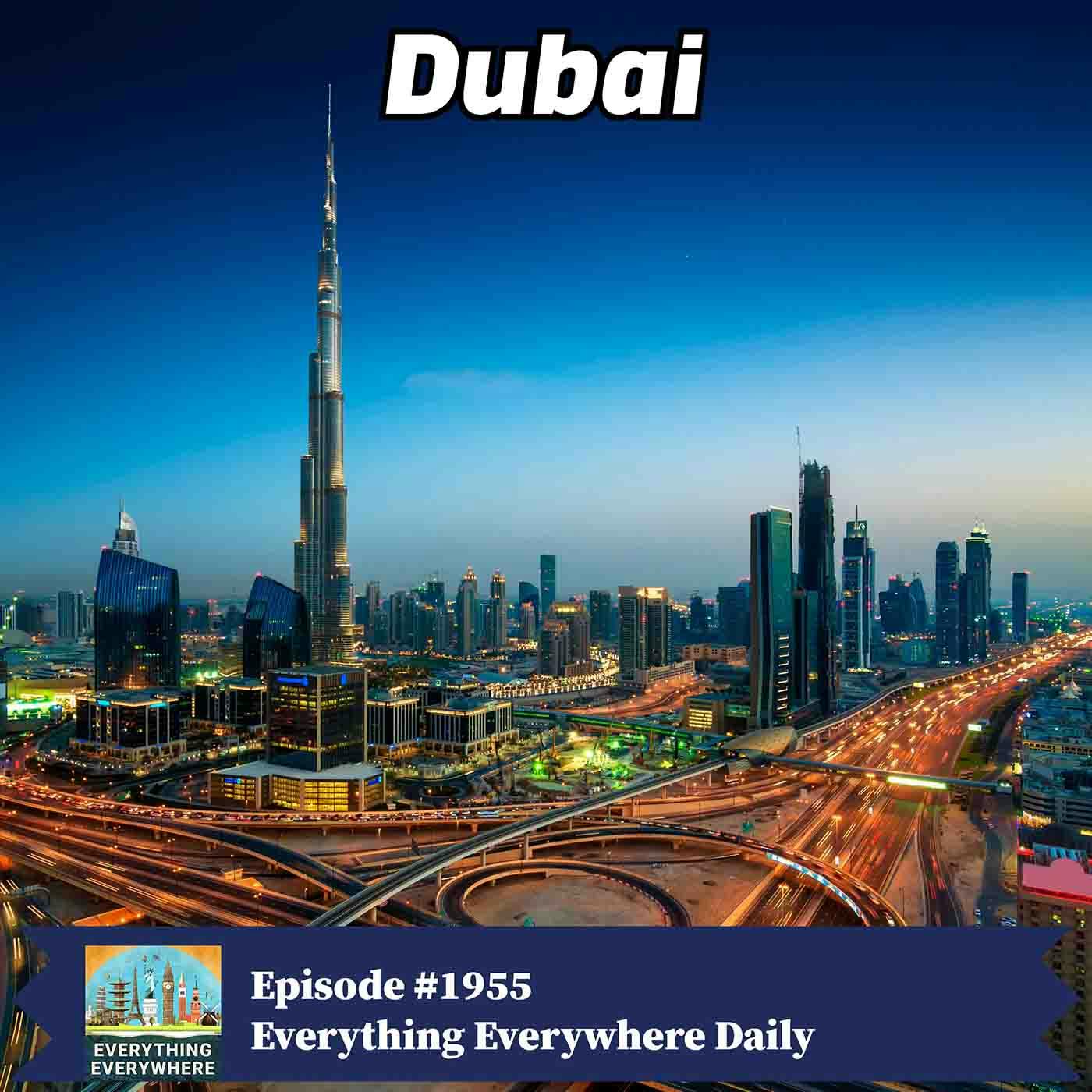
Just 60 years ago, Dubai was a sandy, sparsely populated port on a minor creek emptying into the Persian Gulf. Today, it's one of the most important cities in the world. It's a global center for trade, finance and transportation. But how did a randomly sandy outpost location in the Middle east end up becoming such an important global city in such a short period of time? It didn't happen by accident. Learn more about Dubai and how it went from nothing to become one of the most important cities in the world on this episode of Everything Everywhere Daily. This episode is sponsored by Quints. The holiday season is upon us and that means buying gifts for friends and family. So why not get something that's top tier but affordable? That's where Quince comes in. Quince has great items like $50 Mongolian cashmere sweaters that feel like an everyday luxury and wool coats that are equal part stylish and durable. And you'll pay a fraction of what you would from other retailers. And their prices are literally listed on the Quince website. I just got an Australian merino wool sweater that looks great and cost only half of what it would have if I had bought it somewhere else. By partnering directly with ethical factories and top artisans, Quince cuts out the middleman to deliver premium quality ethics at half the cost of similar brands and often even bigger discounts. Give and get timeless quality staples that last this season with quince. Go to quince.com daily for free shipping on your order and 365 day returns. Now available in Canada too. That's Q-U-I-N-E.com daily free shipping and 365 day returns. Quince.com daily this episode is sponsored by Uncommon Goods. The holiday shopping season is officially here. Uncommon Goods takes the stress out of gifting with thousands of unique, high quality finds you won't see anywhere else. Don't wait, because the most meaningful gifts get scooped up fast and now is the perfect time to cross names off your list. Uncommon Goods looks for high quality, unique products, often handmade or made in the United States. Many are crafted by independent artists and small businesses, making every gift feel meaningful and truly one of a kind. I've already told you about the cheese board I got on Uncommon Goods, but another cool item I found was a wall hanging made from wood that reproduces the sound wave of your favorite song or podcast. So don't wait. Cross those names off your list before the rush. To get 15% off your next gift, go to UncommonGoods.com daily. That's UncommonGoods.com daily for 15% off. Uncommon Goods were all out of the ordinary. Many major cities in the world owe their existence to their geography. For example, London was established because it was an easy place to cross. The Thames, which had access to the sea, and New York and Sydney have large harbors. Dubai is not such a city. It does not have a long history based on its geography. Its origin is very modern, and the fact that it exists at all is more a matter of choice than destiny. So if geography can't explain Dubai's existence, then why does it exist at all? To understand that, we need to go all the way back to the beginning. Archaeological evidence suggests that the area now known as Dubai has been inhabited since at least 3,000 B.C. excavations have uncovered artifacts from the Bronze Age indicating that early settlements existed along the creek that would eventually become central to Dubai's development. These ancient inhabitants likely engaged in fishing, pearl diving and trade, all of which were activities that would define the region for the next several thousand years. The harsh desert environment meant that permanent settlements remained small and scattered for centuries to come. The area was influenced by various civilizations over the centuries, including the Umayyad Caliphate in the 7th century, which helped spread Islam throughout the region. However, because of its low population, detailed historical records from this early period are limited, and much of what we know comes from archaeological archaeological discoveries and references in the writings of travelers and geographers. By the 16th century, the Portuguese tried to control the waters of the Persian Gulf, only to be displaced by a shifting mix of Ottoman, Persian and local Arab powers. Out of this world of small ports and tribal alliances emerged the Bani Yas confederation, initially centered in Abu Dhabi and later extending its influence along the coast. In 1833, the Al Maktoum branch of the Bani Yas seized Dubai with a few hundred followers. Establishing a dynasty still rules today. The new rulers signed the General Maritime Truce with Britain in 1820, followed by subsequent truces in 1835 and 1853, which aimed to suppress maritime conflict in exchange for British protection of shipping. The emirates that signed these truces with Britain became known as the Truchal states. In 1892, Dubai entered into what was known as the Exclusive Agreement, which placed its foreign relations under British oversight while retaining domestic authority in the hands of its sheikhs. Within that framework, Dubai positioned itself as an open entrepot. An entrepot is a commercial center or port where goods are imported, stored, traded, and re exported without the intent of being brought into the country. Dubai's rulers lowered customs duties, welcomed merchants from Persia and India, and Cultivated a reputation for light regulation. Dubai Creek became a hive of activity as dhow captains loaded dates for India and returned with textiles, rice, and tea. Pearling dominated the early economy each summer, employing thousands of divers and sailors and injecting cash into the market during good seasons. The pearling boom collapsed in the 1930s because of the Great Depression and the spread of cultured pearls from Japan. Income fell, debts mounted, and families left the coast in search of work. Sheikh Saheed bin Maktoum and his son, Sheikh Rashid bin Saheed, responded to this economic downturn by doubling down on trade. They dredged parts of the silted creek beginning in the 1950s to admit larger vessels, created new markets, and drew in Iranian merchants fleeing taxes and controls across the Gulf. One thing you might have noticed is that so far I have yet to mention the word oil. Oil entered the story relatively late. Offshore surveys located the fate field in 1966, and oil exports didn't begin until 1969. Because Dubai discovered oil relatively late and in much smaller quantities compared to its neighbors, it adopted a distinctly different approach to oil revenue. Dubai treated oil revenue as seed capital to expand its trading and economic base. Sheikh Rashid bin Saheed Al Maktoum, who had become ruler in 1958, understood that oil revenues, while significant, would not last forever. Unlike some other oil rich states that relied heavily on petroleum exports, Sheikh Rashid invested oil revenue strategically in infrastructure and economic diversification. He famously said that his grandfather rode a camel, his father rode a camel, he drove a Mercedes, his son drove a Land Rover, and his grandson would probably drive a Land Rover, but his great grandson would ride a camel. Once again, unless the Emirate diversified its economy, this was the insight that led to the creation of modern Dubai. In 1971, the Truchal States became the United Arab Emirates. And I should explain a little bit about the organization of the United Arab Emirates as it's unlike any other country on earth. The UAE is neither a republic nor a monarchy. It is a federation of absolute monarchies. The UAE is the entity that manages defense, diplomacy, and relations between the emirates while allowing each emirate to retain autonomy over its own internal affairs. The president of the UAE is always the Emir of Dubai, which is far and away the largest of the Emirates. The Prime Minister is the Emir of Dubai, which is the second largest. The UAE itself is not a monarchy, but all of its constituent parts are monarchies. It will probably be the subject of its own future episode. In many respects, Dubai and the other Emirates act as independent countries in terms of their own sovereignty and autonomy, yet they function under the umbrella of the uae. Internationally, the new oil money resulted in a wave of construction projects. The construction of Port Rashid began in 1967 and was completed in 1972, providing Dubai with a modern deep water port capable of handing larger cargo ships and container vessels. This was followed by the construction of Port Jebel Ali, which began in 1976 and became operational in 1979. Jebel Ali would eventually become the largest man made harbor in the world and one of the busiest ports globally. Dubai International Airport, which opened in 1960 as a small facility, underwent continuous expansion throughout the 1970s and 80s. Sheikh Rashid recognized aviation's potential for connecting Dubai to the world and invested heavily in making the airport a regional hub. The establishment of emirate airlines in 1985 would later prove to be one of the most successful ventures in Dubai's diversification strategy. Dubai's airport occupies a uniquely strategic location in the crossroads of Europe, Asia and Africa, placing nearly two thirds of the world's population within about an eight hour flight. This position enables it to function as a global transfer hub where east, west and north south routes intersect, allowing Emirates and other airlines to connect major cities such as London, Mumbai, Sydney and Johannesburg through a single Layover. Combined with 24 hour operations, efficient infrastructure and minimal weather disruptions, Dubai International has leveraged geography into one of the world's busiest and most connected airports. Throughout the 1980s and 90s, Dubai aggressively pursued even more economic diversification. The establishment of the Jebel Ali free zone in 1985 was a landmark initiative that allowed foreign companies to operate with 100% ownership, full repatriation of capital and profits and exemption from corporate taxes. This model attracted thousands of international companies and was later replicated in specialized free zones for media, finance, healthcare and technology. Dubai also developed its tourism sector, recognizing the potential of its year round sunshine, beaches and strategic location. Hotels were built along the coast and the government actively promoted Dubai as a destination for both business and leisure travelers. The Dubai Shopping Festival, launched in 1996, has become a major attraction that draws millions of visitors annually. The 1990s and 2000s saw Dubai embark on increasingly ambitious projects that captured global attention. Sheikh Mohammed Bin Rashid Al Maktoum, who became Crown Prince in 1995 and Ruler in 2006, accelerated the pace of development and pushed Dubai towards even more ambitious goals. The construction of the Palm Jumeirah, which began in 2001, represented a new level of ambition. The artificial archipelago of islands shaped like a palm tree added 520 km of new coastline and demonstrated Dubai's willingness to reshape its geography literally. The project was followed by plans for even larger artificial islands, including Palm Jebel Ali and the World, a collection of islands arranged to resemble a world map. However, these last two projects have not been very successful. The Palm Jebel Isli has been on hold for 15 years, and the project was only relaunched in 2024. The world likewise was put on hold after the 2008 financial crisis, and there's been reports of some of the islands literally sinking. The Burj Al Arab, completed in 1999, became a symbol of Dubai's luxury brand. Built on an artificial island and shaped like a sail, this seven star hotel, although that officially isn't a thing and it's only rated at five stars, epitomized Dubai's strategy of creating attractions that that would generate global publicity. Perhaps the most symbolically significant was the construction of the Burj Khalifa, which opened in 2010. At 828 meters and 163 floors, it remains the tallest structure of any type in the entire world. The tower anchors downtown Dubai, a massive development that includes the Dubai Mall, one of the world's largest shopping centers, and the Dubai Fountain, the world's largest choreographed fountain system. The rate of growth in Dubai has been astonishing. In 1975, the approximate population of Dubai was a bit under 200,000 people. Today, 50 years later, it has a population of about 4 million. Today, Dubai's economy rests on five pillars that often trade and logistics, aviation and tourism, finance and business, services, real estate and construction, and technology and media. Economically, they've largely achieved their goal of diversifying away from oil revenue. And they've been a model for other countries. In the Persian Gulf, only about 10% of the population is native Emirati. The rest are all people from all over the world, mostly from South Asia, the Philippines and Europe. Dubai has low taxes, bank secrecy and few extradition treaties, which makes it an attractive destination for many people. It's become an expensive place to live, but the lack of taxes compensates for the prices. Dubai, however, is not without controversy. Labor problems for migrant workers, such as recruitment, debts, wage delays, passport confiscation, cramped housing and limited ability to organize has been an issue for years. Dubai is not and has never been a liberal democracy. It's an absolute monarchy in the Middle East. Limits on speech and assembly, as well as laws regarding public morality have been used against activists and journalists seeking reforms and against some visitors who have spoken out while they were in Dubai. That being said, several million people have been drawn to Dubai from around the world from first hand experience. It is arguably the most modern and international city on the planet. The mix of people you'll find there is unlike anywhere else, in part because the native population is so small. Economically speaking, the Dubai experiment has been a smashing success. The Dubai government's goals to diversify its economy and utilize its oil revenue strategically have been achieved and the result is one of the world's most important cities, which several generations ago was nothing but sand and desert. The executive producer of Everything Everywhere Daily is Charles Daniel. The associate producers are Austin Otkin and Cameron Kiefer. My big thanks go to everyone who supports the show over on Patreon. Your support helps make this podcast possible, and I also want to remind everyone about the community groups on Facebook and Discord. That's where everything happens that's outside the podcast, and links to those are available in the show Notes. As always, if you leave a review on any major podcast app or in the above community groups, you too can have it read on the show.