Loading summary
Transcript1 lines
- [00:00]
A
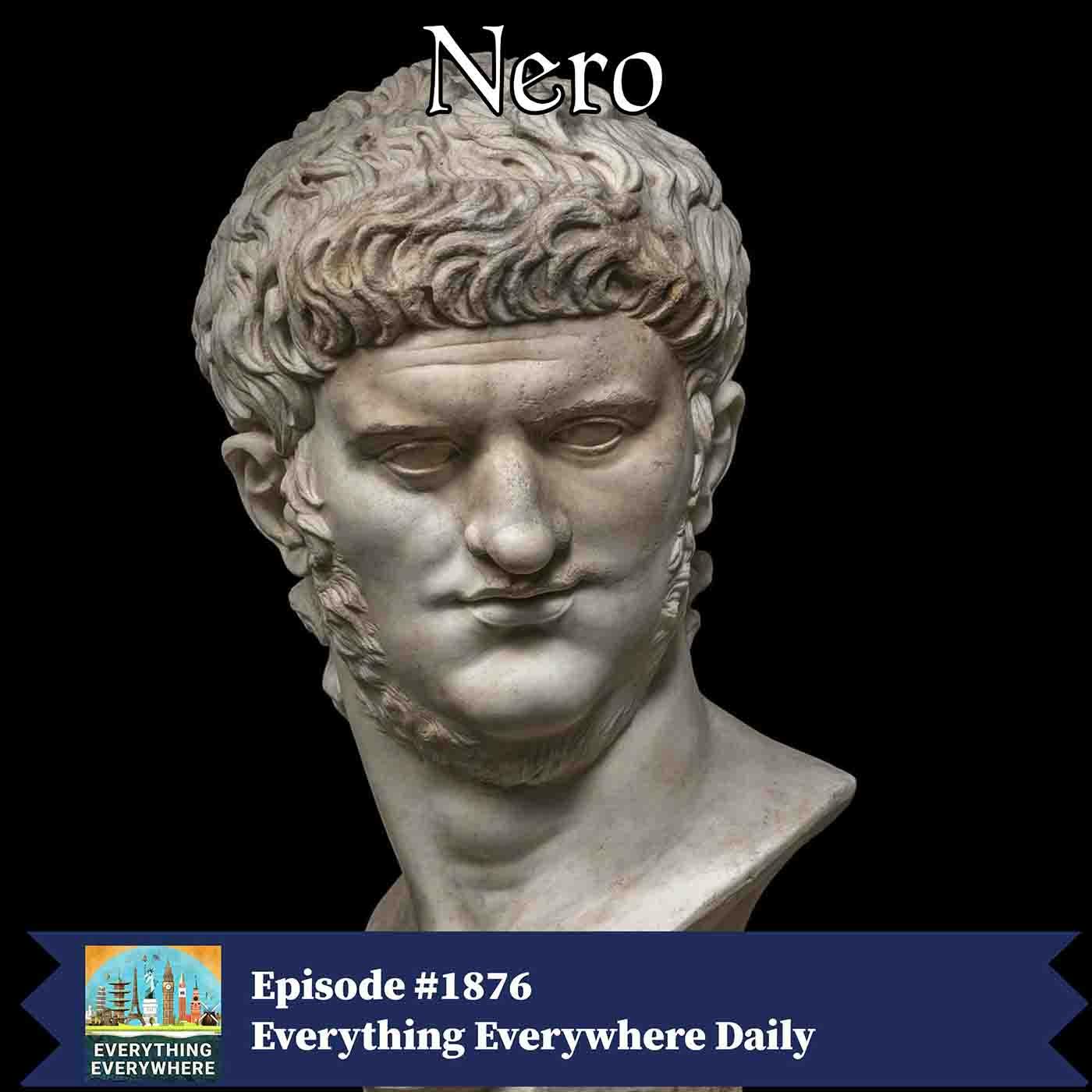
The following is an encore presentation of Everything Everywhere Daily. In the year 54, the Roman Emperor Claudius died and his adopted son Nero became the Emperor of Rome at the age of 16. His reign was one of the most infamous in history, and over 2,000 years after he came to power, his name is still used to invoke the image of a cruel ruler and a despot. But what exactly made him so bad? And was he really as bad as the legends say? Learn more about Emperor Nero and why his reign became so infamous on this episode of Everything Everywhere Daily. This episode is sponsored by Fiji Water. You've probably heard of Fiji Water and have seen it in stores. Well, Fiji Water really is from the islands of Fiji. Drop by drop, Fiji Water is filtered through volcanic rock 1,600 miles away from the nearest continent and all its pollution protected and preserved naturally from external elements. In this process, it collects a unique profile of electrolytes and minerals, resulting in more than double the electrolytes as the other top two premium bottled water brands, giving Fiji Water its smooth taste. Fiji Water's electrolytes are 100% natural and this water even has a perfectly balanced pH of 7.7. I've recently been trying to reduce my consumption of diet soda and I've found Fiji Water to be a great alternative. Visit your local retailer to pick up some Fiji Water today for your next backyard party, beach day hike, or even your home office. Fiji Water is Earth's finest water. This podcast is brought to you in part by Stash. Here's a the best time to start building your financial future is always now. With Stash, you can grow with confidence no matter the market. Stash isn't just another investing app. It's a registered investment advisor that combines automated investing with expert guidance so you don't have to worry about figuring it out on your own. You can choose from personalized investments or let Stash's award winning smart portfolio do the work for you. With Stash, investing doesn't feel like gambling. It's simple, smart and stress free so your money can finally start working as hard as you do. Get access to world class financial advice with personalized guidance for just a $3 monthly subscription. Stash has already helped millions of Americans reach their financial goals. Don't let your money sit around put it to work. With stash. Go to git.stash.com everything to see how you can receive $25 towards your first stock purchase and to view important disclosures. That's git.stash.com everything paid non client Endorsement not representative of all clients and not a guarantee. Investment Advisory Services offered by Stash Investments LLC and SEC registered investment advisor. Investing involves risk offers subject to Ts and Cs. The emperor who was to become known as Nero Claudius Caesar Augustus Germanicus was born with none of those names. He was born Lucius Domitius Ahena Barbus on December 15 in the year 37 in the Italian town of Antium, now called Anzio, which is about 50 kilometers south of Rome. His father, who really has no part in this story, was Gnaeus Domitius Ahenobarbus. The parent who played an outsized role in his life was his mother, Agrippina the younger. Agrippina was the daughter of Germanicus, who was once in line to become Emperor himself. The sister of the Emperor Caligula and the great granddaughter of Augustus, she was a core member of the Julio Claudian dynasty that ruled Rome. Nero's father died when he was just two years old. His mother later became the fourth wife of the Emperor Claudius. And just to get an idea of how dysfunctional this family was, Claudius was the brother of Germanicus and thus Agrippina's uncle. Agrippina was by all contemporary accounts, an extremely ambitious woman who wanted to rule Rome herself. But because she was a woman, she couldn't wield power directly, so she had to wield power indirectly. During the reign of Caligula, she was exiled to a small island off the coast of Italy. It's thought that she was exiled because she was plotting to overthrow her brother. Her marriage to Claudius was largely believed to be so she could position her son as emperor. Claudius was pressured to formally adopt Nero. Agrippina had the tutors of Nero. When Claudius natural son Britannicus changed to men who were loyal to her, and likewise she managed to get the head of the Praetorian Guard changed to one of her men as well. All of the Roman historians who covered this period in history, including Josephus Taticus and Cassius Dio, all implicate Agrippina in the poisoning and death of Claudius. In the year 54, when Claudius died, with all of her people in place, the ascension of her son to emperor went off without question. Nero was only 16 years old when he came to power, and Agrippina assumed that she could easily manipulate her son. And at first she was right. One example of her ambition was that when Nero became Emperor, a coin was issued with the head of Agrippina on one side, not that of the emperor. She also eliminated anyone who could possibly interfere, including Nero's aunt who cared for Nero when Agrippina was in exile and other living male descendants of Augustus. However, a rift soon developed between Nero and his mother. Nero's advisors saw how Agrippina manipulated Nero and did what they could to weaken her influence. The issue that caused a major rift between the two was an affair that Nero had with a freedwoman by the name of Claudia Acte. Prior to becoming emperor at the age of 14, Nero had married Claudius, natural daughter, and thus Nero's adopted half sister, Claudia Octavia. Agrippina arranged this because she was obsessed with keeping the family pedigree impeccable. She was adamantly against Nero having a relationship with a woman who had been a former slave. Nero eventually exiled his mother, but she continued to have contact with his wife and threatened to throw her support to Nero's stepbrother, Britannicus. So Nero had Britannicus killed. Eventually, Nero began a relationship with another woman, Poppaea Sabina, which his mother also objected to. So he plotted to have his mother killed. In the year 59, Nero hatched a plot to kill his mother in a boat that would collapse when she was in it. The boat did collapse, but she swam to shore, not realizing that it was an assassination attempt. On hearing of his mother's survival, he sent an assassin to kill her and to make it look like a suicide. When the news of Agrippina's death became public, Nero was actually sent letters of congratulations by the Senate and the army. The first five years of Nero's rule, when his mother was still around, were largely considered to be good ones. He listened to the advice of his advisors, primarily the head of the Praetorian Guard, Sextus Afranius Burrus, and his former tutor and Stoic philosopher, Seneca. After the death of his mother, however, something began to change in Nero, where without his mother, he no longer felt he had any constraints. And this became even more pronounced just three years later, in the year 62, when Burrus died and Seneca attempted to retire and eventually just distanced himself from Nero's court. Now, with none of his advisors, he divorced Octavia, whom everyone had recommended he not do, and married Pappina Sabina. He exiled Octavia to the same island where he exiled his mother and and had her murdered. His behavior became ever more erratic. Soon after the death of Burrus, the first trial for treason against him took place. He also executed two of his rivals, Cornelius Sulla and Rubilius Plautus. This was widely thought to be the beginning of the downturn in relations with the Senate, which up until that point had actually been rather good. The thing that came to define the rule of Nero, however, and the thing for which most people remember him today, was the Great Fire of Rome in the year 64. The fire began on July 18, somewhere around or in the Circus Maximus, the giant chariot racing stadium. Fires happened all the time in Rome, but this time it was fed by incredibly high winds, which fanned the flames and spread the fire. The fire burned for six days before it was brought under control, and then the fire broke out again and burned for another three days. Of Rome's 14 districts, three were completely destroyed, seven suffered serious damage, and only four remained untouched. Needless to say, the people of Rome were upset and traumatized and they were looking for someone to blame. And the obvious choice was the person in charge of everything, Nero. Up until this point, Nero had been quite popular with the people. Most of the unpopular things he did only affected the senatorial class. Nero, hoping to preserve his popularity with the people, pinned the fire on a scapegoat, a new cult that had appeared in Rome and who called themselves Christians. This was the first great persecution of Christians in history and the first time that they even gained the attention of historians. It's been said that history is written by the winners and that is one of the reasons why Nero has gotten such a bad reputation over the last 2000 years. The Roman Empire fell, but Christianity survived. And the stories of Nero survived with them. Nero supposedly rounded up Christians and had many of them brutally executed. One of the stories of Nero during the Great Fire was that he supposedly fiddled while Rome burned. Regardless of how one defines fiddled, it appears that Nero did nothing of the sort. For starters, the fiddle was a stringed instrument that didn't exist back then. And second, if you define fiddling as just wasting one's time, Nero didn't really do that either. When the fire broke out, Nero wasn't even in Rome. He was probably at his villa in the city of Antium. When he heard the news. He supposedly rushed home to aid in the rescue. Things really started to go south with the construction of the Domus Aurea. I've previously done an entire episode on the Domus Aurea, but to refresh your memory, Nero cleared out a massive area of destroyed buildings in the middle of Rome and built what was arguably the largest building ever constructed in the ancient world. It's located where the Colosseum is today. It was a monstrous affront to the people of Rome, many of whom lost everything. Nero also built a gigantic lake and and created an enormous statue of himself that was almost 100ft or 30 meters tall. The cost of his new palace was greater than all the money in the imperial treasury. And the way he compensated for the shortfall of money was through higher taxes, which nobody liked. As a result, the next year, in the year 65, Senator Gaius Calpurnius Piso and others hatched a conspiracy to get rid of Nero, known as the Pizzonian Conspiracy. It was discovered and reported to Nero by a freedman and all the conspirators, all of them respected senators, were executed. And there's something else I should note about Nero. He had a very odd personality quirk in that he thought himself to be a great artist. Nero studied poetry, music, painting and sculpture. He would often perform in front of his guests, who had no choice but to watch the emperor and applaud one of his top generals. Vespasian once supposedly fell asleep during one of Nero's recitals and had to then exile himself to a small town to avoid Nero's wrath. In the year 67, Nero had the Olympics in Greece postponed a year so he could participate. He entered the competition and won every event that he participated in, including a chariot race where he was thrown from his chariot while studying some arts was considered to be respectable for upper class Romans. Nero took things too far by actually performing. Actors were considered to be the lowest rung of Roman society and Nero's performances were considered undignified for someone of his stature. Ultimately, his highly erratic behavior and his profligate spending caught up with him. In 68, the army in Gaul rose up against Nero and his high taxes. The rebellion in Gaul was put down. But then the governor of Hispania, Tarraconesis Servius Sulpicius Galba, rose up against Nero and and his support kept growing. Eventually, Nero's own Praetorian guard turned against him, causing him to flee Rome. He attempted to go to Rome's port city of Ostia, where his plan was to get a boat and then go to the East. But his own troops refused to help him. He went to bed in one of his palaces and when he woke up, supposedly all of the guards and all of his friends were gone. The Senate then declared Nero a public enemy and finally Nero took his own life. Supposedly his body was cremated and his ashes buried in his birth father's family cemetery by his former mistress, the freedwoman Claudia Acte. Nero's death presented quite a problem. After almost a century of rule by the Julio Claudians, there was now nobody to assume the mantle of Emperor Nero and His mother had killed off everyone who could possibly be considered an heir, and Nero had no children. It ushered in the year of the Four Emperors and a period of chaos that eventually ended when the General Vespasian was declared emperor, the same man who fell asleep listening to Nero. History has not been kind to Nero. He is on almost every list of bad emperors, in no small part to the centuries of Christians, many of whom thought him to be the literal Antichrist that was prophesied in the Bible. However, many modern historians have been rethinking the reign of Nero, thinking that maybe he wasn't as bad as everyone made him out to be. Personally, I don't think that Nero was the worst Roman emperor, nor was he probably even in the top five. There were some truly crazy and sadistic emperors that would eventually follow him. That being said, I don't think Nero was by any stretch a good emperor either. The success he had early in his reign was primarily due to his advisors, not to Nero. He ultimately became unhinged, bankrupted Rome, and killed his own mother and wife. If there's one lesson you can take away from Nero, which many other emperors who followed him have proved, it's that you should never put control of one of the largest empires in the world in the hands of a teenager. The executive producer of Everything Everywhere Daily is Charles Daniel. The associate producers are Austin Otkin and Cameron Kiefer. My big thanks go to everyone who supports the show over on Patreon. Your support helps make this podcast possible, and I also want to remind everyone about the community groups on Facebook and Discord. That's where everything happens that's outside the podcast, and links to those are available in the show Notes. As always, if you leave a review on any major podcast app or in the above community groups, you too can have it read on the show.