Loading summary
Transcript1 lines
- [00:01]
A
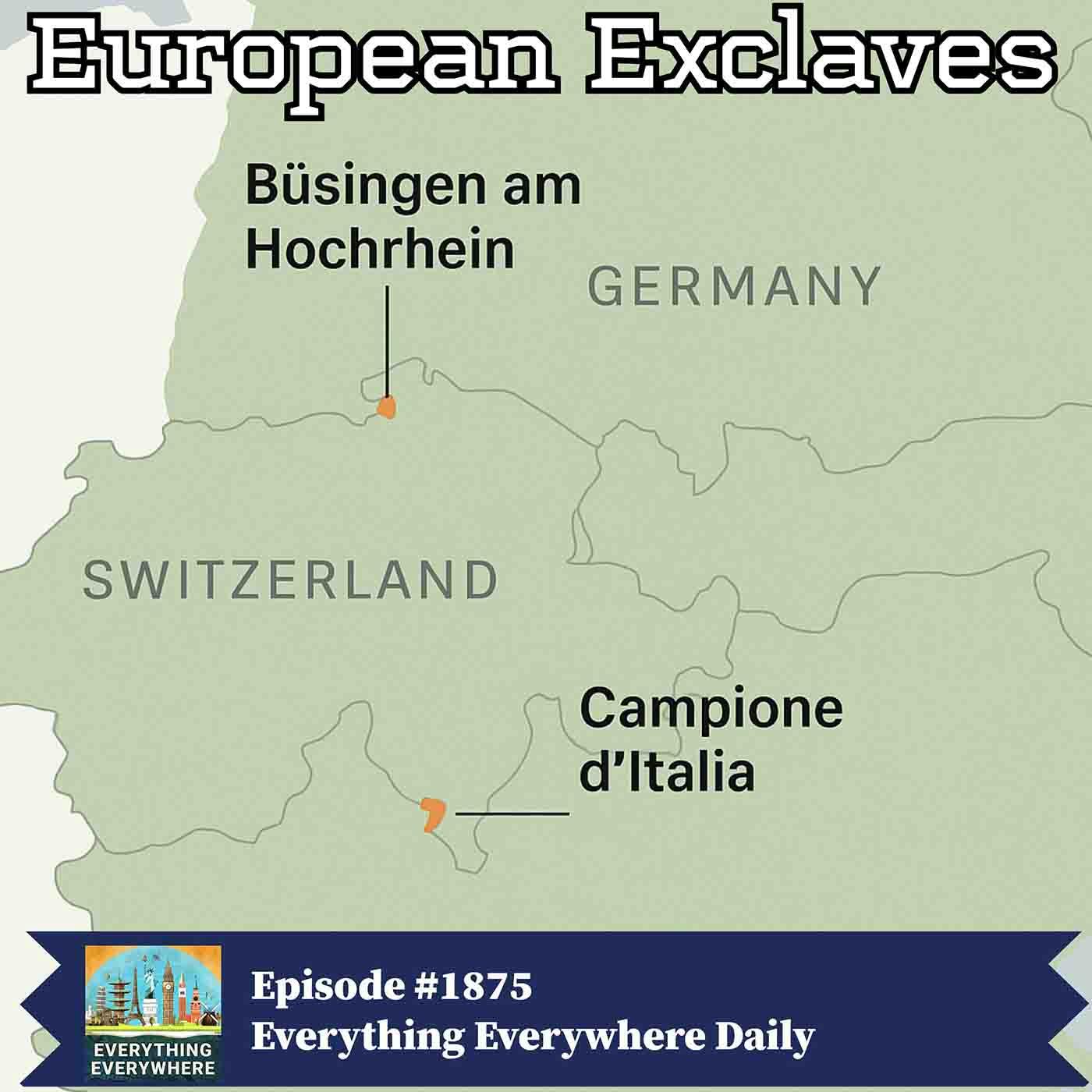
We've all looked at a map and seen all the different countries represented by different colors. A country has some sort of border, and everything inside that border is what makes up the country. However, there are some exceptions. There are exclaves which are bits of a country that are separated from the main landmass, and enclaves which are parts of a country that are totally surrounded by another country. Why in the world would such odd arrangements exist? Well, the reasons are often rather odd. Learn more about the exclaves of Europe and the odd circumstances that created them on this episode of Everything Everywhere Daily. This episode is sponsored by Fiji Water. You've probably heard of Fiji Water and have seen it in stores. Well, Fiji Water really is from the islands of Fiji. Drop by drop, Fiji Water is filtered through volcanic rock 1600 miles away from the nearest continent. In all its pollution, protected and preserved naturally from external elements. In this process, it collects a unique profile of electrolytes and minerals, resulting in more than double the electrolytes as the other top two premium bottled water brands, giving Fiji Water its smooth taste. Fiji Water's electrolytes are 100% natural and this water even has a perfectly balanced pH of 7.7. I've recently been trying to reduce my consumption of diet soda and I found Fiji Water to be a great alternative. Visit your local retailer to pick up some Fiji Water today for your next backyard party, beach day hike, or even your home office. Fiji Water is Earth's finest water. This episode is sponsored by Mint Mobile. According to recent data, approximately 98% of all Americans own a mobile phone, and that means a monthly phone bill is something that almost all of us share. With all the bills you have to pay, why pay more than you have to for your phone bill? With Mint Mobile, you can start with plans as low as $15 per month, and with Mint Mobile, you can keep your phone, your number, and use the same towers and networks that you do now. All you do is save money. And that's why I recommend Mint Mobile this year. Skip breaking a sweat and breaking the bank. Get this new customer offer and your three month unlimited wireless plan for just 15 bucks a month at mintmobile.comeed that's mintmobile.comeed upfront payment of $45 required, equivalent to $15 a month limited time new customer offer for first three months only. Speeds may slow above 35 gigabits on unlimited plan. Taxes and fees extra. See Mint Mobile for details. Often on this podcast, I'll cover great historical events or important places. This is not such an episode. The places I'm going to be covering in this episode are rather small and in the big scheme of things, rather inconsequential. However, they are really interesting. I'm going to be covering the backstories of three different exclaves of three different countries. I've previously covered the topic of exclaves and enclaves more broadly in a previous episode, but in this episode I want to focus on their origins. All three of them are small. None of them have a population of more than about 1700 people, and while totally surrounded by another country, they're not that far from their country's mainland. These three are not the only exclaves in Europe. There are others which are notable in their own way. I'm just going to be covering these three simply because they have very interesting stories and because I happen to have been to all three of them. I'll start with the community of Bussingham am Horeheim. It's a German community that is completely surrounded by Switzerland and is part of the state of Baden Wurttemberg. The town has a population of about 1500 people and an area of 7.62 square kilometers, or 2.94 square miles. It's separated from Germany by a strip of land that is 680 meters, or 2,230ft wide at its narrowest point. The big question, and the question for every one of the enclaves that I'll be covering, is how did this come to be? Why isn't it part of Switzerland? Or why didn't Germany take or negotiate a small parcel of land to connect it to the rest of the country? The village of Bussingen was originally part of the land holdings of the bishopric of Constance in the Middle ages. By the 17th century it had passed into the hands of the Austrian Habsburgs, who controlled much of the region during the Peace of Westphalia. Despite its Habsburg ties, Bussingen was geographically cut off from other Austrian or German ruled lands and sat right in the middle of territory dominated by Swiss cantons. The town's defining event came in 1693. The village lord, Johann Konrad von Stadion, a Catholic, was kidnapped by his Protestant relatives and taken to the neighboring Swiss city of Schaffhausen. After long imprisonment and negotiations, he was released, but this incident hardened the divisions. The Catholic Habsburg authorities kept the village, while the Protestant Swiss surrounding it had little interest in incorporating it. From that moment, Bussingen's odd isolation became entrenched. In 1805, under the treaty of Pressburg, the Habsburgs ceded much of their German territory to other German states. Bussingen was transferred to Wurttemberg and in 1810 it passed to the Grand Duchy of Baden. Baden's territories later became part of the German Empire in 1871, despite being surrounded entirely by Switzerland. The the village was never formally transferred because the Swiss and the Bodinese authorities could not agree on a territorial Exchange. In the 20th century, especially after World War I and again after World War II, there were discussions of annexing Busingen to Switzerland to rationalize the border. The people of Busingen themselves held a referendum in 1918 in which 96% of them voted to join Switzerland. However, Germany demanded too much compensation for the land and Switzerland refused. As a result, the enclave status remained. Because the village is so entwined with Switzerland geographically, practical compromises have been made. Busingen is politically German, but economically and socially integrated with Switzerland. It uses the Swiss franc as its main currency, although the euro is also legal and it's part of the Swiss customs and postal system. Telephone lines, water and infrastructure are linked with Switzerland rather than Germany. However, legally and administratively, it remains under German sovereignty. In short, Bussingen is an exclave. Because of an accident of history, a 17th century political dispute, the piecemeal redistribution of Habsburg lands in the 19th century, and failed attempts to swap territory in the 20th century, neither Switzerland nor Germany have wanted to reopen the matter, since local arrangements now work smoothly. As a result, the village remains a curiosity. A bit of Germany inside of Switzerland. The next enclave I want to cover is the Spanish community of Llive. Yivia is part of Catalonia and is completely surrounded by France. It has a population of about 1,200 people and has an area of 12.9 square kilometers, or 5 square miles. It separated from the rest of Spain by only 1.6 km, or 1 mile. Yivia was once an important settlement in the Sardinia region of the Pyrenees. In fact, during the Visigothic era, it served as the capital of Sardinia, which gave it a higher legal status than the surrounding villages. An important point. By the Middle Ages, Givia was firmly within the crown of Aragon, which later became part of Spain. In the 17th century, Spain and France fought each other in the Franco Spanish War, which which was a part of the Thirty Years War. The war between Spain and France ended with the Treaty of the Pyrenees in 1659, in which Spain ceded several territories north of the Pyrenees to France, including much of the region of Roussillon and northern Sardinia. As an aside, one of the oddities of the Treaty of the Pyrenees was the control of an island called Pheasant island. In a River near the Atlantic side of the border. The two countries couldn't agree on who would get control of the island. So they came to a novel solution. Rather than splitting the island in two, they actually swapped sovereignty over the island every six months. And this arrangement still exists today. Under the Treaty of the Pyrenees, Spain was forced to cede the northern part of Catalonia to France, and the treaty stipulated that Spain would give up the villages of Sardinia to to France. The operative word being villages. Llive had a special status that saved it from this transfer. Unlike the surrounding settlements, Ivia was not classified as a mere village or vila in Catalan, but rather as a town or ceutat. It held the legal status of a city because it had been the historic capital of Sardinia and the seat of a regional government. Since the treaty specifically mentioned only villages, Yivia was technically excluded from the territorial transfer. We don't know the real reason behind what happened, but this wasn't necessarily an oversight. It may have been a deliberate diplomatic maneuver by Spanish negotiators who were aware of Yivia's special status. The distinction between a village, a town or city carried real legal weight in medieval and early modern Europe, often determining administrative privileges, taxation rights and political representation. As a result, when France took control of the surrounding territory in northern Sardinia, Yivia remained Spanish for centuries. Yivia was relatively isolated, and relations between France and Spain over access were sometimes tense. In the Treaty of Bayonne in 1866, the two countries agreed to build a special neutral road connecting Yivia to Spain. France cannot place customs checkpoints on this road, ensuring that the town maintains open access to the rest of Spain. Unlike Busingen, it isn't necessary for Yivia to use as many French institutions, because both countries are now in the European Union. The final exclave I want to cover is Campione d', Italia, an Italian community surrounded by Switzerland. Campione d' Italia has the largest of the three populations I'm covering in this episode. With a population of a bit under 1800 people, it's located on the banks of Lake Lugano and has an area of 2.68 square kilometers, or 1.03 square miles. At its closest point, it is only 1 km, or 0.6 miles, away from the Italian border. Campeone's unique status began in the 8th century with a crucial religious donation. In the year 777, a Lombard nobleman by the name of Toto de Campione gave the area around Campione to the monastery of Saint Ambrosio in Milan, and the word Campeone just Means champion. In Italian, this might seem like a simple religious gift, but it established something legally significant. Campeone became ecclesiastical territory under Milanese control, even though it was geographically separated from Milan by mountains and other territories. This religious connection wasn't just symbolic. Medieval monasteries were powerful economic and political entities. The monastery of sant' Ambrogio was particularly influential because it was connected to Milan, which was becoming one of northern Italy's most important commercial centers. So when Campione became a monastic territory, it gained access to Milanese trade networks, laws, and protection. As centuries passed, the Swiss confederation gradually expanded around Lake Lugano. The Swiss gained control of surrounding territories through a combination of military conquest, political alliances, and strategic marriages between between ruling families. However, they never conquered or even bothered to claim Campeone itself. So why didn't Switzerland claim it? Several factors actually worked together. First, Campeone was small and not strategically vital enough to justify the diplomatic complications of seizing territory belonging to powerful Milanese interests. Second, the town sat on a peninsula jutting into the lake, making it somewhat isolated and defensible. And third, and perhaps most importantly, there were often larger political considerations at play. Swiss cantons sometimes had alliances or trade relationships with Milan that made respecting Campione's special status diplomatically wise. After Napoleon's fall, the Congress of Vienna in 1815 restored Lombardy, including Campione, to Austrian rule. Switzerland hoped to annex the little community for territorial coherence, but Austria rejected this and insisting Campione stay within Lombardy. When Italy unified in the 1860s, the new Italian state inherited all the territories that had historically been part of various Italian kingdoms, duchies and other political entities. This included Campeone because of its ancient connection to Milan and the Lombard region. Meanwhile, at the same time, Switzerland was consolidating into its modern federal form. The Swiss could have claimed Campaione based on geographic logic, as it's completely surrounded by Swiss territory. But by this point, centuries of precedent had established Campeone's Italian character. Mussolini added the d' Italia part to the name Campione in 1933 to emphasize its Italian identity. Yet in practice, because it was surrounded by Switzerland, Campione relied heavily on Swiss services. Swiss francs became the daily currency. Swiss telephone networks and postal systems were used, and even the casino, founded in 1917 to generate income, largely catered to Swiss clients. When European borders were being redrawn after World War II, there were opportunities to rationalize these kind of enclaves. However, both the Italian and Swiss governments, along with Campione's residents, preferred to maintain the historical arrangement. The town's special status was formally confirmed in various modern treaties. I've actually taken the time to visit all three of these exclaves when I happened to be in the region. In all three cases, I had to go out of my way to visit because there was no real reason to visit other than to say that you were there. In every case, other than a sign on the side of the road, you'd be hard pressed to tell when exactly you entered, because there really isn't that much difference between the exclaves and their surroundings. The important takeaway from these three places isn't that they're important or strategic, because they really aren't. It's that seemingly random decisions made centuries ago still affect the borders and geopolitical landscape of Europe today. The executive producer of Everything Everywhere Daily is Charles Daniel. The associate producers are Austin Otkin and Cameron Kiefer. My big thanks go to everyone who supports the show over on Patreon. Your support helps make this podcast possible, and I also want to remind everyone about the community groups on Facebook and Discord. That's where everything happens that's outside the podcast, and links to those are available in the show notes. As always, if you leave a review on any major podcast app or in the above community groups, you too can have it read on the show.